
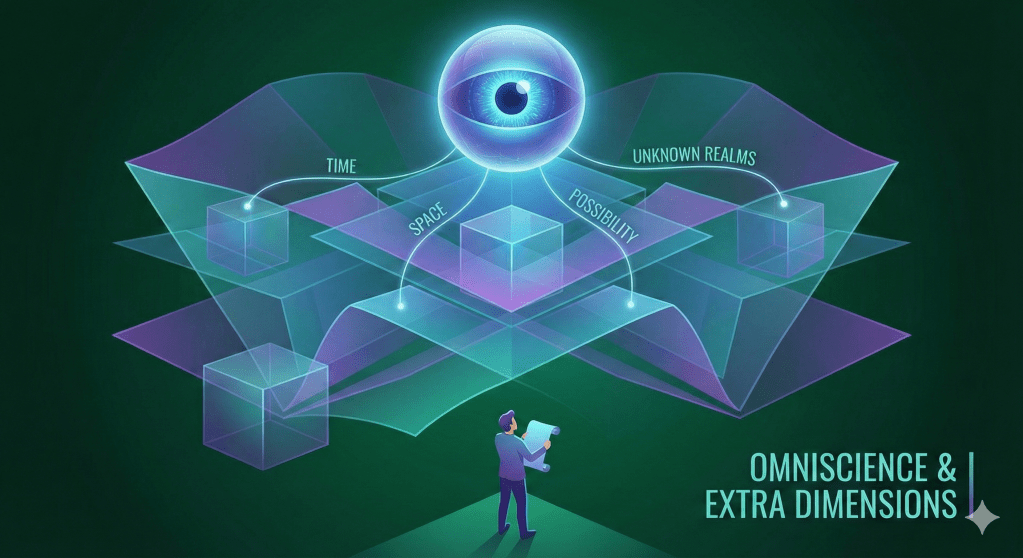
Presented by Zia H Shah MD
Arguing for Hidden Dimensions in Reality from God’s All-Knowing Nature
“He is Allah—other than whom there is no deity—Knower of the unseen and the seen, He is the Compassionate, the Merciful.” – Qur’an 59:22
“Knower of the unseen and the seen, the Mighty, the Wise.” – Qur’an 64:18
Abstract
The Qur’an repeatedly proclaims God’s perfect knowledge of “all that is hidden and all that is open”, affirming Divine Omniscience in absolute terms. Such omniscience implies that no particle of matter or moment in time lies outside God’s awareness. This essay explores an intriguing proposition: that God’s all-encompassing knowledge hints at extra dimensions or realms in our physical reality. Drawing on Islamic scripture, classical theology, and modern physics, we argue that for God to truly know every detail of the universe (and any multiverse beyond), the structure of reality must accommodate a divine presence “everywhere” that transcends our familiar dimensions. We examine how theologians historically conceived of God as present everywhere without being confined in space, and how contemporary theories in physics (like higher-dimensional space-time in string theory) offer analogies for understanding this omnipresence. In bridging these perspectives, we find that God’s omniscience and omnipresence could conceptually correspond to extra spatial or temporal dimensions underlying the cosmos. This interdisciplinary exploration does not claim to prove God via physics, but it highlights a remarkable consonance: a universe with hidden dimensions aligns with the theological notion of an unseen, all-pervading Divine knowledge. In conclusion, believers and scientists alike may find that contemplating extra dimensions enriches understanding of God’s attributes and inspires deeper awe for the vastness of creation.
Introduction
In Islamic belief, God is often described as “‘Ālim al-ghayb wa al-shahāda” – the Knower of the Unseen and the seen – meaning that nothing in existence, whether visible or invisible, escapes His knowledge. The Qur’an emphasizes this attribute repeatedly, across many chapters (e.g. 6:73, 13:9, 32:6, 59:22, 64:18), to remind us that God’s knowledge is all-encompassing. “Not even the weight of a speck of dust in the heavens or earth escapes His knowledge,” as one verse puts it. Such descriptions paint a vivid picture: every leaf that falls, every grain of sand, every subatomic particle and every thought in a mind is perfectly known to God. For believers, this omniscience is a cornerstone of faith, assuring them that God’s wisdom and justice consider all things, seen and unseen.
Yet this theological claim also raises a profound question at the intersection of faith and physics: How can God know every detail of a vast universe (or even a multiverse) down to the smallest quanta? In other words, what would it take for a being to be aware of each and every “speck, atom or quark of the universe” at all times? The renowned physicist Albert Einstein once mused in thought experiments about “if he were God, how would he design the universe?”. Following a similar logic, one might ask: If God’s knowledge truly extends to every corner of reality, does this suggest that God has a sort of access to all points in space and time that we humans do not? As contemporary Islamic writer Zia H. Shah MD argues, “if God is to know each and every speck, atom or quark of the universe, He needs to have some presence there, either personally or through some agents like angels”. This speaks of extra dimensions – in Shah’s words, “Omniscience of God demands Omnipresence of some sort,” from which “one can easily conclude that physics should include extra dimensions.”. In simpler terms, God’s all-knowing nature hints that reality has more layers or dimensions than the observable three-dimensional world, enabling a divine presence that permeates everywhere.
The idea that God’s omniscience implies a form of omnipresence is not new in theology. Both Islamic and Christian scriptures affirm that God is present with His creation in a way beyond ordinary physical constraints. The Bible, for example, teaches that no creature can hide from God’s sight: “If I ascend to heaven, You are there; if I make my bed in Sheol, You are there” (Psalm 139). The prophet Jeremiah relays God’s rhetorical question: “Can a man hide himself in secret places so that I cannot see him? … Do I not fill the heavens and the earth? declares the Lord.”. The Qur’an likewise assures, “He is with you wherever you are” (Qur’an 57:4), and describes God as “All-Encompassing (al-Wāsi‘)”. Such verses conveyed to classical scholars that God is not confined to any single location; His knowledge and power “fill” all of space and time.
Critically, however, earlier theologians also maintained that God is not a physical object spread out in space. They wrestled with how to express God’s omnipresence without diminishing His transcendence. St. Augustine cautioned against imagining God like a gas pervading a room – rather, God is “wholly present in all places at once” in an indivisible, spiritual way. The great scholastic Thomas Aquinas explained that “God is in all things by His power [and] by His presence, inasmuch as all things are bare and open to His eyes”, even though God is not contained by any material space. In the Islamic tradition, theologians of the Ash‘ari school taught that God exists without a place: “not a body, nor in a location, nor subject to time”. They interpreted God’s “being with you” to mean by His knowledge and authority, not by physical incarnation. A concise Sunni creed states: “He is omnipresent… by His knowledge and power, and nowhere [in a way involving] place, direction or location, because He existed before space and time”. In short, classical thinkers agreed that God’s mode of presence is unique – He is intimately aware of every part of creation without being bounded by creation’s dimensions.
If God’s presence is not like a subtle gas or physical ether, how can we conceptualize it? One intriguing way is to use the language of higher dimensions, borrowed from modern physics. The concept of dimensions beyond the familiar three of space (length, width, height) and one of time has become a serious topic in contemporary cosmology. Theoretical physicists have proposed that our universe may have additional spatial dimensions hidden from view. For example, in string theory – an attempt to unify quantum physics and gravity – the mathematics requires six extra spatial dimensions (for a total of ten space-time dimensions) to be consistent. An even more comprehensive framework, M-theory, posits 11 dimensions (10 of space and 1 of time) as the arena in which all fundamental forces and particles fit together. These exotic dimensions are not obvious in everyday life; scientists suggest they might be “curled up” or compactified at extremely small scales, or that we are confined to a three-dimensional “slice” of a higher-dimensional reality. In other words, much like a two-dimensional sheet can exist within a three-dimensional space, our 3D world could be embedded in a higher-D space that we normally cannot perceive.
Illustration of a Calabi–Yau manifold (a complex geometric shape) used in string theory. Such shapes represent how extra spatial dimensions might be compactified and hidden within our 3D universe. In string theory, six additional dimensions are hypothesized beyond the familiar 3D space + time, making a total of 10 dimensions for space-time. These dimensions could be curled up at sub-microscopic scales or otherwise inaccessible to our senses. The concept of “hidden” dimensions, pervasive but unseen, offers a striking parallel to theological ideas of an unseen realm permeating our world.
Modern physics, while still seeking empirical proof of extra dimensions, treats the idea seriously as a way to solve deep puzzles about the universe. To help imagine higher dimensions, scientists often use analogies. A classic analogy is the fictional “Flatland”: a two-dimensional world of flat creatures living on a sheet of paper. If a three-dimensional being (like a human) interacts with Flatland, it would seem god-like to the flat creatures – the 3D being could appear or disappear from their plane without traversing the space in between, and could even see inside closed rooms in Flatland (since it can look “above” their 2D walls). From the 2D perspective these feats are impossible, but from the 3D perspective they are trivial. Now, apply this analogy to ourselves: if there were a fourth spatial dimension, an entity moving through 4D space could likewise “pop up” anywhere in our 3D world, or encompass multiple locations at once, without crossing the intervening distance in 3D. To us, bound in three dimensions, such an entity would seem capable of being everywhere at once or knowing things it seemingly “shouldn’t” – seeing inside sealed boxes, or arriving at a destination instantly. In a sense, it would have a kind of omniscient view relative to our world.
Interestingly, some physicists and science popularizers have noted parallels between these higher-dimensional concepts and the way theology describes God. Michio Kaku (a theoretical physicist) and others have mused that a being in a higher dimension could, for instance, see all of time laid out at once, just as a 3D person can see an entire drawing at a glance. This evokes the theological idea that God is not bound by time – past, present, and future are all “present” to Him in a single eternal now. Mainstream physics usually doesn’t talk about God, of course, but it does countenance the existence of unseen dimensions permeating every point of the universe. Even if these extra dimensions are purely physical, their all-pervasive yet hidden character resonates with religious notions of an invisible realm sustaining the visible world. Contemporary cosmology has widened our view of reality to the point that scientists openly discuss the possibilities of a multiverse (multiple universes) or spatial dimensions beyond the 3D space we know. Such ideas, though speculative, underscore that reality could have far more layers than our senses perceive.
Omniscience, Omnipresence, and the Case for Extra Dimensions
Bridging the theological and scientific perspectives, we arrive at a fascinating integrative argument: if God is truly omniscient and omnipresent – aware of every event and present with every creature – then perhaps the structure of reality itself allows for this, through dimensions or domains beyond the ordinary. Omniscience logically implies some form of omnipresence. To know the exact state of every electron, every galaxy, and every mind in the cosmos at once, God must in some sense “be present” to all those things (or have them present before Him). Classical theologians would phrase this as God being present “by His knowledge and power” everywhere. In modern terms, we might say that God has a kind of multi-dimensional access to each location in space and moment in time. The universe is not an expanse God has to travel across or scan like a limited being; rather, the whole of creation lies “open to His eyes” instantly.
One way to visualize this is to think of the universe as a 3D tapestry and God as a reality of a higher dimension that envelops and permeates that entire tapestry. Just as a 3D being can touch every point on a 2D surface, God could contact every point in our 3D space simultaneously by virtue of operating in a higher-dimensional “space” underlying our own. This higher-dimensional divine presence would not displace anything (just as a 3D hand can touch a flat surface without replacing any 2D creature on it); it would surround and interlock with the world at every location. Islamic theology already has language hinting at such all-pervading presence: for example, one of God’s Qur’anic names is Al-Muḥīṭ (The Encompasser), meaning His being encompasses all things. The Qur’an declares “Allah is All-Encompassing (al-Wāsi‘)” – a phrase that takes on vivid meaning if we imagine God’s being as hyper-dimensional, encircling the cosmos on a level we cannot see. In this view, when God “intervenes” at a place or hears a prayer, He does so not by traveling there, but because He is already present at a foundational level of reality that touches every place at once.
Notably, some contemporary thinkers have explicitly suggested that extra dimensions could be the key to understanding divine attributes. Zia Shah MD, for instance, posits that God’s omnipresence may literally entail higher dimensions of existence beyond our own, in which God’s knowledge and power operate freely. In a similar vein, other writers exploring science and religion have argued that “the existence of God as a higher-dimensional being explains [divine] characteristics simply”. From a higher-dimensional vantage, God could survey every moment of time at once and be simultaneously close to every point in space. One analysis puts it this way: “God – as a higher-dimensional being – is only omnipotent, omniscient, etc. relative to lower-dimensional beings. The existence of higher dimensions clearly explains these powers attributed to God.”. In other words, what appears mystical to a three-dimensional mortal might be perfectly natural for a Being existing in a subtler, expansive dimensional realm. If even physics permits the theoretical possibility that an entity in 5 or 10 dimensions could have a sort of ubiquity in our world, then, as these writers note, how much more conceivable is true ubiquity for an infinite Deity?
To be clear, describing God as operating through extra dimensions is an analogy – a conceptual model to aid our understanding. It does not imply that God is literally a physical object floating in a higher-dimensional space, nor that God “needs” a place to exist. In classical theology, God ultimately transcends all categories of created existence, including space and time; He created dimensions in the first place. Our language of higher dimensions is thus a pedagogical tool, not a limitation on God. It illustrates one way that an all-knowing, all-present being could relate to a world of limits, by envisaging a “meta-space” in which the normal rules of here vs. there, or now vs. then, no longer constrain Him. Indeed, traditional scholars often emphasized that God is everywhere without being in any specific place, and our proposal here honors that: if extra dimensions exist as part of creation, God would encompass them too and be present to every dimension while still remaining beyond all dimensions. The advantage of the higher-dimensional analogy is that it can remove some of the apparent contradiction that a naïve view of omnipresence entails. We no longer picture God as “spread out” like an ethereal fog, but rather as deeply present in a higher reality that undergirds every point of our reality. In this way, omnipresence and omniscience start to look less like magic and more like the natural corollaries of God’s mode of existence – one that might be multi-dimensional relative to our own world.
Implications for Science and Faith
If this line of reasoning is valid, it carries some thought-provoking implications. For physics and cosmology, it suggests that insights might come from not only looking at the material universe but also considering what the universe might be embedded in or permeated by. The idea of extra spatial dimensions or parallel universes is already being entertained to solve scientific problems (such as unifying forces or explaining cosmic fine-tuning). The theological perspective adds another motive: the very existence of a comprehensively conscious Creator might require that the stage of reality has more than three dimensions. Of course, scientists rightly point out that there is no empirical evidence (so far) of large extra dimensions – these ideas remain speculative until, say, a particle experiment or an astronomical observation detects a telltale effect. Yet, the convergence of scripture-inspired reasoning with cutting-edge physics hypotheses is fascinating. It means that religious imagination and scientific imagination are, in this case, pointing to a similar possibility: that our world is part of a much richer, unseen framework. Should future experiments or observations ever confirm the existence of hidden dimensions, it would be a paradigm-shifting moment. As Zia Shah quips, if we are absolutely sure of our theology, it can offer ideas to physics and cosmology – in this case, a theological certainty of God’s omniscience might prefigure a scientific discovery of extra dimensions.
For believers, the extra-dimensions argument also offers a fresh appreciation of classic doctrines. It reinforces that there is no real separation between the “spiritual” and “physical” realms – rather, all of physical reality could be embedded in a larger creation (call it spiritual or higher-dimensional) where God’s power and knowledge are fully active. Miracles and divine actions, which skeptics sometimes dismiss as violations of physical law, could be reinterpreted as higher-dimensional events interacting with our 3D world. For instance, when scriptures describe God “speaking” from the sky or an angel appearing in a closed room, we might analogize this to a 4D being intersecting a 3D space – unusual to us but not unnatural from the higher perspective. Moreover, the concept of an unseen higher dimension dovetails with the Islamic belief in al-Ghayb (the Unseen). The Qur’an frequently tells us that a realm of unseen realities (angels, souls, the hereafter, even unseen aspects of the present world) coexists with the visible world, and that God fully encompasses both. Belief in the Unseen is a fundamental part of faith (Qur’an 2:3), and here we see a beautiful parallel: modern science’s suggestion of unseen dimensions or universes makes the “Unseen” not a myth, but a plausible feature of existence. It invites a dialogue where science broadens its scope and religion finds its intuitions vindicated in new ways. A Muslim philosopher or a theologian might say that it is no coincidence that we find our reality to be subtle and multi-layered – a complex creation befits an All-Knowing Creator.
Of course, skeptics could counter that invoking God or unseen dimensions explains nothing concretely, or that we are piling speculation upon speculation. It’s true that both theology and theories like string theory involve steps beyond currently verifiable knowledge. Yet, exploring these ideas jointly can be fruitful. It helps address misconceptions: for example, that science and religion are at odds. Here, they converge on a vision of reality that is deeper than appearances. It also provides a conceptual model that makes divine attributes intellectually more palatable to some: an omniscient God might have higher-dimensional “room” to operate, so to speak, rather than violating the physical order. Ultimately, whether or not extra dimensions literally exist, thinking about them encourages interdisciplinary reflection. It pushes physicists to consider philosophical implications of space-time, and it pushes believers to appreciate the cosmic grandeur of what divine omniscience entails.
Epilogue
Imagine one day humanity discovers, through subtle experiments or new physics, that our universe is not alone, or that space has additional dimensions curled up beyond our sight. Such a revelation would expand our understanding of creation immensely. For people of faith, it would also kindle a sense of déjà vu. Reality having hidden layers is exactly what scripture led them to expect. As one Muslim author observed, if extra dimensions are real, “the believer could then say: See, a reality with unseen dimensions is exactly the kind of reality we would expect if an invisible God truly fills heaven and earth!”. In other words, the scientific confirmation of unseen dimensions would dramatically underscore a truth that spiritual minds have always known: “There are more things in heaven and earth than are dreamt of in our philosophy.” The universe would appear ever more clearly as a multi-dimensional canvas, with God as the master artist whose presence underlies every stroke of that canvas.
In contemplating God’s omniscience, we are beckoned to think beyond the confines of our small world. Whether through the language of higher-dimensional physics or the timeless poetry of scripture, the message is harmonious: reality is deeper, richer, and more mysteriously interconnected than we realize. For Muslims, the Qur’anic verses at the start of this essay are more than statements of doctrine – they are invitations to wonder. God, “Knower of the unseen and the seen,” challenges us to recognize that what we perceive is only the surface. There are unseen depths accessible to Him, and perhaps, by His grace, partly accessible to us through scientific endeavor and spiritual insight. Physicists, philosophers, and theologians thus find common ground in humility before a cosmos that is wider than our eyes can behold.
In the end, the pursuit of extra dimensions in physics and the belief in God’s all-encompassing knowledge both instill a sense of awe. They remind us that we inhabit a reality of countless dimensions of meaning and existence, upheld at every moment by the One who knows it entirely. As the New Testament fittingly expresses, “In Him we live and move and have our being.” In that higher reality – call it the divine dimension – we are never outside the sight of God. And so, the more we learn about the universe’s hidden depths, the more we are drawn to echo the Quranic proclamation: All praise is due to God, Lord of all the worlds, seen and unseen.
Sources:
- The Qur’an, translations and classical commentary on God’s knowledge of unseen/seen (e.g. Al-Hashr 59:22, Al-Taghābun 64:18).
- Shah, Zia H. “Arguing for Extra Dimensions in Physics from God’s Omniscience.” The Glorious Quran & Science, 13 Sept 2024.
- Shah, Zia H. “From Omniscience of God to Extra Dimensions in Physics.” The Glorious Quran & Science, 9 Mar 2025 (analysis and collected insights on omnipresence and higher dimensions).
- Shah, Zia H. (ed). “Omnipresence, Omniscience, and Extra Dimensions: A Theological and Scientific Exploration.” The Glorious Quran & Science, 19 Apr 2025 – (discusses classical theology of God’s presence (Augustine, Aquinas, Ash‘ari) and modern physics analogies like string theory).
- Augustine, Aquinas, et al., on God’s omnipresence (as cited in Stanford Encyclopedia of Philosophy and other sources).
- Holy Bible, e.g. Jeremiah 23:24 and Psalm 139:7-10 (God “fills heaven and earth” and no one can flee His presence).
- Kaku, Michio. Hyperspace (discussing higher-dimensional space and ability to see time at once) – concept referenced in.
- Physics primers on string theory and extra dimensions (e.g. 10-dimensional space-time, hidden dimensions curled up at Planck scales).
- Qur’an & Science editorial, “Omniscience, Extra Dimensions, and Accountability – Commentary on Qur’an 34:1-4…” – discusses how God’s knowledge of every atom implies an interface with every point of creation.
- Craig, William Lane (philosopher), on God transcending space (commentary alluded to in discussion of classical view).
- The Muslim Times and The Glorious Quran and Science blog – various articles by Zia H. Shah MD exploring intersections of Quranic concepts with modern cosmology.
If you would rather read in Microsoft Word file:



 The Glorious Quran and Science
Leave a comment