
Epigraph
لَّا تُدْرِكُهُ الْأَبْصَارُ وَهُوَ يُدْرِكُ الْأَبْصَارَ ۖ وَهُوَ اللَّطِيفُ الْخَبِيرُ
“Eyes cannot reach Him but He reaches the eyes. And He is the Incomprehensible, the All-Aware.” (Al Quran 6:103)
Presented by Zia H Shah MD
Abstract
Pantheism teaches that “God is the universe”, an immanent divinity inseparable from nature. Orthodox Judaism and Islam, by contrast, proclaim a transcendent Creator who exists beyond the physical cosmos, yet is intimately involved in it. This essay seeks to reconcile these perspectives by showing that the awe and wonder pantheists feel for the cosmos can be affirmed within a traditional monotheistic framework. We explore how the God of Abrahamic faiths is both beyond all dimensions and “closer to man than his jugular vein” – simultaneously Hidden and Manifest. By drawing on Quranic teachings, Jewish theology, and even modern physics, we argue that God’s omniscience and omnipresence can be conceptualized through extra dimensions or unseen realms that pervade our universe. Pantheists are invited to “fine-tune” their view: to continue revering the unity and lawfulness of nature, but also to recognize a personal, transcendent God behind it – a God who is both infinitely beyond the world and present with us at every moment. In doing so, pantheists of all flavors may find themselves comfortably “at home” in the spiritual worldview of Judaism and Islam, where the cosmos is a sign of God rather than God itself. A thematic epilogue reflects on this synthesis, envisioning a reality enriched by science and imbued with sacred meaning.
Introduction
Pantheism is the view that “God and the universe are identical – ‘all is God and God is all.’” In pantheistic thought, the divine is not a separate supernatural being but Nature itself in all its grandeur. This idea has attracted many thinkers – from Baruch Spinoza, who equated God with the totality of existence, to modern scientists like Einstein and Carl Sagan who spoke reverently of the cosmic order. Unlike atheists, pantheists fully acknowledge the creativity, harmony, and awe-inspiring complexity in the universe, yet unlike theists they deny a transcendent Creator distinct from the world. Instead, the pantheist’s “God” is the sum of natural laws and phenomena. As Einstein famously quipped, “I believe in Spinoza’s God who reveals himself in the orderly harmony of what exists, not in a God who concerns himself with the fates and actions of human beings.” In other words, for a pantheist, God is the order and beauty of the cosmos, not a personal deity intervening in history.
This worldview appeals to those who sense something sacred in nature’s workings but are skeptical of traditional theism. Indeed, pantheism can be seen as a middle ground between atheism and theism – “a hedge between theism and atheism,” as one author puts it. It retains the reverence and awe associated with God, while shedding the image of God as an external, anthropomorphic ruler. Many modern spiritual seekers who are dissatisfied with dogmatic religion yet unsatisfied by pure materialism gravitate toward pantheistic or similar naturalistic spirituality. Even prominent scientists have at times described a pantheistic inclination: Stephen Hawking spoke of knowing “the mind of God” as a metaphor for understanding the laws of physics, and Albert Einstein explicitly rejected atheism but also said, “I don’t think I can call myself a pantheist,” struggling with labels for his cosmic religiosity. Einstein’s stance is telling: he was “absolutely not an atheist” and stood in awe of a “superior reasoning power” behind the universe, yet he did not affirm a personal God concerned with human affairs. In essence, figures like Einstein occupy the fuzzy space between pantheism and classical theism. They admire the unity and rationality of nature (hallmarks of pantheism) while sensing that there is something fundamentally mysterious and profound – a hint of transcendence – about reality.
Pantheism’s strengths lie in its celebration of nature’s divinity and its refusal to box the sacred into man-made images. However, it also raises tough questions. Does calling the universe “God” actually explain anything, or is it just poetic rebranding? Critics note that if one attributes no more to “God” than what the material universe already is, “the label ‘God’ adds no logically coherent attribute beyond ‘existence.’” In fact, taken strictly, pantheism “reduces God to a synonym for the universe,” which is why some argue that strict pantheism collapses into atheism. Biologist Richard Dawkins famously dismissed pantheism as “sexed-up atheism” – a pretty label for what is essentially the natural world and nothing more. Moreover, if God is only the impersonal cosmos, one loses the key features of the God of Judaism and Islam: a conscious will, moral perfection, and caring guidance. As we will explore, this has implications for prayer, ethics, and the problem of evil.
In the following sections, we will attempt to bridge the gap between pantheism and the orthodox monotheism of Islam (and by extension, Judaism). We will show that the transcendent God taught by Abrahamic faiths is not a distant stranger to the universe, but rather is present in every corner of it – just not as a physical part of it. The Quran, for example, describes God as “the First and the Last, the Manifest and the Hidden” (57:3), and declares that “He is with you wherever you are” (57:4) while also emphasizing that nothing is like Him. The Jewish tradition, likewise, insists on God’s otherness (as the philosopher Maimonides said, God is “utterly unlike anything in the created order”) even as the Hebrew Bible proclaims God’s presence throughout creation (e.g. “Do I not fill the heavens and the earth? declares the Lord”). Might these ideas offer pantheists a way to keep what they love about their worldview – the sense of divine unity in nature – while shedding what orthodox theists see as its inconsistencies? To find out, we will delve into three key areas: (1) how classical Judaism and Islam understand God’s immanence (presence) versus transcendence, (2) how modern physics concepts like extra dimensions can illustrate a God who is everywhere in nature but not of nature, and (3) why a personal, moral God provides a richer and more coherent framework for understanding reality than pantheism’s impersonal divinity.
By extracting insights from the Quran (and by extension, the Hebrew Bible) and even leveraging ideas from contemporary science, we aim to show that the pantheist’s instinct to see oneness in all things is not only compatible with Abrahamic monotheism, but finds its fullest expression there. As the Quran promises, “We shall show them Our signs in every region of the earth and in themselves, until it becomes clear to them that this is the Truth” (41:53). The signs in nature that pantheists revere can indeed lead to the transcendent truth beyond nature.
God Beyond the Physical: Transcendence with Immanence
A core mistake of naive pantheism is assuming that if God exists, God must exist as part of the physical universe – essentially as a being within the three-dimensional space around us. It is precisely this assumption that Judaism and Islam (and classical Christianity) emphatically reject. In Islamic theology, God (Allah) is transcendent, meaning utterly beyond time, space, and matter. The Quran states, “Eyes cannot reach Him but He reaches the eyes. And He is the Incomprehensible, the All-Aware”. In other words, our physical senses and instruments can never detect or encompass God as if He were a star or a nebula – yet God perceives us completely, and is fully aware of everything happening in the universe. The Islamic scholar Zia Shah succinctly explains this ontology: God “is beyond time, space and matter, [so] we cannot study or find Him in the natural world, as a part of our universe.” The Hebrew Bible conveys a similar idea: at King Solomon’s temple dedication, Solomon marvels, “Behold, heaven and the highest heaven cannot contain You”. God is the creator of all spatial dimensions and thus is not a physical object in space at all.
Crucially though, this transcendence does not imply remoteness or absence. Islamic theology holds that God is “closer to man than his jugular vein” – but in knowledge and power, not in physical distance. God is intimately near to us in His awareness and influence. The Qur’an repeatedly affirms that God is with His creatures in every situation: “He is with you wherever you are” (57:4) and “We are nearer to him (man) than his jugular vein” (50:16). Classical Muslim scholars harmonized these truths by distinguishing God’s essence (which is entirely beyond creation) from God’s attributes or actions (through which He operates within creation). They would say, for instance, that God is “on location” everywhere by virtue of His knowledge and power, even though God’s own being is not a material part of any location. In the words of Christian theologian St. Augustine, God is “wholly present in all places at once,” not spread out like a gas or a liquid, but in an indivisible, spiritual manner. Likewise, medieval Jewish and Islamic sages insisted that when scripture describes God’s presence, it means power, knowledge, and authority permeating all things, not that God’s Essence is those created things.
This nuanced view can be termed panentheism (God in everything, while still beyond everything) as opposed to pantheism (God is everything). Some Islamic mystics, such as the Sufi philosopher Ibn al-‘Arabi, even ventured to say “There is nothing but God,” viewing the world as a manifestation of God’s attributes. While mainstream orthodox scholars cautioned against taking this literally (to avoid blurring Creator and creation), such mystical language poetically underscores how utterly pervading the divine reality is. In plain terms, nothing can escape God’s reach – not a single event or atom – yet God remains greater than all events and atoms combined. The transcendence (tanzīh in Islamic terms) is always paired with immanence (God’s nearness). A concise Sunni creed puts it beautifully: “He is everywhere by His knowledge and power, and nowhere [in a way involving] place, direction or location, because He existed before space and time.”.
From the Jewish perspective, we find a very similar emphasis. The medieval Rabbi Maimonides taught that God is absolutely one and incorporeal – no body, no spatial location, no change. Any human descriptions of God (e.g. God “walking” in the Garden of Eden) are metaphorical accommodations. However, Judaism also speaks of the Shekhinah, a term for God’s indwelling or presence in the world. The Shekhinah is felt to “rest” in holy places or moments, not as a piece of God broken off, but as the manifestation of God’s nearness. The prophet Jeremiah, speaking for God, asks rhetorically: “Can a man hide himself in secret places so that I cannot see him? … Do I not fill the heavens and the earth? says the Lord.” Here again, God “fills” all of creation not like a material substance, but in the sense that wherever you go, God is already there. The entirety of creation is within God’s knowledge and under His power, while God Himself infinitely surpasses creation. Orthodox Christian theology echoes this as well, with doctrines of omnipresence and sustaining providence – God is actively upholding every particle at every moment (as Aquinas said, God is “innermostly” in things by sustaining their existence), yet God in His own nature is not one of the particles or forces of the universe.
For a pantheist, these distinctions may initially seem like splitting hairs. But they are critical. They allow one to say “God is present in the splendor of a sunset” without literally claiming the sun is God. They allow nature to be sacred (as God’s handiwork and continuous revelation) without being divine in itself. This is how orthodox monotheism preserves the Creator–creation distinction, preventing the confusion of categories that pantheism falls into. As one philosophical critique notes, when pantheists say “God = Nature,” they often end up stripping the term God of its classical meaning (as a perfect, necessary being) and end up with a God that is “imperfect, changeable, and finite”, essentially dragging God down into the processes of the evolving universe. In classical theism, by contrast, God can be 100% present to the changing world without Himself being a changing thing. He is like an author present in every scene of his novel, even influencing characters from within the story, yet the author’s life still exists outside the pages. Or to use a common analogy: God is to the universe as an artist is to a painting – the artist’s mind permeates every brushstroke, and in that sense the artist is “present” everywhere in the artwork, but the artwork is not the artist.
In summary, Islam and Judaism (and Christianity) offer a vision of a God who is Maximally Transcendent and Maximally Immanent at once. The Islamic scripture encapsulates this paradox in a single verse: “He is the First and the Last, the Manifest and the Hidden” (Quran 57:3). For a pantheist willing to entertain a broader view, this means you need not abandon the idea of God being truly here. Monotheism invites you to deepen it: God is here with us in every moment by knowledge, will, and power, sustaining our existence, even though God’s own Being is of a higher order than the universe. The next question, then, is how to conceptualize such a God’s relationship to the physical world. This is where some fascinating analogies from modern science come into play.
Omniscience, Omnipresence, and Extra Dimensions of Reality
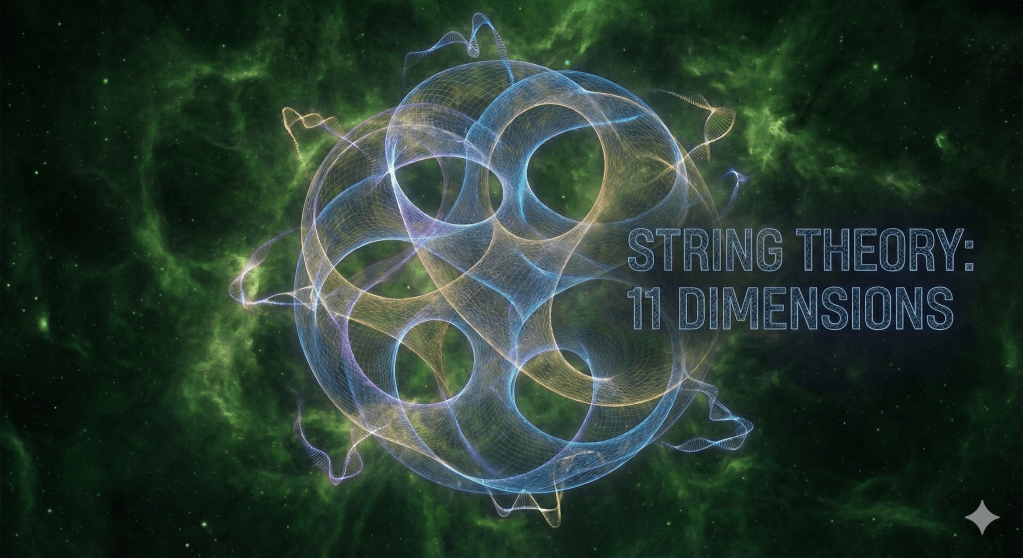
One intriguing way to bridge the pantheist’s intuitive “God-everywhere” idea with the monotheist’s “God-beyond” idea is through the concept of higher dimensions or unseen aspects of reality. In recent decades, theoretical physicists have seriously considered that our universe may have more dimensions than the three of space and one of time that we directly experience. For example, string theory in physics requires six extra spatial dimensions (for a total of ten dimensions of space-time) to make the mathematics work, and M-theory posits up to 11 dimensions. These extra dimensions are thought to be “hidden” – perhaps curled up at sub-microscopic scales, or otherwise inaccessible to our senses. We normally move only along length, width, and height, but there could be additional directions we’re oblivious to, just as a two-dimensional creature on a flat surface wouldn’t perceive the third dimension above or below its plane.
Why bring up extra dimensions in a discussion about God? Because it provides a mental model for how a being could be present everywhere in our world without being limited by it. Imagine, as physicist Michio Kaku has, a group of 2D “flatlanders” living on a sheet of paper. To them, their universe is that flat sheet. Now consider a 3D human (us) interacting with this 2D world. We, as 3D beings, could do things that seem miraculous to the flatlanders. We could, for instance, touch every point on their 2D plane by hovering our finger just a tiny distance above the sheet – we’d be “present” to all of it from a dimension they cannot see. We could also pop in and out of their world by lifting our finger off and on the page, appearing at one location and then another without crossing the in-between points (from the flatlanders’ perspective, we’d vanish from one spot and instantaneously appear in another). We could see inside closed 2D shapes on the paper without opening them – looking from above, the inside of any 2D circle is exposed to us, though a flatlander inside that circle would feel completely enclosed. In short, to the flat 2D minds, a 3D being would appear to violate all the normal constraints of their physics: we could be “everywhere at once,” see the hidden interior of things, and perform actions that seem to transcend space.
Now, analogously, consider that we might be like flatlanders relative to God. If God exists in a higher-dimensional “space” beyond the four-dimensional space-time, God could genuinely be present at every point in our universe (and every moment in time) without being a localized, physical object. From God’s higher vantage, the insides of all things – from the core of stars to the thoughts hidden in a person’s mind – could be “visible” or accessible without God having to physically “travel” here or there. The limitations of distance and opacity that frustrate us in 3D do not apply to a 4D or 11D being. In popular-level discussions, some have mused that God seeing all of time at once is akin to an extra-dimensional being seeing an entire timeline like a stretched-out ribbon. The key point is that modern physics countenances the existence of unseen dimensions permeating our world – domains that are “everywhere” yet untouchable, much like the theological idea of an unseen realm (al-Ghayb) interpenetrating the seen realm (al-Shahadah).
Indeed, the Qur’an speaks of “all that is hidden and all that is open” being known to God. Believers traditionally interpreted such verses as implying that reality has layers: the visible layer that creatures perceive, and hidden layers that are the domain of angels, spirits, and God’s direct knowledge. Science, in its own way, is now speculating about invisible layers of reality too (extra dimensions, parallel universes, quantum wavefunctions, etc.). While physics is not saying these are divine, the conceptual resonance is striking. We find ourselves more able to imagine a hyper-dimensional mode of existence. Monotheistic theologians of earlier centuries, lacking the language of hyperspace, used other analogies (mind vs. body, an undivided point present everywhere, etc.). But if they lived today, they might well point to string theory’s hidden dimensions or the “bulk” space beyond our 3D brane as a metaphor for God’s mode of presence.
The Muslim scholar Zia Shah explicitly makes this connection, arguing from scripture toward physics. He notes that the Qur’an describes God as knowing even the tiniest details – “Not even the weight of a speck of dust in the heavens or earth escapes His knowledge” (34:3) – and posits that “if God is to know each and every speck, atom or quark of the universe, He needs to have some presence there, either personally or through some agents like angels.” In Shah’s words, “Omniscience of God demands Omnipresence of some sort,” and from this “one can easily conclude that physics should include extra dimensions.” Rather than seeing miracles in this, Shah proposes it as a kind of theological science conjecture: if we take God’s omniscience seriously, perhaps the structure of the universe accommodates it via higher dimensions that allow a being to be “inside” everything without being contained by the physical world. In a 2026 analysis, Shah goes so far as to say “divine omnipresence—required for total omniscience—functions as an access mechanism to the higher-dimensional ‘Bulk.’” In plainer terms, God’s knowledge of every subatomic event implies He’s operating from a platform of reality larger than the one accessible to particles in 3D space. Just as a 3D being can oversee an entire 2D plane, the All-Seeing (Al-Basir) can oversee the 3D universe by being in higher-dimensional contact with it.
It’s important to note we are speaking analogically. No one is claiming to prove God by pointing to hidden dimensions, nor to prove extra dimensions by pointing to God. Rather, this line of thought shows a **conceptual harmony: pantheists’ intuition of an all-pervading divinity can map to the theistic idea of an unseen divine presence once we allow that reality might be more than meets the eye. The pantheist says “God is everywhere in the three-dimensional world.” The orthodox theist responds, “Yes, God is everywhere with us, but as an invisible spirit – think of it like an extra dimension enveloping and penetrating the 3D world.” The pantheist might worry this makes God seem too abstract or removed. But the beauty of the higher-dimensional analogy is that it still affirms direct contact. A 4D God can literally be closer to you than the air on your skin, yet you wouldn’t find Him with a microscope or telescope.
To illustrate with a brief thought experiment: If God exists in a higher dimensional realm, all of space and time could be immediately “present” to God. This resonates with the scriptural portrayal of God. The Bible says “Nothing in all creation is hidden from God’s sight” (Hebrews 4:13). The Qur’an says “He is with you wherever you are” (57:4) and repeatedly calls God al-Latif (Subtle) and al-Khabir (All-Aware), suggesting an almost penetrative presence that eludes our detection. In classical Islamic cosmology, there is the concept of the “Preserved Tablet” or “Clear Record” (al-Lawh al-Mahfuz, Kitab Mubeen) in which every event, past or future, is inscribed – a bit like a cosmic database of information. One might poetically compare this to the idea of the universe being a “projection” from a higher-dimensional information realm. Modern information theory even gives credence to the notion that all physical processes fundamentally store information (the holographic principle suggests the information content of a region can be thought of as encoded on its boundary). Such analogies, while speculative, make it easier to conceive how a transcendent God could keep track of every particle and every moment.
In summary, extra-dimensional physics provides a way to visualize God’s immanence without incarnation. A pantheist says “God must be the universe, otherwise how could God be present here?” The monotheist replies, “God can be present here the way a higher dimension is present – touching every bit of the universe, but not limited to the universe.” This preserves God’s transcendence (God exists in a realm of reality beyond the material) while affirming His immanence (God truly penetrates the material world with His knowledge, will, and power). The next logical issue to tackle is personhood and moral agency. Even if a pantheist grants that an unseen God could underlie nature, they often doubt the notion of God as a personal being with intentions and moral commands. We turn now to why accepting God’s personality and moral will actually resolves many philosophical problems that pantheism struggles with.
A Personal God with Purpose vs. an Impersonal Universe
Perhaps the most significant shift pantheists would need to make to “come into the camp” of Judaism and Islam is to accept that the Ultimate Reality has personality – that God is not just a blind force or abstract Oneness, but an intelligent being with will, purpose, and goodness. Orthodox Muslims and Jews address God as “You” – a living, aware interlocutor who can hear prayers, love creatures, and respond. Pantheism, on the other hand, usually rejects this idea. In pantheism, since God = Nature, and nature doesn’t speak or plan with intention (at least not in any evident way), God ends up being impersonal. Spinoza’s God, for example, has infinite attributes (including thought), but is not a “person” you could talk to; it’s the deterministic system of the universe. Einstein’s God was famously “subtle but not malicious,” an expression of admiration for the elegant laws of physics, but he explicitly said it was “not a God who concerns himself with the fates and actions of human beings.” Pantheists tend to see belief in a personal God as a quaint anthropomorphism. As one common critique puts it, pantheism “pretends to put God everywhere, but in fact it makes God nowhere” – a God that has no personhood cannot truly act, love, or guide.
Why does this matter? Because without a personal God, concepts of moral order, purpose, and relationship are fundamentally altered. If the divine is an It rather than a Thou, one does not pray to it expecting any answer. One might still feel a sense of awe or unity, but it’s like admiring a magnificent but indifferent landscape, not communing with a loving parent. The practical result is that pantheism often produces a spirituality of reflection and awe but not one of supplication or moral obedience – since there is no divine lawgiver or responder. By contrast, in Islam and Judaism, the relationship with God is central: God speaks (through revelation), listens (to our prayers), and cares (rewarding good and forbidding injustice). This personal dimension of God provides a basis for ethics (“Be holy, for I the Lord your God am holy,” says the Torah) and for trusting that the universe has a meaningful direction (a teleology or goal willed by God).
Pantheism faces a notorious challenge with respect to good and evil precisely because it lacks a transcendent moral will distinct from the world. If “all is God,” then what we call evil – every act of cruelty, every natural disaster, every instance of suffering – is also a part of God. This is a deeply unsettling implication. In classical theism, one can say evil deeds are against God’s will, or result from the misuse of free will by creatures, or are temporary evils allowed for a greater good, etc., because God stands apart from the world’s imperfections. He is wholly good, and evil exists only in the deviation of creation from His guidance. But in pantheism, “pantheism leaves no distance between God and evil”. As one analysis points out, this makes God “as much evil as He is good, as much predator as He is prey, as much disease as health.” This obliteration of the distinction between divine goodness and worldly evil is morally incoherent to the Abrahamic mindset. The Bible stresses “God is light, in Him there is no darkness at all” (1 John 1:5); the Quran teaches that God is Al-Bar (The Source of Goodness) and All-Just, never tyrannical or unjust to His creatures. Pantheism, however, would force us to say that when a child suffers or a heinous crime occurs, that too is “God” playing out – which is tantamount to denying any real meaning to goodness. Some pantheists have tried to avoid this by claiming that God is “beyond good and evil” – that our moral categories don’t apply to the Absolute. But thinkers like C.S. Lewis retorted that saying “God is beyond good and evil” is just a clever way to excuse God for being evil. If God doesn’t care about right and wrong, then God is not good in any sense that matters to us, making the term “God” rather unworthy of worship. As G.K. Chesterton pithily put it, “Pantheism is heir to a paradox: although it claims to put God everywhere, it really makes God nowhere. It turns the universe into God, but a God who has no mind, no heart, and no moral distinctions – which is effectively no God at all.”
Closely related is the issue of free will and personal identity. If everything is one substance (the pantheist’s God/Nature), then our feeling of being independent persons might be an illusion. Some pantheistic philosophies, like certain strands of Hindu Advaita or even Spinoza’s system, explicitly say that individual selves are not ultimately real – we are modes of the one universal being, destined to lose our individuality in the great unity. This raises questions: if only the One exists, who is choosing to do anything? If I slap you, is “God” slapping “God”? Pantheism can unintentionally undercut the basis for human responsibility. As one critique noted, “if all our judgments (true or false) are the utterance of the One that thinks in us, it is impossible to discriminate the true from the false… He who rejects pantheism is no further from the truth than he who defends it; each but expresses a thought of the Absolute.” In other words, if every thought in every head is just God thinking, even errors and delusions are God’s thoughts, so one cannot even claim pantheism is more true than theism – a self-defeating predicament. Classical theism avoids this puzzle by maintaining a real distinction between Creator and creature: God endowed us with limited freedom, and our thoughts are truly ours, not simply fragments of God’s mind. Thus, one person can truly err while another is correct, and God – as an all-knowing judge distinct from us – can distinguish and guide us to the truth.
All these philosophical issues reinforce why a personal, transcendent God actually provides a more coherent and livable worldview than pure pantheism. In practical terms, pantheists already live much like theists in some respects – they experience wonder and often a moral sense of caring for the world. However, pantheism doesn’t offer a strong basis for why the moral dimension should hold (if the universe “just is,” one can’t objectively say we ought to prefer compassion over cruelty – it’s all equally “God”). Monotheism grounds morality in God’s character – “Be merciful as your Lord is Merciful,” etc. It also offers hope for ultimate justice: wrongs can be righted by a righteous God, whereas a pantheist universe simply contains those wrongs as part of its fabric with no guarantee of cosmic justice. Additionally, a personal God offers the prospect of a relationship – love between Creator and creature – which is a deeply fulfilling idea absent in pantheism. As one Catholic Encyclopedia commentary observed, “an impersonal being…cannot be an object of worship… An infinite It can awaken awe, but not love. You can stand in reverence before a sunset (if you call that God), but you cannot speak to it, nor hear it speak to you in a voice that forgives, commands, or saves.” Pantheists might say those needs for relationship and salvation are psychological comfort blankets – but many pantheists themselves express a profound longing for meaning and unity. Orthodox Judaism and Islam claim that longing is ultimately answered by a real relationship with a real, loving God.
To be fair, not all pantheists are strict “all-is-God” monists. Some shade into panentheism or mystical theism, where God has a dual aspect: impersonal in one sense but personal in another. The 20th-century physicist Paul Davies, whom we mentioned earlier, is an interesting case. Early in his career he spoke of a pantheistic God of physics, but later he mused about the fine-tuning of the universe and the “mind of God” in ways that edged back towards theism. Many who start from pantheistic assumptions eventually find themselves confronted with mysteries (like consciousness, or the origin of the universe, or the reality of moral values) that point beyond a purely impersonal cosmos. It is at this point that the door opens to a more theistic understanding. The transition does not have to feel like a betrayal of nature – rather, it can feel like discovering the Author behind the story you already love. The flowers, mountains, and stars that a pantheist finds divine are, in the monotheistic view, signs of the Divine. The Quran, for example, constantly invites people to reflect on nature: “In the creation of the heavens and earth, and the alternation of night and day, are Signs for those with understanding” (3:190). The difference is that monotheism says don’t stop at the sign. The sign points to something greater: the Sign-Maker. Pantheists already cherish the sign (the universe); theism simply asks them to acknowledge the Artist whose signature is scrawled across the canvas of the cosmos.
Bridging the Gap: A Path Forward for Pantheist Seekers
Pantheists and orthodox monotheists ultimately want to connect with the truth of existence and experience awe at the grandeur of reality. Here are some key adjustments or insights that can help pantheists move closer to the God of Judaism and Islam without losing their reverence for nature’s unity:
- See Nature as a Sign, Not the Final Destination: Rather than equating the universe itself with God, view the universe as a reflection of God’s attributes. All the beauty, lawfulness, and creativity in nature are like artwork produced by the Divine Artist. One can maintain the pantheist’s “marvel and awe of harmony, order, and creativity of nature”, while adding the recognition that these qualities originate from a conscious Creator who intentionally fashioned the cosmos. In Islamic terms, the universe is full of ayat (signs) pointing beyond itself.
- Embrace Transcendence through Extra Dimensions (or Unseen Realms): Pantheists tend to confine their idea of God to the observable universe. Consider that God could exist in higher dimensions or unseen aspects of reality that interpenetrate our world. This allows God to be truly present everywhere without being a material part of the universe. The concept of an unseen realm (whether one imagines it metaphorically as extra spatial dimensions, or spiritually as a different mode of being) lets us reconcile immanence with transcendence. God can be intimately involved in sustaining every atom and moment (immanent) and yet remain infinite and uncaptured by the physical (transcendent).
- Affirm a Personal, Caring God: It might feel like a leap, but acknowledging that the ultimate reality has a personal aspect opens the door to tremendous spiritual richness. A personal God is not an old man in the sky – He is the source of Personhood itself, the wellspring of consciousness and love. If humans have personality and mind, it is not far-fetched that the Creator of humans has at least as much “personhood” (in a transcendent way) as we do. This means the universe is not just an accident or a neutral unity; it has intentionality and purpose behind it. The laws of physics came from a Lawgiver; the moral order comes from a Moral Will. One can still delight in the poetry of saying God is “the soul of the universe,” but now one also believes this “soul” knows and chooses. This solves the moral problem – God is all-good and creation’s evils are not God Himself, but disorders that God permits for a time and will rectify with justice. It also means one can have a relationship with the Divine. Love, gratitude, prayer, and forgiveness all become meaningful when God is “He” and not just “It.” Even Spinoza, strict rationalist though he was, used the language of intellectual “love” towards God – hinting that the human heart longs for a personal connection. In the Islamic tradition, God says, “I was a hidden treasure and I loved to be known” – thus creation. The treasure wants us to know Him.
- Retain the Wonder, Expand the Horizon: Adopting monotheism should not extinguish the pantheist’s sense of wonder – it should amplify it. The universe is no less majestic; in fact, it becomes more amazing, because it is now seen as a deliberate act of Artistry and Love. Every supernova, every hummingbird, every galaxy and quantum particle is intentional and imbued with meaning. The laws that pantheists revere become even more worthy of reverence, as they are expressions of a divine mind (which arguably makes the laws more intelligible, since they come from an Intelligence). The feeling of unity with nature that pantheists often cultivate (the famous “cosmic consciousness”) can translate into a sense of closeness to the Creator who is reflecting His qualities through nature. One does not lose the “oneness” experience; one reinterprets it – when you feel at one with the cosmos, you are touching the handiwork of God, and through it, communing with God’s presence. The Sufi mystics in Islam experienced fana’, a feeling of dissolving into God’s oneness, which sounds akin to pantheistic unity, but they understood it as the soul’s intimate encounter with the very personal Divine Beloved.
- Consider the Afterlife and Ultimate Justice: Pantheism typically has no room for a resurrection or personal afterlife (since an impersonal universe has no interest in individual souls surviving). Orthodox Judaism and Islam, however, promise that our consciousness and moral choices are deeply meaningful – so much so that God will raise us up after death for an accounting and continued life in His presence. This concept of an afterlife (and divine justice) might initially seem like wishful thinking to a pantheist, but it actually flows from the idea of a personal, moral God. If God cares about the good, then ultimate justice and mercy make sense. And if God is able to create the universe, recreating or continuing a human soul is surely within His power. Many pantheists appreciate notions of cosmic justice or karma in a broad sense; monotheism specifies it with a just and merciful God at the helm. The “Clear Record” mentioned in the Quran – a record of all deeds – aligns with the idea that nothing is forgotten in the moral tapestry of the universe. This can provide a powerful hope that all the suffering and striving is not in vain, but part of a larger story that ends in recompense and restoration.
In making these shifts, pantheists do not have to feel they are capitulating to irrational dogma. On the contrary, they may find, as Einstein did, that their sense of awe only deepens. Einstein, late in life, said: “I am fascinated by Spinoza’s pantheism, but admire even more his contributions to modern thought… The problem is too vast for our limited minds. We see the universe marvelously arranged and obeying certain laws but only dimly understand these laws.” He compared humanity to a child entering a huge library filled with books in many languages, dimly suspecting a mysterious order. That humble wonder is something both pantheists and theists share. Where they differ is that orthodox theists are willing to say, “Yes, there is an Author – unseen but real – who wrote these books of nature and scripture.” Einstein himself resisted calling that Author “personal,” yet he spoke of “the presence of a superior reasoning power revealed in the incomprehensible universe”. If we nudge just a little further, as this essay has attempted, that “superior reasoning power” can be recognized as what Jews call Hashem or Adonai, and Muslims call Allah – the God who is transcendently Supreme in being, yet intimately involved in every aspect of creation.
Epilogue: The Hidden Thread of Unity
In the end, the divide between pantheism and Abrahamic monotheism may be more superficial than it first appears. Like two people marveling at a magnificent tapestry from different angles, both pantheists and religious monotheists sense the same hidden thread of unity running through reality. The pantheist rapturously exclaims, “All is One!” – seeing divine unity in the cosmos. The Muslim or Jew responds, “Yes, all is one because it flows from the One True God.” They are, perhaps unknowingly, pointing to the same truth, but using different language. The Qur’an says: “We shall show them Our signs in the horizons and within themselves until it becomes clear to them that He is the Truth”. For some, those signs in the horizons (in nature, in the cosmos) shout “unity” so strongly that they merge God with the horizon. But the signs were always meant to lead beyond themselves, to the Truth that is their source.
Imagine standing on a quiet beach at sunset, the sky aflame with colors. A pantheist feels a deep connection in that moment – a spiritual merging with the ocean, sky, and wind, sensing the sublime oneness of it all. A monotheist stands in the same glow and whispers a prayer, feeling the love and majesty of the Creator who “painted” this sky. Two experiences, one reality. The first sees God in everything; the second sees everything in God. These need not contradict. The transcendent God of Judaism and Islam is not somewhere else; He is right here, “closer than your jugular vein,” as the Quran puts it. Yet, unlike the pantheist’s God, He is not only the sum of here – He is also the Author of a destiny that exceeds the physical world, the giver of a moral law that stands above natural forces, and the lover of souls who can call each star and each person by name.
For the pantheist willing to take that extra step, a remarkable thing happens. Nothing of beauty is lost – the forests, stars, and atoms remain as wondrous as ever – but something is gained: a personal relationship with the One who made those forests and stars. The tapestry of nature gains a new dimension of meaning when we acknowledge the Weaver of the tapestry. One can still practice mindfulness in the forest or gaze at the Milky Way in wordless awe, but now one can also say, “Thank You,” and believe Someone hears. One can feel small under the sky, yet known and cared for by the Power that moves the galaxies. Life’s joys and sorrows take on the texture of a story in which justice and love truly matter, because they reflect the character of the Ultimate Reality.
Orthodox Judaism and Islam invite the pantheist not to abandon the love of nature, but to embrace an even greater love: love of the Creator of nature. They teach that when you admire the elegance of E=mc² or the complexity of a cell, you are glimpsing the wisdom of God. When you thrill at the kindness of a stranger or the innocence of a child, you are touching the mercy of God. All those pieces that pantheists label “divine” within the world are like rays emanating from a single sun. The Qur’an encapsulates this in a beautiful way, with God speaking: “To God belongs the East and the West; wherever you turn, there is the Face of God” (2:115). Everywhere you look, you can find a reflection of the Divine – yet the Face (the Essence) of God is not literally everything you see. It is behind and beyond, smiling through the veil of material forms.
In closing, we recall the Qur’anic verse that describes God as “the First and the Last, the Manifest and the Hidden” (57:3). This paradoxical formulation could serve as a bridge motto. God is Manifest – pantheists are right that the divine saturates the world, “shining from every phenomenon” – and God is also Hidden – the holy Mystery that eludes any telescope or equation, whom prophets and sages have known through spiritual insight. To all who have stood in awe at the unity of the universe, Judaism and Islam say: Come, meet the Unity behind the unity. That One has been calling humanity into relationship across millennia. The door is open, and as one Muslim mystic quipped, inside the door we find that the “God we worshipped as Absolute Oneness” was in fact the Living Beloved waiting to reveal His nearness.
The journey from pantheism to pure monotheism is less a revolution than a revelation – the realization that the Divine Reality you sensed immanent in nature has an identity and a will, and loves you. It is like a character in a story becoming aware that the warmth and light they’ve always felt was the presence of the Author guiding them. This does not destroy the story; it gives it ultimate meaning. In the orthodox Jewish and Islamic understanding, the universe is not itself God, but it wears God’s fingerprints everywhere. By refining the focus of our spiritual vision (shifting that “vague assumption” that God is only the material dimensions), pantheists can find a home in the very traditions they once spurned – discovering that the transcendent God of Abraham is indeed “as close to us as our jugular vein,” and that in knowing Him, nothing true or beautiful in the world is lost. In fact, everything is gained, for one has come to know the Source of all beauty and truth.
Ultimately, the path for the pantheist is not a negation but a fulfillment. It is the heart recognizing its Maker in the myriad reflections that adorn creation. It is the universe, in all its splendor, finally pointing beyond itself and the soul following that pointer to its true destination. The One Reality that pantheists perceive can still be celebrated – now with the clarity that this One is God Most High (El Elyon, Allahu Akbar), exalted beyond the universe yet lovingly sustaining it. The journey that began with seeing God in everything culminates in seeing everything in God. And that is the view from the extra dimensions of faith – a view in which the cosmos is alive with meaning, and God is “the Light of the heavens and the earth” guiding us to an ever deeper unity, not only with nature, but with Himself.
Sources: Pantheism and monotheism discussions adapted from Zia H. Shah’s works on The Glorious Quran and Science; Extra-dimensional analogy drawn from Shah’s omniscience and physics articles; Quranic verses on God’s transcendence and immanence; Critiques of pantheism’s coherence and morality referenced from scholarly analyses; Einstein and Spinoza’s views noted from historical quotations. Pantheism as a stage “between” atheism and theism and the call to a personal God informed by Zia Shah’s commentary.
If you would rather read in Microsoft Word file:



 The Glorious Quran and Science
Leave a comment