
…
Presented by Zia H Shah MD
Abstract
Quran 41:53 proclaims that God will reveal His signs “in the horizons and within themselves” until the truth of the divine becomes manifest. This commentary focuses on human consciousness as a profound “sign within ourselves” pointing to God. Modern science and philosophy have struggled to explain consciousness – the subjective sense of “what it is like” to experience – resulting in hundreds of competing theories with no consensus. Some thinkers, unable to find a material explanation, even dismiss consciousness or free will as illusions, a move that only highlights the depths of our ignorance. Yet from a theistic perspective, this very mystery of the mind is a purposeful sign: an inner miracle that cannot arise from a lifeless universe and thus leads us to affirm a Creator. Drawing on scientific insights, philosophical arguments (the “hard problem” of consciousness), and Quranic wisdom, we argue that human consciousness – with its irreducible subjective depth – powerfully indicates the existence of a transcendent Prior Mind (God) and the reality of the human soul. In short, our own consciousness is a living signpost towards the Infinite, fulfilling the Quran’s promise that through the wonders within ourselves, we can recognize the Truth.
Introduction: The Verse of Signs in Horizons and Selves
Quran 41:53 declares: “We will show them Our signs in the horizons and within themselves until it becomes clear to them that it is the Truth…”. Classical Islamic scholars like Ibn ‘Arabi interpreted “the horizons” (al-āfāq) as the external universe – the vast cosmos – and “within themselves” (fī anfusihim) as the inner world of human beings, including our biology, consciousness, and soul. In essence, the verse asserts that the external world and our internal self are both arenas where God’s signs (āyāt) become evident. Over time, as human knowledge advances, these signs would progressively be unveiled. Indeed, modern discoveries in cosmology (Big Bang, cosmic fine-tuning) have shown striking “signs in the horizons,” aligning with the Quranic vision of an intelligently ordered universe. Yet equally compelling are the signs “within ourselves” – and foremost among these is the mystery of consciousness. Our capacity for subjective experience, self-awareness, and rational insight is an inner cosmos no less wondrous than the outer universe.

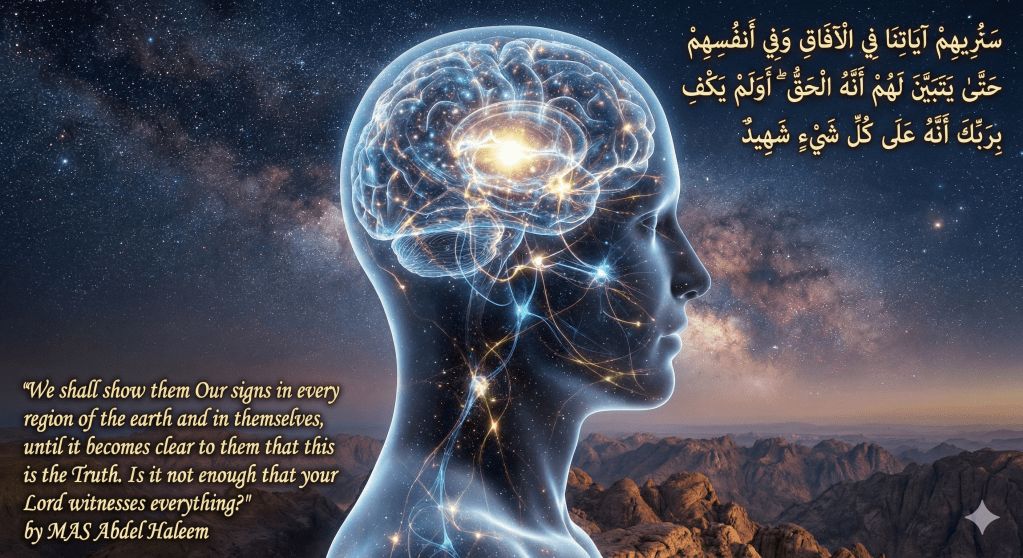
Quran 41:53 speaks of signs “in the horizons and within themselves.” Modern science has illuminated the majestic signs in the horizons – from galaxies to subatomic particles – but the signs within the self are equally profound. Human consciousness stands as a bridge between the material and the transcendent, an inner light that science cannot fully explain.
In this commentary, we focus on human consciousness as a God-given sign within us. We examine why our inner awareness – our mind and soul – defies reduction to physics and chemistry, and how this enigma fulfills the Quran’s promise of signs that lead to truth. First, we review the scientific and philosophical struggle to understand consciousness, highlighting the so-called “hard problem”. Next, we explore how the failure of materialistic explanations points to the need for a higher reality (a soul or divine Mind) to account for consciousness. Finally, we integrate Islamic theological insights: the Quran’s teachings about the soul, God’s nearness to the human heart, and the idea that our conscious self is a direct sign of the Creator. Through this blend of perspectives, we will see that the miracle of consciousness testifies to God’s existence, vindicating the Quran’s insight that in our own selves we find evidence of the Divine.
The Hard Problem of Consciousness: Science’s Struggle to Explain the Mind
Modern science has made great strides in understanding the brain, yet consciousness – the fact that we experience feelings and thoughts – remains an unsolved riddle. The philosopher David Chalmers famously dubbed this the “hard problem of consciousness,” which asks: why and how do physical processes in the brain give rise to subjective experience? Even if we map every neural circuit and explain every behavior, there is still a gap in understanding “why is all this brain activity accompanied by an inner feeling of being – of awareness?”. This explanatory gap means that current science does not even have a clear conception of what a solution would look like – a point noted by neuroscientist Sam Harris, who observes that we “cannot even frame the solution clearly – we only recognize that standard frameworks fall short.” In short, consciousness is the most familiar feature of our existence, and yet it is the least understood. As one writer quipped, “Consciousness is what we know best and explain least.”
Despite enormous research, there is no consensus theory of consciousness. In fact, experts have proposed over 200 distinct theories of what consciousness is or how it arises. Cognitive scientist Robert L. Kuhn surveyed these myriad ideas (eventually cataloguing 225 theories) and noted their “radical diversity” as evidence that no single paradigm commands wide agreement. These theories run the gamut from strictly materialist models (which try to treat consciousness as nothing but brain activity) to models that posit non-physical mind or quantum phenomena. The sheer multiplicity of views, often operating at “astonishingly divergent orders of magnitude” (from micro-scale quantum events to emergent brain networks), underscores how far we are from a unified understanding. In the words of the Quran, “of the knowledge thereof you have been given but a little.” Indeed, many scientists candidly admit that we do not really know what consciousness is – an admission that resonates with the Quran’s statement about the soul: “You have been given only a little knowledge [of it]” (Quran 17:85).
Several major scientific theories illustrate the impasse:
- Integrated Information Theory (IIT): Proposes that consciousness corresponds to the amount of integrated information in a system (quantified as Φ). While IIT has a mathematical elegance, it leads to puzzling implications – for example, even a thermostat or a microchip might have a “flicker” of consciousness if Φ is nonzero. This blurs the line between the inanimate and the animate and faces the “combination problem”: how small bits of proto-consciousness could combine to form a unified mind.
- Global Workspace Theory: Likens consciousness to a spotlight of attention in the brain that broadcasts information to various neural sub-systems. This explains certain cognitive functions (attention, reportability), but critics argue it doesn’t capture the raw feel of experience – the very thing that needs explanation. It addresses the “easy problems” (information processing), not the hard problem of subjective feeling.
- Orchestrated Objective Reduction (Orch-OR): A speculative theory by physicist Roger Penrose and anesthesiologist Stuart Hameroff, which suggests quantum processes in neuronal microtubules produce consciousness. This idea tries to use quantum mechanics’ weirdness (e.g. entanglement, superposition) to bridge the gap between matter and mind. However, it remains highly controversial; there’s little empirical evidence for quantum states in the warm, wet brain, and many scientists doubt that quantum coherence could be sustained in neurons. Orch-OR’s appeal, though, highlights how conventional neurobiology has failed to explain consciousness, pushing some researchers to explore more “exotic” possibilities.
Given the lack of progress, some thinkers have resorted to drastic philosophical positions about consciousness – positions that underscore the desperation to fit consciousness into a materialistic worldview. Two notable examples are panpsychism and illusionism:
- Panpsychism (Mind Everywhere): Panpsychism posits that consciousness is a fundamental feature of matter itself – that every electron, atom, or particle has some tiny element of awareness. This way, mind doesn’t “emerge” magically at a certain complexity, because it was there (in rudimentary form) all along. While this idea avoids the hard problem by fiat, it faces major problems of its own. It is scientifically untestable (we have no way to detect consciousness in an electron) and doesn’t make useful predictions. Philosophically, it struggles with the combination problem: how do countless micro-minds combine to form the single, unified consciousness that humans have? No one has a coherent explanation for that. As one neuroscientist quipped, panpsychism “explains nothing and does not generate testable predictions,” functioning more as a metaphysical last resort than a true explanation. It “simply asserts” that even atoms feel something and “hopes this dissolves the mystery,” which many see as an unfounded and non-falsifiable claim.
- Illusionism (Denying the Reality of Mind): Some die-hard materialists, unable to explain consciousness, try to deny its existence (or downplay it) by calling it an illusion. Philosopher Daniel Dennett and others (like Keith Frankish) argue that our sense of having a first-person experience is a kind of trick – there really is no “hard problem,” because consciousness is not what it seems; it’s just a complex brain process with no inner observer. However, this position is deeply problematic. If consciousness were truly an illusion, who is being deceived? An illusion by definition requires a conscious subject to experience it. Thus illusionism is self-refuting – it assumes the very consciousness it seeks to eliminate. As one philosophical critique puts it, “Claiming that consciousness is an illusion implies a conscious entity that is being fooled, which is a paradox.” Even common sense rebels at this: our direct, first-person experience of being aware is more certain than any theory denying it. As David Chalmers noted, the reality of one’s own consciousness is a Moorean fact – more evident than any speculative neuroscience that would claim it’s not real. In short, explaining away consciousness won’t work; it is “immediate and self-evident” to us. The extreme stance of illusionism mainly shows how cornered the materialist view has become that some feel driven to “deny the obvious daily human experience of our consciousness”.
To summarize, the scientific and philosophical quest to explain consciousness on purely natural terms has hit a wall. Despite sophisticated brain research, we still face what scholars call an “explanatory gap” – the gap between objective brain processes and subjective experience. Leading philosophers (Thomas Nagel, David Chalmers, John Searle, Galen Strawson, etc.) have all argued that something about consciousness is irreducible to matter. The first-person, qualitative feel (what philosophers call qualia) and our inner awareness of self do not map neatly onto firing neurons and synapses. As one analysis states, “inert matter is not self-aware” – no matter how you arrange it. Materialist theories either simply assume consciousness as fundamental (panpsychism), deny it (illusionism), or “pass the buck” to ever more convoluted ideas, but the core mystery remains. It is no surprise, then, that many scientists and philosophers have started entertaining the idea that mind might not be fully explainable by matter alone. In the words of the Chief Editor of The Muslim Times, after surveying the field: “there are more than 200 actively pursued theories of consciousness in academic circles,” yet none has cracked the riddle – a situation that “serves as a testament” to the truth of the Quranic verse that the essence of the soul lies with God’s command, beyond our full grasp.
Consciousness as a Sign of a Prior Mind: From Dead Matter to Living Soul
If a “dead” (insentient) universe cannot by itself generate consciousness, the most plausible conclusion is that consciousness came from outside or above the material system. In philosophical theology, this is known as the Argument from Consciousness: the claim that our conscious mind is evidence of a pre-existing Supreme Mind (God) that endowed us with this faculty. As Christian philosopher Richard Swinburne argues, naturalistic evolution “falls short in elucidating the existence and nature of consciousness. Therefore, a personal explanation, involving a divine consciousness, is more appropriate.”. Likewise, J.P. Moreland contends that if mind cannot emerge from matter, it is logical to infer a Mind-first reality – namely God – as the source of finite minds. In fact, Swinburne and Moreland are among the few prominent thinkers who explicitly formulate arguments for God’s existence based on consciousness, highlighting that theism offers a more coherent explanation for this phenomenon than atheistic materialism.
The crux of the argument is simple yet profound: How can mindless matter give rise to mind? Our ordinary experience and all scientific observations confirm that consciousness comes from life, from other consciousness, not from inert things. Living minds beget ideas, create art, produce technology – but no pile of rocks ever started thinking on its own. As Zia Shah succinctly asks, “When humans, who know what consciousness is from personal experience, still cannot create it [artificially], how can lifeless, inanimate elements randomly reacting with each other lead to conscious life… in the absence of a conscious and All-Knowing Creator?”. The atheist’s worldview, in denying any sort of cosmic mind, must believe that at some point in cosmic history, matter that knew nothing somehow produced beings that know – a leap that defies logic. This is why some atheist philosophers end up denying the reality of mind altogether (as we saw with illusionism), effectively conceding that a consistent materialism cannot accommodate consciousness except by wishing it away. Such an extreme conclusion – denying consciousness and free will as delusions – ironically serves as a “clue for theism,” because it shows how rejecting a Creator forces one to reject the most self-evident truth of personal existence. In other words, if one’s philosophy leads to saying “my consciousness isn’t real”, perhaps there is something wrong with the philosophy rather than with consciousness. The theistic interpretation is far more straightforward: consciousness is real because it comes from a supreme reality (God); it did not magically emerge from dead matter but was bestowed by an eternal Mind.
Philosopher Thomas Nagel (an atheist himself, interestingly) admitted in his book Mind and Cosmos that the materialist neo-Darwinian view of nature is incomplete – consciousness, reason, and values seem like fundamental aspects of reality that cannot be explained by blind physical processes. He mused that the emergence of conscious beings “from configurations of dead matter” is a cosmic fact that cries out for an explanation beyond current science. Nagel didn’t embrace theism, but he highlighted the deep incompatibility between consciousness and reductive materialism. Others, like David Chalmers, have flirted with the idea of “naturalistic dualism” or even panpsychism because they see no way for known physics to account for mind. All these perspectives, while not explicitly theistic, point to the need for something fundamentally new in our worldview to account for consciousness. For theists, of course, that “new thing” is not new at all – it is the postulate that mind is primary, not matter, and that the Mind of God is the source of all lesser minds.
In Islamic theology, this idea is fully harmonious: God is Al-ʿAlīm (The All-Knowing) and Al-Ḥayy (The Ever-Living), the ultimate consciousness that gives life and knowledge to His creations. The Quran teaches that God “breathed His spirit” into the first human (Quran 15:29), indicating that our conscious life is a direct gift from the Divine. Human consciousness, then, is a sign of our likeness to our Creator – not that we are divine, but that we possess a rational soul that reflects a spark of God’s attributes (like knowing, willing, loving) on a finite scale. It is thus no coincidence that the Quran uses the same word “Rūḥ” (spirit) for that breath of life in man and for the divine spirit from God – linking our conscious souls to a transcendent origin. Consciousness is a window through which the Light of God touches our inner world, as hinted by Quran 24:35 (“Allah is the Light of the heavens and the earth… the light within the believer’s heart”). In simpler terms, when we look inward at our own awareness, we are seeing a pale reflection of the Infinite Consciousness that originated all minds.
Modern philosophers of religion argue similarly that if the universe has produced conscious persons (us), the most reasonable explanation is that the ground of the universe is also personal. Christian philosopher C. S. Lewis put it eloquently: “If the solar system was brought about by an accidental collision, then the appearance of organic life… and the very phenomenon of consciousness would be an extraordinary coincidence.” Instead, he argued, it makes more sense that a conscious God created creatures with consciousness. In academic philosophy, Richard Swinburne has articulated an inductive argument: the existence of consciousness is vastly more probable given the existence of God than it is given naturalism, therefore consciousness is evidence for God. Swinburne points out that science can describe correlations (this brain state correlates with that thought) but cannot in principle explain why there is an inner experience at all – whereas a God who is Himself mind could create other minds. Thus, a “personal explanation” (God as cause) is warranted when mechanistic explanations fail.
At this juncture, some skeptics say: “Well, maybe some advanced alien or super-AI originally caused consciousness to arise.” But this only defers the problem – who gave them consciousness? We would face an infinite regress of conscious designers, which is philosophically untenable. The logical stopping point is to accept an uncaused first Consciousness – an eternal Mind that always existed. As the Quran describes God: “Allah – none deserves worship but He, the Ever-Living, the Self-Subsisting (al-Qayyūm)” (Quran 3:2). An eternal, self-subsisting Consciousness can serve as the ultimate source of all finite consciousness. Any chain of creators must end in a First Creator who is Himself uncreated. To use a famous metaphor: it’s not “turtles all the way down” – eventually one needs a ground to reality. In terms of consciousness, the chain of minds points to a beginningless Mind. As one scholar put it, “our consciousness is more plausibly explained by the existence of a divine being than by naturalistic processes alone.” A thoughtful examination of consciousness thus “tends to lead beyond the cosmos to the transcendent” – the finite minds lead us to postulate an infinite Mind. In Quranic language, when we ask, “Why do we have a mind at all?”, the answer that “makes it clear that it is the Truth” is that an eternal, all-aware Reality undergirds everything. In short, mind comes from Mind.
To illustrate this principle, consider an analogy from our technological age: artificial intelligence. Humans have invested great effort in trying to create conscious AIs, so far to no avail. But even if one day we succeeded, note the key fact: it would have taken our human consciousness to design and build that AI. Intelligence would have originated from intelligence. We do not expect a heap of silicon and wires to self-organize into a sentient robot without intelligent input. Similarly, nature’s “AI” – the human mind – is an achievement that points back to an intelligent cause. Just as it takes a mind (scientist) to make a mind-like machine, it takes a cosmic Mind to make the mind of a human. The modern creation of AI by human minds is a metaphor for the universe: if we, the products of the universe, possess consciousness, it hints that the universe itself is the product of a higher Consciousness. We needed pre-existing intelligence to get any artificial mind; likewise, our natural minds needed a pre-existing divine Intelligence to bring them about. This aligns perfectly with the Quranic worldview in which God is Al-Khāliq (The Creator) and Al-Bāri’ (The Originator) of not just the physical world, but of life and spirit.

Just as Michelangelo’s Creation of Adam symbolizes God imparting the spark of life to man, the existence of artificial intelligence owes itself to human creators with minds. Similarly, the existence of human intelligence (our conscious mind) is best explained by a pre-existing supreme Mind. In other words, mind comes from Mind – our consciousness is a sign pointing to the greater Consciousness of God.
In conclusion of this section, the inert universe theory fails – a completely mindless, soul-less cosmos offers no credible path to produce conscious beings. All attempts to explain consciousness solely from physics and chemistry either remain mired in mystery or force one into absurd positions (like denying the reality of one’s own mind). By contrast, the theistic explanation is elegant: consciousness exists because an All-Conscious Being (God) willed for conscious creatures to exist. He endowed us with souls that mirror, in finite measure, His own consciousness. This is why the Quran frames the signs “within ourselves” as evidence of Truth – our very capacity to seek truth, to reason and feel, has its roots in God’s design. As one commentary summarized, “true life and mind require a prior Mind”. Our minds point back to an eternal Mind that is the source of all reality. Far from emerging by accident, consciousness is a deliberate sign of God woven into our being.
Quranic Insights: The Soul’s Mystery and God’s Nearness
Intriguingly, the Quran anticipated the elusive nature of consciousness (the soul) over 1400 years ago. In Quran 17:85, people asked Prophet Muhammad about the essence of the Rūḥ (soul/spirit), and he was told to reply: “The Spirit is by the command of my Lord, and of knowledge, you (humankind) have been given only a little.”. This brief verse packs deep insight. It effectively says that the human soul (or spirit) comes from the “command” (امر, amr) of God – a term which commentators interpret as a higher order of reality, something from God’s own domain. And it directly notes human intellectual limitation in this regard: we may strive, but we will only understand a fraction of this phenomenon. Modern experience affirms this Quranic wisdom: after centuries of studying the mind, the top experts admit we still understand very little. By one count, “more than 200” theories about consciousness exist with “no single paradigm” commanding consensus – a situation one Muslim scholar calls a “testament” to the truth of “you have been given but little knowledge.”. The Quran thus frames our ignorance itself as a sign – a humbling reminder that the soul’s true nature lies beyond our full comprehension, in God’s realm. In Islamic theology, the soul is often understood as an immaterial essence breathed into the body by God; it is not an emergent property of the brain, but a divine endowment. This perspective aligns with the idea that science may chart brain activity, but the spark of subjective life – the “inner light” – comes from God’s command. As one analysis notes, the Quranic term amr suggests that consciousness belongs to a different order of reality than matter. The enduring enigma of consciousness in neuroscience thus echoes the Quran’s message: the human soul is a sacred mystery, only partially accessible to empirical inquiry.
Another illuminating Quranic reference is Quran 8:24, which states: “O believers! Respond to Allah and His Messenger when he calls you to that which gives you life. And know that Allah stands between a person and their heart, and that to Him you will be gathered.” This verse, while in a context of urging faith and obedience, carries a profound implication about God’s relationship to our consciousness. To say that God comes “between a person and his heart” is to say that God is closer to us than our own selves, interposed at the very core of our life and mind. The “heart” (qalb) in Quranic usage often denotes the center of awareness and will – essentially, the mind or soul. So the verse conveys that our consciousness is permeated or accessed by God’s presence and power at all times. Classical scholars explained this as God’s sovereign control over human will and guidance: He can turn hearts as He wishes, giving spiritual life or letting them harden. But in a broader sense, we can read it philosophically: God is the transcendent reality in which our inner life subsists. We are never “sealed off” from Him; every beat of our heart and every flicker of awareness exists only because God is sustaining us from within. As the Quran elsewhere says, “We are nearer to him than his jugular vein” (50:16). Thus, consciousness is the meeting point of the finite and the Infinite: our finite mind is constantly in touch with God’s infinite Knowledge and Will, whether we realize it or not. A modern commentary on Quran 8:24 put it beautifully: “our very consciousness – the meeting place of the finite human mind and the Infinite divine presence – lies under God’s intimate purview… a part of our consciousness will always remain an enigma known only to God”. Indeed, “the secret of our own consciousness is ultimately in the hands of the Infinite.” In practical terms, this means our ability to understand, to intend, to feel – all are contingent on God’s ongoing sustenance. We do not own our consciousness outright; it is a gift and a sign, meant to guide us back to the Giver.
The Quran also draws a connection between the resurrection in the hereafter and God’s ability to revive consciousness. The verse immediately following 41:53 (i.e. 41:54) asks, “Is it not sufficient that your Lord is witness over all things?” – implying that God’s omniscience (all-awareness) guarantees His promises. The God who shows us signs will also fully reveal reality in the end. Another verse (40:57) states: “Certainly, the creation of the heavens and the earth is greater than the creation of mankind; but most people do not know.” This suggests that while the argument from consciousness is powerful, the cosmological argument (creation of heavens and earth) is an even grander sign. Nonetheless, the verse acknowledges human creation (which includes the soul) as a divine act. The Quran frequently ties the mystery of life, death, and rebirth to God’s command: “He says to it ‘Be,’ and it is” (2:117). If God can bestow consciousness in the first place, He can return it after death. From an Islamic perspective, the human soul is on a journey: its inexplicable emergence in this world is a sign, and its continuation into the next world is equally under God’s power. Consciousness, in this view, transcends the physical – it is not extinguished with the body, but returns to God (“to Him you will be gathered” as 8:24 ends). This eternal aspect of the conscious soul further underscores that our mental life is not a byproduct of transient matter, but rooted in a higher reality.
Finally, consider how moral and spiritual awareness – facets of our consciousness – also point to God. We have not only a mind that thinks, but a conscience that senses right and wrong, and a yearning for meaning. Secular explanations try to reduce moral consciousness to evolutionary psychology or social conditioning, but the enduring human experience is that our sense of objective moral values and our quest for purpose transcend material utility. The Quran teaches that Allah “inspired [the soul] its sense of right and wrong” (91:8) and created humans upon a fitrah (innate disposition) to recognize truth. Our consciousness comes pre-loaded, as it were, with intimations of the Divine – a natural inclination to worship and an inner tug towards truth and beauty. Atheist thinkers sometimes marvel at humans’ relentless search for meaning in a presumably meaningless universe. But if theism is true, this “restless heart” (to borrow Augustine’s phrase) is another sign within us pointing to God – we thirst for the transcendent because we were made by and for the transcendent. In sum, the Quran not only identifies the mystery of consciousness as something only God fully knows, and God as intimately involved in our inner life, but it also frames our cognitive and moral faculties as part of a purposeful design to guide us. Our consciousness is thus both an evidence and a tool: a sign of God within, and the very means by which we are able to perceive that sign.
Epilogue: In Our Own Selves, We Recognize the Truth
Reflecting on Quran 41:53 in light of modern knowledge, we witness a remarkable convergence: the “Book of Nature” and the “Book of Scripture” align to affirm a Transcendent Reality. The verse’s prophecy that God would show signs in the cosmos and in ourselves is unfolding before our eyes. In the vast horizons of the universe, science has unveiled a beginning of space-time (the Big Bang) and fine-tuned laws that suggest purpose rather than randomness. And within our selves, the scientific inability to reduce mind to matter has revealed that we carry a sign of the transcendent right inside our conscious experience. The more deeply scholars probe consciousness, the more it appears that materialism is eclipsed by a greater reality – the necessity of something beyond matter, be it called soul, spirit, or God’s design. Rather than diminishing faith, every new finding about the brain’s complexity or the mind’s puzzle has only magnified the wonder that the Quran expressed: “You have been given but little knowledge”. This humbling of human pride is itself spiritually significant: it directs us to look upward (or inward to the soul’s core) for answers we cannot manufacture on our own.
In our journey, we saw that no purely physical theory has bridged the chasm between brain and consciousness, and the desperate measures (like claiming consciousness isn’t real, or that every electron is conscious) betray the failure of metaphysical naturalism. We also saw that recognizing this failure points naturally to God. Indeed, when we strip away all incoherent alternatives, the conclusion becomes inescapable: consciousness leads to God. Our rational soul makes the most sense in a universe where a supreme rational Spirit intended it to emerge. The miracle of our own consciousness – our ability to reflect, to know truth, to choose good – is like a beacon inside us, testifying to a higher source. It fulfills God’s promise: “We shall show them Our signs… within themselves until it becomes clear to them that this [message] is the Truth.” The sign of consciousness within us becomes clear when we realize it cannot be a meaningless accident – it is pointing to the Truth of a Creator. As one writer put it, our awareness “is more plausibly explained by the existence of a divine being” than by any blind process.
For the believer, this realization is deeply moving. It means that God has not left Himself without witness in the world or in our being. Every moment of sentience is, in fact, a quiet witness of God’s presence. In times of doubt, we need only perform the very act we find so natural yet so mysterious – to think, to be aware – and recognize that in doing so we are touching a reality greater than neurons. As the Quran hints, God is “the Light of the heavens and the earth” and that light also illuminates the human heart. Consciousness is where that divine light quietly glows, waiting to be noticed. It is fitting, then, that the Quran addresses humans as beings capable of understanding signs: “In the creation of the heavens and earth and the alternation of night and day are signs for those of understanding – those who remember Allah…” (3:190–191). One might say, only because we are conscious (with understanding) can we perceive those cosmic signs at all. Our consciousness is thus a prerequisite for worship and knowledge, a gift that enables relationship with God. Little wonder that Quran 8:24 said responding to God’s call “gives you life” – ignoring the spiritual call is akin to being dead, for a mind cut off from its source is like a tree severed from its roots. In contrast, recognizing God enlivens the heart and fulfills the highest purpose of consciousness.
As we conclude, we enter a “positive feedback cycle” alluded to by one author: science and philosophy can lead us to appreciate scripture more deeply, and the Quranic vision can, in turn, inspire deeper scientific and philosophical insight. Studying the enigma of consciousness with an open mind can be a journey toward faith, not away from it. It humbles us before the Creator and affirms what revelation has said all along: that man is more than matter, that life has meaning, and that an All-Knowing God is the light behind our eyes and the witness to all truth. Our finite minds, probing their own foundations, end up finding signs of the Infinite Mind. In the end, Quran 41:53 assures that eventually the sincere seekers will see that the Quran is indeed speaking the truth. In our era, the inability of brilliant scientists to explain the simple fact of “I am aware” is part of that unfolding evidence. It pushes us to a grander view of reality – one in which consciousness is not a meaningless byproduct, but a meaningful pointer to the One who is the source of all consciousness. Far from being an afterthought in a blind universe, our mind is a deliberate signpost to the Divine.
Thus, the verse of manifestation (41:53) rings ever true: within our souls, as in the stars, the thoughtful find God’s signs. Each of us carries, in the lamp of our consciousness, a flicker of the divine light – a sign that, if followed, can lead us back to the eternal Light from which it came. Let us, then, heed the signs, both outward and inward, and realize the profound truth they unveil: “That He (God) is indeed the Truth”.
If you would rather read in Microsoft Word file:


 The Glorious Quran and Science
Leave a comment