
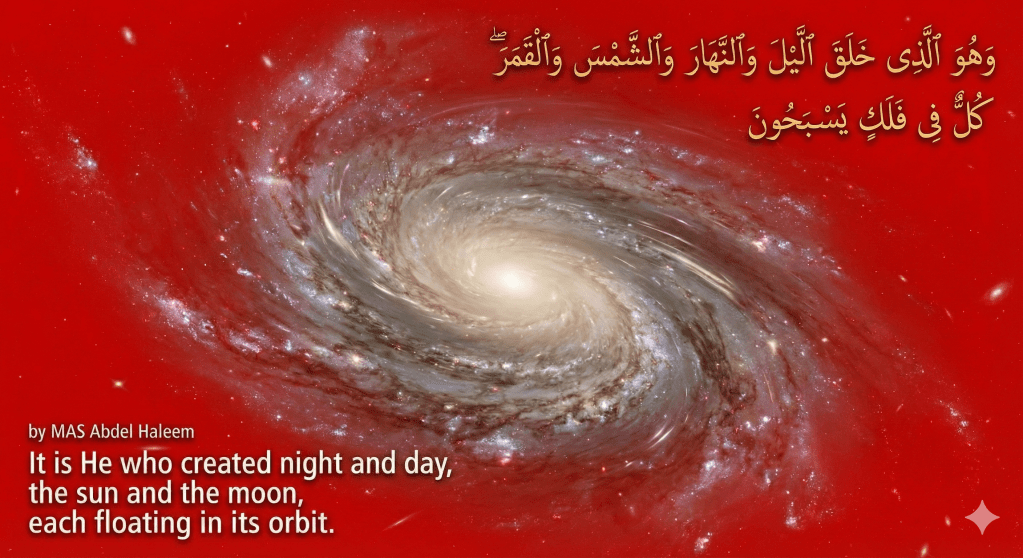
Presented by Zia H Shah MD
Abstract
The evolution of human understanding regarding the cosmos has traversed a trajectory from a static, geocentric canopy to a dynamic, expanding universe governed by complex orbital mechanics. This report provides an exhaustive analysis of the intersection between the astrophysical reality of the Milky Way’s rotation and the cosmological descriptions found in the Quran, specifically within Surah Al-Anbiya (21:33) and Surah Ya-Sin (36:40). Central to this inquiry is the Arabic phrase kullun fi falak yasbahoon (“all in an orbit are swimming”), which is examined for its linguistic precision, including the structural significance of the palindrome kullun fi falak.
Parallel to this theological exegesis, the report details the historical progression of galactic astronomy, focusing on the pivotal work of Harlow Shapley in the early 20th century. Shapley’s displacement of the solar system from the galactic center in 1918 marked a paradigm shift comparable to the Copernican revolution, setting the stage for the subsequent discoveries of galactic rotation by Bertil Lindblad and Jan Oort. The report further elucidates the astrophysical distinction between the geometric center of the galaxy—occupied by the supermassive black hole Sagittarius A*—and the gravitational center of mass (barycenter) around which the galaxy actually rotates. By synthesizing these scientific milestones with the epistemological frameworks of contemporary scholars such as Nidhal Guessoum and Ziauddin Sardar, this document proposes a nuanced reading of scripture that transcends simple concordism, advocating for a worldview where scientific discovery and spiritual reflection are mutually reinforcing.
1. Introduction: From the Static Canopy to the Cosmic Ocean
For the vast majority of human history, the night sky was perceived as a pristine, immutable dome. To the terrestrial observer, the ground was firm and stationary, while the heavens rotated overhead in a predictable, clockwork fashion. This geocentric model, codified by Ptolemy and endorsed by Aristotelian physics, posited that the celestial bodies were embedded in crystalline spheres—solid, transparent shells that rotated around the Earth. In this view, the planets and stars did not move through space; they were carried by the spheres, much like a jewel fixed in a turning ring.
This perception of a static stellar background—the “fixed stars”—persisted well into the modern era. Even as Copernicus displaced the Earth from the center of the solar system, and Kepler shattered the crystalline spheres with elliptical orbits, the sun was largely viewed as the stationary anchor of the universe, and the Milky Way was merely a hazy background of unresolved light.
The 20th century brought a violent upheaval to this quiet cosmos. The realization that the sun is merely one of billions of stars, and that it is hurtling through space at 220 kilometers per second around the center of a colossal galactic disk, fundamentally altered humanity’s sense of place. We awakened to the reality of the “Galactic Year”—the 225-250 million Earth years required for our solar system to complete one revolution around the Milky Way.
Remarkably, in the 7th century CE, amidst the prevalence of geocentric thought, the Quranic text articulated a cosmology defined by universal motion. In two specific instances, the text employs the phrase kullun fi falak yasbahoon—”all in an orbit are swimming”. This language, devoid of the concept of fixed spheres and rich with fluid dynamic imagery, presents a conceptual framework that resonates deeply with the modern understanding of a gravity-governed universe.
This report endeavors to bridge the temporal and epistemological gap between these two narratives. It serves not as a theological apologetic nor a purely technical astronomical manual, but as an interdisciplinary synthesis. It will rigorously dissect the philology of the Quranic text, trace the arduous history of the discovery of galactic rotation, and clarify the physics of the Milky Way’s center, ultimately offering a holistic view of a universe in harmonious motion.
2. The Scriptural Foundation: Philology and Exegesis
The Quranic discourse on celestial motion is not incidental; it is presented as a primary “sign” (ayah) for reflection. To understand the depth of these verses, one must move beyond surface-level translation and engage in a rigorous philological excavation of the key terms falak (orbit) and sabaha (to swim), while appreciating the structural beauty of the text itself.
2.1 The Verses of Motion
The central thesis of Quranic cosmology regarding orbital motion is encapsulated in two primary verses.
Surah Al-Anbiya (21:33)
Arabic Text:
وَهُوَ ٱلَّذِي خَلَقَ ٱلَّيۡلَ وَٱلنَّهَارَ وَٱلشَّمۡسَ وَٱلۡقَمَرَۖ كُلّٞ فِي فَلَكٖ يَسۡبَحُونَ
Transliteration:
Wa Huwal lazee khalaqal laila wannahaara washshamsa wal qamara kullun fee falakiny yasbahoon.
Translations:
- “And it is He who created the night and the day and the sun and the moon; all [heavenly bodies] in an orbit are swimming.”
- “It is He Who created the Night and the Day, and the sun and the moon: all (the celestial bodies) swim along, each in its rounded course.”
- “And He it is Who has created the night and the day, and the sun and the moon, each in an orbit floating.”
Context: This verse appears in a passage discussing the creation of the heavens and earth, refuting polytheism (shirk) by pointing to the singular order of the cosmos. It emphasizes that the alternation of night and day is a function of the created bodies (sun and moon) and their specific motions.
Surah Ya-Sin (36:40)
Arabic Text:
لَا ٱلشَّمۡسُ يَنۢبَغِي لَهَآ أَن تُدۡرِكَ ٱلۡقَمَرَ وَلَا ٱلَّيۡلُ سَابِقُ ٱلنَّهَارِۚ وَكُلّٞ فِي فَلَكٖ يَسۡبَحُونَ
Transliteration:
Lash shamsu yambaghee lahaaa an tudrikal qamara walal lailu saabiqun nahaar; wa kullun fee falaki yasbahoon.
Translations:
- “It is not allowable for the sun to reach the moon, nor does the night overtake the day, but each, in an orbit, is swimming.”
- “It is not permitted to the Sun to catch up the Moon, nor can the Night outstrip the Day: Each (just) swims along in (its own) orbit (according to Law).”
Context: Surah Ya-Sin is often called the “heart of the Quran.” This verse emphasizes the non-collision and precise timing of celestial phenomena. It establishes a law of non-interference; the sun and moon have distinct domains and trajectories that do not overlap in a chaotic manner.
2.2 The Linguistic Miracle: Kullun fi falak
One of the most striking features of these verses is the phrase kullun fi falak (“each in an orbit” or “all in an orbit”). Beyond its semantic payload, this phrase exhibits a sophisticated linguistic structure known as a palindrome, where the sequence of letters reads identically forward and backward.
2.2.1 Structural Analysis of the Palindrome
The phrase in Arabic is written as: كُلٌّ فِي فَلَكٍ
When analyzed by its consonantal skeleton (rasm), excluding diacritical marks (which were formalized later but do not alter the consonantal symmetry), the letters are:
Kaf (ك) – Lam (ل) – Fa (ف) – Ya (ي) – Fa (ف) – Lam (ل) – Kaf (ك)
This symmetry is not merely ornamental; it is structurally significant. The letter Ya (ي) serves as the central pivot. The letters radiating outward from this center mirror each other perfectly.
Table 1: Palindromic Symmetry of Kullun fi falak
| Direction | Letter 1 | Letter 2 | Letter 3 | Pivot | Letter 3 | Letter 2 | Letter 1 |
| Right to Left (Arabic) | ك (K) | ل (L) | ف (F) | ي (Y) | ف (F) | ل (L) | ك (K) |
| Left to Right (Transliteration) | K | L | F | Y | F | L | K |
2.2.2 Semiotics of the Structure
Scholars and artists have interpreted this palindrome as a form of iconic syntax—where the form of the text mirrors its meaning.
- The Pivot as Center: The central Ya can be seen as representing the center of the orbit—be it the Earth (for the Moon), the Sun (for the planets), or the Galactic Center (for the Sun). The other letters “orbit” this central point in a balanced, symmetrical fashion.
- Infinite Loop: A palindrome can be read forwards and backwards indefinitely, mimicking the continuous, cyclical nature of an orbit that has no beginning or end point in its geometric form.
- Artist Interpretation: Contemporary artist Dana Awartani produced a kinetic sculpture based on this phrase. She visualized the letters Kaf, Lam, and Fa encircling the pivoting letter Ya, noting that the letters themselves seem to be “swimming” in their own orbits around the linguistic center. This highlights how the Quranic language encodes the concept of orbital dynamics into the very orthography of the revelation.
2.3 Philological Analysis of Yasbahoon (Swimming)
The choice of the verb yasbahoon to describe celestial motion is perhaps the most scientifically significant linguistic feature of these verses.
2.3.1 Etymology of Sabaha
The verb yasbahoon is the plural imperfect form of the root S-B-H (seen-ba-ha). In classical Arabic lexicons like Lisan al-Arab, the root meaning is “to swim” or “to float” within a medium.
- Terrestrial Usage: It is used to describe a person swimming in water (sabaha fil-ma) or a bird gliding through the air.
- Distinction from Jariya: The Quran uses another verb, jariya (to run/flow), for the sun in Surah Ya-Sin (38: wash-shamsu tajree – “and the sun runs”). However, yasbahoon is used for the collective motion of all bodies.
- Distinction from Darana: The modern Arabic word for rotation or revolution is often derived from dara. The Quran avoids this purely geometric term in favor of sabaha, which implies a physical interaction with a medium or a specific mode of travel.
2.3.2 Implications of Self-Propelled Motion
Linguists and exegetes have noted three key implications of the word yasbahoon:
- Detachmenet: To swim, a body must be immersed in a medium but distinct from it. This contradicts the Aristotelian view where planets were fixed parts of solid spheres. If a planet is embedded in a crystal sphere, it cannot “swim”; it merely rotates with the sphere. Sabaha implies the body is detached and moving through space.
- Self-Propulsion: Swimming implies an internal agency or motive force. A log floats, but a swimmer swims. This linguistic nuance personifies the celestial bodies (reinforced by the use of the masculine plural suffix -oon, usually reserved for rational beings), suggesting they are actively fulfilling a divine command to move. In a physical sense, this aligns with the concept of inertia and momentum—the body possesses the energy of motion itself.
- Smoothness and Grace: Swimming suggests a smooth, unimpeded motion, free from the friction of dragging or the erratic nature of walking on uneven ground. This perfectly characterizes the frictionless vacuum of space where celestial bodies glide along gravitational geodesics.
2.3.3 Classical vs. Modern Exegesis
- Classical View (Tabari, Ibn Kathir, Razi): Early commentators struggled to reconcile yasbahoon with the Ptolemaic astronomy of their time. Some, like Al-Qurtubi, suggested the “orbit” (falak) was like a spinning millstone. However, the use of yasbahoon led many to correctly deduce that the planets were floating in a “wave” or fluid of the heavens, rather than fixed in hard shells. Ibn Abbas is reported to have said they swim “like a fish in water” or “like a spinning whorl,” intuiting the rotational aspect.
- Modern View: Contemporary exegetes see yasbahoon as a startlingly accurate description of motion in space. Space is not “empty” in the absolute sense but is a medium (spacetime) through which bodies move. The “swimming” metaphor captures the dual motion of rotation on an axis and revolution around a center, much like a swimmer rotates their body to propel themselves forward.
3. The Great Unveiling: The History of Galactic Astronomy
While the Quran provided the theological and linguistic framework for a universe in motion, the scientific realization that our own galaxy—the Milky Way—is a rotating entity was a hard-won discovery of the 20th century. This realization required dismantling the long-held belief that the Sun was the center of the universe.
3.1 The Kapteyn Universe (Pre-1918)
At the turn of the 20th century, the prevailing model of the cosmos was the “Kapteyn Universe,” named after the Dutch astronomer Jacobus Kapteyn. Based on rigorous star counts (gauging), Kapteyn concluded that the Milky Way was a lens-shaped island of stars, approximately 10 kiloparsecs (roughly 30,000 light-years) in diameter and 2 kiloparsecs thick.
Crucially, Kapteyn’s data placed the Sun very close to the center of this system. This was an illusion caused by interstellar extinction. Dust and gas in the galactic plane absorbed the light of distant stars, making it appear that the density of stars thinned out equally in all directions from the Earth. Humanity was trapped in a “fog,” believing the limits of our vision were the limits of the universe.
In this model, the motions of stars were seen as random “peculiar velocities” (like a swarm of gnats) rather than organized rotation. The Milky Way was viewed as a static container.
3.2 Harlow Shapley and the Galactocentric Revolution (1918)
The dismantling of the heliocentric galaxy began with American astronomer Harlow Shapley. In 1914, Shapley arrived at the Mount Wilson Observatory in California, armed with the 60-inch reflector telescope—the largest in the world at the time.
3.2.1 The Globular Cluster Beacons
Shapley turned his telescope away from the dusty galactic plane and toward globular clusters—dense, spherical swarms of hundreds of thousands of older stars that orbit in the galactic halo. Because these clusters lie above and below the galactic disk, they are visible over vast distances, unobscured by the dust that blinded Kapteyn.
Shapley noticed a profound asymmetry: globular clusters were not distributed evenly across the sky. Instead, they were heavily concentrated in the direction of the constellation Sagittarius.
3.2.2 Leavitt’s Law and the “Big Galaxy”
To measure the distance to these clusters, Shapley utilized a revolutionary tool discovered by Henrietta Swan Leavitt at Harvard: the Period-Luminosity relationship of Cepheid variable stars (and later RR Lyrae stars). By measuring how quickly these stars pulsed, Shapley could determine their true intrinsic brightness. Comparing this to how bright they appeared gave him their exact distance.
In a series of landmark papers published in 1918, Shapley presented his “Big Galaxy” model:
- The Size: He calculated the galaxy was enormous—300,000 light-years in diameter (an overestimate due to ignoring dust, but correct in order of magnitude compared to Kapteyn’s 30,000).
- The Center: He proved that the globular clusters were orbiting a common center of gravity located tens of thousands of light-years away in Sagittarius.
- The Sun’s Demotion: Consequently, the solar system was not at the center. We were residents of the galactic suburbs, roughly 50,000 light-years (later refined to ~26,000) from the core.
This was the “Second Copernican Revolution.” Just as Copernicus moved the Earth from the center, Shapley moved the Sun.
3.3 The Discovery of Rotation: Lindblad and Oort
Shapley established the size and the center of the galaxy, but he viewed it largely as a static framework. The mechanics of how this massive system prevented collapse were not immediately solved. If the galaxy was a static cloud, gravity should pull everything into the center.
3.3.1 Bertil Lindblad’s Differential Rotation (1926)
Swedish astronomer Bertil Lindblad proposed the solution: Rotation. He theorized that the galaxy must be rotating to generate the centrifugal force necessary to balance gravity. However, he argued it did not rotate like a solid disk (like a CD). Instead, it exhibited differential rotation: stars at different distances from the center orbited at different speeds.
Lindblad also explained the “star streaming” phenomenon (observed by Kapteyn) not as two rivers of stars passing through each other, but as the natural consequence of stars moving in elliptical orbits within this rotating disk.
3.3.2 Jan Oort’s Confirmation (1927)
The definitive proof came from Dutch astronomer Jan Oort (a student of Kapteyn). In 1927, Oort analyzed the motions of stars near the Sun and derived the famous Oort Constants (A and B). These mathematical values quantified the shear (slippage) and vorticity (spin) of the galactic disk.
Oort’s calculations confirmed:
- The Milky Way is rotating.
- The Sun orbits the center at a tremendous speed (calculated then at ~300 km/s, now refined to ~220 km/s).
- The period of the Sun’s orbit is approximately 225 million years.
Thus, the scientific community confirmed what the Quranic text had alluded to centuries prior: the Sun was indeed swimming (yasbahoon) in a vast orbit (falak) around a distant center.
4. Astrophysics of the Milky Way: The Mechanics of the Orbit
With the rotation of the galaxy established, modern astrophysics has refined our understanding of what the Sun orbits and how it moves. This section clarifies misconceptions regarding the central object and details the complex dynamics of the solar trajectory.
4.1 The Myth of the Central Anchor: Center of Mass vs. Sagittarius A*
A common simplification in popular science is that the Milky Way orbits the supermassive black hole, Sagittarius A* (Sgr A*). While Sgr A* lies at the geometric center of the galaxy, it is not the gravitational anchor in the same way the Sun is for the Earth.
4.1.1 The Mass Discrepancy
- The Solar System: The Sun contains 99.8% of the total mass of the Solar System. Therefore, the planets orbit the Sun (or strictly, the barycenter located just inside or near the Sun). The Sun is the gravity well.
- The Galaxy: The mass of Sagittarius A* is approximately 4.3 million solar masses ($4.3 \times 10^6 M_\odot$).
- The total mass of the Milky Way (including Dark Matter) is estimated between 800 billion and 1.5 trillion solar masses ($10^{12} M_\odot$).
Conclusion: Sgr A* represents less than 0.0005% of the galaxy’s mass. If Sgr A* were magically removed, the Sun’s orbit would barely change.
4.1.2 The Barycenter
The Sun and other stars orbit the Galactic Center of Mass (Barycenter). This is the collective center of gravity formed by the billions of stars, vast clouds of gas, and the immense halo of Dark Matter. Sgr A* sits at this location because it has sunk to the bottom of the gravitational potential well, acting as a “marker” or a “queen bee” in a swarm, but it does not hold the galaxy together by itself.
Table 2: Gravitational Anchors Comparison
| System | Anchor Object | Mass Ratio (Anchor/Total) | Orbital Dynamic |
| Solar System | Sun | ~99.8% | Keplerian (Planets dominated by Sun) |
| Milky Way | Center of Mass (Barycenter) | Sgr A* is < 0.001% | Potential Well (Stars dominated by collective mass) |
4.2 Dark Matter and the Rotation Curve
The “orbit” (falak) of the Sun is dictated largely by invisible forces. When astronomers (starting with Vera Rubin, building on Oort’s work) measured the rotation speeds of outer stars, they expected speeds to drop off with distance (Keplerian decline). Instead, the rotation curve remained flat.
This implies that the visible galaxy is embedded in a massive Dark Matter Halo. The Quranic description of the heavens as “raised high” and “constructed with power” (51:47) and a “protected ceiling” (21:32) resonates with this modern view of a galaxy held together by an invisible, massive scaffold that prevents the “swimming” stars from flying off into the intergalactic void.
4.3 The Solar “Swim”: Apex and Oscillation
The verb yasbahoon (swimming) captures the nuance of the Sun’s motion with startling accuracy. The Sun does not move in a flat, 2D circle like a drawing on a page. Its motion is three-dimensional and fluid-like.
- Vertical Oscillation (The Bob): As the Sun orbits the center, it oscillates up and down through the galactic plane, much like a horse on a carousel or a swimmer bobbing in waves. The Sun crosses the galactic plane roughly every 30-35 million years, with a full vertical cycle of ~60 million years.
- The Solar Apex: The Sun has a “peculiar velocity” relative to the average motion of its neighbors (the Local Standard of Rest). It is moving towards a point in the constellation Hercules called the Solar Apex at about 13.4 km/s.
Combining these motions—the rapid orbital velocity (220 km/s), the vertical bobbing, and the drift toward the apex—the Sun’s true path through the universe is a complex, helical trajectory. It is literally “swimming” through the gravitational waves of the galactic disk.
5. Synthesis: Epistemology of Science and Scripture
The correspondence between the Quranic kullun fi falak and the astrophysical reality of galactic rotation invites deep reflection. However, the method of correlating scripture with science requires careful epistemological framing to avoid the pitfalls of “scientific miracles” (I’jaz) which risk reducing eternal scripture to transient scientific theories.
5.1 Beyond Concordism: The Approaches of Sardar and Guessoum
Ziauddin Sardar’s Critique: Prominent intellectual Ziauddin Sardar cautions against reading the Quran as a textbook of science. He argues that science is a human endeavor, subject to revision and paradigm shifts (e.g., from Newton to Einstein). If one ties a Quranic verse to a specific scientific theory, and that theory is later disproven, the scripture is inadvertently falsified. For Sardar, the Quran promotes a “framework of values”—encouraging tafakkur (reflection) and ilm (knowledge)—rather than providing data points. The mention of orbits is an invitation to explore, not a replacement for astrophysics.
Nidhal Guessoum’s Harmonization: Astrophysicist Nidhal Guessoum proposes a “harmonious” approach, termed “Theistic Science.” He rejects the “grocery list” approach of finding every modern invention in the text but acknowledges that the Quranic description of nature is consistently “world-affirming.” He notes that the Quran avoids the mythological errors of its time (e.g., the sun resting in a muddy spring as a literal location, or the sky being a solid object). Instead, terms like yasbahoon are phenomenological descriptions that remain true across eras: accurate to the 7th-century nomad observing the smooth motion of the moon, and profound to the 21st-century astronomer measuring the galactic orbit.
5.2 The “Signs” (Ayat) Approach
The most robust synthesis views these verses as Ayat (signs). A sign points to something beyond itself. The orbital motion of the sun and moon is cited in the Quran not to teach astronomy, but to demonstrate Order (Nizam) and Precision (Taqdeer).
- “The sun and the moon [move] by precise calculation.” (Surah Ar-Rahman 55:5).
- The palindrome kullun fi falak serves as a linguistic sign of this order—a sentence that loops upon itself, mirroring the physical loops of the orbits it describes.
This approach validates the scientific method as the tool to uncover the details of the “how,” while the scripture provides the “why.” Shapley, Oort, and Lindblad uncovered the mechanics of the falak; the Quran asserts the Agent behind the motion.
6. Epilogue: The Cosmic Palindrome
The journey from the desert of 7th-century Arabia to the high-altitude observatories of the 20th century reveals a remarkable convergence. The Quranic injunction to observe the heavens was ultimately answered by astronomers like Shapley and Oort, who peeled back the layers of the Milky Way to reveal a system in constant, rhythmic motion.
The phrase kullun fi falak stands as a palindrome not just in letters, but in concept—a symmetry of meaning that reads the same in the macroscopic galaxy as it does in the microscopic atom. The center pivot of the palindrome, the letter Ya, acts like the galactic center of mass—an invisible anchor around which the structure mirrors itself.
Reading the Quran in light of the best science does not require forcing ancient words into modern equations, but rather appreciating the expansive capacity of the text. When the Quran says “All swim in an orbit,” it invites the believer to look up and see not a static roof, but a dynamic ocean of stars, where the Sun, the Earth, and the Milky Way itself participate in a grand, cosmic tawaf (circumambulation) around the center of creation.
In the words of the Quran: “And We have made the sky a well-protected canopy, still they turn away from its signs.” (21:32). Modern astronomy, by revealing the rotation of the galaxy, allows humanity to stop turning away and finally see the “signs” in their full, majestic motion.
Data Appendices
Table 3: Chronology of Galactic Discovery
| Year | Scientist | Contribution | Impact on Worldview |
| c. 150 | Ptolemy | Geocentric Model | Static spheres; Earth at center. |
| c. 650 | Quran | “Kullun fi falak yasbahoon” | Asserts universal orbital motion and “swimming” dynamics. |
| 1900 | Kapteyn | Star Gauging | “Kapteyn Universe”: Small galaxy, Sun near center. |
| 1918 | Shapley | Globular Clusters / Cepheids | “Big Galaxy”: Sun moved to suburbs; Center in Sagittarius. |
| 1926 | Lindblad | Differential Rotation | Theorized galaxy rotates to balance gravity. |
| 1927 | Oort | Oort Constants | Confirmed galactic rotation; calculated Sun’s orbital speed. |
| 1951 | Ewen/Purcell | 21cm Hydrogen Line | Mapped the spiral arms; confirmed structure. |
Table 4: Quranic Vocabulary of Motion
| Arabic Term | Literal Meaning | Contextual Implication | Scientific Parallel |
| Falak (فَلَكٍ) | Whorl of a spindle / Rounded course | Orbital path | Orbit / Trajectory |
| Yasbahoon (يَسۡبَحُونَ) | They swim | Self-propelled, smooth motion | Rotation + Revolution / Inertial Motion |
| Jariya (جري) | Flow / Run | Continuous course | Solar Apex motion |


 The Glorious Quran and Science
Leave a comment