
Presented by Zia H Shah MD
Abstract
The Quran remarkably alludes to the orbital motion of celestial bodies, a concept only fully understood by science in the last century. In particular, a Quranic phrase meaning “all [heavenly bodies] are swimming in an orbit” appears twice (21:33, 36:40), suggesting a universal principle of orbital motion. This essay explores the profound alignment between these 1400-year-old verses and modern astronomical discoveries. We begin by examining the verses in Arabic – including their palindrome structure – and their translations, highlighting linguistic nuances that mirror the cyclic nature of orbits. We then trace the historical discovery of celestial orbits beyond the Earth-Sun system: from early 20th-century realization that our Milky Way Galaxy is a rotating disk to contemporary understanding of galactic dynamics. Key scientific milestones – Harlow Shapley’s 1918 finding of the Galaxy’s center in Sagittarius, the 1920s evidence of the Milky Way’s differential rotation, and mid-20th-century radioastronomy mapping of our galaxy’s spiral arms – are discussed with supporting citations. We also clarify why the Milky Way orbits its center of mass rather than just its central black hole, underscoring that the black hole’s mass (~4 million suns) is negligible on a galactic scale. Throughout, we draw connections between the Quranic narrative and scientific facts, arguing persuasively that reading the Quran in the light of the best available science enriches our understanding. In conclusion, we reflect on how this harmony between scripture and science encourages a continually expanding interpretation of the Quran – much like the ever-expanding universe itself.
Introduction
We live in an age where the motions of heavenly bodies are well-documented and understood. Most educated people know that the Earth orbits the Sun and the Moon orbits the Earth. Many are also aware that other planets have moons and that those moons circle their planets. Yet it comes as a surprise to many that our entire Milky Way Galaxy is rotating – all its billions of stars (including our Sun) orbit around the Galaxy’s center. This galactic rotation is a fact uncovered by astronomers only in the last century. Imagine the enormity: just as the Earth makes a yearly loop around the Sun, the Sun itself, along with our whole solar system, is hurtling around the center of the Milky Way in a giant orbit taking roughly 200–250 million years to complete.
What is truly fascinating for Muslim thinkers is that the Quran – Islam’s holy book – hinted at the orbital nature of celestial bodies over 1400 years ago. In an era when scientific knowledge was limited to naked-eye observations and when many still believed in an Earth-centered cosmos, the Quran articulated a view of sun, moon, and other heavenly bodies all moving in defined paths. Two verses in particular stand out, each containing the phrase “كُلٌّ فِي فَلَكٍ يَسْبَحُونَ” (pronounced kullun fī falak), which translates to “each one is swimming in an orbit.” These verses not only speak of the Sun and Moon’s motion, but by saying “each” or “all” in orbit, they imply a universal principle encompassing all celestial bodies.
In the sections that follow, we will:
- Present the two Quranic verses (21:33 and 36:40) in Arabic along with their English translation, to appreciate the exact wording.
- Discuss the linguistic and literary significance of the phrase “kullun fī falak,” including a remarkable palindrome feature and its meaning of cyclical motion.
- Explore the scientific meaning of these verses: how they align with what we know today about orbits – from planets and moons up to stars orbiting the galactic center.
- Provide a historical overview of how modern science discovered the Milky Way’s rotation and the structure of our galaxy, detailing key milestones from the early 20th century.
- Clarify a common question: Do we orbit the Galaxy’s central black hole? We will explain that while a supermassive black hole lies at the Milky Way’s core, the galaxy’s rotation is around its collective center of mass rather than exclusively around the black hole – an important distinction that the Quran’s general phrasing (“all swim in orbit”) can accommodate.
- Finally, in a concluding epilogue, reflect on the broader implications: how reading the Quran in the light of modern science can continuously expand our understanding, analogous to the expanding universe.
This journey will show that the Quran’s description of celestial motions, far from being out of date, resonates strongly with contemporary astronomy. For an educated Muslim audience, such alignment offers a persuasive reminder that science and scripture need not be at odds – in fact, scientific discoveries can unveil deeper layers of meaning in the Quran. As we proceed, all key points will be supported by references from both the Quran and scientific literature, underscoring a harmonious convergence of faith and science.
Quranic Verses on Celestial Orbits
The Quran explicitly mentions the orbital motion of celestial bodies in at least two verses. Let us look at these verses in the original Arabic text and their English translation:
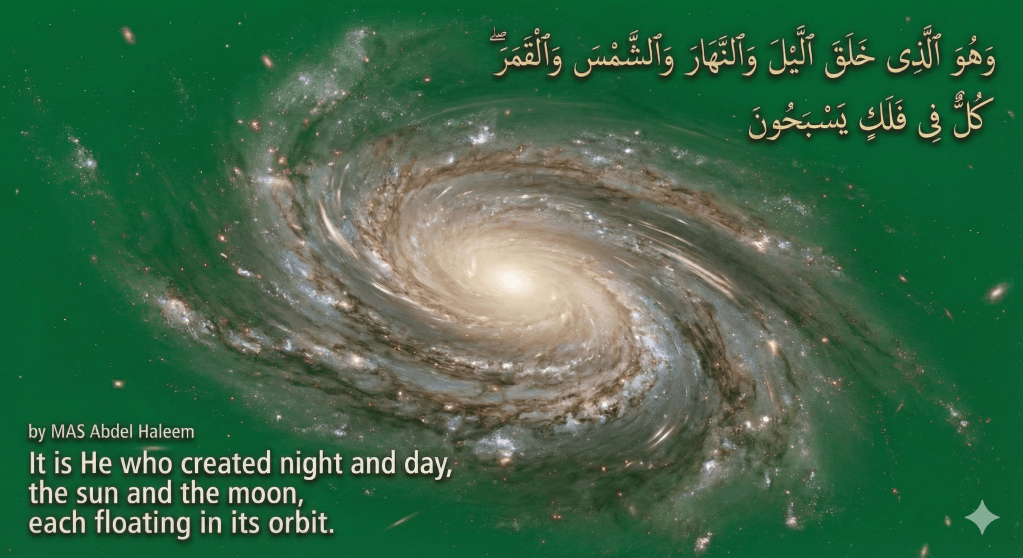
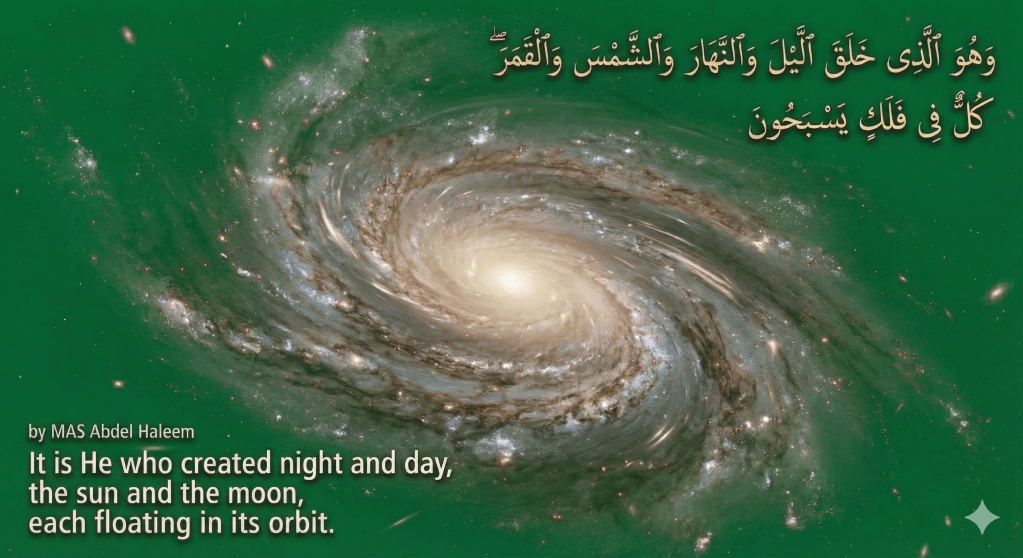
- Surah Al-Anbiya (21:33) – Arabic: وَهُوَ الَّذِي خَلَقَ اللَّيْلَ وَالنَّهَارَ وَالشَّمْسَ وَالْقَمَرَ ۖ كُلٌّ فِي فَلَكٍ يَسْبَحُونَ
Translation: “And it is He who created the night and the day and the sun and the moon; all [heavenly bodies] are swimming in an orbit.” - Surah Ya-Sin (36:40) – Arabic: لَا الشَّمْسُ يَنْبَغِي لَهَا أَنْ تُدْرِكَ الْقَمَرَ وَلَا اللَّيْلُ سَابِقُ النَّهَارِ ۚ وَكُلٌّ فِي فَلَكٍ يَسْبَحُونَ
Translation: “It is not for the sun to overtake the moon, nor does the night outstrip the day. They all float, each in an orbit.”
In these verses, the Quran makes several notable points. In 21:33, after mentioning the creation of night and day (a reference to Earth’s cycle of rotation) and the sun and the moon, it states “kullun fī falak yasbaḥūn” – “each of them is swimming in a falak (orbit)”. Similarly, 36:40 emphasizes an orderly separation of the sun’s path and the moon’s path, and concludes with the same phrase “each in an orbit, floating”. The choice of words paints a vivid picture of celestial bodies moving smoothly and continuously in defined paths, much like swimmers gliding through water.
It is important to note that the Quran does not explicitly spell out the center of these orbits in these verses (for example, it does not say “around the Earth” or “around the Galaxy”). Rather, it leaves the statement general: all of them in orbits, which is remarkably all-encompassing. As we shall see, this general phrasing allows the verse to be valid on multiple levels – from the apparent motion of sun and moon as seen from Earth, to the Earth’s actual orbit around the sun, and even further to the sun’s orbit around the center of the Milky Way. First, however, let us delve into some fascinating linguistic aspects of the phrase used in these verses.
Linguistic and Scientific Significance of “Kullun fī Falak”
A Palindrome Reflecting Cycles
One striking linguistic feature lies in the Arabic phrase “كُلٌّ فِي فَلَكٍ” (kullun fī falak), translated as “each (or all) in an orbit”. In the original Arabic, this sequence of letters is a perfect palindrome – it reads the same forward and backward. In other words, if you remove the spaces and diacritical marks, kullun fī falak is spelled identically from right-to-left and left-to-right. This is an incredibly elegant literary touch: the form of the phrase itself is cyclic, mirroring the very concept of an orbit which is a cycle or closed loop. As one commentator puts it, “The Arabic phrase for orbit used here is ‘kullun fī falak’ – and guess what? It’s a palindrome! The word reads the same forwards and backwards, just like the orbits it’s describing.”. This symmetry in wording symbolically reinforces the idea of a repetitive, circular motion – much like celestial objects tracing the same path over and over.
Such literary craftsmanship in the Quran often serves to draw the attentive reader’s reflection. The palindrome here is not obvious in translation, but in Arabic it would catch the ear, hinting at a cyclical nature in the meaning. The orbit of a planet or star is indeed like a palindrome in space – a path that brings the object around to where it started, repeating the cycle. This subtlety may have been intended to make the verse more memorable and evocative to early listeners, even if they did not know the full scientific implications.
*“Swimming” in an Orbit – Dynamics implied
The Quranic verses use the verb “يَسْبَحُونَ” (yasbaḥūn), which literally means “they swim”. This choice of word conveys an image of smooth, continuous motion. It suggests that these bodies are not stationary; rather they move with ease in a designated path, just as a swimmer cuts through water without sinking. In classical Arabic, yasbaḥūn can imply gliding motion or floating freely – an apt description of how planets and stars travel through the vacuum of space. The noun “falak” (orbit) itself in Arabic can refer to a rounded course or the celestial sphere. Thus, the phrase “swimming in an orbit” beautifully captures the notion of free-floating bodies traveling their circuit in space. It is as if the sky is an ocean and the stars, sun, and moon are swimmers each in their lane – a poetic depiction that aligns with what we know about orbital mechanics (each object following its own path, governed by gravity).
Moreover, the term yasbaḥūn (swimming) subtly implies not just movement along a path but also, potentially, rotation within itself. Arabic lexicons note that this root (س ب ح) can encompass the meaning of spinning motion in addition to forward motion. While the primary point of the verse is orbital motion, it is interesting that the wording can even hint at axial rotation (“spinning”) – for instance, the Earth’s rotation causing day and night, or the sun’s rotation around its axis roughly every 25 days. Whether or not one reads that much into the term, at minimum the Quran’s language leaves no doubt that motion is intended: the sun, moon, and by extension other celestial entities, are not static lamps stuck in a solid firmament; they are moving, living participants in the cosmos.
“Each” in an Orbit – inclusivity of all celestial bodies
Notice the Quran says “kullun” meaning “each” or “all of them” are in orbits. In 36:40, after mentioning sun and moon and the concepts of day and night, it says “وَكُلٌّ فِي فَلَكٍ يَسْبَحُونَ” – and each of them is floating in an orbit. Interestingly, Arabic grammar has a dual form for two items, and a plural for three or more. One might expect, if only the sun and moon were intended, a dual form or a pronoun referring to “both”. Instead, the Quran uses “kullun” (each, all) without specifying a dual, which implies more than two objects are involved. Classical commentators picked up on this point. The verse had mentioned night and day along with sun and moon. Some scholars interpret that night and day here are also signs of cosmic motion – essentially referencing the Earth’s rotation, since the alternation of night and day is caused by the Earth spinning on its axis. Thus, as one analysis explains, the use of “kullun” (all) instead of “both” subtly indicates that not only the sun and moon, but also the Earth (which causes night and day) are in motion. In other words, three (or more) bodies are implied: the sun, the moon, and the Earth.
This interpretation is remarkably in line with modern science: the sun is not static, the moon isn’t static, and indeed the Earth itself rotates and revolves. In the 7th century, people did not know that the Earth moves (it was generally assumed to be stationary with everything else moving around it). Yet, the Quran’s phrasing is such that it encompasses the motion of “all” these celestial phenomena, without tying the statement to an outdated worldview. This point was highlighted by modern scholars as a subtle miracle of wording: by not saying “both of them (sun and moon) are in orbit”, the Quran left open the inclusion of other celestial bodies in this rule, and only now do we realize that Earth itself and indeed all heavenly bodies are moving in space.
Whether one takes this as a deliberate scientific hint or simply a broad poetic expression, the result is that the Quranic statement is universal: every celestial body is moving along an orbit. There are no exceptions stated. This generality stands in stark contrast to the classical idea of fixed stars on a firmament or an immobile Earth. It’s a statement that has aged well with time; as our scientific understanding grows, we keep finding that indeed nothing in the heavens is truly at rest – from the smallest asteroid to the largest galaxy, motion is the norm.
To summarize the Quran’s position: the sun, the moon, the Earth (by implication), and “all” celestial entities swim through space in defined paths. With this understanding of the verses, we now turn to the historical development of the scientific knowledge that mirrors this insight. How did humanity come to learn that, for example, the sun is not fixed in one place? What do we know today about the sun’s orbit and the grand rotation of the Milky Way that the Quran’s words so intriguingly align with? The next sections will chronicle the key scientific milestones that unfolded over the past century, leading to our modern picture of a dynamic, ever-orbiting universe.
The Discovery of Galactic Rotation – A Historical Perspective
Early Views: From Geocentrism to a Moving Earth and Sun
For much of human history, the structure of the cosmos was poorly understood. The ancient Greek model (adopted later by Ptolemy) was geocentric, placing Earth at the center of the universe with the sun, moon, planets, and stars embedded in concentric crystalline spheres revolving around it. In that model, indeed the sun had an “orbit” (a daily journey around Earth), and the moon its own orbit, but the stars were thought to be fixed on a celestial sphere. The Quranic proclamation that “all” are in orbit goes beyond what this ancient model held – it implies no distinction between planets and stars: everything is moving.
It wasn’t until Nicolaus Copernicus in the 16th century (900 years after the Quran) that a major shift happened: the heliocentric model proposed the sun at the center of the solar system with Earth and other planets orbiting it. Even then, the sun itself was assumed to be stationary. The idea that the sun might move was not seriously considered in Copernicus’ time. Over the next few centuries, evidence mounted that Earth rotates on its axis and orbits the sun, completing the Copernican revolution. By the 18th century, astronomers like Edmund Halley and William Herschel observed that the stars themselves showed motions relative to each other – hinting that our sun was drifting through space. In 1783, Herschel even identified a specific direction of the Sun’s motion (toward the constellation Hercules), discovering the solar apex. This was the first clue that our sun is not stationary in the galaxy but is moving relative to nearby stars.
However, knowing the sun moves is different from understanding the grand scheme of the Milky Way’s structure. Throughout the 19th century, many still imagined our galaxy as a relatively static collection of stars, perhaps with the sun near the center. It was generally thought that the Milky Way was the entirety of the universe – an “island universe” of stars – and the idea of it rotating as a whole was speculative at best. Some astronomers in the late 1800s did begin to suspect patterns of star motions. (For instance, in 1897, astronomer Jacobus Kapteyn noted star streaming motions, a hint of galactic rotation.) But the data and understanding were limited. The major breakthroughs would come in the early 20th century with better telescopes and new methods.
Shapley’s Revelation (1918–1920): The Galactic Center and Size
A pivotal figure in uncovering the Milky Way’s structure was Harlow Shapley, an American astronomer. In 1918, Shapley published results of his study of globular clusters – dense spherical clusters of stars – which were scattered across the sky. By measuring distances to these clusters using variable stars as “standard candles,” Shapley mapped their distribution. What he found shocked the astronomical community. The globular clusters were not centered around the Earth or the sun; instead, they appeared to center around a point in the constellation Sagittarius, thousands of light-years away from us. Shapley concluded that this point was the true center of the Milky Way Galaxy, and that the galaxy was immense – far larger than previously thought. In Shapley’s estimate, the Milky Way spanned about 300,000 light years and the sun lay roughly 50,000 light years from the galactic center (we now know the galaxy is smaller, about 100,000 light years across, and the sun is about 26,000 light years from the center, but Shapley’s order of magnitude was dead right that the sun is nowhere near the center).
This discovery was revolutionary. As Shapley later recalled, “It was a shocking thought — this sudden realization that the center of our universe was not where we stood but far off in space”. Humanity learned that our solar system occupies a decidedly off-center position in a galaxy much larger than imagined. The implication was that the Milky Way had a structure and likely a center of mass around which things could revolve. Shapley himself considered the possibility that the globular clusters might be orbiting the galactic center. In fact, he described the Milky Way in terms of “a strange sort of eccentric universe” with our sun far from the hub. Although Shapley did not directly prove the galaxy’s rotation, his work set the stage by finding the galactic center and demolishing the notion of Earth (or even the sun) as the universe’s hub.
Around the same time, another debate was raging: what are the spiral nebulae observed in the sky (like the Andromeda Nebula)? Are they clouds within our galaxy or separate “island universes” (galaxies) of their own? This culminated in the famous Great Debate of 1920 between Harlow Shapley and Heber Curtis. Shapley argued that the Milky Way was enormous and contained everything (he was wrong on that point), whereas Curtis argued that some nebulae were outside the Milky Way (which turned out to be correct). In the aftermath, by 1924, Edwin Hubble’s observations settled it – he discovered Cepheid variable stars in the Andromeda “Nebula” and proved that Andromeda was far outside our Milky Way, an entirely separate galaxy. Thus, humanity’s perspective expanded: the Milky Way was just one of many galaxies in a much larger universe. But importantly, if other galaxies were seen to have spiral structures, could our Milky Way have a spiral structure too? And if so, might it be rotating?
Evidence of the Milky Way’s Rotation (1920s)
Building on Shapley’s map of the galaxy and the idea that our galaxy might be similar to other spirals, astronomers in the 1920s sought to detect rotation of the Milky Way. A Swedish astronomer, Bertil Lindblad, theorized in 1925 that the Milky Way was rotating and that the stars closer to the center would orbit faster than those farther out – a condition called differential rotation. This was a bold proposal at the time, extending the laws of orbital motion (well known for planets) to the entire galaxy.
The definitive proof came from the Dutch astronomer Jan Hendrik Oort. In 1927, Oort analyzed the motions of hundreds of stars in our part of the galaxy. He found a telltale pattern in their velocities: stars in one direction of the sky were approaching us while in the opposite direction they were receding, with a smooth variation in between. From these patterns, Oort concluded that this could only be explained if the stars, including the sun, were orbiting around the galactic center, and at different rates depending on their distance. He provided quantitative evidence of the Milky Way’s differential rotation. Essentially, Oort confirmed Lindblad’s model and showed that our Milky Way is indeed a rotating spiral galaxy. This finding was momentous: our galaxy, which we experience from the inside as a luminous band of stars (the Milky Way in the night sky), is in fact a vast disk-shaped system that spins like a giant whirlpool.
Oort’s work also pinpointed that the galactic center lies in the direction of Sagittarius, corroborating Shapley’s earlier result. By the late 1920s, astronomers understood that:
- The Milky Way is a disk galaxy (a spiral in structure), not an amorphous cloud of stars.
- The Sun is located in the disk, well away from the center (roughly halfway out or more).
- The entire disk of the galaxy is rotating around the center. The stars execute orbits around the galactic nucleus, much as planets orbit the sun, but with more complex behavior since the mass is spread out.
- The rotation is differential – meaning inner parts rotate faster (in terms of completing a revolution) than outer parts. This is why spiral arms tend to develop and also why the concept of a single period for galactic rotation is relative (stars at different radii have different periods).
By establishing galactic rotation, scientists had, in effect, extended the concept of “orbit” to a whole new level. No longer was orbiting just for planets around stars; now stars themselves were orbiting around a galactic core. It is a grand confirmation of the Quran’s statement “all heavenly bodies are in orbit.” One could say, poetically, that just as the moon orbits the Earth and the Earth orbits the sun, so the sun orbits the center of the Milky Way. The Quranic phrase does not specify scale – and indeed, modern astronomy shows orbits at every scale: moons, planets, stars, even galaxies orbiting within clusters of galaxies.
To get a sense of the numbers: based on Oort’s and subsequent measurements, our Sun orbits the Milky Way center at a speed of about 220 km/s (kilometers per second). At this speed, it takes roughly 230 million years to complete one galactic orbit. Astronomers sometimes call this a “Galactic year.” So, since the Sun’s formation about 4.6 billion years ago, it may have orbited the galaxy on the order of 20 times. These figures were refined throughout the 20th century, but they match astonishingly well with the scale suggested by the Quranic emphasis that the sun is moving on a path with its own timing (an “appointed term” as another Quranic verse (39:5) says). Of course, 230 million years is far beyond any human timescale, which perhaps explains why this motion wasn’t known or felt historically – yet the Quran’s wording encompasses it by simply stating the fact of the orbit without trying to quantify it.
Mapping the Milky Way’s Rotation Curve (1950s and beyond)
While Oort’s analysis proved that the Milky Way rotates, it was based on nearby stars (within a few thousand light years). The next leap in understanding came with the advent of radio astronomy. Visible light cannot penetrate the dense dust clouds toward the galactic center, but radio waves can. In 1951, astronomers Harold Ewen and Edward Purcell detected the emission from neutral hydrogen atoms at a wavelength of 21 centimeters – the famous 21 cm hydrogen line. This opened a new window into the galaxy. By mapping the 21 cm radio emissions coming from different directions in the Milky Way, astronomers were able to trace the distribution of hydrogen gas in the galactic disk. Over the next few years (early 1950s), these observations led to the first maps of the spiral structure of our galaxy – indeed confirming that the Milky Way has spiral arms, just as other galaxies do.
Crucially, the 21 cm data also allowed astronomers to measure the rotation curve of the galaxy – that is, a plot of orbital speed versus distance from the center. They could do this by examining the Doppler shifts of the hydrogen line from different parts of the galactic disk. By assuming the gas and stars follow roughly circular orbits, the velocity of rotation at various radii can be deduced. What they found was intriguing: unlike the solar system (where inner planets orbit much faster than outer ones following Kepler’s laws), the Milky Way’s rotation curve stays high even far from the center. Outer parts orbit almost as fast as inner parts, which hinted at the presence of dark matter (an unseen mass component) in the galaxy. But that is another story. For our purposes, the key point is: by the mid-20th century, it was firmly established that the Milky Way is a rotating disk galaxy, and every star (including our Sun) travels in its own orbit around the galactic center.
Let us briefly recap the timeline of discovery with key milestones (each of which fleshes out the idea that “all heavenly bodies are in orbit”):
- 1918: Shapley finds the galactic center far from the Sun, implying a large galactic system not centered on us.
- 1920: Great Debate – the scale of the galaxy and existence of other galaxies debated. This sets context for understanding the Milky Way’s true nature.
- 1923–1924: Hubble proves spiral nebulae (like Andromeda) are external galaxies, confirming that the Milky Way is one galaxy among many – and likely a spiral galaxy itself.
- 1925: Lindblad proposes the Milky Way rotates.
- 1927: Oort’s analysis provides empirical evidence of differential rotation of our galaxy. Galactic rotation becomes an accepted fact.
- 1930: Oort refines the distance of the Sun to center (~30,000 ly) and estimates the Sun’s orbital speed (~220 km/s) and period (~230 million years).
- 1951–1953: 21 cm radio observations by Ewen, Purcell, Oort, and others map out the spiral arms and rotation curve of the Milky Way, giving a direct, detailed confirmation that stars and gas all orbit the center.
- Later 20th century: The concept of dark matter emerges from rotation curves (showing even more mass in orbits than visible), reinforcing that everything observed is in orbital motion governed by gravity.
Through all these developments, the core principle has only been strengthened: nothing in the cosmos is truly static. The Quranic declaration “all are swimming in an orbit” finds resonance here – it is a succinct summary of the dynamism that modern astronomy has revealed.
Orbiting the Center of Mass – Not the Black Hole
A question may arise: when we say the Sun orbits the center of the Milky Way, what exactly is it orbiting? Many have heard that there is a supermassive black hole at the very center of our galaxy, named Sagittarius A* (Sgr A*). This is true – Sag A* has a mass of about 4 million suns and sits at the core of the Milky Way. However, one must be careful: the Milky Way’s billions of stars (total mass on the order of 100 billion suns, plus additional dark matter) are not orbiting solely that black hole. In fact, the black hole’s mass is only a tiny fraction – roughly 0.0003% – of the galaxy’s total mass. The vast majority of the gravitational pull that keeps stars in orbit comes from the mass of the stars, gas, and dark matter spread throughout the galaxy’s disk and halo. In plainer terms, everything in the galaxy orbits the collective center of mass of the galaxy. The black hole happens to lie at (or near) the very center, so it is a convenient reference point, but if (hypothetically) the black hole were to vanish, the stars in the outer galaxy (like the Sun) would continue orbiting almost unchanged.
To understand this, consider an analogy given by astrophysicist Dr. Christopher Baird: imagine three children holding hands and spinning in a circle. They orbit their common center of mass in the middle of the circle. If one of them is wearing a small heavy ring on a finger at the center of the circle, that ring’s presence doesn’t significantly affect their motion. They would continue to spin if the ring was removed. In the same way, the stars orbit the center-of-mass of the galaxy. The black hole is like that heavy ring at the center – it’s massive in absolute terms (4 million suns!) but still negligible compared to the entire galaxy (which is ~100 billion suns in visible mass, and perhaps up to a trillion if we include dark matter). Thus, the stars, including our Sun, are effectively responding to the combined gravity of everything in the galaxy.
Let’s break down a few key points about galactic orbits to avoid misconceptions:
- Center of Mass: All objects in the Milky Way orbit the galaxy’s center of mass (also called the barycenter). This point is very close to the location of Sagittarius A* simply because the distribution of mass is roughly symmetric and the black hole, though small in mass fraction, sits at the deep center of the gravitational well. However, we orbit the massive region at the center, not just the black hole itself. If the black hole were magically removed, the Sun and planets would still orbit the galactic center almost exactly as before, because the remaining mass (stars, gas, dark matter) is overwhelmingly large.
- Negligible Influence of the Black Hole on Outer Regions: The gravitational influence of Sgr A* is dominant only in the innermost few light-years of the galaxy (where a cluster of stars can be observed whipping around the black hole). Beyond that, its effect diminishes. By the time you reach our Sun’s distance (~26,000 light years), the black hole’s pull is minuscule compared to the combined pull of millions of stars and dark matter closer to the galactic center than us. As one astronomer noted, 4 million solar masses is “a negligible fraction of the Galaxy’s total mass”. Indeed, Sagittarius A* accounts for roughly one millionth (0.0001 or 0.01%) of the Milky Way’s mass. So while it’s fascinating that a black hole sits at the core, from a dynamics perspective the Sun and planets effectively orbit due to the mass of the galaxy as a whole, not a single point mass.
- Central Stars and the Black Hole: Only objects very near the center are actually orbiting the black hole itself in a practical sense. For example, astronomers have observed a star named S2 that orbits Sagittarius A* at a mere distance of 120 AU (astronomical units – roughly 120 times the Earth-Sun distance, which is incredibly close on galactic scales) and completes an orbit in about 16 years. S2’s orbit provided the evidence to calculate the black hole’s mass (4.3 million solar masses) by applying Kepler’s laws. Several other stars in the galactic center (within a fraction of a light-year of Sgr A*) have similar tight orbits around the black hole. These are the exceptions – they are orbiting primarily the black hole. But these stars are deep in the galactic core. For the vast majority of stars spread throughout the galaxy, their orbits are governed by the overall gravitational field, not just the central point.
- Milky Way’s Rotation Structure: The Milky Way can be thought of as a giant, rotating spiral disk with a central bulge. The black hole sits in the bulge’s middle like a super-dense anchor point, but the anchor is too small to hold the entire ship on its own, so to speak. Instead, the entire distribution of matter is what keeps the galaxy bound. The Sun is located in one of the spiral arms (the Orion Arm), and as we orbit, we actually bob slightly up and down through the galactic plane and also may drift from one spiral arm to another over millions of years. Yet, through all that, we remain gravitationally tied to the galactic center region as a whole.
This understanding underscores a subtlety: when we interpret the Quranic phrase “all are in orbits,” we shouldn’t simplistically imagine that means everything orbits one single object (like Earth or a black hole). Rather, each thing follows its ordained path around whatever center of mass is relevant – a fact Newtonian gravitation and later general relativity have confirmed. The Quran’s statement is flexible enough to cover this nuance. It does not say “all orbit the Sun” or “all orbit the Earth” or “all orbit a black hole.” It just says each floats in an orbit – allowing that there are various systems of orbits. Indeed:
- The moon orbits the Earth (and in a broader sense orbits the Sun along with Earth).
- The Earth orbits the Sun.
- The Sun orbits the galactic center of mass.
- The Milky Way galaxy itself is moving within its local cluster, orbiting the cluster’s center of mass (and on larger scales, clusters orbit within superclusters, etc.). The cosmic choreography continues at multiple levels.
We see a hierarchy of orbits, alluded to eloquently by the Quran in a very concise manner. And in each case, the principle is the same – gravity pulls objects into orbital motion around centers of mass. The Almighty’s design (as a believer would view it) is such that order is maintained through these orbits, preventing chaos. As 36:40 hinted, the sun cannot “catch up” to the moon, nor does night outstrip day – there are set measures and separations. Each body keeps its appointed course.
From a modern perspective, this implies the stability of celestial mechanics: the Earth will not suddenly go off its orbit and chase the moon; the planets won’t ram into the sun because their orbits keep them in balance; the stars won’t all plunge into the galactic center at once because their angular momentum keeps them cruising around on set tracks. It’s a harmonious system, much like a celestial dance, established by physical laws – or, in theological terms, by divine ordinance.
Cosmic Insights – Merging Quranic Wisdom with Modern Science
Looking back at the scientific narrative and the Quranic verses side by side, one cannot help but be struck by the convergence of ideas: motion, cycles, and orbits everywhere in the heavens. A 7th-century listener hearing “the sun and moon, each swimming in an orbit” might have understood it in the limited context of the sun’s daily motion across the sky and the moon’s monthly cycle. And indeed, that understanding is correct on its own level – the sun appears to travel from east to west each day (because of Earth’s rotation), and the moon truly goes through an orbit around Earth roughly every month. But the wording of the Quran is so broad and profound that it accommodates deeper truths that unfolded later.
Only with the advent of modern astronomy did we realize the sun itself is in orbit around the center of the Galaxy, completing one turn in hundreds of millions of years. Thus, the verse 21:33, without changing a letter, speaks to us today in a way that perhaps no one fully appreciated in earlier centuries: the “orbit” of the sun is not merely an apparent motion in our sky; it is a real galactic orbit through space. The Quran did not specify what the sun orbits – that was left for us to discover. And discover we did: first, that it is not around the Earth (the Copernican revolution), and later that it is around the galaxy’s center. In hindsight, the Quranic phrasing almost feels anticipatory of these revelations.
It is worth clarifying that the Quran is not a science textbook – it does not give detailed astrophysical models or terminology. What it provides are signs (āyāt in Arabic) that point to truths about the natural world and invite reflection. The fact that such a statement about universal orbits is found in a 7th-century text is, to a Muslim, a sign of the Quran’s divine origin and timeless wisdom. It engages people of every era at their level of understanding while containing layers of meaning that become apparent as knowledge progresses. As one contemporary writer notes, the Quran “told us that the Sun is also not stationary” and that all celestial bodies move, at a time when no human had evidence of this. Only “recently we came to know” the full extent of this truth.
For the educated Muslim audience, this alignment between scripture and science is both faith-affirming and intellectually stimulating. It suggests that engaging with modern science can enhance one’s appreciation of Quranic verses. When the Quran says “They all float, each in an orbit,” we now can visualize the solar system whirling around the galactic core, the moon circling Earth, Earth circling the sun, and even the Andromeda Galaxy and Milky Way orbiting the center of their local group – an entire cascade of orbital motions from small scale to gigantic scale. The verse resonates on all these levels. It compels us to say subḥānAllāh (glory be to God) in awe of how apt and encompassing these few words are.
Moreover, the scientific accuracy of the statement (in the sense that it does not conflict with established facts and in fact anticipated knowledge of celestial orbits) provides a counter-argument to those who, in the past, might have viewed religious cosmology as obsolete. Here we have a case where the Quranic cosmology, while expressed in accessible terms, is actually ahead of the paradigms of its time. Historically, no one in the 7th century (or many centuries thereafter) knew that the entire cosmos is in motion. The dominant Aristotelian view held the stars as fixed. The Quran’s language thus challenged people to think differently about the heavens. It wasn’t until the 20th century that science caught up to the idea of pervasive orbits.
It’s also notable that in 36:40 the Quran sets a rule of consistency: “The sun is not allowed to overtake the moon, nor can the night outrun the day.” This can be interpreted in a spiritual or metaphorical sense, but physically it reflects the distinct orbital planes and periods of the sun and moon. The sun governs the cycle of day and night for Earth, while the moon has its own separate orbit causing its phases. The two cycles are independent – the sun will not “catch” the moon because they’re on different tracks. Today we know the moon orbits Earth roughly every 29.5 days, while Earth orbits the sun yearly, and the tilt and rotation of Earth produce day-night cycles daily. All these cycles interweave without collision. The Quran conveys this by saying effectively: everything keeps to its proper course, they do not collide or disrupt each other’s ordained paths. This is a source of stability in the cosmos.
From a scientific perspective, that stability is due to conservation of angular momentum and the fact that planetary orbits are stable over millions of years. From a Quranic perspective, that stability is by the decree of the Almighty, who “has subjected the sun and the moon, each running for a specified term” (Quran 13:2, 31:29 and 35:13 also echo the idea of the sun and moon having appointed courses and terms). The harmony of these motions is something both science and Quranic verses draw attention to, each in their own way.
Epilogue: Ever-Expanding Horizons of Understanding
In light of the above exploration, we arrive at a compelling realization: when we choose to read the Quran in the light of the best available scientific knowledge, we unlock new dimensions of understanding that were previously beyond our grasp. This approach is not about forcing modern science into scriptural verses, but about appreciating how a verse can continue to reveal fresh insights as our collective knowledge grows. In the present age of information, with science making rapid strides, there is arguably no real way to read the Quran in a vacuum, ignoring empirical knowledge. An educated believer today carries an awareness of the cosmos that is vastly richer than that of people centuries ago – and thus, the domain of meanings we can extract from the Quran has expanded, much like our expanding universe of knowledge.
The theme of “all in orbit” exemplifies this beautifully. A simple, elegant Quranic phrase has blossomed into a profound scientific truth: every celestial body, from specks of cosmic dust to sprawling galaxies, is moving along its course. Our Milky Way’s majestic rotation, only confirmed in the last hundred years, was woven into the cosmic order described by the Quran long before. By studying astronomy, we have come to marvel at the precision and grandeur of these orbits – and when we return to the Quran with that marvel in mind, the words shine with even greater clarity. The Quran encourages pondering the signs in the heavens (“Indeed, in the creation of the heavens and earth… are signs for those of understanding” – 3:190). Today, part of that pondering is scientific exploration. Each new discovery in science can be, for the faithful, a new tafseer (exegesis) of Quranic signs.
Importantly, reconciling Quranic interpretation with the best of science keeps our understanding of scripture dynamic and ever-expanding. Just as the universe continues to expand outward at astonishing speeds, our comprehension of the Quran can expand in depth and scope. Where once a verse might have been read narrowly or even puzzlingly, new knowledge can illuminate it in unexpected ways. This is not to say the Quran’s meanings change capriciously – rather, they unfold over time, as layers of an onion pealed back by human inquiry. The Quran remains constant, but we grow in our ability to appreciate its constants.
In embracing this holistic reading, we affirm a core Islamic principle: truth is unified. There is no contradiction between Allah’s word (the Quran) and Allah’s work (the created universe), for they spring from the same source. When apparent conflicts have arisen historically, it was often due to limited human understanding of one or the other. By always seeking the best available knowledge – “the best science” of our time – and reading the Quran in its light, we pay tribute to the idea that the Quran addresses all ages. We refuse to confine it to a 7th-century worldview; instead, we let it converse with the 21st-century worldview, finding that it still has much to say, often in remarkably prescient ways.
The journey we took through astronomical history and Quranic exegesis demonstrates this synergy. It transformed what could have been a dry scientific account of galactic rotation into a thematic tapestry where scripture and science each enhance the other. We saw that the Quran’s words inspired wonder about the cosmos, and science provided the factual canvas to paint that wonder in detail. In closing, consider the night sky – the moon glowing softly, the planets wandering among the stars, the misty band of the Milky Way arching overhead. For thousands of years, humans looked up and sensed there is order and motion in these heavens. The Quran voiced that intuition: “all are swimming in an orbit.” Now, with our satellite telescopes and supercomputers, we have traced those orbits and quantified them, only to stand again in awe at the sublime order governing everything from the turning of the day to the spinning of the galaxies.
As our universe expands, so does our thirst for knowledge. As our knowledge expands, so does our capacity to understand the divine signs. This interplay is itself a sign of wisdom – a wisdom that invites us to never stop learning, never stop reflecting. The Quranic challenge is to integrate what we learn about creation into our understanding of revelation. In doing so, we fulfill a role as both students of science and servants of faith, seeing in every new discovery not a threat to belief but an opportunity to deepen it. Indeed, how beautifully the domain of meaning keeps expanding, like the universe, when we read the Quran with enlightened eyes – eyes that see the orbits of planets and the rotation of galaxies and find in them a mirror to the words “kullun fī falak yasbaḥūn”. Each time the Earth completes a spin or the Sun completes a galactic lap, we are reminded that knowledge and faith are on a journey too – a journey ever in orbit around the Truth.
Sources:
- H. Shapley’s discovery of the Milky Way’s center and size
- Quote from Shapley reflecting on the non-central position of the Sun
- J. Oort’s 1927 evidence for the Milky Way’s rotation
- Mapping the Milky Way’s rotation via 21 cm hydrogen line studies
- Explanation of orbits around the galaxy’s center of mass vs. the central black hole
- StackExchange: Milky Way’s central black hole mass is negligible fraction of galaxy
- Observation of star S2 orbiting the Milky Way’s central black hole (4 million solar masses)
- Palindrome nature of “kullun fi falak” and its symbolic meaning
- Linguistic analysis of “kullun” implying more than two (sun, moon, and Earth) in motion
- The Quran noting the sun’s motion 1400 years ago, aligning with modern findings
Sources
If you will read in a Microsoft Word file:



 The Glorious Quran and Science
Leave a comment