
Presented by Zia H Shah MD
Abstract
Modern physics has revealed that reality operates on levels far beyond the familiar Newtonian framework of deterministic, observable phenomena. Quantum mechanics exposes non-classical features – such as entanglement, tunneling, and possibly extra spatial dimensions – that challenge a purely materialist worldview. Intriguingly, the Qur’an, Islam’s holy text, alludes to a vastly expanded reality in which an all-knowing God is aware of the subtlest inner thoughts, angels meticulously record every word and deed, and even each person’s unique fingerprints will be restored in the Resurrection. This essay explores how these Quranic concepts of omniscience, unseen record-keeping, and afterlife accountability might be viewed alongside cutting-edge scientific ideas. We examine the limits of Newtonian physics and how quantum phenomena open windows to a more holistic cosmos – one that could conceptually accommodate metaphysical truths like divine knowledge, intuition or revelation from “beyond,” and the complete preservation of information for a Day of Judgment. Drawing on Quranic verses (especially 18:47–49) and scholarly interpretations, we present a comprehensive discussion that blends scientific speculation with devotional reflection. In doing so, we aim to show that rather than being at odds, modern science and Quranic insights both point toward a profoundly interconnected reality of multiple dimensions, where every atom and action is accounted for. Ultimately, this interdisciplinary exploration highlights a vision of reality that is at once scientifically intriguing and spiritually awe-inspiring – a reality in which “not a leaf falls without His knowledge”, and “not a word is uttered” without being faithfully recorded for ultimate accountability.
Introduction
Classical Newtonian physics envisions the universe as a clockwork mechanism – a closed, deterministic system of matter obeying fixed laws. In this view, all future events are predetermined by initial conditions, seemingly leaving no room for free will, divine intervention, or metaphysical realities. As one commentary notes, at the macroscopic level of everyday life “Newtonian physics… has always been considered to be complete and deterministic,” treating the universe as a closed system. Yet devout believers in the Abrahamic faiths simultaneously hold that an omnipotent God actively sustains and guides creation, hears prayers, and can reveal truth through dreams or prophecy. How can such beliefs be reconciled with a purely Newtonian world? The answer may lie in expanding our conception of reality.
In the 20th century, physics underwent a revolution: the rise of quantum mechanics shattered the strict determinism of Newton’s laws. Albert Einstein himself resisted the indeterminacy of quantum theory – “God does not play dice,” he famously quipped in objection to its probabilistic nature. He was equally unsettled by quantum non-locality, deriding it as “spooky action at a distance”. However, decades of experiments have vindicated quantum mechanics on both counts: the subatomic world does exhibit genuine randomness and instant correlations between distant particles, phenomena that defy classical explanation. These discoveries invite us to re-imagine the “closed” Newtonian universe as part of a much broader reality – one where uncertainty, interconnectedness, and unseen dimensions play a fundamental role. In this broader reality, the finite and the Infinite might meet: “Is quantum mechanics the interface where finite meets the Infinite God… a Merciful, Gracious God, who intends to be intimately involved with [His creatures]?”. In other words, the new physics may provide conceptual room for understanding divine action and spiritual truths without violating scientific principles.
This essay will explore that exciting intersection. We begin by outlining key quantum phenomena – entanglement, tunneling, and proposed extra dimensions – that suggest the fabric of reality is far more nuanced than classical physics allows. Next, we examine Quranic revelations about the nature of reality: verses describing God’s omniscience of even secret thoughts, the constant recording of human deeds by angels, and the eventual unveiling of a perfect Record on the Day of Judgment. These teachings posit a comprehensive, information-rich universe in which no detail escapes notice. We then discuss how one might bridge these scientific and scriptural perspectives. While we must be cautious – drawing analogies rather than equivalences – the parallels are striking. The Quran paints a picture of a reality with hidden layers (“the keys of the unseen”) and a cosmic ledger that “leaves nothing small or great” unaccounted. Modern physics, too, hints that information is never truly lost and that the universe may store and interconnect data in extraordinary ways. Finally, in a thematic epilogue, we reflect on the synthesis of these insights: a vision of the cosmos as deeply interconnected, just, and purposeful, where science inspires reverence and faith finds affirmation in the very structure of reality.
Beyond the Eye: Limits of Newtonian Physics and the Quantum Paradigm
Newtonian mechanics, successful as it is for everyday scales, treats reality as objectively existing matter moving in space-time with deterministic certainty. In this classical picture, only tangible entities and forces “that meet the eye” (or instruments) are considered real. However, the advent of quantum physics revealed profound limits to this paradigm. Quantum phenomena demonstrate that our intuitive, classical expectations are not the full story of nature’s workings:
- Quantum Entanglement and Non-Locality: In quantum theory, particles that have interacted can become entangled, forming a single system such that measuring one instantly influences the state of the other – no matter the distance between them. This was first theorized in the 1930s and confirmed by experiments decades later. As Einstein’s derisive phrase “spooky action at a distance” suggests, entanglement “implies that the universe allows for connections that transcend classical spatial separations.” Two entangled particles exhibit coordinated behavior instantaneously, defying the Newtonian idea that objects can only affect each other through local interactions or signals that travel at finite speeds. Crucially, while entanglement cannot be used to send usable information faster than light, it shows that separateness is an illusion at a fundamental level – distant entities can be deeply linked in ways classical physics cannot explain. This challenges the notion of a sharply localized reality and hints that the fabric of the universe is holistically interconnected.
Illustration of quantum entanglement: two observers on distant planets share a mysterious connection represented by a wave linking them. Entangled particles behave as a unified system, coordinating their states instantly across any distance. This experimentally validated phenomenon suggests a level of interconnectedness in nature that defies classical, Newtonian intuition.
- Quantum Tunneling and Breaking Classical Barriers: Another non-intuitive phenomenon is quantum tunneling. In classical physics, if a particle (or any object) lacks the energy to overcome an energy barrier or wall, it will always be reflected back – much like a ball that cannot roll over a hill will inevitably roll back down. Quantum mechanics, by contrast, allows a particle a finite probability to appear on the other side of a barrier even when it “should not” have enough energy to cross it. In other words, quantum objects can tunnel through barriers that are classically impenetrable. Formally, “quantum tunneling… is a phenomenon in which an object such as an electron or atom passes through a potential energy barrier that, according to classical mechanics, should not be passable” given its insufficient energy. Tunneling is not mere theory; it is essential to many real processes. For example, the fusion reactions that power the Sun rely on tunneling – protons overcome their electrostatic repulsion and fuse into helium only because quantum mechanics gives them a tiny chance to tunnel through the energy barrier, a chance that classical physics would deem zero. Likewise, technologies like scanning tunneling microscopes and microelectronics explicitly exploit tunneling. The implication is profound: nature is not strictly bound by classical “common sense.” Quantum tunneling shows that the seemingly impossible can occur (with calculable probability) when we account for the wave-like, probabilistic nature of matter. It invites us to consider that what we perceive as rigid limits might be transcended by deeper physical laws – or even, by analogy, by higher metaphysical agencies.
- Unseen Dimensions and Realms: Newtonian physics assumes the three dimensions of space (and one of time) that we directly experience are all that exist. Yet modern theoretical physics has entertained the possibility of extra dimensions beyond the familiar 3+1. For instance, string theory requires additional spatial dimensions (often 10 or 11 in total) for mathematical consistency, and other models like Kaluza–Klein theory posit hidden dimensions to unify fundamental forces. In physics, “extra dimensions are proposed additional space or time dimensions beyond the (3+1) typical of observed spacetime.” Such dimensions might be compactified or hidden at scales we don’t notice in everyday life. While these ideas remain speculative and experimentally unproven, they are taken seriously in cutting-edge physics. The mere contemplation of higher dimensions expands our imagination of reality. If extra dimensions exist, phenomena that seem mysterious or impossible in three-dimensional space might have natural explanations when viewed in a higher-dimensional context. To draw an analogy: a 2D being living on a flat surface might never deduce the existence of “up/down” above its plane, yet we 3D beings can easily move in ways that seem miraculous to the flat creature (disappearing from a plane and reappearing elsewhere, by stepping into the third dimension). Likewise, our 3D universe could be a “slice” of a higher-dimensional cosmos, with certain influences (perhaps spiritual or informational in nature) percolating through dimensions we cannot directly see. Extra dimensions offer a scientific hypothesis for realms beyond perceptual reach, which aligns with the Quranic notion of an unseen world (
al-ghayb) beyond human sensory perception.
In sum, quantum physics upends the naive realism of Newtonian thought. Instead of a universe of separate, solid particles moving predictably, we find a realm of probabilities, entangled relationships, and perhaps hidden structures. Reality appears to be less deterministic and more profoundly interconnected than once assumed. As a review of quantum theory’s spiritual implications observes, while mainstream science does not claim that quantum mechanics proves spiritual doctrines, its strangeness has inspired many metaphors: “Everything is interconnected” (echoing entanglement), “Reality depends on observation” (hinting at the observer effect), “Matter is not solid” (due to wave-particle duality). Responsible scholars note these are metaphors, not literal identity claims. Nonetheless, the shift from a closed, clockwork cosmos to an open, information-rich, and counterintuitive one creates conceptual space for considering realities beyond the material. Quantum theory, with its unresolved mysteries, suggests that our knowledge of reality is still incomplete – a humbling point where science and spirituality can begin a dialogue.
Unseen Dimensions: Intuitions, Revelation, and a Multi-Layered Cosmos
One of the most compelling outcomes of this shift in physics is the possibility that reality has layers or dimensions not immediately evident. The Quran consistently invites believers to acknowledge realms beyond ordinary perception – not only the physical heavens and earth, but also the spiritual realm inhabited by angels, souls, and Divine presence. Could these correspond to the “extra dimensions” or hidden aspects of the universe that physics now hypothesizes? While science cannot confirm metaphysical entities, it offers intriguing analogies.
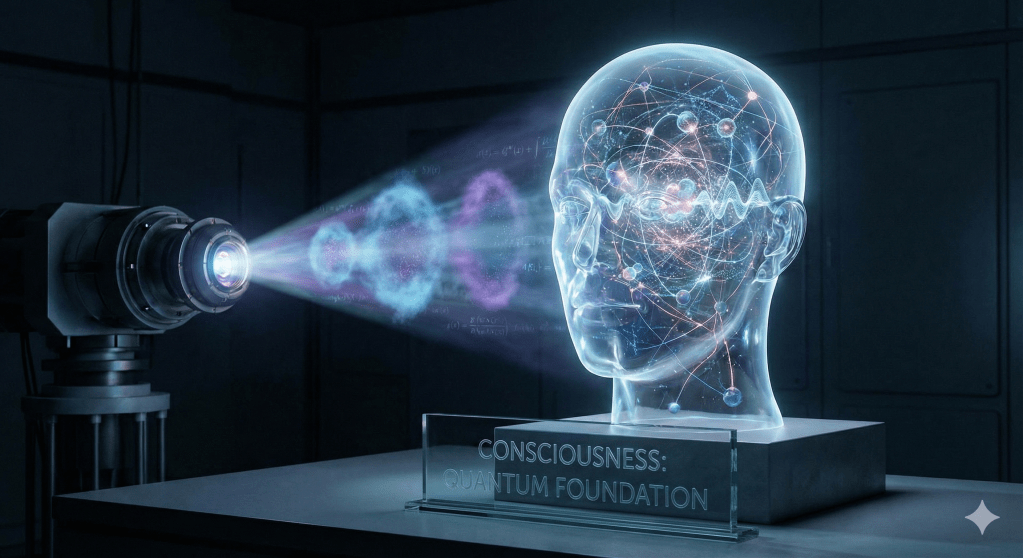
For instance, consider the phenomenon of human consciousness and intuition. Despite advances in neuroscience, consciousness – our inner subjective awareness – remains deeply enigmatic. Some theorists (albeit controversially) have speculated that quantum processes in the brain might contribute to consciousness or allow it to connect with information in novel ways. The Quran and Islamic tradition hold that humans are endowed with a ruh (spirit or soul) and an inherent nature (fitrah) through which God can guide them internally. Inspiration, sudden insight, or true dreams are seen as whispers from a higher reality rather than mere random firings of neurons. Believers maintain that “God can reveal to them through true dreams and [has] blessed saints and prophets with profound revelations.” These revelations are understood as knowledge from Beyond – from outside the closed system of mundane causality. Under a strict Newtonian paradigm, such claims might be dismissed outright as violations of natural law. But if the universe has indeterminacy or extra dimensions, one can conceive of subtle channels or interfaces between the material and spiritual. Quantum indeterminacy, for example, means not every event is rigidly determined – “a universe that chooses among possibilities… leaving room for subtle influence or guidance”. Some theologians have proposed that God could act within the probabilistic framework of quantum events to answer prayers or guide outcomes without breaking physical law. In this view, the inherent uncertainties at the quantum level are opportunities for divine will to shape events invisibly – a concept known as non-interventionist divine action. By extension, one might imagine the mind or soul tapping into deeper layers of reality (through quantum processes or higher dimensions) to receive guidance. Such ideas remain speculative, but they illustrate how an expanded scientific worldview makes room for phenomena that a classical mindset would reject. The question “Could quantum mechanics be one of the means by which a transcendent God interacts with the created world?” is now part of legitimate scholarly discourse. At the very least, we can say that modern physics no longer dogmatically rules out the subtle “non-physical” influences that religious people have long believed in; instead, it presents a universe where much is hidden and where mystery and mechanism co-exist.
Another helpful concept is the idea of the universe as a vast repository of information (an idea embraced in fields like digital physics and quantum information theory). The Quran frequently alludes to the notion that information is never lost from God’s perspective – that every event, word, or intention is known and recorded. Interestingly, in physics the principle of unitarity holds that quantum information is preserved, not destroyed, even when physical forms change. A famous example is the black hole information paradox, where Stephen Hawking once argued that black holes might obliterate information, only for later developments (the holographic principle) to suggest that all information swallowed by a black hole is encoded on its boundary and eventually radiated back out. Physicists like Leonard Susskind showed that a black hole can be thought of as a kind of hologram, storing the detailed information of infallen objects on its 2D surface such that information isn’t truly lost. Likewise, the holographic principle posits that the entire universe could be described as an information structure on a higher-dimensional boundary. These are cutting-edge ideas, but they resonate with a Quranic worldview in which a “Preserved Tablet” (al-Lawh al-Mahfuz) contains the decrees and knowledge of all that exists, and in which an exhaustive Record of Deeds is kept for every soul. One commentator explicitly draws the analogy: “some scientists have poetically described [a black hole’s horizon] as a kind of ‘memory surface’ storing everything that falls in, which evokes the Quranic imagery of the ‘Preserved Tablet’” that records all things. The comparison is metaphorical, of course – physics deals with bits of quantum information, while theology deals with moral and existential truths. Yet the conceptual overlap is striking: nothing vanishes without a trace; the universe has a memory.
Finally, the idea of extra spatial dimensions could offer a way to visualize spiritual entities or events. For example, angels in Islamic belief are said to be made of light and to be normally invisible to human eyes. One might imagine angels as operating in a higher-dimensional space or a parallel realm that occasionally intersects with ours (much as a 3D object passing through a 2D plane would only appear as a cross-section). When people report metaphysical experiences – like sensing a presence during deep prayer or having an out-of-body experience – perhaps they are tapping into these higher dimensions of reality that our ordinary senses cannot probe. The Quran even hints at “heavens and earth” beyond the visible universe; some interpret references to the “seven heavens” as seven layers or realms of existence. While science cannot affirm such layers, it’s noteworthy that serious scientific theories allow for entire unseen dimensions that could host phenomena unknown to us. In short, an enlarged scientific landscape that includes quantum uncertainty, holistic information, and extra dimensions makes the Quranic portrayal of an unseen, interactive, and information-preserving reality far more conceivable. It moves the discussion from outright dismissal (“such things violate physical law”) to thoughtful speculation (“perhaps such things operate through subtleties we have yet to fully understand”).
Quranic Insights: Omniscience, Record-Keeping, and Resurrection in Detail
The Qur’an provides numerous insights into the nature of reality that, while expressed in spiritual terms, align intriguingly with the ideas of a comprehensive, detailed cosmic order. Central among these are the themes of Divine omniscience, the presence of recording angels, and the promise of a meticulous accountability in the Afterlife. These teachings insist that nothing in reality is truly hidden or lost, even if human beings cannot perceive the unseen workings.
First, the Qur’an emphasizes that Allah (God) is All-Knowing (Al-‘Alīm) and All-Aware (Al-Khabīr), with knowledge that penetrates every secret. “With Him are the keys of the unseen—no one knows them except Him” states one verse; “Not even a leaf falls without His knowledge… but it is [written] in a perfect Record”. This vivid image – of even the fall of an autumn leaf being noted in an invisible ledger – conveys the extent of divine knowledge. Another verse declares: “Whether you hide your word or publish it, He certainly has full knowledge of the secrets of all hearts”. Thus, the innermost thoughts and intentions of a person are fully transparent to God: “He knows what is in the land and sea… nor a grain in the darkness of the earth nor anything fresh or dry but that it is written in a clear record”. The Quranic terminology of a “clear record” or “perfect Record” (Arabic: Kitāb or Imām Mubin) suggests that all information in the universe is comprehensively stored and preserved by God’s will. No datum is too trivial – “not a thing, small or great, but is recorded”, as another verse (10:61) assures. In modern terms, one might liken this to the idea that the universe is an information matrix, except that in Islam it is God who is the supreme “Processor” and Preserver of information. For believers, this omniscience has practical implications: it engenders a sense of moral responsibility and inner scruples, knowing that one’s private thoughts and unseen actions are witnessed. It also provides comfort – every struggle or good deed, no matter how ignored by the world, is seen and remembered by God.
Secondly, the Qur’an describes a specific agency for record-keeping: the Kirāman Kātibīn, or “noble recording angels.” These angels are said to accompany each person, documenting their utterances and deeds. Surah Qāf (50:16–18) is particularly explicit. It begins by reaffirming God’s intimate knowledge of our psyche: “Assuredly, We have created man and We know what his own self whispers to him, and We are nearer to him than his jugular vein.” Then it continues with an almost matter-of-fact depiction of the recording process: “When the two recording angels record [his deeds], one sitting on the right and one on the left, he utters not a word except that with him is an observer, ready to record it.” Every word a person speaks is transcribed by these ever-present scribes. In another passage, the Qur’an says, “Indeed, over you are keepers, noble and recording; they know whatever you do” (82:10–12). These poetic descriptions convey the idea that a complete transcript of one’s life is being prepared, even if we ourselves forget much of what we say and do. The verse from Sura Qāf (50:18) specifically – “Not a word does one utter except that there is by him a watcher, ready to record it” – has been cited by scholars as a Quranic equivalent of the notion that information is conserved. Just as physics asserts no information truly vanishes, the Qur’an asserts no word or deed goes unrecorded. It is worth noting that classical Islamic theologians often understood such descriptions metaphorically (since God could know and record everything without needing angels), but even taken at face value, they present a powerful image of redundant data storage: the human conscience, the angels, and God’s own knowledge all serve as witnesses to each life’s events.
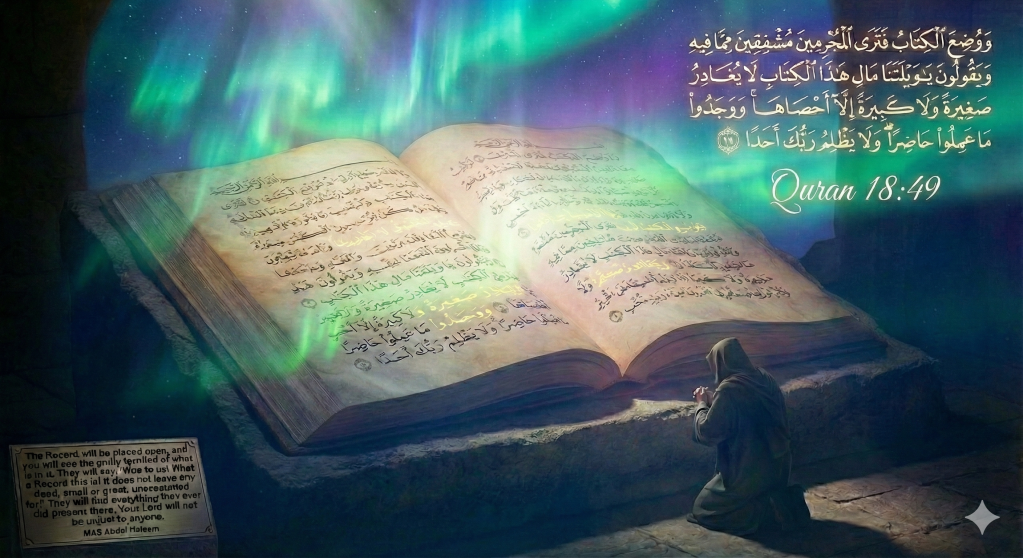
Thirdly, the Qur’an points to a culmination of this perfect record-keeping: the Day of Judgment, when the stored information will be fully disclosed and used for precise accountability. Surah Al-Kahf (18:47–49) provides a dramatic depiction of that Day, blending cosmic upheaval with the unveiling of moral records. It says: “And ˹beware of˺ the Day We will remove the mountains and you will see the earth leveled, and We will gather all of [humankind], leaving none behind” (18:47). All people, from every age, are to be resurrected and assembled before God, an event of unimaginable scale. The next verse (18:48) describes humanity presented in rows before their Lord, and the guilty being fearful of what awaits. Then comes the crux in 18:49: “And the record [of deeds] will be placed [open], and you will see the wicked in fear of what is written in it. They will cry, ‘Woe to us! What kind of book is this that leaves nothing small or large unlisted?’ And they will find whatever they did present before them. And your Lord does not wrong anyone.”. This profound verse portrays the shock of the sinners as they realize the record is utterly comprehensive. Every minor detail – which they perhaps had forgotten or dismissed – is meticulously enumerated. The Quran quotes them exclaiming in horror that the book has “left out nothing small or great”. In other words, the ledger of deeds achieves total informational completeness. The text then reassures that what is written is exactly what each person earned, and that God’s justice wrongs no one. Classical commentators like Al-Ṭabarī noted on similar verses that the reason for this exhaustive record is to eliminate any excuse or denial – the individual will effectively see themselves with perfect clarity. In modern parlance, one might say the ultimate playback of one’s life will occur, a kind of life-review with full data fidelity. The Qur’an even speaks of peoples’ bodies testifying – “on that Day, their tongues, hands and feet will testify against them about what they used to do” (24:24). It is as if every facet of creation that interacted with a person (including their own neural record) is a storage device of their actions. Thus, nothing can be hidden. This scenario strongly mirrors the scientific notion that if one had a complete set of data about all particles and their states, one could theoretically reconstruct all past events (the principle of information conservation). The Qur’an asserts that God will indeed reconstruct every detail of the past for judgment – an idea not far-fetched if the universe fundamentally retains information. What science struggles with (practically decoding scrambled information) the Quran depicts as divinely solved: “secrets will be brought to light and made manifest” easily, due to God’s power and knowledge.
Ink impressions of human fingerprints. The Qur’an remarkably highlights fingertips as a symbol of God’s power to resurrect with precision: “Yes, We are able to perfectly restore even his very fingertips” (75:4). Fingerprints are unique to each individual, serving as an identifier much like a stored record. In modern science, the uniqueness and permanence of fingerprints have become a cornerstone of forensic identification. The Quran’s reference, interpreted historically as “reassembling even the smallest bones,” now resonates with the idea that every minutiae of one’s identity is preserved by the Creator.
A final Quranic detail worth noting is the verse in Surah Al-Qiyāmah where skeptics question resurrection: “Does man think We will not assemble his bones?” God’s reply is emphatic: “Yes indeed, We are able to reconstruct even his fingertips”. This verse (75:3–4) is often highlighted for its choice of fingertips as the example of divine re-creation. Fingertips contain the unique patterns of our fingerprints, which today are known to be different for every individual who has ever lived. The Qur’an’s focus on such a minute detail – as opposed to just saying “restore his body” – drives home the teaching that no detail of personal identity will escape God’s ability to restore. In classical commentaries, scholars like Fakhr al-Razi noted that “fingertips” represent the tiniest bones, implying total reconstruction down to fine details. Modern readers cannot help but connect this to the discovery that fingerprints are not only tiny and unique, but also serve as a metaphor for information encoding: our identities can be confirmed by these delicate ridge patterns, much as a database key identifies a record. The Quran, by invoking fingertips, conveys that resurrection is not a rough copy but an exact restoration – “without the slightest difference”, as one tafsīr puts it. From a scientific standpoint, this resonates with the idea that information about each person (their genetic code, memories, etc.) could be reassembled if one had God-like knowledge. Theologically, it affirms that no person will be lost to oblivion; every soul’s essence and history are preserved by God, awaiting the final reckoning.
Through these verses, the Qur’an presents a worldview where ultimate reality is information-rich and ethically structured. All events are known to an omniscient Consciousness; sub-atomic or psychological secrecy is impossible in front of God. There is an ongoing, unseen recording of the minutest aspects of our lives. And in the future, there will be a full disclosure of that record, ensuring perfect justice. This worldview could be summarized thus: the universe is under total surveillance, not by an Orwellian state, but by a benevolent and all-knowing Creator; the ledger of the cosmos is complete, and nothing truly vanishes. Interestingly, as we have seen, modern science echoes key elements of this worldview in its own domain: it suggests that information is never truly destroyed, that an ultimate “theory of everything” would be able to account for every particle and event, and that the cosmos may be far more interconnected (even “observing itself”) than we fathom. The Quranic concept that “God is with you wherever you are” and “sees what you do” (57:4) finds a thought-provoking parallel in the non-local, observation-entangled reality of quantum mechanics. Some writers have drawn explicit comparisons: just as entangled particles remain in instantaneous contact, so is God omnipresent, able to respond and be “present” without delay anywhere in the universe. While entanglement is a physical analogy and God’s knowledge is metaphysical, the poetry of the comparison can enrich our appreciation of both. It suggests that the seeming gulf between the scientific and the spiritual perspective might not be a gulf at all, but rather different lenses on a single, awe-inspiring reality.
Bridging Knowledge Streams: Toward an Enlarged Vision of Reality
Having examined the scientific conceptions of a non-classical reality and the Quranic assertions of an all-encompassing reality, we arrive at a juncture to bridge these knowledge streams. The goal is not to conflate science and scripture irresponsibly, but to see how they can inform and enrich each other’s portrayal of the cosmos. What emerges is a picture of total reality as a vast, detailed, and fundamentally unified landscape – one that far surpasses the old Newtonian, materialist vision. In this enlarged reality, mind and matter, seen and unseen, physics and metaphysics interweave in coherent ways.
1. The Universe as a Grand Information System: Both modern physics and the Qur’an suggest that reality, at its core, is about information. In physics, one finds serious proposals that “it from bit” – the idea that information is the foundation of physical existence. The holographic principle, quantum computation theory, and the unitarity of quantum mechanics all stress that physical processes are, in essence, information processing, and that information cannot be destroyed. The Qur’an’s depiction of the Kitāb (Record) and the Lawḥ Maḥfūẓ (Preserved Tablet) presents a parallel notion on the spiritual plane: meaningful information (deeds, intentions) is indelibly stored in the fabric of reality by divine command. One could say that what quantum theory posits as an abstract law – “no information loss” – the Qur’an elevates to a moral law: “no deed is lost.” Every event leaves an eternal imprint. This hints at a profound unity: the physical events and moral events are two sides of one tapestry, each thread accounted for. It’s as if the entire universe is a memory bank, and on Judgment Day that memory will be replayed in full. Such a view encourages a scientific believer to see their actions as literally encoded in the cosmos. It imbues even mundane moments with cosmic significance. The resonance between the scientific principle (conservation of information) and the theological principle (universal record-keeping) provides a conceptual bridge – showing that our growing understanding of physics is not negating the spiritual truths, but subtly mirroring them in a different language.
2. Non-Locality and Omnipresence: Quantum entanglement teaches us that distance is not a barrier for correlated influence. Theology teaches that God is omnipresent and that His influence is immediate everywhere. The analogy drawn by some is that entanglement is a physical simile for God’s mode of sustaining the universe. Just as entangled particles respond to each other across light-years as if they were one, God’s knowledge and power “touch” every point of the universe without delay or diminution. In the words of the Qur’an, “He is with you wherever you are” (57:4) and “not a secret consultation occurs among three, but He is the fourth, nor among five but He is the sixth… nor less nor more, except He is with them wherever they may be” (58:7). These verses underscore divine omnipresence. If we think in terms of extra dimensions, one could imagine God as the higher-dimensional reality in which our 3D world is embedded – much like entangled particles might be connected through a higher-dimensional space (there are even conjectures like ER=EPR suggesting entanglement and space-time geometry are related via unseen dimensions or wormholes). The point is not that entanglement is God’s action, but that it provides a tangible model for conceiving how invisible, faster-than-light connectivity is possible. It breaks the mental lock that things must be separated and local. If electrons can display a sort of “telepathy,” surely the Creator of electrons can maintain a unified connection with creation without breaking a sweat. The unity of the cosmos highlighted by entanglement bolsters the theological notion that the world is a coherent whole upheld by One will.
3. Probability, Free Will, and Divine Will: Newton’s clockwork universe struggled with the concept of free will or God’s intervention – everything was fixed, so how could prayers matter or choices be real? Quantum mechanics, by introducing probability, re-opened a door. As noted, some thinkers propose that God’s will could operate at the quantum level, subtly biasing outcomes within the allowed probabilistic range. This is an elegant idea because it means no physical laws are broken – statistically, events still follow quantum rules – yet God could ensure that certain crucial events (perhaps at the level of brain neurons firing or a mutation guiding evolution) fall into one outcome versus another. The believer’s intuition that “my prayer was answered” or “this coincidence feels guided” might correspond to real but undetectable divine tweaks behind the quantum veil. Theologically, this aligns with the concept of Providence (God’s governance of creation) working through natural processes. In the Quran, one finds verses like “No calamity befalls on the earth or in yourselves but it is inscribed in a Record before We bring it into existence” (57:22), suggesting that events unfold according to a divine plan. Quantum theory doesn’t prove such a plan, but it demonstrates that determinism is not absolute. There is “wiggle room” in the universe, which faith can ascribe to a higher agency or purpose. Meanwhile, from the human perspective, the unpredictability at the quantum level can be seen as analogous to the genuine freedom we experience in making choices – not everything we do was fated by initial conditions. In short, the indeterminacy of physics and the moral agency of humans can coexist; both can be framed as part of a universe of potentialities actualized by conscious decisions (whether human or divine). This gives a rational minded believer a way to embrace science without feeling that it negates moral responsibility or the efficacy of prayer.
4. Crossing the Barrier: Revelation and Quantum Tunneling: Earlier, we discussed quantum tunneling as a particle crossing through an energy barrier it classically shouldn’t. This can serve as an inspiring metaphor for revelation and spiritual insight. In normal experience, there is a “barrier” between the material world and the divine realm – an epistemic wall that we cannot simply climb over. Prophets and mystics, however, are said to receive knowledge from beyond that barrier. One might liken this to an information “tunneling” from a higher reality into our brain or heart, something that is impossible by ordinary means but made possible by the special will of God. Just as electrons occasionally materialize on the other side of a wall, a prophet receives a message through what would ordinarily be an impenetrable divide between Creator and creature. Indeed, Islamic theology teaches that revelation (wahy) is not a product of the prophet’s mind but a direct communication from God – by definition a supra-natural event. The mechanism of how God sends revelation is mysterious, but quantum tunneling reminds us that mystery is built into the universe; there are allowed violations of classical common sense. It’s a hint that our understanding of communication and influence is incomplete. Perhaps consciousness itself has “quantum tunnels” that occasionally permit transpersonal knowledge (some have tried to interpret telepathy or clairvoyant experiences in terms of quantum entanglement or tunneling, though evidence is lacking). At the very least, the idea of tunneling erodes the absolute solidity of barriers. It encourages humility: just because our current science cannot trace a channel for spiritual insight does not mean none exists. The Quran even uses imagery that evokes penetration of unseen barriers: angels are said to descend through the heavens, and in one passage (81:23) the Prophet Muhammad’s heart is said to have seen the angelic messenger “at the clear horizon,” suggesting a meeting at the boundary of worlds. In another verse, God says “It is not given to a human that God should speak to him except through inspiration, or from behind a veil, or by sending a messenger (angel)…” (42:51). The “veil” concept implies there is a membrane between our world and the divine, but that communication can happen through or behind it by God’s command. The scientific mind might imagine that revelation involves physics we don’t yet grasp – perhaps higher-dimensional waves or quantum states interacting with the neurons of a prophet in a way that leaves no trace except the message itself. Such musings are speculative, but they show it is intellectually possible to be open to revelation even while upholding a scientific outlook.
5. Life After Death – Resurrection through Reassembly: The Quran’s detailed claims about resurrection, such as restoring fingerprints and bodies, could also be looked at through a quasi-scientific lens. If we accept that information about every person is preserved, then resurrection is essentially a matter of information retrieval and reconstitution. In principle, if one had all the information about a person’s physical and mental state, one could “recreate” them. Some futurists even discuss the idea of uploading consciousness or reviving people via record of their connectome (brain’s neuron map). Islam of course attributes this capability solely to God – the ultimate Information Bearer. But scientifically, we see no law forbidding the gathering of dispersed matter and information to reassemble a being (it’s just currently beyond any technology or natural process we know). The Quran challenges doubters by pointing to God’s knowledge of the minutest aspects of our bodies – symbolized by fingerprints – implying that no part of us is beyond His grasp to reform. If the universe is God’s database, then resurrection is a guaranteed retrieval of all data. Interestingly, one might consider the entire history of the universe as encoded in the present state of the universe (per Laplace’s demon or, in quantum terms, in the entangled state of all particles). If a Creator can rewind or read out that data, the dead could literally be brought back by “re-running” their information. This is a futuristic analogy to inspire our understanding: it underscores that resurrection is not “magic” out of nothingness, but a logical act if one is omniscient and omnipotent. The fact that no two fingerprints are alike among billions of humans, and yet God promises to restore each one correctly, is a sign that individual identity matters immensely in the divine plan. Our uniqueness is divinely encoded, and will be decoded on that Day. In an almost scientific spirit, early Muslim scholars like Ibn Abbas reportedly said, “God will gather our very particles, even if they are scattered across earth and sea,” anticipating an understanding that matter and its identity markers persist. Today we know that atoms are recycled in nature, but the pattern that made you is unique; the Quran assures that this pattern is not lost to God.
Bridging these perspectives encourages a holistic paradigm: we start to see no sharp divide between physical law and spiritual principle. Instead, physical reality with all its new-found intricacy becomes a subset of a grander reality described by spiritual truths. The Newtonian paradigm put science and faith at odds by confining reality to the material and mechanical. The quantum paradigm and similar advanced concepts invite us to widen the scope, so that what was once “supernatural” might be understood as part of the larger natural (i.e. the true nature of creation as God made it). As one writer eloquently summarized, the aim is “to remain scientifically grounded while venturing into metaphysical interpretations,” keeping humility about what science can explain. We must always distinguish metaphor from empirical fact. Yet, exploring these analogies can be deeply illuminating. It can strengthen faith by showing that belief in an unseen moral order is not contrary to reason; likewise, it can elevate science by infusing it with a sense of wonder and ethical depth. We end up with an enlarged vision of reality where scientific insight and Quranic insight are like two eyes – providing depth perception when used together. With both, we perceive a universe that is quantitatively rich (teeming with particles, fields, and dimensions) and qualitatively meaningful (suffused with purpose, record, and accountability).
Epilogue: A Tapestry Seen in Full
In the quiet of a desert night, the Prophet Muhammad ﷺ reflected on the stars above and the revelations unfolding within his heart. The Qur’an he conveyed dismantled the picture of an empty, indifferent cosmos and replaced it with a living universe, conscious of its Lord and filled with signs and recordings. Today, as our telescopes probe the galaxies and our equations entangle particles across space and time, we find echoes of that vision in unexpected places. The Newtonian clockwork has given way to something far more subtle – a universe where uncertainty and interconnection are fundamental. It is as if science has finally caught a glimpse of the threads behind the tapestry, threads the Quranic worldview always insisted were there: the threads of omniscience, causality with purpose, and moral order woven into the fabric of being.
On the Day of Ultimate Reality – what the Qur’an calls Yawm al-Qiyāmah – all veils will fall. The scattered data of countless lives will coalesce into the Book of Deeds, laid wide open. In the Qur’an’s timeless words: “The record of deeds will be placed open, and you will see the sinners in dread of what is in it. They will exclaim, ‘Woe to us! What is this book that leaves nothing small or great uncounted?’ And they will find all they did present before them, and your Lord wrongs no one.” In that moment, the total reality – physical and spiritual – will be experienced in full clarity. What was once known only through intuition or faith (that every action matters, that every secret is known) will become as empirically evident as any scientific demonstration. Every formula of physics, every law of nature, will stand as merely a subset of the all-encompassing Law of Justice that governs creation. The meticulous accounting that modern science hints at (in conservation laws and information theory) will find its ultimate expression in Divine accountability. Nothing truly vanished in the black holes of either spacetime or of history, for “God has kept count of it, while they forgot it” (58:6).
This grand meeting of accounts is not a negation of the natural world but its fulfillment. The Qur’an assures us that truth and purpose underlie existence – “Not without purpose did We create the heavens and earth” (38:27) – and science, in its own way, has been steadily unveiling layers of order and symmetry that speak to an underlying coherence. When we contemplate phenomena like quantum entanglement, we are, perhaps, seeing a physical parable of unity: a reminder that at some foundational level, all is one fabric. When we learn that no information is ever truly lost, we are unknowingly affirming a pillar of the Last Day – that all will be revealed. As we have journeyed through the realms of quanta and Quran, of particles and prophecy, we find ourselves at a horizon where knowledge merges into wonder. We realize that the “total reality” can never be confined to what the eye sees or what equations predict. There are depths upon depths – physical depths, informational depths, spiritual depths – and at the ultimate bottom of this infinitely layered reality is the One who is “First and Last, Evident and Hidden” (57:3), the Sustainer of each layer.
Thus, we conclude with a sense of awe. Our exploration affirms that a devotional worldview – one that accepts revelation, moral accountability, and the sanctity of the unseen – need not be at odds with a scientific worldview that embraces quantum strangeness and cosmic complexity. In fact, they enrich one another. The more we learn about the universe, the more we find that reality is subtle enough to accommodate the divine. And the more we understand the Quranic message, the more we see that it anticipated a reality far beyond mechanistic appearances. It calls us to be humble in pursuit of knowledge, steadfast in conscience, and mindful of the sacred record being written with every moment of our lives.
As the Quran says in another eloquent passage: “On that Day, people will come forward in separate groups to be shown their deeds. And whoever does an atom’s weight of good shall see it, and whoever does an atom’s weight of evil shall see it.” (99:6–8). An atom’s weight – the smallest imaginable measure. Over fourteen centuries ago, the Quran chose that metaphor, and today our science has literally uncovered a world of subatomic actions that underlie all reality. We have learned to measure atoms, to split them, to understand their probabilistic behavior. Yet the Quran reminds us that every one of those atomic actions is ultimately moral and accountable in the human context. In the end, perhaps the true “Theory of Everything” is not only a set of equations, but a complete record combining the physical and the moral, read by the Light of Truth. Such a synthesis is the only one befitting a universe created by The Most Wise.
May our continued study of both the Book of Nature and the Book of Revelation lead us to deeper awe and responsibility. In an age where humanity wields unprecedented scientific power, the Quran’s vision of an all-encompassing reality offers a sobering and elevating truth: we are seen, we are significant, and we shall see the consequences of all that we do. The cosmos is listening and recording. Let us then step lightly on earth, speak kindly, seek knowledge humbly, and perhaps, in doing so, align ourselves with the grain of a universe that is far more alive, attentive, and meaningful than Newton ever dreamed. “And in the end, We will assemble you all for a Day of Account – a promise of God that will surely come to pass” (3:9). In that grand convergence of science and spirit, may we be among those who meet our Lord with radiant faces and records we are proud to claim. Amen.
Sources: Quran 6:59; Quran 50:16–18; Quran 18:49; Quran 75:3–4; Shah, Z. H. (2025). From Quantum Entanglement to Providence, Record Keeping and Afterlife; Shah, Z. H. (2025). Information Preservation in Black Holes and Divine Records; Wikipedia: Quantum Tunnelling; Wikipedia: Extra Dimensions; Ervin, M. (2024). The Spiritual Interpretation of Quantum Physics; Shah, Z. H. (2025). God and the Quantum Universe; Shah, Z. H. (2025). Fingerprints and the Quran.
If you would rather read in Microsoft Word file:



 The Glorious Quran and Science
Leave a reply to Zia H Shah Cancel reply