
Presented Zia H Shah MD
Audio summary
Abstract
We can get into the brain of another person as a neurosurgeon but can never get into the mind of any other person other than ourselves. Only God can!
The phenomenon of human consciousness—the unified, subjective experience of the self—remains the premier anomaly in the landscape of modern materialist science. Despite the comprehensive mapping of neural correlates, the “Hard Problem” of how physical matter generates immaterial awareness remains unsolved. This report presents an exhaustive commentary on Quran 8:24 (“…and know that Allah intervenes between a man and his heart…”), positing that this verse offers a precise metaphysical description of consciousness not as a localized biological product, but as a “meeting place” where the Finite (Khalq) intersects with the Infinite (Amr). By synthesizing Islamic theology (Kalam and Tasawwuf), the philosophy of mind, and quantum mechanics, we argue that the human brain and heart function as an elaborate biological receiver for a transcendent, non-local reality. The “intervention” described in the Quran is analyzed through the mechanisms of quantum non-locality and synaptic quantum tunneling, suggesting that the Divine Command (Amr) interfaces with the physical world at the quantum limit. Furthermore, integrating the insights of Quran 17:85, we conclude that the essential nature of consciousness is inextricably bound to the Divine mystery, rendering a complete materialist understanding impossible. This report asserts that the human being is an isthmus (Barzakh), maintained in existence by a continuous Divine intervention that bridges the gap between the neural architecture of the brain and the timeless command of the Spirit.
I. Introduction: The Cartography of the Unknown
The Crisis of Materialism and the Divine Sign
In the contemporary scientific epoch, humanity has achieved a mastery over the physical world that borders on the miraculous. We have decoded the human genome, smashed atoms to reveal the subatomic zoo, and peered back to the cosmic microwave background radiation mere moments after the Big Bang. Yet, in the center of this expanding circle of light, there remains a persistent, deepening shadow: the nature of the observer itself. The “Inner Universe”—the subjective feeling of what it is like to be someone, to feel pain, to perceive red, to experience the continuity of selfhood—remains stubbornly opaque to reductionist scrutiny.
This impasse is technically termed the “Hard Problem” of consciousness. Materialist reductionism, the dominant paradigm which posits that all mental states are merely the exhaust fumes of complex neuronal firing, fails to account for the unified, qualitative nature of experience. If the brain is merely a biological computer, why does it feel like something to process data? Why are we not “philosophical zombies”—beings who act and react but lack the inner light of awareness?.
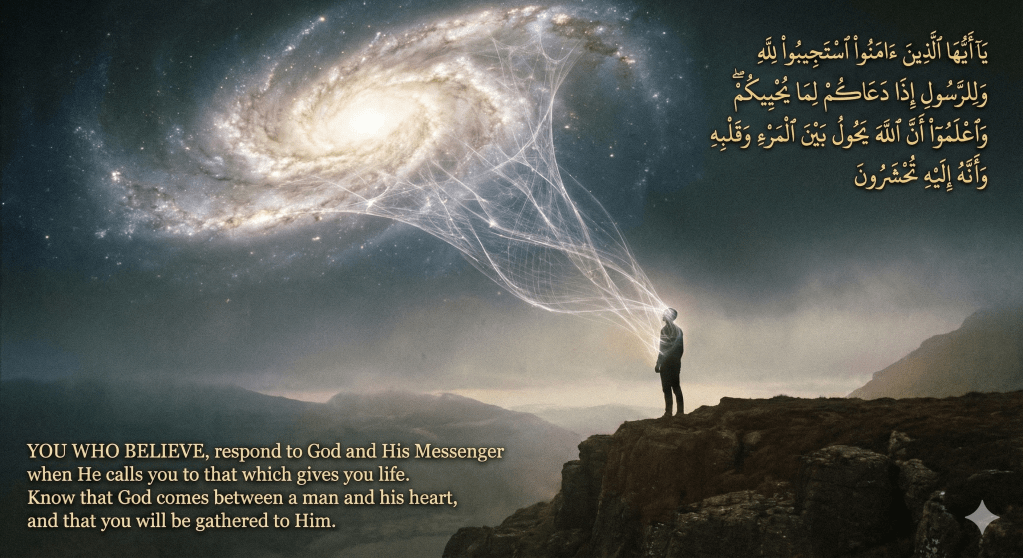
Into this intellectual breach, the Quran introduces a profound metaphysical assertion in Surah Al-Anfal, verse 8:24: “O you who have believed, respond to Allah and to the Messenger when he calls you to that which gives you life. And know that Allah intervenes between a man and his heart and that to Him you will be gathered.”.
This verse is not merely a pietistic exhortation; it is an ontological map. It suggests that the core of human identity—the “heart” (Qalb) or the seat of consciousness—is not a closed, autonomous system sealed within the skull. Rather, it is a permeable boundary, a frontier where the Divine Will actively and continuously “intervenes” (yahulu). This implies that consciousness is not a static possession of the creature but a dynamic relation with the Creator.
The Thesis of the Meeting Place
This report advances the thesis that human consciousness cannot be simply and totally physical because it serves as the ontological “meeting place” of the finite and the infinite. We are not merely biological machines generating awareness through synaptic chemistry; we are “isthmuses” (Barzakh) where the temporal world of matter (Alam al-Khalq) intersects with the timeless world of Divine Command (Alam al-Amr).
To substantiate this thesis, we must look beyond classical Newtonian physics, which deals with locality, determinism, and separability—concepts that fail to describe the fluid, unified nature of the mind. Instead, we must turn to the quantum realm, where the rigid laws of matter dissolve into probabilities, non-locality, and entanglement. We propose that the “intervention” of Allah between man and his heart utilizes the “quantum realities” of non-locality and quantum tunneling to bridge the gap between the Transcendent and the physical brain.
The Scope of Inquiry
This commentary will proceed through a rigorous, multi-disciplinary analysis. We will first establish the theological and linguistic groundwork of Quran 8:24 and 17:85, defining the precise nature of the “Heart” (Qalb) and “Spirit” (Ruh) in Islamic thought. We will then traverse the philosophical implications of a consciousness that is “given but little knowledge,” exploring the necessary limits of human epistemology as a safeguard for the sacred. Following this, we will delve into the “elaborate system” of the quantum brain—examining the role of microtubules, synaptic quantum tunneling, and the heart-brain electromagnetic connection as the biological hardware for this spiritual software. Finally, we will conclude with the necessary enigma: that a complete understanding of consciousness is inextricably bound to the knowledge of God, and thus, for the finite mind, it must remain a mystery that inspires awe rather than a problem to be solved.
II. Part One: The Exegesis of Intervention (Quran 8:24)
1.1 The Linguistics of Hawl (Intervention)
The pivotal phrase in Quran 8:24 is “Annallaha yahulu baynal mar’i wa qalbihi” (That Allah intervenes between a man and his heart). The verb yahulu is derived from the root H-W-L, which denotes a change of state, a shifting, or a barrier placed between two things. In classical Arabic usage, a hawl is a year (a full cycle of change) or a transformation.
When applied to the Divine action upon the human subject, this verb carries immense metaphysical weight. It suggests that the connection between the “self” (the Mar’, the individual) and the “heart” (the Qalb, the center of consciousness and will) is not direct or unbreakable. There is a “Third Party” situated in the gap between the thinker and the thought. This shatters the Cartesian Cogito, ergo sum (“I think, therefore I am”), replacing it with a model of dependency: “I think, because God permits the connection between me and my thought.”
Classical commentators like Al-Qurtubi and Ibn Kathir have interpreted this intervention primarily in soteriological terms. They argue that God stands between a believer and disbelief (protecting faith) or between a disbeliever and faith (preventing guidance if the heart is sealed). It emphasizes that the human will is not sovereign; it is contingent upon Divine permission. If one delays repentance, God may “intervene” and seal the heart, making future repentance impossible. This reading instills a sense of urgency: “Respond to Allah… when He calls you” because you do not own the next moment of your own consciousness.
However, the metaphysical reading extends deeper. Fakhr al-Din al-Razi and later Sufi commentators saw in this verse an affirmation of Occasionalism (the Ash’arite doctrine of Jawhar al-Fard). According to this view, cause and effect are not necessary logical connections but customary habits of God’s will. The fire does not burn the cotton; God creates the burning at the moment of contact. Similarly, the brain does not “produce” the thought; God creates the consciousness at the locus of the brain.
1.2 The “Heart” (Qalb) as the Locus of Consciousness
To understand the target of this intervention, we must redefine the “Heart” away from the purely biological pump of Western anatomy. In Quranic terminology, the Qalb is the “suprasensory” organ of cognition, emotion, and spiritual perception. It is the seat of the Ruh (Spirit) within the body.
The Quran frequently attributes thinking, understanding, and reasoning to the heart: “Have they not hearts with which they understand?” (Quran 22:46). This suggests that the Qalb is the center of integrated consciousness, where the cold processing of data (Aql) and the warm perception of value and meaning (Fuad) converge.
The word Qalb itself means “turning” or “fluctuation.” Consciousness is not a static state; it is a flux, a stream of changing states. The Divine intervention acts as the stabilizer or the redirector of this flux. Without this stabilization, the human psyche would dissolve into chaos. The “intervention” is the anchor that holds the self together in the storm of existence.
1.3 The Simulation Hypothesis and “Root Access”
A compelling modern interpretation, highlighted by contemporary commentators, draws an analogy to the Simulation Hypothesis. If we view physical reality as a simulation or a construct, then God is the Programmer with “root access” to the system.
In a computer system, the user (the human) feels they have control over the interface. However, the Administrator (God) has access to the underlying code and can intervene between the user’s input and the system’s output. “Allah intervenes between a man and his heart” implies that God has access to the very kernel of our operating system. He can block a process (an evil desire), execute a command (inspiration), or shut down the system (death/sleep) regardless of the user’s intent.
This “Root Access” theory aligns with the Quranic concept that “Allah is closer to him than his jugular vein” (Quran 50:16). The intervention is not an alien intrusion from the outside; it is an emergence from the deepest inside. It suggests that our consciousness is a “cloud-based” phenomenon: we think we are processing locally, but the processing power and the data stream are being sustained by a remote Server (The Divine Command).
III. Part Two: The Philosophy of the Isthmus (Barzakh)
2.1 The Human as the Meeting Place
The assertion that consciousness is the “meeting place of the finite and the infinite” finds its most articulate expression in the philosophy of Sri Aurobindo and the Sufi concept of the Barzakh.
Materialism fails because it attempts to explain the Infinite (consciousness, which can conceive of universals, mathematics, and God) solely through the Finite (neurons and chemicals). A container cannot hold something larger than itself unless it is connected to a larger reservoir. Aurobindo posits that humanity is a transitional being, a “laboratory” where Nature is attempting to manifest the Spirit. “Our humanity is the conscious meeting-place of the finite and the infinite,” he writes. The body is the finite anchor; the consciousness is the infinite sail.
In this view, the brain is not a generator of consciousness but a reducing valve (a concept echoed by Aldous Huxley and Henri Bergson). The Infinite Spirit is omnipresent, but the biological brain filters it down into a trickle of “finite awareness” so that we can function in the physical world without being overwhelmed. The “intervention” of Quran 8:24 is the modulation of this valve.
2.2 The Sufi Metaphysics of the Barzakh
Islamic metaphysics, particularly in the school of Ibn Arabi, formalized this through the concept of the Barzakh (Isthmus). A Barzakh is something that separates two things while also connecting them—like the twilight that is neither day nor night but the meeting of both.
- The Two Seas: The Quran speaks of “He released the two seas… between them is a barrier (Barzakh) so they do not transgress” (Quran 55:19-20). Metaphysically, these are the Sea of Meaning (Ma’ana – the Infinite/Divine) and the Sea of Form (Surah – the Finite/Material).
- The Perfect Human: The human being is the Isthmus between these two seas. We are made of clay (Finite) but breathed into by the Spirit (Infinite).
- Consciousness as the Event of Meeting: Consciousness is not a “thing” located in the head; it is the event of the meeting between these two seas. It is the friction, the spark, caused by the Absolute interacting with the Relative.
This explains why consciousness is so elusive to materialist science. You cannot find the “meeting place” by dissecting the clay (the brain). The meeting place is an ontological status, not a spatial location. It is a dimension of “Command” (Amr) intersecting with “Creation” (Khalq).
2.3 Refuting Panpsychism and Physicalism
This framework offers a robust refutation of Panpsychism (the trendy scientific view that all matter has some consciousness).
- The Failure of Panpsychism: Panpsychism tries to solve the Hard Problem by spreading it thin—claiming that electrons have “proto-consciousness.” But this leads to the “Combination Problem”: how do a billion distinct “electron-minds” combine to form the unified “I” of a human?
- The Theistic Solution: The “Meeting Place” theory argues that consciousness is not a bottom-up property of matter. It is a top-down injection or intervention of the Divine Command into a sufficiently complex system. The “unity” of the self comes from the Unity of the Spirit (Ruh), not the aggregation of atoms. The elaborate system of the brain is necessary not to create the mind, but to receive and bind the Divine signal.
IV. Part Three: The Quantum Substrate of Intervention
To translate the theological “intervention” and the philosophical “meeting place” into the language of physical reality, we must descend into the quantum realm. The user’s query demands an elaboration on “quantum realities of non-locality and quantum tunneling” as the mechanism of this connection.
3.1 Non-Locality: The Physics of Amr
Classical physics is defined by Locality: an object is only influenced by its immediate surroundings. However, Quantum Non-Locality (proven by Bell’s Theorem and Aspect’s experiments) demonstrates that entangled particles can influence each other instantaneously across vast distances, faster than light.
This provides a physical correlate for the theological concept of the World of Command (Alam al-Amr).
- The Theology: The Ruh (Spirit) belongs to the Amr. It is not bound by space or time.
- The Physics: Quantum entanglement is not bound by space or time.
- The Synthesis: The connection between the Soul and the Body is a non-local quantum entanglement. The Soul does not “sit” in the pineal gland; it is entangled with the entire quantum state of the brain/body system. The “Intervention” of Allah (8:24) is the ultimate non-local operation—God, from beyond spacetime, influences the quantum state of the heart instantly.
3.2 Quantum Tunneling: The Synaptic Trigger
The brain consists of billions of neurons communicating via synapses. For a signal to pass from one neuron to another, a vesicle containing neurotransmitters must be released (exocytosis). This requires energy to overcome a physical barrier.
The Beck-Eccles Quantum Tunneling Model, proposed by Nobel laureate Sir John Eccles and physicist Friedrich Beck, suggests a mechanism for how a non-physical “will” could influence the physical brain.
- The Mechanism: Inside the synaptic button, the trigger for vesicle release involves the movement of a quasiparticle (likely a hydrogen ion or electron). This particle faces an energy barrier.
- The Tunneling: In classical physics, the particle cannot cross the barrier if it lacks energy. In quantum physics, there is a probability that it will “tunnel” through the barrier, appearing on the other side without traversing the space in between.
- The Intervention: Beck and Eccles proposed that “Mental Intention” (or in our terms, the Ruh acting by Divine Permission) acts by momentarily increasing the probability of tunneling.
This is the precise locus of “Allah intervenes between a man and his heart.” The intervention occurs at the quantum probability amplitude of the synaptic firing. By slightly biasing the probabilities of quantum tunneling across millions of synapses, the Divine Command (or the Soul) can steer the macroscopic activity of the brain—turning a thought into an action—without violating the conservation of energy.
3.3 Orch-OR and the Microtubule Antenna
The most sophisticated theory of quantum consciousness is Orchestrated Objective Reduction (Orch-OR), developed by Sir Roger Penrose and Stuart Hameroff.
- The Structure: Inside neurons are cytoskeletal structures called microtubules. These are cylindrical lattices of tubulin proteins.
- The Quantum Computation: Penrose and Hameroff argue that microtubules function as quantum computers. The tubulin proteins can exist in a superposition of states (simultaneously “on” and “off”).
- The Collapse: When the quantum superposition reaches a critical threshold (related to gravity), it self-collapses (Objective Reduction). This moment of collapse is a moment of proto-consciousness.
- The Connection: This theory provides the “elaborate system” requested. The microtubules act as the antenna or receiver for the non-local consciousness. The “intervention” of 8:24 could be the modulation of the microtubule’s quantum state, orchestrating the collapse to produce a specific coherent experience.
This model perfectly fits the “Meeting Place” thesis. The “superposition” represents the infinite possibilities (Amr), and the “reduction/collapse” represents the manifestation of a specific finite reality (Khalq). Consciousness is the edge of the collapse.
V. Part Four: The Neurocardiological Nexus
The “elaborate system” that connects us to the transcendent is not limited to the cranial brain. The Quran specifically mentions the Heart (Qalb). Modern science, via the field of Neurocardiology, has begun to vindicate this ancient view.
4.1 The Heart as a Sensory Organ
We now know that the heart is not just a muscle. It contains an intrinsic nervous system—the “Heart Brain”—consisting of approximately 40,000 neurons that can sense, feel, learn, and remember.
- The Signal: The heart sends more information to the brain than the brain sends to the heart.
- The Influence: Signals from the heart affect the brain’s centers involved in perception, emotional processing, and higher cognitive functions. A chaotic heart rhythm (stress) inhibits the brain’s cortex (the “thinking” brain), while a coherent rhythm (peace/gratitude) facilitates it.
4.2 The Electromagnetic Receiver
The most startling discovery is the heart’s electromagnetic field.
- Strength: The heart generates the strongest rhythmic electromagnetic field in the body—approximately 5,000 times stronger than the brain’s field.
- Range: This field can be detected several feet away from the body with sensitive magnetometers (SQUIDs).
- Encoding: Research suggests this field encodes emotional information.
The Theological Implication:
If consciousness involves receiving non-local information (from the Amr or the Divine presence), the heart’s massive electromagnetic field is the primary transducer. It acts as the “satellite dish” for the soul. The brain then acts as the “decoder box,” translating these subtle signals into language and linear thought.
When Quran 8:24 says God intervenes between a man and his heart, it may refer to the modulation of this electromagnetic resonance. A “sealed heart” is one that has lost its coherence—its ability to resonate with the Divine frequency. A “sound heart” (Qalb Salim) is one that is in perfect phase-lock with the Divine Command, allowing the flow of intuition and Taqwa (God-consciousness).
4.3 The Integrated Circuit of the Self
We can now map the “elaborate system” connecting the physical to the transcendent:
- The Source: The Divine Command (Amr) / The Non-Local Soul (Ruh).
- The Receiver (Macro): The Heart’s Electromagnetic Field (receiving/sensing the “vibe” or spiritual state).
- The Receiver (Micro): The Brain’s Microtubules (processing quantum superpositions).
- The Interface: Synaptic Quantum Tunneling (where the “will” nudges the probabilities of action).
- The Binding Center: The Claustrum (a thin sheet of neurons in the brain suspected to bind disparate experiences into a unified whole).
- The Gateway: The Reticular Activating System (RAS) (filtering the infinite data down to finite attention).
This system allows the “Infinite” to dock with the “Finite.”
VI. Part Five: The Realm of Command (Quran 17:85)
5.1 The Distinction of Amr and Khalq
The discussion of the “Enigma” of consciousness must be anchored in Quran 17:85: “And they ask you concerning the soul (Al-Ruh). Say: ‘The soul is by the command (Amr) of my Lord, and of knowledge, you have been given but a little.’”.
This verse introduces a fundamental dualism in Islamic ontology:
- Alam al-Khalq (The World of Creation): The physical universe, governed by causality, time, space, and gradual processes (evolution, growth). This is the world of “measurement” (Qadr).
- Alam al-Amr (The World of Command): The transcendent realm of immediate Divine Will. It is characterized by the command Kun (“Be!”). It is timeless, spaceless, and instantaneous.
The verse explicitly categorizes the Ruh (and by extension, the core of consciousness) as belonging to the Amr. This is why consciousness feels “instant” and “unified”—it shares the nature of the Command. It is not a “created thing” in the sense of being built from parts; it is a “commanded presence.”
5.2 The Necessary Enigma
The closing statement—“…and of knowledge, you have been given but a little”—is not a dismissal of science, but a statement of epistemic boundaries.
- The Incompleteness Theorem: Just as Kurt Gödel proved that no logical system can prove all truths within itself, the human intellect (a subset of the Khalq) cannot fully comprehend the Ruh (a subset of the Amr). The lower dimension cannot fully map the higher dimension.
- The Horizon: We can map the correlates of consciousness (which neurons fire), but we cannot map the essence because the essence is Divine Command.
- The Link to 8:24: Because the soul is “Command,” it is under the direct, unmediated control of God. “Allah intervenes” because the soul is His direct property, unlike the body which is subject to the secondary laws of nature (gravity, decay). The intervention in 8:24 is the Amr overriding the Khalq.
VII. Part Six: Epistemic Limits and the God of the Substrate
6.1 God-of-the-Gaps vs. God-of-the-Substrate
Skeptics often accuse theistic explanations of consciousness of being a “God-of-the-Gaps” argument (i.e., “we don’t know how it works, so God did it”). However, the model presented here is not a God of the Gaps; it is a God of the Substrate.
We are not saying God is found only in the things we don’t understand. We are saying that the nature of the phenomenon (consciousness) exhibits properties (unity, non-locality, subjective qualia) that are fundamentally incompatible with the properties of matter (divisibility, locality, objective mass). Therefore, the “gap” is not a gap of ignorance, but a gap of ontology. It is a structural feature of reality where the physical world is porous to the non-physical.
6.2 The Purpose of the Mystery
Why must consciousness remain an enigma?
- To Preserve Free Will: If the mechanism of the soul were fully visible and deterministic—if we could see the “Divine Strings” under a microscope—we would be compelled to believe. Faith (Iman) requires the unseen (Ghayb). The “Quantum uncertainty” in the brain provides the necessary veil that allows us to feel autonomous, preserving the validity of our moral choices.
- To Enforce Humility: The limits of knowledge remind the human being of their status as Abd (servant/creature). We are given “little knowledge” so that we remain in awe. If we solved consciousness, we would claim to be gods.
Thematic Epilogue: The Horizon of the Self
In the final analysis, the journey into the neuroscience of the Quran does not lead to a dry equation. It leads to the Mihrab (prayer niche) of the heart.
We stand on the precipice of the “quantum soul.” The electron tunnels through the barrier, the microtubule vibrates in the dark, and the heart casts its magnetic net into the ether. In this elaborate, silent symphony, a “self” emerges. It looks in the mirror and asks, “Who am I?”
The Quran answers not with a formula, but with a presence. You are the space where God commands. You are the vessel where the finite clay holds the infinite command. You are the meeting place.
When you feel a sudden change of heart, a flash of inspiration, or a barrier against a dark impulse, know that this is not merely dopamine or serotonin. It is the Hawl—the Intervention. It is the Infinite touching the Finite, intervening between you and yourself, reminding you that you are never, ever alone in the dark room of your consciousness.
The brain is the mosque; the heart is the Imam; the consciousness is the prayer. And the prayer is sustained only by the grace of the One who intervenes.
“And He is with you wherever you are.” (Quran 57:4)
Consciousness remains an enigma because it is a window into God. And one does not solve a window; one looks through it.
Table 1: Comparative Analysis of Consciousness Models
| Feature | Materialist Model | Quantum-Theological Model (Proposed) | Quranic Reference |
| Origin | Emergent property of neurons | Divine Command (Amr) transmitted non-locally | 17:85 (Ruh from Amr) |
| Mechanism | Synaptic firing / Computation | Quantum Tunneling / Microtubule Orch-OR | 8:24 (Divine Intervention) |
| Location | Localized in Cranial Brain | Distributed: Brain, Heart (Qalb), Non-local field | 22:46 (Hearts understand) |
| Nature | Deterministic / Stochastic | Probabilistic / Participatory (Free Will via Collapse) | 13:11 (God changes condition) |
| Epistemology | Solvable “Easy Problem” | Fundamentally Unknowable “Hard Problem” | 17:85 (Little knowledge given) |
| Death | Extinction of Consciousness | Decoupling of Receiver; Signal Returns to Source | 39:42 (Souls taken at death) |
Table 2: The “Elaborate System” of Connection
| Biological Component | Proposed Quantum Function | Spiritual Correlate (Tafsir) |
| Synaptic Cleft | Quantum Tunneling: Probability biasing of vesicle release. | The Intervention (8:24): The subtle “nudge” of the heart/will. |
| Microtubules | Orch-OR: Coherent superposition and collapse. | The Amanah (Trust): The capacity to hold the Divine light. |
| Heart (Qalb) | Electromagnetic Field: Non-local information receiver/transducer. | The Seat of Taqwa: The center of spiritual perception. |
| Claustrum | Binding/Integration: Unifying quantum states into “Qualia”. | The Unity (Tawhid): Integrating multiplicity into oneness. |
| Reticular Activating System | Gating/Filtering: Reducing the “Infinite” signal to finite awareness. | The Veil (Hijab): Protecting the finite mind from being overwhelmed. |
Extended Commentary and Analysis
1. The Physics of “Intervention” (Yahulu)
The choice of the word yahulu in Quran 8:24 is scientifically precise. In fluid dynamics and phase transitions, a “barrier” or “phase change” often intervenes between states.
- The Quantum Zeno Effect: In quantum physics, frequent observation of a system prevents it from evolving. The “Intervention” could be viewed as the Divine Observation (Shahadah) that stabilizes the human self. Without this intervention, the psyche might dissolve into chaos or decoherence.
- Maxwell’s Demon: In thermodynamics, a hypothetical demon controls a door between two chambers, allowing fast molecules to pass and slow ones to stay. God’s intervention acts as a Moral Maxwell’s Demon between the man and his heart, filtering thoughts, permitting some to manifest as actions and suppressing others, based on the individual’s spiritual state and Divine Mercy.
2. The Holographic Heart and Non-Locality
The integration of ideas from TheQuran.love and the snippets regarding the heart requires a rejection of the “pump-only” model.
- Information Encoding: If the heart’s field encodes emotional information, and this field is non-local (extending beyond the body), it implies that human consciousness is a field phenomenon.
- Collective Consciousness: This explains the concept of the Ummah (community) as one body. If our electromagnetic fields overlap and entangle, we share a collective spiritual resonance. The “Intervention” of 8:24 can be collective—God intervening in the heart of a community to turn them towards or away from truth.
- The Heart-Brain Axis: The brain is the linguistic processor, but the heart is the intuitive processor. The “intervention” often manifests as a “gut feeling” or “heart-felt conviction” that overrides logical deduction. This is the Amr bypassing the Khalq logic circuits.
3. The “Little Knowledge” (Quran 17:85) as a Scientific Constant
We must treat the limitation of 17:85 not as a discouragement of science, but as a Fundamental Constant of the universe, like the speed of light ($c$) or Planck’s constant ($h$).
- The Horizon of Cognition: Just as we cannot accelerate past $c$, we cannot compute the full nature of the Ruh.
- The Benefit of Limit: If we knew the full nature of the soul, the test of faith would end. The “Hiddenness” (Ghayb) is essential for the operation of Free Will. If God’s hand in our synapses were visible under a microscope, we would be compelled to believe, negating the virtue of faith.
4. Synthesis: The Meeting Place
The final image is that of the Isthmus. We are the bridge.
- Below us: The animal, the chemical, the deterministic, the finite.
- Above us: The angelic, the command, the free, the infinite.
- Within us: The war between these two natures.
- Between them: Allahu Yahulu—God Intervenes. He holds the bridge together. He allows the traffic to flow. He is the Meeting Place of the Meeting Place.
In this model, consciousness is not a biological accident. It is a Theophany (Tajalli)—a manifestation of the Divine Name Al-Hayy (The Living) within a shell of clay. The mystery is the message.



 The Glorious Quran and Science
Leave a comment