
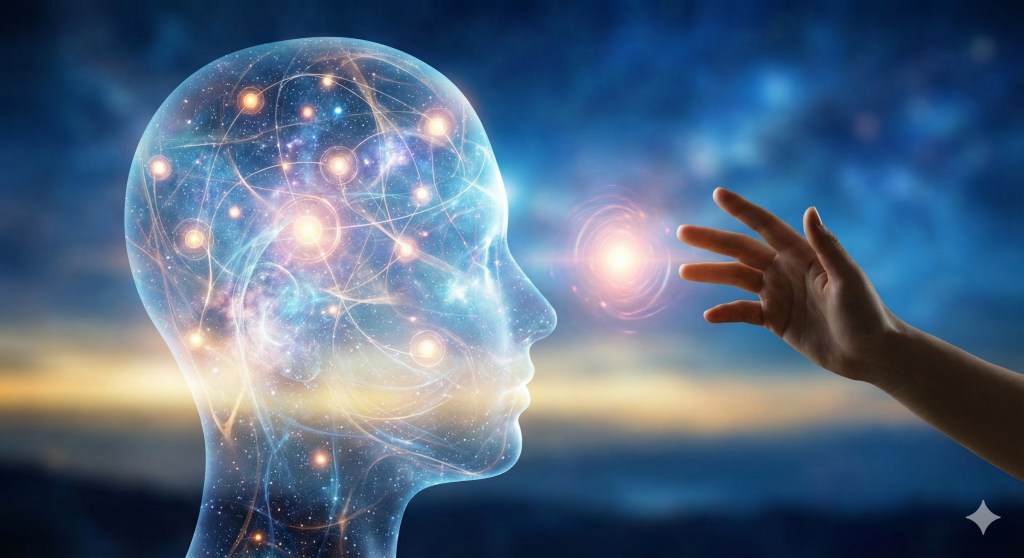
Epigraph:
And they ask you concerning the soul. Say, ‘The soul is by the command of my Lord; and of the knowledge thereof you have been given but a little.’ (Al Quran 17:85)
What is Ultimate Reality? | Episode 1301 | Closer To Truth – YouTube
Presented by Zia H Shah MD
Abstract
The nature of consciousness—the subjective, qualitative feeling of existence—remains the premier unsolved mystery of modern science and philosophy. While the physical sciences have successfully mapped the cosmos and decoded the genome, the “inner light” of awareness stubbornly resists reduction to standard materialist explanations. This report provides an exhaustive analysis of the contemporary debate surrounding the origins of mind, anchored by a detailed examination of the arguments presented by neuroscientist Christof Koch in his dialogue with Robert Lawrence Kuhn on Closer to Truth. We explore Koch’s significant philosophical transition from the rigid neural correlates of consciousness (NCC) to the panpsychist implications of Integrated Information Theory (IIT), highlighting his controversial stance that consciousness may be a fundamental property of the universe rather than a mere biological by-product.
Critically, this report embellishes the scientific discourse with the theological and philosophical insights of Dr. Zia H. Shah, MD, a prominent thinker on the intersection of religion and science. By juxtaposing Koch’s “Romantic Reductionism” with Shah’s Quranic exegesis—specifically the implications of Surah Al-Isra (17:85) and the distinction between the World of Creation (Alam al-Khalq) and the World of Command (Alam al-Amr)—we interrogate the epistemological limits of materialist inquiry. The report synthesizes evidence from neuroscience, quantum mechanics, and terminal lucidity to challenge the prevailing “brain-as-generator” model, proposing instead a “brain-as-receiver” paradigm. We conclude that the persistence of the “Hard Problem” is not merely a gap in data but an ontological signpost pointing toward a transcendent reality, echoing Robert Lawrence Kuhn’s climactic realization: “Nobody knows why consciousness is part of our universe!”
1. Introduction: The Last Frontier of Human Inquiry
1.1 The Perennial Question of Being
Since the dawn of cognitive reflection, humanity has grappled with the “Enigma of the Self.” How does a kilogram and a half of wet biological tissue—the human brain—give rise to the technicolor cinema of the mind? How do firing neurons, essentially sodium and potassium ions traversing lipid membranes, transmute into the sensation of the colour red, the sharp pang of grief, or the abstract comprehension of infinity? This question, often termed the “mind-body problem,” has traversed the corridors of ancient madrasas, Greek academies, and modern laboratories, remaining as potent and divisive today as it was three millennia ago.
For centuries, this domain belonged exclusively to theologians, mystics, and philosophers. In the 20th century, however, the tools of neuroscience—fMRI, EEG, and single-neuron recording—emboldened the scientific community to claim consciousness as a biological phenomenon, solvable through the same reductionist methods that decoded the genome or split the atom. Yet, as we advance deeper into the 21st century, a unified theory remains elusive. The field is fractured into rival camps: physicalists who insist the mind is an illusion of the brain, dualists who maintain a separation of substance, and panpsychists who see mind as woven into the fabric of matter itself.
1.2 The Closer to Truth Inquiry
It is within this turbulent intellectual landscape that the Closer to Truth series, hosted by Robert Lawrence Kuhn, operates. Kuhn, a rigorous interrogator of ultimate reality, seeks to strip away the “easy” answers to expose the raw nerve of the mystery. In his engagement with Christof Koch, a titan of modern neuroscience, Kuhn presses on the fundamental question: Is the person all material? Is the self merely a “pack of neurons,” as Francis Crick famously declared, or is there a “ghost in the machine”?
The video in question, featuring Christof Koch, serves as a pivotal text for understanding the current state of this inquiry. It captures a moment of paradigm shift where high-level neuroscience begins to admit the insufficiency of classical materialism. Koch, once a staunch reductionist working alongside Francis Crick, presents a view that is physically grounded yet metaphysically expansive, suggesting that consciousness is not a magical emergence but a fundamental property of organized information.
1.3 The Theological Counter-Narrative
Parallel to this scientific investigation is the work of Dr. Zia H. Shah, MD, Chief Editor of the Muslim Times and a prolific writer on the harmony between the Quran and science. Shah offers a robust critique of the materialist assumptions that underpin much of Western neuroscience. Drawing upon the Quranic tradition, specifically the verse “And they ask you concerning the soul…” (17:85), Shah argues that the failure of materialism is not a temporary setback but a necessary consequence of the nature of the Soul (Ruh).
This report takes the Koch-Kuhn dialogue as its departure point. It deconstructs Koch’s arguments for a physicalist yet non-reductive understanding of consciousness and contrasts them with the theistic critique articulated by Shah. By weaving together the “hard science” of Integrated Information Theory with the “hard theology” of the Divine Command, we aim to provide a panoramic view of the consciousness debate that respects both the empirical data and the spiritual intuition of humanity.
2. The Materialist Project: From Neurons to Awareness
2.1 The Legacy of Francis Crick
To understand Christof Koch’s position in the video, one must first understand the intellectual lineage he represents. Koch was the long-time collaborator of Francis Crick, the Nobel laureate who co-discovered the structure of DNA. After solving the mystery of life (heredity), Crick turned his formidable intellect toward the mystery of mind. In his seminal work, The Astonishing Hypothesis, Crick laid down the gauntlet of strict physicalism: “You, your joys and your sorrows, your memories and your ambitions, your sense of personal identity and free will, are in fact no more than the behavior of a vast assembly of nerve cells and their associated molecules.”
This was the starting point for Koch. The mission was to find the “Neural Correlates of Consciousness” (NCC)—the minimal set of neuronal events and mechanisms sufficient for a specific conscious percept.1 The working hypothesis was mechanical and reductionist. If one could identify the specific oscillation of neurons (e.g., the 40 Hz gamma waves) that synchronized visual information, one would have “explained” consciousness. The underlying assumption was that consciousness is a computation, a software running on the wetware of the brain. If you build the hardware correctly, the “light” of consciousness should turn on.
2.2 The Limitations of Correlation
However, as the decades passed, a profound problem emerged. Correlation is not causation. Identifying where consciousness happens in the brain (e.g., the claustrum or the posterior hot zone) does not explain how or why it happens. One can map the brain activity of a person seeing “red” with perfect precision, but that map contains no “redness.” It contains voltage spikes, neurotransmitter flows, and hemodynamic responses. The qualitative experience—the qualia—is entirely absent from the objective description.
This “Explanatory Gap” is what drove Koch toward a more radical theory. In the Closer to Truth interview, we witness a scientist who has stared into the abyss of the brain and realized that standard biological explanations are insufficient to account for the “feeling” of existence. He does not abandon science, but he expands the definition of the physical to include information as a fundamental entity.
3. Video Analysis: Christof Koch on the Nature of Consciousness
3.1 The Definition of Consciousness
In the video “Is Consciousness Entirely Physical?”, Christof Koch begins by defining the parameters of the discussion. For Koch, consciousness is not merely “intelligence” or “behavior.” It is “experience.” It is the famous definition by philosopher Thomas Nagel: “Is there something that it is like to be a bat?” If there is “something it is like” to be a system, then that system is conscious.
Koch argues that consciousness is the most familiar thing we have—it is, in fact, the only thing we have. We know about the external world (atoms, stars, neurons) only through the medium of consciousness. Therefore, explaining it away as an illusion, as some eliminative materialists do, is intellectually dishonest. It is the primary datum of existence.
3.2 The Argument for Physicalism
Despite the mystery, Koch maintains a commitment to physicalism, but a nuanced one. He argues against Cartesian Dualism—the idea that the soul is a “spooky substance” distinct from the body that floats around and interacts with the pineal gland. His argument is grounded in the causal closure of the physical universe. We see no evidence of non-physical forces pushing ions across membranes. The brain appears to be a closed loop of cause and effect.
However, Koch admits that the “material” might be stranger than we think. He posits that any physical system that has a certain type of causal structure—specifically, one that integrates information—will possess consciousness. This is not because of a “ghost” entering the machine, but because consciousness is a property of the complex system itself, much like “wetness” is a property of water, though wetness is not found in a single water molecule.
3.3 The Shift to Integrated Information Theory (IIT)
The core of Koch’s argument in the video revolves around Integrated Information Theory (IIT), developed by his colleague Giulio Tononi.2 IIT represents a Copernican shift in consciousness studies. Instead of asking “how does the brain produce consciousness?”, IIT asks “what are the essential properties of consciousness?” and then reasons backward to the physical substrate.
The Axioms of IIT:
- Existence: Consciousness exists.
- Composition: Consciousness is structured (it has parts, like left and right visual fields).
- Information: Consciousness is specific (seeing a blue book rules out seeing a red car).
- Integration: Consciousness is unified (you don’t experience the color of the book and the shape of the book as separate films; they are one experience).
- Exclusion: Consciousness is definite (it flows at a specific speed and resolution).
Koch explains that for a physical system to support these properties, it must have a specific causal architecture. It must be able to affect itself. The measure of this capacity is called Phi (Φ). A system with zero Phi is a “zombie” or a feed-forward mechanism (like a camera sensor). A system with high Phi (like the human brain) is highly conscious.
3.4 The Kuhn-Koch Dialectic: The Simulation Argument
Robert Lawrence Kuhn, playing the role of the skeptical metaphysician, pushes Koch on the implications of IIT. He asks: If we simulate the human brain on a computer, perfectly replicating every synapse, will that simulation be conscious?
Koch’s answer is a surprising “No.” This is a critical divergence from standard computationalism (functionalism). Koch argues that consciousness is not about input-output functions; it is about causal power. A computer simulation of a rainstorm does not get the desk wet. Similarly, a computer simulation of a brain simulates the behavior of consciousness but does not produce the feeling. To have consciousness, you must build a neuromorphic chip that actually has the integrated physical structure, not just a software simulation running on a Von Neumann architecture.
This distinction highlights Koch’s “physicalism”—he believes the physical substrate matters. You cannot divorce the mind from the physics of the system.
4. The “Hard Problem” and the Limits of Materialism
4.1 The Insurmountable Wall
While IIT provides a mathematical framework for measuring consciousness, critics argue it still fails to bridge the gap. Why should “integrated information” feel like anything? Why shouldn’t a high-Phi system just be a very complex, dark data processor? This brings us back to the “Hard Problem” of consciousness, a term coined by David Chalmers.
Dr. Zia H. Shah, in his extensive collection of articles, identifies the “Hard Problem” as the lethal wound to metaphysical naturalism. He writes:
“The ‘Hard Problem’ of Consciousness… addresses the question of why and how subjective experiences, or ‘qualia,’ arise from physical brain processes. Many philosophers argue that qualia pose a fundamental challenge to materialist and reductionist accounts of the mind.” 3
Shah argues that physicalism faces a choice: either deny the reality of the mind (Illusionism) or admit that matter has properties that are not described by standard physics. The former is absurd (denying the only thing we know for sure), and the latter opens the door to panpsychism or dualism.
4.2 The “Philosophical Zombie” and the Failure of Logic
Shah utilizes the “Philosophical Zombie” thought experiment to dismantle the confidence of physicalism. If it is logically possible to conceive of a creature that is atom-for-atom identical to a human but lacks an inner life, then consciousness is not logically supervenient on the physical structure alone.
“If such a being is logically possible, then consciousness is not logically entailed by physical structure, implying that consciousness involves ‘further facts’ beyond physics.” 4
This aligns with Koch’s admission in the video that a simulation (a “Zombie” in silicon) could behave like a human without feeling. However, while Koch solves this by demanding specific hardware, Shah sees it as evidence that consciousness requires a non-physical explanation entirely.
4.3 The “Mary’s Room” Argument
Shah also leverages the “Knowledge Argument” (Mary’s Room) to prove that physical facts are not all facts. If a scientist knows every physical fact about the colour red but has never seen it, she learns something new when she steps out of her black-and-white room.
“She learns a new, non-physical fact about ‘what it feels like’… This subjectivity is inherently first-person and cannot be captured by third-person physical descriptions.” 4
This epistemological gap suggests that science, which deals in third-person objective descriptions, is structurally incapable of capturing the first-person reality of the self.
5. The Theological Intervention: Insights from Dr. Zia H. Shah
5.1 The “Eclipse of Matter”
Dr. Zia H. Shah posits that the study of consciousness is currently bringing about the “Eclipse of Matter.” The deeper we look into the brain, the less “material” the explanation becomes. Koch moves to “Information,” which is abstract. Others move to Quantum Fields. Shah argues that we are rediscovering the spiritual nature of reality through the failure of materialism.
“We face a choice: either the ultimate reality is dead, mindless matter, or the ultimate reality is a Conscious Mind. The former explanation leads to the absurdity of mind emerging from non-mind.” 4
Shah argues that the “emergence” of consciousness from inert matter is a logical impossibility—a rabbit pulled out of a hat where no rabbit existed. A more coherent causal chain is that Consciousness comes from Consciousness. The human mind is a spark derived from a Cosmic Mind (God).
5.2 Quran 17:85 and the Divine Command
The cornerstone of Shah’s theological argument is Surah Al-Isra, Verse 85:
“And they ask you concerning the soul (al-rūḥ). Say: The soul is of the command of my Lord, and you have not been given of knowledge except a little.” (Quran 17:85) 5
Shah provides a detailed exegesis of this verse, distinguishing between two Quranic orders of existence:
- Alam al-Khalq (The World of Creation): The physical universe, governed by time, space, evolution, and causality. This is the domain of science. The brain belongs here.
- Alam al-Amr (The World of Command): The realm of the immediate Divine Will (Kun! – Be!). This realm is non-spatial, instantaneous, and spiritual. The Soul (Ruh) belongs here.
Shah argues that consciousness is the interface between Amr and Khalq. The brain is the biological machinery (Khalq) that anchors the Soul (Amr) to spacetime. The “Little Knowledge” mentioned in the verse is a statement of epistemic humility. It predicts that human science will never fully “solve” the soul because the soul originates from a realm (Command) that transcends the tools of measurement (Creation).
“This verse places a divine limit on human knowledge of the human soul or spirit, intriguingly foreshadowing today’s struggles to understand consciousness… The total lack of consensus among the ‘more than 200 actively pursued theories’… is a testament to the truth of the Quranic verse.” 6
5.3 The Distinction Between Ruh (Spirit) and Nafs (Self)
Shah clarifies a common confusion in the debate. The “Self” or personality that changes, grows, gets angry, or suffers dementia is the Nafs. This is the product of the union between the Ruh (pure consciousness) and the body.
- Ruh: The pure, immutable witness. The light of the projector.
- Nafs: The movie on the screen. The evolving ego.
Neuroscience studies the Nafs (personality, memory, cognition), which is indeed dependent on the brain. But it fails to isolate the Ruh, which is the underlying condition for there to be any experience at all.
6. The “Brain-as-Receiver” Model
6.1 Challenging the Production Theory
Standard neuroscience, including Koch’s early work, assumes the brain produces consciousness the way the liver produces bile. Dr. Zia H. Shah challenges this “Production Theory” and advocates for the “Transmission” or “Filter” Theory, referencing William James and Henri Bergson.
“A longstanding idea is that the brain does not produce consciousness on its own, but rather acts as a filter or transmitter of mind from a larger reality… much like a radio receiver tuning into a broadcast.” 1
In this model, the brain is a “reducing valve.” Universal consciousness is too vast and overwhelming for a biological organism focused on survival. The brain’s function is to limit consciousness, to focus it on the immediate physical environment.
6.2 The Radio Analogy
Shah uses the radio analogy to explain brain damage, which is often the strongest argument for physicalism.
“Just as a radio can be damaged and distort sound without generating the music itself, a damaged brain may alter consciousness without being its source.” 1
If you smash the speakers of a radio, the music stops or becomes distorted. A Martian examining the radio might conclude, “The music was generated by the speakers.” But the signal remains intact in the airwaves. Similarly, when a person suffers a stroke and loses speech (aphasia), the “tuner” is broken, but the Ruh (the signal) remains untouched, simply unable to manifest through the damaged hardware.
6.3 Clinical Evidence: Terminal Lucidity
Shah supports the Receiver Model with medical anomalies that physicalism struggles to explain, most notably Terminal Lucidity.
“Terminal lucidity challenges physicalist assumptions by demonstrating the unexpected and often brief return of mental clarity… in individuals who have suffered from long-term, severe cognitive impairment.” 1
Consider a patient with severe Alzheimer’s. Their brain is physically ravaged—atrophied, plaque-ridden, synapses destroyed. According to the Production Model (Koch/Crick), a coherent mind should be impossible because the machinery is broken. Yet, hours before death, many such patients suddenly “wake up,” recognize loved ones, speak coherently, and exhibit a fully intact self.
Shah argues this is the “reducing valve” failing completely as the body dies, allowing the full signal of the soul to flood back in one last time before the connection is severed. It suggests the self was always there, merely blocked by the damaged filter.
7. The Metaphysics of Sleep and the Daily Resurrection
7.1 The “Minor Death”
Dr. Zia H. Shah expands the theological inquiry by linking consciousness to the circadian rhythm, citing Quran 39:42:
“Allah takes the souls at the time of their death, and those that do not die [He takes] during their sleep. Then He keeps those for whom He has decreed death and releases the others for a specified term…” 7
This verse establishes a functional and ontological equivalence between sleep and death. Shah describes sleep as “minor death” (al-mawt as-sughra).
- Scientific View: Sleep is a metabolic recharge, a synaptic pruning process, a time for memory consolidation.
- Theological View: Sleep is a temporary release of the Ruh from the constraints of the body/brain interface.
7.2 Consciousness as Non-Local
Shah uses this scriptural foundation to propose that consciousness is inherently non-local. If the soul can be “taken” during sleep and returned, it implies that the locus of the self is not strictly the pineal gland or the claustrum.
“The ‘Hard Problem’ of Consciousness… addresses the question of why and how subjective experiences… arise from physical brain processes.” 3
If the soul leaves, the body enters a vegetative state (sleep) where the “I” is suspended. When it returns, the “lights” come back on. This aligns with the “Brain-as-Receiver” model. The “signal” is paused or redirected. Shah notes the irony that we spend one-third of our lives in this state of “minor death,” yet we take the continuity of our consciousness for granted. The fact that “I” am the same person this morning as I was yesterday is, in Shah’s view, a daily miracle of the Soul’s re-attachment, a “Daily Resurrection” (Nushūr) described in Quran 25:47.
“The energy and activity of the morning following the stillness of sleep serve as a mini-revival… intended to subtly teach the reality of the ultimate Resurrection.” 8
8. Panpsychism vs. Theism: The Battle for the Universe
8.1 Koch’s Embrace of Panpsychism
In the Closer to Truth video, Kuhn presses Koch on the implications of IIT. If any integrated system has consciousness, does that mean the universe is alive? Koch bites the bullet: Yes. He admits that consciousness might be a fundamental property of the universe, ubiquitous in matter. This is Panpsychism.
For Koch, this is a way to save physicalism. He doesn’t need a God; he just needs matter to be “magical” enough to have mental properties.
8.2 Shah’s Critique: The “Combination Problem”
Dr. Zia H. Shah offers a stinging critique of this position. He views panpsychism as a “desperate atheist’s effort” to avoid theism while admitting materialism has failed.
“Panpsychism attempts to save naturalism by expanding the definition of the ‘physical’ to include the ‘mental.’… As Dr. Shah argues, it is an attempt to ‘re-enchant’ nature without submitting to a Creator.” 4
Shah highlights the logical fatal flaw of panpsychism: the Combination Problem. Even if every atom has a tiny “proto-mind,” how do billions of tiny minds combine to form the unified “I” that is Christof Koch? There is no mechanism in physics for “mind-merging.”
“The panpsychist needs micro-to-macro combination… Panpsychists prefer to move the mystery to a place where it might have an answer (combination) rather than leave it as a sheer miracle.” 9
Shah references the Closer to Truth series itself to mock the absurdity of this view:
“In a Closer to Truth video, John Rawls jokingly says that panpsychism means that his watch has consciousness and his belt has an understanding that today he has put it on too tight!” 10
For Shah, the Unity of Consciousness (I am one person, not a colony of cells) reflects the Unity of the Creator (Tawhid), not the aggregation of atomic feelings.
9. Quantum Clues: The Zero-Point Field and the Observer
9.1 Beyond Classical Neuroscience
Christof Koch’s neuroscience is largely based on classical physics (neurons as electrochemical switches). However, Shah and other researchers cited in his collection suggest that the mystery of consciousness might require Quantum Mechanics.
Shah cites research suggesting the brain may harness the Zero-Point Field (ZPF).
“Conscious states may arise from the brain’s capacity to resonate with the quantum vacuum… This theory proposes that conscious experiences are connected to the ‘hum of the universe’ rather than being solely the result of neuronal chatter.” 811
This hypothesis aligns with theories like Orch-OR (Penrose/Hameroff), which suggest consciousness occurs in the quantum vibrations of microtubules.
9.2 The Observer Effect and the Conscious Universe
Quantum mechanics introduced the necessity of the “Observer.” In the Copenhagen Interpretation, the wave function (a cloud of probabilities) only collapses into a definite particle when measured.
Shah synthesizes this with the Quranic view. If the universe requires an Observer to exist in a definite state, then “Metaphysical Naturalism” is circular. Matter cannot generate the Observer if the Observer is required for matter to be defined.
“The Universe in some sense must have known we were coming.” — Freeman Dyson 12
This leads to Shah’s assertion: Consciousness is Fundamental. It is not a late-arriving accident of evolution; it is the ground of being. This aligns with the “Amr” (Command) of God. The Divine Consciousness collapses the possibilities of the Void into the reality of Creation. Our human consciousness is a spark of that Divine Light, lent to us to observe and interact with the physical world.
10. The Question of Artificial Intelligence
10.1 Can a Machine Feel?
A major theme in the Closer to Truth video is the potential for AI consciousness. If IIT is correct, and consciousness is just a specific mathematical structure of information (Phi), then a computer built with the right architecture should be conscious. Koch is open to this possibility, provided the hardware is neuromorphic.
10.2 The Quranic Refutation
Dr. Zia H. Shah offers a “Quranic Refutation” of AI sentience.
“The core argument is that human consciousness is not a result of material processes or complex computation but has a spiritual origin referred to as the ‘soul.’… Therefore, any machine or artificial system, being material in nature, cannot attain real consciousness.” 8
Shah aligns with philosopher John Searle’s “Chinese Room” argument. A computer can manipulate symbols (syntax) but it cannot understand meaning (semantics). AI is a “Philosophical Zombie”—it mimics the behavior of a conscious being perfectly, but there is “nobody home.”
For Shah, the rush to ascribe consciousness to AI is a symptom of the materialist’s desperation to prove that mind is just “matter in motion.” If we can build a mind, then we don’t need God. But if the mind is Ruh (Spirit), then AI will forever remain a sophisticated calculator, simulating life but never possessing it. The “Mystery of the Soul” is a “Divinely Kept Mystery” 8, protected from human replication.
11. Synthesis: The Limits of Knowledge and the Return to Awe
11.1 The Convergence of Science and Theology
Despite their starting points—one in the laboratory, the other in revelation—Koch and Shah converge on the magnitude of the mystery.
- Koch: Admits that standard reductionism has failed. He turns to IIT/Panpsychism, acknowledging that consciousness is a fundamental property of reality, distinct from mere computation.
- Shah: Agrees that consciousness is fundamental, but identifies that fundamental reality as the Divine, not the atomic.
The “Romantic Reductionism” of Koch eventually hits the same wall as the theologian: the irreducible nature of experience. Koch tries to embed it in the causal structure of matter; Shah anchors it in the Creator.
11.2 The Function of Mystery
Shah argues that the unknowability of consciousness is a feature, not a bug. It is designed to induce humility.
“The enduring inscrutability of consciousness can be seen not as a failure of human inquiry, but as a profound sign of its sacred origin – a living miracle that ever invites humility and wonder.” 6
By hitting the “hard limit” of the Soul, the human intellect is forced to admit its dependence. It breaks the arrogance of scientism—the belief that science can solve all problems. It leaves a space for the Sacred in a secular world.
12. Conclusion: The “Why” Remains
The dialogue between the scientific search for the “Neural Correlates” and the theological assertion of the “Divine Command” reveals a profound symmetry. Both Christof Koch and Dr. Zia H. Shah agree that the classic materialist model—the idea that dead atoms accidentally engaged in a complex dance to produce the tragedy of Hamlet—is insufficient.
Koch’s journey on Closer to Truth takes him to the edge of physicalism, where he is forced to grant consciousness a ubiquitous existence in the universe. Dr. Shah meets him at that edge and points upward. He argues that the ubiquity of consciousness is not because atoms are awake, but because the universe is sustained by a Living, Subsisting Creator (Al-Hayy, Al-Qayyum). The brain is not a generator of the soul; it is the instrument played by the soul. When the instrument breaks (death or dementia), the music stops for the audience, but the musician remains.
In the final analysis, the scientist and the mystic stand together before the Great Unknown. The intricate machinery of the brain is the “How,” but the Soul is the “Who.” The persistence of the mystery is not a failure of our microscopes, but a feature of our existence, designed to keep the human heart in a state of wonder.
Epilogue: The Horizon of Truth
As we close this inquiry into the nature of the self, we are left with the echoing resonance of the comment by Robert Lawrence Kuhn at the end of his interview of Christof Koch. After traversing the landscapes of neuronal firing, integrated information, panpsychism, and the potential for artificial minds, the discussion lands not on a period, but on an exclamation mark of existential bewilderment.
Kuhn, having exhausted the scientific possibilities, looks at Koch and declares:
“Nobody knows why consciousness is part of our universe!”
This statement captures the essence of the entire debate. It is the secular echo of the Quranic verse: “You have not been given of knowledge except a little.” It is the admission that despite our best efforts to weigh, measure, and simulate reality, the experiencer of that reality remains a ghost, a divine spark, a mystery that is part of our universe for reasons that transcend the equations of physics. It invites us to consider that perhaps the universe exists for consciousness, rather than consciousness being a mere accident within it.
Table 1: Comparative Paradigms of Consciousness
| Feature | Materialist / Reductionist (Crick) | Integrated Information Theory (Koch) | Theistic / Transmission Model (Shah) |
| Origin of Mind | Neuronal firing (Epiphenomenon) | Intrinsic property of complex causal systems | Divine Command (Amr) infused into matter |
| Role of Brain | Generator (Factory) | Substrate (Hardware) | Receiver (Radio/Filter) |
| Death | Extinction of the Self | Dissolution of the System (Phi drops to 0) | Release of the Ruh (Signal continues, Receiver breaks) |
| Explanation of Qualia | Illusion / Trick of evolution | The “Internal View” of Information | The fundamental reality of the Soul |
| AI Consciousness | Possible (if behavior is replicated) | Possible (if causal structure is replicated) | Impossible (Spirit cannot be coded) |
| Relationship to Universe | Accidental byproduct | Fundamental property (Panpsychism) | Purpose of Creation (The Observer) |
| Key Metaphor | Computer / Machine | Network / Web | Light / Signal / Breath |




 The Glorious Quran and Science
Leave a comment