
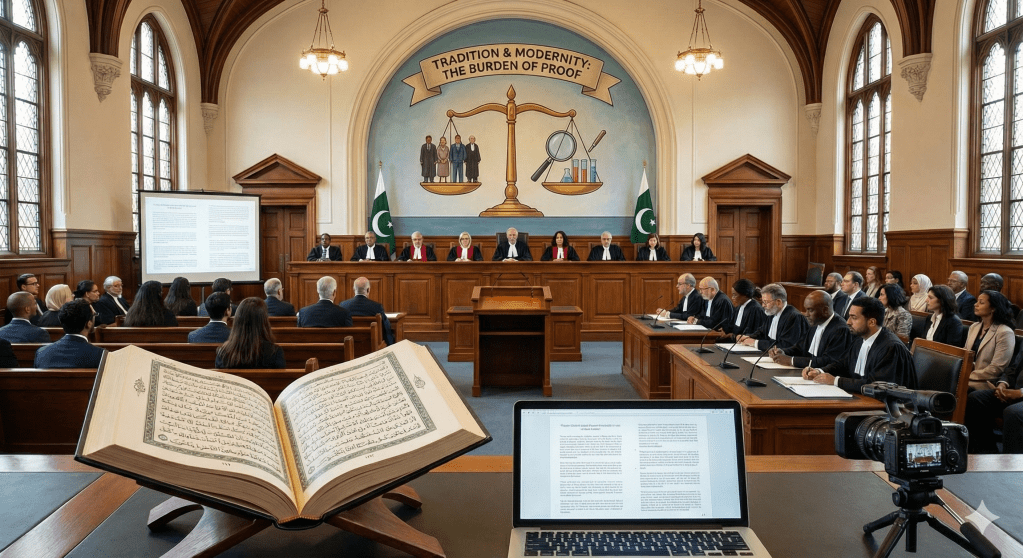
Presented by Zia H Shah MD
Abstract
Quran 24:1–6 (Surah An-Nur, “The Light”) establishes foundational Islamic guidelines on chastity, justice, and the sanctity of personal honor. These opening verses introduce the prescribed punishment for adultery (zina), discourage believers from marrying those persistently unchaste, and set a stringent standard – four eyewitnesses – for any accusation of sexual misconduct. Classical Muslim scholars have elucidated these commands as measures to protect moral society and individuals’ reputations, revealed amid real events in the Prophet’s community. Contemporary scholars build on this understanding to argue that the essence of these laws – ensuring strong proof and preventing false accusations – remains paramount, even if the means of evidence have evolved. In the 7th-century context, requiring four eyewitnesses effectively deterred slander and invasion of privacy; in today’s context, forensic evidence (e.g. DNA) and other clear proofs can serve the same purpose. This commentary explores the classical exegesis and modern applications of Quran 24:1–6, highlighting how a literalist adherence devoid of context can undermine justice, whereas fidelity to the spirit of the law upholds the Quran’s true message. A thematic epilogue reflects on balancing text and intent in understanding divine law.
Introduction and Context of Revelation (24:1)
Verse 1 of Surah An-Nur is a solemn preamble: “[This is] a surah which We have sent down and made [its rulings] obligatory; and We sent down in it clear verses so that you may take heed.” This introduction alerts believers to the surah’s serious legal and ethical injunctions. Classical commentators note that by explicitly declaring the surah’s commands “obligatory” (faradna-ha), the Quran emphasizes compliance with what follows. Indeed, Surah An-Nur was revealed in Madinah and addresses community morality and legal standards; it notably came in the aftermath of the infamous “Great Slander” (Hadith al-Ifk) against ʿAisha (the Prophet’s wife), where false accusations of adultery were spread by hypocrites. The rulings in verses 4–5 (requiring four witnesses and punishing slanderers) were directly aimed at preventing such devastating defamation in the future. Thus, verse 1 sets the stage: An-Nur’s guidelines are “clear verses” from God, meant to protect the nascent Muslim community’s moral fabric and honor. Both classical and modern scholars stress that this verse underlines the divine authority and wisdom behind these laws, cautioning believers to observe not just the letter but also the objectives of the guidance that follows.
Punishment for Adultery – 100 Lashes (24:2)
Verse 2 prescribes the hudud punishment for zina (fornication or adultery): “The [unmarried] female and male found guilty of illicit sexual intercourse – flog each of them with a hundred lashes, and let not compassion for them keep you from carrying out Allah’s law, if you believe in Allah and the Last Day; and let a group of believers witness their punishment.” In classical exegesis, this ayah is taken as a general ruling for sexual misconduct. It mandates 100 lashes for each perpetrator, to be applied publicly (hence the instruction to have believers witness, as a deterrent and communal warning). The verse also pointedly warns judges and authorities not to let pity or social status prevent enforcement of this divinely ordained penalty. Early Muslim scholars like Ibn ʿAbbas interpreted the term “adulterer and adulteress” here as referring primarily to unmarried fornicators, noting that the Prophet (ﷺ) supplemented this verse by establishing a stricter punishment for married adulterers based on his Sunnah. In hadith, the Prophet said: “Take from me this ruling: for virgins [unmarried persons], it is one hundred lashes and exile for a year; for previously married persons, it is one hundred lashes and stoning.”. The second Caliph, Umar, even stated that there was once a Quranic verse about stoning that did not remain in the written text, but its legal force was retained by consensus. Classical jurists thus unanimously held that a married person guilty of proven adultery faced rajm (stoning to death) as hadd, whereas verse 24:2’s hundred lashes was applied in cases of fornication (unmarried zina). Some more literalist or modernist interpreters have questioned the authenticity of stoning since it’s not explicitly in the final Quran, but the historical ijma’ (consensus) in classical scholarship accepted it via hadith.
From a values perspective, scholars like Al-Qurtubi observed that the Quran’s insistence on not yielding to pity in executing the punishment reflects the priority of justice over misplaced leniency in serious moral crimes. However, they also noted that Islam encourages repentance – a theme seen later in verse 5 regarding slanderers – and that punishments expiate the sin in the Hereafter. The requirement to carry out flogging publicly (“let a party of believers witness”) serves both as humiliation for the offender and as a sobering example to society. Modern commentators often add that these severe hudud penalties were meant to maintain social order and deter sexual crimes in a small, close-knit community. Importantly, classical law set a very high evidentiary bar to actually implement such punishments (as verses 4–6 will elaborate) – demonstrating that while the penalty for adultery is harsh, proving the crime was intentionally made difficult, thereby protecting privacy and limiting enforcement to only the most incontrovertible cases.
Discouraging Immorality in Marriage Choices (24:3)
Verse 3 declares: “The adulterer shall marry none except an adulteress or an idolatress, and the adulteress shall marry none except an adulterer or an idolater. That [i.e. such a union] is forbidden to the believers.” This verse has been understood by classical scholars as a prohibition on knowingly entering into marriage with an unrepentant fornicator or with someone who associates partners with God (a mushrik). In essence, a chaste believing man or woman should not marry a person who is openly immoral (committing zina) or polytheistic. Exegesis by scholars like Imam Al-Tabari and Ibn Kathir relates that this verse was revealed in part to prevent Muslims from joining in wedlock with prostitutes or those of grossly impure lifestyle. A reported context is that a Muslim man asked the Prophet’s permission to marry a notorious prostitute (known as Umm Mahzul) on the condition that she would financially support him; verse 3 was recited to discourage this arrangement. Likewise, Abu Hurayrah narrated that “a flogged adulterer should marry none but someone like him”, underscoring that a grossly immoral person is only befitting for someone of similar character.
Classical jurists debated the legal extent of this “forbidden” marriage. Most viewed it as an advisory and moral injunction rather than an absolute nullification of such a marriage if it occurred. Renowned exegete Abu’l-Aʿla Maududi explains that verse 3 warns believers not to knowingly give their daughters or sons in marriage to unabashed fornicators; such a sinner is unfit for a virtuous believer unless and until they repent and reform. If genuine repentance is made, the person is no longer considered an “adulterer” in the eyes of God or community, and marriage with them would not be prohibited. Maududi clarifies that this verse is meant to stigmatize the act of zina by saying, in effect, “one who persists in such sin has debased themselves to the level that only an idolater (who denies divine law entirely) or another adulterer would accept them”. Imam Ahmad ibn Hanbal held a stricter view that a marriage contract with an adulterer would have no legal effect (i.e. considered invalid), but the majority did not go that far, understanding the verse as a strong deterrent and social directive, not an automatic annulment of sinful marriages. Contemporary scholars tend to read verse 3 as emphasizing compatibility in values: A believer committed to sexual purity should seek a like-minded spouse, for marrying an unrepentant philanderer invites discord and moral compromise in the home. In all, verse 3 complements the legal rulings by promoting a morally upright marital environment, thereby fortifying the social fabric against promiscuity.
False Accusation and the Four-Witness Rule (24:4–5)
Verses 4 and 5 address the crime of false accusation of adultery, known in Islamic law as qadhf. Verse 4 proclaims: “Those who accuse chaste women [of adultery] and then do not produce four witnesses – flog them with eighty lashes, and do not ever accept their testimony thereafter. They are indeed transgressors.” This stern injunction was revealed to combat slander and unsubstantiated allegations of sexual immorality, which could destroy lives and reputations. Classical commentators emphasize that although the verse explicitly mentions accusing chaste women, the same punishment applies if someone slanders a chaste man. The verse imposes a three-fold penalty on the false accuser who fails to back up their claim: (1) 80 lashes as corporal punishment, (2) permanent rejection of their credibility as a witness, and (3) branding them as fasiq (rebellious evildoer) in the sight of society and God. This is a hadd punishment (fixed by Allah), and classical jurists from all schools concurred on its implementation. Only if the accuser subsequently repents and reforms (verse 5 adds “except those who afterward repent and do righteous deeds…”) can penalties #2 and #3 be lifted – meaning, a truly penitent slanderer might have their testimony considered again in future and no longer be seen as an incorrigible fasiq. However, the flogging (80 lashes) must still be carried out in any case of proven slander; repentance spares one’s soul and future standing, but it does not undo the worldly punishment once the offense is established.
The requirement of “four witnesses” is central to these verses and perhaps one of the most crucial (and often misunderstood) evidentiary rules in the Quran. Classical exegetes like Al-Qurtubi underscore that this extremely high standard of proof was intended to “make such accusations nearly impossible without overwhelming proof”, thereby shielding people’s honor from rumor, gossip, and sexual slander. In practical terms, Islamic courts historically required four adult, sane, trustworthy eyewitnesses who each saw the act of penetration itself clearly – a virtually unattainable scenario unless a couple fornicates in public view. This was no accidental loophole; it was a deliberate feature of Islamic law. As one analysis puts it, “the evidentiary requirement of four eyewitnesses to the act of penetration is so impossibly high that the law’s primary function is not to punish the (adulterer), but to punish the accuser”. In other words, Qur’anic law prioritizes protecting individuals from false accusations over aggressively policing private sins. The revelation came soon after the community had been rocked by false allegations against ʿAisha – teaching a timeless lesson that a person’s honor is sacred and the bar for tarnishing it must be extraordinarily high. Thus, verse 4 ingeniously creates a “social failsafe”: unless one has incontrovertible proof (four witnesses) of someone’s adultery, they had better remain silent, or face grave consequences themselves. This shifted the focus away from spying or prying into people’s private lives and instead strongly deterred the spread of unsubstantiated claims.
Classical juristic works record how this rule was enforced. There’s the famous case of al-Mughira ibn Shuʿba at Caliph Umar’s time, where three witnesses swore they saw him commit adultery, but the fourth witness gave inconsistent testimony – as a result, the accusers were flogged for qadhf (and no adultery conviction occurred) because the strict threshold was not met. The wisdom, as noted by scholars ancient and modern, is to uphold the principle “better to err on the side of acquitting the guilty than punishing the innocent.” Islam’s Prophet (ﷺ) said to avoid hudud punishments in cases of doubt, and requiring four witnesses for zina virtually ensured doubt unless the act was flagrantly public. Maqāṣid (higher objectives) scholars today often cite this rule as evidence that Islamic law’s goal was to safeguard honor and privacy – effectively, to prevent scandals and vigilante morality policing. The 80-lash punishment for false accusers further hammers in how serious such slander is; as one commentary notes, it amounts to a “social death” for the slanderer, who not only endures whipping but also loses all credibility in society thereafter. The Quran’s severe treatment of slander thus serves as a powerful deterrent against character assassination, recognizing the “immense value Islam places on protecting individual honor” and social cohesion.
Verse 5, “except those who repent afterwards and mend their conduct…”, offers a ray of hope for reform. Classical authorities differed on whether a slanderer’s later taubah (repentance) fully restores their legal credibility. Many, including Saʿid ibn al-Musayyib (a leading successor), held that sincere repentance reinstates the person’s admissibility as a witness and lifts the stigma of fisq. Others like al-Shabi and al-Dahhak were more cautious, suggesting that only if the accuser admits their lie could their testimony be accepted again. In any case, spiritually Allah promises forgiveness to the truly penitent. Modern commentators tend to emphasize Allah’s mercy here – even one guilty of such a grave sin as falsely ruining someone’s honor can earn pardon by turning back to righteousness. This balances the hardline approach of verse 4 with the compassion inherent in Islam: while society must punish and discourage slander, individuals are encouraged to repent and seek God’s mercy, which is always available.
Spousal Accusation and the Li‘ān Oath (24:6)
Verse 6 addresses a special scenario: “As for those who accuse their own wives [of adultery] and have no witnesses except themselves – then the testimony of one of them shall be four oaths [swearing] by Allah that indeed he is truthful.” This introduces the procedure of liʿān (mutual cursing or imprecation) between a husband and wife. In an ordinary accusation, a lone accuser without witnesses would be guilty of slander under verse 4. But the painful predicament of a husband who personally catches his wife in adultery (or doubts a pregnancy’s paternity) had to be addressed – he cannot reasonably produce four witnesses to his wife’s infidelity, yet if he stays silent he lives in torment, and if he speaks he faces 80 lashes for qadhf. The historical context of verse 6 is indeed a case of this nature: a Companion named Hilal ibn Umayyah accused his wife of adultery after seeing her with another man. He reported this to the Prophet (ﷺ), who initially told him, “Bring proof or you will receive the punishment (for slander)”, knowing Hilal had no other witnesses. Hilal pleaded, “O Messenger of Allah, I saw her with my own eyes, Allah will make a way out for me.” In response, Allah revealed verses 6–9 of Surah An-Nur, establishing liʿān as the divinely ordained solution for such cases. Verse 6 (along with verses 7–9 that follow) thus lifts the normal requirement of four witnesses only in the context of a husband accusing his wife, by allowing a series of solemn oaths to substitute for eyewitness testimony.
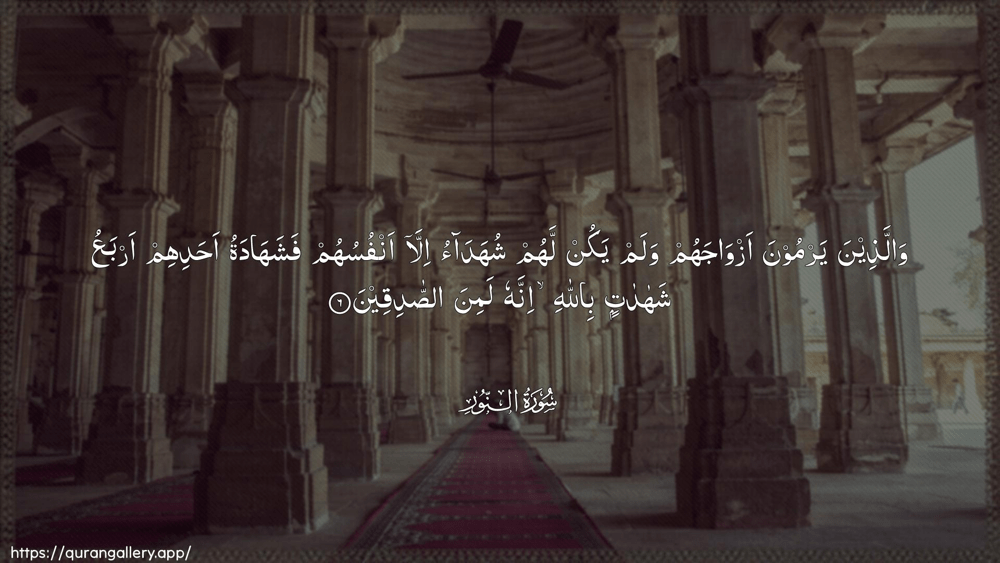
Quran 24:6 in Arabic (Indo-Pak calligraphy script): “And those who accuse their wives and have no witnesses except themselves – then the testimony of one of them shall be four testimonies [swearing] by Allah that indeed he is truthful.”
In classical Islamic law, the liʿān process is a formal court procedure with the following steps: The husband publicly swears four times by Allah that he is telling the truth about his wife’s adultery (each oath effectively standing in place of one witness, hence four oaths). For the fifth oath, he invokes Allah’s curse (laʿnah) upon himself if he is lying. These five declarations on the husband’s part fulfill his “testimony” as described in verse 6 (and verse 7 which adds the fifth curse). If the husband completes this procedure, he is spared the 80-lash penalty that a normal accuser would suffer – essentially, his oaths elevate the matter to God’s judgment, as he calls divine curse on himself if untruthful. The wife, however, is then given the chance to defend herself and avert punishment: verse 8–9 (following verses) explain that she can likewise swear four oaths by Allah that her husband is lying, and a fifth oath invoking Allah’s wrath (ghadab) on herself if he is truthful. If she undergoes liʿān, she is spared the hadd punishment for adultery (which would have been stoning or lashes) since her counter-oaths negate his claim. The choice is hers – she could also decline to swear, in which case the hadd for adultery would be carried out on her – but in practice, women would perform the oaths to assert innocence. Once both sides have sworn, the consequences of liʿān are far-reaching and final: The husband and wife are immediately and irrevocably divorced and can never reunite in marriage after this solemn damnation of their union. If the accusation involved denial of paternity of a child, that child is legally disavowed from the husband (attributed solely to the mother) with no stigma on the child – this protects the husband from raising a child he swore is not his, while also freeing the child from any punishment (since the child did nothing wrong). Moreover, both parties walk away unpunished by worldly law: the husband is not flogged for slander and the wife is not punished for adultery, with the matter “left to Allah” to judge between them on Resurrection Day. Classical jurists saw this as a merciful relief valve in the law: it resolves an “agonizing dilemma” by transferring the case “from human courts to the ultimate judgment of Allah”. Neither side can remarry each other, preventing them from returning to an acrimonious union, and both have effectively called God as a witness to their truthfulness or guilt. The Prophet (ﷺ) enforced liʿān in Hilal’s case and others, and it became an established part of Islamic family law thereafter (though incidences have historically been rare).
From an ethical viewpoint, liʿān demonstrates how the Sharia balances strictness with compassion. Normally, without four witnesses a husband’s accusation would be dismissed and he punished for slander; with liʿān, God allowed an alternative path acknowledging the unique pain of marital betrayal. Yet, the process is made so solemn and severe – invoking divine curse and wrath – that it is not taken lightly. In effect, it warns spouses: do not ever falsely accuse, for you’ll damn yourself if lying; and do not betray, for God may expose you. It also spares any innocent party: if the husband was truthful, he is relieved of the wife and stigma; if the wife was truthful, she swears innocence and is free from him. Modern legal systems in Muslim countries still recognize liʿān in personal status laws (for example, as grounds for judicial divorce). With the advent of DNA testing, some contemporary scholars have revisited liʿān especially for paternity cases – more on this below – but the principle remains that the honor of both spouses and the sanctity of lineage are to be upheld, either through evidence or through sworn oaths that place the fear of God into the hearts of the accuser and the accused.
The Four-Witness Rule: 7th-Century Necessity and Modern Application
The Quran’s insistence on four eyewitnesses in cases of adultery (or else 80 lashes for accusers) made eminent sense in the 7th-century world of Arabia. This was a society without forensic science, surveillance cameras, or reliable documentary evidence; testimony was the primary means to establish facts. By requiring not one or two but four eyewitnesses to the act of zina, the Quran set an almost unreachable bar, effectively curtailing people from even attempting to prosecute such sins in ordinary circumstances. Classical scholars understood the wisdom behind this: it was meant to protect women (and men) from unfounded smears, and to uphold a community ethic that discouraged prying into others’ private affairs. As the modern writer Kaya Gravitter succinctly notes, “The four-witness requirement was revealed in the context of slander — specifically, false accusations of adultery against women. Its purpose was to make such accusations nearly impossible without overwhelming proof, thereby shielding women’s honor from rumor, gossip, and sexual weaponization.” It was never intended as a standard for proving rape, because rape (ightiṣāb in Islamic law) is a completely different offense (a violent coercion, not a mutual act). Indeed, classical jurists categorized rape under hirabah (violent crime) or as a form of zina with coercion (zina bil-ikrah), where the female victim is blameless and does not require any punishment or four witnesses on her behalf. They viewed the four-witness rule as applicable to voluntary adultery/fornication accusations – essentially to prevent malicious prosecutions – whereas a rape victim’s claim was never meant to be silenced by this rule. Unfortunately, as we will discuss, some later interpretations (or misapplications in legal codes) conflated the two, causing the very injustice the Quran sought to avoid.
In today’s era, the essence of the four-witness requirement can be fulfilled by modern forms of strong, clear evidence. Where 7th-century Arabia had no concept of forensic proof, 21st-century technology can often provide near-certain proof of sexual crimes or paternity. DNA evidence is one such game-changing tool. If, for example, DNA from a rape kit matches the accused, this can be more conclusive than multiple eyewitnesses. Many contemporary Islamic jurists affirm that “a rapist can be convicted on lesser evidence (including scientific evidence such as DNA tests and medical reports). The four-witness requirement applies only to the hadd punishment in case of adultery.”. This quote from Sheikh Faraz Rabbani (echoing top jurists like Mufti Taqi Usmani) emphasizes that Islam does not demand an impossible burden from rape victims. The spirit of the law is to require proof beyond reasonable doubt, not necessarily four human eyewitnesses, especially when other forms of evidence can achieve the same or greater level of certainty. In fact, even centuries ago, classical scholars implicitly acknowledged other evidence: for instance, pregnancy of an unmarried woman was taken as prima facie proof of zina in the absence of a husband, unless she claimed coercion or rape – at which point, her allegation of rape would be investigated and she would not be punished if found credible. Likewise, physical signs of struggle or injury, or the victim’s outcry (istighatha), were considered supportive evidence that could exonerate a rape victim from any charge of fornication and could implicate the assailant. The objective behind requiring four witnesses was to assure the community that accusations were not false. Now that we have tools like DNA, CCTV footage, and advanced investigation techniques, an array of evidentiary means can similarly assure the truth of an accusation. Modern Islamic legal thinkers argue that to slavishly insist on “four eyewitnesses or nothing” in the face of such compelling scientific evidence is to betray the Quran’s intent, not uphold it.
We see practical examples of this evolution: In many Muslim-majority countries’ courts today, DNA tests are admissible to establish paternity or identify perpetrators of sexual violence. For instance, in cases of contested paternity (related to liʿān situations), contemporary scholars have debated the use of DNA. A 2002 fatwa by the Muslim World League’s Fiqh Council recognized DNA testing as “an effective scientific method, yielding near-certain results” for verifying lineage – essentially a modern equivalent of the old Arabian practice of qiyāfa (physiognomy) used to infer paternity. The council held that DNA evidence can be used to support or even supersede weaker traditional proofs in paternity disputes, so long as it doesn’t contradict an established legitimate lineage. This shows a willingness among Islamic jurists to integrate modern knowledge in service of justice. In the context of rape cases, there has been considerable reform in some countries. After decades of problematic enforcement of Pakistan’s old Hudood ordinance – where rape was treated as zina requiring four witnesses – the law was changed in 2006 to allow rape to be proven by forensic and circumstantial evidence, moving it out of the zina category. Today, most Muslim scholars agree that the hadd of zina (with its four-witness standard) does not apply to rape victims at all, and rapists should be punished based on any proof that establishes guilt with certainty. For example, the Council of Islamic Ideology in Pakistan, which initially resisted DNA as sole proof, conceded that DNA could be used as supporting evidence alongside other proofs. And in many jurisdictions, rapists are convicted under taʿzir (discretionary punishment) when the strict hadd standards are not met, ensuring they do not walk free. The underlying rationale is fully in line with Quranic justice: protect the innocent and punish the guilty with truth-established evidence.
It must be noted, however, that some conservative voices are wary of over-reliance on technology. They argue, for instance, that DNA evidence, while powerful, is not infallible (errors or lab fraud can occur) and thus they prefer it as corroboration rather than primary proof. Nevertheless, this is a matter of procedure – no serious scholar today says a woman must bring four eyewitnesses to “prove” she was raped, as that would be an absurdity against both reason and the Sharia’s spirit. In fact, such a demand would invert justice, protecting the perpetrator and punishing the victim – a result utterly at odds with Islamic ethics. The contemporary consensus is encapsulated by Gravitter: “To demand four eyewitnesses to a rape is to misunderstand the Quran’s intent, ignore Islamic legal tradition, and weaponize scripture against the violated. That inversion is injustice (ẓulm).”. The Quran came to eliminate ẓulm, not foster it. So, while the letter of the Quran stipulated four witnesses in its 7th-century milieu, the living legacy of that law is ensuring accusations are proven by the clearest evidence available in any age – be that honest eyewitnesses or a DNA fingerprint. The Maqasid al-Shariah (objectives of Islamic law) approach supports this adaptation, aiming to preserve the values of justice, protection of honor, and security of lineage that the four-witness rule embodied.
Literalism vs. Essence: The Perils of Misreading the Quran
When fundamentalists insist on reading the Quran’s legal texts in a strictly literal or historical way without regard to context or purpose, they risk losing the message and causing harm. Surah An-Nur 24:1–6 provides a vivid example. The literal words say “produce four witnesses or flog the accuser” – and a rigid, context-blind implementation of this by some zealots led to grotesque outcomes like rape victims being accused of adultery because they, by nature of the crime, could not have four eyewitnesses to corroborate them. This tragic misapplication occurred under Pakistan’s Hudood laws (1979–2006), where several women who reported rape found themselves facing zina charges when they couldn’t meet the medieval standard of proof. Such an approach utterly betrays the Quran’s intent. The Quran distinguished clearly between consensual zina and forcible rape – the former being a sin/crime by two willing parties, the latter being a violent crime against an unwilling victim. Classical fiqh books never required a rape victim to bring witnesses; her claim plus supporting evidence (injuries, screams heard, etc.) were sufficient to spare her any blame and to punish the rapist under discretionary judgments. Thus, when some hardliners conflated the two and said “No witnesses, no rape case,” they were not following Shariah but a gross distortion of it. Literalism in this case produced the opposite of justice – effectively providing rapists a license to offend in private and silencing victims, which the Quran never intended. Gravitter poignantly remarks, “Any system that treats a raped woman as suspect while protecting her violator has abandoned the Quran’s moral framework entirely… God does not confuse rape with sin. Men do.”.
Beyond the issue of rape, a solely literal reading can miss the spirit in other ways. For example, someone might focus on the physical punishment of 100 lashes in verse 2 and push for implementing it state-wide, yet ignore the equally important implication that proof must be near-absolute and that repentance is valued. Or one might read verse 3 and think it permanently condemns sinners from ever marrying a believer, ignoring the clause of repentance and mercy. The Khawarij mentality (an extremist sect in early Islam) often involved lifting Quranic verses from context and applying them uncompromisingly, which led to egregious takfir (excommunicating sinners) and vigilantism – behaviors the Prophet strongly warned against. In our times, ISIS and the Taliban, for instance, claimed to enforce Quranic hudud literally, but their “justice” often lacked the Quran’s mandated due process and compassion, thereby undermining the higher intent of Shariah: justice tempered with mercy and oriented toward reform. Verse 2 says “let not compassion stop you” in carrying out punishment if guilt is proven, but the Prophet’s example shows he actively encouraged concealing others’ sins and avoiding hadd punishments if any doubt exists. Fundamentalists obsessed with the letter may publicly flog or stone people (sometimes on flimsy evidence or coerced confessions), thinking they are upholding Quran, when in reality they violate the Quran’s preventive mechanisms (like the four-witness rule and the principle of shubha (doubt) halting hudud) put in place to protect the innocent. This is the very “loss of the message” that occurs when the outer form of scripture is followed without grasping its inner rationale.
Mainstream Islamic scholarship urges a balance: literal compliance in ritual worship, but in social laws, a maqasid-based understanding that looks to the objectives. The Quran’s laws were not arbitrary; they aim to promote certain outcomes – truth, fairness, moral society, protection of dignity, etc. If new circumstances provide better ways to achieve those Quranic ends, scholars have argued, then employing those means is not abandoning the Quran but rather being faithful to it. A relevant example is how almost all contemporary scholars accept fingerprint or digital evidence for theft cases, whereas classical jurists required two eyewitnesses for amputation of a thief. Using technology to catch a thief does not violate the Quranic verse on theft; it upholds its intent (punish the guilty) with even more precision. Similarly, using DNA to establish zina or rape meets the Quranic evidentiary ethos (“proof so strong that falsehood is extremely unlikely”) even if it’s not a “witness” in the classical sense. It would be a tragic irony for Muslims to insist on medieval methods and end up defeating the law’s purpose. As one Muslim writer said, “Islam does not require women to prove their pain. It requires society to stop committing injustice in God’s name.”. Thus, a faithful, non-fundamentalist approach to Quran 24:1–6 (and all Quranic injunctions) is to follow the text and the taught wisdom behind it. Those who “refuse to distinguish between entirely different acts and words”, or collapse categories the Quran kept distinct, end up, in Gravitter’s words, with “linguistic ignorance and ethical failure”. Muslims believe the Quran’s guidance is just and merciful; if an interpretation yields cruelty and absurdity, it signals a misinterpretation. The fundamentalists’ error is often over-simplification: they isolate a rule from its context, whereas the true message lies in the harmony of text, intent, and circumstance.
Thematic Epilogue
The opening verses of Surah An-Nur weave together themes of moral discipline, justice, and social well-being that resonate across ages. They begin with an assertion of divine authority (24:1) – reminding us that these are not mere human conventions, but wise limits set by the Creator to nurture a healthy community. The command to flog adulterers (24:2), though stern, underscores the priority of family sanctity and public decency in Islam; yet it is paired with procedural safeguards (the requirement of witnesses) that display profound divine mercy by making punishment rare. We see a delicate balance: Islam neither trivializes sexual sin nor permits witch-hunts under the guise of piety. The prohibition of marrying those openly immoral (24:3) teaches that values and character must form the foundation of a Muslim’s personal relationships – a principle as relevant now as ever, when choosing a spouse means looking beyond surface and assessing their commitment to fidelity and faith. Verses 4–6 elevate the discourse to the societal level, establishing a robust defense of individual honor: they tell us reputations are not playthings, and anyone who casually besmirches others must face dire consequences. In an era of social media gossip and trial-by-public-opinion, this Quranic principle could not be more pertinent – it implores us to verify information, avoid reckless accusations, and remember that from Allah’s perspective, protecting an innocent person’s honor is a matter of great weight.
Crucially, this commentary has highlighted how the essence of these rulings endures even as the mechanisms adapt with time. The seventh-century requirement of four eyewitnesses achieved the Quran’s aim of practically nullifying false charges; the 21st-century incorporation of forensic evidence aims to achieve that same aim – certainty in establishing guilt and innocence – through the best God-given tools we have. Far from being a departure, this is a fulfillment of the Quran’s ethos in a new context. The spirit of Surah An-Nur is that justice must be manifest and tempered with compassion. Fundamentalists who freeze the law in literal amber miss that the Quran came as “light upon light” – it provided light (guidance) for a specific situation, but also the light of reasoning to apply its morals afresh in each age.
In conclusion, Quran 24:1–6 teaches a community how to uphold virtue while preventing vice from turning into vigilante chaos. The verses reflect a deep understanding of human behavior: severe punishment to deter real crimes, yet nearly insurmountable proof requirements to deter false allegations. This dual protection – of society’s moral order and of individuals’ dignity – is the hallmark of Islamic law at its best. As we carry these principles forward, we remember that Allah describes this surah’s verses as “clear” and “obligatory” for us to ponder and implement. Clarity, however, is not only in the letter but in grasping the purpose. By embracing both the letter and the spirit – by lashing only the truly guilty, by rejecting scandal-mongers, by honoring the sanctity of marriage, and by never confusing oppression for piety – believers ensure that the Nur (light) of these verses continues to illuminate hearts and societies. And in that enlightenment, we find the true message of the Quran: justice, tempered with mercy; law, enriched by compassion; and humanity, dignified under God’s guidance.
Footnotes:
- Quran 24:4–5 – Tafsir Ibn Kathir, summarizing the punishment for slander (qadhf).
- Kaya Gravitter, Medium (Dec 19, 2025) – Explaining the intent of the four-witness rule and distinction between zina and rape.
- Quran Gallery (2026) – “Deeper Insights” into Quran 24:4, highlighting how the high evidentiary bar protects privacy and shifts focus to punishing slander.
- Faraz Rabbani (citing Mufti Taqi Usmani) – Clarification that rape in Islamic law can be proven with lesser evidence including DNA; the four-witness requirement is specific to adultery.
- Stabroek News (Jan 9, 2013) – Letter to the editor discussing the wisdom of the four-witness rule in a pre-forensics age and its objective to prevent false rape allegations.
- Quran 24:6 – QuranGallery (2026) – Context of revelation (Hilal ibn Umayyah’s case) and explanation of the liʿān procedure and consequences.
- Tafsir Maududi on Quran 24:3 – Adultery and marriage; immoral persons are not fit spouses for believers unless they repent.
- Hadith (Sahih Muslim, etc.) – Prophet’s Sunnah on zina: 100 lashes (and exile) for unmarried, stoning for married adulterers. (See also Caliph Umar’s statement on the stoning verse).
- Council of Islamic Ideology, Pakistan (2013) – Resolution on DNA as supporting evidence in rape cases, reflecting conservative caution.
- Islamic Fiqh Council (2002, Mecca) – Resolution on DNA testing for paternity: accepted as near-certain proof, to be used within Sharia’s framework (e.g., in liʿān cases to verify claims).
- Quran 24:11–20 (not part of this question’s scope) addresses the Incident of Slander (Ifk) in detail, vindicating ʿAisha. It complements verses 4–5 by emphasizing how Allah exonerates the innocent and warns against spreading unverified talk. This context underscores why Quran 24:4 set such a high bar for accusations.
If you would rather read in Microsoft Word file:



 The Glorious Quran and Science
Leave a comment