
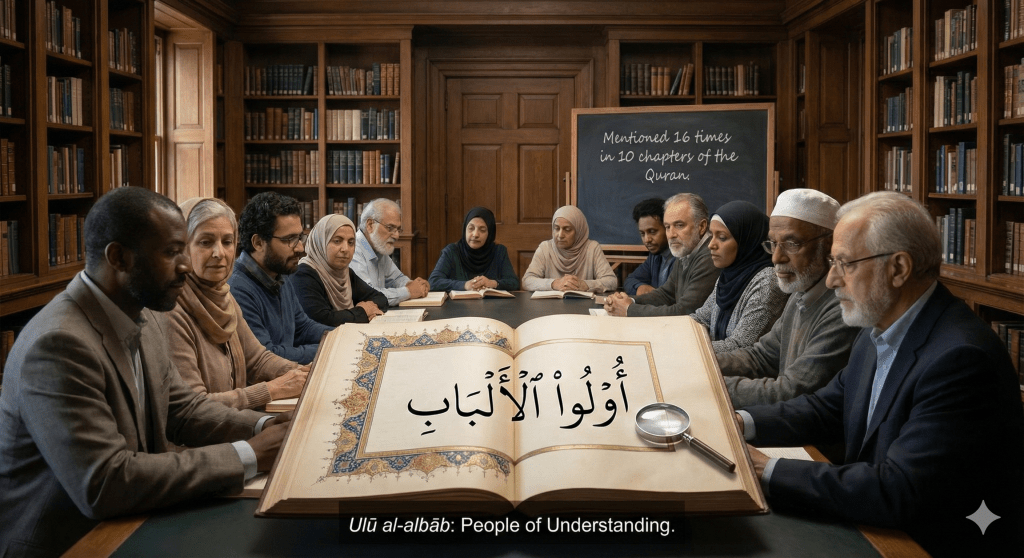
Presented by Zia H Shah MD
Abstract
The Qur’an repeatedly praises the Ulū al-Albāb – a term meaning “people of core intellect” or “those of understanding” – as the individuals who truly grasp its guidancethequran.lovethequran.love. By appealing to reason, reflection, and sincerity of heart, the concept of Ulū al-Albāb nurtures a Quranic reading that transcends sectarian boundaries. All Muslims, regardless of sect, are invited to engage both mind and soul with the Quran’s signs in scripture and nature. True understanding in Islam is holistic, integrating knowledge, spiritual insight, and moral sensibilitythequran.love. Such an enlightened approach exposes the myopia of sectarian divides: no single sect can monopolize the Quran’s wisdom, for God’s words are infinite and inexhaustiblethequran.love. In this article, we explore how embracing the ethos of Ulū al-Albāb leads to a non-sectarian reading of the Glorious Quran – one that bridges divides by focusing on the timeless core of divine guidance. An inspiring thematic epilogue envisions Muslims united as “people of understanding,” jointly illuminated by the Quran’s wisdom beyond all sectarian silos.
Introduction: One Quran, Divergent Readings
All Muslims revere the same unaltered Quran, yet historical interpretations have splintered along sectarian linesthequran.love. Sunnis, Shīʿa, Ismāʿīlīs, and others developed distinct tafsīr (exegesis) traditions, each often operating within its own “parochial box” of preferred sources and methodsthequran.love. Over centuries, these approaches hardened into sectarian silos, where each group prioritized its commentary heritage and sometimes spoke past the othersthequran.love. For example, classical Sunni exegesis leaned on hadith and early scholars, Twelver Shīʿa emphasized Imams’ teachings, while others pursued esoteric or rationalist readingsthequran.lovethequran.love. This divergence, compounded by the limits of medieval knowledge, meant that vast portions of the Quran – especially verses about nature and the cosmos – were under-explored, whereas legal and doctrinal verses fueling sectarian debate received disproportionate attentionthequran.love. The result has been a tapestry of interpretations, each illuminating certain truths but also narrowing perspective to sect-specific concernsthequran.lovethequran.love.
Amid this diversity, the Quran itself provides a corrective lens. It proclaims that if all the oceans were ink, they would dry up before God’s words are exhausted (Qur’an 18:109), and that even if all trees were pens and more seas of ink added, “the words of Allah would not be exhausted” (31:27)thequran.love. These verses remind us that no single school or scholar can claim a monopoly on understanding the Quran’s infinite wisdomthequran.love. They call believers to humility and openness: the Quran’s meaning is layered and limitless, ever inviting fresh reflection. Recognizing this is essential to move beyond narrow sectarian exegesis and approach the Quran as universal guidance for all humanitythequran.love. In this spirit, the Qur’an addresses Ulū al-Albāb – the people of deep understanding – as an ideal audience capable of rising above superficial differences. Embracing the ethos of Ulū al-Albāb offers a way to reconcile divergent readings into a cohesive, non-sectarian understanding of the Glorious Quran.
Ulū al-Albāb: People of Core Intellect
The Arabic term Ulū al-Albāb linguistically combines ulū (“possessors of”) with albāb, the plural of lubb, meaning “core” or “essence.” Thus, Ulū al-Albāb are “people of the core intellect” – those who possess a pure, essential understanding unclouded by superficialitiesthequran.love. Classical scholars likened the lubb to the kernel within a nut: one must remove the hard shell to reach the nourishing corethequran.love. Likewise, the person of understanding peels away the husk of whims, ego, and prejudices to arrive at truththequran.love. As one commentary describes, Ulū al-Albāb refers to those with “sound, pure, and healthy minds… capable of looking beyond the surface to grasp the core realities of existence.”thequran.love. They are not swayed by outward allure or partisan bias; instead, they seek the fundamental wisdom beneath appearances.
In the Qur’an, Ulū al-Albāb are consistently portrayed as people who learn, reflect, and take heed of divine signsthequran.love. They unite intellectual reasoning with remembrance of God and a keen moral sensethequran.love. This means they are more than just learned individuals or “book-smart” scholars – they engage their hearts alongside their minds. Ibn Kathīr and other exegetes note that those endowed with such understanding gain elevated rank, benefiting from guidance in ways others do notthequran.lovethequran.love. Indeed, many Quranic verses conclude with phrases like, “None will take heed except those of understanding.” Such reminders imply that while the Quran addresses all humanity, only those who cultivate this inner core of insight truly absorb its lessonsthequran.love. In fact, the Quran sometimes speaks directly to Ulū al-Albāb, almost as if singling out the intelligentsia of faith. “So fear Me, O people of understanding,” Allah says in one verse, and “Take warning, O people of understanding,” in anotherthequran.love. It is both a compliment and a responsibility: God’s guidance is “a reminder for those of understanding”, and those who fail to respond with understanding miss the very point of revelationthequran.love.
Crucially, any believer can aspire to be among Ulū al-Albāb – this term is not the province of a sect but of a mindset. The Quran honors thinking, perceptive believers as its ideal readersthequran.love. To be “people of understanding” is to have a mind and soul attuned to the deepest truths, cutting across labels and group loyalties. It is a Qur’anic honor open to all who are willing to purify their intellect from bias and engage with God’s message sincerely. This universality makes Ulū al-Albāb a unifying ideal for Muslims: a call to focus on the core of faith that binds rather than the shells that divide.
Faith and Intellect as Complementary Guidance
In Islamic thought, faith (īmān) and intellect (ʿaql) are complementary lights that guide the believer. Far from demanding blind faith, the Quran relentlessly encourages the use of reason. It asks, “Do they not reflect?… Will you not use your reason?”thequran.love – urging believers to ponder creation, question unjust practices, and seek understanding. This ethos is epitomized by the address to Ulū al-Albāb, who are called upon precisely because they will think deeply. The Quran’s worldview integrates rational inquiry with spiritual devotion at every turn. Through the sixteen verses that mention Ulū al-Albāb (spanning ten different surahs), the scripture highlights the role of human intellect in various domains: grasping moral law, appreciating the signs in nature, learning from history, and morethequran.love. In each case, the message is that true understanding is not a dry, cerebral exercise, but an active engagement of mind and heart togetherthequran.love.
The Quran underscores that “true understanding (ulū al-albāb) is not mere abstract reasoning, but an integration of knowledge, spiritual insight, and moral sensibility.”thequran.love In other words, the highest form of comprehension involves the whole human being – ethics, spirituality, and intellect reinforcing one another. Islam envisions faith and intellect as mutually reinforcing forces: “Only those who possess insight will remember,” says the Quran, melding remembrance of God with insightthequran.love. A believer is called to be not a passive follower but an active thinker whose intellectual faculties illuminate the path of faiththequran.love.
This harmonious balance is illustrated by verses such as “Indeed, in the creation of the heavens and the earth and the alternation of night and day are signs for those of understanding” (Qur’an 3:190). Here the Quran points to the cosmos itself as an open book, inviting reflection. The “people of understanding” are those who ponder the wonders of nature as signs (āyāt) of the Creator, blending scientific curiosity with reverence. Classical and modern scholars have noted that this verse exemplifies the convergence of religious faith with scientific inquirythequran.love. By encouraging believers to study the “Book of Nature” alongside the “Book of Revelation,” the Quran provides a common ground where faith and reason meetthequran.love. Such a holistic approach is inherently non-sectarian – the laws of nature and the call to reason are universal, not owned by any one sect. All Muslims can stand in awe together at the marvels of creation, seeing in them confirmation of Quranic truths without entering into sectarian disputes.
Many other verses reinforce this unity of faith and intellect for Ulū al-Albāb. For example, when addressing legal and ethical matters, the Quran often appeals to reason before authority. In Surah al-Baqarah 2:179, after prescribing equitable retribution (qiṣāṣ) for murder, Allah proclaims, “There is life for you in retribution, O people of understanding, that you may become mindful of God.”thequran.love. By addressing the believers as people of understanding in matters of law, the Quran signals that its injunctions carry rational benefits graspable by thinking minds. Justice, even when stern, is shown to be life-saving for society – a wisdom that Ulū al-Albāb will recognize beyond emotional reactionsthequran.love. Likewise, in Surah al-Mā’idah 5:100 we read, “The evil and the good are not equal, even if the abundance of evil might impress you. So fear Allah, O people of understanding, so that you may be successful.”thequran.love. Here, God speaks to people of understanding to instill discernment: what is wrong may appear popular or plentiful, but the wise are not dazzled by quantity over qualitythequran.love. Only those who think deeply will see through such illusions and adhere to truth. These examples show the Quran honoring believers’ reasoning capacity. By engaging intellect and conscience, the Ulū al-Albāb approach uncovers the universal ethical and spiritual wisdom of Quranic teachings – a wisdom accessible to any sincere mind, regardless of sectarian background.
Transcending Sectarian Bias through Core Understanding
Because Ulū al-Albāb focus on the core of matters, they are uniquely positioned to transcend sectarian biases. Sectarian divides often arise from elevating secondary interpretations or group loyalties above the broader principles of Islam. However, the people of understanding are defined by looking beyond the surface – beyond cultural accretions, partisan viewpoints, and inherited prejudice – to grasp the essence of God’s guidancethequran.love. Their intellect is “free from the husk of whims, ego, and prejudices”thequran.love, which surely includes the prejudices of sectarian partisanship. In striving for sincerity and truth, Ulū al-Albāb set aside the “husk” of bias that says “my sect’s interpretation alone is correct,” and instead humbly seek wisdom wherever it is found. They remember the Prophet’s teaching that “Wisdom is the lost property of the believer” – it belongs to all who seek it. Thus, an Sunnī or Shīʿa or any other who becomes a person of understanding will be willing to learn from all facets of knowledge (be it another school of thought or new scientific insight), so long as it leads closer to the truth of Allah’s message.
In practice, this means embracing a Quranic outlook that is bigger than any sect. The Quran itself hints at limitless layers of meaning, as noted earlier (with the oceans of ink metaphor). Ulū al-Albāb appreciate that depth and thus avoid the trap of thinking that their group has said the final word. In fact, the Quran’s call to reflection is an ever-open invitation to continuous discoverythequran.love. This cultivates intellectual humility: even as one gains knowledge, one remains aware that God’s words far exceed our full graspthequran.love. Such humility undercuts sectarian arrogance. No matter how venerable one’s tradition, there is always more to learn. As the Beyond Sectarian Tafsīr study observes, “no single sect or scholar can monopolize the Quran’s wisdom,” and the unity of truth means insights can emerge from anywhere in the ummah (or even outside it) without contradicting Revelationthequran.love. The Ulū al-Albāb mentality naturally aligns with this principle of seeking wisdom broadly, because it prioritizes the Quran’s infinite guidance over any narrow agenda.
By contrast, sectarian approaches can become intellectually myopic. Each sect tends to interpret the Quran mostly within the parameters set by its early authorities, often neglecting verses not central to its historical debatesthequran.lovethequran.love. For instance, centuries of commentary in different sects produced rich discussions on jurisprudence and theology, but left many “cosmic” or scientific verses in relative obscuritythequran.love. This was not ill-intentioned – scholars focused on what was pressing in their context – but it shows how human understanding can be fenced in by tradition. Ulū al-Albāb, however, are called to break out of any such confines. The Quran demands that they “bypass the immediate, superficial reaction” and engage in rigorous thought to reach the kernel of truththequran.love. They would thus be the first to question inherited assumptions when confronted with clear evidence or Quranic signs that challenge sectarian dogma. For example, modern scientific discoveries about the cosmos, geology, or biology can shed light on Quranic verses in a way that classical scholars could not have imaginedthequran.love. A person of understanding from any school will welcome these insights as enriching their faith, rather than dismiss them out of loyalty to old sectarian interpretations. In this way, Ulū al-Albāb serve as bridges: they are devout, yet broad-minded; intellectually rigorous, yet spiritually devout. Their allegiance is to truth itself – haqq – which they know transcends the limits of any faction.
By appealing to “people of understanding,” the Quran essentially sidesteps sectarian divisions and speaks to the fitrah (innate intellect and moral sense) in every human being. The message is that anyone who employs clear reason and sincere heart will recognize the Quran’s guidance, no matter their background. This is a profound antidote to sectarian myopia. When Muslims of different stripes all focus on the core Quranic principles – the oneness of God, justice, compassion, seeking knowledge, and moral uprightness – they find far more that unites them than divides them. Ulū al-Albāb grasp this intuitively. They see sectarian strife over peripheral matters as a distraction, a surface illusion one must see pastthequran.love. Like a traveler climbing a mountain, as one ascends in understanding, the myriad paths (sects) below merge into one vista. The higher viewpoint exposes how small and close together those paths actually are, compared to the vast horizon of truth. Thus, the myopia of sectarian divides is healed by the wide vision of Ulū al-Albāb – a vision that encompasses the Ummah as one body of believers and humanity as recipients of one merciful Revelation.
A Unifying Journey of Reflection and Knowledge
The Kaaba in Mecca has long symbolized the unity of the Muslim community, transcending sectarian divides. Similarly, the Quran’s call to be “people of understanding” (Ulū al-Albāb) is addressed to all believers, inviting them to a shared journey of reflection. Inspiration for All Muslims: The concept of Ulū al-Albāb inspires a return to the Quran’s universals. It reminds us that the Quran was revealed as “guidance for mankind” – a guidance that does not come with sectarian labels. All Islamic schools hold the same scripture sacred, preserved without alteration across 14 centuriesthequran.love. While interpretive traditions may vary, the Quran’s exhortation to use one’s reason, to observe the signs of God in the world, and to live ethically resonates with every Muslim’s spiritual instincts. By focusing on these common core teachings, believers can rise above historical schisms. The unity of the Quranic text calls us toward unity of purpose: to seek the pleasure of Allah and the betterment of humanity as a whole. Ulū al-Albāb exemplify this by prioritizing shared principles over sectarian polemics.
One practical way this non-sectarian ethos manifests is through the pursuit of knowledge as a collective enterprise. The Quran repeatedly invites all who hear it to contemplate and learn – effectively creating a community of learning (umma al-qāri’īn, one might say). In the modern context, this has meant that scientific inquiry and discovery can become a meeting ground for Muslims from all backgroundsthequran.love. When a verse of the Quran about the universe or life is illuminated by a scientific finding, it doesn’t matter whether the scientist or the interpreter is Sunni or Shia; what matters is the truth that all can appreciate. This is why some scholars advocate scientific tafsīr as a neutral, unifying approach – it operates on the principle of the Unity of Truth, showing that reality (Allah’s creation) and revelation (Allah’s word) ultimately agreethequran.love. Such commentary can be appreciated by Sunnis, Shias, and others alike, because it steps outside the old sectarian debates and points to something tangible and universally awe-inspiringthequran.love. The spirit of Ulū al-Albāb is very much aligned with this: wherever God’s signs appear – be it in a telescope’s view of galaxies or a microscope’s view of cells – the people of understanding draw faith and insight from it. In doing so, they forge connections among believers who share in that wonder, rather than divisions.
Furthermore, the ethical and moral guidance of the Quran serves as common ground. Concepts like justice (ʿadl), compassion (raḥma), honesty (ṣidq), and patience (ṣabr) are at the heart of Quranic teaching and are cherished across all sects. Ulū al-Albāb, by virtue of their deeper insight, see the primacy of these values and do not allow sectarian loyalties to undermine them. For example, an Ulū al-Albāb approach to intra-Muslim differences would emphasize justice and fairness – listening to others’ perspectives, avoiding injustice even to one’s adversaries – because the Quran instructs, “Do not let the hatred of a people lead you to be unjust” (5:8). It would also emphasize compassion and brotherhood, recalling the Quranic declaration that “the believers are but a single brotherhood” (49:10). In this way, core Quranic values act as a compass that keeps the community oriented towards unity and mutual respect. Those of understanding recognize that sectarian bigotry violates these very Quranic principles. They therefore become agents of reconciliation and mutual learning, rather than division.
Thematic Epilogue: Toward a Shared Enlightenment
In the end, the legacy of Ulū al-Albāb is a vision of holistic wisdom and unity that the Muslim world dearly needs. It represents an ideal of believers whose intellect deepens their faith and whose faith broadens their intellect, until both become one light guiding them forwardthequran.love. If Muslims across schools of thought embrace this ideal, the effect would be transformative. Imagine a future where scholars from different backgrounds collaborate, each bringing their insights to the table in humility, recognizing that the Quran’s meanings are inexhaustible and far greater than any one perspective. In such a future, Quranic interpretation would be “freed from any sectarian or scholarly monopoly,” as all contributions are valued in the spirit of seeking truththequran.love. Disagreements would of course remain – as they do in any rich intellectual tradition – but they would be approached with intellectual humility and mutual respect, not as battles for sectarian dominance.
This shared enlightenment is not a utopian fantasy; it is grounded in the Quran’s own call. When Allah says that the Quran is “a guidance for the worlds” and repeatedly addresses “O people of understanding,” He is inviting us to rise above the limits of our fragmentary viewpoints. The pursuit of knowledge (ʿilm), both religious and scientific, can become a collective endeavor uniting Muslims in wonder and discoverythequran.love. Picture students of the Quran from all corners of the globe marveling together at the āyāt (signs) in the fossil record that hint at God’s creative power, or at the astronomical data that reveal the cosmos’s expanse – all the while linking these findings with the verses of the Quran. In doing so, they bond over a shared awe of the Divine signs, fulfilling the Quranic injunction to reflect and learn. This is the opposite of sectarian myopia; it is a panoramic vision of faith seeking understanding.
Ultimately, the concept of Ulū al-Albāb teaches that guidance is for the humble, inquisitive heart. It leads us to conclude that sectarian divides are a shortsighted product of human rigidity, whereas the Quran’s wisdom is vast and inclusive. When Muslims approach the Quran as people of understanding, we become, in effect, one community of learners under the tutelage of the Almighty. Differences do not disappear, but they are put in perspective – like diverse threads woven into the same beautiful tapestry. The Quran’s light shines on all, and those who open their minds to that light will naturally find themselves closer to each other. In the words of the Qur’an, “Hold firmly to the rope of Allah all together and do not become divided” (3:103). The rope of Allah is this Revelation, and Ulū al-Albāb grasp it with both hands of reason and faith. In doing so, they help knit the ummah back into a fabric of unity. May all of us, Muslims of every tradition, strive to be among the Ulū al-Albāb – the people of profound understanding – so that the Glorious Quran’s non-sectarian, life-giving guidance can truly illuminate our collective path forward.
If you would rather read in Microsoft Word file:



 The Glorious Quran and Science
Leave a comment