
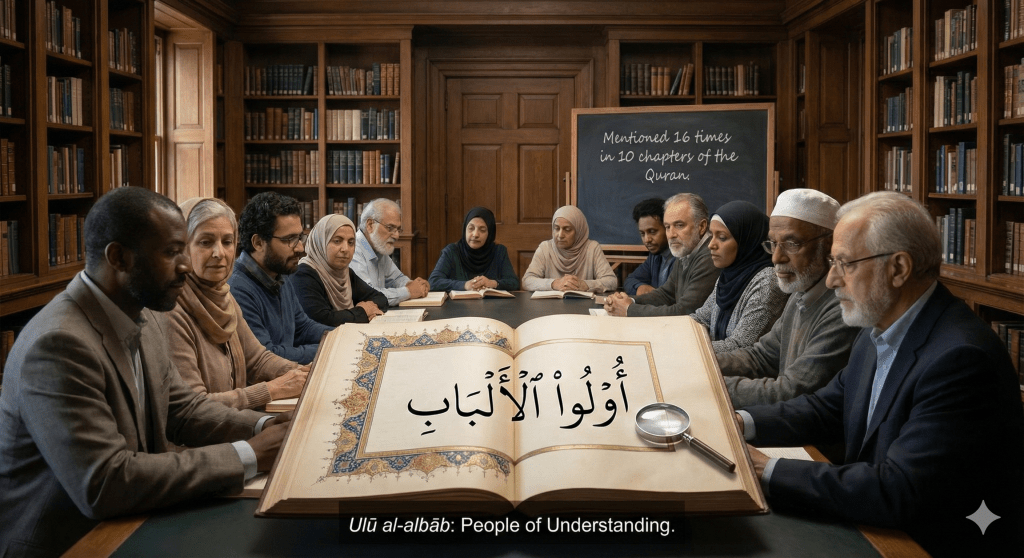
Presented by Zia H Shah MD
Abstract
The Qur’an repeatedly praises and addresses Ulū al-Albāb – a Qur’anic term meaning “people of core intellect” or “those of understanding.” This treatise provides a comprehensive philosophical and theological commentary on the sixteen Qur’anic verses across ten chapters that mention this term. We explore how each verse highlights the role of human intellect in grasping divine guidance, reflecting on moral laws, appreciating the signs in creation, and learning from history. Within an Islamic framework, we examine themes such as the harmony of reason and revelation, the ethical responsibilities of the intellectual, and the convergence of religious faith with scientific inquiry as exemplified in Qur’an 3:190. Through these verses, the Qur’an emphasizes that true understanding (ʾulū al-albāb) is not mere abstract reasoning, but an integration of knowledge, spiritual insight, and moral sensibility. The commentary underscores that Islam envisions faith and intellect as mutually reinforcing: “Only those who possess insight will remember”quran.com. In the end, we offer a thematic epilogue reflecting on the enduring legacy of Ulū al-Albāb as an ideal of holistic wisdom that bridges religious belief and rational reflection in the modern world.
Introduction
Islam is often described as a faith that encourages reflection and the use of intellect. The Qur’an, far from demanding blind belief, frequently calls on people to think, reason, and understand. It poses rhetorical questions and prompts introspection: “Do they not reflect?”; “Will you not use your reason?”; “Do they not contemplate the Quran?”medium.com. This emphasis is epitomized in the Qur’anic appellation Ulū al-Albāb, typically translated as “those endowed with understanding” or “people of reason.” Throughout the Qur’an, Ulū al-Albāb are highlighted as the individuals who truly heed God’s signs and guidance. They appear in diverse contexts – from legal injunctions and ethical principles to theological reflections and natural observations – yet in each case, they represent exemplars of intellectual and spiritual clarity.
The phrase Ulū al-Albāb occurs sixteen times across ten surahs, indicating a recurring theme in the Qur’anic worldview. These verses collectively teach that intellect (ʿaql), when sound and sincere, guides one to recognize truth, differentiate right from wrong, remain mindful of God, and marvel at His creation. Islam’s theological tradition holds that reason and faith are complementary; the Qur’an addresses itself to the “possessors of intellect”, inviting them to engage both heart and mind in understanding revelationmyislam.org. In what follows, we will explore each of these verses and their broader implications:
- What does lubb (the singular of albāb) literally mean, and why does the Qur’an use this term for intellect?
- How do people of understanding respond to moral and legal directives in the Qur’an?
- In what way are they distinguished in terms of piety, gratitude, and patience?
- Why are they uniquely positioned to grasp the wisdom in divine revelation and creation?
- How did classical and modern Islamic thought view the relationship between reason, science, and religion, especially in light of verses like 3:190?
By delving into these questions, we can appreciate how the Qur’an envisions an ideal believer: not a passive follower, but an active thinker whose intellectual faculties illuminate the path of faith. As we shall see, to be among Ulū al-Albāb is a Qur’anic honor – it signifies a mind and soul attuned to the deepest truths.
Meaning of Ulū al-Albāb: Intellect at the Core
The term Ulū al-Albāb is rich in meaning. Linguistically, it combines ulū (“possessors of”) with albāb, the plural of lubb, which means “core” or “essence.” Thus, Ulū al-Albāb implies people of core intellect – those possessing a pure, essential understanding unclouded by superficialitiesqurangallery.app. Classical scholars likened the lubb to the kernel of a nut, hidden within a shellatlantis-press.com. Just as the shell must be removed to reach the nutritious core, the intellect of Ulū al-Albāb is free from the “husk” of whims, ego, and prejudices. What remains is a sound, sincere mind and heart devoted to truthqurangallery.app.
“This term refers to those who possess sound, pure, and healthy minds… capable of looking beyond the surface to grasp the core realities of existence.”qurangallery.appqurangallery.app
In Qur’anic usage, Ulū al-Albāb are consistently portrayed as people who learn, reflect, and take heed. They are not merely book-smart or intellectually talented; rather, they unite reasoning with remembrance of God and moral awareness. Ibn Kathīr notes that the rank of people with these qualities is elevated in this world and the hereafter, for they benefit from divine guidance in a way others do notislamicity.orgislamicity.org. Indeed, many Qur’anic verses conclude a teaching by saying “None will be reminded except those of understanding.” This implies that while the Qur’an’s guidance is addressed to all humanity, only those who cultivate their inner core of insight truly absorb its lessons.
Significantly, the Qur’an sometimes speaks directly to Ulū al-Albāb, in effect singling out the intelligentsia of faith. When Allah says, “So fear Me, O people of understanding”myislam.org, or “take warning, O people of understanding”, it is both a compliment and a responsibility. The Quranic message is “a guidance and reminder for those of understanding”islamicstudies.info – implying that those who fail to respond with understanding are missing the very point of the divine revelation. In the sections below, we will see how Ulū al-Albāb are depicted in various domains of life and thought, ultimately painting a portrait of the ideal believer whose intellect deepens his or her faith.
Ulū al-Albāb in Ethics and Piety
One of the earliest Quranic contexts invoking people of understanding is in relation to moral law and ethical guidance. Far from presenting dry legalisms, the Qur’an often appeals to the intellect to grasp the wisdom and benefit behind its commandments. For example, in Surah al-Baqarah 2:179 we read:
“And there is life for you in legal retribution (qiṣāṣ), O people of understanding, that you may become mindful (of God).”quran.com
Addressing the believers as Ulū al-Albāb in matters of law underscores that these laws are understood best by thinking minds. Here, the Qur’an is defending the just principle of qiṣāṣ (equitable retaliation for murder) by saying it preserves life through deterrence. It is a call to reason out the societal value of justice. Classical exegesis elaborates: enforcing justice deters would-be killers – “if the would-be killer knew he would be killed in retaliation, he would refrain, thus giving life to himself and the one he intended to kill”surahquran.com. Thus, those of understanding will see that God’s law is not barbaric but life-saving and conducive to social well-being. They will “restrain themselves” in awe of God’s wisdomquran.com.
Similarly, in Surah al-Mā’idah 5:100, Allah addresses Ulū al-Albāb to instill an ethical principle of discernment:
“Say: The evil and the good are not equal, even if the abundance of evil might impress you. So fear Allah, O people of understanding, that you may be successful.”surahquran.com
Here, the Qur’an acknowledges that what is wrong can sometimes appear attractive in its sheer quantity or popularity, but urges the intellectual believers to see through the illusion. Good and evil are qualitatively different and must not be judged by crude metrics. The address “O people of understanding” implies that only those who think deeply will not be swayed by surface allure. They are to exercise taqwā (God-consciousness) despite societal trends – an ethic of principled living that yields ultimate success. A commentary explains: Be mindful of Allah by leaving the bad and doing the good, so that you achieve Paradise and are saved from Hellsurahquran.com. In other words, use your reason to choose virtue over vice, and do not be dazzled by the prevalence of corruption.
Both of the above verses tie moral action to intellectual awareness. It is Ulū al-Albāb who truly appreciate that:
- Justice, even when stern, is a mercy for society (preserving life)surahquran.com.
- Morality is not subject to majority rule or personal taste; it has an objective standard that the wise recognize, staying mindful of God’s commandsurahquran.com.
This pattern continues in verses addressing religious duties. In Surah al-Baqarah 2:197, the Qur’an lays out etiquette for the sacred pilgrimage (Ḥajj) – avoiding obscenities, disputes, etc. – and concludes by saying: “Take provisions, but the best provision is piety. And fear Me, O you of understanding.”myislam.org. Those endowed with understanding will grasp that rituals of Hajj are not empty; their soul is the cultivation of piety. Likewise, when warning disbelievers of punishment, Allah appeals to the believers’ intellect in Surah al-Ṭalāq 65:10:
“Allah has prepared for them a severe punishment; so fear Allah, O you of understanding who have believed. Allah has sent down to you a Reminder (the Quran).”surahquran.com
Notice again the linkage of intellect with faith (“who have believed”) and with divine Reminder. If you truly understand, the verse suggests, you will both fear the consequences of evil and value the Reminder that God sent to guide you away from it. The Ulū al-Albāb are thus the moral conscience of the community: people keenly aware of right and wrong, deeply mindful of God, who guide their conduct accordingly. They exemplify the Qur’anic assertion: “Only those with insight will heed the warning.”surahquran.com
In summary, the Qur’an honors the intellect by engaging it in matters of ethics and law. Rather than saying “obey because I said so,” these verses say “obey because, if you reflect, you will see the goodness and wisdom in God’s command.” Ulū al-Albāb are the ones who do reflect, internalize the value of God’s guidance, and thus obey with understanding and reverence. Their fear of Allah is not born of irrational dread, but of an enlightened awareness of moral reality. As one scholar put it, they “avoid futile and harmful behaviors”, seeking what benefits self and societyislamicity.orgislamicity.org.
Ulū al-Albāb and the Pursuit of Knowledge
Islamic tradition places enormous value on learning and wisdom, and here again the Qur’an associates the highest knowledge with Ulū al-Albāb. Knowledge in Islam is not merely accumulation of information, but a light and guidance granted by God. In Surah al-Baqarah 2:269, this connection is made explicit:
“He grants wisdom to whom He wills; and whoever is granted wisdom has indeed been given abundant good. Yet none takes heed except those of understanding.”islamicstudies.info
Wisdom (ḥikmah) is described as a great treasure – “abundant good” – but even that treasure only benefits those who recognize its value. The verse ends by effectively saying, only the Ulū al-Albāb will truly remember or internalize this. According to a classical commentary, sound judgment and perception are meant here by “wisdom,” and a person endowed with wisdom will naturally choose God’s path over Satan’s deceptionislamicstudies.infoislamicstudies.info. But many people fail to incline toward wisdom; they chase material gains or fall prey to shortsighted cleverness. It takes a person of insight to “receive admonition” from wisdom’s callislamawakened.com. In the words of the Qur’an: “How true it is! How many really incline toward studying the wisdom?” – only men of understanding doversebyversequranstudycircle.wordpress.com.
This theme is echoed in Surah al-Zumar 39:9, a verse that extols knowledge and by contrast exposes ignorance:
“…Say, ‘Are those who know equal to those who do not know?’ It is only men of understanding who will remember (take heed).”quran.com
Here the Qur’an uses a rhetorical question to assert the obvious: knowledge and ignorance are not equal. The verse occurs in a context describing a devout believer who prays at night versus one who is heedless; it then commands the Prophet to ask the above question. The immediate answer is provided: only people of understanding get the point. In other words, the Ulū al-Albāb realize the primacy of knowledge – especially knowledge that leads one to humility and devotion – whereas others remain “blind.” This blindness is not of the eyes but of insight. No wonder the verse likens the knowledgeable to the seeing and the ignorant to the blindqurangallery.appqurangallery.app.
The phrase “only they will remember who are people of understanding” also implies that knowledge itself is a reminder of God. To the insightful, every new piece of true knowledge – whether it be spiritual or even scientific – points back to the Creator and His wisdom. The 13th-century scholar Ibn Qayyim noted that all knowledge should increase one’s awe of God if properly understood, for it unveils more of the wonders of God’s work. A modern Muslim writer similarly comments that all fields of study can be given spiritual life, since to truly know the world and self is to better know Godnimirasblog.wordpress.comnimirasblog.wordpress.com. Thus, an astronomer or physicist with wisdom becomes more humble before Allah, whereas one lacking that inner light may see the same data but fail to “remember.” This is precisely what the Qur’an highlights: it is not raw intelligence or data that makes one guided, but the quality of lubb – the penetrative core intellect – which allows knowledge to transform into enlightenment.
In the Islamic ethos, then, knowledge is sacred and seeking it is an act of faith. The Prophet ﷺ famously said, “Seeking knowledge is an obligation on every Muslim.” It is fitting that the very first word revealed in the Qur’an was “Read!” (Iqra’) – a command to engage the intellectmedium.com. The Ulū al-Albāb embody this by always learning and recalling what is truly important. They do not equate quantity of information with quality of understanding. As the Qur’an warns, “many are those who have eyes but do not see, and hearts but do not understand” (7:179). In contrast, Ulū al-Albāb have what one might call intellectual piety: their knowledge makes them more God-fearing, grateful, and mindful. Such people, the Qur’an implies, are the ones guided to success in this life and the next.
Ulū al-Albāb and Understanding Revelation
Perhaps the most significant arena where Ulū al-Albāb operate is in understanding the Word of God itself. The Qur’an positions them as the people who truly grasp the message of revelation, especially in instances where others might go astray. A key verse highlighting this is Surah Āl ʿImrān 3:7, which discusses the interpretation of the Qur’an’s verses:
“It is He who sent down to you the Book; in it are verses that are clear (muḥkamāt)… and others are allegorical (mutashābihāt)…. Those firm in knowledge say, ‘We believe in it; all of it is from our Lord.’ And none will grasp the Message except men of understanding.”myislam.org
Here, Ulū al-Albāb are contrasted with those in whose hearts is perversity. The latter get hung up on the ambiguous verses, seeking discord or twisted interpretations. But the people of sound understanding accept the limits of their knowledge – they affirm “we believe – all is from our Lord” – and thus avoid the pitfalls of misinterpretation. They focus on the clear teachings and entrust the ambiguous matter to God. The verse ending, “none will take admonition except those of understanding,” underscores that correct comprehension and admonition (dhikr) from the Qur’an is a special province of the sincere, humble intellectmyislam.orgmyislam.org. Indeed, only a pure-hearted intellect can navigate the Qur’an’s depths without becoming deviated. This verse became a foundational text in Islamic hermeneutics, essentially saying that faithful, holistic understanding (as opposed to obsessive literalism or speculative fixation) is a hallmark of the wise.
Another verse, Surah al-Raʿd 13:19, directly uses the term Ulū al-Albāb while describing the stark difference between a believer and a non-believer:
“Is then one who knows that what has been revealed to you from your Lord is the Truth like one who is blind? Only those of understanding will take heed.”qurangallery.appqurangallery.app
This powerful analogy equates recognizing the truth of revelation with sight, and rejecting it with blindness. The verse asserts that such recognition is not trivial – it “is not grasped by everyone”qurangallery.app. Innamā yatadhakkaru ulū al-albāb: only the people of core intellect truly remember and discern this differencequrangallery.app. The context, as noted in exegesis, even ties it to real individuals (the believer Hamza vs. the stubborn Abu Jahl)qurangallery.app, but the principle is universal. Ulū al-Albāb are those whose intellects and hearts are “attuned to recognizing and accepting the truth revealed by Allah”qurangallery.app. They do not suffer the “blindness of the heart.” Instead, their minds are open to the light of faith and can see that the Qur’an is indeed from God. Consequently, they align their lives with that truthqurangallery.app.
Allah also describes previous scriptures as guidance specifically for Ulū al-Albāb. In Surah Ghāfir 40:53-54, after mentioning giving Moses the Torah, it says:
“We gave Moses guidance and made the Children of Israel inherit the Scripture – a guide and a reminder for people of understanding.”legacy.quran.comislamicstudies.info
Thus, whether it is the Torah of Moses or the Qur’an of Muhammad, the true beneficiaries of scripture are the Ulū al-Albāb. They are the ones who will take it to heart as a reminder (dhikr) and follow its guidance. Those lacking this quality may receive the same book but derive no benefit, or even misuse it. The Qur’an laments elsewhere that many people carry scripture like donkeys carrying books – a graphic image for failing to understand what one has. By contrast, Ulū al-Albāb carry the scripture in their minds and hearts, not just on their shelves.
Finally, the Qur’an itself, at the end of Surah Ibrahim (14:52), makes a general proclamation about its purpose:
“This is a message for all mankind so that they may be warned by it, and so that they may know He is one God, and so that those of understanding may take heed.”surahquran.com
The sequencing here is intriguing: the Qur’an is for all people, but the outcome hoped is that (1) people at large be warned, (2) they come to recognize the oneness of God, and (3) Ulū al-Albāb take heed. The mention of Ulū al-Albāb at the climax indicates that they are the ones who will truly remember and benefit from this ultimate message. In other words, human beings as a whole should respond to the Qur’an, but it is the people of deep understanding who actually do. Their minds grasp the significance of the warning and the reality of Tawḥīd (Divine Unity) being taught, and their hearts respond in faith and submission. The famous commentator Al-Ṭabarī wrote that this verse underscores how the Qur’an’s guidance ultimately comes to fruition in the hearts of the wise and insightful, completing the circle of revelation and understanding: God’s word is understood by those whom He granted sound intellect.
What emerges from these verses is a kind of intellectual-spiritual elitism, not by lineage or class, but by sincerity and acumen. The Qur’an doesn’t favor any race or rank of people – but it does favor a certain quality in people: the quality of lubbul-ʿaql (a pure intellect). Any person, man or woman, rich or poor, can become of the Ulū al-Albāb by purifying their mind and using it rightly. Those who do so become the torchbearers of faith. They interpret revelation correctly, remember God’s signs, and carry the prophetic message forward. In them, reason and revelation meet in harmony – fulfilling the Quranic supplication: “Our Lord, let not our hearts deviate after You have guided us” (3:8). They are safeguarded from deviance by their God-given wisdom. In an age of confusion and extremist misreadings on one hand, and heedless secularism on the other, the Ulū al-Albāb model is ever relevant: faithful, thoughtful, balanced understanders of God’s word.
Ulū al-Albāb and Reflection on Creation
Contemplating the natural world is one of the domains where the Qur’an most insistently urges humans to use their intellect. The cosmic signs – the sun, moon, stars, mountains, plants, alternation of day and night – are depicted as a grand revelation alongside the written revelation. And who are these signs for? The Qur’an answers: for Ulū al-Albāb. The most oft-cited verse in this regard is Surah Āl ʿImrān 3:190:
“Indeed, in the creation of the heavens and the earth and the alternation of night and day, there are signs for those of understanding.”medium.com

The Qur’an (3:190) invites believers to reflect on the vast cosmos as evidence of divine wisdom. Early Muslims understood that studying the universe is a means to know the Creator – an ethos that helped inspire their contributions to astronomy, medicine, and other sciencesnimirasblog.wordpress.com. Modern Islamic scholarship likewise affirms that scientific inquiry is not mere secular activity, but integral to appreciating Qur’anic signsthequran.love. The more one learns about the cosmos, the more one marvels at the power and knowledge of Allah – turning the study of quarks and galaxies into an act of worship.thequran.love
In this verse, Ulū al-Albāb are essentially defined by their ability to “read” the universe as a book full of signs (āyāt). Each phenomenon – the orbits of celestial bodies, the cycle of day and night – conveys meaning to the attentive soul. The Prophet Muhammad ﷺ was reported to often recite this verse upon waking for night prayer, and he said: “Woe to anyone who reads it and does not reflect!”qurangallery.app. This Prophetic censure highlights that thinking about creation is a religious duty, not an optional exercise. It is a foundation for what one might call “active, intellectual faith based on certainty.”qurangallery.app The Ulū al-Albāb respond to this call by engaging in what the Qur’an in the next verse (3:191) describes: “remembering God standing, sitting, and lying down, and reflecting on the creation of the heavens and earth.” They exclaim, “Our Lord, You did not create this in vain!” Such is the holistic mentality of people of understanding – their scientific wonder does not lead them away from God, but right into a deeper awe of God’s creative majestymedium.commedium.com.
Crucially, Qur’an 3:190 was among the verses that later Muslims would point to as Qur’anic endorsement of scientific exploration. It is no accident that the classical Islamic civilization, inspired by the Qur’an, invested great efforts in astronomy, mathematics, medicine, and the natural sciences. As one modern commentator notes, “The Quran’s call to observe nature implies that scientific inquiry is not merely compatible with faith but integral to it.”thequran.love Early scientists like Al-Biruni or philosophers like Ibn Sina saw no conflict between investigating the world and believing in scripture; on the contrary, they believed (and demonstrated) that faith enriched science with purpose, and science enriched faith with insightthequran.lovethequran.love.
The intimate link between religion and science in Islam stems from verses like 3:190. The Qur’an uses the term “ayat” (signs) both for verses of the scripture and phenomena of nature. Both types of ayat are meant to be reflected upon. In effect, nature is an open book for the believer to study. The only ones who truly fail are those who pass by these wonders heedlessly: “and how many signs in the heavens and earth do they pass by, turning away from them?” (12:105). But the people of understanding never turn away. They gaze at the stars and see the handiwork of the All-Powerful. They study biology or physics and see confirmation of divine wisdom. Each discovery becomes for them “a deeper insight into the magnificence of creation and the purpose of life”medium.com.
The Qur’an harshly criticizes the “vegetative” state of those who do not use their intellect to ponder (see 7:179, 8:22). By contrast, Ulū al-Albāb fulfill their human potential by using reason in the service of understanding God’s signs. As one article succinctly put it: “The Quran encourages the study of nature as a means to recognize divine wisdom.”thequran.love This has two profound implications:
- Theologically: It means the more you uncover about the universe, the more your faith should grow. The Qur’an invites a curiosity about creation that leads to certainty in the Creatorthequran.lovethequran.love. Many modern Muslim thinkers cite examples like the Big Bang or embryology lines in the Qur’an that have been illuminated by sciencethequran.lovethequran.love – not to claim the Qur’an is a science textbook, but to show that for the believer, scientific facts can become signs that enhance one’s awe of revelation.
- Epistemologically: It shows that in Islam, there is no schism between sacred and secular knowledge. All knowledge is unified under the truth of Tawḥīd (God’s oneness). In the Islamic golden age, a single scholar could be a master of theology, law, philosophy, and medicine – because all were seen as connected pursuits of truthnimirasblog.wordpress.com. This integration was possible due to the worldview of Ulū al-Albāb: the conviction that, since “all things begin and end within the compass of One Source,” one can study physics or metaphysics and still be mapping the signs of the same Godnimirasblog.wordpress.com.
In sum, Surah 3:190 and similar verses (e.g. 30:22, 45:3-5) encapsulate the Qur’anic philosophy of nature. The world is a book of God open to all, but truly read only by the insightful. Ulū al-Albāb read both the “Book of Revelation” and the “Book of Creation.” They validate the Quranic assertion that when a believer of understanding looks at the natural world, far from seeing something that undermines faith, they find innumerable supporting signs. For them, every sunrise is a reminder of resurrection, every scientific truth a further glimpse into God’s artistry. Little wonder that the Qur’an pairs remembering God (dhikr) with reflecting on creation (fikr) in describing the people of understanding. These two practices together strengthen their certainty. They embody the maxim that ”thinking about the creation of Allah” is an act of worship – as long as it leads one to glorify Allah, not to arrogance. And the Qur’an wisely cautions: “Think about the creation of Allah, but do not think about His Essence, for you cannot comprehend it.”medium.com. In other words, there is a limit to intellect: Ulū al-Albāb recognize the signs and then humbly say, “Glory be to You, O Lord, we have only a fraction of knowledge!” Such humility is itself a sign of true wisdom.
Learning from History: Lessons for Ulū al-Albāb
The Qur’an is full of historical narratives – stories of past prophets and nations – and it expects the listener to draw lessons from them. Here too, the Qur’an states that only those endowed with understanding will truly benefit. The concluding verse of Surah Yūsuf (12:111), after recounting the dramatic story of Prophet Joseph, is an example:
“Indeed, in their stories there is a lesson for those of understanding. Never was the Qur’an a narration invented, but a confirmation of what came before, and a detailed explanation of all things, and a guidance and mercy for people who believe.”surahquran.com
This verse serves as a commentary on the entire genre of Qur’anic storytelling. It declares that the tales of previous peoples and prophets (whether Joseph and his brothers, or others) are not told for entertainment or myth. They carry ‘ibrah – a moral and spiritual lesson, “a message of admonition for men of understanding.”internetmosque.net Only a person with insight will pause and reflect on these events to extract wisdom. Others might hear the same story and treat it as a fable or simply ignore its implications. But Ulū al-Albāb will see patterns and morals: how pride leads to downfall, how patience and faith eventually triumph, how God’s plan unfolds through tests, etc.
An explanation of 12:111 notes: The narratives of former peoples serve to instill abhorrence of impatience and despair, and to warn against abuse of one’s faculties.surahquran.com In Joseph’s story, for instance, one sees how envy causes Joseph’s brothers to err, yet Joseph himself exemplifies forgiveness and foresight – all under God’s providence. These are not just anecdotes; they are mirrors in which we see timeless human behaviors and divine principles at work. But only those with a reflective core (lubb) will actually mirror themselves in these stories and change their own lives accordingly. As the saying goes, “The fool learns from his own loss, the wise person learns from others’ losses.” The Qur’an provides the latter opportunity by sharing previous nations’ fates. Ulū al-Albāb seize that opportunity.
Furthermore, the verse emphasizes the authenticity and purpose of the Qur’an itself – “not a tale invented, but a confirmation… and guidance and mercy for those who believe.” In effect, understanding the true nature of the Qur’an as guidance, not fiction is also restricted to those with understanding. A skeptic might dismiss the Qur’an’s stories as legends, but a person of understanding will discern the continuity of divine message (“confirming what came before”) and the comprehensive wisdom in the Qur’an (“explanation of everything needed for guidance”)surahquran.com. Thus the intellectual faculty is needed not only to learn from the content of the stories but also to recognize the Qur’an itself as a truthful, divinely revealed book.
We see again the merging of intellect with faith: it takes a certain clarity of mind to see the truth in scripture and history. The Qur’an often asks, after describing a historical punishment of a wicked people, “Do they not travel in the land and have minds to reason with?” (22:46). This is a challenge: use your intellect when studying history – do not just pass by the ruins of past civilizations (or the lessons of past generations) without “hearts to understand”. The implication is that God has built a moral order in the rise and fall of nations; an insightful person will discern it (for example, that tyranny and corruption eventually lead to collapse, whereas faith and justice lead to prosperity, etc.). The Qur’an says of such signs in history: “In that are signs for every steadfast, grateful (person)” (14:5), and also, “in that are signs for every insightful heart”. The combination of patience, gratitude, and insight is telling – it describes the believers who, when witnessing or hearing of trials and triumphs, respond with steady faith and lessons learned.
In the Islamic scholarly tradition, history (tārīkh) was not seen as secular trivia but as a repository of wisdom. Writers like Ibn Khaldūn (14th century) applied keen analysis (a very ‘aqlī approach) to historical cycles, arguably influenced by Quranic encouragement to find the ‘ibrah (lesson). This intellectual engagement with history was part of being of understanding. The Qur’an thus cultivates a historical consciousness: believers should know their spiritual ancestry and the rise/fall of communities. Such knowledge inoculates them against pride and heedlessness. It also gives them hope: if prophets and the righteous were eventually helped by God after adversity, the believers know the same principles apply in their struggles.
To sum up, Ulū al-Albāb treat past events as teaching moments ordained by God. They do not regard history as “one damn thing after another” or a random sequence; they see patterns of divine justice and mercy. They heed warnings addressed to others as if to themselves, and take encouragement from past believers’ perseverance. Thus they fulfill the Quranic purpose of storytelling: “Certainly there is an instructive example in the accounts of those who have passed away, for those endowed with understanding.”internetmosque.net Such people enliven their own practice of religion with the collective memory of humankind that the Qur’an imparts. In them, the past is not dead; it is a living guide. And in guiding them, those lessons become, by extension, a mercy (raḥmah) for them from Allahsurahquran.com – because through understanding, they can avoid mistakes and follow the noble precedents of the prophets and saints.
Epilogue: Faith and Intellect in Harmony
The exploration of Ulū al-Albāb in the Qur’an reveals a consistent message: intellect (ʿaql) and faith (īmān) are meant to reinforce one another, not compete. The Qur’an’s ideal believer is a person of sound reason, ethical discernment, and spiritual depth – all at once. In an era often marked by a perceived divide between religion and science, or between traditional faith and modern rationality, the Qur’anic vision of “those endowed with understanding” offers a healing paradigm. It tells us that the truly devout are thoughtful, and the truly thoughtful are devout.
Every domain we examined – law, ethics, knowledge, revelation, nature, history – demonstrated that Islam invites critical reflection and sincere contemplation:
- Legal and moral injunctions were coupled with rationale and higher objectives graspable by reasonsurahquran.comsurahquran.com.
- Pursuit of knowledge was sanctified, with the caveat that wisdom only benefits those pure in mindislamicstudies.infoquran.com.
- Understanding revelation required intellect guided by humility, to avoid both blind literalism and fanciful allegorymyislam.orgqurangallery.app.
- Observing the cosmos was elevated to an act of worship, turning what we call “science” into a chapter of the sacredthequran.lovethequran.love.
- Learning from past peoples was made a sign of wisdom, essentially forming a philosophy of history centered on moral lessonssurahquran.com.
What unites these threads is the Qur’an’s confidence that truth from God will withstand and indeed welcome rational scrutiny. As Muslim scholars have often remarked, “Islam is a religion of intellect (dīn al-ʿaql)”, citing sayings of ʿAlī ibn Abī Ṭālib that intellect is the guide of the believer and a hadith of the Prophet: “God has not created anything more noble than reason.” While some religious traditions have had uneasy relationships with reason, the mainstream Islamic tradition held reason to be an ally – within the bounds of its proper use. The Qur’an sets those bounds: reason must recognize its own limits (e.g. do not speculate arrogantly about God’s Essence beyond what you’re toldmedium.com), and it must be rooted in a moral center (the “lubb” unclouded by ego). When this is the case, reason becomes a light (nūr) that complements the light of revelation. The two lights together guide humanity: “Light upon Light” (24:35).
The notion of Ulū al-Albāb also carries a hopeful inclusivity. It is not a title for prophets or scholars alone, but for any person, anywhere, who uses their God-given faculties rightly. A simple farmer who deeply ponders the signs of God in crops and stars could be more Ulū al-Albāb than an ivory-tower intellectual who lacks spiritual insight. As the Qur’an says, it is “not the eyes that go blind, but the hearts within the chests” (22:46). Thus, Ulū al-Albāb is ultimately a station of the heart and mind together. It’s a democratic ideal – all humans have been endowed with some degree of intellect, and all are called to purify and develop it.
Today, the lessons of these verses are particularly poignant. We live in an age of information overload but often scant wisdom – echoing the Quranic theme that many have “knowledge” but cannot distinguish truly good from bad. We also see extremes: some reject faith in the name of reason; others reject reason in the name of a misunderstood faith. The Qur’an’s answer is that truth is one. There are not two truths (religious vs scientific, or spiritual vs rational); there is only the singular truth of Allah, which encompasses all reality. The people of understanding recognize this integrative truth. They do not compartmentalize their lives into sacred and secular. For them, “all knowledge, scientific or spiritual, ultimately points to the same Truth.”thequran.love
As we conclude, let us recall the beautiful harmony that Islam envisions: The believer’s heart submits to God, and his intellect glorifies God. Each supports the other. In Quran 3:190-191, those who remember God often are the same who contemplate creation deeply – devotion and reflection intermingle to produce enlightened conviction. And it is such believers who say at the end of their contemplation: “Our Lord, You have not created all this in vain! Exalted are You; save us from the fire.” They see purpose in creation and thus orient themselves purposefully in life.
May we all strive to be among the Ulū al-Albāb – cultivating a clear mind, a faithful heart, and a life dedicated to truth. As Allah promises in the Qur’an, those who use their reason will find guidance and those who truly know can never be equal to those who do notquran.com. The legacy of Ulū al-Albāb is that each generation of Muslims, by embracing both the Revelation and the powers of Reason, can renew the vitality of Islam’s message in their era. In a world rife with confusion, their example shines: people who think deeply, act righteously, stand humbly before their Lord, and lead others from darkness into lightislamawakened.com. In their depth of understanding lies an antidote to superficial faith and irrationality alike.
The Qur’an began addressing them 1400 years ago, and today it still calls out: “So take heed, O people of understanding.” Will we respond? The answer, as always, lies in whether we choose to activate that inner core – that lubb – which God has placed within each of us as a compass toward Himself.
References: Quranic verses are cited from various translations and tafsīr works as indicated. Key sources include: Tafsīr al-Jalālayn and Tafsīr Ibn Kathīr for 2:179surahquran.com, Maududi’s Tafhīm al-Qurānislamicstudies.infoislamicstudies.info, and contemporary writings on Islam and reasonthequran.lovethequran.love. These elucidate how “the Quran invites to reason, reflection, and understanding”, promising guidance and success to those who respond with both mind and soulmedium.comsurahquran.com.
If you would rather read in Microsoft Word file:



 The Glorious Quran and Science
Leave a comment