
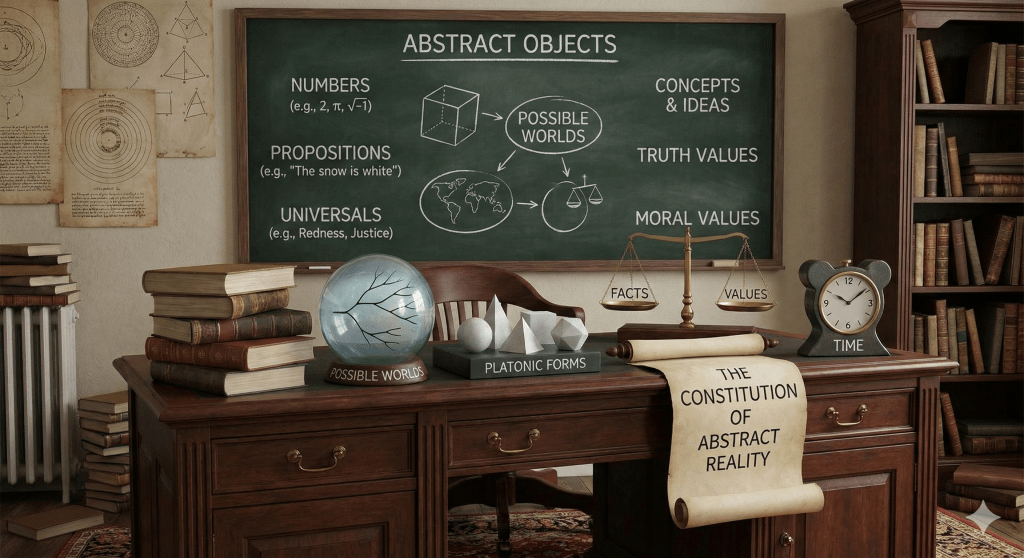
Presented by Zia H Shah MD
1. Introduction: The Furniture of Reality and the Crisis of Naturalism
The fundamental inquiry of metaphysics—the investigation into the nature of reality—begins with the inventory of existence. What exists? For the better part of the last century, the dominant intellectual paradigm in Western academia has been naturalism, the view that the spatiotemporal universe of matter and energy comprises the totality of existence. Under this rubric, reality is defined by physical properties: mass, charge, spin, and location in space-time. However, this materialistic ontology faces a persistent and formidable challenge, not from the mystical or the supernatural in the first instance, but from the indispensable foundations of reason itself: abstract objects.
Abstract objects—universals, propositions, mathematical entities, and logical laws—possess a mode of existence that is fundamentally distinct from the concrete world. They are acausal, meaning they do not stand in cause-and-effect relationships with physical matter in the way billiard balls do; they are atemporal, existing outside the flow of time; and they are non-spatial, possessing no physical coordinates. Yet, they constitute the very framework through which we understand the physical world. The number seven, the Pythagorean theorem, the laws of logic, and the property of “justice” are not physical things, yet to deny their existence is to render science, mathematics, and ethics unintelligible.
This report posits that the existence of abstract objects serves as a rigorous philosophical pathway to the affirmation of a Divine Reality. By analyzing the ontological status of these entities, we find that they cannot be adequately explained as “brute facts” of a godless universe, nor can they be reduced to mere fictions of the human brain. Instead, the most coherent explanation for the existence, necessity, and intentionality of abstract objects is that they are grounded in a Supreme, Necessary Mind. This conclusion is reached through a synthesis of contemporary analytic philosophy—specifically the arguments of Divine Conceptualism and the Argument from Logic—and the rich metaphysical traditions of Ismaili Gnosis, which envisions these abstract realities as the radiant content of the Universal Intellect (‘Aql-e-Kull) and the Manifest Imam.
1.1 The Bump Against Reality: Defining the Real
To understand why abstract objects point to God, one must first establish their robust reality. A common deflection in secular philosophy is Nominalism, the view that abstract objects are merely names or linguistic conventions. However, philosopher J.P. Moreland offers a penetrating criterion for reality that dispels this notion: reality is “what you bump up against” when your beliefs are false.1 This pragmatic definition moves the debate from theoretical abstraction to existential encounter.
Moreland argues that we can distinguish between fantasy and reality by the resistance we encounter. If one believes they can float and steps off a ledge, the physical law of gravity “bumps back” with lethal consequence. This resistance confirms the reality of the physical world. Similarly, in the realm of logic and mathematics, we encounter an equally rigid resistance. One cannot simply “will” the sum of two and two to be five. One cannot “decide” that a contradiction is true. If a person attempts to live as though the Law of Non-Contradiction is false, they will fail to function. We “bump up against” the laws of logic just as surely as we bump up against a wall.1
This “bump” indicates that logical laws and mathematical truths are not soft, malleable conventions of human language, but hard, objective features of the world. They exist independently of our minds. The number seven was prime before the first human evolved, and it will remain prime long after the universe potentially succumbs to heat death. If these objects are real, objective, and non-physical, the naturalist is left with a “clutter” of infinite, invisible, eternal entities that do not fit into a materialist worldview. This opens the door to a supernatural explanation: that the “Third Realm” of abstract objects is the mind of God.
1.2 The Epistemological Crisis of Materialism
The challenge to naturalism is not merely ontological (what exists) but epistemological (how we know it). If abstract objects exist in a realm distinct from the physical, and if human beings are merely physical organisms evolved for survival, how do we have access to these abstract truths? This is known as the Benacerraf-Field problem. There is no causal mechanism by which the number $\pi$, which has no mass or energy, can interact with the neurons in a human brain.
If naturalism is true, our mathematical beliefs should be evolutionary accidents, useful perhaps, but with no guarantee of being true about a transcendent reality. Yet, we do possess certain knowledge of necessary truths. This “unreasonable effectiveness of mathematics,” as Wigner famously termed it, suggests a deep congruence between the human mind and the structure of reality. Theism offers a natural solution: if the universe is the product of a Divine Mind, and the human mind is created in the image of that Divine Mind (or is a spark of the Universal Soul), then the correlation between our thoughts and the abstract structure of the cosmos is not a coincidence, but a design feature. We know abstract objects because we share the cognitive architecture of the Creator.3
2. The Anatomy of the Abstract: Propositions and Intentionality
To rigorously argue from abstract objects to God, we must dissect the nature of the objects in question. The strongest arguments focus on Propositions—the bearers of truth and falsity.
2.1 Propositions as Essential Entities
A proposition is the content of a declarative statement. It is distinct from the sentence used to express it. The English sentence “Snow is white,” the German sentence “Schnee ist weiß,” and the binary code representing these characters are all distinct physical or linguistic tokens. However, they all express the single, identical abstract proposition: that snow is white.
Propositions have unique properties:
- Truth Value: They are either true or false.
- Necessity: Some propositions (like logical laws) are necessarily true; they could not be false in any possible world.
- Intentionality: They are inherently about something.
2.2 The Argument from Intentionality
The property of intentionality—”aboutness”—is the bridge between abstract objects and the Divine Mind. Physical objects lack intentionality. A collection of atoms in the shape of a rock is not “about” the universe; it simply exists. Ink marks on a page are only “about” something because a mind interprets them. Original, intrinsic intentionality is a feature exclusively of minds.
Current champions of the “Argument from Logic,” such as philosophers James Anderson and Greg Welty, construct the following syllogism 5:
- The Laws of Logic are real. (Evidenced by the “bump against reality”).
- The Laws of Logic are propositions. (e.g., The Law of Non-Contradiction is the proposition “It is not the case that P and not-P”).
- Propositions are intentional entities. (They represent states of affairs).
- Intentional entities are mental in nature. (Only thoughts possess intrinsic aboutness).
- Therefore, the Laws of Logic are thoughts.
- The Laws of Logic are necessary and eternal. (They exist in all possible worlds and at all times).
- Human minds are contingent and temporal. (We have not always existed).
- Therefore, the Laws of Logic are not thoughts of human minds.
- Conclusion: There exists a Necessary, Eternal Mind that thinks these thoughts.
This argument updates the “Augustinian Proof” for the modern analytic context. Augustine of Hippo argued that just as the eye needs physical light to see, the mind needs “Divine Light” to see eternal truths. The truths of mathematics and logic are superior to the human mind—we judge by them, we do not judge them. Therefore, they must reside in a Mind superior to ours: God.7
2.3 The Failure of Fictionalism
Atheistic philosophers often resort to Fictionalism—the view that mathematical statements are false but useful fictions, much like a novel is “true” within the context of the story but false in reality. However, this view collapses under the weight of the “Indispensability Argument” put forth by Quine and Putnam. Physics, our best description of physical reality, is indispensable from mathematics. If we say “The electron has a spin of 1/2,” we are using a number to describe a fundamental feature of the physical world. If numbers are mere fictions, then our description of the electron is a fiction. To accept the reality of the electron (which we cannot see) while denying the reality of the mathematics used to describe it (which we rely on) is an arbitrary philosophical move. The “bump against reality” confirms that the mathematical structure of the universe is not a story we tell ourselves, but a reality we discover.3
3. Divine Conceptualism: The Mind of God as the Locus of Logic
If we accept that abstract objects are thoughts, and that they are necessary, we arrive at the position known as Divine Conceptualism. This view posits that abstract objects are concepts in the Divine Mind. This theory elegantly solves the problems of ontology (where do they exist?) and epistemology (how do we know them?).
3.1 Leftow’s “Leaner and Meaner” Ontology
Brian Leftow, a prominent philosophical theologian, argues that Divine Conceptualism offers a superior ontology because it is more parsimonious. In a standard Platonist view (Theistic Platonism), the universe contains God plus an infinite horde of uncreated abstract objects (numbers, properties, sets). God is stuck with them; He did not create them, and He cannot change them.
Leftow proposes that we eliminate the “middle man.” We do not need a separate entity called “The Number 6.” We only need God. God eternally conceives of quantities. The “Number 6” is simply God’s eternal act of thinking about sextets. Similarly, the property of “Redness” is not a floating ghost; it is God’s concept of red. God creates red apples based on His internal concept.9
Leftow describes this as a “leaner and meaner” ontology. It strips the universe of unnecessary “clutter.” Instead of a crowded metaphysical attic filled with infinite abstracta, there is only God and His creation. God “does the work” of abstract objects. The necessity of logic is simply the necessity of God’s own nature. God cannot think a contradiction because He is the Truth; therefore, the Law of Non-Contradiction is necessary.10
3.2 JP Moreland and the Defense of Realism
J.P. Moreland, famously bearing the bumper sticker “I Brake for Universals,” defends a robust Realism regarding abstract objects but grounds them in the Divine Essence. Moreland addresses a critical objection: The Bootstrapping Problem.
- The Objection: If God creates all properties, He must create the property of “being powerful” and “existing.” But He must be powerful and exist before He can create anything. Therefore, God relies on properties that exist prior to Him.
- Moreland’s Solution: We must distinguish between essential attributes and created concepts. God does not “have” the property of existence in the sense of participating in an external form. God is His existence. His essential nature is uncreated. However, the vast majority of abstract objects—concepts of things that don’t exist yet, mathematical structures, possible worlds—are thoughts generated by God’s mind. This avoids circularity while maintaining that God is the ultimate ground of all reality.12
3.3 The Euthyphro Dilemma of Logic
Divine Conceptualism faces a variation of the Euthyphro Dilemma: Is a logical law true because God thinks it, or does God think it because it is true?
- If the former (Voluntarism), logic is arbitrary. God could have made $2+2=5$. This seems absurd.
- If the latter (Externalism), God is subject to logic. He is not the ultimate Sovereign.
The Divine Conceptualist offers a third way: Essentialism. Logic is neither an arbitrary decree nor an external constraint. It is the reflection of God’s internal nature. God is inherently rational and consistent. He cannot deny Himself. Therefore, the laws of logic are necessary reflections of His being. They are “God’s thoughts,” but they are thoughts that flow necessarily from Who He Is. This preserves both the necessity of logic and the sovereignty of God.13
4. The Universal Intellect: Insights from Ismaili Gnosis
While analytic philosophy provides the skeletal logical structure for Divine Conceptualism, the tradition of Ismaili Gnosis (specifically the philosophical theology of the Fatimid era and thinkers like Nasir Khusraw) provides the flesh and blood—a comprehensive cosmology that explains how the Divine Mind manifests in reality.
4.1 ‘Aql-e-Kull: The Universal Intellect
In Ismaili metaphysics, the Absolute Reality (Al-Mubdi, the Originator/God) is utterly transcendent—beyond being and non-being, beyond names and attributes. God does not “think” in the discursive human sense, as thinking implies a transition from ignorance to knowledge, which suggests change.
Instead, God originates (via Ibda, or timeless command) the Universal Intellect (‘Aql-e-Kull). The Universal Intellect is the first originated being, a pure spiritual reality composed of Light (Noor). It contains all forms, all knowledge, all archetypes, and all abstract truths. It is the Ismaili equivalent of the “Divine Mind” in the context of abstract objects. It knows all things instantaneously, perfectly, and timelessly.14
This framework aligns perfectly with the problem of abstract objects. The “Realm of Forms” is not a disorganized library of floating concepts; it is a living, conscious, unified Intellect. The necessity of abstract truths is grounded in the perfection of the Universal Intellect.
4.2 The Spiritual Sun and the Light of Knowledge
A key insight from Ismaili teachings, as highlighted in the provided video material 16, is the metaphor of the Spiritual Sun. The video explains that just as the physical sun illuminates the material world, enabling the eye to see, the Imam (the spiritual guide) acts as the Spiritual Sun, illuminating the intellect.
This “Light” (Noor) is explicitly identified with Knowledge (‘Ilm) and Wisdom (Hikmat). Here, we see a convergence with the Augustinian “Divine Illumination.” Abstract objects—mathematical truths, ethical values, logical laws—are “rays” of this Divine Light. When a human being grasps a necessary truth, they are participating in the Light of the Universal Intellect. The act of learning is not the creation of truth, but the reception of Noor.
This cosmology adds a soteriological (salvific) dimension to the study of abstract objects. In Ismaili thought, the human soul (Nafs) is a particularization of the Universal Soul (Nafs-e-Kull). Its purpose is to ascend back to perfection by acquiring knowledge. Thus, the study of logic, mathematics, and philosophy is a religious act—it is the gathering of the “Light” that allows the soul to return to its source.14
4.3 The Imam-e-Mubeen: The Container of Universals
The video source 16 introduces the concept of the Imam-e-Mubeen (The Manifest Imam). A profound philosophical point is raised regarding the “containment” of the universe. The speaker argues that while the Imam appears as a finite human being, his spiritual reality “contains” the entire universe.
The speaker uses the analogy of the human mind: “When you look at the universe, the universe enters your eyes and goes into your mind… Your mind contains the universe”.16 This analogy is crucial for understanding Divine Conceptualism.
- Just as the human mind can “hold” the concept of a mountain or a galaxy without being physically expanded, the Divine Mind (or the Universal Intellect manifested in the Imam) holds the archetypes of all reality.
- The Imam is the “locus of manifestation” (Mazhar) of the Universal Intellect in the physical world. He is the bridge between the abstract (the Universal Intellect) and the concrete (humanity).
- This resolves the “Access Problem” of Platonism. How do we access abstract truths? We access them through the “Rope of God”—the guidance and light provided by the Universal Intellect, which is accessible through the teaching of the Imam.18
4.4 The Hierarchy of Being
Integrating these insights, we can construct a table of the Ismaili hierarchy as it relates to abstract objects:
| Level of Being | Arabic Term | Metaphysical Function | Relation to Abstract Objects |
| The Originator | Al-Mubdi | Absolute Transcedence | The Source of the Command that originates truth. |
| Universal Intellect | ‘Aql-e-Kull | Perfect, Timeless, Static | The Repository of Abstract Objects. The “Divine Mind.” |
| Universal Soul | Nafs-e-Kull | Dynamic, Temporal | The Engine that imparts Form (abstracta) into Matter. |
| Manifest Imam | Imam-e-Mubeen | Concrete/Human | The Container of the Intellect; the guide to Abstract Truth. |
| Human Intellect | ‘Aql-e-Juzwi | Potential | The receiver of Abstract Truth via illumination. |
This hierarchy demonstrates that “abstract objects leading to God” is not just a logical inference but a description of the cosmic structure. We start with the physical, rise to the intellectual (abstract), and ultimately arrive at the Originator.
5. Comparative Synthesis: The Argument from Possibility and Necessity
The synthesis of Western Analytical Theology and Eastern Ismaili Gnosis provides a robust defense against Naturalism. Both traditions agree that the “Possible” must be grounded in the “Necessary.”
5.1 Possibilia and the Divine Imagination
What makes it possible for a unicorn to exist, even though none do? Naturalism struggles with unactualized possibilities. They are not physical, yet they are real possibilities.
- Leftow’s Insight: Possibilities are simply God’s powers and concepts. A “possible world” is a scenario God imagines and has the power to enact. If God did not exist, nothing would be possible. There would be no “framework” for possibility to exist within.9
- Ismaili Insight: The Universal Soul desires the perfection of the Intellect. This desire drives the motion of the universe, turning “possibility” (potential) into “actuality.” The dynamic nature of the cosmos is the unfolding of the abstract possibilities held in the Universal Intellect.14
5.2 The Necessity of Truth vs. The Contingency of Matter
J.P. Moreland emphasizes the distinction between the contingent and the necessary.
- Contingent: The universe could have been different. The gravitational constant could have been slightly higher.
- Necessary: The logical truth $P \lor \neg P$ could not be different.
Naturalism tries to explain the Necessary (logic) arising from the Contingent (matter/evolution). This is logically impossible; the lesser cannot generate the greater. The Necessary must precede the Contingent. Therefore, a Necessary Being (God) must exist to ground Necessary Truths. As Moreland argues, if we strip away the physical universe, we are not left with “nothing.” We are left with the necessary framework of logic and mathematics. And since these are mental, we are left with a Mind.3
6. Detailed Analysis of Objections
To ensure this report is exhaustive, we must address the primary objections to the “Abstract Objects to God” thesis.
6.1 The Objection of Psychologism
Objection: Logic and mathematics are just structures of the human brain. We think $2+2=4$ because our brains are wired that way.
Rebuttal:
- The Bump against Reality: As Moreland points out, if logic were just brain wiring, we could “rewire” ourselves to fly. But reality resists. Logic applies to galaxies we have never seen.
- Subjectivity: If logic is human-psychological, then if humans died out, logic would cease to exist. But it is absurd to claim that “logical contradictions” would become possible in a universe without humans.
- Circularity: We use logic to study the brain. If logic is just a byproduct of the brain, we are using the product to validate the source. We must assume the objective validity of logic to do neuroscience.
6.2 The Objection of Atheistic Platonism
Objection: Abstract objects exist, but they are just “brute facts.” They don’t need a mind; they just are.
Rebuttal (The Access Problem): This leaves the epistemic question unanswered. How do we know them? As Plantinga and Leftow argue, it is an incredible coincidence that an evolved primate brain effectively tracks independent, acausal, invisible abstract truths.
Theistic Advantage: Divine Conceptualism explains the correlation. God designed the abstract structure (in His Mind) and designed the human mind to resonate with it. The Ismaili concept of the Imam as the “Manifest Intellect” further solidifies this: there is a mechanism (Divine Guidance/Light) that bridges the gap.
6.3 The Objection of Simplicity
Objection: Identifying abstract objects with God’s thoughts introduces complexity into God (millions of thoughts), violating Divine Simplicity.
Rebuttal (Divine Conceptualism): Leftow argues that God’s “thoughts” are not separate parts of Him. God is one simple act of cognition. He grasps all truths in a single, eternal intuition. The multiplicity is in the objects understood, not in the understanding itself.
Rebuttal (Ismaili Gnosis): Ismaili theology places the multiplicity in the Universal Intellect, not in the Originator (God). God (Al-Mubdi) remains absolutely Simple and One. The Intellect is the “First Created,” and it is the locus of multiplicity (the forms). This preserves God’s absolute Oneness (Tawhid) while accounting for the multiplicity of abstract objects.14
7. Implications: The Theo-Centric Cosmos
The conclusion of this research is that the existence of abstract objects fundamentally reorients our understanding of the universe from a material-centric to a Theo-centric model.
7.1 The Reality of the Invisible
The modern secular worldview privileges the visible. “Seeing is believing.” However, the analysis of abstract objects forces us to acknowledge that the most fundamental realities—the laws that govern the visible—are themselves invisible. As the video on the Imam suggests, the “internal” or “spiritual” aspect of reality (the Batin) is the source of the “external” or “physical” (Zahir).16
The Imam is the “Manifest” (Mubeen), meaning he makes the invisible visible. He brings the abstract light of the Intellect into the concrete world of human experience. This parallels the role of abstract objects in science: numbers (invisible) make the laws of physics (visible effects) intelligible.
7.2 Living by Reality
J.P. Moreland’s exhortation to live according to “what is real” 1 takes on a profound theological weight. If abstract objects are real, and if they point to God, then living in denial of God is living in a fantasy—a “non-reality.”
- To ignore the moral law is to clash with the objective moral structure of the universe (bump against reality).
- To ignore the logical necessity of a First Cause is to clash with the rational structure of the universe.
- To live as a materialist is to ignore the “furniture of reality” that makes life possible.
7.3 The Sanctuary of the Mind
Finally, this research suggests that the human mind is a sacred space. It is the only entity in the physical world capable of “containing” the universe and “touching” the Divine Ideas. When we think logically, we are imitating God. When we discover truth, we are receiving Divine Light.
- Ismaili Perspective: The soul’s journey is to polish the mirror of the intellect so it can reflect the Universal Intellect perfectly.
- Christian/Theistic Perspective: We are to “think God’s thoughts after Him” (Kepler).
8. Conclusion
The journey from abstract objects to God is paved with the undeniable bricks of necessity, intentionality, and truth.
- Naturalism fails because it cannot account for the existence or knowledge of non-physical, necessary entities.
- Platonism fails because it leaves these entities as inexplicable brute facts that are inaccessible to human minds.
- Divine Conceptualism succeeds because it grounds abstract objects in the only entity capable of sustaining them: a Necessary, Eternal Mind.
- Ismaili Gnosis enriches this view by providing a cosmic architecture—the Universal Intellect and the Manifest Imam—that explains how these abstract truths illuminate the human soul.
The “Third Realm” is not a void; it is a Voice. The laws of logic are not cold bars of a prison; they are the structured thoughts of a Creator. To study the abstract is to stand in the presence of the Divine Logos. As the “Spiritual Sun” illuminates the mind, we see that abstract objects are the breadcrumbs left by the Intellect, leading the rational soul back to its Source.
Appendix: Key Definitions
- Abstract Object: An entity that is non-spatial, non-temporal, and acausal (e.g., numbers, propositions).
- Aseity: Self-existence; the attribute of existing from oneself, independent of anything else.
- Divine Conceptualism: The view that abstract objects are concepts or thoughts in the mind of God.
- Intentionality: The property of “aboutness” or “directedness” exhibited by thoughts and propositions.
- Nominalism: The view that abstract objects do not exist; only particulars and names exist.
- Platonism: The view that abstract objects exist independently of any mind or physical world.
- ‘Aql-e-Kull (Universal Intellect): In Ismaili thought, the first originated being containing all knowledge and forms.
- Ibda: Eternal origination outside of time (creation ex nihilo in a higher sense).
- Imam-e-Mubeen: The Manifest Imam, who serves as the locus of the Universal Intellect in the physical world.
If you would rather read in Microsoft Word file:



 The Glorious Quran and Science
Leave a comment