
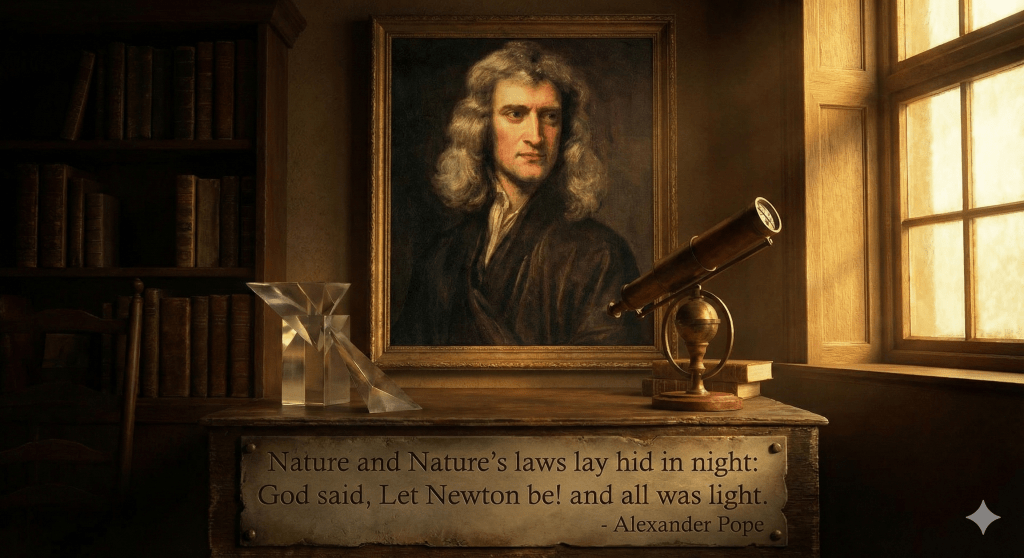
Presented by Zia H Shah MD
I. Introduction: The Bifurcated Legacy of the Last Magus
The intellectual historiography of the West has long maintained a sanitized bifurcation of Sir Isaac Newton. On one side stands the paragon of the Enlightenment, the Lucasian Professor of Mathematics whose Philosophiæ Naturalis Principia Mathematica banished mystery from the mechanics of the heavens and established a universe governed by immutable, rational laws. On the other side, often relegated to the embarrassment of senility or eccentricity, stands the private Newton: the alchemist, the obsessive chronologist, and the radical heretic who wrote millions of words on the nature of God, the corruption of Scripture, and the apocalyptic timeline of history. However, the release of the Portsmouth and Yahuda manuscripts—suppressed by his heirs for centuries due to their explosive theological content—has forced a total re-evaluation of this dichotomy.
It is now evident that Newton’s scientific and theological pursuits were not distinct enterprises but parallel manifestations of a singular, overarching quest: the recovery of the Prisca Sapientia (Ancient Wisdom). Central to this worldview was a fierce, uncompromising monotheism that rejected the Trinitarian dogma of the Church of England as a fourth-century corruption, a “wicked form of polytheism” that had shattered the primitive unity of the faith.1 This report provides an exhaustive examination of Newton’s Unitarian theology, his forensic reconstruction of the “Great Apostasy,” his textual criticism of corrupted scriptures, and his prophetic interpretation of the rise of Islam. Furthermore, drawing upon recent scholarship and the interpretative framework provided by The Muslim Times, this report explores the thesis that Newton’s theological architecture aligns significantly with the Islamic concept of Tawhid (the absolute Oneness of God), placing him within a broader heritage of strict monotheism that views the Trinity as a deviation from the divinely revealed order.2
Newton’s life was a perilous negotiation between the pursuit of truth and the preservation of his position. Living under the Blasphemy Act of 1697, which criminalized the denial of the Trinity, Newton became a “Nicodemite”—a secret believer who outwardly conformed to the Anglican establishment while privately dismantling its foundational dogmas.3 His vast unpublished corpus reveals a mind that applied the same rigorous empiricism to the Bible that he applied to the trajectory of comets, concluding that the “God of Dominion” was One, Undivided, and Absolute—a conclusion that estranged him from European Christendom and inadvertently aligned him with the theology of the “Saracens” he studied in the prophetic texts.
II. The Metaphysics of Dominion: Newton’s Unitarian Theology
2.1 The Rejection of Substance and the Argument for Dominion
The central pillar of Newton’s theology, which underpinned both his physics and his religion, was the rejection of the metaphysical substance theory that dominated the Council of Nicaea. The Nicene Creed defined the relationship between the Father and the Son using the term homoousios (of one substance). Newton considered this term not only unscriptural but philosophically unintelligible. In his private manuscripts, specifically those analyzing the Council of Nicaea, Newton argued that the early Church had been hijacked by “metaphysical subtleties” derived from Greek Gnosticism and Platonism rather than the simple revelation of Jesus Christ.4
Newton proposed an alternative definition of God based on dominion (Lordship) rather than substance. This is most clearly articulated in the General Scholium added to the second edition of the Principia (1713). In this famous text, Newton writes:
“This Being governs all things, not as the soul of the world, but as Lord over all: And on account of his dominion he is wont to be called Lord God Pantokrator, or Universal Ruler. For God is a relative word, and has a respect to servants; and Deity is the dominion of God, not over his own body… but over servants.” 5
This distinction is profound. If God is defined by His substance (as in the Trinity), He might be divisible or shareable. But if God is defined by His Dominion—His absolute, sovereign rule over the creation—then He must be One. A universe with two omnipotent rulers is a contradiction in terms. Newton’s God was the Pantokrator (All-Ruler), a term he borrowed from the Greek Septuagint and the Book of Revelation.6 This “God of Dominion” stands outside the system of nature, imposing laws upon it by the fiat of His Will.
This theological stance provided the necessary metaphysical foundation for Newtonian physics. A Trinitarian God, whose essence is a mystery of internal relations, or a Pantheistic God who is the “soul of the world,” could not guarantee the uniformity of natural law. Only a single, transcendent Legislator—a Monarch of the Universe—could institute a single set of laws (gravity, motion) that applied universally to all matter.2 Thus, Newton’s Unitarianism was not incidental to his science; it was the prerequisite for it.
2.2 The Subordination of the Son: Arianism vs. Socinianism
Scholars have long debated the precise nature of Newton’s anti-Trinitarianism. The two primary heresies available in the 17th century were Arianism (which believed the Son was a pre-existent divine creature, the firstborn of creation) and Socinianism (which believed Jesus was a human Messiah with no pre-existence).
Newton’s view was a sophisticated synthesis, though it leaned heavily toward the Arian position regarding pre-existence. He believed that the Word (Logos) existed before the world and was the agent through whom the Father created the universe. However, Newton was adamant that this pre-existence did not imply co-equality. The Son’s power was derived, whereas the Father’s power was underived and absolute. In his manuscripts, Newton famously stated: “The Father is God of the Son (whom he created), and the Son is the Image of the Father.”.7
However, Newton also shared significant ground with the Socinians, particularly in his emphasis on the humanity of Jesus and his rejection of the Incarnation as a metaphysical fusion of two natures. He corresponded with Samuel Clarke and studied the works of Socinian writers like Johann Crell and the Polish Brethren, utilizing their exegetical arguments to deconstruct Trinitarian proof-texts.89 He avoided the label “Socinian” primarily because it was the most reviled heresy of his day, often equated with atheism, whereas Arianism had a more patristic pedigree.
The defining characteristic of Newton’s Christology was subordinationism. He argued that all worship of the Son is “relative worship”—worship paid to the King’s representative—which ultimately redounds to the glory of the Father. To worship the Son as the Supreme God, however, is to commit the “fundamental sin” of idolatry, breaking the First Commandment.10 This fear of idolatry drove Newton’s entire theological project.
2.3 The “God of the Philosophers” vs. The “God of the Scriptures”
Newton despised the “God of the Philosophers”—the abstract, immutable deity of Descartes and Leibniz who did not intervene in the world. He accused the Cartesians of making God a “dwarf-god” or an absentee landlord.11 Newton’s God was alive, active, and present. He famously described space as the “sensorium of God” (though he later qualified this), implying that God is immediately present to every point in the universe, sustaining the laws of nature by His active will.
This aligns closely with the monotheistic argument presented in The Muslim Times article, which posits that the “God of Islam, Judaism, and Unitarian Christianity” is a personal Lawgiver who acts. The article argues that the scientific revolution faltered in China and Greece because their theologies lacked this concept of a single, external Lawgiver who encoded the universe with rational laws.2 For Newton, the “unity of the Godhead” was the guarantee of the “unity of Nature.”
III. The Great Apostasy: A Forensic Reconstruction of Church History
Newton did not view the Trinity as a benign error; he viewed it as a “Great Apostasy” prophesied in scripture, a catastrophic deviation that had plunged the world into darkness for over a millennium. He devoted decades to reconstructing the history of the 4th-century Church to identify the precise moment when the truth was lost.
3.1 The Council of Nicaea (325 AD) as Ground Zero
In Newton’s historical scheme, the Council of Nicaea was the turning point where “primitive Christianity” was overthrown by a new, paganized religion. He focused his critique on the introduction of the term homoousios (“of one substance”). Newton argued that this term was unscriptural and was introduced by a faction of Gnosticizing clerics who wished to synthesize Christianity with Greek philosophy.4
Newton believed that the Council was a political sham, manipulated by Emperor Constantine to secure imperial unity. He contended that the majority of bishops at Nicaea did not understand the term homoousios and were coerced into signing the creed. For Newton, the “true Church” after 325 AD was represented not by the orthodox victors, but by the persecuted minority—the Arians and the Eusebians—who maintained the distinction between the Father and the Son.7
3.2 The Villainy of Athanasius
If Newton’s theology had a Satanic figure, it was Athanasius of Alexandria, the architect of Trinitarian orthodoxy. In his private notebooks, Newton subjected Athanasius to a relentless prosecutorial assault, accusing him of forgery, lying, and political violence.12
Newton’s specific charges against Athanasius included:
- Forgery of Patristic Testimony: Newton claimed that during his exiles in the Egyptian desert, Athanasius forged letters attributed to earlier Church Fathers (like Dionysius of Alexandria) to make them sound Trinitarian, thereby creating a false historical consensus.12
- Introduction of Monasticism: Newton linked Athanasius to the rise of the monastic movement in Egypt (specifically the Life of Antony). He viewed monks as the “shock troops” of the Apostasy, responsible for spreading superstition and fanaticism.12
- Necromancy and Relic Worship: Newton argued that the veneration of saints and relics, championed by the Athanasian party, was a revival of the pagan cult of the dead. He described the practice of praying to dead saints as “necromancy,” a direct violation of biblical law. He saw the Trinitarian Church’s obsession with the “bones and ashes” of the martyrs as the fulfillment of the prophecy in Daniel regarding a “God of Forces” (Mahuzzim) honored with gold and silver.1
3.3 The Prophetic Timeline of Corruption
Newton believed that the “Falling Away” predicted by St. Paul (2 Thessalonians 2) began in the 4th century. He interpreted the “opening of the Seventh Seal” in Revelation as occurring in 380 AD, the year Emperor Theodosius made Trinitarian Nicene Christianity the official state religion of the Roman Empire.7 From this point onward, Newton believed, the “visible Church” was the Beast of Revelation, and the “true believers” (the Unitarians) were forced into the wilderness.
IV. The Forensic Scalpel: Textual Criticism of Corrupted Scripture
Newton’s rejection of the Trinity was not merely historical; it was textual. He believed that the Trinitarian party, having seized power, systematically corrupted the Bible to insert their dogma into the text. His treatise, An Historical Account of Two Notable Corruptions of Scripture (1690), is a masterpiece of early textual criticism, anticipating modern scholarship by centuries.
4.1 The Case Against 1 John 5:7 (The Johannine Comma)
The verse 1 John 5:7 (“For there are three that bear record in heaven, the Father, the Word, and the Holy Ghost: and these three are one”) is the only explicit Trinitarian statement in the Bible. Newton set out to prove it was a forgery.
Newton collated evidence from every available manuscript and version. He noted:
- Greek Manuscript Silence: The verse was absent from all early Greek manuscripts. It did not appear in the texts used by the early Greek Fathers.13
- Patristic Silence: During the ferocious Arian controversies of the 4th century, neither Athanasius nor his opponents ever cited this verse. Newton argued that if the verse existed, it would have been the “smoking gun” for the Trinitarians. Their silence proved its absence.14
- The Origin of the Corruption: Newton traced the interpolation to the Latin tradition. He hypothesized that it began as a marginal gloss—a mystical interpretation of the adjacent verse about “spirit, water, and blood”—and was mistakenly (or maliciously) incorporated into the main text by a scribe. From the Latin Vulgate, it eventually contaminated the Greek text via the Complutensian Polyglot and Erasmus’s third edition.13
Newton wrote to Locke: “It is rather a danger to religion than an advantage to make it now lean upon a bruised reed.”.13 He believed that defending a known forgery exposed Christianity to the ridicule of atheists and Muslims.
4.2 The Case Against 1 Timothy 3:16
The second major “corruption” was 1 Timothy 3:16, which in the King James Version reads: “God was manifest in the flesh.” This verse was crucial for the doctrine of the Incarnation.
Newton argued that the original Greek reading was not Theos (God) but hos (who/which). In the Greek uncial script, “God” is written as ΘΣ (Theta-Sigma with a contraction line), while “who” is written as ΟΣ (Omicron-Sigma).
- The Ink Argument: Newton (or his sources) examined the Codex Alexandrinus, a 5th-century manuscript given to Charles I. He argued that the horizontal line converting the O to a Θ was added in a different ink by a much later hand.
- Contextual Evidence: He argued that the early versions (Syriac, Latin, Ethiopic) all read “Great is the mystery of godliness, which was manifested in the flesh,” referring to the mystery itself or to Christ as a person, not to God as a substance.1516
By restoring the reading to “He who,” Newton stripped the verse of its Trinitarian power, realigning it with his Unitarian Christology where Jesus is the manifestation of God’s will, not the incarnation of God’s essence.
Table 1: Newton’s Forensic Analysis of Scripture
| Scripture | Traditional Trinitarian Reading | Newton’s Restored Unitarian Reading | The Mechanism of Corruption | Implications for Theology |
| 1 John 5:7 | “There are three that bear record in heaven… and these three are one.” | **** | Interpolation of a marginal gloss into the Latin Vulgate; absent in all ancient Greek MSS. | Removes the concept of “Three in One” from the Bible. Supports absolute Monotheism. |
| 1 Timothy 3:16 | “God was manifest in the flesh.” | “He who was manifest in the flesh.” | Alteration of Greek ΟΣ (Who) to ΘΣ (God) via a single pen stroke in later manuscripts. | Denies the ontological Incarnation. Christ is a human agent revealing the mystery of godliness. |
V. Prophetic Historicism: The Role of Islam in the Divine Plan
Newton’s theological system was not static; it was dynamic and historicist. He utilized the “day-year principle” to interpret the prophecies of Daniel and Revelation, mapping them onto the history of empires. In this framework, the rise of Islam was not a random heresy, but a divinely ordained event—a scourge sent to punish the idolatrous Christian Church.
5.1 The Fifth Trumpet and the Saracenic Locusts
Newton interpreted the Fifth Trumpet of Revelation (Chapter 9) as the rise of the Islamic Caliphates. He identified the “star fallen from heaven” who opens the bottomless pit as the prophet Muhammad (or the spiritual force behind him), and the smoke that darkens the sun as the false doctrine (in Newton’s view) that obscured the “sun” of the Roman Empire.17
The “locusts” that emerge from the smoke are explicitly identified by Newton as the Saracens (Arab armies). He correlates the description of the locusts—”crowns like gold,” “faces of men,” “hair of women” (long hair), “teeth of lions”—with the cultural attributes of the Arab warriors (turbans, beards, long hair).18
Newton writes in Observations upon the Prophecies:
“The King of these locusts was the Angel of the bottomless pit, being chief governor as well in religious as civil affairs, such as was the Caliph of the Saracens… They began to invade them A.C. 634… and reigned over Persia, Syria, Arabia, Egypt, Africa.” 17
Crucially, Revelation 9:4 commands the locusts to hurt only “those men which have not the seal of God in their foreheads.” Newton interpreted those “without the seal” as the Trinitarian Christians who had succumbed to the idolatry of saint-worship. Thus, the Islamic conquest was God’s judgment upon the apostate Church. The Muslims were the instrument of God’s wrath against idolatry, preserving a form of monotheism in the East while the West sank into the “Dark Ages” of Popery.1
5.2 The King of the South (Daniel 11)
Newton also mapped the geopolitics of the Middle East onto the prophecy of Daniel 11. He identified the “King of the South” at the “time of the end” as the Empire of the Saracens, pushing against the Roman/Byzantine power.
“And at the time of the end the King of the South, or the Empire of the Saracens, shall push at him; and the King of the North, or Empire of the Turks, shall come against him like a whirlwind…” 19
This distinction between the Saracens (Arabs) and the Turks (Ottomans) reveals Newton’s nuanced understanding of Islamic history. He saw the Saracens as the initial wave of judgment, followed by the Turks as the “King of the North” who would eventually overflow the lands. This prophetic categorization accorded the Islamic empires a central, legitimate place in the history of salvation, distinct from the “Gentile” nations.
5.3 Newton and the Prophet Muhammad
While Newton publicly classified Islam as a false religion in his prophetic charts (referring to “Mahometanism”), there is evidence of a more complex private view. A contemporary account relays that Newton believed “Muhammad had been sent by God to lead the Arabs back from darkness towards belief in one God”.20
This aligns with Newton’s theory of the Prisca Theologia. If the original religion of Noah was pure monotheism, and if the Christian Church had corrupted it into Trinitarianism by the 4th century, then the emergence of a radical monotheism in Arabia in the 7th century fits the pattern of divine restoration. Newton likely viewed Muhammad not as a prophet in the same sense as Isaiah or Jesus, but as a providential figure raised to destroy idolatry—a mission Newton shared.
VI. The “Muslim Heritage” Thesis: Tawhid as the Engine of Science
The article from The Muslim Times posits that Newton is part of the “Muslim heritage” because his theology and his science are both products of a strict monotheistic paradigm.2 This thesis finds strong support in the structure of Newton’s thought.
6.1 The Unity of Law requires the Unity of God
The article argues that the scientific method relies on the axiom that the universe is governed by a single, non-contradictory set of laws. This axiom is a theological derivative: if there is one Lawgiver, there is one Law.
- Polytheism’s Failure: In a polytheistic worldview (like that of ancient Greece or Rome), nature is the playground of competing deities. Poseidon rules the sea; Zeus rules the sky. Their wills conflict, making nature capricious and unpredictable. Science cannot thrive here.
- Trinitarian Ambiguity: Newton felt that Trinitarianism introduced a similar confusion—a “mystery” at the heart of the Godhead that defied rational analysis.
- Unitarian/Islamic Clarity: Newton’s God—and the Allah of the Quran—is the Absolute Monarch. His will is singular. Therefore, the laws of gravity must be universal.
The Muslim Times cites the Quranic verse (21:22): “Had there been within the heavens and earth gods besides Allah, they both would have been ruined.” This is the theological equivalent of the physical argument for the conservation of momentum and the universality of gravity. A cosmos with two omnipotent wills would collapse into chaos. Newton’s Principia is the mathematical demonstration of this monotheistic truth.
6.2 The Rejection of Idolatry as Scientific Hygiene
Newton’s hatred of idolatry was also scientific. Idolatry involves attributing divine power to created things (statues, saints, bread). Science involves correctly identifying the secondary causes (gravity, inertia) while reserving the First Cause for God alone.
- The Alchemical Connection: Newton’s alchemy was also a search for the “vegetative spirit” that God used to organize matter. He despised the Catholic doctrine of Transubstantiation because it confused matter with Spirit, just as he despised the confusion of the Creator with the creature in Trinitarianism.
- The Islamic Parallel: Islam’s strict prohibition of Shirk (associating partners with God) mirrors Newton’s intellectual discipline. Both systems demand a rigorous separation between the Absolute (God) and the contingent (creation).
VII. The Prisca Sapientia: Newton’s Quest for the Ancient Wisdom
To understand Newton fully, one must recognize that he did not see himself as discovering new truths, but recovering lost ones. This concept, known as the Prisca Sapientia (Ancient Wisdom), held that God revealed the fullness of scientific and theological truth to the earliest civilizations (Adam, Noah, Moses), but this truth was encoded in myths and lost through idolatry.
7.1 The Theology of Noah
Newton believed the original religion of mankind was the “Precepts of the Sons of Noah”—a simple, rational monotheism requiring the love of God and the love of neighbor.12 He believed that:
- The Prytaneum: The ancients worshiped God in temples with a central fire (representing the sun) and planets orbiting around it. Thus, the ancients knew the Heliocentric nature of the solar system (Copernicanism was a rediscovery).12
- The Corruption: When men began to worship the created symbols (the sun and stars) rather than the Creator, idolatry was born.
- The Restoration: Moses, Jesus, and (arguably) Muhammad were sent to restore this primitive Noachide faith. Newton viewed himself as the latest in this line of restorers, using mathematics to strip away the accretions of error and reveal the original design of the Temple of the Universe.21
7.2 The Temple of Solomon
Newton spent years reconstructing the floor plan of the Temple of Solomon. He believed the Temple was a scale model of the universe. By decoding its dimensions, he hoped to find the harmonic ratios of the cosmos. This obsession illustrates the unity of his thought: the same God who designed the solar system designed the Temple. To study one was to study the other.
VIII. The Nicodemite Dilemma: Secrecy and the “Pious Fraud”
The tragedy of Newton’s life was his silence. He lived as a “Nicodemite,” a term derived from Nicodemus who visited Jesus by night.
- The Political Danger: Under the Blasphemy Act, Newton could have lost his position at the Mint, his presidency of the Royal Society, and his freedom. He witnessed the expulsion of William Whiston from Cambridge in 1711 for publicly admitting Arian views.3
- The Moral Dilemma: Newton despised “pious frauds” in the Church, yet he practiced a form of deception himself by conforming to Anglican rituals (though he famously refused the last rites). He justified this perhaps by his belief that the “milk” of the truth should be given to the masses, while the “meat” was reserved for the initiated few who could handle it.
- The “Yahuda” Legacy: Newton left his massive theological cache to his family with vague instructions. They were examined by Thomas Pellet in 1727, who marked them “Not fit to be printed.” They remained buried until the 20th century, when Abraham Yahuda and John Maynard Keynes purchased them. Keynes famously declared, “Newton was not the first of the age of reason. He was the last of the magicians.”.3
IX. Conclusion: The Convergence of Truths
The portrait of Isaac Newton that emerges from the deep research into his manuscripts is of a man possessed by a singular vision of Unity. He sought the Unity of the Cosmos in the law of gravity, and the Unity of God in the rejection of the Trinity.
His theological investigations led him to conclusions that were structurally identical to the central tenets of Islam:
- Absolute Monotheism: God is One, without partner or equal.
- Prophetic Historicism: God interacts with history through prophets and empires (including the Saracens) to chastise idolatry.
- Textual Corruption: The current Bibles are corrupted by human councils (Nicaea) and require forensic restoration.
The assertion by The Muslim Times that Newton is part of the “Muslim Heritage” is, therefore, not a claim of conversion, but a recognition of intellectual convergence. Newton represents the apex of a monotheistic trajectory that transcends the specific boundaries of religious labels. He stands as a witness that the “Book of Nature” and the “Book of Scripture,” when read correctly—without the corruptions of philosophy and priestcraft—tell the same story: La ilaha illallah (There is no god but God).
Table 2: The Timeline of Corruption and Prophecy in Newton’s Thought
| Year (approx) | Event | Newton’s Interpretation |
| 325 AD | Council of Nicaea | The victory of the Trinitarian faction; the beginning of the “Great Apostasy.” Introduction of the unscriptural homoousios. |
| 356-362 AD | Athanasius in Exile | The period of “forgery” where Athanasius fabricated patristic support for the Trinity and introduced monasticism.12 |
| 380-381 AD | Council of Constantinople / Edict of Theodosius | The “Opening of the Seventh Seal.” Trinitarianism becomes the enforced state religion; the true Church flees to the wilderness.7 |
| 600s AD | Rise of Gregory the Great | The consolidation of Papal power; the establishment of the “Man of Sin.” |
| 634 AD | Rise of the Saracens | The “Fifth Trumpet.” The Locusts emerge from the pit to torment the idolatrous (Trinitarian) nations.17 |
| 766 AD | Founding of Baghdad | The consolidation of the Saracenic Empire (King of the South). |
| Future | The Fall of Babylon | The destruction of the Trinitarian Church and the restoration of the Primitive Monotheism (Newton believed he was preparing for this). |
Table 3: Newton’s Spectrum of Divine Agents
| Entity | Nature | Status in Newton’s Theology | Status in Orthodox Christianity | Status in Islam |
| The Father | Uncreated, Infinite, Sovereign | The One True God (Pantokrator) | First Person of Trinity | Allah (The One God) |
| The Son (Jesus) | Created (pre-existent), Subordinate | The Messiah, Agent of Creation, Judge | God Incarnate, Second Person of Trinity | Prophet/Messiah (Isa), Created, Not God |
| The Holy Spirit | Spirit of God (Power/Influence) | The active force of God’s will | Third Person of Trinity (Person) | Spirit (Ruh), Gabriel (in some interpretations) |
| Angels | Created Beings | Ministers of God | Ministers of God | Ministers (Malaikah) |
| Saints/Mary | Dead Humans | Sleeping until resurrection; Worship of them is Idolatry | Venerated/Intercessors | Respected, but worship is Shirk |
Newton’s universe was a hierarchy of being, with the Father at the infinite summit, and all other beings—including Christ—occupying descending rungs of derived power. This structure, he believed, was the only one that preserved the logic of the cosmos and the glory of the Creator.
If you would rather read in Microsoft Word file:


 The Glorious Quran and Science
Leave a comment