
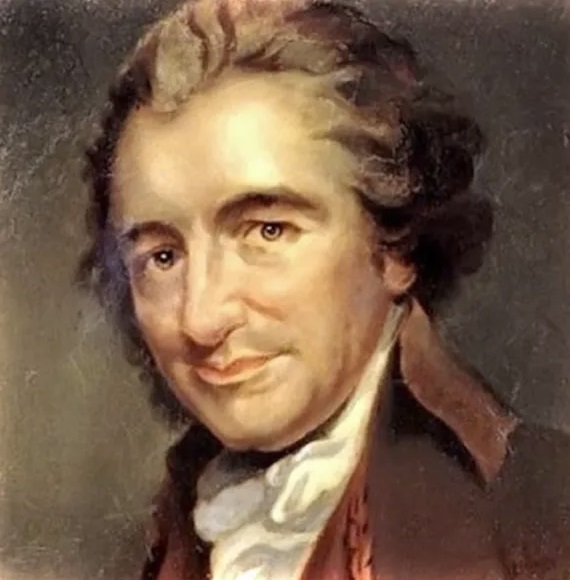
Presented by Zia H Shah MD
Abstract
This report presents an exhaustive biographical reconstruction of the life of Thomas Paine, the seminal radical of the Atlantic Enlightenment, alongside a forensic textual analysis of his theological magnum opus, The Age of Reason. While Paine is historically canonized for his political interventions in the American and French Revolutions through Common Sense and The Rights of Man, his theological writings precipitated his social ostracization and obscured his legacy for nearly two centuries. This document argues that Paine’s religious iconoclasm was not an aberration but the inevitable philosophical culmination of his radical egalitarianism; just as he sought to liberate the citizen from the tyranny of the Crown, he sought to liberate the conscience from the tyranny of the Priest. Central to this analysis is the inclusion of Paine’s pivotal childhood recollection regarding the doctrine of Redemption, a psychological rupture that defined his Deistic worldview. Through a detailed chapter-by-chapter review of Parts I and II of The Age of Reason, this report elucidates Paine’s forensic dismantling of Biblical inerrancy, his defense of “natural religion,” and the fierce contemporary controversies that branded him a “filthy little atheist.” The report concludes with an assessment of the work’s enduring impact on modern secularism, arguing that Paine constructed the vernacular vocabulary of modern skepticism.
Introduction: The Enigma of the Transatlantic Radical
Thomas Paine remains one of the most complex figures of the Enlightenment. Born a subject of the British Crown, he became a citizen of the United States and an honorary citizen of the French Republic, only to die an outcast in the nation he helped found.1 His life traces the arc of the Age of Revolutions, intersecting with key figures such as Benjamin Franklin, George Washington, Edmund Burke, and Maximilien Robespierre. Yet, unlike his contemporaries who maintained a separation between political liberty and religious orthodoxy, Paine viewed them as inextricably linked systems of oppression.
To understand the intellectual ferocity of The Age of Reason, one must locate its origins not in the prison cells of the French Terror, where the manuscript was penned, but in the quiet, repressed gardens of Thetford, England. It is there that the young Paine first confronted the theological dissonance that would fuel his lifelong war against dogma.
Chapter I: The Making of a Dissident (1737–1774)
The Thetford Dualism: Quaker Roots and Anglican Rites
Thomas Paine was born on January 29, 1737, in Thetford, Norfolk, a small market town dominated by the glorious ruins of its religious past and the rigid class structures of the present.1 His parentage was a study in theological conflict. His father, Joseph Paine, was a stay-maker and a devout Quaker, a member of the Society of Friends whose tenets of pacifism, simplicity, and the “inner light” of conscience stood in quiet defiance of state authority.3 His mother, Frances Cocke, was an Anglican, the daughter of a local attorney, and a woman of “sour temper” and orthodox piety.3
This mixed marriage was the crucible of Paine’s intellect. Because his parents belonged to different denominations, Paine was never baptized, a fact that placed him legally and spiritually on the margins of English society from birth.4 From his father, he inherited a distrust of hierarchy and a belief in the sanctity of the individual conscience—traits that would later endear him to the radical democratic movements in America and France. From his mother and her relations, he received a forced education in the dogmas of the Church of England, a pedagogy that backfired spectacularly.
The Garden of Revolt: The Primal Scene of Deism
The psychological root of Paine’s theology—and indeed, the entire thesis of The Age of Reason—can be traced to a singular, traumatic event in his childhood. This moment serves as the emotional anchor of his later writings, a point of divergence where the innate moral logic of the child clashed with the received wisdom of the institution.
Paine recounts this epiphany in The Age of Reason with vivid clarity. It is a passage that moves from the pulpit to the garden, symbolizing the movement from artificial theology to natural reason. The full weight of his later Deism is contained within this recollection:
“From the time I was capable of conceiving an idea, and acting upon it by reflection, I either doubted the truth of the Christian system, or thought it to be a strange affair; I scarcely knew which it was: but I well remember, when about seven or eight years of age, hearing a sermon read by a relation of mine, who was a great devotee of the church, upon the subject of what is called Redemption by the death of the Son of God. After the sermon was ended, I went into the garden, and as I was going down the garden steps (for I perfectly recollect the spot) I revolted at the recollection of what I had heard, and thought to myself that it was making God Almighty act like a passionate man, that killed his son, when he could not revenge himself any other way; and as I was sure a man would be hanged that did such a thing, I could not see for what purpose they preached such sermons. This was not one of those kind of thoughts that had anything in it of childish levity; it was to me a serious reflection, arising from the idea I had that God was too good to do such an action, and also too almighty to be under any necessity of doing it. I believe in the same manner to this moment; and I moreover believe, that any system of religion that has anything in it that shocks the mind of a child, cannot be a true system.”.5
Biographical research identifies the “relation” mentioned in this passage as his aunt, Ms. Cocke, a strict adherent to the High Church who sought to correct the Quaker deviations of her nephew’s upbringing.8 The setting of the garden is crucial; in Paine’s narrative, the garden represents the realm of Nature, where God’s laws are intuitive and benevolent, contrasting with the dark interior of the house/church where God is depicted as a vengeful tyrant requiring blood sacrifice.9 This dichotomy—Nature vs. Scripture, Garden vs. Pulpit—would become the structural backbone of his theology.
The Failures of Early Adulthood
Paine’s formal education ended at the age of thirteen, a truncation typical for his class, though he had shown aptitude at the Thetford Grammar School.3 He was apprenticed to his father as a stay-maker. Contrary to the later myths propagated by his enemies that he made corsets for women (a gendered insult intended to belittle his masculinity), his father’s trade involved making stays for ship rigging as well as garments, a detail that foreshadows his later interest in engineering and naval affairs.10
His early adulthood was a procession of failures and restless wanderings. He briefly served as a privateer on the ship King of Prussia in 1756, an experience that exposed him to the brutality of war and the raw mechanics of empire.3 He married Mary Lambert in 1759, but she died in childbirth the following year, a tragedy that left him widowered and destitute.3
He eventually found employment as an excise officer (tax collector) in Lewes, Sussex. It was here that Paine’s political consciousness began to crystallize. Witnessing the rampant corruption of the British government and the grinding poverty of the working class, Paine wrote his first political pamphlet, The Case of the Officers of Excise (1772), arguing for better pay to prevent corruption.10 He spent a winter lobbying Parliament in London, an effort that ended in failure but introduced him to the wider world of political discourse and, crucially, to Benjamin Franklin.3
By 1774, Paine’s life in England had collapsed. He was dismissed from the excise service for his agitation, separated from his second wife, Elizabeth Ollive, and facing debtors’ prison. It was Franklin who saw the potential in this articulate, angry man, advising him to emigrate to America and providing him with letters of introduction that described him as an “ingenious, worthy young man”.3
Chapter II: The Architect of Revolution (1774–1787)
Common Sense and the American Voice
Paine arrived in Philadelphia in November 1774, barely surviving the voyage after contracting typhus.11 He entered a colonial society that was already in ferment, yet lacked a unified direction. While the colonial elite debated legalistic grievances regarding taxation and representation within the British constitution, Paine perceived a deeper, systemic issue: the legitimacy of monarchy itself.
In January 1776, Paine published Common Sense. The pamphlet was a revelation. discarding the dry, legalistic prose of his contemporaries, Paine wrote in the vernacular of the common people—the style of the sermon and the tavern. He argued that it was “common sense” for a continent to not be ruled by an island.11 More radically, he attacked the “Divine Right of Kings,” using Biblical analysis to show that the Israelites had sinned by asking for a king, thus using the colonists’ own religious reverence to undermine their political allegiance.11
The impact was immediate and seismic. It is estimated that nearly 50,000 copies were sold in a population of a few million, the equivalent of millions of copies today.11 George Washington noted that the pamphlet was “working a powerful change in the minds of many men”.11 Paine had transformed a tax revolt into a war for human liberty.
The Crisis and the Soldier-Writer
Paine did not merely write; he served. He joined the Continental Army as an aide-de-camp to General Nathanael Greene.1 During the darkest days of the war, when Washington’s army was retreating across New Jersey in the winter of 1776, Paine wrote the first of his Crisis papers. The opening lines became legendary: “These are the times that try men’s souls. The summer soldier and the sunshine patriot will, in this crisis, shrink from the service of their country…”.2 Washington ordered these words read to his freezing troops before they crossed the Delaware to attack Trenton, crediting Paine with sustaining the morale of the army.2
Despite his massive literary success, Paine remained poor, as he donated the copyrights of his works to the revolutionary cause—a pattern of financial self-sacrifice that would leave him destitute in later life.10
Chapter III: Science, Bridges, and the Rights of Man (1787–1793)
The Engineer of Iron
Following the American victory, Paine turned his restless mind to science and engineering, reflecting the Enlightenment ideal of the polymath. In 1787, he returned to Europe not initially for politics, but to promote his design for a single-span iron bridge.3 He corresponded heavily with Franklin and Jefferson regarding the mechanics of the design, which he hoped to build across the Schuylkill River in Philadelphia.3 This period highlights Paine’s deep commitment to Deism in its most scientific form: he believed that the laws of mechanics were the “handwriting of God,” and that by mastering engineering, one was participating in the divine rationality of the universe.12
The Defense of the French Republic
Paine’s engineering ambitions were sidelined by the outbreak of the French Revolution. In 1790, Edmund Burke published Reflections on the Revolution in France, a scathing attack on the uprising and a defense of hereditary monarchy and tradition. Paine responded with Rights of Man (1791–1792), a work that went far beyond a defense of France to propose a comprehensive program of republicanism and social welfare.1
In Rights of Man, Paine argued that “every age and generation must be as free to act for itself, in all cases, as the ages and generations which preceded it.” He advocated for progressive taxation, old-age pensions, and public education—ideas centuries ahead of his time.14 The British government, terrified by the spread of radicalism, indicted Paine for seditious libel. He fled to France just ahead of arrest, never to return to his homeland.3
In France, Paine was greeted as a hero of liberty. Despite speaking no French, he was granted honorary citizenship and elected to the National Convention.3 However, his position soon became precarious. As the Revolution radicalized under the Jacobins, Paine’s moral commitments—specifically his opposition to capital punishment—clashed with the revolutionary tribunal. During the trial of Louis XVI, Paine argued, “Kill the king, but spare the man,” proposing instead that Louis be exiled to America.6 This act of mercy was viewed by Marat and Robespierre as a sign of weakness, or worse, royalist sympathy.
Chapter IV: The Shadow of the Guillotine and the Birth of The Age of Reason
Imprisonment in the Luxembourg
By late 1793, the Reign of Terror was in full swing. Foreigners were viewed with suspicion, and Paine’s association with the moderate Girondin faction sealed his fate. On December 28, 1793, Paine was arrested and imprisoned in the Luxembourg Palace, which had been converted into a prison.15
It was during the weeks leading up to his arrest, living in the shadow of the guillotine, that Paine began writing the first part of The Age of Reason. He handed the manuscript to his friend Joel Barlow while being escorted to prison, fearing it would be destroyed by his captors.17
Paine’s motivation for writing The Age of Reason at this specific moment is crucial. He witnessed the French revolutionaries dismantling the Catholic Church, replacing it with the Cult of Reason and later the Cult of the Supreme Being. Paine saw the violent de-Christianization of France not as a triumph, but as a danger. He feared that in rejecting the corruption of the priesthood, the people would reject God entirely and fall into atheism, which he viewed as morally bankrupt. The Age of Reason was intended as a lifeline—a way to preserve belief in God through reason when the authority of the Church had collapsed.17
The Miracle of the Chalk Mark
Paine’s survival in prison is the subject of a famous and somewhat debated anecdote, often referred to as the “Chalk Mark” incident. As the Terror reached its climax in July 1794, prisoners condemned to die were identified by a chalk mark placed on their cell doors by the jailers.
According to Paine’s own account and later biographies, he fell ill with a fever and was unconscious in his cell. The door of his cell was left open to allow for ventilation. The jailer, moving down the hallway, placed the chalk mark on the inside of the open door. Later, a turnkey came and closed the door, hiding the mark on the inside. When the executioners came to collect the victims, they saw no mark on the outside of Paine’s door and passed him by.9
This serendipitous event (or “providence,” as Paine might ironically call it) preserved him until the fall of Robespierre on July 27, 1794 (9 Thermidor), after which the mass executions ceased. He was released in November 1794, largely due to the intervention of the new American Minister to France, James Monroe.16
Chapter V: The Age of Reason, Part I — The Theology of Nature
The Creed of the Deist
Part I of The Age of Reason, published in 1794, lays out the philosophical groundwork of Paine’s Deism. It is a work of constructive theology, distinct from the destructive biblical criticism that characterizes Part II. Paine begins with a clear profession of faith:
“I believe in one God, and no more; and I hope for happiness beyond this life. I believe in the equality of man, and I believe that religious duties consist in doing justice, loving mercy, and endeavoring to make our fellow-creatures happy.”.17
This creed reflects the “moral justice” he yearned for in the garden of his childhood. It is simple, universal, and ethical, devoid of dogma, liturgy, or hierarchy.
The Critique of Revelation: The Problem of Hearsay
The central epistemological argument of Part I is the distinction between Revelation and Hearsay. Paine accepts the theoretical possibility of revelation—that God could communicate directly to a human being. However, he argues that the nature of revelation is inherently subjective and non-transferable.
“Revelation is a communication of something, which the person to whom that thing is revealed, did not know before. For if I have done a thing, or seen it done, it needs no revelation to tell me I have done it, or seen it, nor to enable me to tell it, or to write it. Revelation, therefore, cannot be applied to any thing done upon earth of which man is himself the actor or the witness; and consequently all the historical and anecdotal part of the Bible, which is almost the whole of it, is not within the meaning and compass of the word revelation, and, therefore, is not the word of God.”.23
Paine proceeds to argue that even if God did speak to Moses, or Jesus, or Mahomet, that communication is only revelation to them. When Moses tells the Israelites what God said, it is no longer revelation; it is merely hearsay. No person is morally obligated to believe hearsay, especially hearsay that is thousands of years old, translated through multiple languages, and copied by fallible scribes.23
The Argument from Design: The Universe as Scripture
If the Bible is not the Word of God, where is God to be found? Paine answers with the classic Deist argument from design, but elevates it to a theological primary.
“The Creation is the Bible of the Deist. He there reads, in the handwriting of the Creator himself, the certainty of his existence and the immutability of his power.”.25
Paine contrasts the “word of God” printed on paper (which can be forged, altered, and suppressed) with the “word of God” written in the heavens (the planetary motions, the laws of physics). The universe serves as a universal text, accessible to every human being regardless of language or literacy. Science, therefore, becomes a form of worship. To study the laws of nature is to study the mind of the Creator.12
Paine also employs the “plurality of worlds” argument, a common trope in Enlightenment thought. He argues that the vastness of the universe, with its millions of stars and potential worlds, renders the Christian drama of redemption absurdly parochial. Why would the Creator of the universe single out one small planet, and one small tribe within that planet, to enact a cosmic drama of death and resurrection?.27
Chapter VI: The Age of Reason, Part II — The Sword of Criticism
The Shift in Tone
While Part I was written from memory without access to a Bible, Part II was written in 1795 after Paine had been released (or while still imprisoned, accounts vary slightly on the exact start) and had procured a copy of the scriptures.16 The tone of Part II is markedly different: it is forensic, detailed, and often scathing. Having narrowly escaped death, Paine attacks the texts that he believes have enslaved humanity to superstition.
The Old Testament: Mythology and Morality
Paine subjects the Old Testament to a rigorous historical and moral critique.
1. The Authorship of the Pentateuch
Paine challenges the traditional attribution of the first five books of the Bible to Moses. He employs what would later be known as “Higher Criticism” (though he lacked the academic terminology). He points to internal anachronisms as proof of later authorship.
- The Death of Moses: Paine notes that Deuteronomy records the death and burial of Moses, which Moses obviously could not have written.
- The List of Kings: He cites Genesis 36:31, “And these are the kings that reigned in the land of Edom, before there reigned any king over the children of Israel.” Paine argues this sentence could only have been written after the establishment of the Israelite monarchy (Saul/David), centuries after Moses.28
- The “Dan” Anachronism: He points out references to the town of Dan in Genesis, noting that the town was not named Dan until long after the Mosaic age.29
Paine concludes that the Pentateuch is a compilation of myths and histories written by anonymous scribes during the Babylonian exile or later, falsely attributed to Moses to give them authority.28
2. The Moral Indictment
More damning than his historical critique is his moral one. Paine catalogs the violence commanded by God in the Old Testament—the slaughter of the Midianites, the genocide of the Canaanites, the orders to kill women and children.
“It is a history of wickedness, that has served to corrupt and brutalize mankind; and, for my own part, I sincerely detest it, as I detest everything that is cruel.”.28
He argues that attributing such atrocities to the Creator is blasphemy. Thus, Paine paradoxically argues that he is defending God’s reputation against the libels of the Bible.
The New Testament: Contradictions and Fabrications
Paine applies the standard of legal evidence to the Gospels. He treats the Evangelists (Matthew, Mark, Luke, John) as witnesses in a court of law. If witnesses contradict each other on material facts, their testimony is discarded.
1. The Genealogy of Jesus
Paine produces a direct comparison of the genealogies of Jesus found in Matthew 1 and Luke 3.
- Table of Contradictions:
| Feature | Matthew’s Account | Luke’s Account | Paine’s Analysis |
| Lineage Start | Solomon (son of David) | Nathan (son of David) | Completely different royal lines. |
| Father of Joseph | Jacob | Heli | A direct contradiction in immediate paternity. |
| Number of Generations | 28 generations from David | 43 generations from David | “Did these two agree, it would not prove the genealogy to be true… but as they contradict each other in every particular, it proves falsehood absolutely.”.28 |
Paine mocks the attempts of theologians to reconcile these lists, arguing that if this were a legal case regarding the inheritance of an estate, the case would be thrown out of court immediately.31
2. The Resurrection Narratives
Paine dissects the accounts of the Resurrection morning with ruthless precision. He asks: Who went to the tomb? When did they go? What did they see?
- Matthew: Mentions an earthquake and an angel sitting on the stone outside.
- Mark: Mentions a young man sitting inside the sepulcher.
- Luke: Mentions two men standing.
- John: Mary Magdalene goes alone, sees the stone taken away, and runs to tell Peter.
Paine argues, “The writers of these books… tell us a story of an angel… but they are not agreed whether it was one angel or two, or whether the angel was sitting or standing, or whether he was inside or outside”.32 He concludes that these are the hallmarks of a fabricated legend, not eyewitness history.
3. The Ascension and the Balloon
Paine reserves his sharpest satire for the Ascension. He notes that the Ascension—the culminating proof of Christ’s divinity—is missing from the Gospels of Matthew and John, the supposed eyewitnesses. It is only recorded by Mark and Luke, who were not present.
“The story of the ascension is told by Mark and Luke… but Matthew and John say not a syllable about it.”.18
Paine compares the Ascension to a “balloon ascent,” ridiculing the physics of a physical body levitating into the stratosphere. He links this to pagan mythology, where deified heroes often ascend to Olympus, arguing that Christianity is merely “heathen mythology” with a new coat of paint.13
4. The Death of Judas
Paine highlights the contradiction regarding the death of Judas Iscariot.
- Matthew 27:5: Judas “cast down the pieces of silver… and departed, and went and hanged himself.”
- Acts 1:18: Judas “purchased a field with the reward of iniquity; and falling headlong, he burst asunder in the midst, and all his bowels gushed out.”
Paine writes: “Here is no harmony… The one account says he hanged himself, the other says he fell and burst asunder.” He dismisses the apologetic explanation (that the rope broke) as a desperate invention not found in the text.23
The French Context of Part II
Paine’s critique must be read against the backdrop of the French Revolution’s failure. He saw the Terror as the result of a society that had lost its moral compass. By dismantling the “fabulous theology” of Christianity, he hoped to clear the ground for the “true theology” of Deism, which would provide a rational basis for human rights and republican government. He believed that the “adulterous connection” between Church and State had corrupted both; only by severing them could true religion and true government flourish.24
Chapter VII: The Intellectual War and Social Reaction
The Bishop’s Apology
The publication of The Age of Reason provoked a massive counter-offensive from the religious establishment in Britain and America. The most famous rebuttal was An Apology for the Bible (1796) by Richard Watson, the Bishop of Llandaff.34
Watson’s strategy was twofold. First, he attempted to answer Paine’s factual objections (e.g., arguing that Moses compiled earlier records). Second, and more effectively, he attacked Paine’s class and style. Watson portrayed Paine as an uneducated “vulgar” mechanic who had no business discussing high theology. He accused Paine of “intoxicating” the lower classes with dangerous ideas that would lead to anarchy.35
The popularity of Watson’s Apology (it ran through many editions) demonstrates the fear Paine inspired. The British ruling class realized that Paine’s Deism was not just a theological stance but a political weapon. If the common man could question the Bible—the foundation of the monarchy’s authority—he could question the King.
Prosecution and Censorship
The British government did not rely solely on bishops to fight Paine; they used the courts. In 1797, a bookseller named Thomas Williams was prosecuted for selling The Age of Reason. The prosecution was led by Thomas Erskine (who had previously defended Paine for Rights of Man, highlighting the shift in public sentiment). The court ruled that attacking Christianity was an attack on the common law of England, effectively criminalizing Paine’s Deism as sedition.3
The American Backlash
In the United States, the reaction was complicated by partisan politics. The Federalists, led by figures like John Adams and supported by the Congregationalist clergy in New England, used The Age of Reason to attack the Jeffersonian Republicans. They painted Jefferson (a friend of Paine and a suspected Deist) as an atheist revolutionary who would import the French Terror to America.36
The Second Great Awakening was beginning to stir, and The Age of Reason inadvertently fueled it. Christian revivalists used Paine as a foil, a symbol of the “infidelity” that threatened the soul of the nation. Preachers railed against “Tom Paine” from the pulpits, creating a caricature of him as a drunken, immoral atheist—a caricature that persisted for over a century.25
Chapter VIII: The Long Exile and the Bitter End (1802–1809)
Return to America
In 1802, at the invitation of President Thomas Jefferson, Paine returned to the United States. He expected to be welcomed as a Founding Father. Instead, he was a pariah. The Federalists attacked Jefferson for inviting the “infidel” back to American shores. When Paine arrived in Baltimore, he was jeered in the streets. Stagecoach drivers refused to carry him. In New Rochelle, where he had been gifted a farm by the state of New York for his revolutionary services, he was denied the right to vote by local officials who claimed that his service in the French Convention had forfeited his American citizenship.14
The Solitude of Conviction
Paine’s final years were marked by isolation, poverty, and declining health. He continued to write, producing the third part of The Age of Reason (an examination of biblical prophecies) and pamphlets on various subjects, but his influence was gone. He was ostracized by former friends; even Washington, whom Paine had criticized for not doing enough to get him out of the French prison, was now an estrangement.2
Despite the pressure, Paine never recanted. As he lay dying in 1809, clergy from various denominations visited him, hoping to secure a deathbed conversion that would vindicate their faith. To one patronizing minister who asked if he wished to accept Christ, Paine replied, “I have no wish to believe on that subject”.2
The Fate of the Bones
Paine died on June 8, 1809. He had requested to be buried in a Quaker cemetery, honoring his father’s faith, but the Quakers refused, citing his “controversial” writings. He was buried on his farm in New Rochelle. Six people attended the funeral.1
In a bizarre postscript, the English radical William Cobbett dug up Paine’s bones in 1819 and took them to England, intending to build a magnificent memorial. The memorial was never built, and after Cobbett’s death, the bones were lost. Paine’s remains were scattered, much like his legacy—fragmented, contested, but impossible to completely bury.14
Chapter IX: Legacy and Modern Reassessment
From “Filthy Little Atheist” to Secular Prophet
For much of the 19th and early 20th centuries, Paine was dismissed in the phrase of Theodore Roosevelt as a “filthy little atheist”.25 This label was a double slander: Paine was not an atheist, nor was he “filthy” (though his enemies often exaggerated his drinking and hygiene in his later depressed years).
It was not until the mid-20th century, with the rise of secular humanism and a re-evaluation of the radical Enlightenment, that Paine’s reputation began to recover. Historians like Moncure Conway, and more recently Eric Foner and Harvey Kaye, have reconstructed Paine’s image, presenting him not as a destroyer of faith, but as a champion of free faith.29
The Vocabulary of Secularism
The Age of Reason is now recognized as a seminal text in the history of secularism. While its specific biblical criticisms have been superseded by modern archaeology and philology, its method remains revolutionary. Paine democratized theology. He took the arguments of the elite Deist philosophers (like Voltaire and Hume) and translated them into the language of the working class. He told the shoemaker and the farmer that they were capable of judging the truth of a text for themselves, without the mediation of a priest.26
Paine’s assertion that “My own mind is my church” anticipates the modern concept of “spiritual but not religious.” He envisioned a world where religion was a private matter of conscience, separated entirely from the coercive power of the state. In this sense, The Age of Reason is the theological equivalent of the First Amendment.22
A Critical Legacy
Scholars today acknowledge the limitations of Paine’s work. His attack on the Bible was often blunt and lacked nuance. He failed to appreciate the literary or metaphorical value of scripture, reading poetry as if it were a legal deposition.38 However, his central insight—that a religion claiming to be universal cannot rely on particular, localized, and contradictory texts—remains a potent challenge to orthodox theology.
Thematic Epilogue: The Tragedy of the Enlightened Garden
Thomas Paine was the tragedy of the Enlightenment personified. He possessed the rare genius to translate the highest abstractions of philosophy into the visceral reality of the street, a gift that ignited revolutions on two continents. Yet, this same gift ensured his alienation. By taking the tools of Reason—which the elite reserved for the salon and the university—and handing them to the common man, Paine committed the ultimate transgression against the established order.
The Age of Reason stands not merely as a theological treatise but as a manifesto of intellectual dignity. It is the spiritual sequel to Common Sense. Just as Common Sense argued that an island could not rule a continent, The Age of Reason argued that the dead hand of tradition could not rule the living mind.
In the garden of his childhood, fleeing the sermon of his aunt, Paine realized that the God of the Altar was incompatible with the God of his Conscience. The “God of the Altar” was a projection of human cruelty—a passionate man who killed his son. The “God of the Garden” was the Architect of the stars, the author of immutable laws, the benevolent Creator who required no blood, only justice.
Paine’s life was an attempt to reconcile the world to that garden. He sought to strip away the “fabulous theology” of kings and priests to reveal the “true theology” of nature and equality. That the world was not ready for such a reconciliation—that it greeted his message with prisons, slander, and unmarked graves—was Paine’s sorrow. That he had the courage to speak it, knowing the cost, remains his glory. In the final analysis, Paine did not destroy religion for his readers; he offered them a faith that required no apology: the faith in their own capacity to reason.
If you would rather read in Microsoft Word file:



 The Glorious Quran and Science
Leave a comment