
Presented by Zia H Shah MD
I. Introduction: The Crisis of Perception and the Architecture of Belief
In the contemporary intellectual landscape, the discourse on the nature of reality is dominated by a schism between two fundamental epistemologies: the materialist worldview, which asserts the causal closure of the physical universe, and the transcendental worldview, which posits that the observable cosmos is but a subset of a vaster, unobservable reality. The opening passage of Surah Al-Baqarah (The Cow), comprising verses 1 through 7, addresses this dichotomy with a precision that anticipates and critiques the modern philosophical stance of Metaphysical Naturalism.
This report provides an exhaustive commentary on these verses, synthesizing classical Islamic scholarship (Tafsir), modern philosophy of science, and contemporary theoretical physics. The primary objective is to elucidate how the Quranic definition of the believer—anchored in the “Belief in the Unseen” (Iman bi’l-Ghayb)—serves as a descriptive inverse of the atheist. By strictly defining the guided intellect as one that acknowledges the “Unseen,” the text implicitly defines the unguided intellect as one imprisoned within the “Seen.” This analysis draws significantly from the insights of the TheQuran.Love commentary, specifically regarding the incompatibility of Quranic guidance with the dogmatic empiricism of the modern age.1
The report proceeds through a granular analysis of the text, examining the linguistic, theological, and scientific dimensions of each verse. It argues that the “Sealed Heart” described in verse 2:7 is not an arbitrary divine punishment, but the inevitable epistemic consequence of a worldview that refuses to look beyond the material horizon—a state of cognitive closure that renders the individual incapable of processing the “AM signals” of revelation while tuned exclusively to the “FM frequencies” of matter.1
II. The Preamble of Silence: The Linguistic and Theological Challenge of Alif, Lam, Meem (2:1)
2.1 The Disjointed Letters (Al-Muqatta’at) as an Epistemic Check
The Quranic discourse commences not with a proposition, a command, or a narrative, but with a sound: Alif, Lam, Meem (2:1). These three letters, disjointed and seemingly devoid of immediate lexical meaning, stand as the sentinel at the gate of revelation. Their presence at the beginning of Surah Al-Baqarah—and twenty-eight other chapters—constitutes a profound philosophical intervention that destabilizes the reader’s intellectual arrogance before the engagement with the text begins.3
In the context of 7th-century Arabia, these letters represented a rhetorical shock. The Arabs were masters of language, poetry, and eloquence. By utilizing the foundational building blocks of their own tongue—Alif, Lam, Meem—yet arranging them in a manner that defied their linguistic conventions, the Quran established a “Challenge” (Tahaddi). It signaled that while the vehicle of revelation (language) is human and familiar, the source and structure are Divine and inimitable. As noted by Ibn Kathir, these letters testify to the miraculous nature of the Quran; they are the raw materials of speech, yet no human can construct a comparable edifice from them.5
2.2 The Interpretative Silence and Anti-Positivism
From a theological perspective, the most resonant interpretation—favored by the primary caliphs Abu Bakr, Umar, Uthman, and Ali (RA)—is that these letters are “Divine Secrets” (Sirr Allah), the knowledge of which is reserved for God alone.4 This interpretation establishes the primary axiom of the Quranic worldview: The Limit of Human Reason.
This stands in stark contrast to the demands of modern Logical Positivism and Scientism, which posit that a statement is only meaningful if it can be analytically verified or empirically demonstrated.8 The positivist mind demands immediate transparency; it insists that “if I cannot understand it, it is nonsense.” Alif, Lam, Meem rejects this epistemological entitlement. It forces the intellect into a posture of humility. It declares that there are frequencies of meaning that transcend human cognitive processing power. Before the reader can receive guidance, they must acknowledge that their cup of knowledge is not full. The “silence” of meaning in verse 2:1 prepares the “vessel” of the heart for the “water” of guidance in verse 2:2.
2.3 Symbolic Interpretations and Divine Attributes
While the majority view emphasizes the mystery, other classical exegesis provides symbolic interpretations that deepen the theological context. Some scholars suggest the letters are acronyms for Divine Attributes: Alif standing for Allah (The God), Lam for Al-Latif (The Subtle/The Benevolent), and Meem for Al-Majid (The Glorious) or Al-Malik (The King).4 This view suggests that the entire cosmos and the text that explains it are bookended by the names of God. The text begins with the Divine Signature, reminding the reader that what follows is not the speculation of a philosopher but the decree of a Sovereign.
III. The Axiom of Certainty: The “Book” and the “Closed” Mind (2:2)
3.1 The Absolute Negation of Doubt (La Rayba Fih)
“This is the Book about which there is no doubt…” (2:2).
Following the mystery of the letters comes the assertion of absolute certainty. The Arabic phrase La Rayba Fih (No doubt in it) is an existential statement. In the history of philosophy, particularly in the Cartesian tradition, knowledge begins with doubt (Dubito, ergo cogito, ergo sum). The modern scientific method is predicated on skepticism—the provisional acceptance of theories until they are falsified.
The Quran, however, presents a different epistemology. It asserts that while human inquiry begins with doubt, Divine Revelation provides an anchor of absolute certainty (Yaqin). This certainty is not “dogmatic” in the pejorative sense, but “axiomatic.” Just as mathematics relies on axioms that cannot be proven within the system but make the system possible, the Quran presents itself as the axiomatic foundation of moral and metaphysical truth.9
3.2 The Conditionality of Guidance (Hudan lil-Muttaqin)
Crucially, the verse does not say “This is a guidance for humanity” (at this specific juncture), but rather “a guidance for those conscious of Allah” (Hudan lil-Muttaqin). This restriction is the key to understanding the Quranic critique of atheism.
Guidance is described here as an interactive phenomenon. It is not a static property of the text, but a dynamic result of the interaction between the Text and the Heart. As noted in the commentary from TheQuran.Love, guidance is “conditional.” It acts as a light that illuminates only those hearts that are already inclined to trust in realities beyond sensory verification.1
This concept parallels the “Observer Effect” in quantum mechanics, where the state of the observer influences the outcome of the observation. In the spiritual realm, the “state” of the reader (Taqwa or Arrogance) determines whether the Quran manifests as “Guidance” or “Blindness.” For the Muttaqin—those who possess a protective awareness and fear of God—the book is open. For the arrogant or the indifferent, it remains opaque.
3.3 The “Closed Book” and Materialism
Drawing from the insights of Muhammad Asad, we find a profound critique of the materialist mindset here. Asad argues that the Quran remains a “closed book” to those whose minds cannot accept the premise that ultimate reality extends beyond the observable world.1 This is not due to a defect in the Book, but a defect in the receiver’s frequency.
If a person approaches the Quran with the presupposition of Metaphysical Naturalism—that only physical matter exists and that there is no author beyond the human—they will encounter the text only as literature, history, or sociology. They will miss the Huda (Guidance) entirely. The text explicitly locks its own treasures against those who lack the key of Taqwa.1
IV. The Ontology of the Unseen (Al-Ghayb) and the Definition of the Atheist (2:3)
4.1 The Fulcrum of Faith: Defining Al-Ghayb
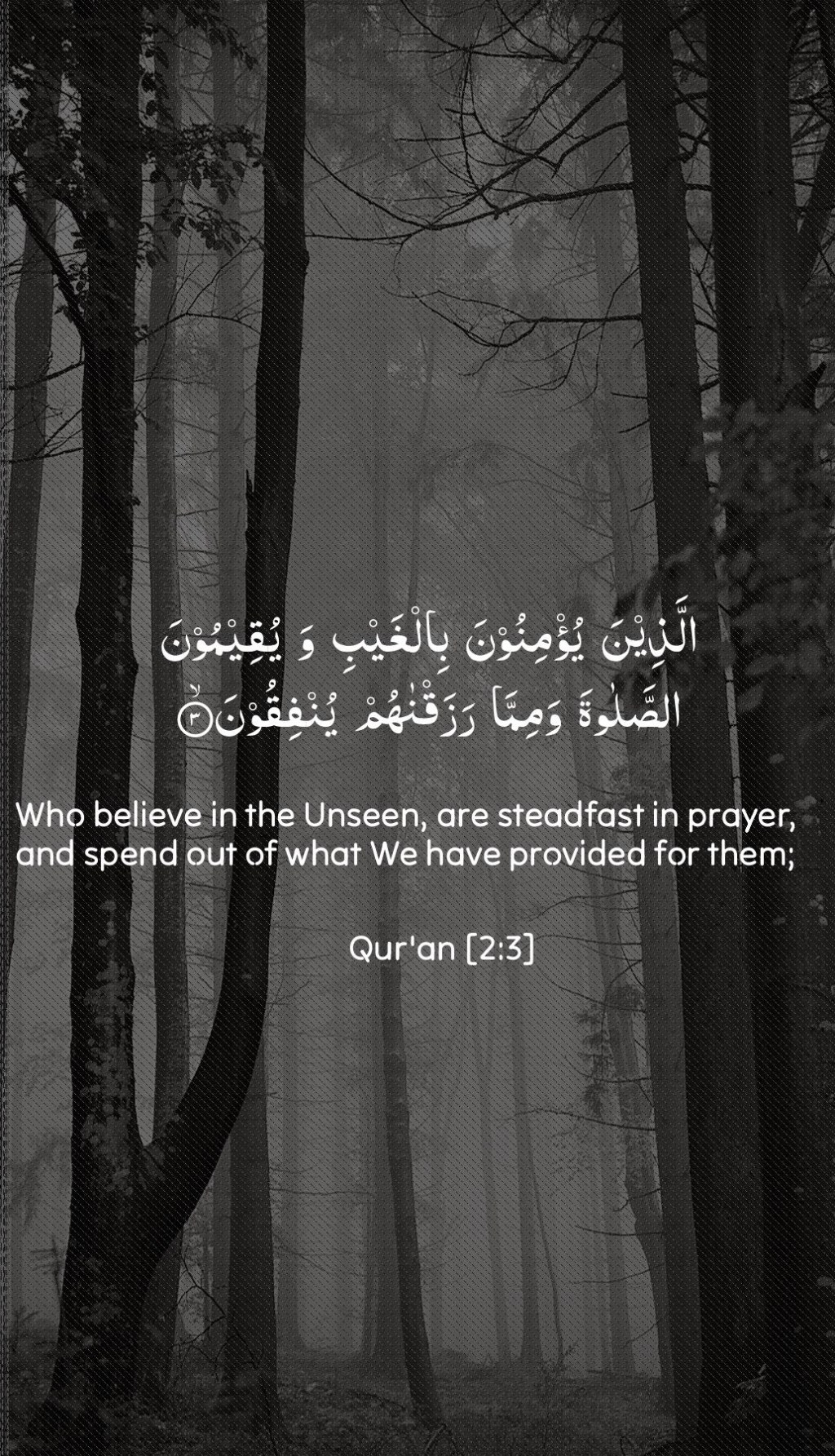
The definition of the Muttaqin begins in verse 2:3 with the primary criterion: “Who believe in the unseen…” (Allatheena yu’minoona bil-ghayb).
The term Al-Ghayb is the philosophical fulcrum upon which the entire Quranic worldview balances. Etymologically, it refers to that which is “absent,” “concealed,” or “hidden” from the faculties of perception.12
In Islamic theology, Al-Ghayb is categorized into:
- The Absolute Unseen (Ghayb Mutlaq): Realities that are intrinsically unknowable to created beings in their totality, such as the Essence (Dhat) of Allah and the precise timing of the Hour.13
- The Relative Unseen (Ghayb Nisbi): Realities that are unperceived by some but perceived by others (e.g., what is happening in another room), or realities that are currently unperceived but may be discovered later (e.g., microscopic life before the microscope).14
Belief in the Unseen is not a call to superstition. It is an act of Intellectual Humility. It is the admission that the human sensory apparatus (eyes, ears) and the human cognitive apparatus (brain) are limited tools that capture only a fraction of existence. The believer asserts that the Observable (Shahadah) is merely the surface of the Unobservable (Ghayb).15
4.2 The Atheist as the “Denier of the Unseen”
The prompt asks to highlight how verse 2:3 describes the atheist. By defining the guided as those who believe in the Unseen, the Quran effectively defines the misguided (the atheist/naturalist) as those who refuse to look beyond the Seen.
The atheist, in this Quranic schema, is the embodiment of Metaphysical Naturalism.
- The Definition: Metaphysical Naturalism is the worldview which holds that “there is nothing but natural elements, principles, and relations of the kind studied by the natural sciences”.16 It asserts the “Causal Closure of the Physical,” meaning every event in the universe has a sufficient physical cause, leaving no room for God, the soul, or divine intervention.2
- The “Emphatic Belief” in Naturalism: The atheist does not merely lack belief in God; they possess a dogmatic belief in the self-sufficiency of matter. They demand that all truth claims be subjected to the “Witnessed” (Shahadah)—the laboratory or the telescope.
- The Logical Contradiction: As noted in snippet 12, this demand is logically incoherent. One cannot “witness” the “unseen.” If the Unseen could be weighed and measured, it would cease to be Unseen. The atheist’s demand for “empirical evidence of God” is a category error, akin to demanding to smell the color blue. It reveals a fundamental limitation in their epistemological framework.
Table 1: The Epistemological Divide (Quran 2:3 vs. Naturalism)
| Feature | The Believer (Quran 2:3) | The Atheist (Metaphysical Naturalism) |
| Ontology | Reality = Shahadah (Seen) + Ghayb (Unseen). | Reality = Shahadah (Seen) only. |
| Epistemology | Knowledge comes from Senses, Reason, AND Revelation. | Knowledge comes from Senses and Reason only (Empiricism). |
| Posture | Openness: “There is more than I can see.” | Closure: “If I can’t see/measure it, it doesn’t exist.” |
| Consciousness | A non-material reality (Soul/Ruh). | An emergent property of neural firing (Biological). |
| The Universe | An open system permeable to Divine Will. | A closed system governed solely by physical laws. |
4.3 The Failure of “Strict Physicalism”
The commentary emphasizes that strict physicalism (the modern iteration of materialism) fails to account for the most immediate aspect of human existence: Consciousness.
The “Hard Problem of Consciousness” remains unsolved by naturalism. Physics can explain the wavelength of light, and biology can explain the processing of the optic nerve, but neither can explain the experience (qualia) of “redness.” The believer in Al-Ghayb acknowledges that the mind/soul is a reality that transcends the physical brain—an “Unseen” operator of the “Seen” hardware. The atheist, by refusing to look beyond the physical brain, is forced into the absurd position of denying the reality of their own subjective experience or reducing it to an illusion.1
This refusal to acknowledge the non-material is described by modern commentator Zia H. Shah as a “breach in the wall of being.” The believer acknowledges the breach (Revelation/Soul); the naturalist cements it shut.2
V. Scientific Commentary: The Physical Reality of the Unseen
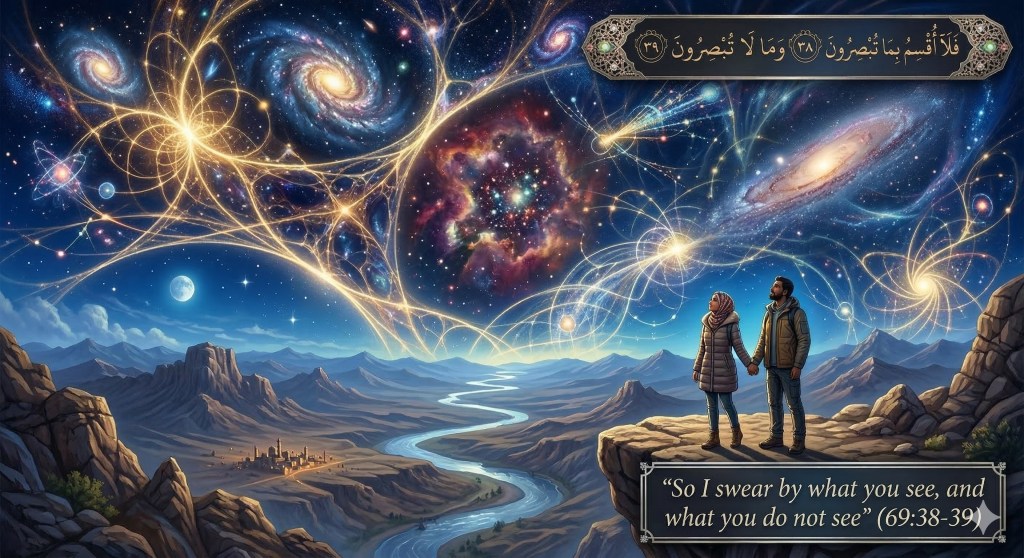
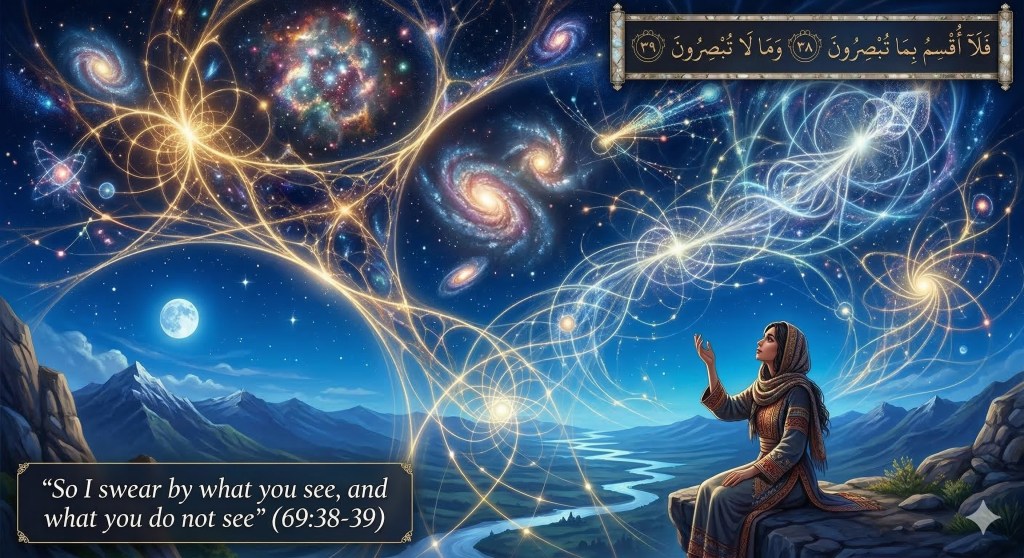
While the primary meaning of Al-Ghayb is theological, modern physics offers powerful analogies that dismantle the “common sense” materialism of the 19th and 20th centuries. The notion that “only what is visible is real” is scientifically archaic.
5.1 The Dark Sector: The Universe is 95% “Unseen”
One of the most profound ironies of modern atheistic scientism is that cosmology has revealed the visible universe to be a minority constituent of reality.
- Baryonic Matter: The matter that makes up stars, planets, human bodies, and everything we can see or touch constitutes only ~4.9% of the universe’s total mass-energy content.18
- Dark Matter (~26.8%): This is a form of matter that does not interact with the electromagnetic force. It absorbs no light, reflects no light, and emits no light. It is literally invisible (Ghayb to our senses). We only know it exists because of its gravitational effects on visible galaxies. Without it, galaxies would fly apart.19
- Dark Energy (~68.3%): A mysterious force driving the accelerated expansion of the universe. It is equally invisible and detectable only by its effects on the fabric of spacetime.18
Theological Implication: If a scientist in the 21st century refuses to believe in anything “unseen,” they must reject 95% of the universe. The existence of Dark Matter serves as a physical parable for the theological Unseen. Just as the “unseen” Dark Matter is required to hold the “seen” galaxy together, the “Unseen” God is required to sustain the existence of the cosmos. The atheist who relies solely on the “observable” is making a judgment based on a tiny fraction of the data.
5.2 Multi-Dimensionality and String Theory
The user query asks for scientific context. String Theory (and M-Theory), the leading candidate for a “Theory of Everything,” posits that our universe possesses more dimensions than the familiar three of space and one of time (3D + 1T).
- Extra Dimensions: Mathematical consistency in String Theory requires 10 or 11 dimensions. The extra 6 or 7 dimensions are “compactified” or curled up at the Planck scale, rendering them inaccessible to our perception.20
- The “Seven Heavens”: Several modern Muslim commentators and physicists have drawn parallels between these extra dimensions and the Quranic concept of the “Seven Heavens” (Sab’a Samawat).20 The Quran speaks of these heavens as layered realities (Tibqa).
This scientific perspective reinforces the rationality of Iman bil-Ghayb. It demonstrates that “invisibility” is not synonymous with “non-existence.” It is merely a function of dimensional perspective. The atheist’s denial of the Unseen is, in this light, a form of “dimensional flatness”—an insistence that the 3D world is all there is, despite mathematical evidence to the contrary.
5.3 The “Smoke” of the Early Universe
Snippet 22 highlights the Quranic verse: “Then He directed Himself to the heaven while it was smoke…” (41:11).
Modern cosmology confirms that for the first 380,000 years after the Big Bang (before the Epoch of Recombination), the universe was an opaque, hot plasma of photons, electrons, and baryons. It was a “cosmic fog” or smoke through which light could not travel freely.22
The accuracy of this description serves to validate the source of the “Book.” If the Quran accurately describes the physical “unseen” past of the universe—a fact unknowable to a 7th-century Arab—it strengthens the credibility of its claims regarding the metaphysical Unseen.
VI. The Praxis of Belief: The Action of the Unseen (2:3-5)
Belief in the Quran is not a passive intellectual assent. The definition of the Muttaqin immediately couples belief with action.
“…who establish prayer and spend out of what We have provided for them.” (2:3).
6.1 Prayer (Salah) as the Negation of Autonomy
To “establish prayer” (Yuqimoona as-Salah) is the functional proof of belief in the Unseen.
- The Atheist’s Autonomy: For the naturalist, the human being is the highest intelligence in the known proximity. There is no one to talk to, no one to ask for help, and no one to thank essentially. The self is autonomous.
- The Believer’s Dependency: Prayer is the act of connecting the “Seen” self with the “Unseen” Lord. It is a daily declaration of dependency. It breaks the illusion of autonomy. By bowing physically, the believer acknowledges that the vertical axis of reality (Human-God) is more important than the horizontal axis (Human-World).12
6.2 Spending (Infaq) as the Negation of Materialism
“And spend out of what We have provided for them…”
This command strikes at the heart of the materialist ethos.
- The Logic of Hoarding: If the material world is the only reality, and death is the end, then accumulation of resources is the only logical strategy for security and pleasure. Spending without immediate return is irrational.
- The Logic of Infaq: The believer views wealth (Rizq) not as their own creation, but as a “provision” from the Unseen. By spending it (Charity/Zakat), they demonstrate two things:
- Detachment: They are not enslaved by the material.
- Trust: They believe the Unseen Provider will replace it or reward it in the Unseen Future (Afterlife).Asad notes that this spending is not just monetary but includes knowledge and emotional support. It is the active “flowing” of resources, preventing the stagnation of the heart.1
6.3 Certainty in the Hereafter (Al-Akhirah) (2:4)
“And of the Hereafter they are certain [in faith].” (2:4).
This is the capstone of the believer’s worldview. The “Hereafter” is the ultimate Unseen.
- Certainty (Yaqin): The verse uses the word Yuqinun (they have certainty), implying a conviction as strong as sensory sight.
- Teleological Orientation: For the atheist, time is a line that ends at a cliff (death). For the believer, time is a bridge. This changes the valuation of every action. The “Success” (Falah) mentioned in verse 2:5 is defined not by accumulation in the Dunya (World), but by status in the Akhirah. The atheist who refuses to look beyond the Dunya fails to plan for the infinite, investing 100% of their effort in a 0% return timeline (eternally speaking).
VII. The Pathology of Disbelief: The “Sealed” Heart (2:6-7)
Having defined the Open System of the Believer, the Quran turns to the Closed System of the Disbeliever in verses 2:6-7.
“Indeed, those who disbelieve – it is all the same for them whether you warn them or do not warn them – they will not believe. Allah has set a seal upon their hearts and upon their hearing, and over their vision is a veil. And for them is a great punishment.”
7.1 The Meaning of Kufr (Disbelief)
The Arabic word Kafir comes from the root K-F-R, meaning “to cover” or “to hide.” In agriculture, it refers to the farmer who covers the seed with soil.
- The Philosophical Implication: The disbeliever is not someone who lacks the truth, but someone who covers it. They bury the innate witness of the Fitrah (the God-given intuition) beneath layers of argumentation, arrogance, or materialist distraction.23 The atheist described here is active in their suppression of the spiritual instinct.
7.2 The “Seal” (Khatam) as Epistemic Closure
The “Sealing” of the heart is often misunderstood as predestination—that God forces them to disbelieve. However, classical Tafsir and modern psychology offer a nuanced view.
- The Law of Consequence: As noted in the Ma’arif ul-Quran and by Maududi, the “Seal” is a natural consequence of the individual’s own choices.9 It is a “Divine Law of Nature”: if a limb is unused, it atrophies. If the spiritual faculty (the “Heart”) is repeatedly suppressed by the refusal to acknowledge the Unseen, it eventually loses the capacity to perceive.
- Epistemic Closure: In modern philosophy, this is akin to Epistemic Closure or Confirmation Bias. When a person adopts a dogmatic worldview (like Naturalism) and refuses to entertain contrary evidence (“refuses to look beyond”), their mind rewires itself.
- They see a Sign (Ayah), but their mind filters it as “coincidence.”
- They hear the Quran, but their mind filters it as “ancient poetry.”
- This filtering mechanism is the “Seal.” It renders the warning and the silence “all the same” to them (2:6).25
7.3 The Self-Imposed Blindness
Verse 2:7 mentions a “veil” (Ghishawah) over their vision. This is the condition of the materialist who studies the universe but misses its point.
- Mechanistic vs. Teleological Vision: They see the “how” (mechanisms of gravity, evolution, physics) but are blind to the “why” (purpose, design, Creator).
- The Punishment: The “Great Punishment” begins in this world with the “desolation of reality.” The sealed heart lives in a universe that is, by its own definition, accidental, indifferent, and purposeless. It is a form of existential solitary confinement.27
VIII. Synthesis: The Breaking of the Seal
The opening of Surah Al-Baqarah presents a binary choice between two modes of existence.
- The Open System (The Muttaqin):This path begins with Humility (Alif Lam Meem), expands through the belief in the Unseen (Ghayb), manifests in action (Prayer/Charity), and aims for the Infinite (Hereafter). It is a worldview that aligns with the multi-dimensional, deep reality suggested by modern physics and demanded by human consciousness.
- The Closed System (The Kafir/Atheist):This path is defined by the refusal to look beyond the immediate sensory horizon. By “emphatically believing in naturalism,” the atheist seals their own epistemic faculties. They mistake the limit of their vision for the limit of reality.
Conclusion:
The Quranic description of the atheist in 2:3-7 is not a caricature but a precise diagnosis of Metaphysical Naturalism. It identifies the core error: the arrogance to assume that “what we see is all there is.” In an age where science itself is revealing the vastness of the invisible—from the quantum vacuum to Dark Matter—the Quranic invitation to “Believe in the Unseen” is not a retreat from reason, but an invitation to a higher, more complete rationality. It is a call to break the seal of materialism and let the light of the Ghayb illuminate the Shahadah.
Table 2: Summary of Quranic vs. Naturalistic Worldviews
| Dimension | The Quranic View (Open System) | The Naturalistic View (Closed System) |
| Origin | Divine Creation (Kun Faya Kun). | Cosmic Accident / Quantum Fluctuation (Self-Caused). |
| Nature of Reality | Stratified: Shahadah (Seen) + Ghayb (Unseen). | Flat: Shahadah (Seen) only. |
| Human Status | Khalifah (Vicegerent), ensouled, accountable. | Advanced primate, biological accident, unaccountable. |
| Knowledge | Revelation + Reason + Senses. | Reason + Senses (Empiricism) only. |
| Morality | Objective (Divine Command). | Subjective (Social Contract / Evolutionary Utility). |
| Destiny | Eternity (Akhirah). | Annihilation (Death). |
| Result (2:5 vs 2:7) | Falah (Ultimate Success). | Adhab (Punishment/Loss). |
If you would rather read in Microsoft Word file:


 The Glorious Quran and Science
Leave a comment