
Presented by Zia H Shah MD
Audio teaser:
Introduction: The Architecture of Divine Wisdom
Surah Luqman, the thirty-first chapter of the Qur’an, stands as a monumental pillar in the architecture of Makkan revelation. Revealed during the middle period of the Prophet Muhammad’s mission in Makkah, this Surah addresses the spiritual and intellectual crisis of a society steeped in idolatry and tribal arrogance. Unlike other chapters that often center on the narratives of the great Prophets—Noah, Abraham, Moses, or Jesus—this Surah distinguishes itself by deriving its title and central didactic core from a non-prophetic sage: Luqman the Wise (Luqman al-Hakim). This choice of nomenclature is in itself a profound theological statement, signaling the universality of wisdom and the democratization of piety. It underscores a fundamental Qur’anic premise: that wisdom (Hikmah) is not the exclusive preserve of prophecy but a divine endowment accessible to the righteous who align their intellect with the reality of Monotheism (Tawhid).
The Surah is composed of thirty-four verses and is situated in the twenty-first Juz (part) of the Qur’an. Structurally, it forms an integral part of a specific cluster of Makkan Surahs—Al-Ankabut (29), Ar-Rum (30), Luqman (31), and As-Sajdah (32)—which are bound together by their opening disjointed letters (Al-Muqatta’at): Alif, Lam, Mim. This sequence is not merely numerical but thematic. As noted in literary analyses, Surah Luqman serves as a theological bridge. While Surah Ar-Rum concludes with an exhortation to patience against those who “lack certainty” (la yuqinun), Surah Luqman opens by establishing the believers as those who possess “certainty” (hum yuqinun) in the Hereafter. Similarly, the end of Surah Luqman, which enumerates the five mysteries of the Unseen (the Hour, rain, wombs, tomorrow, and death), acts as a prelude to Surah As-Sajdah, which immediately unpacks themes of divine decree and creation.
The thematic contour of Surah Luqman is shaped by a distinct “philosophy of religion.” It moves beyond mere dogmatic assertion to engage the human faculty of reason. It juxtaposes the frivolity of “idle talk” (lahw al-hadith)—which distracts and degrades the human spirit—with the weightiness of the “Wise Scripture” (al-Kitab al-Hakim), which elevates and guides. Through the intimate narrative of a father counseling his son, the Surah transforms abstract theological concepts into practical ethics, covering gratitude, parental rights, social conduct, and the ultimate accountability to the Creator.
Part I: The Book of Wisdom and the Archetype of Success (Verses 1–5)
Verse 1
Alif Lam Mim.
The Surah commences with the mysterious disjointed letters: Alif, Lam, Mim. These letters function as a “divine signature,” a rhetorical challenge to the Arab linguists of the time. They signal that while the Qur’an is composed of the ordinary letters of their own alphabet—letters available to any poet or soothsayer—the resulting composition transcends human capability. In the specific context of Surah Luqman, which is preoccupied with the concept of Hikmah (Wisdom), these letters may be interpreted as the elemental “atoms” of wisdom. Just as the physical universe is constructed from elemental particles that only God can arrange into life, the “Wise Book” is constructed from linguistic elements that only God can arrange into revelation. They demand a posture of humility from the reader, an acknowledgment that the ultimate meaning rests with the Divine.
Verse 2
These are Verses of the Wise Book (the Quran).
The text immediately identifies itself as al-Kitab al-Hakim. The adjective Hakim (Wise) is personified; the Scripture is not merely a passive object containing wisdom, but an active agent that possesses wisdom. It acts as a “sage” that speaks to the intellect. The use of the demonstrative Tilka (These)—referring to something distant—elevates the status of the verses, suggesting they are high in station and sublime in meaning. This verse establishes the epistemological foundation of the Surah: true wisdom is not found in the conjecture of philosophers or the traditions of forefathers, but in the Revelation. This creates a direct link to verse 12, where Luqman is given wisdom; the Surah argues that the wisdom of the sage (Luqman) and the wisdom of the Scripture (Quran) are identical in source and substance.
Verse 3
A guide and a mercy for the Muhsinun (good-doers).
Here, the Qur’an specifies its target audience. It is Hudan (Guidance) and Rahmah (Mercy), but specifically for the Muhsinin. The term Muhsinin is derived from Ihsan (excellence/goodness), which is the highest tier of Islamic spirituality. This restriction is significant. While the Qur’an is intellectually available to all, its guidance only penetrates the hearts of those who approach it with a disposition towards goodness. Intellectual arrogance acts as a barrier to this guidance. The pairing of “Guidance” and “Mercy” is crucial; guidance provides the roadmap for the intellect, while mercy provides the nourishment for the soul. One cannot exist without the other; guidance without mercy becomes legalism, and mercy without guidance becomes sentimentality.
Verse 4
Those who perform As-Salat (Iqamat-as-Salat) and give Zakat and they have faith in the Hereafter with certainty.
This verse provides the functional definition of the Muhsinin. It does not define them by their lineage or wealth, but by three active qualities that encompass the totality of human existence:
- Iqamat as-Salat (Establishing Prayer): This governs the vertical relationship between the human and the Creator. The term Iqamat implies not just performing the ritual, but “establishing” it—ensuring its structural integrity, regularity, and spiritual quality.
- Giving Zakat (Alms): This governs the horizontal relationship between the human and society. It represents the purification of wealth and the acknowledgment that one’s resources are a trust from God to be shared with the vulnerable.
- Certainty in the Hereafter (Wahum bil-akhirati hum yuqinun): The syntax here emphasizes exclusivity and intensity. They do not merely “believe” in the Hereafter; they have Yaqin (certainty). This certainty is the psychological anchor that allows them to sacrifice immediate gratification (like wealth in Zakat or time in Salat) for a future reward they cannot see. It is this long-term orientation that distinguishes the wise from the foolish.
Verse 5
Such are on guidance from their Lord, and such are the successful.
The consequence of this spiritual orientation is Falah (Success). The imagery “on guidance” (ala hudan) suggests that guidance is a vehicle or a mount that carries them. They are not struggling through the path; they are supported by the path. The term Muflihun (the successful ones) refers to agricultural success—cultivating a harvest. It implies that spiritual life is organic; it requires planting (faith), watering (prayer/zakat), and patience until the harvest (paradise). This opens the Surah with the “Thesis of Success,” which will be immediately contrasted with the “Thesis of Failure” in the subsequent verses.
Part II: The Antithesis of Wisdom – The Distraction of Idle Talk (Verses 6–9)
Verse 6
And of mankind is he who purchases idle talks (i.e. lahw al-hadith) to mislead (men) from the Path of Allah without knowledge, and takes it (the Path of Allah) by way of mockery. For such there will be a humiliating torment.
In a sharp tonal shift, the Surah moves from the “Wise Book” to “Idle Talk” (Lahw al-Hadith). This juxtaposition is deliberate. Historical Context (Asbab al-Nuzul): Classical exegetes, including Ibn Kathir and Al-Tabari, cite the story of Nadr ibn al-Harith. He was a Meccan pagan who traveled to Persia and learned the legends of Rustam and Isfandiyar. Upon returning to Makkah, he challenged the Prophet Muhammad, claiming, “Muhammad tells you stories of Ad and Thamud, and I tell you stories of the Persian kings.” He would even purchase singing girls to distract people from the Qur’an. This context highlights that “idle talk” is not passive entertainment; it is an active, funded counter-narrative designed to compete with Divine revelation.
Theological and Legal Nuance: The term Lahw al-Hadith has been the subject of intense debate regarding the permissibility of music in Islam. Companions like Ibn Mas’ud swore that it referred to singing. However, the broader exegetical view, supported by scholars like Al-Qurtubi and contemporary commentators, suggests that Lahw encompasses any discourse—be it music, fictional narratives, frivolous philosophy, or celebrity gossip—that diverts the human heart from the remembrance of God and the cultivation of virtue. It is the “purchase” of distraction at the expense of reality.
The Transaction of Foolishness: The verse uses commercial language (“purchases”) to contrast with the believers who “transact” with God. The disbeliever invests his resources (time, money, attention) in emptiness. The purpose of this investment is li-yudilla (to mislead)—indicating that the culture of distraction is often a weaponized tool to confuse the moral compass of society. The result is a “humiliating” (muhin) punishment, fitting for one who sought to humiliate the Truth through mockery.
Verse 7
And when Our Verses (of the Quran) are recited to such a one, he turns away in pride, as if he heard them not, as if there were deafness in his ear. So announce to him a painful torment.
The psychological consequence of consuming “idle talk” is Istikbar (arrogance). The individual becomes desensitized to truth. The imagery is vivid: he turns his back physically, feigning deafness. The Qur’an diagnoses this not as a physical ailment but as a spiritual blockage (waqr) caused by the accumulation of frivolous distractions. The phrase “Announce to him” (bashir-hu) typically refers to good news; here, it is used ironically to mock his arrogance: his “good news” is a painful punishment. This reflects the literary feature of the Surah where tonal shifts from compassionate counsel to scathing irony are used to expose the absurdity of disbelief.
Verses 8–9
Verily, those who believe (in Islamic Monotheism) and do righteous good deeds, for them are Gardens of delight (Paradise). To abide therein. It is a Promise of Allah in truth. And He is the All-Mighty, the All-Wise.
Utilizing the literary device of contrast, the narrative returns to the believers. While the dealer in “idle talk” faces humiliation, the believers are promised Jannat al-Na’im (Gardens of Delight). The key phrase here is Wa’d Allahi Haqqan (God’s promise is true). In a world where the distractions of Lahw promise immediate pleasure but deliver emptiness, God’s promise appears distant but is the only reality. The concluding attributes Al-Aziz (The Mighty) and Al-Hakim (The Wise) reinforce this: God has the Might to execute His will against the mockers and the Wisdom to reward the righteous appropriately. This section concludes the comparison between the path of Wisdom and the path of Folly.
Part III: The Cosmological Evidence – God the Creator (Verses 10–11)
Verse 10
He has created the heavens without any pillars that you see and has set on the earth firm mountains, lest it should shake with you. And He has scattered therein moving (living) creatures of all kinds. And We send down water (rain) from the sky, and We cause (plants) of every goodly kind to grow therein.
The Surah shifts from moral philosophy to cosmological empiricism. It challenges the listener to observe the visible universe as a testimony to Tawhid.
- Heavens Without Pillars: The phrase bighayri amadin tarawnaha can be translated as “without pillars that you can see.” This ambiguous phrasing allows for dual interpretations: either there are no pillars at all, or there are pillars (forces like gravity) that are invisible. In either case, the structural integrity of the vast cosmos without visible support is a sign of Divine maintenance.
- Firm Mountains (Rawasiya): The Qur’an asserts that mountains are placed “lest the earth should shake with you.” This aligns with the geological concept of isostasy, where mountains act as “pegs” or stabilizers for the earth’s crust, balancing the lithosphere floating on the asthenosphere. This scientific insight, centuries ahead of its time, is presented here as a sign of God’s provident care.
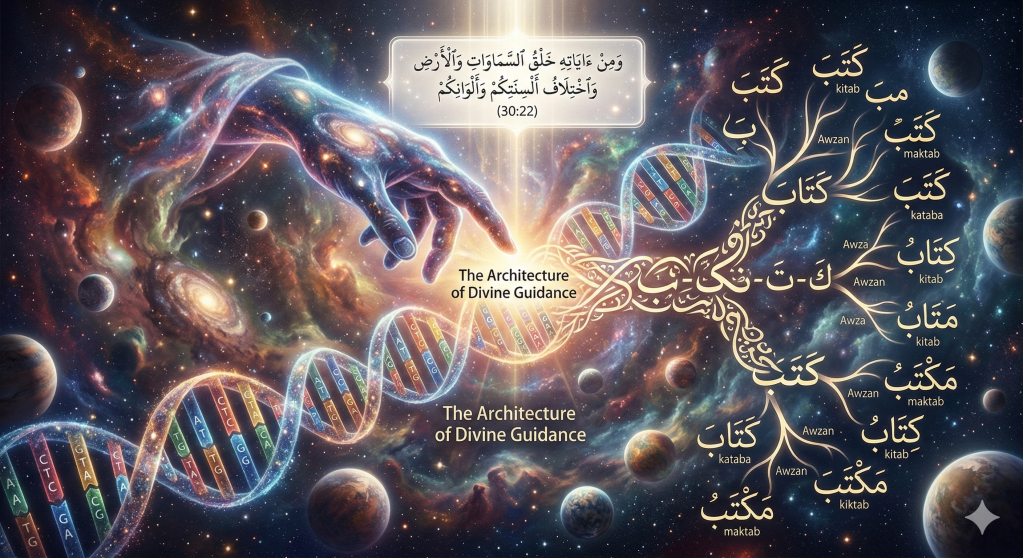
- The Unity of Life: The verse mentions the scattering of “creatures of all kinds” and the growth of “every goodly kind” (kull zawj karim). The use of zawj (pair/mate) for plants highlights the reality of sexual reproduction in botany. Furthermore, modern biological insights drawn from this—such as the universality of the genetic code—point to a singular Creator. As noted in the analysis of this Surah, the fact that all life (plants, bugs, humans) shares the same four-letter DNA alphabet argues against polytheism. If there were multiple creator-gods, we would expect multiple, incompatible biological systems. The unity of the “machine language” of life proves the Unity of the Designer.
Verse 11
This is the creation of Allah. So show Me that which those (whom you worship), besides Him have created. Nay, the Zalimun (polytheists, wrong-doers and those who do not believe in the Oneness of Allah) are in plain error.
The theological hammer falls: “This is the creation of Allah.” The challenge is empirical. If the idols (or modern equivalents like nature, chance, or ancestors) are worthy of worship, where is their creation? Can they create a heaven, a mountain, or even a single DNA strand? The silence of the opposition serves as the proof of their error. The verse labels the polytheists as Zalimun (wrongdoers). In Qur’anic semantics, Zulm is to misplace something. To assign the attribute of “Divinity” to a powerless statue or a dead ancestor is the ultimate metaphysical misplacement—the greatest injustice against reality.
Part IV: The Core of Wisdom – The Legacy of Luqman (Verses 12–19)
This section constitutes the heart of the Surah, presenting the archetype of wisdom through the persona of Luqman.
Verse 12
And indeed We bestowed upon Luqman Al-Hikmah (wisdom and religious understanding, etc.) saying: “Give thanks to Allah,” and whoever gives thanks, he gives thanks for (the good of) his own self. And whoever is ungrateful, then verily, Allah is All-Rich (Free of all wants), Worthy of all praise.
The Identity of Luqman: Who was Luqman? The vast majority of classical scholars, including Ibn Abbas and Mujahid, maintained that Luqman was a righteous sage (Hakim) and not a prophet. Tradition describes him as an Abyssinian or Nubian slave, a carpenter or a shepherd by trade. This background is critical. By elevating a non-Arab, former slave to the status of a sage whose advice is immortalized in the Qur’an, Islam challenges the Makkan aristocracy’s obsession with lineage and wealth. Wisdom is a meritocracy of the soul, not a privilege of the elite.
The Definition of Wisdom: The verse explicitly defines Hikmah (Wisdom) as Gratitude to Allah. This is a profound redefinition. Wisdom is not merely high IQ, philosophical complexity, or rhetorical skill. True wisdom is the intellectual recognition of the Source of all benefit and the behavioral alignment with that truth through gratitude. The theology of gratitude here is self-reflexive: “Whoever gives thanks, gives thanks for his own self.” God is Ghani (Self-Sufficient); He does not need human thanks. Gratitude is a mechanism designed for human growth—it expands the soul’s capacity for joy and preserves blessings. Ingratitude, conversely, hurts only the ingrate, cutting them off from the reality of abundance.
Verse 13
And (remember) when Luqman said to his son when he was advising him: “O my son! Join not in worship others with Allah. Verily! Joining others in worship with Allah is a great Zulm (wrong) indeed.”
Luqman’s counsel begins with the foundation of all Islamic thought: Tawhid (Monotheism). The Pedagogical Approach: The address Ya Bunayya (“O my little son”) uses a diminutive form of endearment. This indicates that religious instruction must be wrapped in love and tenderness to be effective. Luqman does not bark commands; he appeals to the bond of kinship. The Logic of Tawhid: Luqman explains why Shirk is forbidden: it is Zulm Azim (Great Injustice). Justice is giving everyone their due. Since God created, sustains, and owns the universe (as proven in v.10-11), He alone is due worship. To worship a created being is to rob the Creator of His right—a crime of cosmic proportions. This verse was pivotal in reassuring the Companions of the Prophet. When the verse “Those who believe and do not mix their belief with injustice” (6:82) was revealed, the Companions were terrified, thinking “injustice” meant any sin. The Prophet clarified by quoting Luqman: “Injustice here means Shirk,” referencing this specific verse.
Verse 14
And We have enjoined on man (to be dutiful and good) to his parents. His mother bore him in weakness and hardship upon weakness and hardship, and his weaning is in two years give thanks to Me and to your parents, unto Me is the final destination.
The Divine Parenthesis: In a unique stylistic shift, the narrative voice changes from Luqman to God (The Royal “We”). This interruption serves a crucial function. While Luqman advises his son to worship God, God interrupts to command the son to respect his parents. This mutual endorsement—the sage pointing to God, and God pointing to the parents—creates a hierarchy of rights. The Biological Reality: The verse highlights the physical sacrifice of the mother: wahn ala wahn (weakness upon weakness). It references the physiological toll of pregnancy and the exhaustion of nursing, specifying the weaning period as two years. This acknowledgment serves as the rational basis for the command of gratitude. The Dual Gratitude: The command “Give thanks to Me and to your parents” places parental gratitude immediately next to divine gratitude. This elevates filial piety to the highest level of social ethics. However, the reminder “unto Me is the final destination” serves as a check: ultimately, accountability is to God, preventing parental obedience from becoming absolute if it contradicts divine law.
Verse 15
But if they strive to make you associate with Me that of which you have no knowledge, do not obey them but accompany them in [this] world with appropriate kindness and follow the way of those who turn back to Me [in repentance]. Then to Me will be your return, and I will inform you about what you used to do.
The Limits of Obedience: This verse addresses a specific social crisis in Makkah: the conflict between new Muslim converts and their pagan parents. It establishes the rule that obedience to parents is conditional. If parents exert pressure (Jahadaka—strive/struggle) to force the child into Shirk, the child must disobey. The Ethics of Disagreement: Remarkably, the verse commands Sahib-huma (keep company with them) in this world Ma’rufan (in a kind and honorable way). Even in the face of spiritual tyranny from parents, the child must maintain social kindness and care. This nuanced ethic balances theological integrity with social grace, preventing the breakup of the family unit while preserving the faith of the individual. It teaches that one can disagree fundamentally with a parent’s beliefs while still serving them dutifully.
Verse 16
“O my son! If it be (anything) equal to the weight of a grain of mustard seed, and though it be in a rock, or in the heavens or on the earth, Allah will bring it forth. Verily, Allah is Subtle (in bringing out that grain), Well-Aware (of its place).”
The narrative returns to Luqman. Having established the “Who” of worship (God) and the “Who” of social duty (parents), he now establishes the “How” of spiritual consciousness: Muraqabah (God-consciousness). The Mustard Seed Metaphor: The mustard seed was proverbially the smallest object known to the ancient Arabs. Luqman uses a hyperbole of concealment: a seed, inside a solid rock, lost in the vastness of space or the depth of the earth. Attributes of God:
- Latif (Subtle/Refined): God’s knowledge penetrates the most microscopic and hidden barriers. He is not just the God of the earthquake; He is the God of the atom.
- Khabir (Aware): God is fully acquainted with the nature of the object. This teaches the son that there are no secrets. It instills an internal moral compass. The child is taught to behave not because the police or the father is watching, but because the Subtle, All-Aware God is watching. This accountability is the bedrock of Islamic character.
Verse 17
“O my son! Perform As-Salat (Iqamat-as-Salat), enjoin (people) for Al-Ma’ruf (Islamic Monotheism and all that is good), and forbid (people) from Al-Munkar (i.e. disbelief in the Oneness of Allah, polytheism of all kinds and all that is evil and bad), and bear with patience whatever befall you. Verily! These are some of the important commandments ordered by Allah with no exemption.”
Luqman moves from creed to action, outlining a three-step program for the believer:
- Establish Prayer: The personal spiritual foundation.
- Enjoin Good and Forbid Evil: The projection of that goodness into society. The believer cannot be passive; they must be a force for moral rectification.
- Patience (Sabr): Luqman realistically anticipates that social activism will generate backlash. “Forbidding evil” often angers those who profit from evil. Therefore, he commands patience to endure the inevitable persecution. The phrase min azm al-umur (matters of determination) signifies that this path requires grit and resolve; it is not for the faint-hearted. This reflects the struggle of the Prophet’s companions in Makkah who were actively persecuted for their beliefs.
Verses 18–19
“And turn not your face away from men with pride, nor walk in insolence through the earth. Verily, Allah likes not each arrogant boaster. And be moderate (or show no insolence) in your walking, and lower your voice. Verily, the harshest of all voices is the voice (braying) of the ass.”
The counsel concludes with Emotional Intelligence and Etiquette.
- Body Language: The phrase La tusa’ir khaddaka refers to a disease in camels (sa’ar) where the animal twists its neck. Luqman uses this to describe the human who turns their cheek away in contempt. He forbids this physical display of arrogance.
- Gait: Walking “exultantly” (marahan) is forbidden. The believer’s walk should be purposeful but humble.
- Voice: The command to “lower the voice” is reinforced by a scathing simile: the braying of a donkey. In a tribal culture where loud oratory was often equated with power, this teaching radically redefines strength as self-control. The donkey is loud but not wise; volume does not equal validity. This sequence—from Tawhid to Prayer to Manners—shows the holistic nature of Islamic wisdom. A person who prays but is arrogant, or who is monotheistic but rude to parents, lacks true Hikmah.
Part V: Divine Sovereignty vs. Human Obstinacy (Verses 20–26)
Verse 20
See you not (O men) that Allah has subjected for you whatsoever is in the heavens and whatsoever is in the earth, and has completed and perfected His Graces upon you, (both) apparent (i.e. Islamic Monotheism, and the lawful pleasures of this world, including health, good looks, etc.) and hidden [i.e. One’s Faith in Allah (of Islamic Monotheism) knowledge, wisdom, guidance for doing righteous deeds, and also the pleasures and delights of the Hereafter in Paradise, etc.]? Yet of mankind is he who disputes about Allah without knowledge or guidance or a Book giving light!
The Surah widens the lens from Luqman’s private counsel to a public address. It employs the concept of Taskhir—that the universe is “subjected” or made serviceable to humanity. The sun, rain, and earth function to support human life, evidence of a gracious Creator. The Epistemological Standard: The verse critiques the disbelievers who argue about God without three qualifications:
- Ilm (Knowledge/Empirical data).
- Huda (Guidance/Rational insight).
- Kitab Munir (Illuminating Book/Revelation). This establishes a rigorous standard for truth claims. Islam demands that faith be grounded in observation, reason, or authentic revelation, rejecting the baseless speculation of the idolaters.
Verse 21
And when it is said to them: “Follow that which Allah has sent down”, they say: “Nay, we shall follow that which we found our fathers (following).” (Would they do so) even if Shaitan (Satan) invites them to the torment of the Fire?
Here, the Qur’an confronts the primary intellectual block of the Meccans: Taqlid (Blind Imitation). They prioritized ancestral custom over revealed truth. The verse reframes this conservatism as a Satanic trap. By following their forefathers into error, they are effectively following Satan’s invitation to Hell. This is a radical call for intellectual independence; one must honor parents (as per verse 14) but not follow their errors. The “Wisdom” of Luqman is the antidote to the “Folly” of blind tradition.
Verse 22
And whosoever submits his face (himself) to Allah, while he is a Muhsin (good-doer)… then he has grasped the most trustworthy handhold. And to Allah return all matters for decision.
The metaphor of al-Urwa al-Wuthqa (the most trustworthy handhold) appears here. In the treacherous terrain of desert life, a secure rope or handhold was a matter of life and death. The verse equates Islam (submission of the face/self) combined with Ihsan (doing good) to grasping an unbreakable support. Unlike the fragile reliance on idols or clan prestige, the connection to God is the only security that withstands the trials of life and death.
Verses 23–24
And whoever disbelieves, let not his disbelief grieve you (O Muhammad). To Us is their return, and We shall inform them what they have done. Verily, Allah is the All-Knower of what is in the breasts (of men). We let them enjoy for a little while, then in the end We shall oblige them to (enter) a great torment.
God consoles the Prophet Muhammad. The rejection of the message caused the Prophet immense personal grief. God shifts the perspective: the disbeliever’s rebellion is not a failure of the Messenger, but a temporary reprieve granted by God. The phrase “enjoy for a little while” (numatti’uhum qalilan) emphasizes the fleeting nature of worldly power. It introduces the theme of the “Illusion of Time”—the pagan chieftains may seem dominant now, but they are being herded towards a massive, unavoidable accountability.
Verses 25–26
And if you (O Muhammad) ask them: “Who has created the heavens and the earth,” they will certainly say: “Allah.” Say: “All the praises and thanks be to Allah!” But most of them know not. To Allah belongs whatsoever is in the heavens and the earth. Verily, Allah, He is Al-Ghani (Rich, Free of all wants), the Worthy of all praise.
This verse exposes the Cognitive Dissonance of the Meccan polytheists. They were not atheists; they believed that Allah created the universe (Tawhid ar-Rububiyyah). However, they failed to translate this belief into exclusive worship (Tawhid al-Uluhiyyah). The Prophet is commanded to say “Alhamdulillah” (Praise be to Allah) upon hearing their admission, for their own words serve as evidence against them. If God created everything (V.26), then He owns everything. To worship the “owned” (idols) instead of the “Owner” is logical bankruptcy. The attribute Al-Ghani reminds them that God does not need their worship; they need Him.
Part VI: The Infinite Words of God (Verses 27–30)
Verse 27
And if all the trees on the earth were pens and the sea (were ink wherewith to write), with seven seas behind it to add to its (supply), yet the Words of Allah would not be exhausted. Verily, Allah is All-Mighty, All-Wise.
This verse presents one of the most powerful metaphors in scripture regarding the concept of Divine Infinity. The Image: Imagine a logging operation that converts every tree on Earth into pens. Imagine the oceans turned to ink, replenished by seven more oceans. The Implication: Even with these massive resources, one could not finish recording the Kalimat (Words/Creative Decrees/Knowledge) of Allah. Scientific and Philosophical Resonance: This verse (echoing Surah Al-Kahf 18:109) puts human knowledge in perspective. The “knowledge” claimed by the disputers in Verse 20 is less than a drop in this ocean. It establishes that the universe is not a closed system but an open manifestation of God’s infinite creative power. As noted in the “God the Creator” analysis, the complexity of a single DNA strand or the physics of a single atom hints at this depth; the “Words” of God in creation are inexhaustible.
Verse 28
The creation of you all and the resurrection of you all are only as (the creation and resurrection of) a single person. Verily, Allah is All-Hearer, All-Seer.
Following the infinity of Knowledge, this verse addresses the infinity of Power. The polytheists doubted how God could resurrect billions of dead bodies. The Qur’an answers with a digital-age logic: for a Being of infinite power, quantity is irrelevant. The effort required to create or resurrect one soul is identical to the effort required for all souls. It is merely a command: “Be.” This dismantles the anthropomorphic view of God as a limited craftsman who gets tired or overwhelmed by numbers.
Verse 29
See you not (O Muhammad) that Allah merges the night into the day (i.e. the decrease in the hours of the night are added to the hours of the day), and merges the day into the night (i.e. the decrease in the hours of the day are added to the hours of the night), and has subjected the sun and the moon, each running its course for a term appointed; and that Allah is All-Aware of what you do.
Cosmological Signs: The alternation of day and night and the precise movements of the sun and moon are cited as proofs of a Single Administrator. Scientific Nuance: The phrase “each running its course for a term appointed” (kullun yajri ila ajalin musamma) contains deep scientific resonance.
- Orbits: It implies the sun is not static but moving (running).
- Solar Lifecycle: The “appointed term” suggests that stars like the sun are not eternal but have a life cycle (birth and death/supernova). Theological Point: These massive celestial bodies are “subjected” to laws. They obey God without fail. The implicit question to the human is: Why do you, a tiny creature, rebel when the massive sun submits?.
Verse 30
That is because Allah, He is the Truth, and that what they invoke besides Him is Al-Batil (falsehood, Satan and all other false deities), and that Allah, He is the Most High, the Most Great.
This verse serves as the logical conclusion to the cosmic arguments. Because God controls the heavens (V.29), the earth (V.27), and life/death (V.28), He is Al-Haqq (The Ultimate Reality/Truth). Anything else worshipped is Batil (Falsehood/Vanity/Non-existent). This binary—Truth vs. Falsehood—leaves no room for a pantheon of lesser gods. The Surah strips away the legitimacy of all idols, exposing them as mere names without reality.
Part VII: The Maritime Metaphor and the Conclusion (Verses 31–34)
Verse 31
See you not that the ships sail through the sea by the Grace of Allah? that He may show you of His Signs? Verily, in this are signs for every patient, grateful (person).
The Surah turns to the sea. The ship is a symbol of human technology, yet it relies entirely on the “Grace of Allah” (buoyancy, wind, water physics) to function. The verse links this observation to the dual qualities of the believer: Sabbar (Patient) and Shakur (Grateful). Patience is needed when the wind dies or the storm hits; gratitude is needed when the journey is smooth. This echoes the advice of Luqman, reinforcing that the observation of nature requires a specific moral disposition to yield wisdom.
Verse 32
And when a wave covers them like shades (i.e. like clouds or the mountains of sea-water), they invoke Allah, making their invocations for Him only. But when He brings them safely to land, there are among them those that stop in the middle, between (Belief and disbelief). But none denies Our Signs except every perfidious, ungrateful one.
The Metaphor of the Storm: This verse depicts “Foxhole Religion.” When the waves loom like “canopies” (zulal—giant shadows or mountains), the polytheists instinctively abandon their idols. They call upon Allah Mukhlisina (sincerely/exclusively). This proves that Shirk is an artificial cultural overlay, while Tawhid is the innate instinct (Fitrah) that emerges in crisis. The Traitor (Khattar): Once safe on land, some “waver” or stay “moderate” (muqtasid—here implying lukewarm indecision). The Qur’an labels the one who returns to disbelief as Khattar (Perfidious/Traitor). It frames the return to idolatry not just as an error, but as a betrayal of the covenant made with God during the storm. This psychological analysis exposes the ingratitude of the human condition.
Verse 33
O mankind! Keep your duty to your Lord and fear a Day when no father can avail aught for his son, nor a son avail aught for his father. Verily, the Promise of Allah is true, let not then this (worldly) present life deceive you, nor let the chief deceiver (Satan) deceive you about Allah.
The Dissolution of Ties: The Surah returns to the father-son motif but with a terrifying twist. In Makkah, Luqman could guide his son, and the son could help the father. On the Day of Judgment, these ties dissolve. No parent can take the punishment for their child. This establishes the principle of Individual Moral Responsibility. The Two Deceivers: The verse warns against:
- Al-Hayat Al-Dunya: The life of this world (distracting with its glitz and “idle talk”).
- Al-Gharur: The Deceiver (Satan), who tricks people into relying on God’s mercy while continuing to sin (“God is forgiving, so I can keep sinning”). This effectively summarizes the warnings of the entire Surah.
Verse 34
Verily, Allah! With Him (Alone) is the knowledge of the Hour, He sends down the rain, and knows that which is in the wombs. No person knows what he will earn tomorrow, and no person knows in what land he will die. Verily, Allah is All-Knower, All-Aware (of things).
The Surah concludes with the Mafatih al-Ghayb (The Five Keys of the Unseen). While Luqman was given “wisdom,” he was not given “Absolute Knowledge.” This distinction is vital.
- The Hour: The timing of the Day of Judgment is the exclusive domain of God.
- Rain: While meteorology can forecast, the decree of where, when, and how much rain falls to sustain specific life is a Divine prerogative.
- The Wombs: Modern science can determine gender via ultrasound, but the verse uses the phrasing Ma fi al-arham (What is in the wombs). This refers to the reality of the new life—its character, its destiny, its happiness or misery, its spiritual potential. This remains entirely Unseen.
- Tomorrow: No human knows their future earnings or actions with certainty. The illusion of control is stripped away.
- Place of Death: Humans plan where to live, but they cannot plan where they will die. This is the ultimate limit of human agency. Conclusion: The Surah ends by humbling the human intellect. We can know the “wisdom” of how to live (from Luqman), but we cannot know the “Unseen” of when we die. Thus, the ultimate wisdom is to submit to the Alim (All-Knowing) and Khabir (All-Aware).
Thematic Epilogue: A Synthesis of Wisdom
Surah Luqman is not merely a collection of ethical injunctions; it is a profound reconstruction of the concept of Wisdom (Hikmah) itself. In the pre-Islamic Jahiliyyah, wisdom was often associated with tribal cunning, poetic prowess, or the ability to navigate the social hierarchies of Arabia. This Surah radically redefines wisdom as the alignment of the human intellect with the reality of Monotheism (Tawhid) and the human will with the practice of Gratitude (Shukr).
1. The Pedagogy of Luqman
The figure of Luqman serves as a timeless archetype for Islamic education and parenting. His method, as detailed in the Surah, offers a blueprint for transmitting faith across generations:
- Rapport over Rigor: His repeated use of “O my dear son” proves that religious transmission rides on the vehicle of love.
- Rationalization: He does not merely give rules; he gives reasons (“For Shirk is a great injustice,” “God is Subtle/Aware”). He treats the child as a rational agent.
- Holistic Curriculum: He weaves theology, ritual, social activism, and manners into a seamless garment of character. A child who prays but is arrogant is incomplete; a child who is polite but commits Shirk is lost.
2. The Science of Tawhid
The Surah integrates the “Book of Scripture” with the “Book of Nature.” It invites the reader to look at the pillars of gravity, the stabilizing mountains, the botany of pairs, and the genetics of life. It argues that the unity observed in the laws of physics and biology is a direct evidence of the Unity of the Creator. As noted by modern commentators referencing Matt Ridley and Richard Dawkins, the universality of the genetic code—the fact that all life uses the same dictionary—is a powerful corroboration of the Monotheistic argument presented in verses 10-11. The Surah bridges the gap between science and religion, positing that true science inevitably leads to Tawhid.
3. The Psychology of Distraction vs. Wisdom
Perhaps the most contemporary theme of the Surah is the dichotomy between “Wise Scripture” and “Idle Talk.” In an age of information overload, the warning against Lahw al-Hadith—content that distracts, creates spiritual deafness, and sells an illusion of happiness—is strikingly relevant. The Surah suggests that the remedy for the anxiety and aimlessness of the modern human is not more information, but “Wisdom”—which is defined as the deep, grateful, and focused connection to the Creator.
4. The Ring Composition
The Surah exhibits a perfect ring structure.
- It begins with the Wise Book (v.2) and the definition of the Successful (v.5).
- It centers on the Wise Man (Luqman) and his advice on how to be successful (v.12-19).
- It concludes with the Source of Wisdom (Allah) and the limits of human knowledge (v.34). This structure reinforces the message: Wisdom descends from God through Revelation, is embodied in the Sage, and leads back to the acknowledgment of God’s absolute sovereignty.
In conclusion, Surah Luqman teaches that to be wise is to recognize one’s smallness in the face of the Infinite. It is to walk on the earth with humility, to lower one’s voice in the presence of Truth, and to anchor one’s fragile vessel to the “Trustworthy Handhold” of Allah before the waves of eternity crash down.
Table 1: The Structure of Luqman’s Advice (Verses 13-19)
| Verse | Topic | The Wisdom |
| 13 | Theology (Aqidah) | Prohibition of Shirk: The foundation of all reality. Shirk is defined as “Great Injustice.” |
| 14-15 | Social Ethics (Rights) | Parents: Gratitude to parents is coupled with gratitude to God. Obedience is conditional on Tawhid. |
| 16 | Accountability (Muraqabah) | The Mustard Seed: God’s knowledge is absolute. Instills internal conscience over external policing. |
| 17 | Ritual & Activism | Prayer & Enjoining Good: Faith must translate into action (Prayer) and social responsibility (Reform). |
| 17 | Psychology | Patience (Sabr): The necessary emotional resilience to withstand the reaction to social reform. |
| 18-19 | Manners (Akhlaq) | Humility: Prohibition of arrogance in body language (turning cheek), gait (walking proud), and voice (donkey’s bray). |
Table 2: The Five Keys of the Unseen (Verse 34)
| The Key | The Domain | Human Limitation |
| The Hour | Time (Ultimate) | We cannot know the end of the universe. |
| The Rain | Sustenance | We cannot control the precise distribution of life-giving water. |
| The Wombs | Life | We can know gender, but not the destiny or soul of the child. |
| Tomorrow | Future Actions | We cannot guarantee our earnings or actions; plans are tentative. |
| Death | Space (Ultimate) | We cannot know where we will die. The ultimate surrender of control. |
If you would read in the Microsoft Word file:

 The Glorious Quran and Science
Leave a comment