

Presented by Zia H Shah MD
Audio teaser or promo:
Abstract
The prevailing intellectual orthodoxy of the modern era, metaphysical naturalism, rests upon the axiom of the “Causal Closure of the Physical”—the assertion that the material universe is a hermetically sealed system where every event is explicable solely by antecedent physical causes. This worldview necessitates a model of the human mind as a purely biological generator of information, evolved for survival rather than the apprehension of transcendent truth. This report presents an exhaustive philosophical and empirical interrogation of this paradigm, positing that a single, verifiable instance of “true revelation”—information acquired by the human consciousness from a source external to the physical continuum—is sufficient to falsify the naturalist claim.
By synthesizing the Urdu literary taxonomy of Amad (spontaneous arrival) and Aawurd (labored craft), historical accounts of anomalous scientific discovery, and the theological concept of Al-Aleem (The All-Knowing), we construct a rigorous argument for the permeability of the human mind. We examine the “Black Swan” events of epistemology: the “true dreams” of Otto Loewi, Dmitri Mendeleev, and Friedrich August Kekulé, and the continuous visionary state of Srinivasa Ramanujan. These case studies demonstrate the acquisition of complex, veridical information—often unknown to the dreamer and humanity at large—that bypasses the cognitive labor predicted by evolutionary psychology. The existence of such phenomena suggests that the human brain functions not merely as a computer but as an antenna, capable of receiving transmissions from an unknown reality. The confirmation of this “open system” epistemology destroys the foundations of physicalism, necessitating a return to a worldview where the physical is permeable to the metaphysical.
1. The Iron Cage: The Fragility of Metaphysical Naturalism
1.1 The Axiom of the Closed System
Metaphysical naturalism, often conflated with the scientific method itself, is a philosophical position asserting that the natural world—comprising matter, energy, space, and time—is the totality of existence. In this view, there are no supernatural entities, no divine interventions, and no non-physical sources of knowledge. The universe is described as a “causally closed” system.1 This means that for every physical event $E$, there is a sufficient physical cause $C$. If a neuron fires in the brain to produce a thought, that firing must be the result of electrochemical gradients and prior neural states, which in turn are the results of sensory inputs and genetic coding.
The implications of this worldview for the human mind are profound and reductive. Consciousness is viewed as an epiphenomenon—a byproduct of complex neural computation. Creativity is reduced to the reshuffling of stored data; “inspiration” is merely the subconscious mind processing information faster than the conscious executive function can track. In this framework, it is ontologically impossible for a human being to know something that they have not learned through sensory experience or derived through logical inference. There is no “outside” from which information can enter.
1.2 The Epistemological Black Swan
The fragility of metaphysical naturalism lies in its totalizing nature. It is a universal negative claim regarding the supernatural (i.e., “There is no non-physical reality”). To maintain this position, the naturalist must prove that every instance of knowledge acquisition in human history is the result of internal processing or sensory input. Conversely, to refute naturalism, one need not prove the existence of God, angels, or a specific religious dogma in its entirety. One needs only to demonstrate a single instance where the “closure” was breached—a single “Black Swan” event where information arrived in the human mind from a source that is demonstrably not physical, not sensory, and not a reconfiguration of memory.3
This report argues that such breaches are not only possible but are well-documented in the annals of the very discipline naturalism claims to own: science itself. We posit that the phenomenon of the “true dream” (Ruya Sadiqah) or the “spontaneous arrival” of complex structure (Amad) constitutes this breach. If a mathematician can dream of a theorem he does not understand, or a chemist can envision a molecular structure that contradicts his waking theories, and if these visions turn out to be empirically true, we are forced to admit that the mind has access to a database that exists outside the skull.
1.3 The Theological Counter-Thesis: Al-Aleem
Against the silent universe of naturalism stands the theistic model, which posits that the universe is sustained by a consciousness that is Al-Aleem (The All-Knowing).5 In this view, knowledge is not created by the human mind but is “bestowed” or “revealed.” The Quranic perspective, as elucidated in the source material, suggests that God “taught man what he knew not” (Quran 96:5). This implies that the human intellect is a receptive faculty.
The theological model predicts exactly what the naturalist model forbids: that there will be moments where the finite human mind transcends its biological limitations and interfaces with the Infinite. These moments are not violations of natural law but manifestations of a higher law—the law of Amad, or the descent of meaning. The “Muslim Times” articles referenced throughout this report argue that these phenomena are intended to serve as “signs” for the rational mind—empirical proofs that the material world is suspended in a web of higher intelligence.5
2. The Phenomenology of Inspiration: Amad vs. Aawurd
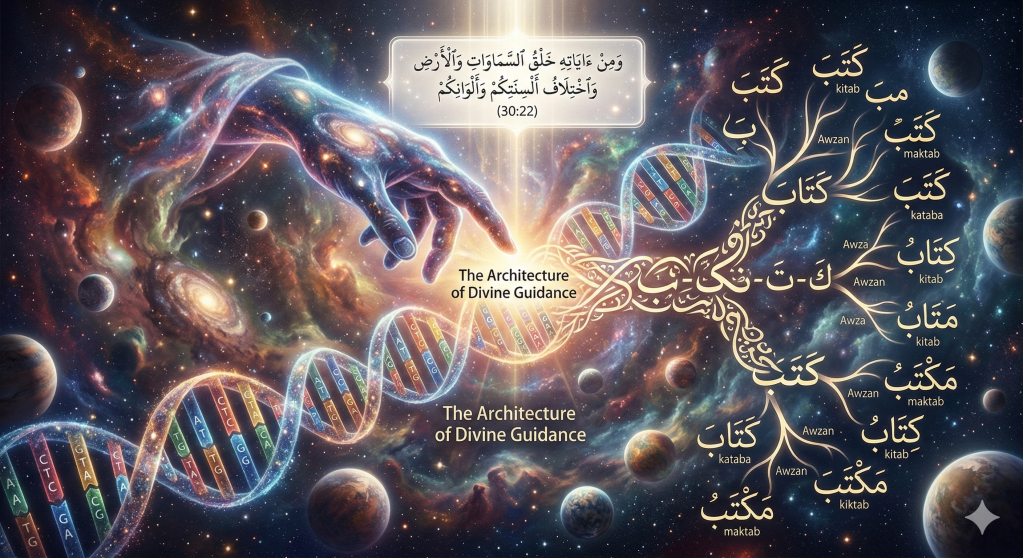
To rigorously analyze the mechanism of revelation, we require a taxonomy that distinguishes between ordinary cognitive labor and the anomalous reception of truth. Modern cognitive psychology often blurs this distinction, grouping all creative output under “cognition.” However, literary theory—specifically the rich tradition of Urdu poetics—offers a precise framework for distinguishing these two modes of mental activity: Amad and Aawurd.6
2.1 Aawurd: The Architecture of Effort
Aawurd comes from the Persian verb meaning “to bring” or “to carry.” In the context of creativity, it refers to work that is “brought forth” through deliberate, conscious effort. It is the domain of the craftsman.
- The Process: Aawurd involves planning, construction, editing, and polishing. It is linear and logical. The poet or scientist starts with a premise, applies rules (grammar or the scientific method), and constructs a result.
- The Metaphor: It is likened to “juice forcibly squeezed out of grapes”.6 It requires pressure, time, and mechanical action.
- Naturalist Compatibility: Aawurd is entirely compatible with metaphysical naturalism. It represents the brain functioning as a processor, taking inputs (vocabulary, data) and using algorithms (rules of prosody, logic) to generate outputs. The output is equal to the sum of the inputs plus the labor.
2.2 Amad: The Descent of the Divine
Amad, meaning “arrival” or “coming,” stands in direct opposition to Aawurd. It describes the spontaneous outpouring of complex, structured information that enters the mind fully formed, without conscious volition or labor.
- The Process: In Amad, the recipient is passive. The verse or idea “descends upon the poet instinctively”.6 The creator acts as a vessel or a scribe, recording what is being dictated by an internal or external voice.
- The Metaphor: It is the “sweet juice that drips naturally from ripe grapes”.6 It flows by gravity, not by force.
- The “God-Given” Harmony: A famous Persian adage states, “cho sher āmad, mawzuni-ash khudādād ast” (“when a poem comes by amad, its harmony is God-given”).6 This implies that the structural perfection of the idea is intrinsic to its source, not the result of the recipient’s skill.
2.3 Amad as a Challenge to Materialism
The phenomenon of Amad poses a critical problem for the physicalist model of mind. If the brain is a closed system, all “spontaneous” ideas must be the result of subconscious Aawurd—hidden processing. However, the characteristics of Amad often defy this explanation:
- Speed: The arrival is instantaneous, often bypassing the necessary intermediate logical steps.
- Novelty: The content of the Amad often exceeds the educational or experiential database of the recipient (as we will see with Ramanujan).
- Veridicality: In the case of scientific Amad, the “revealed” information accurately describes external physical realities (molecular bonds, atomic weights) that the subconscious mind had no way of measuring.
The Urdu critics, such as Hali and Shibli, debated the merits of these two modes, with classical poets valuing Amad as a sign of spiritual connection (Ilham).6 In the scientific realm, we find that the greatest paradigm shifts often occur via Amad, while the “normal science” (in Kuhn’s terminology) that follows is the work of Aawurd. The materialist view attempts to reduce Amad to Aawurd, but the historical record of “true dreams” resists this reduction.
3. The Mathematician of the Goddess: Srinivasa Ramanujan
The life of Srinivasa Ramanujan (1887–1920) serves as the primary “Black Swan” in our investigation. His mathematical output, which revolutionized number theory, infinite series, and continued fractions, was produced through a methodology that is incomprehensible to the materialist worldview but perfectly aligned with the concept of Amad and the attribute of Al-Aleem.
3.1 The Failure of the “Intuition” Hypothesis
When Ramanujan was brought to Cambridge by G.H. Hardy, the clash of worldviews was immediate. Hardy, a confirmed atheist and a rigorous formalist, viewed mathematics as a logical construction of the human mind. He recognized Ramanujan’s genius but attempted to secularize it, attributing Ramanujan’s insights to “deep intuition” or a subconscious grasp of numbers.9
However, this explanation fails to account for the specific phenomenology of Ramanujan’s experience. “Intuition” is a vague label we apply to rapid pattern matching. Ramanujan did not describe a “feeling” or a “hunch.” He described a relational transaction with an external entity. He explicitly stated, “An equation for me has no meaning unless it represents a thought of God”.9 For Ramanujan, math was not invented; it was revealed.
3.2 The Mechanism of the “Scrolls of Blood”
Ramanujan provided a detailed account of how he received his information, which fits the definition of Amad perfectly. He credited his family goddess, Namagiri Thayar (Mahalakshmi of Namakkal). He described a specific dream state where he would see drops of blood, symbolizing the god Narasimha (the consort of Namagiri). Following this visual cue, “scrolls containing complex mathematical content” would unfold before his inner eye.10
Table 1: Materialist vs. Theistic Interpretation of Ramanujan’s Process
| Feature of Experience | Materialist/Naturalist Explanation | Refutation/Deficiency of Naturalist View | Theistic/Revelation Explanation (Amad) |
| Source Attribution | Delusion or cultural metaphor for subconscious processing. | Dismisses the subject’s own testimony; fails to explain the visual specificity (scrolls). | The mind acts as a receiver for Al-Aleem (The Knower) via a spiritual interface (Namagiri). |
| Volume of Output | Freak statistical anomaly of neural wiring. | The quantity (3,900 results) and density of truth exceed random mutation or standard “savant” abilities. | Continuous Amad (flow) due to the recipient’s spiritual “tuning.” |
| Lack of Proofs | Defect in training; the mind “skipped steps.” | Ramanujan knew the destination without knowing the path. Logic (Aawurd) came later. | Revelation provides the conclusion (truth); logical proof is the human labor (Aawurd) required to verify it. |
| Zero and Infinity | Abstract concepts derived from counting. | Ramanujan treated them as theological realities (Zero = Absolute Reality). | Mathematical entities are ontologically real “thoughts of God” rooted in the Infinite. |
3.3 The Argument from Complexity
The “scrolls” Ramanujan saw contained mathematical formulas—specifically Mock Theta functions and modular forms—that were not only unknown at the time but are still being unpacked by physicists today to understand black holes.11 How does a “subconscious reshuffling” of basic arithmetic and high school geometry (Ramanujan’s primary formal education) result in the derivation of modular forms that describe the entropy of black holes?
The information content of the “output” ($O$) vastly exceeded the information content of the “input” ($I$). In a closed physical system, this is impossible ($O \le I + \text{Processing}$). The only explanation is that the system is open, and additional information was injected from an external source ($O = I + P + \text{Revelation}$). Ramanujan’s life is a testament that the “unknown reality from beyond” is capable of transmitting high-fidelity, structured data to a receptive human mind.
4. The Sleep of Reason: Scientific Dreams as Empirical Breaches
While Ramanujan lived in a state of near-constant revelation, the history of Western science is punctuated by singular moments where the veil of the material world was pierced during sleep. These “revealing dreams” 12 constitute verifiable instances where the Amad of scientific truth bypassed the Aawurd of the scientific method.
4.1 Otto Loewi: The Dream That Woke Up Biochemistry
The discovery of the chemical transmission of nerve impulses is a foundational moment in neuroscience. Before 1921, the consensus was that nerves communicated electrically. Otto Loewi, a pharmacologist, proved they communicated chemically. The design of the experiment, however, did not come from a textbook.
The Narrative of the Event:
On Easter Saturday, 1921, Loewi fell asleep and had a vivid dream. He woke up, scribbled the dream on a piece of paper, and went back to sleep. The next morning, he could not read his own writing. The “revelation” was lost. The next night, the dream returned. This time, Loewi did not risk the frailty of memory. He went immediately to his lab at 3:00 AM.13
The “Impossible” Variable:
The experiment involved stimulating the vagus nerve of one frog heart and transferring the fluid to another heart. The second heart slowed down, proving the presence of a chemical (acetylcholine).
Crucial Detail: The enzyme cholinesterase rapidly breaks down acetylcholine. If Loewi had performed this experiment during the day (as Aawurd or standard procedure would dictate), the enzyme activity would have been too high, and the chemical would have degraded before detection. At 3:00 AM, the metabolic rate of the frogs was low enough, and the enzyme activity suppressed enough, for the experiment to work.13
The Philosophical Implication:
The dream did not just provide the concept (chemical transmission); it provided the methodology (transfer fluid) and, most critically, the timing. A subconscious mind “processing data” might guess the theory. But how could the subconscious mind know the precise enzymatic kinetics of a frog’s heart at 3:00 AM versus 12:00 PM, a variable Loewi himself had not consciously considered? The dream compelled an action that was scientifically counter-intuitive but factually correct. This is the signature of Al-Aleem—knowledge that encompasses variables invisible to the human agent.
4.2 Dmitri Mendeleev: The Order of the Elements
Dmitri Mendeleev had been struggling for years to find a logical system to organize the chemical elements. He had reached a cognitive impasse (Aawurd had failed). In a state of exhaustion, he fell asleep at his desk.
The Vision:
“I saw in a dream a table where all elements fell into place as required. Awakening, I immediately wrote it down on a piece of paper”.15
The Predictive Verification:
Mendeleev’s dream-table was not just a reorganization of known data. It contained gaps. Based on the logic of the revealed pattern, Mendeleev predicted the existence of elements that had never been seen by human eyes: eka-aluminum (Gallium), eka-boron (Scandium), and eka-silicon (Germanium). He even predicted their atomic weights and densities with uncanny accuracy.17
When these elements were discovered years later, they fit exactly into the slots Mendeleev’s dream had provided.
- The Materialist Failure: To explain this, the materialist must argue that Mendeleev’s subconscious mind extrapolated a pattern. But patterns in nature are not always linear or obvious. The “Periodic Law” is a fundamental feature of the quantum mechanical structure of atoms—a structure unknown in 1869. The dream revealed the deep structure of reality, allowing the mind to “see” matter that did not yet exist in the library of human knowledge.
4.3 Friedrich August Kekulé: The Ouroboros and the Ring
The structure of benzene (C6H6) was the great riddle of 19th-century chemistry. The valency rules (Carbon has 4 bonds) seemed to make the molecule impossible.
The Reverie:
Kekulé was dozing by a fire when he saw atoms dancing. Suddenly, the chain of atoms twisted like a snake and seized its own tail, whirling “mockingly” before his eyes.18 He awoke with the solution: the benzene molecule is not a chain, but a ring (a cyclic structure).
Symbolism and Amad:
The image of the Ouroboros (snake biting tail) is an ancient archetype. In this moment of Amad, the “Unknown Reality” used a universal symbol to compress complex chemical data. The “mocking” nature of the snake 19 is significant—it implies an agency separate from Kekulé’s ego. It was not Kekulé thinking; it was the image presenting itself to him. This structural revelation laid the foundation for the entire dye and pharmaceutical industries.20
4.4 Elias Howe: The Point of the Needle
A more practical, yet equally profound, example is Elias Howe, the inventor of the sewing machine. He was blocked by the problem of where to put the eye of the needle. In a nightmare, he was captured by savages who threatened to kill him if he didn’t solve the machine. As they raised their spears, he noticed that the spears had holes in the tip.
He woke up, realized the eye must be at the point (unlike a hand-sewing needle), and revolutionized the textile industry.
- The Problem-Solving Mechanism: The dream utilized fear (a primal emotion) to focus attention, but the solution (the inverted needle) was a mechanical innovation delivered via visual symbolism. The “savages” were the delivery mechanism for a piece of engineering truth.
5. Al-Aleem and the Theological Mechanics of Revelation
The materialist attempts to explain away these events as “lucky guesses” or “subconscious processing.” However, as the number of “lucky guesses” that drive civilization forward accumulates, the probability of chance vanishes. We need a theory that accounts for the transmission of truth. This brings us to the theological concept of Al-Aleem.
5.1 The Attribute of Al-Aleem (The All-Knowing)
The “Muslim Times” articles referenced emphasize the attribute of God known as Al-Aleem.5 This concept posits that:
- Universal Knowledge: All knowledge—past, present, future, visible, and invisible—resides with the Creator.
- The Sustainer of Reality: The laws of physics are not independent mechanisms but the active will of this Consciousness.
- The Bestower: Knowledge is not “created” by humans; it is “bestowed” or downloaded.
“He is Allah and there is no god besides Him, the Knower of the unseen and the seen.” (Quran 59:22).
5.2 The True Dream (Ruya Sadiqah)
In Islamic epistemology, the “True Dream” is a recognized category of knowledge. The Prophet Muhammad is reported to have said that “True dreams are one-fortysixth part of prophecy”.21 This is a profound statement. It suggests that the mechanism used by Prophets to receive Divine Law (Wahi) and the mechanism used by scientists or common people to receive inspiration (True Dreams) are fundamentally the same channel, differing only in signal strength and authority.
The article “Al-Aleem: The Bestower of True Dreams” 5 outlines three categories of recipients:
- The Ordinary/Sinful: May receive true dreams due to “intellectual appropriateness” (e.g., a scientist focused on a problem). The dream is a “gift” to advance knowledge, even if the recipient has no spiritual merit. This explains why secular scientists or atheists like Hardy (had he been open to it) could receive truth.
- The Seekers: Those with an imperfect relationship with God. They see the “light of the fire” from afar.
- The Spiritual Champions: Those who are fully guided. Their dreams are clear, frequent, and protected from error.
5.3 The Dream as a “Breach”
The mechanism of the true dream refutes naturalism because it establishes a flow of information from the “Unseen” (Al-Ghaib) to the “Seen” (Al-Shahada).
- Naturalism: Mind $\leftarrow$ Senses $\leftarrow$ Physical World.
- Revelation: Mind $\leftarrow$ Al-Aleem $\rightarrow$ Physical World.
In the Revelation model, the mind can bypass the senses to access the source code of the Physical World directly, because both the Mind and the World are sustained by Al-Aleem. Mendeleev didn’t need to see Gallium to know it existed; he accessed the Mind of the Maker who created Gallium.
6. The Philosophical Refutation of Physicalism
We now move to the formal synthesis of these arguments. How exactly does a single true revelation destroy metaphysical naturalism?
6.1 The Logic of the “Single White Crow”
William James famously argued that to upset the conclusion that all crows are black, one does not need to show that no crows are black; it is sufficient to produce one single white crow.
- The Naturalist Claim: “All mental events are caused solely by physical events.” (All crows are black).
- The Counter-Evidence: The dream of Otto Loewi was a mental event containing information (the experimental timing) not derived from antecedent physical events (sensory input or conscious deduction). (A white crow).
- The Conclusion: The Naturalist Claim is false.
The user’s query highlights the argument: “Even a single profound dream or revelation defeats physicalism”.3 If the universe is closed, it must be closed everywhere and always. A single leak sinks the boat. The case studies provided—Ramanujan, Loewi, Mendeleev—are not just leaks; they are floods.
6.2 The Argument from Truth-Tracking (The “Hard Problem” of Truth)
Evolutionary naturalism suggests that our cognitive faculties evolved for survival (feeding, fleeing, fighting, reproducing), not for discerning the deep structure of the cosmos. As philosopher Alvin Plantinga argues (referenced in the context of the “Muslim Times” discussions on atheism 22), if our minds are purely material survival engines, the probability that they would be reliable for abstract metaphysical or quantum truth is low.
Why should a primate brain, evolved to run from lions on the savannah, be capable of dreaming the Periodic Table or receiving the modular forms of black holes?
- Naturalism: It is a lucky accident (spandrel).
- Revelation: It is the function of the mind. The mind was designed to know God and His creation.
The fact that these “revelations” track the truth of the universe so precisely (Veridicality) is evidence that the mind is not an accidental byproduct of matter, but a non-physical entity tuned to the frequency of reality.
6.3 Hallucinations vs. Revelations: A Distinction
Critics often conflate revelations with hallucinations. However, the article on “What hallucinations reveal” 5 makes a crucial distinction. Hallucinations are “perceptual experiences without external stimuli” that often fail to map to reality. They are subjective errors.
“True Revelations,” by contrast, are subjective experiences that map to objective unknown realities.
- A hallucination is seeing a pink elephant that isn’t there.
- A revelation is seeing a benzene ring that is there, but is invisible to the eye.The difference is the truth content. The verification of the dream in the laboratory (Loewi) or in the history of chemistry (Mendeleev) moves the experience from the category of “brain glitch” to “valid transmission.”
7. Thematic Epilogue: The Open Universe
The evidence gathered in this report forces a reconsideration of the human condition. We are not ghosts trapped in a biological machine, spinning in a silent, purposeless void. The “Iron Cage” of metaphysical naturalism, constructed by the rigid application of 19th-century materialism, has been breached by the very science it claims to protect.
The “breach” comes in the form of the Amad—the spontaneous arrival of truth. It comes in the “scrolls of blood” of Ramanujan, the “whirling snakes” of Kekulé, and the “beating hearts” of Loewi. These moments testify that the universe is permeable. There is a “Beyond,” and it is communicative.
If a single true revelation has occurred—and the history of science suggests that many have—then the mind is not a generator of consciousness, but a receiver. We are vessels for a knowledge that transcends us. The “Unknown Reality” is not merely a void, but a Presence—Al-Aleem—that whispers to the sleeping scientist, the praying mathematician, and the inspired poet, guiding the faltering steps of humanity toward the truth.
To deny this is to deny the empirical record of how human knowledge has actually advanced. It is to choose a philosophy of blindness over the evidence of sight. The “single true revelation” is the key that unlocks the cage, revealing a cosmos that is not dead matter, but living thought.
“Whatever is in the heavens and whatever is in the earth glorifies Allah; and He is the Mighty, the Wise.”
(Al Quran 61:2)
The Conclusion: Physicalism is refuted not by dogma, but by data. The data of the “True Dream” proves that the mind extends beyond the brain, and reality extends beyond the physical. We dream, therefore He Is.
Appendix: Comparative Analysis of Discovery Models
Table 2: Amad (Revelation) vs. Aawurd (Cognitive Labor) in Scientific Discovery
| Feature | Aawurd (Materialist Model) | Amad (Revelation Model) | Historical Example |
| Origin | Internal: Subconscious processing of stored data. | External: Reception from Al-Aleem / Unknown Reality. | Ramanujan’s scrolls vs. Hardy’s proofs. |
| Effort | High: “Squeezed juice.” Requires conscious focus. | Zero: “Dripping juice.” Spontaneous and effortless. | Mendeleev’s struggle vs. Mendeleev’s dream. |
| Experience | Active: “I am thinking.” | Passive: “It is being shown to me.” | Kekulé’s “mocking” snake (agency). |
| Information | $Output \le Input$. Reconfiguration of the known. | $Output > Input$. Introduction of the radically novel. | Prediction of Gallium (Eka-aluminum). |
| Time Factor | Linear: Takes time to compute. | Instantaneous: The “Flash” of insight. | Loewi’s 3:00 AM compulsion. |
| Implication | Supports Naturalism (Brain as computer). | Refutes Naturalism (Mind as antenna). | The existence of “True Dreams.” |
Table 3: The Argument for Refutation
| Premise | Description | Supporting Evidence |
| P1: The Condition | If Naturalism is true, the physical world is causally closed; no information enters from “outside.” | Definition of Metaphysical Naturalism.1 |
| P2: The Anomaly | Humans have received verifiable information (True Dreams) not derivable from physical inputs. | Ramanujan’s formulas 10; Loewi’s experiment.13 |
| P3: The Verification | This information is objectively true (Veridicality) and complex. | Benzene structure 18; Periodic Table predictions.15 |
| Conclusion | Therefore, the system is NOT closed. Naturalism is false. | The “Black Swan” logic.3 |
If you would rather read in Microsoft Word file:



 The Glorious Quran and Science
Leave a comment