

Presented by Zia H Shah MD
Abstract
In popular science and Islamic philosophy alike, each ray of light and each quantum event can be seen as a “witness” to a deeper reality. This article explores how the quantum unpredictability of photons, the nonlocal correlations of entangled particles, and the barrier-defying leaps of quantum tunneling all resonate with the age-old doctrine of occasionalism championed by the medieval theologian Abu Hamid Al-Ghazali. Occasionalism holds that God is the direct cause of every event, with natural “causes” being merely habitual sequences that God sustains moment-to-moment thequran.love thequran.love. We begin by outlining Al-Ghazali’s occasionalist metaphysics – essentially the “metaphysics of Inshallah” (if God wills) – and then turn to modern physics. Quantum mechanics reveals a world where outcomes are fundamentally probabilistic and often “spooky,” challenging classical notions of deterministic causality thequran.love thequran.love. We will see how: (1) Individual photons behave indeterministically – suggesting each “ray of light” is decided event-by-event, much as occasionalism posits divine discretion thequran.love; (2) Quantum entanglement produces instantaneous, acausal correlations that echo the idea of a single unifying will behind separate objects thequran.love thequran.love; (3) Quantum tunneling allows particles to appear where no classical cause could put them, recalling Al-Ghazali’s insistence that no physical barrier can thwart God’s commandthequran.lovethequran.love. These scientific insights have prompted even secular thinkers to acknowledge that reality may be “metaphysically contingent” – upheld by an unseen agency rather than by autonomous matter thequran.love thequran.love. In weaving together modern physics, Quranic reflections, and Al-Ghazali’s philosophy, this article offers a spiritually reflective yet scientifically grounded exploration. We find a surprising harmony: the empirical world operates on consistent patterns (lawful regularities), yet at its foundation it is utterly dependent on a constant Sustainer thequran.love thequran.love. In conclusion, what appears as randomness or “spooky action” in the lab can be reinterpreted as creation happening in real-time – every photon’s path, every electron’s jump, a direct testimony to the ongoing will of the Divine thequran.love thequran.love.
Introduction: From Al-Ghazali to Quantum Physics
Modern science and traditional theology might seem to speak different languages, but they converge on a profound insight: the universe, with all its order and unpredictability, is ultimately contingent thequran.love thequran.love. The Islamic sage Imam Al-Ghazali (1058–1111) argued that nature has no independent causal power – only the command of God makes anything happenthequran.lovethequran.love. Centuries later, quantum physics has upended the clockwork view of the cosmos, revealing phenomena that defy classical cause-and-effectthequran.lovethequran.love. This unexpected parallel invites a fresh dialogue between faith and science. In everyday Muslim parlance, “Inshallah” (“if God wills”) prefaces future plans as a humble reminder that nothing occurs except by divine willthequran.love. Al-Ghazali’s doctrine of occasionalism is essentially the metaphysics of “Inshallah” – a systematic understanding of reality as utterly dependent on God at each momentthequran.lovethequran.love.
In this article, we delve into occasionalism and examine how quantum experiments – from the behavior of single photons to the entanglement of particles across space – appear to “give testimony” to Al-Ghazali’s vision of a world sustained directly by God. We will reflect on Quranic perspectives that describe nature as a collection of signs (āyāt) of God’s power, and see how each ray of light or flicker of a star can be viewed as a witness to the divinethequran.lovethequran.love. Our journey is both scientific and spiritual: we use clear scientific concepts (in a popular, non-technical tone) and draw philosophical meaning from them, much as Dr. Zia H. Shah MD has done in his commentaries reconciling the Quranic worldview with modern science. The goal is not to prove God with physics (indeed, science remains agnostic about the metaphysical), but to show a resonance between cutting-edge physics and an ancient theological ideathequran.lovethequran.love. By the end, we hope to appreciate how the laws of nature can be seen as God’s customary habits, how quantum uncertainty can imply divine freedom, and how every glimmer of light might carry a message for the soul.
Al-Ghazali’s Occasionalism: God, the Only True Cause
To ground our discussion, we must first understand what occasionalism means. In Islamic philosophy, occasionalism is the doctrine that God alone is the true cause of all events, while what we call “natural causes” are merely the occasions or instruments through which God’s will manifeststhequran.lovethequran.love. Abu Hamid Al-Ghazali, one of Islam’s greatest theologians, articulated this view in his famous work Tahāfut al-Falāsifa (The Incoherence of the Philosophers). He challenged the prevailing Aristotelian idea that objects have fixed natures that produce effects (for example, that fire has an intrinsic power to burn). Instead, Al-Ghazali argued in essence:
- No Independent Causality: Created things have no autonomous power to cause effects. Every effect flows directly from Allah. The Qur’an says, “The outcome of every affair is with God” (31:22)thequran.love – meaning nothing, not even a leaf falling, occurs outside His will. Al-Ghazali insisted that when we say fire burns cotton, it is only shorthand for saying God is creating the burning upon the contact of fire with cottonthequran.love. The fire itself has no ability to burn in and of itselfthequran.lovethequran.love.
- Continuous Divine Action: God’s action is ongoing and direct at every moment. The cosmos is not a wound-up clock running on its own; rather, it is perpetually sustained by God’s command. The Qur’an states, “Every day He is engaged in an affair” (55:29), underscoring that creation is continuous, not a one-time eventthequran.love. Al-Ghazali took verses like “Indeed, God holds the heavens and the earth, lest they cease…” to heart: if God were to withdraw His sustaining power even for an instant, everything would lapse into nothingnessthequran.lovethequran.love. One medieval analogy likened the world to a ball of light that must be re-lit at every moment – if the supply (the divine will) stopped for a second, reality would vanishthequran.lovethequran.love. In modern terms, the universe runs on God’s “electricity” at all times, not on battery powerthequran.love.
- Absolute Sovereignty: Because of the above, God’s omnipotence and omniscience are uncompromised – He has total control and knowledge of every eventthequran.lovethequran.love. Nothing can happen independently of Him. Even our own actions occur by God’s creation at the moment we intend themthequran.lovethequran.love. As the Qur’an reminded the Prophet Muhammad in battle: “You did not throw when you threw, but God threw”, highlighting that even seemingly human actions are actually effectuated by Godthequran.love. The cumulative message is that nature is not an autonomous entity at all – it is a “theater of divine will”, full of signs pointing to God rather than to itselfthequran.love.
Al-Ghazali’s occasionalism was developed within the Ash‘arite school of theology, aiming to uphold a pure monotheism (tawḥīd) where all power belongs to God alonethequran.lovethequran.love. By denying secondary causes any independent efficacy, it also safeguarded the possibility of miracles: since “natural laws” are merely how God usually does things, God can depart from the usual at any time without “breaking” anything – He is not constrained by a system of laws outside Himselfthequran.love. This worldview turned nature into a sign-language of God: patterns exist, but only because God consistently wills them, not due to nature’s own machinerythequran.lovethequran.love. As Al-Ghazali famously put it, when a billiard ball hits another, it is not transmitting motion by its own power; God recreates the motion of the second ball at the moment of impactthequran.lovethequran.love. When fire meets cotton, the cotton burns only because God causes it to burn at that moment, not because of any necessary chemical property of firethequran.lovethequran.love. And if God wanted, He could make the cotton not burn, or make it burn without fire – nature has no say in the matter.
Critics like the philosopher Ibn Rushd (Averroes) objected that this view makes the world unintelligible and undermines science – if anything can happen at any time “by God’s whim,” why should the world exhibit order and regularity that we can study?thequran.love Al-Ghazali’s response (implicit and explicit) was that God is rational and consistent, and He has established sunan (habits or patterns) in nature precisely so that we can function and learnthequran.love. He never denied that there is a pattern to God’s action – in fact, he affirmed that cause and effect appear stable precisely because God usually wills consistent outcomesthequran.lovethequran.love. We can discover those patterns (plant crops and expect them to grow, mix chemicals and expect specific reactions) because God’s habits are regular and He has promised a degree of consistency in creationthequran.love. However, these patterns are descriptive, not prescriptivethequran.lovethequran.love. They describe what God ordinarily does, but they don’t dictate what must happen. Natural laws, in this view, are like the grammar of God’s customary speech – a grammar He can poetically break when He wishes, though He seldom does so in order to keep the world intelligible for us. Al-Ghazali thus maintained a nuanced position: study nature and expect regularity, but always with the humility that the underlying reality is God’s will, not an independent mechanismthequran.lovethequran.love. This balance allowed the flourishing of science in the Islamic world (Ghazali himself studied medicine and astronomy) while affirming ultimate reliance on God.
In summary, Al-Ghazali’s occasionalism paints a picture of a world that is radically dependent on God, moment by moment. The world is like a grand theater where God is the only actor, and what we call secondary causes are just costumes or props with no autonomous powerthequran.love. Fire, water, wind, and heartbeats – all are directly operated by God. This worldview will be our lens as we examine what modern physics has discovered about light and matter. Are there hints in nature that “cause and effect” is indeed just a surface illusion, underlain by a deeper agency? As we proceed, keep Al-Ghazali’s premise in mind: if at base “there is no power nor might except God,” then we might expect nature at its core to be contingent and mysterious, not self-sufficientthequran.lovethequran.love. Strikingly, modern science is finding exactly that: at the foundational level, the universe is “woven with mystery” and does not behave like a deterministic machinethequran.love.
Every Ray of Light: Quantum Uncertainty as a Divine Sign
In classical physics, a beam of light behaves in a completely predictable way. When a ray of light strikes a glass surface, for example, we can calculate exactly what percentage will reflect and what percentage will refract (pass through) based on Snell’s law and the indices of refraction. It seems very mechanical: say 4% reflected and 96% transmitted, every time, as if the photons were just identical pellets following a script. But quantum mechanics tells a very different story. When we go down to individual photons – the particles of light – we find that each photon’s fate is fundamentally unpredictablethequran.lovethequran.love.
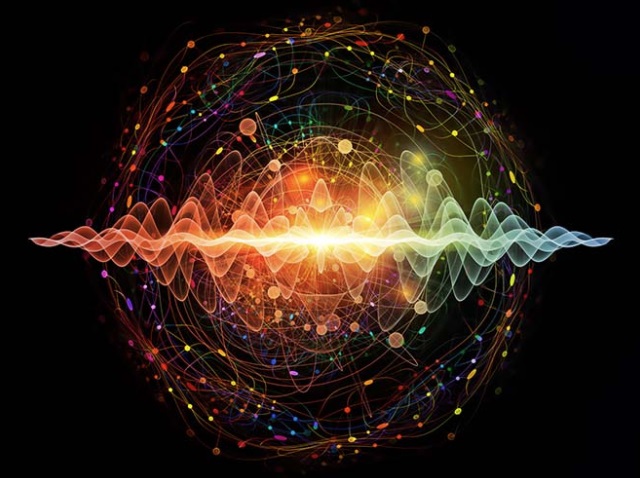
An artistic visualization of light as vibrant, unpredictable streams. In classical physics, a light beam’s behavior can be described in terms of average percentages (e.g. 95% reflection, 5% transmission), but quantum experiments show that each individual photon is a coin-flip event. This inherent uncertainty in every ray of light opens the door to deeper interpretations about causality and divine will.thequran.lovethequran.love
Consider a simple experiment: shine 100 photons one by one at a half-silvered mirror (a mirror that reflects part of the light and lets the rest transmit). If you do this, you will find about 95 photons go through and 5 reflect (for instance) – matching the 95%/5% ratio predicted by classical optics. However, what you cannot predict is which specific photons will pass and which will reflectthequran.lovethequran.love. Photon #17 might go through, photon #18 might bounce back – there is no hidden variable or classical factor deciding this that we know of. As one explanation succinctly puts it: fire photons at a half-silvered mirror and “about 95% pass through and 5% reflect – but no one can predict which particular photon will do what. There is no deterministic cause deciding each photon’s fate; only a statistical distribution is fixed.”thequran.lovethequran.love In other words, nature only guarantees the overall percentages; the individual outcomes are left “loose.” This is a confirmed scientific fact from experiments: science can only predict probabilities for quantum events, not certaintiesthequran.love. Whether a given photon will reflect or not is fundamentally random (to us). The same is true in the famous double-slit experiment: send electrons one by one through two slits, and each will hit a screen at an unpredictable position, even though a clear interference pattern emerges after many electrons. Each single event is random; only the accumulation shows a stable patternthequran.love.
Quantum theory encodes this randomness in the wavefunction, which gives us only the probability amplitudes of outcomes. When an observation is made (like detecting a photon in a transmitted or reflected path), the wavefunction “collapses” to a definite result – but which result is a matter of chance within the allowed probabilitiesthequran.lovethequran.love. Einstein famously disliked this idea, saying “God does not play dice with the universe.” Yet, decades of experiments have shown that, at least from a physical standpoint, dice are indeed being cast at the microscopic level. The uncertainty principle further cements that indeterminism: certain pairs of properties (like position and momentum) cannot both be known exactly – the universe keeps a fundamental fuzziness.
From the standpoint of philosophy and theology, this quantum uncertainty is intriguing. Al-Ghazali argued that what we call “cause A leading to effect B” is not a fixed necessity – God could will A without B or B without Athequran.lovethequran.love. For example, just because fire met cotton (A) doesn’t mean burning (B) had to happen – it happened yesterday because God willed both together, but He could separate them. In classical physics, this idea seemed absurd: given the same initial conditions, the same outcome always followed, implying a kind of necessary link. But quantum physics illustrates vividly that the same initial condition can lead to multiple outcomesthequran.lovethequran.love. We prepare photon + mirror (same initial setup every time), yet sometimes outcome = “photon passes” and sometimes outcome = “photon reflects.” There is “looseness at the joints” of causality, to use a phrase from David Hume (who argued we never actually see a necessary causation, only one event following another)thequran.lovethequran.love. One group of scholars noted: “since quantum mechanics doesn’t specify why one outcome happens instead of another in a single event, it doesn’t rule out that a divine will is selecting outcomes”thequran.lovethequran.love. Physics calls these outcomes “random,” but an occasionalist might say that “random is simply how divine choice appears to those ignorant of God’s will.”thequran.lovethequran.love In other words, what looks like pure chance could be God deciding each instance uniquely – science would see only a random scatter within statistical rules, which is exactly what quantum physics gives us. This idea cannot be proven (and is outside the scope of science proper), but importantly, it is fully compatible with the scientific datathequran.love. Nothing in quantum mechanics contradicts the possibility that God is “flipping the coin” each time, so to speak, because quantum theory itself humbly stops at predicting probabilities and admits there is no known cause for each individual resultthequran.love.
Al-Ghazali would likely be fascinated by this. In his terms, no “secondary cause” (the mirror, the photon itself, etc.) necessitates its effect – the photon can either reflect or not, and nothing in the mirror or photon’s nature determines it absolutelythequran.lovethequran.love. The Qur’an teaches that “the outcome of every affair is with God” and that nature’s patterns are signs of God rather than independent powersthequran.lovethequran.love. Every photon’s behavior can thus be seen as an ayat (sign): a tiny showcase for divine agency. It is as if at the quantum level, the laws of nature present opportunities rather than mandates – opportunities for God’s will to choose among possibilities within the bounds of those lawsthequran.love. Far from making the universe chaotic, this simply means the universe has room for freedom and command at its foundations, rather than being an automated machine. We still see consistent averages and patterns (since God typically acts with order), but the mechanism of enforcement is His will, not an independent natural necessity.
To make this more concrete in spiritual terms: each ray of light can be thought of as saying “Inshallah” – “if God wills, I will reflect; if God wills, I will pass through.” On average God wills a 95/5 split, so we see regular percentages, but the particular outcomes testify that nothing happens unless God specifically decrees it for that photon. This perspective elevates even a mundane physical event to a theophany (a manifestation of God’s action). Indeed, the Qur’an often links natural phenomena with divine oversight, reminding believers that these are not just physics – they are signs. For example, the Qur’an states: “Allah alternates the night and the day – indeed in that is a sign for those who have vision” (24:44). It also says, “He directs the regulation of the affair from the heaven to the earth…” (32:5), and in a poetic verse: “Not a leaf falls but He knows it” (6:59). Shah summarizes this worldview: “nature’s laws are but God’s customary practice (sunnatullah)”, and the Quran presents Allah as an “intimate, moment-to-moment sustainer of all reality”thequran.lovethequran.love. Thus, even each flicker of sunlight on a wall is, to the eye of faith, a direct witness to God’s will in action. It was not compelled by previous material states; it was allowed by the Sustainer.
To underscore this with an image from classical physics: think of Newton’s cradle, the desk toy where steel balls knock into each other transferring motion. Classical science sees it and says: momentum and energy are conserved, the cause travels through the balls mechanically. Occasionalism says: even in that simple, lawful process, God is the one moving each ball in sequence – if He stopped willing the transfer, the balls would inexplicably stopthequran.lovethequran.love. The image of a ball of light that must be re-lit at every moment (the medieval analogy) is equally apt for quantum phenomena: a photon is like a little light that must be “lit” into a specific behavior at each interaction by God. If God doesn’t specify the outcome, we only have a distribution of possibilities. Modern physics and ancient theology, remarkably, meet at this point: what we see as chance in science can be seen as the “breathing space” for divine providence in theologythequran.lovethequran.love.
Shah writes that science is catching up to the Quranic proclamation that “Allah is the Light of the heavens and the earth” (24:35) – not literally photons, but meaning that all light and all means of illumination exist only through Godthequran.love. When we study light, we are in a sense studying a physical metaphor of God’s guidance and presence. The Qur’an calls the sun, moon, and stars “signs” (āyāt) of divine wisdomthequran.love. It even swears oaths “by the sun and its brightness” or “by the sky full of paths” to draw our attention to the marvel of cosmic order as a testimony to the Creatorthequran.love. Each unpredictable photon that hits our eye from a twinkling star can thus be thought of as a personal delivery – “here is another photon for you, from the star, by God’s command”. Without God continually “sending” that light, the sky would go dark. Thus, every ray of light is a fresh act – a continuing witness that our Lord is actively sustaining everythingthequran.lovethequran.love.
It is worth noting that this interpretation does not violate any scientific understanding; it adds a layer of meaning on top of it. Quantum physics says: we get randomness within a statistical law. Occasionalism says: what you call randomness is in fact particularization by God’s will, and the statistical law is simply the habit of God (His chosen pattern)thequran.lovethequran.love. This view can enrich a believer’s appreciation of science rather than conflict with it. One can be in awe of the precision of the laws (the 95% vs 5% reflectance, etc.) and simultaneously be in awe of the freedom at the microscopic level that points to a free Creator. As Shah concludes in one essay, the universe is “empirically lawful yet metaphysically contingent, consistent in its observable patterns yet ultimately reliant on an external Sustainer.”thequran.love This means we can fully embrace the study of physics (empirical laws) while also understanding that those laws have no autonomous existence – they are contingent on God’s ongoing choicethequran.lovethequran.love.
In summary, each ray of light carries a dual message: scientifically, it obeys elegant probabilistic laws; spiritually, it testifies that law itself is not lord – God is. The unpredictability in each photon’s behavior is like a built-in reminder of “Inshallah.” The Qur’an promises that God will continue to show signs in the horizons and within ourselves until it becomes clear that the truth is from Him (41:53)thequran.lovethequran.love. In a very real sense, quantum physics has opened our eyes to a new horizon of those signs, revealing a world where material causation is not absolute – inviting us, much as Al-Ghazali did, to see the direct hand of the Divine behind every natural event.
Quantum Entanglement: Nonlocality and a Unified Cause
If the randomness of individual photons hints at a space for God’s will, then quantum entanglement takes things a step further – it hints at a unity of control behind seemingly separate objects. Entanglement is one of the strangest and most celebrated aspects of quantum mechanics. When particles (like two photons or two electrons) become entangled, they share a single quantum state such that what happens to one immediately affects the state of the other, no matter how far apart they arethequran.lovethequran.love. Einstein dubbed this “spooky action at a distance,” because it appeared to violate the classical idea that influences must travel through space gradually (at most at the speed of light). For a long time, even physicists scratched their heads: could it be that the particles carry some hidden code (hidden variables) from their common origin that tells them what to do when measured? Perhaps they only seem connected because of some pre-arranged agreement?
However, in 1964 physicist John Bell formulated a theorem with inequalities that allowed this question to be tested, and subsequent experiments – notably by Alain Aspect in 1982 and many others since – confirmed that no local hidden variable theory can explain the observed correlationsthequran.lovethequran.love. In 2022, the Nobel Prize in Physics was awarded to Aspect, John Clauser, and Anton Zeilinger for these groundbreaking experiments, which essentially proved that nature is not “locally real” in the classical sensethequran.lovethequran.love. In entanglement, if we measure particle A in region A and particle B in region B, we find their results are correlated (often perfectly anti-correlated or same) far beyond what chance allows, and crucially, this correlation cannot be attributed to any signal or influence traveling between them at the time of measurementthequran.lovethequran.love. Moreover, it can be shown that the particles do not have pre-determined values for the measurement (like hidden “fortune cookies” opened at the measuring stations) – instead, it’s as if the act of measuring one conjures the complementary property in the other instantlythequran.lovethequran.love.
To put it pictorially: imagine you have two particles that fly apart to opposite ends of the galaxy, but they are entangled in such a way that if one is “spin up” the other is “spin down,” with equal probability for which is which until measured. You measure particle A here on Earth and find it “spin up.” At that very moment, particle B (on the other side of the galaxy) is instantaneously determined to be “spin down.” It was not already spin down (in a definite sense) until the measurement of A forced the joint state to collapse into an opposite pair. This kind of instant coordination with no mediating signal blows our classical intuition. It’s like you and a friend flipping coins light-years apart but somehow always getting opposite faces if the coins were entangled – and nothing physical traveled between you to ensure that.
What could this possibly mean? Some interpretations of quantum mechanics (like the Bohmian pilot-wave theory or the idea of a single holistic wavefunction) suggest that entangled particles are not really separate – they are two parts of one system, and that system, while it appears split in space, is governed by underlying unitythequran.love. Another mainstream interpretation, the Many Worlds Interpretation, would say both outcomes happen in branching universes so there’s no communication needed (more on that later). But let’s focus on the intuitive message: entanglement shows us that the universe can have “togetherness” that transcends spatial separationthequran.love. Two distant things behave as if they are one, in some sense. There is no local cause linking them, yet they act in tandem.
From an occasionalist perspective, this is incredibly affirming. Al-Ghazali taught that when one event seems to cause another, in reality God is causing both according to His willthequran.lovethequran.love. For example, when fire touches cotton and the cotton burns, he says it’s not that the fire itself caused the burning – rather, God caused the fire to be hot and caused the cotton to combust, synchronizing themthequran.lovethequran.love. So what we see as one event “making” another happen is actually two simultaneous events coordinated by God. Now look at entanglement: when particle A is measured and particle B “magically” mirrors or complements that state, we could equally say that there is a hidden coordination. Classical physics can’t tell how B “knows” what happened to A – but an occasionalist can suggest a simple answer: both outcomes were set by the same Agent. It is as though God, being beyond space and time, is setting A to one value and B to the other according to one unified decision. No physical signal is needed because the cause isn’t physical at all – it’s metaphysical. In this light (pun intended), entanglement is not spooky action of particle on particle, but spooky action of God on both. It’s “spooky” only if one assumed the particles were alone; with God in the picture, it becomes simply a demonstration of one will acting in two places at once – which for an omnipresent deity is not spooky but expected.
Let’s support these assertions with Shah’s analysis and sources. After the Nobel-confirmed experiments, we know for sure: “nature is not locally real – no local cause can fully explain the correlations observed”thequran.lovethequran.love. In scientific terms, “there are no hidden variables in each particle that predetermine the joint outcome; and no signal passes between them at measurement.”thequran.lovethequran.love The outcome looks as if when we check A, B just happens to have the matching value, with nothing in the intervening space causing itthequran.lovethequran.love. This is indeed breathtaking: the universe allows coordinated events with no observable causal linkthequran.lovethequran.love. Philosophically, as Shah points out, “entangled particles seem to ‘transcend space’ as a single system”thequran.lovethequran.love. And one science writer noted that they “do not have independent properties determined ahead of time”thequran.lovethequran.love. This is key: entangled particles challenge the notion that each object carries its own fate individually – instead, the fate is in the relationship, or in something beyond both.
Al-Ghazali said essentially the same about all things: creatures have no fixed powers or natures independent of God’s continual bestowalthequran.lovethequran.love. So hearing that entangled particles have no definite properties until measured, Al-Ghazali might smile and say, “Yes, nothing has any independent property – it’s all given at the moment by God.” Shah explicitly draws this parallel: entanglement bears an “uncanny resemblance” to Ghazali’s visionthequran.love. “In entanglement,” he writes, “one could likewise say the outcomes were coordinated by a hidden unity beyond spacetime… An occasionalist can naturally add: that underlying unity is the will of one Creator.”thequran.lovethequran.love In other words, what Bohr or Bohm might call a unified wavefunction, a theist might call a unified divine will that spans the particles. It’s like two pixels on a screen lighting up the same color simultaneously because they’re driven by the same computer program – except here the “program” is not in the particles but outside the physical realm.
To avoid misunderstanding: none of this is to say quantum mechanics proves God or directly points to God without interpretation. As a physicist would clarify, quantum mechanics itself does not include God in the equations – it remains a mathematical formalism that is agnostic about metaphysical causes. And indeed, quantum mechanics cannot by itself tell us that “God did it.” However, what these phenomena have done is “undermine the idea of self-sufficient local causation on which strict materialism was built.”thequran.lovethequran.love They force even secular thinkers to grapple with a universe where connections exist without local causes, and where events don’t have explanations in terms of prior physical states alone. This invites us – or at least leaves logical space – to “think in terms of contingency and deeper causes, much as Ghazali did.”thequran.lovethequran.love
One could put it this way: In a purely materialist, classical view, once you knew all the particles and forces, you wouldn’t need God – everything would tick along locally caused. But in our quantum reality, even knowing all the particles and forces, you find something important missing: a cause for why entangled outcomes match, a cause for why one radioactive atom decays now and another identical one later, etc. Physics says, “There is no cause within the system – it just happens.” Occasionalism cheerfully replies, “That’s because the cause is God’s decision – it happens when He says ‘Be.’” Occasionalism doesn’t compete with physics; it completes the picture by positing a cause where physics finds none (yet does so in a way that doesn’t disrupt physics’ empirical success).
To illustrate this with the entangled particles again: Two distant particles show a coordinated behavior that seems to transcend space. The theist can imagine “God’s private wiring behind the scenes” connecting themthequran.lovethequran.love. It’s like seeing two marionettes moving in perfect sync on different stages – a reasonable inference is that a single puppeteer has strings on both. Quantum physics has revealed that in some deep way, the world is holistic and not separable into isolated pieces. The occasionalist interpretation of that holism is straightforward: one holistic power (God) orchestrates all the pieces. The classical alternative was to assume each piece had its own built-in script (which occasionalism denied). Quantum mechanics vindicates the denial: there is no script inside each particle. So what is the alternative? Either accept true randomness (no reason at all) or allow a non-material reason. Occasionalism opts for the latter – a reason not of this world.
It is fascinating that even some secular researchers and philosophers have drawn these parallels explicitly. Zia Shah cites a 1993 paper by Karen Harding which observed that both the Copenhagen interpretation of quantum physics and Ghazali’s occasionalism see objects as having “no inherent properties and no independent existence” apart from measurement or God’s actthequran.lovethequran.love. That’s a striking convergence of language: Bohr’s idea that the properties of particles aren’t real until measured, and Ghazali’s idea that nothing exists or has power except through God’s ongoing creation, are indeed analogous. Harding’s point was that quantum physics requires a “context” (measurement setup) to give an object definite attributes, whereas Ghazali requires God’s willing for anything to have effect – in both cases, things aren’t self-standing. This kind of commentary shows that the dialogue between modern physics and theology is not just fanciful apologetics; serious thinkers have noticed the philosophical import of quantum mechanics and how it “reopens a conceptual space” for divine action in a way that classical physics had closedthequran.lovethequran.love.
In sum, quantum entanglement illustrates that the universe is deeply interconnected in a nonlocal way. Occasionalism provides an intuitively satisfying explanation: everything is connected because everything is at root connected to the One. The connections we observe (entanglement correlations) are just glimpses of an underlying unity of purpose. Al-Ghazali viewed the entire cosmos as a single system held in God’s handthequran.love. Entanglement is as if physics stumbled upon that single “Hand” manifesting in correlated outcomes. At minimum, it demolishes the notion that each part of the world is a closed causal island; instead, the world behaves more like an organism or a symphony than a set of independent cogs. To a believer, that is poetic: it is one Composer playing all the instruments in harmony.
Quantum Tunneling: Causal Barriers and the Freedom of the Creator
Another quantum phenomenon that challenges classical causality is quantum tunneling. Tunneling occurs when a particle manages to cross a barrier that, classically, it has no business crossing because it doesn’t have enough energy. It’s as if a ball at the bottom of a hill spontaneously finds itself on the other side of the hill without having the energy to go over the top. In classical physics, that is impossible – the ball would need at least enough kinetic energy to climb the hill (overcome the potential barrier). In quantum physics, however, particles are described by wavefunctions which have a finite (though sometimes very small) probability of “leaking” through barriers. If the barrier is thin enough or the particle’s wavefunction has a long enough tail, the particle can materialize on the other side even when it seemingly should be reflected back. This is not science fiction; it’s a well-verified effect that is essential to technologies like semiconductor devices (tunneling diodes) and is responsible for phenomena like nuclear fusion in stars (protons tunneling through their electrostatic repulsion) and radioactive alpha decay (alpha particles tunneling out of the nucleus).
A simplified diagram of quantum tunneling. In classical terms (blue curve), an object trapped in a local “valley” of potential would require enough energy to climb over the barrier (peak) to escape, and without that energy it would remain stuck. Quantum mechanically (yellow path), there is a probability that the particle can “tunnel” straight through the barrier to emerge on the other side at a lower energy state. This means a particle can appear in a location that would be forbidden by classical energy-conservation at that moment. Such tunneling events underscore that physical “laws” (like energy thresholds) are statistical and can be circumvented in individual cases, aligning with occasionalism’s view that events unfold by God’s decree rather than strict necessity.thequran.lovethequran.love
Quantum tunneling shows us two important things: (1) Nature is not absolutely rigid about what can or cannot happen; (2) The timeline of cause and effect can be non-classical (the particle doesn’t travel through the barrier in the normal sense – it disappears on one side and appears on the other seemingly without traversing the intermediate space in the usual waythequran.lovethequran.love). Let’s elaborate these points.
Firstly, in classical determinism, if a particle lacks the required energy, it will not cross a barrier – end of story. There is a deterministic prohibition. In quantum mechanics, we instead get a probability: perhaps a 0.001% chance it will tunnel. For any single particle, it’s not impossible – just very unlikely. This itself is a dramatic shift from the classical mindset of impossibility to the quantum mindset of unlikeliness. Occasionalism similarly shifts the perspective: nothing is inherently impossible for God, but He may make some things extremely rare or uncommon. Natural law might say “this essentially never happens,” but not “this absolutely cannot happen.” Al-Ghazali would say that fire won’t normally fail to burn cotton, but it’s not impossible if God so wills (hence the possibility of miracles like Abraham being thrown into a fire and not burning, according to Islamic tradition). Quantum tunneling is like a mundane, microscopic “miracle” built into physics: things can happen that classically would be “miraculous” (like a particle getting past an energy barrier it shouldn’t). Of course, it’s a statistically common miracle in certain contexts (in a block of uranium, alpha particles tunnel out constantly – that’s radioactive decay). But from a stricter classical lens, each decay is like a little violation of classical cause. No cause made that particular atom decay at that exact moment – it just “happened” within a probability distribution. That’s no cause in the physical sense, which again is room for a metaphysical cause.
Secondly, the non-sequential nature: in tunneling, the particle doesn’t gradually move through the barrier (there is no classical path over the top). It’s either reflected or it appears on the other side. It’s like the particle took a shortcut through a domain where classical physics says it can’t exist. Some descriptions say the particle borrows energy from the vacuum to cross then pays it back so quickly that no laws are broken on average. In any case, the effect is essentially instantaneous – as soon as one realizes the particle is not reflected, it’s already beyond the barrier. This again echoes occasionalism’s concept that effects need not follow by a chain of material pushes. A particle can vanish here and appear there because God can place it where He wants, without needing to “push” it through every point in between. Ghazali argued against the idea that motion has to be transferred – why can’t God just recreate the object in a new location? Well, in tunneling, something akin to that seems to happen (mathematically via the wavefunction’s penetration). Occasionalism almost “predicted” this sort of allowance: events do not need a continuous material link. A modern physicist might recall the idea of quantum teleportation (different phenomenon but conceptually similar in breaking sequential locality): particles’ states can be transferred without traversing the space in between, under certain conditions.
Let’s use Shah’s words to summarize tunneling’s challenge to classical causality: “If a particle can ‘skip’ over barriers without a direct force acting upon it, this implies that events do not necessarily follow from prior physical states. This is precisely Ghazali’s argument – physical objects do not bring about effects by their nature, but by the will of God.”thequran.lovethequran.love. Additionally, “tunneling demonstrates that classical cause-effect chains break down. The particle does not ‘travel through’ the barrier; it simply appears on the other side, suggesting that causation is not sequential in the classical sense.”thequran.lovethequran.love. Shah notes that physical laws do not rigidly determine outcomes – if they did, a particle would never cross an energy barrier without requisite energy, yet tunneling occursthequran.lovethequran.love. Instead, the laws give a probability, and the actual outcome still has to be “decided.” We see again that the chain of determinism has a gap – a gap through which, potentially, divine agency can act freely.
To imagine it more visually: Suppose you have a wall and a ball. Classical worldview says if the ball doesn’t have enough speed, it will bounce off the wall every time, no exceptions – the wall is an absolute causal stopper. Quantum says, if the ball is an electron, there is a tiny chance it will just appear on the other side of the wall. So how did it get there? There’s no hole in the wall; it didn’t break it. The cause “the electron’s energy” was insufficient, so the classical chain would stop. But something still happens – the electron goes through. We can almost hear Al-Ghazali: “It goes through because God did not make the wall stop it that time.” The barrier was only a barrier as long as God enforced it. If He lets the particle through, through it goes. In physics, we might say the particle tunneled due to wavefunction penetration, but why that particle at that moment successfully tunneled is again probabilistic. It’s as if the universe occasionally says “oh well, let’s allow this one.” The law is not broken (tunneling is within quantum laws), but the law is statistical, not iron-clad. Occasionalism precisely paints natural laws as statistical habits of God – consistent outcomes most of the time, but not an inviolable decreethequran.lovethequran.love.
There’s also a cosmological significance to tunneling: Some theories of the origin of the universe (e.g., Hartle-Hawking state) describe the universe spontaneously “tunneling” into existence from a quantum gravity realm. Stephen Hawking even popularized the idea that the universe could “create itself from nothing” via quantum tunneling of a sort (a controversial and debated proposition)thequran.lovethequran.love. Critics pointed out that Hawking’s “nothing” wasn’t really nothing – it had laws like gravity in placethequran.lovethequran.love. But the point is, quantum physics allows events that naively seem to violate classical cause (like universes from ‘nothing’ or particles through walls). Occasionalism was ridiculed historically because it posited such things (God could make a universe from nothing, God could make a man live inside a fire unharmed, etc.) and philosophers said that’s against the nature of things. Now physics says, actually the universe did have a beginning from something beyond classical physics (the Big Bang), and particles can do classically impossible feats. The “nature of things” is not so binding after all.
Before leaving quantum tunneling, let’s not forget the everyday impact of this phenomenon: If you use a scanning tunneling microscope, you are harnessing tunneling electrons to image surfaces at the atomic level (electrons tunnel between the microscope tip and the surface, creating a measurable current). The very existence of the Sun’s heat relies on proton tunneling (quantum mechanics gives protons a chance to fuse despite their repulsion, which they wouldn’t at the Sun’s core temperature classically, but they do via tunneling, powering the Sun). Our existence is partly owed to quantum tunneling! Think about that – one could poetically say: God lights the stars by letting protons tunnel through their barriers. A staunch determinist might have said, “Stars can never ignite on their own, the repulsion is too high without higher temperature.” But the universe found a loophole: tunneling. In occasionalist language, that’s God’s providence: He isn’t limited by the barrier; He allows those nuclear reactions to proceed via a quantum chance.
To encapsulate, quantum tunneling exemplifies occasionalism by demonstrating that what we consider “hard” barriers are not absolutely hard. The material world offers possibilities, but which possibilities become reality can sometimes defy straightforward cause – requiring either randomness or an external decider. Occasionalism asserts there is an external Decider, one who can say “happen” even when the door seems closed. Thus, tunneling is a kind of “fingerprint of freedom” at the heart of physics. Events unfold in an open system not a closed one. And as Shah highlights, this indeterminacy at fundamental levels means “physical laws do not rigidly determine outcomes”thequran.lovethequran.love. In the occasionalist view, this is because laws are just regularized choices, not constraints on the Chooser.
Beyond Chance: The Search for Meaning in Quantum Reality
Up to now, we’ve seen how specific quantum phenomena – the uncertainty in each photon, the nonlocal correlation of entangled particles, and the leaping of particles across barriers – align with the idea that nature’s events are not self-caused but depend on something deeper. We can now step back and consider the bigger picture: what do these insights mean for how we view the universe? Is it purely random and meaningless at its foundations, or is the randomness a sign of something transcendent at work? How can a believer reconcile the existence of physical laws with the belief in continuous divine action? We’ll address these questions in this section, bridging scientific findings with philosophical reflections.
Laws of Nature as God’s Habits, Not Prison Bars
One recurring theme is that occasionalism does not deny the existence of natural laws or regularities. Instead, it reframes them. In this view, a law of nature is like a reliable habit of God – the usual way He operatesthequran.love. Because God is rational and wise, His governance of the world exhibits order (what the Qur’an calls “measure” and “balance” in creation). Thus, science is fully possible: we can observe patterns, formulate laws, predict outcomes in normal circumstances. However, these laws have no independent power to bind God’s will. They describe what God normally does, not what must happen regardless of Godthequran.lovethequran.love. This subtle philosophy can prevent the conflict that sometimes arises between religion and science. Instead of seeing miracles or exceptions as “violations” of natural law, occasionalism sees them as simply different choices by the Lawgiver. The laws themselves are contingent on those choices.
Shah emphasizes this by calling Al-Ghazali’s stance a kind of “theological critical realism.” We study the world realistically – assuming the patterns we find are true and dependable – but critically, we realize they are not the ultimate truth, only the surface of deeper divine causationthequran.lovethequran.love. So a scientist can work with Maxwell’s equations for electromagnetism and get precise results, but an occasionalist believes that at every point in space and time where those equations hold, it is because God is faithfully acting in accordance with them, not because the equations have a life of their own. This is analogous to how a programmer can set up consistent rules in a simulation, yet at any tick of the clock, the program runs because the computer (under the programmer’s direction) makes it run. If the programmer pauses or changes the rules, the simulation changes accordingly.
One might wonder, if God can do absolutely anything at any time, why do we see such incredible consistency? (E.g., why doesn’t the probability of photon reflection suddenly change tomorrow?) Occasionalism answers: because God, in His wisdom, chooses consistency and reliability – which reflects His nature (orderly, sustaining, dependable) and allows His creatures to live in a stable worldthequran.lovethequran.love. The Qur’an often mentions that one of God’s “sunnahs” (ways) is not to change the condition of a people until they change themselves (13:11), and by analogy one might say God doesn’t change the physical sunan (ways of nature) capriciously. Miracles are rare by design; everyday life is meant to operate lawfully so that we can learn, plan, and be tested in a consistent environment. Ghazali’s view allowed that for practical purposes, we treat causes as if they are causes, fully expecting them to work – we plant seeds expecting crops, we take medicine expecting cures – because God’s habit (based on past observation) is to bring those effects aboutthequran.lovethequran.love. But the key difference is one of mindset: a scientist who is an occasionalist knows that these patterns persist only by God’s ongoing sustentationthequran.lovethequran.love. This instills a sense of gratitude and humility – the apple falls due to gravity, yes, but ultimately because God is actively holding the fabric of space-time that produces gravitythequran.lovethequran.love. If He were to cease gravity, apples would not fall – and crucially, there is nothing in the apple that guarantees its fall independent of God.
One might say the laws of nature are like promises of God, and miracles are simply rare occasions when God does something outside the usual promise (for a special wisdom). And quantum events? They are like a reminder that even within the promise, there is freedom. They are like little deviations (within statistically allowed limits) that say: “See, the law is not absolute; it’s just the usual case.” For instance, radioactive decay follows a half-life law very consistently on average, but which atom decays when is unpredictable – a hint that each decay “waits for instruction.” If an entire sample of uranium were miraculously kept from decaying beyond its half-life expectation, it would be a noticeable miracle; but each single decay being unpredictable is like the miracle distributed in time and hidden in randomness.
Free Will, Providence, and Quantum Openness
Another fascinating implication of a nondeterministic universe is the room it leaves for free will and divine intervention without “breaking” physical laws. This is a bit beyond Al-Ghazali’s medieval scope (they debated free will on different terms in Islamic theology, balancing qadar (divine decree) and human kasb (acquisition of act)). But in modern discussions, some theologians and philosophers have proposed that if nature is not a closed deterministic system – if at the quantum level there are genuine choice-points – then perhaps God can influence events subtly through those indeterminate outcomesthequran.lovethequran.love. This is often called quantum divine action: God could, for example, cause this particular radioactive atom to decay at this moment (out of the range of randomness) in order to bring about some larger outcome, and science would just see a random decay that was within statistical bounds. In this way, God could steer things (even, say, mutations in DNA relevant to evolution, or events in your brain affecting decisions) without violating natural laws, because natural laws only give probabilitiesthequran.lovethequran.love. Notably, thinkers like John Polkinghorne (physicist-turned-theologian) and Robert John Russell have developed this idea, treating quantum indeterminism as an avenue for God’s providential guidance in the unfolding of the universethequran.lovethequran.love.
Occasionalism would say: “Yes, indeed – except we would add that God not only guides some events but actually determines every event.”thequran.love In other words, an occasionalist doesn’t need to confine God’s action to the gaps of quantum indeterminism; all phenomena are directly determined by God. However, the quantum openness becomes a concealment mechanism. It means that God can control outcomes without it being obvious to scientific inquiry that anything special happened (since science expects only probabilities anyway). So, for an occasionalist, the probabilistic nature of quantum events is almost like God’s signature way of operating continuously yet subtly. It is “lawful” (follows statistics) and “lawless” (unpredictable individual events) at the same time – exactly what we’d expect if a rational Deity is deciding each case according to a purpose that might be inscrutable to us but yields, when averaged, a stable cosmos.
What about human free will? If God is doing everything, do we do anything? This is a theological conundrum that long predates quantum mechanics. The Ash‘ari occasionalists had the doctrine of kasb: we “acquire” our acts – our choices matter in that we intend and God creates the action corresponding to our intention. It’s like we make the decision, and God immediately makes the muscles move. In quantum terms, one might whimsically think: perhaps our conscious intentions are the “measurements” that collapse possibilities in our brain’s quantum states, and God ensures that when you will to raise your hand, the myriad quantum events that trigger neurons align to make the hand actually go up (rather than by chance doing something else). This is speculative and ventures into theories of quantum consciousness, which are controversial. But some interpretations (e.g., the Wigner or von Neumann interpretation) suggest consciousness itself might play a role in collapsing wavefunctions. If that were true, then the mind (even a finite human mind) is an example of a non-physical agency influencing physical outcomes (a tiny echo of occasionalism, except not God’s mind but ours in that case). An occasionalist could say: well, all collapses are really due to Mind – specifically, the divine Mind, or mediated by divine permission to created minds. Regardless, the compatibility is there: in a nondeterministic physics, free will and divine will have elbow room to operatethequran.lovethequran.love. Whereas in a Laplacean deterministic block-universe, every thought and action would be pre-fixed by initial conditions, leaving little logical space for true agency.
Cosmology and a Created Universe
It’s worth noting that modern cosmology also ended up siding with Ghazali on a big debate: whether the universe had a beginning or existed eternally. Al-Ghazali argued fiercely against the Aristotelian/Avicennan idea of an eternal cosmos, insisting that only God is eternal and the world was created in time (he said philosophers’ belief in an eternal universe undermined creation and God’s sovereignty). At his time, the eternity of the world was a common philosophical view. Fast forward to the 20th century, and the Big Bang theory (supported by Hubble’s discovery of an expanding universe and later cosmic microwave background etc.) established that our universe did have a beginning about 13.8 billion years ago. Time and space as we know them originated from a hot dense state – essentially creation ex nihilo from the perspective of physics (albeit physics can’t describe t=0 exactly, we get to a Planck time and a singularity). This “beginning” vindicated theists who had always maintained a temporal beginning. As Shah points out, today’s dominant model “affirm[s] a cosmic beginning” and thus removes the old objection that “the universe is just eternal, no need for creation”thequran.lovethequran.love. Materialists then shifted to talk of multiverses or quantum foam spawning universes to avoid a true beginning from absolute nothing – but even those raise the question: why does any of that exist? The laws, the multiverse, etc., still cry out for explanationthequran.lovethequran.love. Occasionalism happily asserts: the universe exists because God wills it, and it began when He first said “Be.”
Moreover, cosmology shows the universe is not only created but finely tuned to continue existing. Why doesn’t it collapse into chaos? Why are the physical constants just so that stars and life can exist? Some scientists propose the anthropic principle or infinite multiverses where we’re just in the lucky one. But to a believer, this precision suggests intent. Occasionalism would phrase it as: God’s continuous creation includes maintaining the stability and life-permitting order of the cosmosthequran.lovethequran.love. The Quranic verse of the Throne says God sustains the heavens and earth and it doesn’t tire Himthequran.love. Ghazali interpreted that as meaning every atom is being kept in existence each moment by Godthequran.lovethequran.love. Modern physics doesn’t speak in those terms, but it does marvel at how, for example, protons don’t decay (much) and how the vacuum of space has just the right properties, etc. It’s as if a delicate balance is upheld. Occasionalism gives a straightforward why: because the Sustainer is actively balancing it.
Many Worlds vs One Will
One interesting alternative interpretation of quantum mechanics is the Many Worlds Interpretation (MWI), which says that whenever a quantum event has multiple possible outcomes, all outcomes happen, each in its own branching universe. Thus, nothing truly random occurs; the wavefunction’s every possibility is realized, and there’s no collapse – just an ever-splitting multiverse where every outcome plays out. This idea was partly motivated to remove the randomness and observer-dependence in Copenhagen. In Many Worlds, there’s a kind of determinism restored at the multiverse level (the wavefunction evolution is deterministic; it’s just that it encompasses zillions of branches). One could say that Many Worlds tries to “rescue” the principle of sufficient reason by making nothing truly counterfactual: anything that can happen does happen (in some branch), so there’s no question of “why this outcome and not another” – all happened, we just find ourselves in one.
From an occasionalist view, Many Worlds might be seen as extravagant and un-testable, but it’s conceptually interesting. It’s almost like a secular version of “every intention of God is realized.” If one believed God wanted to explore all possibilities, MWI is like that – except there’s no singular will guiding it, it’s just a brute unfolding of math. Occasionalism by contrast says one world, one timeline, chosen by God out of the possibilities. We don’t really need to delve deep here, but Shah notes it as well: MWI posits all outcomes occur in some branchthequran.lovethequran.love – it’s a radical contrast to occasionalism which posits a single outcome guided by a will. In a sense, MWI multiplies realities to avoid needing a selector; occasionalism says there is a Selector (God) who actualizes one reality among many possible. Ockham’s razor might favor one will over infinite universes, but that’s a philosophical preference. However, practically MWI doesn’t change anything we experience, so whether one imagines branches or not, the single observed reality still has those features of contingency and lack of local cause in each branch. Occasionalism deals with that by one God; MWI deals by saying “just don’t ask why you saw that outcome, there’s another you that saw the other outcome.”
The Simulation Analogy
A very apropos modern analogy for occasionalism – one that has even been mentioned by non-theists – is the simulation hypothesis. This is the idea (popularized by Nick Bostrom and by science fiction like The Matrix) that perhaps our reality is a computer simulation created by some advanced programmer. Within a simulation, the entities (characters, objects) have no true causal power; the code and the computer’s processor determine all events. The simulated physics can have stable rules (gravity in the simulation, etc.), but those rules are just part of the program and can be altered or suspended by the programmer. To inhabitants of the simulation, things happen because “the code says so,” but ultimately it’s because the programmer wrote the code and the computer runs it continually. If the computer/simulator stops, the whole simulated world vanishes.
This is almost exactly occasionalism in a technological metaphor. Shah notes with some amazement: “Al-Ghazali’s occasionalism maps onto the simulation metaphor with astonishing precision”thequran.lovethequran.love. In a simulation: the world is non-autonomous and contingent on the external agent (the simulator) at all timesthequran.lovethequran.love. Likewise in occasionalism: the world is contingent on God at all times. In a simulation: the internal entities can’t cause anything unless the program makes it happenthequran.lovethequran.love – e.g., Mario doesn’t really cause a coin to appear; the program does when Mario hits a block. In occasionalism: creatures don’t cause effects except that God causes the effect when conditions meetthequran.lovethequran.love. In a simulation: if the program halts, the world disappears. In occasionalism: if God stopped willing, the world would disappearthequran.lovethequran.love. The correspondence is so tight that some writers have started using the simulation argument as a secular way to conceive of divine sustenancethequran.lovethequran.love. The advantage is that people today can understand how, for example, a whole world can be dependent on something “outside” it because we have computers that run virtual worlds. For Al-Ghazali, God’s power was understood more abstractly, but now we have a concrete parallel. We can even map terminology: God is the Programmer, His will is the Code, the physics we see is the code’s rules, and the physical events are the rendered graphics on our screen of perception. If an apparent miracle happens, that’s like a patch or cheat code the Programmer inputted that deviates from the usual rules for a special purpose. To the characters, it’s inexplicable by internal laws; to the Programmer, it was straightforward to implement.
Of course, the simulation hypothesis in its popular form says maybe aliens or future humans are the simulator, which just pushes the question up one level (who simulated them, or if they are “base reality,” why does that base reality exist?). Occasionalism cuts to the ultimate base: the ultimate simulator is God, who Himself is uncaused and necessary. So, while Bostrom’s argument suggests we might literally be in a simulation by another creature, the occasionalist might say that’s an unnecessary multiplication – but the analogy holds even if reality is “real” in a non-digital sense. That is, whether or not we’re in a computer, reality behaves as if it’s being actively computed by a mind. And quantum phenomena are very reminiscent of computer graphics: sometimes things pixelate or behave in jumps, suggesting the world isn’t analog smooth under the hood (energy comes in quanta, events happen in probability jumps). One could whimsically say the Planck length and Planck time might be like the “pixel resolution” and “frame rate” of the divine simulation – below that scale, spacetime might not even make sense independently.
The point of bringing this up is to highlight that occasionalism has found new life in modern analogies and scientific paradigms. It’s not just an old theological whimsy; it speaks to real features of our world recognized by contemporary science. As one summary of Shah’s work puts it, across everything – from quantum physics to cosmology to even speculation about simulations – “a common theme unfolds: our universe, with all its regularities, is fundamentally contingent. Al-Ghazali’s occasionalism captures this theme in a robust theological vision.”thequran.lovethequran.love.
In the end, whether one is religious or not, the findings of modern science have humbled our view of the universe. The more we learn, the more we see that reality is not the simple clockwork we once imagined. Mystery is woven into the fabric of the cosmos at the quantum levelthequran.lovethequran.love. For Al-Ghazali, mystery (al-ghayb, the unseen) is the domain of God – that behind what is seen (shahada) lies the unseen sustaining power. Where a materialist might just shrug and say “well, it’s mysterious but that’s just how it is,” a theist can very naturally say “it is mysterious because it is the work of an infinitely subtle God.” The Quran (21:30) asks, “Do the disbelievers not see that the heavens and earth were a joined entity, and We clove them asunder?”, hinting perhaps at something like the Big Bangthequran.love. It (67:3-4) challenges, “Look again at the creation – do you see any flaw? Look again and again – the sight returns exhausted.” Indeed, scientists found no flaw in classical physics until they looked deeper, and then they found the flaw was in our assumption of independence – nature turned out to be far more surprising. As the Quran (41:53) says: “We shall show them Our signs in every region of the earth and in themselves, until it becomes clear to them that it is the Truth. Is it not sufficient that your Lord is witness over all things?”thequran.lovethequran.love. Some might interpret this as a hint that as we explore the world (science), we’ll keep finding pointers to something beyond the world’s own self-explanation, until we realize the only sufficient witness is God.
Epilogue: Every Star, Every Breath – A Universe Whispering “God Willing”
In the stillness of a clear night, when we gaze up at the stars, we are bathing in ancient light – photons that have traversed light-years to gently ping our retina. Every one of those photons has a story. Perhaps it left a star after a million-year journey from the core where it was born, bounced around, finally escaped, then crossed the void. On its way, it might have skimmed past an exoplanet, bent slightly by gravity, and eventually one particular photon, out of countless, hits your eye. Why that photon, why that moment? You cannot say – it could have gone elsewhere or never arrived, but here it is, triggering a cell in your eye that sends a signal to your brain that says: “sparkle”. At that moment you notice a tiny star flicker. In that flicker, if you pause and reflect, there is something profoundly personal: a meeting between a quantum event and a conscious witness.
For the materialist, it’s a neat coincidence governed by probabilities. For the spiritually attuned, it’s as if the universe just winked. “See me,” it says, “I am more than equations; I am a sign.” Al-Ghazali’s occasionalism invites us to regain a sense of the world as thoroughly enchanted – not in a naive, superstitious way, but in a deeply meaningful way. Everything around us, from the sunlight on our face to the electrons dancing in our neurons as we think, is an ongoing act of divine presentation. The regularities we rely on are the rhythms of God’s speech, and the spontaneities and surprises are His improvisations and wisdom.
By understanding how modern science has actually corroborated the contingency of things, we do not diminish science – rather, we elevate our appreciation of it. When Newton’s apple fell, Newton marveled at gravity put in place by God. When we observe an electron tunneling, we can marvel at the subtle freedom God has woven into physical law. When entangled particles coordinate across vast distances, we can almost hear an echo of the Quranic idea that “Allah is closer to you than your jugular vein” (50:16), maintaining a oneness where we see separation.
Zia Shah beautifully concluded that “the cosmos is empirically lawful yet metaphysically contingent, consistent in its observable patterns yet ultimately reliant on an external Sustainer.”thequran.love The empirical laws are not negated by God’s agency – they are affirmed as the chosen mode of His action, which is why the more we study them, the more we stand in awe of the mind of the Maker. This unity of truth – that scientific truth and spiritual truth are complementary – was a running theme in Shah’s work. He reminded us that the Quran calls both its verses and the phenomena of nature ayāt (signs)thequran.lovethequran.love. In other words, reading the Book of Nature can be a form of devotion akin to reading scripturethequran.lovethequran.love. And what do these signs tell us? They tell us of a grand reality beyond mere material interactions.
Standing at the intersection of 21st-century physics and age-old wisdom, we find a richer perspective on existence. We are not cogs in a deaf cosmos, nor spectators of a random multiverse. We are participants in a living, sustained reality where every heartbeat and every photon is a gift being given, an action being performed by the Only One who IS by Himself. Al-Ghazali’s occasionalism, once dismissed as mystical or anti-science, emerges not as an obstacle to science but as a philosophy that cherishes science’s findings and infuses them with significance. After all, science tells us how marvelously unpredictable a single quantum event is; occasionalism tells us why we should marvel – because it is God’s handiwork made manifest, a direct witness (shāhid) to the truth that at every moment, in every place, “La hawla wa la quwwata illa billah” – there is no power or might except through God.
So, the next time you flip on a light and photons stream out, consider for a moment: each ray of that light is acting out a drama of uncertainty decreed into order. On the grand scale, the sunlight that nourishes our world comes from nuclear fusion that only occurs because of quantum tunneling. Every ray of sunshine is, in a sense, a child of a quantum “miracle.” And the Qur’an says, “Allah is the Light of the heavens and the earth” (24:35) – a verse often interpreted metaphorically, but which resonates with the idea that all light (literal and figurative) issues from Himthequran.lovethequran.love. The photons that brighten our day are not isolated, accidental flickers; they are part of a sustained opus of creation, in which even the smallest components “submit” to the divine command “Kun” (Be).
In this holistic view, science becomes a hymn – each law a verse, each observation a note, all pointing beyond themselves. We end with the thought that inspired this exploration: “In short, every ray of light – from the sun, moon, or stars – is a living witness to God’s creative act, a tiny yet telling āyat of the divine order.”thequran.love Let that sink in: every ray of light is testifying, for those willing to listen. And not just light: every entangled particle pair whispers of unity, every tunneling particle hints at transcendence. The whole universe is engaged in perpetual worship by its very being (in Islamic terms, “the stars and trees prostrate”, 55:6). Our role, as conscious beings, is to join that chorus with eyes open – appreciating through science the intricacy of the song, and through our hearts the Singer to whom belongs all praise.
Occasionalism, in the end, is not about denying causality but about recognizing the true Cause. It invites us to live in a world where nothing is “just mundane” – where a flicker of light can rekindle faith, and the quantum tremblings of atoms can draw our minds to the threshold of the Divine. It teaches intellectual humility (since the deeper we go, the more wonder and mystery we findthequran.love) and fosters gratitude (since stability and change alike are blessings bestowed each moment). As we marvel at quantum experiments or gaze at cosmic vistas, we do so with the words “SubhanAllah” (Glory be to God) on our lips, for truly, “Reality does not run on deterministic laws, but on contingent events willed by God, moment by moment.”thequran.lovethequran.love And in that realization lies a profound peace: the chaos isn’t chaos at all; it is freedom woven with order by the Most Merciful, inviting us to trust not in the gift (nature) but in the Giver.
Sources: This discussion drew upon multiple articles by Zia H. Shah MD in The Glorious Quran and Science series (2025) – including analyses of occasionalism in light of quantum mechanicsthequran.lovethequran.love, reflections on each ray of light as a divine witnessthequran.lovethequran.love, commentary on Qur’anic verses emphasizing God’s direct governance of naturethequran.lovethequran.love, and comparisons of modern scientific paradigms with Al-Ghazali’s philosophythequran.lovethequran.love. These sources are cited throughout the text for detailed reference.
If you would rather read in Microsoft Word file:


 The Glorious Quran and Science
Leave a comment