
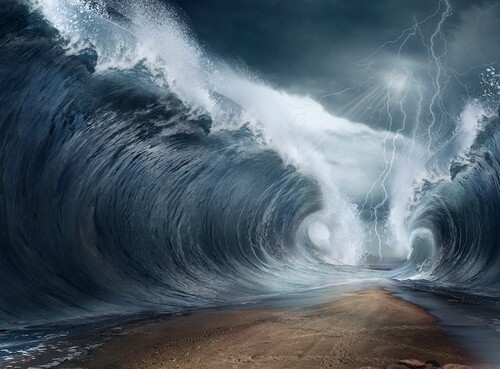
Presented by Zia H Shah MD
Abstract
Moses – known in Arabic as Mūsā – is revered in both the Quran and the Bible for the extraordinary miracles God worked through him. This essay explores all the major miracles of Moses as described in the Quran and the Bible, from the burning bush and the miraculous staff to the ten plagues of Egypt, the parting of the Red Sea, and the wonders in the wilderness (like water from a rock and manna from heaven). Through extensive quotes from scripture, we will see how these miraculous signs were meant to demonstrate divine power to both the Israelites and the Egyptians. We then delve into the philosophical implications of these miracles, focusing on the concept of occasionalism – the idea that God is the direct cause of all events – as espoused by the 11th-century theologian Al-Ghazālī and others. The Quranic worldview strongly emphasizes that nothing occurs except by God’s will, which aligns with occasionalism and is vividly illustrated by Moses’s miracles. We will highlight Al-Ghazālī’s perspective (with insights from modern commentator Zia H. Shah MD) that miracles are not mere anomalies but evidence that natural laws have no independent force against the will of God. Ultimately, we find that the story of Moses’s miracles, approached through scripture and philosophy, invites a reflective appreciation of God’s absolute sovereignty in nature. In an age of science, this occasionalist interpretation provides a framework to understand miracles not as violations of nature, but as reminders of the continuous divine action sustaining all reality. A thematic epilogue will conclude with reflections on how Moses’s story and occasionalism together deepen our understanding of faith, causality, and the relationship between the Creator and creation.
Introduction
Moses is among the greatest prophetic figures in the Abrahamic traditions, and his life is punctuated by dramatic miracles that have inspired believers for millennia. In the Bible, Moses is God’s chosen prophet to lead the Israelites out of bondage in Egypt, and the Book of Exodus records a series of astonishing wonders performed by God through Moses – events that defy ordinary explanation. In the Quran, Moses (Mūsā) is the most frequently mentioned individual, and his narrative is told across numerous chapters, emphasizing the same miraculous signs (āyāt) that proved God’s power to the tyrant Pharaoh and guided the Children of Israelen.wikipedia.orgen.wikipedia.org. The Quran often refers to these miracles as “clear signs” granted to Moses. For example, God says: “We gave Moses nine clear signs”qurantalkblog.com – nine miraculous evidences of divine authority – and challenges skeptics to “ask the Children of Israel” about Moses, indicating the lasting impression these signs left on those who witnessed themqurantalkblog.com. Both scriptures portray these wonders as not just supernatural events, but as purposeful communications from God: they were meant to prove God’s sovereignty over creation, humble the arrogant, deliver the oppressed, and solidify the faith of the believers.
One striking aspect of the Quran’s account is its insistence that these events unfold only by the will and command of Allah (God), with no independent power in Moses or in nature itself. In Islamic theology, this leads naturally to the concept of occasionalism – the doctrine that God is the only true cause of all that happens. Al-Ghazālī, the great 11th-century theologian, famously articulated this view, arguing that what we call “natural laws” or causes are merely customary sequences that God typically follows, but God can override them at any momentthequran.lovethequran.love. From this perspective, miracles are not violations of nature, but rather instances where God chooses to act differently than the usual pattern (sunnat Allāh). As Zia H. Shah MD explains, “Al-Ghazali’s doctrine of Occasionalism is essentially the metaphysics of ‘Inshallah.’ It is an attempt to rigorously explain reality as the Qur’an depicts it – utterly contingent on God at every moment.”thequran.love. In other words, Muslims saying “Inshā’Allāh” (“if God wills”) is not just pious etiquette – it reflects the belief that every outcome depends directly on God’s willthequran.lovethequran.love. The miracles of Moses serve as prime examples of this principle: at critical moments, God’s will decisively trumps all natural expectations, making a staff turn into a snake, water turn to blood, or a sea split in two.
In this essay, we will first recount the miracles of Moses as related in the Quran and the Bible, quoting the sacred texts to capture the narrative and the divine messages behind these events. We will then discuss how these miracles underscore the occasionalist worldview championed by Ghazālī and others. By examining each miracle, we will see a pattern emerge: cause and effect bow to the command of the Almighty. Finally, in a thematic epilogue, we will reflect on what Moses’s miracles and the philosophy of occasionalism mean for us today – how they inspire a deeper understanding of faith, science, and the nature of reality as continuously sustained by the Divine.
The Early Miracles: Moses’ Call and the Signs from the Burning Bush
Moses’s journey as a prophet begins with a dramatic encounter with the Divine. According to the Bible, this occurs at Mount Horeb when Moses, having fled Egypt, sees a bush that is burning yet “not consumed” by the flames (a miracle in itself)en.wikipedia.org. In the biblical account, as Moses approaches, God speaks to him from the bush, commanding him to remove his sandals on this sacred ground and commissioning him to confront Pharaoh and lead the Israelites to freedom (Exodus 3:1-14). To bolster Moses’s confidence and demonstrate divine power, God grants Moses miraculous signs even before he leaves Midian. The Book of Exodus describes two initial signs given to Moses:
- The Staff into a Serpent: God asks Moses, “What is that in your hand?” Moses replies, “A staff.” God then says, “Throw it on the ground.” Moses does so, and the staff miraculously transforms into a snake, causing Moses to jump back in fear. God then tells him to grab the snake by the tail, and when Moses does, it turns back into a staff in his hand (Exodus 4:2-4). This startling metamorphosis was meant to show Moses (and later the Israelites) that God can change the very nature of objects at will.
- The Leprous (Shining) Hand: Next, God gives Moses another personal sign: He instructs him to place his hand inside his cloak and then pull it out. When Moses does so, his hand becomes “leprous, as white as snow” (diseased and discolored). Then God says to put it back in, and when Moses pulls it out again, it is healed and normal (Exodus 4:6-7). The Quran also references this sign, describing Moses’s hand coming out “shining white without blemish” as one of the miracles to show Pharaohqurantalkblog.com. In Quranic language, “Put your hand into your pocket; it will come out white, without blemish – among nine signs [you will take] to Pharaoh and his people”qurantalkblog.com. This sign, like the staff-snake transformation, defies natural explanation and is a direct exhibition of divine power.
It is worth noting that the Quran highlights these same two wonders during the call of Moses. Surah 20 (Ṭā-Hā) recounts how, when Moses first encounters the burning bush, God commands him: “Throw down your staff, O Moses!” and “it became a snake, moving swiftly.” Moses recoils in fear, but God reassures him and then says, “Draw your hand close to your side; it will come out white and shining, without harm – another sign.” (Quran 20:19-22, paraphrased). These were preparatory miracles, meant first to convince Moses himself of God’s presence and support. They also symbolized what Moses’s mission would entail: transforming the ordinary into the extraordinary by God’s will (a shepherd’s rod becomes a serpent) and bringing healing/light out of affliction (a diseased hand is restored).
Importantly, these signs were given to Moses in private, but they would soon be demonstrated publicly before the Israelites and the Egyptians. The Quran emphasizes that Moses was equipped with these signs as proof of his divine commission: “Go to Pharaoh, for he has truly transgressed all bounds,” God commands, and then says, “Show him the sign of the staff that becomes a serpent, and the hand gleaming white” (see Quran 20:23-24, 26:32-33). Moses, however, was apprehensive; he felt unqualified due to his faltering speech and past exile from Egypt. So he prayed for support, and God appointed Moses’s brother Aaron (Hārūn) as a prophet to assist him (Exodus 4:10-14, Quran 20:25-36). Armed with divine signs and the reassurance of support, Moses set out for Pharaoh’s palace to deliver one of history’s most consequential messages: “Let my people go.”
These early miracles at the burning bush set the stage for everything that follows. They establish a key theme: God’s direct control over reality. A wooden staff has no intrinsic power – it cannot become a snake on its own – yet by God’s command it does exactly that, demonstrating that material objects inherently possess no fixed nature when faced with the Creator’s will. As Al-Ghazālī would later argue, if God can make a staff turn into a serpent in a special case, then in principle every instance of fire burning or bread nourishing occurs only because God makes it sothequran.lovethequran.love. The inherent message of the burning bush and the initial signs is that the laws of nature are subordinate to the Lord of nature. Moses’s mission begins with this lesson personally learned, fortifying him for the confrontation to come.
Showdown in Pharaoh’s Court: The Staff and the Magicians
Emboldened by God’s command and the miracles granted to him, Moses (with Aaron at his side) faces Pharaoh, the mightiest ruler of that era, to deliver God’s demand: “Send forth the Children of Israel!” (Exodus 5:1, Quran 7:105). Pharaoh is skeptical – in the Quranic account, Pharaoh even mocks Moses, saying, “Who is this Lord of the worlds?” (Quran 26:23). To prove that he indeed comes with divine authority, Moses presents the first great sign before Pharaoh’s eyes: he casts down his staff, and it turns into a writhing serpent.
The confrontation is vividly described in both scriptures. The Bible relates: “So Moses and Aaron went to Pharaoh… Aaron threw his staff down in front of Pharaoh and his officials, and it became a snake” (Exodus 7:10). Not to be outdone so easily, Pharaoh summons his court magicians – sorcerers reputed for their tricks – and they too cast down their staffs, which appear to become snakes by their magic (7:11-12). For a moment it seems like Moses’s miracle might be dismissed as just another sorcery. But then a remarkable thing happens: “Aaron’s staff swallowed up their staffs” (Exodus 7:12). One can imagine the shock in the court as the single serpent devours the others, leaving Pharaoh’s magicians suddenly staff-less and exposed as frauds. The Quran also tells this story in several passages, emphasizing that what the magicians performed was mere illusion, “a magician’s trick,” whereas Moses’s act was true divine power. When Pharaoh’s sorcerers cast their ropes and staffs, “their magic caused the illusion that they were moving,” making Moses feel a bit of fear, but God inspired him, “Fear not! For you will have the upper hand. Throw down what is in your right hand – it will swallow up what they have produced. What they have produced is only a magician’s trick. And the magician will never succeed.” (Quran 20:66-69). Indeed, when Moses’s staff-turned-serpent swallowed the false snakes, the truth of God’s power became manifest, and the sorcerers fell to the ground in prostration, declaring faith in the Lord of Moses and Aaron (Quran 20:70, 7:117-120).
Illustration: An Ottoman-era depiction (c. 1585) of Moses and Aaron (right, with veiled faces) confronting Pharaoh (left) – Moses’s staff miraculously turns into a dragon, devouring the magic serpents of Pharaoh’s sorcerersen.wikipedia.org. This dramatic showdown, depicted in art and scripture, demonstrated that mere human magic was powerless before the true divine miracle.
This event is a turning point. Pharaoh’s own magicians, witnessing the outcome, publicly acknowledge, “We believe in the Lord of Moses and Aaron” (Quran 7:121-122). The irony is rich: those meant to discredit Moses end up affirming Moses’s message. In the Bible, it is not explicitly stated that the magicians believed (Exodus simply says their hearts were hardened along with Pharaoh’s), but the Quranic narrative highlights their conversion and Pharaoh’s furious reaction – he threatens to torture and crucify them for siding with Moses (Quran 20:71, 7:123-126). The magicians’ response in the Quran is one of profound faith: “So decree whatever you will. You can only decree about the life of this world” (20:72), refusing to renounce what they now know to be true. Thus, the first public miracle of Moses in Pharaoh’s court not only establishes God’s supremacy over Egyptian sorcery, but also wins Moses unexpected converts from within Pharaoh’s ranks.
From a philosophical standpoint, this clash of the staffs carries deep symbolism for occasionalism. The magicians could only create illusions – they manipulated perception but did not truly change reality. Moses’s miracle, by contrast, was ontologically real: wood transformed into a living serpent that consumed other objects. If one asks how a wooden staff could become a snake, the answer in an occasionalist framework is simply the will of God – He who created both wood and snake can alter any object’s properties in an instant. There is no “hidden mechanism” or natural cause at work; it is a direct act of the Creator. The failure of the magicians highlights that created beings have no autonomous power even when they seem to produce effects. As Zia Shah comments, “nature is [but] a theater of divine will, a collection of signs (āyāt) pointing beyond themselves to God”thequran.lovethequran.love. Moses’s staff was one such sign: ordinarily a piece of dead wood, it pointed beyond itself by doing the work of a living snake, thereby pointing to the living God who can “bring the dead to life and the living to death” at His command.
Pharaoh, however, remained obstinate. The Quran (27:13-14) notes that although Pharaoh and his chiefs’ hearts were convinced inwardly by the truth of Moses’s signs, they arrogantly rejected them out of injustice and pride. Pharaoh accused Moses of sorcery and continued to deny his message. This stubborn rejection set the stage for a series of calamities that would soon befall Egypt – escalating miracles of punishment designed to break Pharaoh’s will. Moses warned him that God would send plagues if the oppression of the Israelites did not cease. What unfolds next is one of the most famous sequences of miracles in all of sacred history: the Plagues of Egypt.
The Plagues of Egypt: Nine (or Ten) Devastating Signs
When Pharaoh refused to heed Moses’s message of liberation, God sent down repeated signs of His wrath upon Egypt. These signs served a dual purpose: they were punishments for Pharaoh’s cruel intransigence and simultaneously persuasive proofs of God’s power, giving Pharaoh multiple opportunities to repent. The Quran explicitly frames them as “ayat bayyinat” – clear, distinct signs (miracles)quran.com. It states: “So We plagued them with floods, locusts, lice, frogs, and blood – all as clear signs, but they persisted in arrogance and were a wicked people.”quran.com. In another verse, the Quran says, “We certainly seized Pharaoh’s people with years of drought and scarcity of fruits, that they might take heed” (Quran 7:130), indicating that even famine was used as a divine sign. Meanwhile, the Biblical account in Exodus chapters 7–12 enumerates ten famous plagues that struck Egypt. These can be listed in order:
- Water Turned to Blood: Moses, at God’s instruction, struck the Nile River with his staff, and “all the water of the Nile turned into blood”. The fish died, the river stank, and the Egyptians could not drink its wateren.wikipedia.org. This plague of blood extended to all water sources in Egypt (even water stored in vessels) turning red and undrinkable (Exodus 7:19-24). Notably, in the Bible, Pharaoh’s magicians attempted to replicate this miracle and “with their secret arts” they too turned some water to blood – possibly using dye or sleight of hand – which Pharaoh used as an excuse to harden his hearten.wikipedia.org. In the Quranic perspective, one of the signs sent was “blood” (damm) that afflicted the Egyptiansquran.com, which corresponds to this first plague.
- Frogs: God next sent a vast infestation of frogs across Egypt. Exodus 8:3-4 records Moses warning Pharaoh: “The Nile shall swarm with frogs… they shall come up into your palace, into your bedchamber and your bed, and into the houses of your officials and of your people…” Soon frogs overran the land, entering houses, kitchens, and even bedroomsen.wikipedia.org. The magicians again apparently produced a few frogs by trickery (Ex 8:7), but they could not reverse the plague. The Quran explicitly includes “the frogs” as one of the clear signs sent to Pharaohquran.com.
- Gnats/Lice: The third plague in the Bible was gnats (or lice) that arose from the dust of the ground and tormented man and beast (Exodus 8:16-17). “All the dust of the earth turned into gnats throughout the land of Egypt.” The Egyptian magicians this time failed to replicate it and exclaimed, “This is the finger of God!” (Ex 8:19). The Quran mentions “al-qummal”, which can be translated as lice or some biting insect, in its list of signsquran.com, corresponding to this calamity of vermin.
- Swarms of Flies: The fourth plague was swarms of flies (or according to some Jewish traditions, wild insects or beetles). Exodus 8:21 says, “I will send swarms of flies on you, your officials, and your people, and into your houses…” The flies filled the Egyptian houses and land, causing chaosen.wikipedia.orgen.wikipedia.org. Uniquely, from this plague onward, the Bible notes a distinction: the region of Goshen, where the Israelites lived, was spared so that Pharaoh would know God makes a distinction between His people and the oppressors (Ex 8:22-23)en.wikipedia.org. (The Quran does not separately mention flies, though it could be subsumed under the generic “flood” or other difficulties.)
- Pestilence on Livestock: Next, God struck the Egyptian livestock with a deadly disease. “All the livestock of the Egyptians died” – horses, donkeys, camels, cattle, sheep, and goats – “but of the livestock of the Israelites, not one died.” (Exodus 9:4-6)en.wikipedia.org. This devastated Egypt’s agrarian economy and food supply. (The Quran does not list this specifically among the five named signs, but it is part of the biblical ten.)
- Boils: God then told Moses to take soot from a kiln and toss it in the air before Pharaoh. This resulted in fine dust spreading over Egypt, causing festering boils on people and animals (Exodus 9:8-10)en.wikipedia.org. Even the magicians were afflicted and could not stand before Moses because of the boils (Ex 9:11). This painful plague showed the impotence of Egypt’s physicians and gods to provide healing.
- Fiery Hailstorm: The seventh plague was announced with perhaps the most warning and gravity. Moses raised his staff toward heaven, and the Lord sent an unprecedented storm of hail, thunder, and fire (lightning) upon Egypt. “There was hail, and fire flashing continually in the midst of the hail… it struck down everything that was in the open field, both man and beast, and shattered every plant.” (Exodus 9:22-25). The Quran refers to “the flood (ṭūfān)” as a signquran.com, which some commentators interpret to include destructive storms or perhaps specifically this fiery hailstorm that ruined crops and killed livestock. Notably, the Bible says “the flax and barley were struck down” by the hail, indicating heavy economic loss (Ex 9:31). Pharaoh even admitted “I have sinned” at the height of this plague and begged Moses to intercede to stop the hail, but once it ceased, Pharaoh’s heart hardened again (Ex 9:27-35).
- Locusts: Next, God brought forth a swarm of locusts unlike any before or after, covering the land and devouring whatever green plants had survived the hail. “They shall eat every tree of yours that grows in the field,” Moses warned, “and they shall fill your houses…something that neither your fathers nor your grandfathers have seen” (Exodus 10:4-6). The locusts came on the wind and “covered the face of the whole land, so that the land was darkened,” eating every herb and fruit until “nothing green remained” (Ex 10:14-15). Locust plagues were dreaded in the ancient world; this one was divinely sent for maximum impact. The Quran explicitly includes “the locusts” among the signs on Pharaoh’s peoplequran.com.
- Darkness: The ninth plague was a deep, terrifying darkness over Egypt for three days. “People could not see one another, nor did anyone rise from his place for three days,” says Exodus, “but all the Israelites had light where they lived.” (Exodus 10:21-23). This tangible darkness was “felt” – perhaps a heavy sandstorm or supernatural eclipse that blotted out light completely. It symbolized the spiritual darkness of Pharaoh’s stubbornness. Though not mentioned in the Quran’s list, this plague prepared for the final blow by paralyzing Egypt in fear and confusion.
- Death of the Firstborn: The climax of the biblical plagues is the most severe: in one night, every firstborn in Egypt was struck dead, from Pharaoh’s own eldest son to the firstborn of prisoners in dungeons, and even the firstborn of cattle (Exodus 12:29). This was the night of the first Passover for the Israelites, who were instructed to mark their doorposts with the blood of a lamb so that the destroying angel would “pass over” their houses. “There was a great cry in Egypt, for there was not a house where someone was not dead.” (Ex 12:30) This tragedy finally shattered Pharaoh’s resistance – he summoned Moses and Aaron by night and urged them to take the Israelites and go, ending the oppression at last (Ex 12:31-32). The Israelites departed in haste, beginning the Exodus. Passover became an enduring Jewish festival commemorating how God spared them and judged Egyptqurantalkblog.com.
It is significant that the Quran does not explicitly mention the slaying of the firstborn among the signs given to Moses. The Quran’s tally of signs is generally understood to be nine, excluding this final deadly plaguequrantalkblog.comquran-islam.org. Those nine (as commonly enumerated by Islamic scholars) are: (1) the staff-turned-serpent, (2) Moses’s radiant hand, (3) years of drought, (4) the flood, (5) locusts, (6) lice, (7) frogs, (8) blood, and (9) perhaps the parting of the sea (though some, as we will see, argue the ninth was something else and the sea parting was separate). The Quran itself references these: “We gave Moses nine clear signs – ask the Children of Israel [about] when he came to them…” (Quran 17:101)qurantalkblog.com. The death of the firstborn is conspicuously absent in the Quran’s narrative. Some Muslim commentators suggest that taking innocent lives as a collective punishment did not accord with God’s typical justice as emphasized in Islam (where “no soul shall bear the burden of another”). It’s interesting to note that even within the Bible, later verses echo a principle that children should not be punished for their parents’ sins (e.g. Ezekiel 18:20, Deuteronomy 24:16)qurantalkblog.com. Whether for this reason or others, the Quranic story focuses on the other calamities and omits that final plague, moving straight to Pharaoh finally deciding to let the Israelites go after the preceding signs and the pressure from his people who were reeling under these disasters (Quran 7:133-135).
From Pharaoh’s perspective, throughout the plagues we see a cycle: when a plague strikes, Pharaoh often calls Moses and pleads for relief, sometimes even saying “Pray to your Lord to remove this, and I will let you go”. But after each plague is lifted (often at Moses’s intercession), Pharaoh’s heart hardens again and he breaks his promise, refusing to free the Israelites (Exodus 8:8-15, 8:25-32, 9:27-35, etc.). The Quran summarizes this stubbornness: “Whenever the plague befell them, they said, ‘O Moses, pray for us to your Lord by virtue of the covenant He has with you. If you remove the plague from us, we will surely believe and let the Children of Israel go.’ But when We removed the plague from them – until a term they were to reach – behold, they broke their word.” (Quran 7:134-135). This fickleness further proved Pharaoh’s insincerity and justified the successive blows. It also underscores that the purpose of miracles is not always to create faith – sometimes they can harden those who are arrogant, as each miraculous deliverance only led Pharaoh to further presume upon God’s mercy until it was too late.
For our study, the Plagues dramatically illustrate **the occasionalist principle that God can suspend the normal functioning of nature at will. Each plague represents nature turned against the Egyptians by an unseen hand:
- Water, normally life-giving, becomes blood and undrinkable.
- Frogs and insects, usually limited by ecosystems, breed out of control at God’s command.
- Disease strikes not by contagion alone but by divine decree discriminating between Egyptian and Hebrew livestock.
- Weather, ordinarily following season and climate, suddenly hurls unprecedented hail and lightning at a precise time and place.
- Locusts arrive in perfect coordination, then are driven out by a wind when Moses prays (Ex 10:19).
- Darkness falls not due to astronomical causes but seemingly by the direct order of God, and it lifts exactly when God wills.
- Even life and death are shown to be in God’s hand, as a selective plague targets the firstborn.
These phenomena defy any attempt at purely naturalistic explanation; they are pointedly miraculous. As Ghazālī would note, if fire does not burn when God doesn’t will it (e.g. the burning bush didn’t consume, or the fire of Nebuchadnezzar’s furnace didn’t burn Abraham per Quran 21:69thequran.love), and if water stands like walls when He commands (as we’ll see at the Red Sea), then “natural laws” are not absolute laws at all – they are habits of God. The plagues show God’s absolute sovereignty over natural processes: each element of nature (water, animals, dust, sky, light, life) responds to its Creator’s command, rather than adhering to any inviolable independent order. In the words of Zia Shah, “The laws of physics are simply God’s customary practice (sunnatullah), which He maintains for our benefit and can suspend at will.”thequran.lovethequran.love. The Egyptians were forced to realize that their Nile, their sun, their very bodies were not under their control nor under the control of their local deities, but under the control of the one God whom Moses represented.
Despite enduring nine mighty signs, Pharaoh still attempted to reassert control or at least salvage pride. After the darkness (and biblically, after the death of firstborns), he finally let the Israelites go – only to once more change his mind and pursue them in a final bid to prevent their escape. This leads to Moses’s most famous miracle of all, an event that would definitively demonstrate God’s dominion and deliverance.
The Parting of the Red Sea
The Exodus reaches its dramatic climax at the shores of the sea. Freed at last by Pharaoh’s command, the Israelites – numbering in the hundreds of thousands – set out from Egypt. But Pharaoh soon regretted losing his slave workforce and assembled his army of chariots to chase them (Exodus 14:5-8). The Bible describes the scene: the Israelites camped by the Red Sea (Yam Suf, possibly the Sea of Reeds or a Gulf of the Red Sea), when Pharaoh’s forces drew near. The people panicked, thinking they were trapped between the sea’s waters and Pharaoh’s soldiers. But Moses told them, “Fear not, stand firm, and see the salvation of the LORD, which He will work for you today… The LORD will fight for you; you have only to be silent.” (Exodus 14:13-14).
At God’s command, Moses stretched out his staff over the waters. Then, in one of the greatest miracles recorded, the sea was split in two: “The LORD drove the sea back by a strong east wind all night and made the sea dry land, and the waters were divided” (Exodus 14:21). The Israelites went into the midst of the sea on dry ground, with the waters piled up as walls on their right and leften.wikipedia.org. The Quran emphasizes this miracle multiple times, often using very visual language. In Surah 26, for example, when the Israelites reach the water and despair, God commands Moses: “Strike the sea with your staff.” “So it split, and each part was like a huge towering mountain.” (Quran 26:63en.wikipedia.org). We can imagine two looming walls of water, held back by an invisible hand, with a path of dry seabed between them wide enough for a nation to traverse. The Quran elsewhere succinctly reminds the Children of Israel of this favor: “We parted the sea for you and saved you and drowned Pharaoh’s people while you looked on.” (Quran 2:50).
The Israelites rushed through the opened path. Pharaoh, in his hubris, drove his chariots in after them, pursuing into the seabed corridor. Once the Israelites had all crossed over, God instructed Moses to stretch out his hand again. The walls of water then collapsed upon the Egyptians. Pharaoh’s chariots became bogged down. In a last-moment desperation as the waves closed in, Pharaoh is said (in Islamic tradition) to have declared faith in the God of Israel. The Quran captures Pharaoh’s futile last cry: “I believe that there is no god but He in whom the Children of Israel believe, and I am of those who submit!” (Quran 10:90). But it was too late for insincere repentance at the moment of death. God replies in the Quran: “Now? When before you rebelled and were among the corruptors?!” (10:91) and tells that Pharaoh’s body would be preserved as a sign for future generationsquran-islam.orgquran-islam.org. Indeed, the drowning of Pharaoh’s army is described in both scriptures: “The waters returned and covered the chariots and the horsemen… Not so much as one of them remained” (Exodus 14:28en.wikipedia.org). The Quran says, “We drowned them in the sea, because they rejected Our signs and were heedless of them.” (Quran 7:136quran-islam.org).
The parting of the Red Sea is perhaps Moses’s most iconic miracle. It is directly referenced in the Quran as a favor God did to Moses and Israel, and it’s a central memory in Jewish tradition (commemorated in the Song of the Sea, Exodus 15). This event is in many ways the ultimate occasionalist miracle on multiple levels:
- It involves a grand-scale suspension of natural law: Water does not stand up in towering heaps under any normal physical conditions. Yet, in this moment, gravity was overridden by the command of its Creator. The laws of fluid dynamics were temporarily rewritten at a specific place and time, showing that what we call “laws of nature” are subject to exception whenever God wills.
- It shows precise divine timing and control: the sea opened exactly when needed and closed at the precise moment to engulf the Egyptians. This timing rules out any deist notion of a distant clockmaker God – instead it reveals an intimate, moment-to-moment divine governance. As the Quran says, “Every day He is engaged in an affair” (Quran 55:29), meaning God is continually active, not leaving the world to run on autopilotthequran.love.
- It delivers both mercy and judgment simultaneously through one act of God. The Israelites pass to freedom (mercy), while the oppressors are destroyed (judgment) by the same waters. Such moral purposeful steering of a natural event suggests the will behind the event is an All-Knowing Will, not blind nature.
It is interesting to note that the Quran, while lauding this miracle, does not count the sea parting among the “nine signs to Pharaoh” in the most common understanding. The reasoning, as some Muslim scholars explain, is that the nine signs were those sent to convince Pharaoh to release the Israelites (i.e. before the Exodus), whereas by the time of the Red Sea crossing, Pharaoh’s chance for repentance was over and the miracle was now one of deliverance and punishment rather than a warning signquran-islam.orgquran-islam.org. In any case, the parting of the sea stands as a capstone miracle that decisively demonstrated God’s power. Little wonder the Quran calls that moment “a manifest victory” (44:30) and frequently tells the story to remind later generations of God’s saving power and the fate of the arrogant.
From the perspective of faith and philosophy, when believers recount the Red Sea crossing, they are reminded that no obstacle is insurmountable for God. What could be more impossible, to human eyes, than escaping an army by walking through an ocean on dry ground? Yet, “Where there is God’s will, a way opens.” This cements the occasionalist lesson: causality lies in God’s hands alone. Water can behave as walls if God so commands; conversely, something as solid as a mountain can crumble to dust if He wills (as we’ll see in a moment at Mount Sinai). Nature has no choice but to obey its Maker: “To Him submits whatever is in the heavens and the earth, willingly or unwillingly” (Quran 3:83). Al-Ghazali in his Incoherence of the Philosophers pointed to miracles like this to argue that cause and effect are not necessary connections, but habits that God can alter. If someone asked, “How could human bodies possibly be resurrected after death?”, the answer could be, the same way seas part or fire doesn’t burn – by God’s power. In fact, Ghazālī famously said no natural limitation can be placed on God – fire will not burn unless God creates burning; if He wants, a man can live without a head or a mountain can be lifted off the earththequran.love. The simulation analogy used by modern writers like Zia Shah is apt: “In a simulation, miracles are mundane: the programmer can change any variable or suspend any rule with a keystroke… Similarly, in occasionalism, miracles are expected as perfectly possible events – God can at any moment override the usual course of nature without any contradiction, since natural ‘laws’ have no binding power over Him.”thequran.love. The Red Sea miracle is like the ultimate “suspension of the rules” in the simulation of our world – a vivid demonstration that the Programmer is in full control.
Thus, with Egypt’s forces vanquished, Moses and the Israelites stood as free people on the other side of the sea. They broke into songs of praise (Exodus 15), thanking God for this extraordinary salvation. But the journey of Moses and his people was far from over. Ahead lay the vast deserts of Sinai, where again God’s providence would manifest in remarkable ways – and where Moses himself would witness further divine marvels, not of destruction now, but of sustenance and revelation.
Miracles in the Wilderness: Manna, Quail, Water, and the Mount
Having escaped the shackles of Egypt, the Israelites entered the wilderness by God’s guidance. Yet freedom brought its own challenges: How would this large community survive the harsh desert environment? The ensuing period (often reckoned as 40 years of wandering) became another stage upon which divine miracles were displayed, this time primarily as mercies for the believers rather than plagues on enemies. The Quran and Bible both recount how God miraculously provided food, water, guidance, and revelation to the Children of Israel during this time. Each of these provisions can be seen as a continuation of occasionalism in practice – nature yielding sustenance in ways that suspend normal cause-effect, reminding the Israelites of their utter dependence on God.
1. Water from the Rock: Not long after crossing the sea, the people suffered from thirst. In the Bible (Exodus 17:1-7), they found no water at a place called Rephidim and complained bitterly to Moses. God instructed Moses to strike a certain rock with his staff. Moses did so, and water gushed forth from the rock in abundance, enough for all the people to drink. The Quran refers to this miracle as well: “[Remember] when Moses prayed for water for his people, We said, ‘Strike the rock with your staff.’ Then twelve springs gushed out from it, and each tribe knew its drinking place.” (Quran 2:60, also 7:160). From one rock, God brought forth twelve springs – conveniently one for each of the Twelve Tribes of Israel – to avoid quarrels and ensure organized accessen.wikipedia.org. This is a beautiful example of divine compassion coupled with power. Geologically, one cannot derive water from a dry stone at will; but here the inert rock became a source of flowing streams by God’s command. It reminds of the Quranic verse: “If only you knew, your hearts would be as hard as rock – or even harder; for there are rocks from which rivers gush, and some split and water flows, and some fall down in awe of God” (2:74). In this context, the literal splitting of the rock under Moses’s staff demonstrated that even the hardest matter obeys God – and even more, God can bring life-giving sustenance out of lifeless stone, a lesson not lost on later readers who saw it as a prefiguring of spiritual nourishment.
From an occasionalist view, this miracle underlines that the properties we assign to things (like “a rock is dry and solid”) are not inviolable. If God wills, a rock can act as a fountain. Modern science might try to rationalize it (perhaps there was an underground spring and Moses opened a fissure), but the timing, quantity, and tribal allocation of the springs point to a direct divine intervention rather than a lucky strike of geology. It teaches trust: the community learned that even when natural means seem absent, God can create new means ex nihilo. Zia Shah notes that an Omnipotent God can easily “suspend combustion or remove the need for eating”thequran.love; similarly, He can bring water without rain or oasis, directly by kun fayakun (“Be, and it is”) – the creative word.
2. Manna and Quail: As the journey continued, hunger became an issue. In the desert wilderness of Sinai, growing crops or finding plentiful food was impossible. The people again grumbled, fearing starvation. But God provided in an utterly unprecedented way. The Bible (Exodus 16) tells how manna appeared – a mysterious edible substance, like small white flakes or wafers, that would coat the ground each morning after the dew evaporated. The Israelites were instructed to gather it daily (enough for each person’s needs) and to trust that it would reappear each day. They could not hoard it (any leftover rotted by the next day, except miraculously it stayed fresh over the Sabbath). Manna is described as tasting like wafers made with honey (Ex 16:31). Along with manna, God sent quail – migratory birds that suddenly flew into the camp in vast numbers, providing meat (Ex 16:13). The Quran also references these events succinctly: “We shaded you with clouds and sent down to you manna and quails: ‘Eat from the good things We have provided for you.’” (Quran 2:57). In another verse, after listing the springs from the rock, it says “We caused the clouds to overshadow them and sent down to them manna and quails…” (7:160). Thus, both scriptures agree that the Israelites in the desert survived by heaven-sent food – literally bread from the sky and fowl delivered to their camps – a continuous miracle that lasted years.
This daily provision was a lesson in reliance on God’s ongoing activity. It’s one thing to witness a one-time miracle; it’s another to live amid a miracle for decades. The manna appeared six days a week, every week (except Sabbaths) for the entirety of the wilderness sojourn (Exodus 16:35). It was a constant reminder that their sustenance depended not on agriculture or natural resources, but on God’s word. Deuteronomy 8:3 reflects on this: “He humbled you and let you hunger and then fed you with manna… that He might make you know that man does not live by bread alone, but by every word that comes from the mouth of the LORD.” This line is later echoed by Jesus in the Gospels, but its origin is in the context of the manna. For occasionalism, it’s a perfect illustration: normally, people live by eating food that grows from the earth, but here God showed that truly, life is sustained by Him – He can “upload” nourishment in any form. If He says “Be fed,” even a wafer of unknown origin can keep a person alive. The Quran similarly emphasizes that God is al-Razzāq (the Provider), who sends provisions from the sky and earth. When discussing trust in God, the Prophet Muhammad invoked how God fed Israel with manna and quail to remind believers that God can provide from sources you could never imagine if you are mindful of Him.
One can also see a subtle philosophical point: Manna defied classification – the Israelites even named it man hu (“What is it?” in Hebrew) because they didn’t know what to call it. It was literally extra-natural. This humbling of human categorization hints that the categories and natures we take for granted are not fixed in God’s realm. He can create things anew, with unique qualities, outside the chain of earthly causation.
3. Guidance and Protection: While not “miracles” in the conventional sense of startling transformations, the constant guidance of God’s presence in the journey is noteworthy. The Bible says God led Israel with a pillar of cloud by day and a pillar of fire by night (Exodus 13:21-22), a visible manifestation of guidance and protection. The Quran alludes to shading with clouds as mentioned above (which could refer both to physical shade and divine presence). This continuous guidance is another example of God’s direct involvement. Unlike a normal migration led by maps or stars, this was a journey led by a theophany – a sign that God was orchestrating their movements in real-time. Occasionally, miracles occurred as needed: when enemies attacked (like the Amalekites), as long as Moses held up his staff, the Israelites prevailed (Exodus 17:8-13) – a miracle of a different sort, indicating battles are won by God’s support more than by force of arms.
4. Mount Sinai and the Revelation: The pinnacle of the wilderness narrative is the gathering at Mount Sinai (Mount Tur in the Quran). Here, Moses would receive the Torah (Law) including the Ten Commandments, and the Israelites would formally enter into a covenant with God. The theophany at Sinai was itself accompanied by awe-inspiring phenomena. The Bible describes Mount Sinai wrapped in smoke, with thunder, lightning, a thick cloud, and loud trumpet blasts; the mountain quaked greatly, and the people trembled (Exodus 19:16-20). God descended upon it in fire. Moses went up into the cloud on the mountain for 40 days to commune with God and receive the stone tablets (Exodus 24:15-18). The Quran also references this event: “And when Moses came to Our appointment and his Lord spoke to him…” and it mentions that the mountain was made to tower above the people as if to enforce the gravity of the covenantquran.comqurantalkblog.com. Specifically, Quran 7:171 says: “[Remember] when We raised the mountain above them as if it were a cloud (or canopy), and they thought it was going to fall on them. [We said], ‘Hold firmly to what We have given you and remember what is in it….’”quran.com. This raising of the mountain is an intriguing detail in Islamic tradition – commentators explain it as either an earthquake that lifted the mountain or a metaphor for the overwhelming divine pressure to accept the law. In any case, it’s presented as a miraculous sign: the Israelites literally felt the mountain might collapse on them if they broke their pledge, impressing upon them the seriousness of God’s commands.
After Moses had been on Sinai for 40 days, another incident occurred: some Israelites, in Moses’s absence, fell into idolatry by worshiping a golden calf (under the influence of the figure known as Samiri in the Quran; Aaron was unable to stop them entirely). Moses returned to find this abomination and, in anger, smashed the stone tablets (Exodus 32, Quran 20:83-97). The Quran mentions that the calf seemed to low (make a sound) – possibly by some demonic trick or as Samiri had crafted it – which in itself was a kind of false miracle deluding the people (Quran 20:88). Moses destroyed the idol and chastised the wrongdoers. Eventually, he went back to the mountain to receive a second set of tablets, and the covenant was renewed.
One more subtle miracle: after communing with God, Moses’s face shone with light so intensely that the Israelites could not look at him unless he covered it with a veil (Exodus 34:29-35). The Quran doesn’t mention this radiance of Moses’s face, but it is an interesting detail from the Bible indicating Moses literally physically absorbed some of the divine glory during his encounter. It’s reminiscent of how objects or persons can become vehicles of divine action – even Moses’s face became a sort of “sign” after exposure to God’s presence.
In summary, the wilderness period was filled with manifestations of God’s care: bread from heaven, meat delivered to the doorstep, water from dry rocks, sheltering clouds, guiding fire, thundering revelation, and forgiving mercy after lapses. Each of these highlights the theme that God was with them at every step, controlling their environment directly. The Israelites often faltered in faith (worrying about food, water, or enemies despite having seen miracles), which shows the frailty of human nature. The miracles were meant to teach them – and by extension, us – that God is the Sustainer and Guide at all times. The Quran often chides the Children of Israel for failing to live up to the covenant despite witnessing so many miracles: “How often have We shown them a sign, but most of them [continued to] act defiantly!”
For occasionalism, these stories underline that secondary causes are not necessary for life: God can sustain life directly. Normally, one needs to sow and reap for bread, hunt for meat, dig for water – here God skipped all intermediary steps. As Ghazālī would say, bread doesn’t nourish by its nature, but by God’s habitthequran.love. In the desert, God simply withheld the usual means and provided nourishment in new forms, driving home that it is He who feeds and quenches thirst (Quran 26:79). This has spiritual ramifications: believers are to depend on God rather than worry excessively about material means. Not that one shouldn’t work or use means (Islam does encourage effort), but recognizing that ultimately success comes from God’s decree. The Israelites, when they tried to hoard manna, found it spoiled – a lesson that one cannot secure oneself by greed, but by trusting God’s daily provision.
It’s also worth noting how these miracles reaffirm moral and spiritual lessons. The water from the rock came after earnest prayer by Moses (showing the power of supplication). Manna came with the condition of Sabbath observance (tying divine gift to obedience). The Sinai phenomena underscored the holiness of God and the seriousness of His law. In occasionalist thinking, because God is the only causal agent, every miracle also carries intentionality and wisdom – they are not random marvels, but teachings. Nature, when altered by God, is making a point. As the Quran terms them, these are signs – pointing to truths beyond the material event itself.
At this juncture, we have surveyed the major miracles in Moses’s story as told in the Quran and Bible:
- The Burning Bush and initial signs (staff to serpent, radiant hand).
- The confrontation with Pharaoh (the staff swallowing the magician’s snakes).
- The series of plagues on Egypt (blood, frogs, lice, etc., culminating in the Passover in the Bible).
- The crossing of the Red Sea (waters parting and drowning the oppressors).
- The miracles during the sojourn (water, manna, quail, Sinai events).
Throughout, a consistent message rings out: God’s power is absolute, compassionate to the oppressed, and purposeful in guidance. In each case, events occur that no natural cause could possibly explain, and often against what natural cause would dictate. This sets the stage for a deeper discussion: what do these miracles imply about how the universe operates? Are miracles exceptions to a rule, or are they simply uncommon instances of the same agency that is behind all events? The Islamic intellectual tradition, especially the teachings of Al-Ghazālī and his school, firmly take the latter stance. We now turn to how occasionalism interprets miracles like those of Moses – not as suspensions of reality, but as illuminations of the true nature of reality.
Miracles as Evidence for Occasionalism: Al-Ghazālī’s Insight
When medieval Muslim theologians contemplated events like Moses’s miracles, they asked: What do these extraordinary signs tell us about how causation works in the world? The dominant Islamic theological school that addressed this was the Ash‘arite school, and its most renowned champion, Imam Abu Hamid al-Ghazālī (1058–1111). Ghazālī argued strenuously against the philosophers of his time who believed in inherent secondary causes or necessary causal laws in nature. In his landmark work Tahāfut al-Falāsifa (The Incoherence of the Philosophers), he posited that what people call cause and effect are merely sequences that God habitually maintains, but at any moment God can produce a different outcome with no contradiction. This doctrine is known as occasionalism.
According to Ghazālī, every event is directly created by God. Fire does not burn cotton by its own property; rather God creates the burning when cotton meets firethequran.love. Likewise, food doesn’t nourish by itself; God creates nourishment in the body when food is eatenthequran.love. If we let secondary things have real efficacy, Ghazālī warned, we are subtly ascribing partners to God in power (shirk)thequran.lovethequran.love. True tawḥīd (monotheism), in his view, means acknowledging that God alone wields power at all times, in all situationsthequran.lovethequran.love.
Miracles, then, were a key evidence for Ghazālī’s occasionalism. He would say: If fire by nature must burn, how was Abraham saved from Nimrod’s fire? (The Quran says God commanded “O fire, be coolness and safety upon Abraham,” and it did not burn him, Quran 21:69thequran.love.) If knives by nature must cut, how was Abraham’s son unharmed when Abraham attempted to sacrifice him at God’s command, until a ram was provided? (In Islamic tradition, Abraham’s knife could not cut Ishmael’s throat because God didn’t allow itthequran.love.) If water must drown a large army, how did Moses and the Israelites walk safely on the seabed? Clearly, these instances show that so-called natural laws have no independence before God’s decreethequran.lovethequran.love. As one Zia Shah article summarizes Ghazālī’s stance: “He posited that what we observe as regular cause-and-effect is only by the constant permission (izn) and customary practice (sunnat Allāh) of God, not due to any necessity in the objects themselves. At any time, God can suspend or contravene the usual order – which is precisely what miracles are.”thequran.lovethequran.love. This captures the essence: a miracle is not a violation of inviolable laws (for no law binds God), but rather a deviation from God’s normal pattern, meant to show people something vital.
We see this philosophy reflected in numerous Quranic verses and prophetic teachings. The Quran constantly ascribes what we think of as natural phenomena directly to God’s action: God “sends down rain from the sky and gives life to the earth after it had died” (Q. 30:24), God “alternates the night and day” (Q. 24:44), God “causes the seed grain and date stones to sprout” (Q. 6:95). It even says no person is wounded or healed except by God’s leave (Q. 64:11, 6:17). In a striking example, referencing a scene from the life of Prophet Muhammad, the Quran says: “It was not you who threw when you threw, but God threw.” (Quran 8:17)thequran.lovethequran.love – meaning that even as the Prophet cast a handful of sand in battle, the true force that made it hit the eyes of the enemy was God’s. This verse was a cornerstone for the Ash‘arite doctrine of kasb (acquisition): humans acquire acts by intention, but God creates the effectsthequran.love.
The miracles of Moses fit perfectly into this worldview. Consider the staff of Moses: ordinarily a dry wooden stick is among the most inert of objects, yet it became a wriggling predator that could swallow other sticks. If one accepts this happened by God’s power, one might ask – why then do sticks usually not turn into snakes? The occasionalist answer: because God usually doesn’t will it so. There is no intrinsic reason in the stick’s material that forbids it from becoming a snake; it’s just that God gives it a fixed form and role in the usual course of things. But the moment He wants, “Every day He is engaged in an affair,” He can reshape realitythequran.lovethequran.love. Occasionalism thus eliminates the philosophical puzzle of how miracles “break” natural law. As Zia Shah puts it, it “safeguards miracles – since there are no ‘natural laws’ binding God, He can make anything happen without constraint.”thequran.love. In an occasionalist cosmos, a sea splitting or a rock giving water is no more problematic than the sun rising – both occur because God commands them at that moment. The difference is simply that God’s habit (His sunnah) is that seas usually flow and rocks are dry. But habits can have exceptions, especially when God intends a sign.
Al-Ghazālī was aware that his ideas made some philosophers scoff, accusing him of denying causality outright and thus undermining science or reason. However, Ghazālī didn’t deny the observations of causality; he only denied their necessity. To illustrate, he famously said there is nothing logically impossible about fire not burning cotton, it’s just that we reliably see burning because God consistently creates that outcome – yet He could choose otherwisethequran.love. Modern people might think of David Hume’s critique of causality (though Hume came centuries later): that we never actually see causation, only sequences, and it’s habit of mind that makes us think A must cause B. Ghazālī similarly asserted the must is an unwarranted addition. The only must is if God wills it, then it happens; if not, it doesn’t.
In the centuries after Ghazālī, occasionalism became a standard part of Sunni kalām theology. Not all Muslim thinkers agreed – the rival Māturīdī school and many philosophers allowed a bit more room for secondary causation – but the Ash‘ari position held great influence. The debate was not whether God can do miracles (all agreed He can), but how to conceive of everyday causation. Occasionalists basically extended the logic of miracles to all events: if a staff can turn into a snake, then indeed even when it appears as just a staff, it’s only a staff because God is constantly making it so. They often cited the Quranic idea of continuous creation: “God holds the heavens and earth lest they cease to exist…” (Q. 35:41), “Every day He is bringing about a matter” (Q. 55:29)thequran.lovethequran.love, and Ayat al-Kursī which says “He sustains the heavens and earth, and their preservation tires Him not” (Q. 2:255)thequran.lovethequran.love. In other words, if God stopped “broadcasting” reality, it would vanishthequran.love. A medieval Ash‘ari analogy likened the world to a lamp that needs continuous oil – the oil being God’s will – or a light that God must keep rekindling every instantthequran.love. This is strikingly similar to certain modern analogies, like the simulation hypothesis, where the universe is like a rendering that ceases if the programmer stops the programthequran.lovethequran.love.
To relate this back to Moses: consider how each moment of the miracles required ongoing divine action. When the Red Sea was parted, God had to hold those waters in walls for the duration of crossing. It’s not like He split it and then stepped away; the moment He withdrew support, the waters crashed back. Occasionalism would say all of nature is like that – it’s just that we don’t notice the constant support in ordinary times because nothing dramatic happens. But if God were to withdraw His support from, say, the force binding atoms together, the atoms would disintegrate in an instant. In fact, an Ash‘ari might say that God is literally re-creating the positions of atoms each moment. Some went so far as to claim that causality is just the custom of God, and a miracle is God simply choosing a different custom momentarilythequran.love. The Qur’anic term “sunnatullāh” (God’s way of acting) is interpreted in this lightthequran.love.
Modern Muslim thinkers like Zia H. Shah MD (whom we’ve been citing) draw parallels between Ghazālī’s occasionalism and contemporary ideas in science and philosophy. For example, quantum mechanics introduces indeterminism and the idea that at fundamental levels, things don’t have deterministic cause-effect as classical physics assumed. This has revived interest in philosophical models where will or information underlies reality. Shah notes how some scientists talk about the fine-tuning of constants and laws as if an intelligent choice underlies themthequran.lovethequran.love. Moreover, the “simulation hypothesis” – the idea that perhaps our universe is a programmed simulation – inadvertently provides a conceptual model for understanding occasionalismthequran.lovethequran.love. In a simulated world, entities inside it follow the code set by the programmer. If the programmer changes something, the inhabitants experience a “miracle” relative to prior rules, but from outside it’s just an update or a command. Shah eloquently states: “From the inside perspective, things follow consistent rules (physics), but from the outside perspective, those rules are just choices of the Programmer – they could be altered at any time. In a simulation, miracles are mundane: the programmer can change any variable or suspend any rule… with a keystroke. Similarly, in occasionalism, miracles are expected as perfectly possible events – God can at any moment override the usual course of nature without contradiction.”thequran.love. He even quotes Ghazālī to reinforce that the only thing God won’t do is what is logically impossible (like a square circle), but anything logically possible is within God’s powerthequran.love. Fire not burning or people surviving without food are not logical impossibilities; they’re just uncommon – hence totally doable by Godthequran.love.
By now, we see that the miracles of Moses are essentially case studies in occasionalism. They invite the listener or reader to realize that the world is not a closed causal system; it’s an open story in the hands of its Author. Al-Ghazālī insisted this view not to undermine science or daily life, but to put God back at the center. He was combating a deterministic view that nature could run on its own (like Aristotle’s eternal universe idea or Ibn Sina’s necessary causation). Ghazālī feared that gave nature a kind of independence incompatible with the Quran’s message of radical monotheism. For believers, seeing the world as constantly dependent on God yields a different attitude: humility, reliance (tawakkul), and a sense of wonder. The Quranic narratives of Moses were intended to instill exactly those attitudes in the Children of Israel and later in the believers of Muhammad’s time (who often drew analogies between Moses’s struggles with Pharaoh and Muhammad’s with the pagan Meccans).
It’s noteworthy that occasionalism also deals with miracles of guidance and the heart. For example, the Quran says God “turned Pharaoh’s heart hard” after repeated signs (some might interpret that as Pharaoh’s own choice, others as God’s punishment by sealing his heart). In either case, even guidance or misguidance is in God’s control ultimately, though He only guides those who turn to Him. This again emphasizes that every facet of existence – physical and spiritual – is under divine agency.
To ensure a balanced view, one might ask: if everything is a miracle in a sense, does that not make the term “miracle” (in the sense of an unusual event) meaningless? Occasionalists would answer that miracles as usually defined (khariq al-‘āda, breaches of the customary) are still special because they breach the pattern we’re accustomed to. They serve specific purposes like validating a prophet’s truthfulness or delivering a pious community. So while all events are equally direct from God’s power, not all events are signs for a specific message. Miracles are ayat (signs) in a more pointed way – they grab attention. In daily life, one might start taking the regular signs (sunrise, rain, growth) for granted and not see them as God’s work due to their regularity. Miracles break that complacency. They are like God’s bold-font or underlined interventions in history to say, “I am here, in charge.” Yet, once we notice that, the occasionalist would have us realize even the “normal” is God’s work too, just written in regular script.
Zia Shah notes that an occasionalist worldview “inspires intellectual humility and gratitude”thequran.love. Because if you truly grasp that your heart beats by God’s command every moment, pride and anxiety diminish. You neither boast in your strength (since it’s not really yours) nor despair in hardship (since the Deliverer can change things instantly). He also says it encourages believers to study the natural world scientifically while conscious of the divine hand behind all phenomenathequran.love. Interestingly, occasionalism historically did not hamper scientific investigation in the Islamic world; one could still catalog the patterns of God’s habits (i.e. do science) but with the philosophical knowledge that these patterns have no absolute necessity. In fact, one might argue it frees the mind to accept outliers without rejecting the whole system, since you’re not dogmatically bound to inviolable laws.
In the context of Moses’s story, what occasionalism ultimately suggests is that the same God who turned Moses’s staff into a serpent is turning the gears of the cosmos at every second. The Israelites, having seen water appear from a rock, should have trust that God will handle their needs (yet they often faltered, demonstrating human weakness). For us reading these accounts, the takeaway is to recognize that the power that split the sea is the same power sustaining our very breath right now. The God of Moses is alive and active – not just in ancient tales but in each moment of existence. This is why the Quran tells the Moses story repeatedly; it’s not just history, it’s a paradigm for understanding Allah’s relationship with creation. It is as if God is saying: “I who gave victory to Moses and did all these wonders am fully capable of aiding you, O believers, and of checking any modern ‘Pharaoh’ that may arise.”
Epilogue: Faith, Occasionalism, and the Living Message of Moses’s Miracles
The miracles of Moses are not just wonders of a bygone age; they are timeless signs carrying profound lessons for faith and philosophy. Through them, we discern a consistent theme: the world is fundamentally a theater for God’s willthequran.lovethequran.love. For those present at the events – be it Moses and Aaron, the Israelites, or even Pharaoh’s magicians – the miracles were transformative (or for some, tragically, hardening) experiences. For us who inherit these stories, they serve as reminders of truths that modern life can sometimes obscure.
One key lesson is the immediacy of the Divine in our lives. It is easy to fall into a habit of viewing nature as an autonomous machine and God as a distant architect. But the occasionalist perspective, so vividly illustrated by Moses’s story, re-centers our view: God is as close to us as our jugular vein (Quran 50:16)thequran.love, intimately involved in every unfolding moment. When we reflect on Moses raising his staff at the Red Sea and the waters parting, we realize that nothing in our own lives – no obstacle or crisis – lies beyond God’s power to alter. As the Quran says in a related context, “For those who fear God, He will make a way out [of difficulty] for them and provide for them from where they do not expect. And whoever puts his trust in God – He is sufficient for him. Indeed, God will accomplish His purpose. God has set a measure for all things.” (65:2-3). Moses literally saw a path open where none was visible; our “seas” of trouble can also part in ways we never anticipated, if God so wills.
Another lesson is intellectual humility and gratitude. Understanding that every benefit we enjoy – from daily bread to the beating of our hearts – is a perpetual gift curbs arrogance and instills thankfulness. The Israelites in the desert learned through manna that each day’s sustenance was in God’s hand. Likewise, an occasionalist mindset makes one constantly aware that “the outcome of every affair is with God” (Q. 31:22)thequran.love. This doesn’t negate human effort; Moses still had to cast the staff, strike the rock, and lift his arms in prayer. But it frames human effort as the quest for God’s grace, not the independent engine of results. As the Prophet Muhammad (peace be upon him) taught, “Tie your camel, and then trust in God.” We do our part (like Moses did what God asked him to do), but we never forget that success or failure is ultimately God’s decree.
Occasionalism also bridges faith and reason in a unique way. By affirming that the cosmos has consistent patterns (since God chooses consistency most of the time)thequran.love, it validates the enterprise of science – we can study those patterns that God normally upholds. But by denying that those patterns are inviolable, it leaves room for the miraculous and the unseen without conflict. A believer can thus investigate nature passionately, yet always with an eye open that nature is pointing beyond itself. The Quran invites humans to observe and reflect on nature’s signs as indications of the Creator. When Moses turned his staff into a serpent, it was explicitly to “show you [Pharaoh] a sign of the Lord of the worlds” (Q. 26:30-32). In a sense, every law of physics, every biological process, is also a sign of the Lord of the worlds – just a regularly occurring one. The difference is that miracles like those of Moses shout where daily phenomena speak softly. But for the person of faith, both can inspire awe. A sunrise can be seen with the same wonder as the Red Sea’s parting when one realizes that each operates only by God’s command.
There is also a moral dimension to Moses’s miracles that resonates with the occasionalist view: justice and deliverance. The miracles were not magic tricks for entertainment; they were responses to tyranny and cries for freedom. They show God’s siding with the oppressed and downtrodden. In our world, when injustice seems entrenched in “systems” and “structures”, Moses’s story reminds us that no system is too powerful for God to crumble. Pharaoh’s empire was the superpower of its time, yet its might was undone by gnats and frogs at God’s orders, and its army drowned by a sudden return of water. This should give hope to the oppressed and pause to the arrogant in any age. As one Quranic verse addressed to the Prophet Muhammad points out: “And how many a sign in the heavens and the earth do they pass by, yet they turn away from them!” (12:105). Sometimes those signs are the rise and fall of nations orchestrated by God. Ghazālī’s worldview assures that even in historical processes, God can intervene unpredictably – a small force can overcome a great one if God wills (as in the case of David and Goliath, or indeed Moses’s meek staff swallowing royal sorcery)en.wikipedia.org. This fosters an outlook of active hope rather than fatalism. Occasionalism doesn’t mean we expect miracles on demand, but it means we never lose sight that “God has power over all things” (a Quranic refrain).
In our scientifically informed era, some may struggle with ancient miracle accounts, asking, “Did these events really happen, and if so, how?” The occasionalist response, as we’ve elaborated, is that asking “how” is misplaced if one acknowledges an Omnipotent God. The how is simply God’s will – the details are ultimately inaccessible to us, just as a computer character can’t fully grasp how the programmer is altering the code in real time. Interestingly, occasionalism finds a kind of validation even within modern cosmology, which shows the universe to be highly contingent. The precise “laws of nature” as we have them could have been otherwise – there’s nothing logically necessary about the charge of an electron or the force of gravity being exactly what they are. This contingency hints at a chooser – or as Zia Shah notes, “Modern cosmology… by highlighting the contingency and precision of our universe, reinforces the notion that the cosmos is not a brute fact but could have been otherwise – a key tenet of occasionalist thought.”thequran.love. In essence, reality is finely tuned and could be re-tuned at any moment by the Tuner.
Finally, reflecting on Moses’s miracles and occasionalism invites a spiritual posture of “seeing beyond the veil” of material causationthequran.love. In an age where materialism (in the philosophical sense) prevails, this is profoundly important. We are constantly bombarded with the narrative that the universe is a closed system of cause and effect, with no room for the divine. Moses’s story is a radical challenger to that narrative – it tears open the curtain and lets us peek at the stagehands behind the scenes, as it were. Once we’ve seen that glimpse, even when the curtain falls back (i.e., in normal life where cause and effect appear seamless), we know Who is back there. The Quran often reminds us that God is the unseen mover behind what is seen: “Allah is the One Who sends the winds, and they stir the clouds…” (30:48), “He gives life and causes death” (23:80), “Not a leaf falls but He knows it” (6:59). The miracles in religious narratives are special cases that help train our insight (basirah) to perceive God’s hand in all things.
In conclusion, the miracles of Moses as related in the Quran and the Bible are more than just fascinating stories of the past. They are enduring “signs” – to use the Quran’s own term – meant to strengthen our faith in God’s omnipotence and nearness. They point us towards the theological understanding that Ghazālī articulated: that everything is an act of God, and what we call natural causation is merely His customary way. When Moses threw his staff and it became a serpent by God’s command, it was as if God were saying to humanity: “All the world is under My command; do not be deceived by its seeming independence.” Occasionalism, therefore, is not a dry philosophical idea, but a lens through which believers can view reality with heightened awareness of the divine presence. It calls us to live in continuous recognition of God – to say “Inshā’Allāh” and mean it, knowing truly that nothing, big or small, happens unless God wills.
As we stand back and admire the panorama of Moses’s story – the river turned to blood, the nights filled with frogs, the daylight turned to darkness, the sea split open, the bread raining from heaven, the mountain towering above – we realize that the ultimate miracle behind them all is the existence of a compassionate, responsive God who engages with His creation. That same God invites us, in our own lives, to trust Him, to call upon Him, and to find His signs even in the mundane. In a world often described by impersonal laws and chance, the occasionalist message revives a sense of sacred personalism: the cosmos is personal because it’s the deliberate work of a Personal God at every moment. This infuses every aspect of life with meaning and possibility. As the Quran beautifully states: “Is not He who created the heavens and earth able to create the like of them [again]? Yes, indeed, for He is the Supreme Creator, All-Knowing. His command is only, when He intends a thing, that He says to it, ‘Be,’ and it is. So glory be to Him in whose hand is the dominion of all things, and to Him you will be returned.” (36:81-83).
Moses’s miracles are instances of that “Be, and it is” – exceptional instances, to be sure, but meant to awaken us to the reality that at every moment, in every place, God is saying “Be” to the world. The wise take heed of this and find peace and courage in the Ever-Present, while the heedless, like Pharaoh, ignore the signs to their own loss. May we be among those who see, understand, and believe. Amen.
en.wikipedia.orgthequran.lovethequran.lovequran.comqurantalkblog.comqurantalkblog.comthequran.lovethequran.love
If you would rather read in Microsoft Word file:

 The Glorious Quran and Science
Leave a comment