

Presented by Zia H Shah MD
Abstract
Science and empirical truth play a pivotal role in illuminating the meanings of the Glorious Qur’an. The Qur’an, while foremost a book of spiritual guidance, contains hundreds of verses directing believers to observe nature, use reason, and seek knowledge. Classical and modern Islamic scholars alike affirm that revealed truth and empirical truth are complementary, both originating from the same Divine source thequran.love thequran.love. Indeed, an estimated 750 verses (about one-eighth of the Qur’an) exhort believers to study the natural world and reflect on its phenomena thequran.love. This underscores that understanding the Qur’an often requires engaging with scientific knowledge. Throughout history and especially in modern times, Muslim thinkers have increasingly drawn upon science as a tool to interpret and defend the Qur’an’s message thequran.love thequran.love. From cosmology and the origin of life to biology and even evolution, empirical discoveries have revealed striking correspondences with Qur’anic statements – reinforcing faith in the Qur’an’s divine origin. By exploring themes such as the creation of the universe, the water cycle, geology, winds, the diversity of life, and concepts like guided evolution and occasionalism in light of quantum physics, this article demonstrates why science is an important source for Qur’anic commentary. The Qur’an itself invites mankind to ponder the “signs upon the horizons and within themselves” until the truth is manifest thequran.love. Embracing scientific truth in tafsīr (Qur’anic exegesis) not only enriches our understanding of scripture but also strengthens the harmony between faith and reason. In the end, we find that the “Book of Nature” and the Book of Scripture speak in unison – a coherent testimony to the wisdom, power, and truth of the Almighty.
Introduction
The Glorious Qur’an is not a science textbook – it is foremost a book of theology that guides humanity toward belief in One God and righteous living thequran.love. Its primary focus is spiritual and moral, not to teach physics or biology in detail. Yet, the Qur’an extensively draws upon natural phenomena as evidence of Divine wisdom. Nearly a thousand verses discuss aspects of nature, urging believers to reflect on the cosmos, the earth, and living creatures thequran.love. By contemplating these signs in creation, the Qur’an argues, one can infer the greatness of the Creator and the reality of resurrection and accountability. For example, the Qur’an often cites God’s creation of the universe and life as proof of His power to recreate life in the Hereafterthequran.love. Thus, while the Qur’an does not explicate scientific theories, it interweaves empirical truths into its theological arguments, making science a relevant lens through which to read many passages.
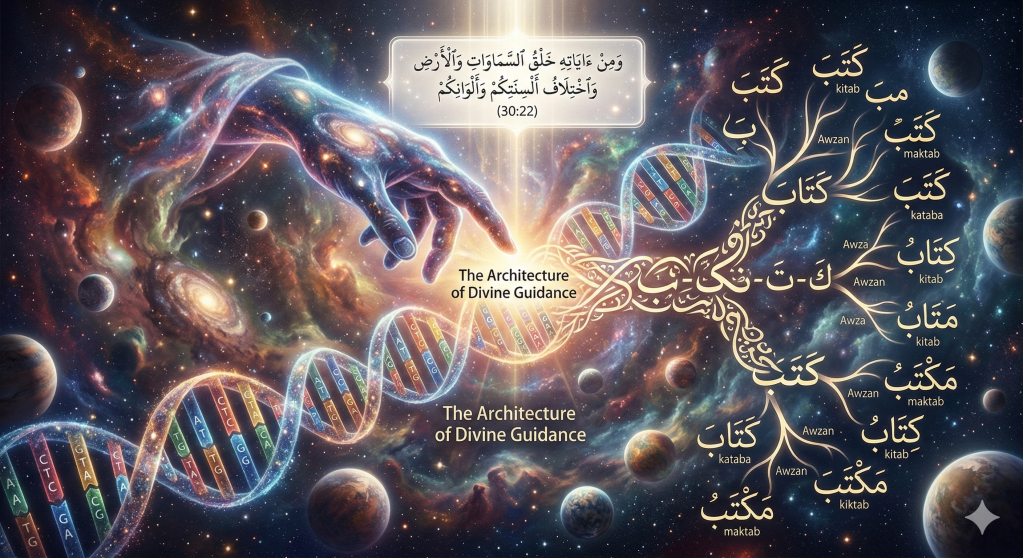
Importantly, the Qur’an itself encourages the use of reason and observation as tools for understanding. It repeatedly invites readers to “look,” “think,” and “reflect” on the world. The Quranic epistemology does not draw a sharp line between religious and secular knowledge – rather, it presents all truth as a unified whole emanating from Godthequran.lovethequran.love. As one Islamic scholar put it, “The Quran manifestly acknowledges the role of rationality for the attainment of truth without drawing any separating line between religious or secular truths”thequran.love. In fact, classical Quran commentators noted that the Qur’an uses the same term āyāt (signs) for both verses of scripture and phenomena of naturethequran.love. The message is clear: the written revelation and the natural world are twin sources of insight into realitythequran.love. God’s two “books” – the Qur’an and the cosmos – are meant to be read side by side. “We shall show them Our signs upon the horizons and within themselves until it becomes clear to them that it is the Truth,” Allah says in the Qur’anthequran.love. This foundational verse (Fuṣṣilat 41:53) has inspired Muslims to expect that scientific exploration will continually unveil evidence of the Qur’an’s truth.
Early Muslim scholars took these exhortations to heart, laying the foundation for a flourishing of science in the Islamic Golden Age. They believed that studying nature was a form of worship – a way to appreciate God’s work – and that true scientific findings could never contradict the Qur’anthequran.love. This optimism stemmed from the Qur’anic view that the laws of nature are divinely authored. Thus, medieval Muslim astronomers, mathematicians, physicians, and philosophers often saw their work as uncovering the patterns that Allah placed in creation. Their confidence that “truth cannot contradict truth” propelled advances in knowledge and at the same time enriched their understanding of scripture. In modern times, this legacy continues, with Muslim thinkers increasingly engaging contemporary science to shed light on the Qur’an’s meanings. As we shall explore, scientific discoveries – from the cosmic Big Bang to the microscopic genetic code – have opened new windows into Qur’anic verses, clarifying and reaffirming the scripture’s message in remarkable ways.
In this comprehensive article, we will delve into why science and empirical evidence are vital for Qur’anic commentary (tafsīr). We will examine how various fields – cosmology, geology, meteorology, biology, and even cutting-edge areas like evolutionary theory and quantum physics – intersect with the Qur’anic worldview. Along the way, we will highlight insights from both classical Islamic scholarship and modern researchers (including the influential work of Dr. Maurice Bucaille and others who followed his approach) that demonstrate a harmonious convergence between Qur’anic revelation and scientific truth. By journey’s end, it will become evident that engaging with science is not a threat to faith but a means of deepening it. In the Qur’anic vision, the empirical study of nature is not a secular distraction but a sacred endeavor – one that leads to a fuller appreciation of God’s glory and the miraculous nature of His word.
Qur’an and the Pursuit of Knowledge: A Unified Perspective
One of the foremost reasons that empirical truth is crucial in understanding the Qur’an is that the Qur’an explicitly endorses the pursuit of knowledge – both spiritual and worldly. Islam teaches that seeking knowledge is a religious duty. The Prophet Muḥammad ﷺ famously said, “Seeking knowledge is obligatory upon every Muslim (male and female).” This exhortation was not limited to religious knowledge; Muslims throughout history understood it to include the exploration of God’s creation. The Qur’an’s own text supports this broad view. According to one analysis, approximately 750 verses of the Holy Qur’an – nearly one-eighth of the entire scripture – exhort believers to study nature, reflect, use their reason, and investigate the worldthequran.love. These verses greatly outnumber those dealing with formal law or ritual. The implication is profound: intellectual engagement with the natural world is an integral part of faith.
For instance, the Qur’an often points to the alternation of day and night, the sun, moon, stars, rain, growth of plants, and the diversity of creatures as “signs for those of understanding.” A celebrated passage in Surah Āl ‘Imrān states:
“Indeed, in the creation of the heavens and the earth and the alternation of the night and the day are signs for those of understanding – who remember Allah standing, sitting, and lying on their sides and reflect on the creation of the heavens and the earth [saying], ‘Our Lord, You have not created all this without purpose!’” (Qur’an 3:190-191)
Here, spiritual contemplation (dhikr) is directly linked with reflection (tafakkur) on natural phenomena – showing that pondering the cosmos can lead to recognition of divine purposethequran.love. Another verse encourages a form of scientific curiosity: “Travel through the land and see how He originated creation” (Qur’an 29:20). This can be understood as an invitation to study the history of life and the earth, what we today call geology and biology. The Qur’an poses rhetorical questions that spur analytical thinking: “Do they not look at the camels, how they were created? And at the sky, how it is raised?” (88:17–18). “Will you not then reason (ta‘qilūn)?” is a recurring challenge in the scripturethequran.love. Such verses establish that observing the natural world and using rational thought are encouraged modes of worship in Islam.
Crucially, the Qur’an uses the term **āyah (plural: āyāt) to denote both a verse of the scripture and a sign in nature. This linguistic choice is deliberate. Muslim scholars like Fakhr al-Dīn al-Rāzī noted that the universe is like a book of God: just as each Qur’anic verse is a sign pointing to truth, each phenomenon in creation is a sign pointing to the Creatorthequran.love. In other words, empirical facts – when correctly understood – are verses in a universal Qur’an authored by God. This concept leads to a foundational principle of Islamic thought: the unity of truth. Since Allah is the source of both revelation and creation, there can be no contradiction between the two realms of knowledgethequran.love. As the Qur’an states, “Had it [the Qur’an] been from anyone other than Allah, they would have found in it much inconsistency” (4:82). The Qur’an not only asserts its own consistency, but by extension, implies that it will be consistent with reality. It effectively invites testing and verification: “Do they not then reflect on the Qur’an?” (4:82) – a call to scrutinize and confirm the truth of revelation through reason and evidencethequran.lovethequran.love.
This principle that “truth cannot contradict truth” was articulated by later Islamic scholars and finds resonance in other religious traditions as well. For example, the medieval Muslim philosopher Ibn Rushd (Averroes) wrote about reconciling scripture with Aristotle’s philosophy, and much later, Catholic thinker Galileo and others echoed that God’s two books (Scripture and Nature) must agree. In Islam, this harmony was never seen as heretical; it was mainstream. This partly explains why, historically, Muslims felt confident in scientifically examining the world: they believed any true discovery would only further unveil the wisdom of God’s design. When a new empirical finding appeared to conflict with scripture, the response was typically to re-examine human interpretations of scripture, rather than reject the finding outright. The Qur’an’s commentators understood that apparent conflicts might arise from misreading the Qur’anic text or from incomplete scientific knowledge. But they held that ultimately, there is no real contradiction between the “book of God’s words” and the “book of God’s works.” As modern scholar Sheikh Tantawi of Al-Azhar University wrote, “If scientific fact is established with certainty, it can elucidate the meaning of a Qur’anic verse, but it will never falsify it.” This attitude is rooted in the confidence that the Author of the Qur’an is also the Designer of the universethequran.love.
It is worth noting how broad and inclusive the Islamic perspective on knowledge has traditionally been. Pioneering Muslims in fields like astronomy, medicine, mathematics, and philosophy did not see themselves as leaving the faith’s domain; rather, they often framed their work as tafsīr al-kawn – “exegesis of the universe” – complementary to tafsīr al-Qur’ān, exegesis of the scripture. For example, Nobel laureate physicist Dr. Abdus Salam attributed the early flowering of science in Muslim civilization to the Qur’an’s insistence on inquiry. He cited the statistic of 750 verses on nature as evidence that Islam compels believers to seek scientific knowledgethequran.love. The renowned 19th-century Indian scholar Sir Syed Ahmad Khan wrote extensively on harmonizing the Qur’an with modern science, arguing that Islam is inherently rational and scientific. This trend continued into the 20th and 21st centuries, setting the stage for scholars like Maurice Bucaille and others to explicitly use science as a tool in Qur’anic commentary and apologetics.
In summary, the Qur’an establishes a framework of unity between faith and reason. It presents divine revelation and observed reality as co-witnesses to the same truththequran.lovethequran.love. Therefore, to comment on the Qur’an without reference to empirical knowledge is to ignore a key aspect of the Qur’an’s own message. When the Qur’an points to natural phenomena as signs, it expects us to understand those phenomena – which is where science enters the picture. In the following sections, we will see how modern scientific insights can enhance our understanding of various Qur’anic verses, fulfilling the Qur’anic command to “contemplate all the signs of God” in both scripture and the world.
Science as a Tool for Qur’anic Commentary (Tafsīr)
Because the Qur’an integrates references to the natural world throughout its discourse, knowledge of science becomes an indispensable tool for tafsīr, the interpretation of the Qur’an. Classical commentators did their best to explain verses about the sun, moon, stars, mountains, and embryonic development using the knowledge available in their era. However, human understanding of nature was limited in the past. As science has advanced, new layers of meaning in those Qur’anic verses have come to light, allowing contemporary commentators to appreciate the verses more fully. In many cases, modern science has confirmed the literal truth or apt metaphorical description in Qur’anic statements – sometimes in ways that would have been impossible for a 7th-century observer to know. This has significant implications: it serves as a faith-strengthening proof of the Qur’an’s divine origin, and it guides interpreters toward interpretations that harmonize with reality rather than conflict with itthequran.love.
The Legacy of Maurice Bucaille and “Scientific Tafsīr”
Perhaps the most famous champion of using modern science in Qur’anic commentary was Dr. Maurice Bucaille. A French medical doctor, Bucaille conducted a study of the scriptures in light of science in the 1970s. In 1976, he published “The Bible, The Qur’an and Science,” a book that compared the scientific accuracy of the Bible and the Qur’anthequran.love. Bucaille concluded that unlike the Bible, the Qur’an contains no statements that are untenable by modern sciencethequran.love. On the contrary, he found many Quranic passages astonishingly in line with scientific discoveries, which he argued could not be the result of chance or the limited scientific knowledge of the 7th century. This led him to affirm that the Qur’an is of divine origin. For example, Bucaille was impressed by the Qur’an’s detailed description of human embryonic development – from the mixing of fluids, to the clot-like leech stage (alaqah), to the chewed-lump appearance (mudghah), to the formation of bones and flesh (Qur’an 23:12-14). These descriptions, he noted, match modern embryology far too closely to have been guessed by an unlearned man in the desertthequran.love. Bucaille also highlighted Quranic verses on astronomy, the water cycle, mountains, and biology that square with scientific facts known only centuries later.
Bucaille’s work gave rise to what some call “Bucailleism” – an approach to Quranic study that actively seeks out congruence between Quranic statements and modern sciencethequran.love. This movement has been very influential in the Muslim world, popularizing the idea that scientific truth testifies to the truth of the Qur’an. Following in Bucaille’s footsteps, numerous authors and scholars have written on “the Qur’an and science.” These include figures like Maulana Wahiduddin Khan, who wrote “God Arises” presenting Islam in light of modern knowledge; Dr. Muzaffar Iqbal, who has written on Qur’anic insights into scientific phenomena; Dr. Mir Aneesuddin, a geologist who in the 1960s penned articles on science in the Qur’an and even produced a Qur’an translation with scientific notes; Dr. Zakir Naik, a popular speaker known for citing scientific points in the Qur’an; Farouk Abdul-Aziz, a filmmaker who made documentaries on Qur’an and science; and Gamal Abdel-Nasser al-Ganainy, a chemist who runs a “Qur’an and Science” websitethequran.lovethequran.love. These individuals (among others) see themselves as commentators of the Qur’an through the lens of science, continuing the journey that Bucaille beganthequran.lovethequran.love.
It is important to note, as many of these scholars themselves do, that no human commentary is flawless or finalthequran.love. The Qur’an is a deep ocean, and each era uncovers new pearls from it. Bucaille and those who followed him made great strides, but they also faced critiques – for instance, the charge of forcing scientific meanings onto the text (so-called ‘ijāz science, or claims of scientific miracles). Some critics caution that if science is treated as the sole measure of Qur’anic truth, one might risk misinterpreting metaphorical statements as scientific or tying the Qur’an to scientific theories that could later change. Muslim thinkers balance this by emphasizing that while the Qur’an contains verses compatible with science, it remains primarily a book of guidance and should not be read reductively as a science manualthequran.love. Its verses use natural imagery to point toward spiritual lessons; the focus is always on the Creator, not just the creation.
Nonetheless, the benefits of engaging science in tafsīr are manifold. Firstly, it helps clarify the meanings of certain Quranic terms or descriptions. For example, when the Qur’an mentions that Allah “made the sky a protective canopy” (21:32), science today explains the role of the atmosphere and ozone layer in shielding life from lethal radiation and meteoritesthequran.love. This gives us a concrete understanding of what “protective canopy” entails, something earlier commentators could only generalize about (often saying it refers to the sky’s protection from falling on us, etc.). Secondly, using scientific knowledge guards against misinterpreting verses in ways that conflict with reality. In the past, lacking science, some interpreters speculated in ways we now find incorrect – e.g., suggesting the sky is a solid dome. With today’s knowledge, commentators can avoid such errors and offer explanations that uphold the Qur’an’s veracity in the eyes of an educated audience. Thirdly, scientific insights often reveal a remarkable precision or wisdom in the Qur’an’s choice of words, bolstering belief. When the Qur’an says “We made every living thing from water” (21:30), it aligns with the scientific fact that water is the essential solvent of life and that all life forms are mostly water in compositionthequran.love. When it describes the mountains as “pegs” (78:7) or says “We set firm mountains on the earth so it would not shake with them” (21:31), one is reminded of how mountains have deep roots and stabilize tectonic plates – a concept not understood until modern geology. These correspondences inspire awe and conviction that the Qur’an is truly from the All-Knowing.
Perhaps most profoundly, incorporating empirical truth into Qur’anic commentary fulfills a spiritual purpose: it enables Muslims to worship Allah with a deeper understanding of His signs. Each new scientific marvel discovered – the genome’s complexity, the vastness of galaxies, the intricacy of a cell – can become a means to glorify God, when connected back to the Qur’anic verses that allude to God’s creative power. In an age where science often dazzles people, showing the Qur’an’s harmony with those discoveries can also be a powerful form of da‘wah (inviting others to Islam) as well as a means to reassure youth that one can be intellectually fulfilled and a person of faith simultaneously. Contemporary scholars like Fazlur Rahman and Muhammad Asad have emphasized that **Islam demands use of both Revelation and Reason – and that a Muslim’s faith is strengthened, not threatened, by honest scientific inquirythequran.lovethequran.love.
To sum up, using science as a tool in Qur’anic commentary is not about bending the Qur’an to fit every fleeting hypothesis. It is about unveiling the consistent truth that the Qur’an has always had, through the cumulative and refining lens of human knowledge. It is about reading the Qur’an in the context of an ever-unfolding understanding of God’s creation. As knowledge progresses, so too can our appreciation of the Qur’an’s miraculous depth. In the following sections, we will apply this approach to various key areas where science and the Qur’an intersect, demonstrating concrete examples of why empirical truth is indispensable for a rich and accurate Qur’anic exegesis.
Read further in Microsoft Word file:




 The Glorious Quran and Science
Leave a comment