
Presented by Zia H Shah MD
Abstract
This article presents a comprehensive exploration of fingerprints in the light of modern science and the Qur’an, adopting scientific, forensic, philosophical, and theological perspectives. It begins by summarizing how fingerprints – the intricate ridge patterns on human fingertips – are formed and how they have been proven unique to each individual, a fact only scientifically established in the 19th century. We then discuss the revolutionary use of fingerprints in forensic identification, demonstrating how their uniqueness allows law enforcement to identify persons with certainty. The philosophical significance of fingerprints is considered, highlighting what the individuality of each person’s fingerprints implies about human identity and uniqueness. Central to our discussion is a Qur’anic verse (Surah Al-Qiyamah 75:3–4) which asserts that God is capable of resurrecting a human being even to the precision of “proportioning their very fingertips.” We examine classical and contemporary interpretations of this verse: historically, Muslim scholars saw it as an emphasis on God’s power to reconstruct even the smallest bones, while modern observers note that the specific mention of fingertips intriguingly aligns with the scientific discovery that fingerprints are unique identifiers. By weaving together evidence from biology, forensic science, Qur’anic exegesis, and philosophy, this article illustrates how a detail in scripture prefigured later scientific insight. In a faith-affirming conclusion, we reflect on how the convergence of scientific knowledge and Qur’anic wisdom regarding fingerprints deepens appreciation for the divine message, underscoring the Qur’an’s timelessness and the idea that each human being’s identity is preserved by the Creator’s will.
Introduction
Fingerprints – the swirling patterns on our fingertips – are a key marker of human identity in modern science and society. No two individuals, not even identical twins, share the same fingerprint patterns, making them a powerful tool for identificationmedlineplus.gov. Yet the significance of these tiny ridges was not understood by humans for most of history; it was only in the late 19th century that scientists and law enforcement realized that fingerprints are unique and can serve as infallible personal signaturessites.rutgers.edugalton.org. Fascinatingly, over 1,400 years ago the Qur’an appeared to allude to this very fact in a theological context. In Surah Al-Qiyamah (The Resurrection), verses 75:3–4 challenge the doubter of life-after-death by asserting that God can even reconstruct a person’s fingertips on the Day of Resurrection:
“Does man think that We will not assemble his bones? Yes indeed! We are able to perfectly restore even his very fingertips.” (Qur’an 75:3–4)
This striking mention of fingertips – as opposed to simply “hands” or “bones” – has drawn considerable attention. It suggests that not only will God resurrect the human body, He will do so with meticulous precision, down to the tiniest detail of one’s individual identity. Modern readers cannot help but notice that fingerprints reside on those very fingertips and serve as a unique “identifier” for each person – a concept that only entered scientific knowledge millennia after the Qur’an was revealed. This convergence between scripture and science raises intriguing questions: How are fingerprints formed and why are they unique? How did forensic science come to use them for identification? What deeper philosophical meaning might underlie the uniqueness of each person’s fingerprints? And how have Islamic scholars, past and present, understood the Qur’an’s reference to fingertips in the context of divine power and human identity?
In this comprehensive essay, we will address each of those questions in turn. We begin with the science of fingerprints, explaining how these ridges form and why they are unique to each individual. Next, we explore the forensic history and usage of fingerprints – the journey from an anatomical curiosity to a cornerstone of criminal identification. We then reflect on the philosophical implications of every human being bearing an unrepeatable identifier on their fingertips, considering what this means for concepts of self and personhood. Finally, we delve into the theological significance of Qur’an 75:3–4, examining classical interpretations and contemporary insights that link this verse to the modern scientific understanding of fingerprints. Through this multidisciplinary approach, we aim to shed light on how a single Qur’anic verse about fingertips can be appreciated on many levels – scientific, spiritual, and symbolic – and how it serves as a faith-affirming example of harmony between revelation and reason.
The Science of Fingerprints: Uniqueness and Formation
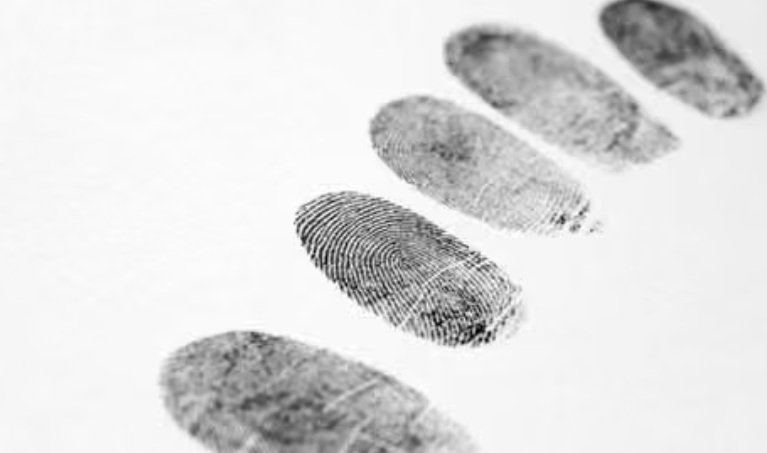
Human fingerprints are formed by raised epidermal ridges (called dermatoglyphs) on the pads of the fingers. These ridges develop in the womb by around the sixth month of fetal development and remain unchanged throughout one’s lifemedlineplus.gov. The primary patterns of fingerprints are commonly categorized as loops, whorls, and arches, but beyond these general shapes lies an intricate landscape of tiny ridge details known as minutiae – bifurcations, ridge endings, dots, and other micro-featuressites.rutgers.edu. It is in these minutiae that the fingerprint’s true uniqueness resides. While many people can share a similar overall pattern type (for example, loops are common), the probability of two individuals – even identical twins – having all the same minutiae in the same configuration is effectively zeromedlineplus.govsites.rutgers.edu. In other words, each person’s fingerprints are unique, a fact that has been repeatedly confirmed by both empirical observation and statistical analysis. Early pioneers of fingerprint science like Sir Francis Galton formally demonstrated this individuality; Galton’s 1892 study collected thousands of prints and showed statistically that no two fingerprints have identical sets of ridge characteristicsgalton.org. Indeed, the assumption that “no two fingerprints are alike” has become a foundational principle of modern science and law enforcementsites.rutgers.edusites.rutgers.edu.
Microscopic view of friction ridge skin on a human fingertip. The complex pattern of ridges and furrows (dermatoglyphs) is established before birth and remains constant throughout life. These patterns are unique to each individual, even among twinsmedlineplus.gov. The fine details (minutiae) in these ridges provide a “fingerprint signature” that can distinguish one person from all otherssites.rutgers.edu.
Biologically, the uniqueness of fingerprints arises from a combination of genetic and developmental factors. Genes influence the general size, spacing, and curvature of the ridge patterns, but the exact placement of every tiny ridge ending or split is shaped by stochastic (random) events in the womb such as subtle differences in finger positioning, blood pressure, and hormonal fluctuations during developmentmedlineplus.gov. This means that while the overall pattern type might be inherited, the finer details are effectively random, making each fingerprint one-of-a-kindmedlineplus.gov. Not even clones or identical twins (who share the same DNA) have identical fingerprints; they often have similar pattern types, but side-by-side comparisons reveal mismatches in the minutiae that unequivocally differentiate one twin’s prints from the other’smedlineplus.gov. The permanence and uniqueness of fingerprints have a clear biological purpose as well – the ridges enhance our sense of touch and grip, but from a broader perspective, they endow each individual with a kind of built-in biometric identity card.
It is worth noting that the scientific recognition of fingerprint uniqueness is relatively recent in human history. Ancient civilizations like those in Babylon and China observed fingerprints and even used thumb impressions as seals or signatures on clay tablets as far back as 1000 B.C.openfox.com, implying an intuitive trust in their individuality. However, those early uses were not based on a rigorous understanding that every fingerprint is truly unique – that understanding only crystallized in the 19th century. In 1823, anatomist Johannes Purkinje formally classified fingerprint patterns, but it wasn’t until the 1880s–1890s that researchers such as Sir Francis Galton and Sir Edward Henry applied statistics and created classification systems to prove and catalog the uniqueness of fingerprintsgalton.org. Galton, in particular, collected over 8,000 fingerprint sets and demonstrated a “statistical proof of the uniqueness, by minutiae, of individual prints”galton.org. By the turn of the 20th century, it was broadly accepted in scientific circles that the odds of two people sharing the same full fingerprint were astronomically low. This remarkable feature of human biology – that even the tiny swirls on our fingertips differentiate each of us from every other person who has ever lived – was thus firmly established as scientific fact.
Forensic Identification and the “Fingerprint Revolution”
The discovery of fingerprint uniqueness quickly gave rise to a forensic revolution: fingerprints became an invaluable tool for identifying individuals in law and justice. Prior to this, methods of identification were primitive (relying on eyewitness accounts, written descriptions, or later, photographic records) and prone to error. The adoption of fingerprinting introduced an objective, reliable means of linking a person to a record or crime scene. The journey began in the 19th century. In colonial India, British administrator Sir William Herschel started using fingerprints in 1858 as signatures on contracts, noting that the inked impressions could unmistakably tie a person to a documentopenfox.com. Around the same time, Dr. Henry Faulds in Japan and Scotland Yard officials in Britain were investigating fingerprints as a forensic tool. In 1880, Faulds famously used fingerprints to solve a minor case (matching a greasy fingerprint on a bottle to a laboratory worker), demonstrating their potential for criminal investigationsopenfox.com. By 1892, the first murder case solved by fingerprint evidence had occurred in Argentina, when police analyst Juan Vucetich matched a bloody print at a crime scene to the murderer – a breakthrough that grabbed international attentionopenfox.com. Thereafter, police departments in cities around the world rapidly began collecting fingerprint files. By 1896, Scotland Yard had established a Fingerprint Bureau, and within a few years fingerprint identification spread to law enforcement in Europe, India, and North Americaopenfox.comopenfox.com. The “fingerprint revolution” had begun.
The reason fingerprints were so eagerly embraced by forensic experts is their combination of reliability and exclusivity. A fingerprint lifted from a crime scene (a latent print) can be compared to a suspect’s known prints, and if the ridge patterns and minutiae align, it provides powerful evidence that the suspect was present. Courts were initially cautious, demanding proof that fingerprint matching was scientifically valid. Advocates like Galton and Edward Henry had laid the groundwork by publishing data and classification schemes, and by the early 20th century, the idea that “no two finger prints are alike” was a mantra in forensic literaturesites.rutgers.edu. In training materials for police, it was emphasized that even if two prints showed a similar overall pattern, a careful examination would find differences in the detailssites.rutgers.edu. This principle proved true time and again; as one early 20th-century fingerprint instructor confidently stated, after collecting hundreds of thousands of prints, “there would be no two that we could call absolutely alike in every detail”sites.rutgers.edu. The accumulated global experience (even the fingerprint records of millions of individuals compiled by the mid-20th century) never found a duplicate fingerprint belonging to different peoplesites.rutgers.edu. Such empirical success cemented the forensic community’s confidence that a fingerprint is an individualizing marker – effectively a “signature” left by the skin.
Forensic techniques to capture and compare fingerprints became more sophisticated over time. Investigators learned to dust crime scenes with fine powder or use chemical reagents to reveal latent fingerprints on surfaces, as natural skin oils or sweat residues leave behind an impression of the friction ridges. Once visualized, these prints can be lifted with adhesive tape or photographed for analysis. Examiners then compare the crime-scene print’s pattern of minutiae (ridge endings, splits, etc.) with a suspect’s fingerprint card. A sufficient number of matching minutiae in relative position leads to a conclusion that the prints are from the same sourcesites.rutgers.edu. Because the chance of two people sharing enough minutiae in the same arrangement is vanishingly small, a match can implicate an individual to the exclusion of all otherssites.rutgers.edusites.rutgers.edu. This method has been used to solve countless cases, from identifying petty criminals to verifying the identities of disaster victims. By the mid-20th century, national agencies (like the FBI) had amassed vast fingerprint databases – the FBI’s collection exceeded 200 million prints by 1971openfox.com – and today automated fingerprint identification systems (AFIS) use computers to quickly match prints against such databases.
A forensic scientist uses a magnetic powder applicator (magna brush) to develop a latent fingerprint on a surface. The black iron powder clings to the residues left by the finger’s ridges, making the pattern visiblecommons.wikimedia.org. Once revealed, the fingerprint’s unique features can be recorded and compared to reference prints. The longstanding forensic axiom “no two fingerprints are exactly alike” underpins this practicesites.rutgers.edu, giving investigators a reliable way to identify individuals with a high degree of certainty.
It is remarkable to reflect that all of this – the global systems for criminal identification, border security, biometric locks, and so on – rests on the simple biological truth that your fingerprints are yours alone. Forensic science has effectively turned a biological fact into a tool of justice. In doing so, it confirmed something fundamental about nature: an aspect of our anatomy that seems superficially trivial (the loops and whorls at our fingertips) encodes a vast amount of identifying information. This realization arrived well into the scientific age. But intriguingly, long before microscopes and fingerprint files existed, the Qur’an had pointed to fingertips as a symbol of divine precision in re-creating human beings. To that Quranic perspective we now turn, after a brief philosophical digression on identity.
Identity and Individuality: A Philosophical Perspective
Beyond their scientific and forensic importance, fingerprints invite reflection on questions of identity and individuality. Philosophically, one might ask: What does it mean that every human being carries an indelible, unique signature on the tips of their fingers? This fact illustrates in a tangible way the concept of human uniqueness. We often speak of each person having a unique soul or a unique personality; the fingerprints provide a physical analog of this metaphysical idea – a reminder that individuality is inscribed even in our flesh. The probability of anyone else having the same fingerprints as you is effectively zero, underscoring that you are truly one of a kind in the human family. Such uniqueness resonates with philosophical notions of personal identity: there are qualities that make you “you” and not someone else, and at the biological level the fingerprint is one small but potent marker of that non-repeatable identity.
This observation can lead to deeper contemplation. Fingerprints are formed by natural processes, yet they end up distinguishing each individual as if purposely designed to do so. It’s as though nature has given each person a nametag in the form of ridge patterns. In forensic science, as we saw, a single partial fingerprint can establish the presence or identity of an individual – implying that part of us can stand in for the whole of us. Philosophically, this invites the view that every fragment of a person carries something of their essence. The fact that a mere touch of a fingertip can identify a person speaks to a holistic unity of identity: even our smallest features are consistent with who we are in entirety. In literature and thought, fingerprints have thus been used as metaphors for individuality or fate – for example, we say something “has someone’s fingerprints all over it” meaning it obviously reflects their influence or identity.
Moreover, the permanence of fingerprints (barring scars, they remain the same from youth to old age) can symbolize the continuity of self. Despite the many changes a person undergoes in life, some core identifiers remain stable. One could draw an analogy between the unchanging fingerprint and the enduring self or soul of a person across time. This perspective aligns with theological viewpoints that while our physical bodies change or even decay, there is an aspect of our identity that is preserved by divine decree.
These philosophical ruminations tie directly into the theological discussion of resurrection in Islam. A classic question in philosophy of religion is: In what sense will the person who is resurrected be the same person as before? The Qur’an’s answer in Surah 75:4 is that not only will the scattered bones be reassembled, but the person will be reconstituted down to the exact tips of their fingers, i.e. with their unique physical identity intact. In light of what we now know scientifically, this can be seen as saying that the same individual – with all the fine-grained details that make them who they are – will live again. The deniers of resurrection in the Prophet’s time cynically asked, “Who could give life back to bones after they have crumbled to dust?” (Qur’an 36:78). The Qur’an’s reply, across various passages, is that the same God who created life in the first place can assuredly do so again, no matter how dispersed the parts. Surah Yasin (36:79) responds: “He who created them the first time will resurrect them; He is Knower of every creation.” Surah Al-Qiyamah 75:3–4, our focus, adds another dimension: it emphasizes not just raw power over matter, but precision – God can “perfectly restore his very fingertips.” Some scholars have read in this an answer to the question of personal identity: God is able to bring you back exactly as you were, not as an indistinct copythelastdialogue.org. The 7th-century listener would understand “fingertips” as a synecdoche for the smallest bones or extremities of the body, implying nothing is too minute for God to resurrectal-islam.org. A 21st-century listener, with knowledge of fingerprint uniqueness, hears an added layer of meaning: even the subtle markers of your individuality (the whorls and ridges of your fingertips) are within God’s power to recreate. In other words, divine resurrection is not a coarse cloning or replacement, but a restoration of the original person in full detail, ensuring continuity of identity.
Thus, from a philosophical standpoint, fingerprints exemplify how identity can be both physically grounded and spiritually significant. They are tiny physical formations that connect to a big idea: the uniqueness of each self. It is little wonder that contemporary Muslim thinkers have highlighted the fingerprint as a sign (ayah) in both nature and scripture – a sign inviting us to reflect on creation, selfhood, and the power behind it all. As we transition to the theological discussion, this convergence of ideas will become even more evident.
The Quranic Perspective: “Able to Perfectly Restore His Fingertips”
The Qur’anic verses in Surah Al-Qiyamah (75:3–4) provide a profound theological assertion using a very specific anatomical reference. The context of these verses is a discourse on the Day of Resurrection (Yawm al-Qiyamah). The surah addresses skeptics who doubt that humans will be raised up after death, and it dismantles their arguments in stages. Verses 3–4 read: “Does man think that We will not assemble his bones? Yes indeed, We are able to proportion even his banān (fingertips)!”quran.com. The term banān in Arabic refers to the fingertips or the extremities of the fingers. Classical Arabic lexicons and Qur’anic commentators concur that banān means the tips or end phalanges of the fingers – essentially what we would call the fingertipsthelastdialogue.org. It is a notably precise and rare word choice in this context; the verse does not say God can restore the person’s “hands” or “limbs” in general, but drills down to the fine detail of fingertipsthelastdialogue.org.
What is the significance of this choice? Early Muslim scholars understood it primarily as a way of emphasizing the absolute power of God in resurrection. The logic is: if God can reassemble the most delicate and detailed part of the human body, then surely reassembling larger bones poses no challengeal-islam.org. The fingertip bones are small and numerous, and the skin on them carries very intricate patterns – highlighting the micro-level of creation. According to renowned exegete Ibn Kathir, the verse implies that Allah could even make all of a person’s fingertips exactly alike if He wished (making “his fingertips all equal”), underscoring that God’s power has no limitquran.com. In his tafsir, Ibn Kathir explains that “We are quite able to put together his fingertips” means Allah can not only gather a person’s bones but also restore the fingers perfectly, and if He wanted, He “could surely resurrect him with more than what he originally had,” even to the point of altering the fingertips’ formquran.com. In other words, God’s capability extends from the macro (assembling skeletons) to the micro (recreating the subtle patterns of a fingertip). The Tafsir Ma’ariful Qur’an notes similarly that the mention of fingertips is to stress that “the smallest and the most delicate of the bones” will be restored in their original formal-islam.org. Classical commentators did not explicitly know about fingerprint patterns as a means of identification, but they did recognize the banān as a symbol of the minutiae of a human body – a part unique enough that one finger can be distinguished from another (hence Ibn Kathir’s example of making them equal in length as a hypothetical exercise of power)quran.com.
Fast forward to contemporary times, and the verse has taken on an additional resonance. Modern Muslim scholars and apologists often point out that fingertips are the site of fingerprints, and thus the verse can be read as alluding to the uniqueness of each person’s identity. They argue that it is striking for a 7th-century text to single out fingertips, when only in the 19th–20th centuries did humanity realize that the fingertips contain an “individualized signature” (the fingerprints) for every personthelastdialogue.org. As one Quranic commentary puts it, “the Qur’an used ‘fingertips’ as the symbol of individuality 1,400 years before forensics made them a legal symbol of that very same thing.”thelastdialogue.org The verse is therefore seen as miraculously precise: it addresses not just the reassembly of the human body in general, but the restoration of one’s personal identity in full detailthelastdialogue.orgthelastdialogue.org. Long before anyone knew about forensic fingerprinting, the Qur’an chose a word (banān) that in hindsight aligns perfectly with the idea of fingerprint uniqueness. This has been highlighted in various modern writings on Qur’anic miracles: “Why fingertips? Because they are the symbol of unique identity. Long before modern science, this verse points to the most intricate, individualized part of the human body as a testament to God’s power.”thelastdialogue.org. The fact that “no two are alike” in fingerprints was of course unknown to the Prophet’s contemporaries, but today we appreciate that “the fingertips are the location of our fingerprints — a biological signature unique to every single human who has ever lived. This, of course, was not a known scientific fact in 7th-century Arabia.”thelastdialogue.org.
It is important to note that the primary intent of the verse is theological, not scientific. Its main message is to refute the notion that resurrection is impossible. In doing so, it provides a proof by example: God is capable of reconstructing even the fine details of a person’s form. The use of “fingertips” drives the point home vividly. However, the happy concordance with an empirical scientific fact – that fingerprints are unique and identify us as individuals – enriches the verse’s implications. For believers, this is seen as an indication of the divine knowledge behind the Qur’an. It falls under what is called I’jaz al-Qur’an (the miraculous eloquence or content of the Qur’an), especially in the subset of “scientific miracles” where verses appear to allude to truths not known to people at the time. Many find it faith-affirming that one of the Qur’an’s arguments for resurrection rests on something as uniquely identifying as fingertips. As one commentary concludes: the verse is “multi-layered proof, unfolding its full miraculous nature over centuries”, so that as science advanced, new understandings of the verse became apparent, **“proving its divine origin for all times.”*qurangallery.app. Such interpretations must be balanced with a sober understanding that the Qur’an is not a science textbook. But in cases like this, where a straightforward reading coincides with modern knowledge, it’s seen as a sign (ayah) meant to strengthen faith (tafakkur) and invite humans to ponder God’s wisdomqurangallery.appqurangallery.app.
To illustrate, consider the dramatic way these verses may address a skeptic. Islamic tradition mentions an incident (associated either with Surah Yasin or Surah Qiyamah) where an elderly pagan, Ubayy ibn Khalaf, took a decayed bone and crumbled it in front of the Prophet Muhammad ﷺ, mockingly asking if God could bring it back to lifethelastdialogue.org. The Qur’an’s response, as reflected in 75:3–4, is essentially: Not only can God revive that crumbled bone, He can even restore the tip of that bone – the fingertip – with all its fine details. It is a stunning rebuttal that goes beyond the challenge. It asserts an ability to “perfectly restore his very fingertips”, meaning God will recreate the person exactly as they were, right down to the tiny finger ridge patterns that signify who they werethelastdialogue.org. The choice of focusing on banān (fingertips) instead of just bones shifts the argument from merely Can God put the physical pieces back together? to Can God restore the precise original identity? The Qur’an’s answer is a resounding yes on both countsthelastdialogue.orgthelastdialogue.org. This is why scholars like those behind The Last Dialogue commentary note that Surah Al-Qiyamah’s argument is “more advanced,” pointing not just to revival, but to perfect, individual re-creation.thelastdialogue.orgthelastdialogue.org In a beautiful tie-in, they also highlight how this complements Surah Yasin – the latter focuses on God’s power to resurrect bones (the basic material), whereas Surah Al-Qiyamah focuses on His power to resurrect your unique self (symbolized by fingertips)thelastdialogue.org.
Classical scholars, lacking the concept of fingerprint ridges, still derived the core meaning correctly: ultimate precision in resurrection. For instance, a modern summary of classical exegesis notes that “foundational exegetes like Ibn Kathir and Al-Tabari” explained the verse as “a divine rebuttal to those who questioned how decayed bones could be reassembled.” Allah’s response, by mentioning fingertips, “demonstrates His absolute power over creation” – since fingertips are “the smallest and most intricate of parts”, their restoration proves nothing is beyond Godqurangallery.app. These scholars even offered an additional insight: God’s ability to “make them all equal if He wished” (as Ibn Kathir mentioned) implies that not only will God recreate them as they were, but He has the power to change or standardize them – yet He doesn’t, which subtly indicates that He will restore each person with their individual traits intactqurangallery.app. In other words, the true marvel is His choice to bring everyone back exactly as themselves, “with their unique identity intact, signifying perfect justice and individual accountability.”qurangallery.app For on the Day of Judgment in Islamic theology, each person stands before God as themselves, bearing their own deeds; preserving one’s distinctive identity is integral to the concept of moral responsibility. Thus, whether understood in the 7th-century sense of “small bones” or the 21st-century sense of “fingerprints,” the mention of fingertips in Qur’an 75:4 highlights that Allah’s knowledge and power encompass the minutest details of our being. It assures believers that no individual will be lost in the crowd, no person’s essence will be misplaced in resurrection – every human being will be restored completely, recognized by themselves and others, down to the very fingerprints that stamp their identitythelastdialogue.org.
Epilogue: Faith at Your Fingertips
In the tiny furrows of a fingertip lies a world of meaning. Scientifically, those delicate ridge patterns tell the story of embryonic development and genetic uniqueness; they form an unchanging code that differentiates each of us among billions. Forensically, a single fingerprint can solve a mystery or secure a liberty, tying a person irrefutably to an action or identity. Philosophically, the fingerprint symbolizes individual identity and the notion that from the smallest detail to the grandest traits, each human being is uniquely fashioned. Theologically, as we have seen, a reference to fingertips in the Qur’an carries profound implications about God’s creative power and the promise of personal resurrection. It is a point where science and spirituality touch: the “proof” quite literally is at our fingertips.
That the Qur’an pinpointed (no pun intended) this part of the body in a verse about resurrection invites us to marvel. It encourages a posture of humility and awe. How incredible that something as seemingly trivial as a fingertip holds the key to one’s identity – and how even more incredible that the Qur’an employed it to make a theological point centuries before anyone understood its full significance. For believers, this is not mere coincidence but a sign of the divine origin of the scripture. It exemplifies how Qur’anic statements can reveal layers of wisdom as human knowledge progresses. When the verse about fingertips was revealed, it met the challenge of its time – “Who can reassemble decayed bones?” – by asserting God’s power down to the finest detail. Today, that same verse echoes a second resonance: “We know now that even those fine details are unique to each person”. Thus, the verse speaks afresh to a modern mind attuned to biological science, affirming that the Author of the Qur’an had knowledge beyond that of any mortal. As one commentator eloquently put it, “The Qur’an used ‘fingertips’ as the symbol of individuality 1,400 years before forensics made them a legal identifier”thelastdialogue.org. Appreciating this point can strengthen one’s faith, as it highlights the harmony between God’s word and His work – the revelation in the Qur’an and the revelation in nature.
Beyond apologetics and “miracles,” there is a deeper, more personal lesson to be drawn. The uniqueness of our fingerprints can be seen as a reminder of the personal attention and care in God’s creation. In Islamic spirituality, it is often said that the same God who created the cosmos in its vastness also “fashioned you in the womb” and “knows you better than you know yourself.” The fingertip, with its intricate, intimate detail, is a testament to this divine attentiveness. It is as if every fingertip proclaims, “I was made by One who values individual identity.” When pondering one’s fingerprints, a believer might be moved to reflect: if God does not repeat a simple pattern on two different individuals, how much more unique is each soul and each life’s purpose? Our fingertips thus encourage tafakkur (reflection) and shukr (gratitude) – reflection on the wisdom of creation and gratitude for being endowed with a distinct existence.
In a practical sense, the Qur’an’s “fingertip argument” also reinforces the concept of ultimate justice. On the Day of Resurrection, every person will be resurrected as themselves, with no loss of identity or confusion. Just as a fingerprint leaves no doubt of who someone is, the re-created fingertips symbolically assure that no one will be wrongly identified or lost in the assembly of souls. Each of us, with our unique “marks,” will stand before our Creator to account for our lives. For those who denied resurrection because it seemed impossible or far-fetched, the Qur’an’s answer is both logically and emotionally satisfying: the God who made you once, uniquely, can surely make you again – and will, in order that justice be served and mercy be fulfilled. It shifts the focus from the power required (which is infinite but granted) to the precision and knowledge involved. In doing so, it invites the doubter to reconsider: if we humans can use fingerprints to keep track of millions of individuals, cannot the One who gave us those fingerprints keep track of His creation, even in death? As the Qur’an asserts elsewhere, “Indeed, We have enumerated them and counted them one by one” (19:94). Not a single person escapes His knowledge.
Ultimately, the interplay of fingerprints and the Qur’an teaches a beautiful lesson about the relationship between science and faith. Rather than being at odds, they are seen here as complementary. Science uncovered a feature of God’s creation – the individuality of fingerprints – and faith provides a context of meaning for that feature. It transforms a cold fact (“no two fingerprints are alike”) into a warm signpost pointing toward the Creator (“He is able to restore you exactly as you were”). For an academic or a seeker, this synergy can be intellectually and spiritually satisfying. It demonstrates that engaging with modern knowledge can enrich one’s understanding of scripture, and conversely, scripture can imbue scientific facts with a layer of philosophical significance. In the example of fingerprints, knowledge that once served only pragmatic ends (identification of criminals, etc.) now also inspires spiritual awe: what was once a quirk of anatomy becomes a reminder of divine wisdom.
In conclusion, the humble fingertip – with its whorls and ridges – encapsulates a remarkable convergence of truth. It is a meeting point of forensic truth, biological truth, and spiritual truth. As you look at your own fingertips, you can appreciate that you are sui generis, created with an attention to detail that escapes human artistry. You can recall that these very patterns helped usher in a new era of justice in human history through forensic science. And if you are a believer, you can take comfort in the promise that the One Who first inscribed those lines on your fingers can bring you back to life, “down to the last swirl on your fingertip,” as the same unique individual you were – a prospect both awe-inspiring and reassuringthelastdialogue.org. Thus, in a real sense, our faith can be at our fingertips: each time we fold our hands in prayer or touch the Qur’an, the grooves of our skin testify to the power and knowledge of the One who said “Yes, We are able to proportion his very fingertips.” The next time you see a fingerprint – whether on a smartphone sensor, an ID card, or a dusty surface – it is worth pausing to reflect on the extraordinary sign present in that ordinary impression. It is a reminder that “the proof of the Qur’an itself is at our fingertips.”thelastdialogue.org, waiting to be recognized by those who reflect and believe.
Sources:
- The uniqueness and permanence of fingerprints: MedlinePlus Genetics – “Each person’s fingerprints are unique… Even identical twins, who have the same DNA, have different fingerprints.”medlineplus.govmedlineplus.gov
- Historical development of fingerprint science: OpenFox Digital Forensics Blog – “In 1892, police in Argentina solved a crime using a bloody fingerprint, the first case of its kind… by 1896, authorities around the world began to use fingerprints.”openfox.comopenfox.com; Galton.org – “Galton… was the first to place their study on a scientific basis… he was able to construct a statistical proof of the uniqueness, by minutiae, of individual prints.”galton.org
- Forensic use of fingerprints and the assumption of uniqueness: Rutgers University Fingerprinting Exhibit – “Since its invention in the 19th century, modern fingerprint identification has relied upon the assumption… that no two people have fingerprints exactly identical in every detail… even identical twins do not have identical fingerprints.”sites.rutgers.edusites.rutgers.edu
- Quranic insight on fingertips: The Last Dialogue (thelastdialogue.org) – “Why fingertips? Because they are the symbol of unique identity… The Qur’an used ‘fingertips’ as the symbol of individuality 1,400 years before forensics made them a legal symbol of that very same thing.”thelastdialogue.orgthelastdialogue.org; Qur’an Gallery (qurangallery.app) – “Classical scholars focused on [fingertips] as a testament to God’s meticulous power, while contemporary scholars highlight the modern discovery that fingerprints are unique to every individual as a profound, miraculous layer of meaning (i’jaz) within the verse.”qurangallery.app
- Tafsir Ibn Kathir on Qur’an 75:4: Quran.com – “Surely, We will gather them and We are able to put together his fingertips… if We wished We could make his fingertips all equal. (This is to say) We can restore even the smallest bones exactly or change them if we will.”quran.com
- Hadith/Reports on skeptic challenging the Prophet with a crumbled bone: The Last Dialogue – “(75:4) is widely understood to be a response to… Ubayy ibn Khalaf. He came to the Prophet ﷺ with a decayed bone, crumbled it and said: ‘O Muhammad, do you claim your Lord can bring this back to life?’ This verse was the stunningly precise reply.”thelastdialogue.org
- Reflection on the miracle of creation and resurrection: The Last Dialogue – “Wiggle [your fingers]. Ponder the miracle that this intricate, unique, functional thing came from a single microscopic cell… The miracle of your creation from a ‘drop’ to a being with unique ‘fingertips’ is the only proof you need that God can (and will) resurrect you.”thelastdialogue.orgthelastdialogue.org
If you would rather read in Microsoft Word file:

 The Glorious Quran and Science
Leave a comment