
Presented by Zia H Shah MD
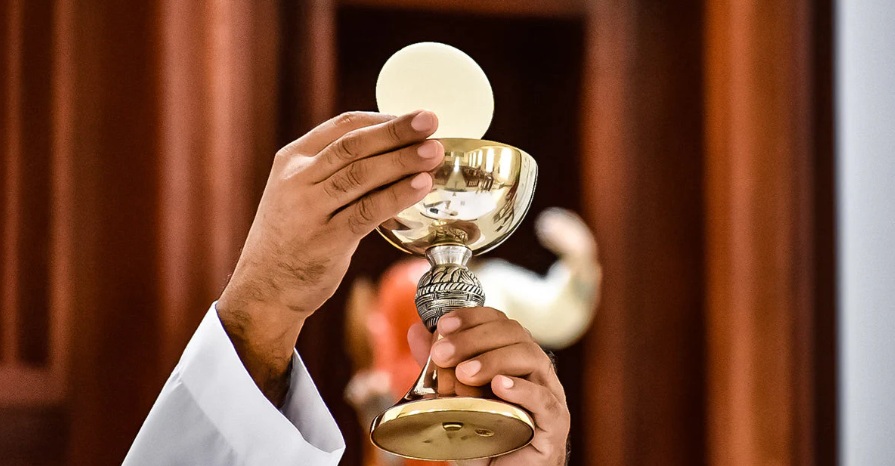
The Eucharist (or Holy Communion) – from Greek eukaristia (“thanksgiving”) – is the central Christian sacrament commemorating Jesus’ Last Supper. It is understood variously: Catholics hold to transubstantiation – the consecrated bread and wine truly become Christ’s body and blood (though still looking like bread and wine) en.wikipedia.org. Eastern Orthodox likewise affirm a real, mystical change, often simply calling it a mystery en.wikipedia.org. Lutherans teach a sacramental union: Christ’s body and blood are really “in, with, and under” the elements en.wikipedia.org. In contrast, Reformed (Calvinist) theology speaks of a spiritual presence, and Zwinglian Protestantism sees the Lord’s Supper as a memorial symbol. Anglicans and Methodists vary (some embracing a real presence, others a symbolic view), while groups like Baptists emphasize a symbolic remembrance. (Even Jehovah’s Witnesses commemorate it once a year as a symbolic memorial, and Quakers omit any ritual meal.)
- Catholic: Transubstantiation – bread and wine become Christ’s body and blood en.wikipedia.org. Only priests may consecrate; after Communion, Catholics worship the Real Presence.
- Orthodox: Real Presence as well (often called “sacred gift”), the bread/wine truly unite into one Body of Christ en.wikipedia.org. Eucharistic liturgy is the high point of worship.
- Lutheran: Real Presence via sacramental union (sometimes called “in, with, under” presence) en.wikipedia.org. Rejecting the term “transubstantiation,” Lutherans still affirm Christ’s true body/blood in the Supper.
- Reformed (Calvinist): Rejecting a change in substance, they nonetheless teach that believers truly commune with Christ spiritually during Communion (a “real spiritual presence”).
- Anglican/Methodist: Ranges from “high church” (close to Catholic ideas of real presence) to “low church” (more memorialist). John Wesley (Methodist founder) explicitly rejected transubstantiation as “incredible,” favoring a spiritual presence.
- Baptist/Evangelical: Communion is a symbolic ordinance. The bread and wine (or juice) memorialize Christ’s sacrifice but do not change substance.
- Others: Jehovah’s Witnesses hold an annual Memorial (only bread and wine, with most members abstaining) to remember Christ’s death. Quakers and some modern groups emphasize the inward, spiritual communion without formal elements.
Despite these spiritual interpretations, Eucharistic doctrine has long attracted controversy. Critics since the Reformation have pointed to its seeming irrationality or even macabre imagery. Sixteenth-century Protestants “detested the Catholic mystery of the Eucharist with its overtones of cannibalism,” and embraced emerging empirical science insteadshc.stanford.edu. Enlightenment thinkers (e.g. Descartes in Meditations) later noted the logical problem of how bread seems bread yet is said to be flesh. In short, what believers call a miraculous presence skeptics often dismiss as metaphor or superstitionshc.stanford.edu.
Historical Skepticism and Secular Decline
Historically, the Eucharist’s mystical claims have been challenged whenever rationalism grew. By the 17th century many scholars treated it as poetic allegory, not a literal change shc.stanford.edu. In modern times this skepticism coincides with secularization: churches in Europe and North America face steep declines. For example, the Pew Research Center found that from 2010 to 2020 the share of Americans affiliated with any religion fell 13 percentage pointspewresearch.org. Most developed countries report similar trends: today 20% or more of people in Europe and North America identify as having “no religion”swissinfo.ch. In the United States about one in five adults now say they have no religious affiliationtheguardian.com. Clergy and media worry that the U.S. may follow Western Europe “where attendances have plummeted”theguardian.com. In Switzerland, for example, one recent survey declared “Swiss abandon God,” noting that churches are increasingly empty and tens of thousands have formally left official churches in recent yearsswissinfo.ch.
Many Western churches today stand nearly empty, reflecting this trend. In wealthy societies with modern medicine, social welfare and entertainment, fewer people turn to the old religious institutionsswissinfo.chtheguardian.com. Sociologists and demographers note that younger generations are especially likely to be “nones.” As one study observed, “most developed countries are seeing a decline in religiosity,” with the UK having no Christian majority and France now majority nonreligiousswissinfo.ch. The rising “no religion” share in the U.S. and Europe parallels a collapse of traditional piety: even routine rituals like Sunday Communion are often seen as optional, weakening the shared experience of the sacred.
The Sacred and Psychological Perspectives
- Freud (sigmund Freud): He viewed religion (including rituals like the Eucharist) as an illusion born of childhood wishes and anxiety. Freud described belief in God as akin to an “obsessional neurosis” tied to unresolved father-figures, predicting it would be shed as society maturesiep.utm.edu. In Future of an Illusion he argued that maturing humanity must “go out into hostile life,” abandoning comforting illusions. Thus, under Freud’s model, the loss of Eucharistic faith reflects a broader turning away from “fatherly” consolation to a secular “reality education”iep.utm.edu. Religion’s decline is almost inevitable, he suggested, as science and psychological maturity advance.
- Jung (Carl Jung): He saw the decline of religion as causing a spiritual void. Jung argued that a “malaise of the modern world” comes from losing the old sacred frameworkssacredweb.com. At the same time he maintained that the sacred isn’t “out there” but also within each person’s psyche – a deep “God-image” archetype. As one Jungian commentator notes, Jung “acknowledged that the sacred is not only transcendent, but also a reality that dwells within all human beings”sacredweb.com. For Jung, modern individuals must rediscover inner sources of meaning, or risk psychological imbalance. The loss of communal sacraments like the Eucharist can leave people feeling adrift in an “infinite nothing” (echoing Nietzsche) unless they cultivate inner symbols of the sacred.
- Durkheim (Émile Durkheim): He defined religion in sociological terms: humanity’s way of marking sacred vs. profane to forge social bondsrevisesociology.com. Any symbol or ritual can be sacred if the community so chooses. Durkheim argued that worshipping the sacred is really worshipping society itself – reinforcing a shared “collective conscience”revisesociology.com. By this logic, the Eucharist (a collective rite) was a key way Christians reinforced group identity. Its decline suggests a weakening of communal solidarity. In Durkheim’s view, when church rituals fade, social cohesion must find new focus. He even observed that secular icons (nationhood, flags, or sports teams) can become secular “totems,” but the loss of religious “totems” like Communion may leave a gap in shared meaning revisesociology.com.
- James (William James): James emphasized personal religious experience over dogma. In The Varieties of Religious Experience he conducted a psychological study of individual private religious experiences and mysticism en.wikipedia.org. For James, the value of religion lay in the existential “feelings of the sacred” – ineffable states of unity, peace or awe – that some individuals have. He distinguished, for example, “healthy-minded” faith from the “sick soul” burdened by evil, but either way treated genuine religious emotion as psychologically real and potentially beneficial. The decline of liturgical rituals like the Eucharist does not eliminate such experiences altogether, but it means that many people no longer encounter the sacred through communal rites. James might say they now seek personal meaning through other experiences (art, nature, psychology) – “religion” survives in new forms as long as people have access to experiences that command a sense of the numinous en.wikipedia.org.
Nietzsche’s “Parable of the Madman” (Death of God)
Nietzsche famously dramatized the loss of the sacred in his “Parable of the Madman” (1882). He imagines a madman in a church shouting “Whither is God? I will tell you. We have killed him—you and I.”sourcebooks.web.fordham.edu In a vivid speech the madman laments that humanity has “drunk up the sea” and wiped away the sun – an image of a world unmoored from its spiritual center. He asks: “Do we feel nothing as yet of the noise of the gravediggers who are burying God?” and “Do we not smell anything yet of the divine decomposition?”sourcebooks.web.fordham.edu. The line “God is dead. God remains dead. And we have killed him.”sourcebooks.web.fordham.edu captures the core claim: modern Western culture has effectively executed the idea of a transcendent lawgiver.
The madman then grapples with the enormity of this act. He cries, “How shall we comfort ourselves, the murderers of all murderers? What was holiest and mightiest… has bled to death under our knives…”sourcebooks.web.fordham.edu. He suggests that after murdering God, humanity must now invent new “festivals of atonement” or become gods themselves just to bear the guiltsourcebooks.web.fordham.edu. In the closing scene he enters churches and plays a requiem for God, proclaiming “What after all are these churches now if they are not the tombs and sepulchers of God?”sourcebooks.web.fordham.edu. The parable thus symbolically links the empty church to the death of God: just as the Eucharist was once the body of Christ made manifest, Nietzsche argues all such religious structures now contain only the corpse of a vanished deity.
Analysis: Nietzsche uses the Eucharistic imagery implicitly – “killing” God with his own followers’ disbelief – to diagnose a nihilistic crisis. The madman’s outcry suggests that secularization leaves a void (“infinite nothing”sourcebooks.web.fordham.edu) and moral uncertainty. Without belief in God (and the sacred authority he represented), humanity stands at a crossroads: either create new values (“sacred games”) to replace the oldsourcebooks.web.fordham.edu, or face meaninglessness. This parable complements the sociological and psychological analyses above: it poetically underlines that the communal sacred (exemplified by Communion in the church) has evaporated in the modern West. In Nietzsche’s view, as in Freud’s and Durkheim’s, something fundamental has been “lost” – not just a theological claim but a shared source of meaning.
In sum, the Eucharist once gave common Christians a tangible experience of the sacred – an act they felt as a real encounter with the divine. As churches empty and secular ideologies spread, that shared ritual experience has faded. Psychologists like Freud and Durkheim see this as part of an inevitable shift toward a more individualistic, scientific ageiep.utm.edurevisesociology.com. For many, Nietzsche’s pronouncement rings true: the symbolic center is gone. Demographically, this aligns with the rise of the unaffiliated (now about 20% of U.S. adultstheguardian.com) and declining Mass attendance. Each theory suggests we must grapple with a “world without the sacred” – whether by creating new communal bonds, rediscovering inner meaning, or resigning ourselves to the “infinite nothing.”
Sources: Historical and demographic data are drawn from sociological surveys and news reportspewresearch.orgswissinfo.chtheguardian.com. Doctrinal details come from church teachings and theological overviewsen.wikipedia.orgen.wikipedia.org. Psychological interpretations are based on classic works by Freud, Jung, Durkheim and Jamesiep.utm.edusacredweb.comrevisesociology.comen.wikipedia.org. Nietzsche’s parable is cited from The Gay Sciencesourcebooks.web.fordham.edusourcebooks.web.fordham.edusourcebooks.web.fordham.edu. Other analyses use these sources for context and quotes.



 The Glorious Quran and Science
Leave a comment