
Thailand is dotted with thousands of Buddhist temples (known as wats), from glittering royal shrines in Bangkok to serene hilltop sanctuaries in the north. Many Thai temples trace their origins to centuries of history and royal patronage. For example, Wat Phra Kaew (Temple of the Emerald Buddha) in Bangkok was built in 1782–85 by King Rama I as part of the new Grand Palace complexen.wikipedia.orgroyalgrandpalace.th. Its sanctified ubosot (ordination hall) was explicitly built to enshrine the Emerald Buddha, a sacred statue brought from Laosen.wikipedia.org. Likewise, Wat Pho (Bangkok’s Reclining Buddha temple) is one of the city’s oldest, rebuilt by Rama I and III atop a 16th-century ruinen.wikipedia.orgtimetravelturtle.com. Across the country, temples serve as centers of faith and culture: Wat Mahathat in Ayutthaya (a 14th-century royal monastery) once housed Buddha relics and today is famous for its Buddha head entwined in tree rootsyourthaiguide.comyourthaiguide.com. And Wat Phra That Doi Suthep in Chiang Mai, founded in the 14th century, perches on a mountain above the city with a golden stupa containing a relic of Buddhacharacrosstheworld.comcharacrosstheworld.com. Through their architecture, statues and rituals, each temple tells a story of Thai history and spirituality.
This guide details major temples in Bangkok and notable sites elsewhere. For each, we cover its location, history, architecture, key statues/artifacts, cultural significance, visitor information (hours, fees, dress code, access), and practical tips. We also compare them in summary tables below for quick reference.
| Temple (Wat) | Location (City/Region) | Key Features & Highlights | Visitor Info (Hours/Fee/Dress) |
|---|---|---|---|
| Wat Phra Kaew (Temple of the Emerald Buddha) | Grand Palace, Bangkok | Houses the Emerald Buddha (revered jade statue) and elaborate Thai royal shrines. Richly gilded ubosot with Narayana–Garuda motifs, golden stupas, mythic guardiansen.wikipedia.orgen.wikipedia.org. | Open daily ~8:30 AM–3:30 PM (Palace grounds 8:30–4:30)royalgrandpalace.throyalgrandpalace.th. Foreigners THB 500 (includes Grand Palace); strict dress code (shoulders & knees covered)royalgrandpalace.throyalgrandpalace.th. |
| Wat Pho (Reclining Buddha) | Phra Nakhon, Bangkok | Home to Thailand’s largest collection of Buddha images, including a 46 m golden Reclining Buddhaen.wikipedia.orgtimetravelturtle.com. 17th C origins, rebuilt by Rama I/III. Many stupas (chedis) and mural-lined viharns. Birthplace of Thai massage schoolen.wikipedia.org. | Open daily 8:00 AM–6:30 PMtimetravelturtle.com; fee ~THB 200 (foreigners)timetravelturtle.com. Modest attire required. Closed during royal or Buddhist ceremonies. |
| Wat Arun (Temple of Dawn) | Thonburi, Bangkok (Riverside) | Iconic riverside temple with an 82 m Khmer-style prang (spire) adorned with Chinese porcelain mosaicsen.wikipedia.orgthethaipass.com. Historically housed the Emerald Buddha until 1784. Three smaller prangs and river views. | Open daily 8:00 AM–6:00 PMthethaipass.com; entrance THB 100. Modest dress, remove shoes inside buildings. Best visited at sunrise/sunset for light and river viewsthethaipass.com. |
| Wat Saket (Golden Mount) | Pom Prap Sattru Phai, Bangkok | Temple built on an artificial hill. Crowned by a golden chedi (stupa) at 79 m heighten.wikipedia.orgen.wikipedia.org. 18th C origins (founding temple), hill constructed under Rama I–III, chedi completed under Rama V with Buddha relicen.wikipedia.orgreevesroam.com. Hosts an annual Loy Krathong festival and candlelight procession up the mountreevesroam.comen.wikipedia.org. Panoramic city views from top. | Open daily 7:00 AM–7:00 PMreevesroam.com; fee THB 100reevesroam.com. Dress code: cover shoulders & kneesreevesroam.com. Shoes off in shrine areas. Climb 300+ steps (or enjoy peaceful gardens). |
| Wat Suthat (with Giant Swing) | Phra Nakhon, Bangkok | First-class royal temple (started Rama I, finished Rama III) known for its giant nine-story viharn and elaborate muralsyourthaiguide.comblog.urbanadventures.com. Houses a 13th C bronze Buddha (largest in Thailand, made from old opium pipes)yourthaiguide.comblog.urbanadventures.com and copper Temple Guardians brought from China. Its exterior is famed for the Giant Swing (used in Brahmin ceremonies until 1932)yourthaiguide.com. Largest ordination hall in Thailand, lush cloister gardens. | Open daily 9:00 AM–4:00 PMyourthaiguide.comblog.urbanadventures.com (viharn open till 9 PM); fee THB 100yourthaiguide.com. Respectful attire required (cover knees/shoulders)yourthaiguide.com. Photography allowed in most areas. Nearby: Wat Saket, Golden Mount. |
Bangkok’s Famous Temples
Wat Phra Kaew (Temple of the Emerald Buddha)
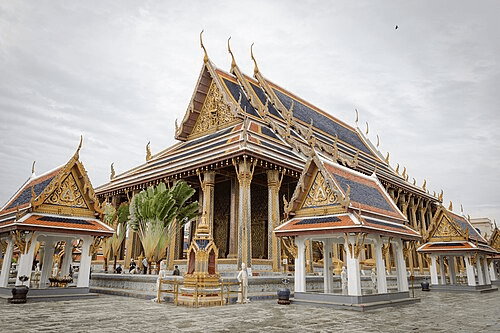
The Phra Ubosot (ordination hall) of Wat Phra Kaew, Bangkok’s holiest shrine, is surrounded by golden spires and mythical guardians.
Wat Phra Kaew (วัดพระแก้ว) stands within the Grand Palace precinct in Bangkok’s historic Rattanakosin districten.wikipedia.org. Built by King Rama I (r. 1782–1809) on the site of his new palace, it enshrines the Emerald Buddha – a highly venerated jade statue captured from Laos in 1779en.wikipedia.org. The Emerald Buddha is housed in the central ubosot, a richly gilded hall whose architecture features blue-yellow roof tiles and elaborately carved pediments depicting Hindu gods riding Garudaen.wikipedia.orgen.wikipedia.org. Surrounding the ubosot are 12 pavilions and eight sema boundary stonesupload.wikimedia.orgen.wikipedia.org. The complex also includes gold-covered stupas (chedis) commemorating Rama I–III and a model of Angkor Wat nearby.
History: Founded as the royal temple of the Chakri dynasty, Wat Phra Kaew was ceremonially opened in 1784, though interior and exterior decorations continued into the reigns of Ramas II and IIIen.wikipedia.org. Rama III (r. 1824–51) renovated the ubosot’s exterior after an 1827 fireen.wikipedia.org. Over time it became Thailand’s foremost religious shrine and site of royal ceremonies; even the king’s access to the central hall is through a special elevated dooren.wikipedia.org.
Key Artifacts: The principal object is the Emerald Buddha itself (2.5 ft tall, carved from a single jade stone). Seasonal gold and gemstone costumes on the statue are changed thrice yearly (tourists can view these). Other treasures include the Three Kings Shrine (honoring the country’s founder and surrounding dynastic kings) and numerous gilt statues of Buddhist and Hindu figures along the perimeters.
Cultural Significance: Known as the “Palladium of the Kingdom,” Wat Phra Kaew is central to Thailand’s monarchy and identity. Major ceremonies (such as changing the Emerald Buddha’s robes, coronations, and New Year rites) are held hereen.wikipedia.org. It ranks as one of Thailand’s six highest-class royal temples.
Visitor Info: The temple area is open to visitors daily (8:30 AM–3:30 PM for ticket sales; grounds till 4:30)royalgrandpalace.throyalgrandpalace.th. Entry is via a combined Grand Palace ticket (THB 500 for foreigners)royalgrandpalace.th. Strict dress code is enforced (no sleeveless shirts or shorts; shoulders and knees must be covered)royalgrandpalace.th. Shoes must be removed to enter halls. Tourists should arrive early (lines form by mid-morning) and respect the solemn shrine: photography is allowed, but climbing any statue or inner sanctum is prohibited.
Tips: Visit early to avoid crowds (especially tour groups). Audio guides or guided tours add context to the richly symbolic art (e.g. murals of the Ramayana). Keep valuables secured: the complex is busy. Nearby Wat Pho and Wat Mahathat (Bangkok) can be combined in a half-day tour.
Wat Pho (Temple of the Reclining Buddha)
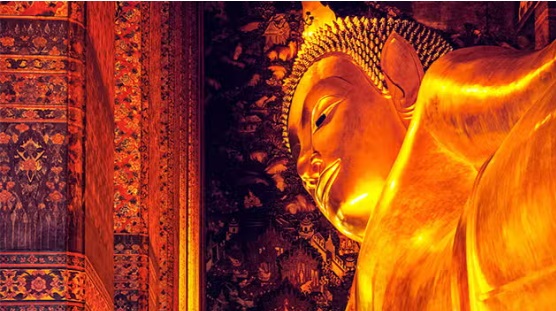
The Reclining Buddha at Wat Pho (Bangkok) measures 46 m in length and is gilded in gold leaf. Just south of the Grand Palace on Rattanakosin Island, Wat Pho (วัดโพธิ์) is Bangkok’s oldest Buddhist temple en.wikipedia.orgtimetravelturtle.com. King Rama I (r. 1782–1809) chose this site to build the royal monastery for his newly-founded capital, rebuilding an earlier ruin named Wat Photaramen.wikipedia.orgtimetravelturtle.com. Rama I expanded it significantly, and Rama III (r. 1824–51) later added new halls, images and stupas.
Architecture: The complex is immense, with over 90 structures. Its most famous centerpiece is the 46 m-long Reclining Buddha statue (also called Phra Buddhasaiyas), gilded and housed in the Viharn Phranorn, with feet inlaid mother-of-pearl mapsen.wikipedia.orgtimetravelturtle.com. Surrounding this main building is a cloister containing over a thousand smaller Buddha images (most in sitting posture)en.wikipedia.org. Outside are four 40 m bell-shaped stupas (chedis) built in 1832, each representing a Buddha of a previous era. The viharn and other halls feature extensive murals depicting Buddhist lore and the Buddha’s life. Outside, statues of Chinese gods and figures (brought as ballast from junks) line the front piazza.
Statues/Artifacts: The reclining Buddha (Nirvana pose) symbolizes the Buddha’s passing into final nirvana. It is flanked by 108 alms bowls and behind it sits a shrine with small earth-toned Buddha images, royal portraits, and the “Buddha baths.” Wat Pho also hosts a famous school: inscriptions and wall diagrams depict traditional Thai medicine and massage. In fact, Wat Pho is regarded as the birthplace of Thai massage, with a small school still teaching it on site.
Significance: Wat Pho holds first-class royal temple status in Thailand’s hierarchyen.wikipedia.org. It has long been a center of education and healing; its murals and inscriptions (dating from Rama III) were included in UNESCO’s Memory of the World for their historical value. It also contains the ashes of King Rama I. Pilgrims come to pay respects, and laypeople often participate in releasing fish, lighting incense, and offering flowers.
Visitor Info: Open daily, normally ~8:00 AM–6:30 PMtimetravelturtle.com (though sometimes closing for brief ceremonies). Entrance is around THB 100–200 for foreignerstimetravelturtle.com (locals often enter free). Modest dress is required (no shorts, bare shoulders); shoes off inside halls. Photography is allowed (except flash on Buddha). Tip: after viewing the Reclining Buddha, explore the grounds for quieter nooks and leaf-blowing Bodhi tree park. Afternoon light brings out the gold; mornings avoid heat. Traditional massage sessions are available at the western edge of the grounds (no children allowed inside halls).
Wat Arun (Temple of Dawn)
On the Thonburi (west) bank of the Chao Phraya River stands Wat Arun (วัดอรุณ), named after Aruna, the Hindu god of dawn. Its tall central prang (spire) is immediately visible from across the river. The temple dates back to at least the Ayutthaya period but gained fame under King Taksin (late 18th C), who briefly established his palace here and renamed it Wat Chaeng. King Rama II (r. 1809–24) began rebuilding and enlarging it, and Rama III (r. 1824–51) completed the prang in 1851en.wikipedia.org.
Architecture: Wat Arun’s most remarkable feature is its 82 m high central prang, built in Khmer style (similar to Angkor Wat architecture)en.wikipedia.org. The prang is covered in a mosaic of multicolored Chinese porcelain and seashells (an ironic reuse of discarded trade wares)thethaipass.comen.wikipedia.org. Four smaller satellite prangs encircle it, each honoring the Hindu triad of Brahma–Vishnu–Shiva and guardians on the directions. The viharn (ordination hall) sits to the east of the prangs, with a stupa behind it containing relics. Statues of demons from the Ramayana guard the main staircase. At ground level, rows of eight Chinese stone pillars topped by demon statues line the central terrace, reminiscent of an Asian mosque layout.
Statues/Artifacts: The central prang was once surmounted by a spire called photisat, covered in gold (during King Taksin’s time). The viharn houses a sitting Buddha image. The entire complex is richly symbolic, blending Buddhist and Hindu motifs. In former times, the Emerald Buddha was kept at Wat Arun (then near the king’s palace) before being moved to Wat Phra Kaewen.wikipedia.org.
Cultural Significance: Wat Arun is a symbol of Bangkok (it’s featured on Thailand’s 10-baht coin). It represented the city’s recovery after the fall of Ayutthaya – Rama II’s embellishment signaled Thai resilience. The central towering prang is said to represent Mount Meru, the center of the universe in Buddhist cosmology.
Visitor Info: Open daily 8:00 AM–6:00 PMthethaipass.com; entry THB 100. The temple is accessed by ferry or riverboat from the east bank. Dress code: modest (cover arms/legs). Visitors climb the steep steps of the central prang (handrails only), so caution and good footwear are advised. Sunset or sunrise views (from the east bank or river) highlight the prang’s beauty – photographers often time visits for golden lightthethaipass.com. Avoid the midday heat and crowds by going early morning or late afternoon.
Wat Saket (Temple of the Golden Mount)
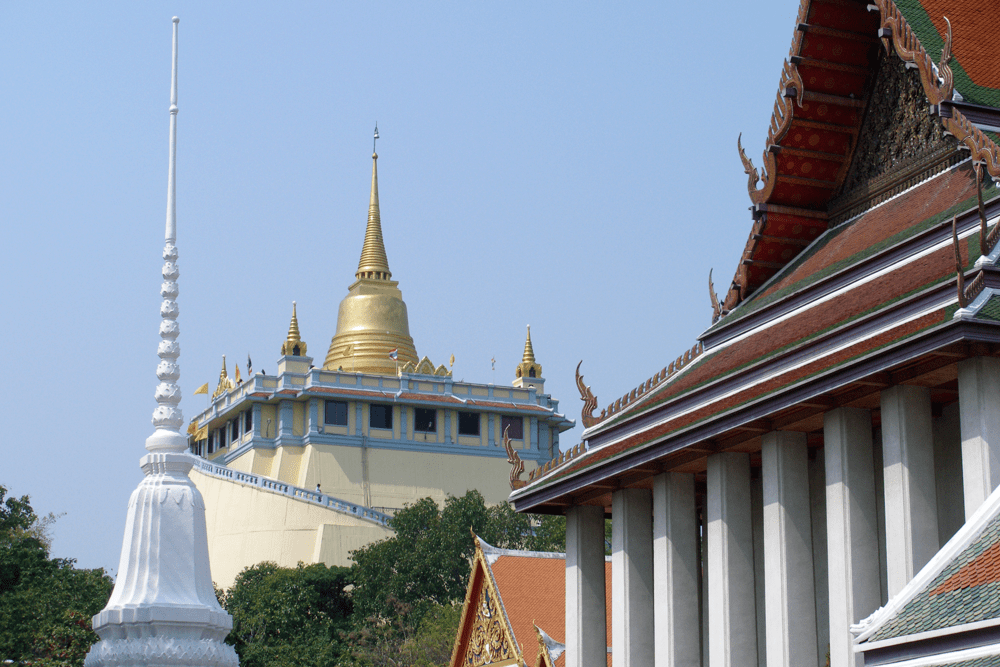
The golden stupa atop Wat Saket’s artificial hill (Phu Khao Thong), a Bangkok landmark. Wat Saket Ratcha Wora Maha Wihan, known as the Golden Mount (ภูเขาทอง, Phu Khao Thong), sits at the top of a man-made hill in central Bangkok. The temple itself dates to Ayutthaya times (originally called Wat Sakae) but was rebuilt when Bangkok became capital. Its most striking feature is the 58 m high artificial hill crowned by a gleaming gold-covered chedi containing a Buddha relicreevesroam.comen.wikipedia.org. The hill was created from the collapsed 19th C Rama III chedi, which over time became a raised mound. Rama V (r. 1868–1910) completed the current chedi and had it gildeden.wikipedia.org.
Architecture: The Golden Mount’s stairway (344 steps on 3 sides) leads visitors through tranquil gardens to the summit terrace. On the top sits the bell-shaped stupa encased by a low wall and corner shrines. Below, the temple complex includes a grand ubosot and viharn with multi-tiered roofs. Nearby shrine halls honor King Rama I (who renamed the temple in a legend of washing his hair thereen.wikipedia.org) and revered monks. Marble reliefs and columns illustrate Jataka tales.
Statues/Artifacts: Inside the stupa is said to enshrine a fragment of Buddha’s relics (shoulder bone) brought from Sri Lankaen.wikipedia.org. Around the base are hundreds of Buddha images from donations. The temple holds statues of the founding and venerated monks (Luang Phor).
Cultural Significance: The Golden Mount hosts a famous November festival combining Loi Krathong and the “Candlelit Ascent.” Pilgrims climb at night waving candles, draping a long red robe (pha tham thung) around the chedi, symbolizing merit-making and blessingsen.wikipedia.org. The temple offers panoramic views of Bangkok’s skyline and a peaceful retreat from the bustle.
Visitor Info: Open daily 7:00 AM–7:00 PMreevesroam.com; entry THB 100reevesroam.com. Modest dress is required (cover knees/shoulders)reevesroam.com. There is no fee to climb the steps aside from the entry. Note: The climb can be hot; visitors often go early or late. At top, shaded pavilions allow rest and worship. Shoes removed before entering the stupa.
Wat Suthat Thepwararam (Temple of Giant Swing)
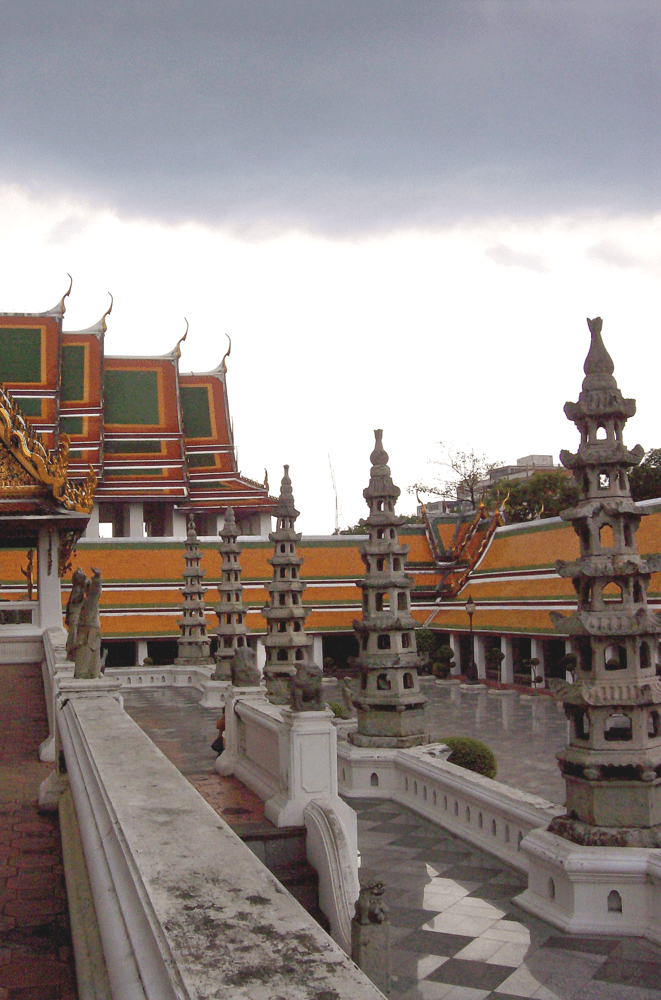
Covered walkways and stupas at Wat Suthat in Bangkok. The Giant Swing stands in the foreground. Wat Suthat (วัดสุทัศน์เทพวราราม) is one of Bangkok’s oldest and largest temples. Commissioned by King Rama I (r. 1782–1809) and completed under Rama III (1847), it features Bangkok’s largest ubosot (ordination hall)yourthaiguide.com. The entrance grounds are dominated by the Giant Swing (Sao Ching Chaa), a towering red wooden swing frame used for an ancient Brahmin ceremony (topped with gold trim). Though the swing is now ceremonial only, it remains an iconic landmark.
Architecture: Wat Suthat’s striking double-tiered golden roof and tall pillars enclose a grand viharn (prayer hall). Inside the viharn are 28 panel murals on the “Jataka wall” depicting Buddha’s past lives, second only in importance to the Grand Palace’s. The hall houses a large 13th C Buddha image brought from Sukhothai (the “Phra Sri Sakyamuni”) covered in gold leafblog.urbanadventures.com. Surrounding cloisters contain dozens of smaller Buddha statues. The temple compound also includes wihans and chedis: a bronze Buddha in meditation (cast from old opium pipes!) is one highlightyourthaiguide.com.
Statues/Artifacts: Key images include the main Phra Sri Sakyamuni (19 tons of bronze), and the giant nail-head Buddha (Phra Nak Prok reclining under Buddha-protecting nāga serpent). A rare relic of King Rama VIII rests beneath one altar, making it also a royal memorialyourthaiguide.com. The temple’s walls and door panels are splendidly carved and lacquered, with original wooden doors (one carved by Rama II) preserved in the National Museum.
Cultural Significance: Designated a first-class royal wat, Wat Suthat is especially significant as a former site of the annual Triyampavai-Tripavai ceremony (the Giant Swing festival) to invoke Shiva’s blessingyourthaiguide.com. Today, it remains a working monastery, and locals pray here regularly. The murals and relics make it a cultural heritage site, and it’s a peaceful spot for reflection near the bustling old city.
Visitor Info: Open daily ~8:30 AM–4:00 PMyourthaiguide.comblog.urbanadventures.com; admission THB 100yourthaiguide.com. Modest attire required (long pants/skirts; no bare shoulders)yourthaiguide.com. Shoes off inside all halls. Photography is allowed (no flash on Buddha images). Nearby are other attractions (Golden Mount, Giant Swing), making a temple walking tour convenient.
Temples Across Thailand
While Bangkok’s temples are must-sees, other regions host equally spectacular wats:
Wat Phra That Doi Suthep (Chiang Mai)
On a mountain overlooking Chiang Mai, Doi Suthep is one of northern Thailand’s most sacred sites. Legend says a 14th C white elephant carried a Buddha relic to the summit, marking the temple’s sitecharacrosstheworld.com. A steep naga-lined staircase (309 steps) leads up or visitors may take a funicular. The golden stupa (chedi) contains the relic shardcharacrosstheworld.com. Inside the complex are dozens of smaller shrines and a museum. From the terraces you get panoramic views of Chiang Mai city.
- Significance: A major pilgrimage destination, associated with Lanna Kingdom history. The stupa’s white elephant legend is central to the temple’s founding mythcharacrosstheworld.com.
- Visitor Info: Open daily 6:00 AM–6:00 PMcharacrosstheworld.com. Modest dress (shoulders/knees covered) is required. Admission is THB 30characrosstheworld.com. Best seen at sunrise or sunset to avoid heat and crowdscharacrosstheworld.com. A cable car (THB 20) is available for those who cannot climb the stepscharacrosstheworld.com.
Wat Rong Khun (White Temple, Chiang Rai)
bonvoyagethailand.com In northernmost Thailand near Chiang Rai city lies Wat Rong Khun, the “White Temple.” Unlike centuries-old wats, it was begun in 1997 by artist Chalermchai Kositpipat. The all-white façade, inlaid with mirrored glass, symbolizes the purity of Buddhabonvoyagethailand.com. Visitors cross a bridge of “desire” over a sea of outreaching hands, then encounter contemporary Buddhist artwork (even pop culture references) blending ancient motifs with modern commentary.
- Architecture: Entirely white with ornate carvings and statues; the main ubosot (ordination hall) is richly decorated. Notable is the entrance hall’s ceiling mural mixing religious icons with modern images (e.g. Superman, Big Brother) as metaphors of good vs evil.
- Significance: Although not an active monastery, it’s a working temple and art shrine. It has become a pilgrimage and tourist highlight of Chiang Rai for its unique design.
- Visitor Info: Open daily 6:30 AM–6:00 PMbonvoyagethailand.com. Entrance THB 100bonvoyagethailand.com. Follow strict dress code (shoulders/knees covered). Photography of the exteriors is permitted (the entire compound is a photo exhibit), but respect areas where signage prohibits flash. Early morning brings fewer crowds and softer light on the white surfaces.
Wat Chalong (Phuket)
On Phuket Island’s main road, Wat Chaiyathararam (Wat Chalong) is the largest and most revered temple in the regionwat-chalong-phuket.com. Built in the early 19th century, it contains a 60 m tall tiered chedi enclosing a purported splinter of Buddha’s bonewat-chalong-phuket.com. The interior walls display vivid mural scenes of Buddha’s life, and many golden Buddha statues are placed around. The temple honors two famous monk-warriors (Luang Pho Cham and Luang Pho Chuang) who protected locals in 1876wat-chalong-phuket.com.
- Significance: Aside from housing relics, Wat Chalong is the center of religious life in Phuket. Thais flock here to light incense for good luck, especially at the consecrated urn of the two venerated monks.
- Visitor Info: Generally open daily (~7:30 AM–5:30 PM). Admission is freewat-chalong-phuket.com. Dress code: cover shoulders and kneeswat-chalong-phuket.com. Remove shoes in all buildings. Climbing the chedi’s floors offers a vantage over the complex (the relic is on top floor)wat-chalong-phuket.com. Tourists should visit outside high-noon and be prepared for crowds at popular times (e.g. New Year).
Wat Mahathat (Ayutthaya)
yourthaiguide.com In central Thailand, the ruined Wat Mahathat in Ayutthaya (former Siamese capital) is famed for the Buddha head entwined in tree roots. Founded in 1374 to house royal relics, it once had a 43 m Khmer-style prangyourthaiguide.com and seven chedis. Today, its remaining stupa and collapsed structures stand amid Bodhi trees. The Buddha head in roots (16th–18th C) symbolizes nature’s reclamation of the pastyourthaiguide.com.
- Significance: It was Ayutthaya’s royal temple and a UNESCO World Heritage site. The unique Buddha image draws photographers worldwide.
- Visitor Info: Open ~8:00 AM–5:00 PMyourthaiguide.com; entry THB 50. Modest dress advised (though the site is ruins). There is no shrine inside, so visitors can walk through ruins freely. Combine with nearby Ayutthaya ruins (Wat Ratchaburana, Wat Phra Si Sanphet).
Other Notable Temples
- Wat Phra Si Sanphet (Ayutthaya): Ancient royal chapel with three large stupas once holding kings’ ashes (ruins).
- Wat Chaiwatthanaram (Ayutthaya): 1630s riverside temple with one central and eight smaller prangs (Khmer style).
- Wat Benchamabophit (Bangkok): Marble temple built 1899 by Rama V, famed for its Italian marble ubosot and Buddha statues from various reigns.
- Wat Traimit (Bangkok): Houses the world’s largest solid gold Buddha (5.5 t, cast in 13th C) under a deceptively plain exterior.
- Wat Suwan Khiri (Chiang Rai): Subduing Naga naga images, last resting place of Chiang Rai’s city forebearer.
- Phra Phuttha Baat (Phitsanulok): Historic temple with a famous walking Buddha and ashes of King Naresuan.
Each of these temples, whether grand or modest, embodies aspects of Thai culture and beliefs. When visiting, observe mahaphra (temple etiquette): dress respectfully (cover knees/shoulders, no shorts or tank tops) and remove shoes in covered halls. Approach each shrine with courtesy: do not point feet at Buddha images or climb on artifacts. During festivals (Loy Krathong, Songkran, Visakha Puja), temples host special events worth planning around. Finally, mornings are usually quieter and cooler for touring, while midday brings more crowds. Always remain mindful of worshippers and the sacred nature of these sites.
Tourist Tips: Wear lightweight, modest clothing (long skirt/pants and top) for entry. Carry water and hat for outdoor temple grounds. Be prepared to remove shoes (many temples provide shoe racks). Bargain politely or avoid hawkers near entrances. Support the temples (many welcome small donations for upkeep). Hiring a local guide can enrich visits by explaining symbolism (e.g. naga stairways, garuda emblems, Buddha mudras). Use temple visits to learn about Thai history: plaques or guides often recount royal patronage or founding myths. Finally, allow at least 1–2 hours per major temple to appreciate its art and atmosphere fully.
Summary Table: Key Temple Highlights
| Wat (Temple) | Location | Date/Founder | Highlights | Entry (Hours/Dress) |
|---|---|---|---|---|
| Phra Kaew (Emerald Buddha) | Grand Palace, Bangkok | Built 1782–85 by Rama I | Emerald Buddha statue; gilded ubosot with windbells & Nāgasen.wikipedia.org; royal ceremonies | 8:30–15:30 (Palace 8:30–16:30); THB 500; strict cover shoulders/kneesroyalgrandpalace.throyalgrandpalace.th |
| Pho (Reclining Buddha) | Phra Nakhon, Bangkok | Rebuilt 1788–1801 (Rama I) | 46 m gold Reclining Buddhaen.wikipedia.org; >1000 Buddha images; Thai massage center (inscription school) | 8:00–18:30timetravelturtle.com; THB 200 (approx); modest dress |
| Arun (Temple of Dawn) | Thonburi, Bangkok | 17th C origins; rebuilt 1809–51 (Rama II–III) | 82 m central Khmer-style prang decorated with porcelainthethaipass.com; riverside location | 8:00–18:00thethaipass.com; THB 100; cover shoulders/knees |
| Saket (Golden Mount) | Pom Prap, Bangkok | 14th C origin; golden chedi added 1850s (Rama IV–V) | Artificial hill (79 m) crowned by gold stupaen.wikipedia.org; annual candle festival; city views | 7:00–19:00reevesroam.com; THB 100reevesroam.com; cover shoulders/knees |
| Suthat (Giant Swing) | Phra Nakhon, Bangkok | Begun 1807 (Rama I), finished 1847 (Rama III) | Giant bronze Buddha; giant red swing (old Brahmin ceremony)yourthaiguide.com; massive muralsyourthaiguide.com | 9:00–16:00; THB 100yourthaiguide.com; cover knees/shouldersyourthaiguide.com |
| Phra That Doi Suthep | Chiang Mai Province | Legend: founded 1383 | Golden stupa with Buddha relic; 309 naga stairway; city vistascharacrosstheworld.com | 6:00–18:00characrosstheworld.com; THB 30characrosstheworld.com; cover knees/shoulderscharacrosstheworld.com |
| Rong Khun (White Temple) | Chiang Rai Province | Begun 1997 by Chalermchai K. | White exterior with mirrored mosaicsbonvoyagethailand.com; modern Buddhist art | 6:30–18:00bonvoyagethailand.com; THB 100bonvoyagethailand.com; cover knees/shoulders |
| Chalong (Wat Chaiyathararam) | Phuket Island | Built early 1800s | 60 m three-tier chedi (Buddha relic)wat-chalong-phuket.com; shrine to revered monks | ~7:30–17:30; free entrywat-chalong-phuket.com; cover knees/shoulderswat-chalong-phuket.com |
| Maha That (Ayutthaya) | Ayutthaya Historic Park | Founded 1374 (King Boromma R.) | Khmer-style prang ruins (43 m tall); Buddha head in banyan rootsyourthaiguide.comyourthaiguide.com | 8:00–17:00; THB 50yourthaiguide.com; cover knees/shouldersyourthaiguide.com |
Each temple’s grandeur and lore make it an unmissable part of Thailand’s heritage. By planning around opening times, adhering to temple etiquette, and allowing ample time for exploration (1–2 hours or more per major site), visitors can fully appreciate the art, architecture and spirituality on display at Thailand’s templesreevesroam.comcharacrosstheworld.com.
Sources: Details above are drawn from temple websites, Thailand tourism guides, and academic referencesen.wikipedia.orgen.wikipedia.orgen.wikipedia.orgtimetravelturtle.comthethaipass.comreevesroam.comen.wikipedia.orgyourthaiguide.comcharacrosstheworld.combonvoyagethailand.comwat-chalong-phuket.comyourthaiguide.com (see citations). All practical information reflects 2024–2025 data as available from official sources.

 The Glorious Quran and Science
Leave a comment