
Presented by Zia H Shah MD
Abstract
Beauty in the natural world has long been a source of wonder and a pointer to something beyond mere chance. This article explores how the aesthetic richness of nature – exemplified by the twinkling lights of fireflies – can be seen as a path to recognizing God’s presence and purpose. Integrating insights from Islamic theology and modern science, we consider the concept of guided evolution: the idea that evolutionary processes are not random, but subtly directed to fulfill a divine design thequran.love. The Qur’an often invites reflection on nature’s beauty and order as signs (āyāt) of a wise Creator thequran.love. Here, we delve into the evolution of fireflies’ remarkable bioluminescence, examining how even this small phenomenon of beauty might illuminate a larger truth. By drawing on scholarly perspectives and scientific findings, we aim to show that the world’s splendor – from glowing insects to the fine-tuned cosmos – serves as a beacon guiding the mind toward belief in a purposeful Creator.
Introduction
From ancient philosophers to modern scientists, observers of nature have felt that beauty in the world evokes a sense of meaning beyond the material. In Islamic thought especially, the majestic harmony and elegance of creation are seen as unmistakable signs of the Creator. The Qur’an declares that God “perfected everything which He created” and extols Him as “Al-Muṣawwir” – “The Fashioner, the Bestower of Forms” thequran.love. Such verses highlight a worldview in which every aspect of nature, from the grandeur of the galaxies to the intricacy of a leaf, reflects intentional design and divine beauty thequran.love. Believers are invited to contemplate the natural world as evidence of divine wisdom and beneficence thequran.love. The Prophet Muhammad ﷺ taught, “God is Beautiful and loves beauty,” linking the human appreciation of the beautiful to a spiritual instinct. When we behold a starry night sky or a forest lit by fireflies, we experience awe and order – qualities that Islamic theology says reflect the Creator’s attributes of perfection and purpose thequran.love thequran.love.
Crucially, this orderly beauty is pervasive. Everywhere we look, nature exhibits patterns and symmetry, far more often than random chance would predict. We find bilateral symmetry in most animals, radial symmetry in many flowers, and fractal branching in trees and coastlines – a prevalence of elegant structure that “hints that natural processes are not chaotic but [are] oriented toward order” thequran.love. Even on the cosmic scale, there is coherence: our Milky Way galaxy is a near-symmetric spiral, with one astronomer calling it “a near-perfect mirror image of itself” thequran.love rather than a haphazard scatter of stars. Researchers have remarked that it is almost as if nature “prefers” beauty – for example, studies of protein structures find a “startling bias towards simple structural symmetry” in the forms that actually evolve, compared to the vast number of irregular forms that are theoretically possible thequran.love. In short, the universe is teeming with mathematical elegance and aesthetic order. To a religious perspective, this is not an accident at all, but a signature of intentional creation: it “hints that the universe is not random at its core but lovingly crafted.” thequran.love
Yet mainstream science typically explains nature’s order through impersonal laws and evolutionary processes. Does the prevalence of beauty pose a challenge to a purely materialistic view? Charles Darwin himself wondered at features like the peacock’s lavish tail, which seemed excessive for mere survival. His solution was sexual selection – in nature, animals could evolve striking colors, adornments, and songs simply because those traits attracted mates, even if they offered no survival advantage. In recent years, biologists have renewed focus on such ideas, arguing that natural selection for survival alone cannot account for all the flamboyant splendor of the animal kingdom. As a New York Times article put it, “the extravagant splendor of the animal kingdom can’t be explained by natural selection alone” themuslimtimes.info. Many creatures invest extraordinary effort in displays of beauty: for instance, male bowerbirds spend hours arranging colorful twigs, berries, and even trash to build elaborate nests (bowers) purely to impress females. Here is a bird that single‐beakedly creates something far beyond practical necessity – one scientist argued the bowerbird’s creation is “nothing less than art.” themuslimtimes.info Examples like this suggest that an aesthetic drive is a real factor in evolution: life often evolves beauty simply because other life finds it beautiful. Such findings intrigue scientists and philosophers alike, because they hint that evolution is not a mindless, ugly scramble for survival, but has an inherent tendency to produce beauty for beauty’s sake.
For those who believe in God, this trend is not surprising – it fits the idea that God, “the Beautiful,” delights in beauty and has woven it into the fabric of life. This perspective leads to the concept of guided evolution, which posits that God works through evolutionary processes to fulfill a wise purpose. In this view, the natural mechanisms of mutation, selection, and so forth are real, but they are ultimately steered by a divine intelligence toward ordained outcomes thequran.love. As Dr. Zia H. Shah explains, guided evolution is “a theistic view that divine wisdom underlies evolutionary processes.” thequran.love It suggests that God set the initial conditions and laws of nature – and perhaps influences mutations or environmental pressures in subtle ways – so that evolution achieves His intended designs. The Qur’an, when describing creation, leaves hints that can be read in this light. Rather than saying life appeared instantly in its final form, the Quranic narrative often speaks of gradual creation: “He created you in stages” (Qur’an 71:14) and “God germinated you from the earth like a plant” (Qur’an 71:17) thequran.love. Such verses portray the Creator working through stages and natural growth – imagery that beautifully dovetails with biological evolution. A guided-evolution paradigm thus sees no conflict between faith and science: evolution is real, but it is ultimately God’s method of creation. The Qur’an’s statement that God “gave everything its perfect form” (Qur’an 32:7) can then be understood to mean that every species attained its divinely intended form over time, through a process guided by Providence rather than by chance alone thequran.love.
To illustrate this fusion of scientific and spiritual insight, we now turn to the humble firefly. Fireflies – those little blinking insects of warm summer nights – will serve as a case study of how beauty, evolution, and faith interconnect.
Fireflies: Evolutionary Lights in the Dark
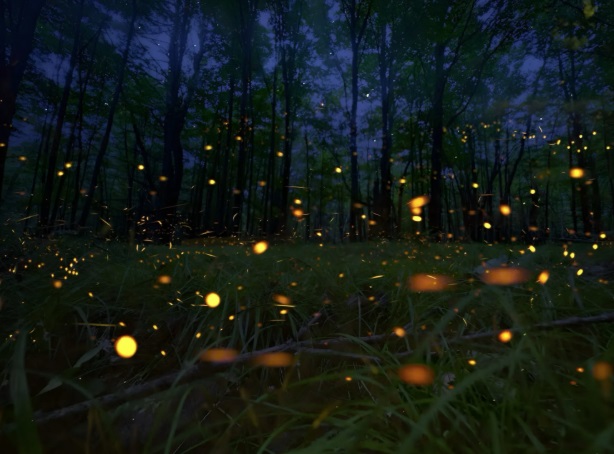
Figure: Fireflies blinking on a summer night create a living light show. These small beetles produce light through a highly efficient chemical reaction in their abdomens, resulting in an enchanting bioluminescent display that has fascinated humans for centuries. Fireflies use their gentle flashes primarily to communicate and attract mates in the darkness. The ethereal beauty of their synchronized glow is not just a random quirk of nature, but a phenomenon that invites deeper reflection on how such biological artistry came to be.
Biologically, a firefly’s glow is produced by mixing a chemical called luciferin with oxygen and an enzyme, luciferase, in a specialized abdominal light organ. Remarkably, this reaction is almost 100% efficient in emitting light – it generates virtually no heat nps.gov. (For comparison, an old-fashioned incandescent bulb wastes about 90% of its energy as heat, emitting only 10% as light nps.gov.) In a very real sense, the firefly’s lantern is more elegantly engineered than our own early light bulbs. Why would a small insect evolve such an advanced biochemical capability? The standard evolutionary answer is that it served survival functions: communication and defense. Indeed, fireflies use flashes to find mates – each species has a unique flash pattern, a kind of Morse code that helps males and females of the same species recognize each other in the dark nps.gov. In some species, females respond with their own timed glimmer, completing a silent dialogue of light. The flashes can also warn predators: many fireflies contain bitter-tasting chemicals, and a frog that has once swallowed a firefly often learns to avoid those that advertise themselves with a bright flash. In evolutionary terms, the firefly’s glow likely began as a warning signal (a form of aposematic display).
Fascinatingly, recent scientific sleuthing suggests an even deeper origin for firefly luminescence. Genetic studies indicate that fireflies have been carrying the genes for light production for a very long time – the oldest known firefly fossils with light organs date to around 100 million years ago, in the mid-Cretaceous period phys.org. That means the ancestors of today’s fireflies were glowing amid the age of dinosaurs. Why did they start glowing? A 2024 genomic analysis upended the old hypothesis that luminescence evolved solely to help fireflies signal their toxicity. It found that the light trait appeared before the chemical toxins – implying that the first fireflies might have glowed for a different reason scitechdaily.com. One idea is that the original function was to help handle oxidative stress in cells (since luciferin has antioxidant properties); in other words, the firefly’s distant ancestors may have evolved a light-producing chemistry as a physiological aid in an oxygen-rich environment, and only later was that glow co-opted for communication and defense scitechdaily.comscitechdaily.com. Over time, what began perhaps as a faint glimmer inside a primitive beetle became a fully developed language of light for the firefly family.
Whatever its beginnings, the firefly’s bioluminescence was eventually refined by natural selection into a sophisticated signaling system. Today, there are over 2,000 firefly species, each with its own pattern of flashes. Some blink in single pulses, some in double flashes, others in long glows or rapid flickers. Notably, in certain regions like the forests of Tennessee, synchronous fireflies coordinate their blinking in unison – an entire woodland will pulse on and off together, as if choreographed. The species Photinus carolinus in the Great Smoky Mountains is famous for this rare ability, transforming patches of forest into a flickering spectacle for a few nights each year nps.gov. Park rangers now manage this high-demand viewing opportunity with a lottery system to limit the crowds, so that a lucky few can witness the magic without harming the habitat nps.gov. One cannot help but marvel at the fact that nature produces such theater. The synchronous display, in particular, has no obvious benefit beyond mating: biologically, the males flash together to impress females, but the effect of it is a breathtaking light show that dazzles human observers. It prompts the question: did blind evolution “accidentally” stumble on this beauty, or is there a deeper reason behind it?
Consider that fireflies didn’t have to evolve this trait. Many other nocturnal insects find mates using smells or sounds. Fireflies could have remained dark, like most beetles, and lived perfectly well. Yet over immense spans of time, here we have tiny creatures that turn chemical energy into cool, living light – filling summer nights with a gentle carnival of floating sparks. In the worldview of faith, this is not interpreted as an irrelevant accident; it is seen as part of a pattern. Nature is beautiful in excess – often beyond what strict survival needs would seem to require. As one writer observed, if nature were truly blind and random, it “should be tasteless – devoid of the patterns, colors, and joys that we call beautiful.” Yet our world is “saturated with beauty at all levels” thequran.love. This stark contrast “invites an inference: perhaps the world is not blind after all, but rather the work of an Artist.” thequran.love In other words, the lavish beauty we see – in dancing firefly lights, in radiant flowers, in birdsong – far exceeds mere utility. Such “unnecessary” splendor is, for a believer, highly meaningful: it is a kind of signature left by the Creator, a deliberate flourish to signal His presence. The firefly’s glow, in this view, is more than a mating signal or a predator warning; it is one of the countless ayāt (signs) woven into nature, inviting us to wonder and pointing beyond itself.
Epilogue: The Light That Guides
In the end, the journey of understanding how beauty leads to God brings us back to a simple observation: there is far more beauty, order, and coherence in the world than a purely random universe would likely produce. This realization aligns with classical arguments for God’s existence. Philosophers speak of the cosmological argument, noting that the very existence of a finely ordered universe points to a necessary Being as its source. Scientists speak of the fine-tuning of physical laws – for example, if the fundamental constants of nature (like the strength of gravity or the charge of the electron) were even slightly different, life as we know it would be impossible. As Nobel laureate Steven Weinberg put it, “Life as we know it would be impossible if any one of several physical quantities had slightly different values.” thequran.love Many have interpreted this astonishing convergence of “just-right” conditions as evidence of purposeful calibration rather than chance. The Qur’an anticipated this line of reasoning in its own poetic way. Over 1400 years ago it posed a challenge: “[God] created seven heavens in layers. You do not see in the creation of the Most Merciful any inconsistency. So look again: do you see any flaw?” (Qur’an 67:3). After directing the skeptic to look repeatedly, it concludes: “your vision will return to you humbled and exhausted” (67:4) thequran.love. In other words, the more deeply one examines the universe, the more one perceives its exquisite order – there are no gaps or cracks in the overall design. From the macro-scale of galaxy clusters down to the micro-scale of a firefly’s enzymes, creation manifests a delicate balance and purpose.
For a scientifically literate believer, theories like guided evolution offer a harmonious framework to embrace these insights. They allow us to say: yes, species arose through evolutionary change, but this was not a series of fortunate accidents – it was the unfolding of a plan. Millions of years of evolution produced not only brains and survival machines, but also symmetry, song, color, and light. In the Quranic view, the natural world is full of signs meant to draw our attention. The diversity of our languages and colors, the “varied hues” of plants, the alternation of night and day – “in these are signs for those who ponder,” says the Qur’an (6:99) thequran.love. Such phenomena “serve as the most eloquent witnesses” to God’s existence, unity, and supreme artistry thequran.love. The firefly’s small lantern, too, can be understood as one of those eloquent witnesses. When we see its light, we are seeing more than an insect’s trick; we are, in a sense, seeing a tiny reflection of the divine Light that suffuses the universe.
Our exploration began with the question of beauty and ends with a renewed sense of wonder. The lights of the firefly and the lights of the stars both guide us – not physically as a lighthouse would, but intellectually and spiritually toward transcendence. They stir in us the intuition that there is meaning woven into the world. Rather than being deceived by nature’s beauty, we may be meant to be enlightened by it. The world’s countless beauties are like lamps along a trail, leading the sincere seeker to the Source of all light. In the words of the Qur’an, “Our Lord, You have not created this in vain, glory be to You!” (3:191). Recognizing that truth, we can affirm that beauty leads to God – and that even the evolutionary tale of a firefly can be a chapter in a divinely guided story. Each flicker in the dark whispers that there is an Author of this “perfected” creation thequran.love, and to those who listen, it offers guidance far beyond its small glow.
Sources:
- Zia H. Shah, MD, “Beauty in Nature as a Path to God: An Islamic Perspective,” The Glorious Quran and Science, April 11, 2025 thequran.love thequran.love.
- Ferris Jabr, “How Beauty Is Making Scientists Rethink Evolution,” The New York Times Magazine, Jan 2019 (quoted in The Muslim Times, Oct 7, 2020) themuslimtimes.info themuslimtimes.info.
- Zia H. Shah, MD, “Guided Evolution and the Beauty of Butterflies: Commentary on Qur’an 32:7,” The Glorious Quran and Science, Oct 28, 2025 thequran.love thequran.love.
- Zia H. Shah, MD, “Aesthetic Transcendence: How Beauty Reveals the Divine,” The Glorious Quran and Science, Oct 29, 2025 thequran.love thequran.love.
- Chengqi Zhu et al., “Firefly toxin lucibufagins evolved after the origin of bioluminescence,” PNAS Nexus, vol. 3, no. 6, 2024 (summarized in SciTechDaily) scitechdaily.com scitechdaily.com.
- Chinese Academy of Sciences, “Cretaceous fireflies reveal early evolution of insect bioluminescence,” Phys.org news, Sep 26, 2024 phys.org.
- National Park Service (U.S.), “Synchronous Fireflies – Great Smoky Mountains NP,” updated 2025 nps.gov nps.gov.
- The Holy Qur’an, translated by Abdullah Yusuf Ali (3:191, 6:99, 32:7, 67:3–4)thequran.love thequran.love.
- Ard A. Louis et al., “Evolutionary Probability and the Role of Symmetry in Biology,” University of Oxford, 2020 (as cited in The Glorious Quran and Science) thequran.love thequran.love.
- Steven Weinberg, in “Life in the Universe,” Scientific American, 1994 (as quoted in The Glorious Quran and Science) thequran.love.




 The Glorious Quran and Science
Leave a comment