
Presented by Zia H Shah MD
Quantum entanglement is the phenomenon where two or more particles become linked such that the state of one instantaneously correlates with the state of the other, no matter how far apart they are. Einstein famously called this “spooky action at a distance,” expressing doubt that anything could influence another particle faster than light. Modern experiments have since confirmed that entangled particles do exhibit correlations essentially instantaneously over large distancesnewatlas.comspinquanta.com. This does not mean we can send usable information faster than light – rather, quantum theory forbids using entanglement alone to transmit messages, preserving Einstein’s relativityen.wikipedia.orgbigthink.com. Below, we explore the evidence for entanglement’s seemingly instantaneous effects, the mainstream and alternative explanations proposed for how entanglement works, and practical applications of long-distance entanglement in communication and teleportation.
Experimental Evidence: Does Entanglement Act Instantaneously?
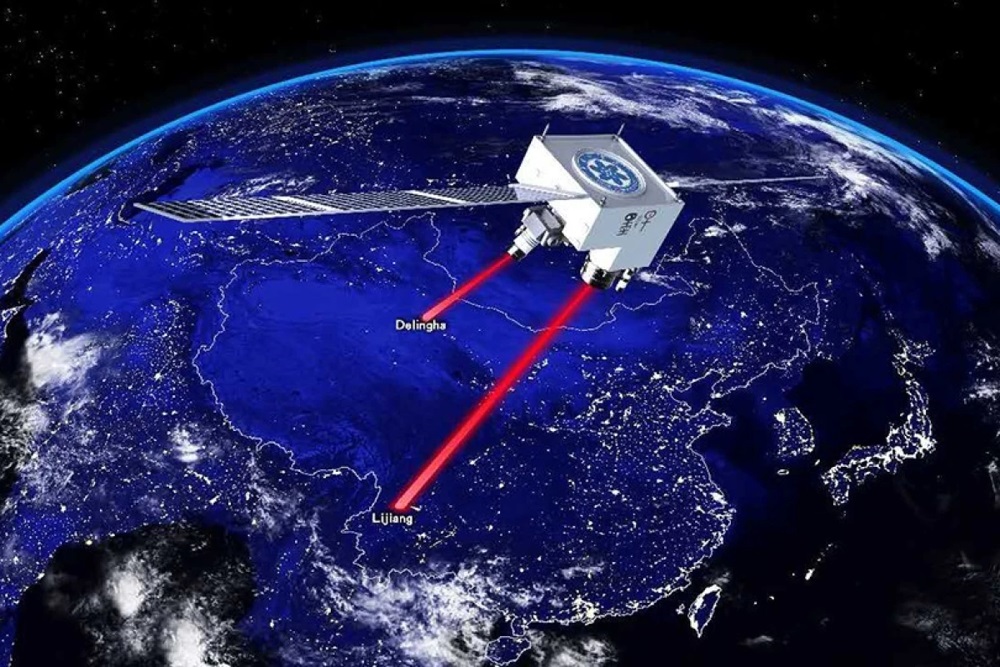
Extensive tests show that when one entangled particle is measured, the other particle’s state is correlated immediately, even if separated by kilometers or morenewatlas.com. In 2017, for example, the Micius satellite was used to entangle photons and send them to two ground labs 1,200 km apart; measurements upheld quantum predictions, indicating distance made no difference in the entanglement correlationnewatlas.comen.wikipedia.org. Anton Zeilinger and colleagues had earlier demonstrated entanglement over 144 km between Canary Islands, and through fiber-optic links over tens of kilometers, again finding that entanglement is not limited by distancespinquanta.com. As technology improved, experiments pushed these limits further, culminating in the satellite tests that effectively showed “spooky action” works even on a continental scalenewatlas.com.
One stringent test by Juan Yin et al. measured whether any signal might be linking entangled photons ~15 km apart. They found that if a hypothetical influence traveled between the particles, it would need to do so at at least 10,000 times the speed of light (based on timing the synchronized measurements)newatlas.com. In other words, no slower-than-light signal could explain the observed instant correlation. This suggests the entanglement effect is either truly instantaneous or propagates at an undetectably high speed – essentially “as close to infinitely fast as we can measure”newatlas.com. Crucially, even with these massive speeds, no usable information travels in this process. The randomness of quantum outcomes means that while the measurement results are correlated, neither party can control the outcome to send a message to the other. All known schemes to exploit entanglement for faster-than-light communication have failed, consistent with fundamental theory: no information can be exchanged superluminallybigthink.combigthink.com. Thus, experimentally, entanglement acts as if distance doesn’t matter, instantaneously establishing correlations, but without violating causality or relativity.
Mainstream Explanation: Quantum Nonlocality Without Communication
Mainstream quantum physics accepts that entanglement is intrinsically nonlocal, meaning entangled particles behave as one system even when separate in spacenewatlas.comnewatlas.com. When two particles are entangled, their joint quantum state cannot be factored into independent states – any measurement on one immediately influences the overall state, yielding a correlated outcome on the partner. In the traditional Copenhagen interpretation, this is often described as the wavefunction collapsing instantly across any distance when a measurement is made. While this “collapse” is a useful concept, it is not a physical signal or force; it’s a change in our knowledge of the system. Quantum theory does not provide a mechanism for how the collapse occurs – it simply postulates that the math updates globally and correlations emerge accordingly.
Bell Test Experiments: A major breakthrough in understanding entanglement came with John Bell’s theorem (1964) and subsequent experiments. Bell showed that if hidden local properties (local realism) were governing particles, there was an upper limit to how correlated their measurements could be. Quantum mechanics predicted stronger correlations violating Bell’s inequality. Dozens of experiments (Aspect 1982, and many since) have violated Bell’s inequality, proving that no local realist theory can explain the results – nature’s correlations are indeed nonlocalnewatlas.comspinquanta.com. This doesn’t mean signals fly between particles, but it means any model of reality must allow distant events to be connected in a way classical physics wouldn’t. In fact, the 2022 Nobel Prize in Physics was awarded to Aspect, Clauser, and Zeilinger for these experiments confirming entanglement’s nonlocal predictionsspinquanta.comspinquanta.com.
No-Signaling Principle: Despite quantum nonlocality, standard quantum mechanics strictly respects Einstein’s cosmic speed limit for information. The no-signaling theorem proves that entanglement cannot be used to transmit a message faster than light. Any measurement outcome is fundamentally random, and although the distant partner’s outcome is correlated, you can’t choose what outcome you get to encode a bit of information. Only when the two parties later compare their measurement results (which requires a normal light-speed or slower communication) do the correlations become evident. In essence, quantum mechanics “cheats” locality by having correlations without force or communication. As one source succinctly puts it: entangled states do obey the arcane quantum rules, but no information can ever be exchanged faster than lightbigthink.com. This is how entanglement can appear instantaneous and nonlocal yet not allow any causality violation.
Interpretations: Different interpretations of quantum mechanics describe entanglement in various ways, but all agree on the observable outcomes. For instance, the Many-Worlds Interpretation avoids talking about wavefunction collapse at all. In Many-Worlds, when entangled particles are measured, the universe’s state splits into branches for each outcome – each observer sees a definite result correlated with the other, but there was no single “instantaneous jump” between particles. This way, no signal is needed; the correlation is simply because the two measurements are part of one quantum state that evolves together. Other interpretations (like relational quantum mechanics or objective collapse models) have their own twists, but none re-introduce any slower-than-light mechanism to explain entanglement – the nonlocal correlation is accepted as fundamental. Standard quantum field theory also accommodates entanglement as a natural property of fields: a single field can have entangled excitations in two places, and measuring one part affects the state of the whole field. The mystery remains how nature pulls this off, but mainstream science typically says: “That’s just how quantum reality is”. As Niels Bohr famously suggested, quantum phenomena defy ordinary intuition – those not shocked by entanglement’s implications “cannot have understood it” – yet the theory’s predictions work perfectlynewatlas.com.
Alternative and Speculative Models for Entanglement Mechanisms
While the standard quantum framework treats entanglement’s nonlocality as a given, several physicists have explored alternative explanations or deeper mechanisms. These speculative models aim to demystify how entangled particles coordinate their outcomes across vast distances. Below are a few prominent ideas and how they propose to explain entanglement:
- Pilot-Wave Theory (de Broglie–Bohm): A deterministic hidden-variable theory in which particles have well-defined positions and velocities, and a guiding pilot wave (the wavefunction) orchestrates their motion. In pilot-wave theory, when particles are entangled, they share a single, connected wavefunction that extends across space. A measurement on one particle instantly influences the guidance of the other because the pilot wave links them nonlocallyen.wikipedia.orgen.wikipedia.org. Essentially, the “influence” travels through the pilot wave, which permeates both particles’ locations. This theory explicitly involves faster-than-light connections (hence it is a nonlocal theory) but remains consistent with the no-signaling theoremen.wikipedia.org. That is, even though the pilot wave transmits correlations instantaneously, it still cannot be used to send messages (the theory reproduces all of standard quantum mechanics’ predictions, including no FTL communication). Pilot-wave models provide an intuitive (if mathematically complex) picture of entanglement: the particles are like puppets connected by invisible quantum strings (the wave), so pulling one’s string instantly affects the other. The cost of this clarity is giving up locality – nature must have a preferred frame or other structure to allow the instantaneous pilot-wave connection.
- Superdeterminism: This proposal takes a very different tack – it denies that any mysterious long-distance influence is needed at all by suggesting that everything (particle properties and even our choices of what to measure) was determined in advance in a correlated way. Superdeterministic models say that when we perform an entanglement experiment, the universe has “conspired” such that the detector settings and the particle pair’s hidden variables are not independent. In other words, the reason entangled particles seem to coordinate their answers is because they were always set up to give matching outcomes; the experimenters’ choice of measurement angle isn’t truly free but correlated with the particles’ states from the start. This avoids any need for a signal between distant particles – no spooky action, since the results were pre-synchronized like a rigged deck of cards3quarksdaily.com. While this idea can in principle reproduce quantum statistics, it requires us to abandon the assumption of “free will” (or, more formally, the statistical independence of measurement settings). Superdeterminism remains highly controversial and largely untested. Critics argue that it undermines the scientific method (if everything is predestined including our experiments, can we trust conclusions?), hence it’s a fringe view. Its advocates counter that it demystifies entanglement by removing the need for instant influence, at the price of a universe where nothing is truly independent. So far, no compelling superdeterministic model has both matched quantum theory and remained palatable to mainstream scientists, but research and debate continue3quarksdaily.com.
- Extra-Dimensional Connections (Wormholes and ER=EPR): An intriguing modern idea posits that entangled particles might be connected by structures outside our familiar 3D space. The ER = EPR conjecture (proposed by physicists Maldacena and Susskind) suggests that every entangled pair of particles could be connected by a tiny Einstein-Rosen bridge – essentially a quantum wormhole. In this picture, “spooky action at a distance” is not really traveling across normal space at all, but through a shortcut in another dimension or through spacetime itself. If two particles share a wormhole, an action on one end might affect the other end without needing to traverse the normal space between – hence it would appear instantaneous to usreddit.comnewatlas.com. However, these wormholes are hypothesized to be non-traversableen.wikipedia.org. That means you still cannot send a signal or object through them (they would collapse or not carry usable information), which neatly keeps relativity safe – no violating the light-speed limiten.wikipedia.org. The extra-dimensional idea is highly theoretical and currently without experimental support, but it’s fascinating because it attempts to unify quantum mechanics with gravity. If ER=EPR is true in some form, entanglement and spacetime geometry would be two sides of the same coin – the universe could be “stitched together” by quantum entanglementen.wikipedia.org. This remains speculative, but ongoing research in quantum gravity is probing whether such connections might be real or useful for understanding the quantum structure of space and time.
Each of these models handles the core facts – entanglement correlations and no FTL messaging – in different ways. To summarize their approaches compared to standard quantum theory, consider the comparison below:
| Theory / Interpretation | How Entanglement Correlations Occur | Nonlocal Influence? | Notes |
|---|---|---|---|
| Standard Quantum Mechanics (Copenhagen & related) | No mechanism beyond the quantum wavefunction. Measurement causes a global wavefunction collapse that instantaneously correlates outcomes across any distance. It’s treated as a fundamental property of nature, not via a force or signalspinquanta.com. | Yes (correlations are nonlocal), but no signaling is possibleen.wikipedia.org. | Proven by countless experiments. Relies on the no-signaling theorem to respect relativity. The “instantaneous” effect is real but has no classical analogue (it’s not a radio signal or field). |
| Many-Worlds Interpretation | No collapse occurs at all. Entanglement means the particles (and observers) become part of one quantum state that encompasses multiple outcomes. When a measurement is made, the world branches into outcomes – each branch has correlated results. No need for communication; both outcomes were encoded in the joint state from the start. | In our branch, correlations appear as if nonlocal, but fundamentally all of quantum evolution is local in the bigger multi-world wavefunction. (No explicit FTL influence – each branch separately obeys quantum laws.) | An interpretation of quantum mechanics rather than a new theory. It removes the mystery of instantaneous collapse by saying it never happens – all outcomes exist. Still, observers see effective nonlocal correlations when comparing results after the fact. |
| Pilot-Wave (Bohmian Mechanics) | A hidden pilot wave guides particles. For entangled particles, there is one unified wavefunction; a measurement on one particle instantly affects the guidance of the other through this wave. The particles have definite states, and the wave transmits correlation deterministicallyen.wikipedia.org. | Yes – explicitly nonlocal. The pilot wave connects entangled particles across space, so an influence at one point can instantaneously affect another point via the wave. | Provides an intuitive mechanism for entanglement at the cost of reintroducing a preferred frame or universal connectivity. It reproduces all quantum predictions (including no FTL communication, due to subtleties of quantum statistics)en.wikipedia.org. Not yet extendable to fit neatly with relativity (a challenge for proponents). |
| Superdeterminism | All outcomes and measurement choices are pre-correlated by hidden variables set in the initial conditions of the universe. Entangled particles produce matching results because both the particles and experimenters’ choices were orchestrated in sync from the start3quarksdaily.com. No dynamic change at measurement – the correlation was “baked in.” | No need for any influence at measurement time (local or nonlocal). The universe’s initial setup ensures detectors and particles are aligned to give correlated outcomes. | Avoids nonlocality, but at a steep price: it abandons the assumption that experimenters have free, independent choices. Highly controversial and not experimentally differentiated from standard QM yet. Seen by most as a loophole in Bell’s reasoning that is logically possible but implausible or unproductive3quarksdaily.com. |
| Extra-Dimensional/Wormhole (ER=EPR) | Entangled particles are connected by a wormhole or hidden spatial shortcut. Instead of sending a signal through normal space (which would require FTL speed), the correlation is achieved through this tiny bridge in spacetime (or higher dimension) that directly links the particlesreddit.com. To an observer in 3D space, it looks like instantaneous influence, but in theory the particles are adjacent in the higher-dimensional sense. | Not in ordinary space. In our 3D view it’s nonlocal, but the wormhole idea implies there is a path (through extra dimensions) where it’s actually local. Importantly, any such wormhole must be non-traversable, meaning you cannot actually send signals or objects through iten.wikipedia.org. | A cutting-edge theoretical idea bridging quantum physics and general relativity. No experimental support so far. If true, it ties quantum entanglement to the geometry of spacetime – the universe might use hidden pathways to correlate particles. Even so, relativity remains safe because nothing useful can travel through the wormhole faster than light (it’s more like a shared quantum state than a tunnel for messages)en.wikipedia.org. |
The above models illustrate the lengths to which physicists have thought about “how entanglement works” behind the scenes. As of 2025, no alternative model has outperformed or replaced standard quantum mechanics, but research continues. Mainstream science sticks with quantum theory’s built-in nonlocality as the simplest explanation, even if it’s weird. Still, these speculations are valuable: they could one day lead to new insights or even a deeper theory that explains why quantum mechanics has the features it does.
Practical Applications of Long-Distance Entanglement
Beyond the philosophical and theoretical implications, entanglement across long distances is a key resource for emerging quantum technologies. Because entangled particles share states in perfect unison, scientists can leverage this for tasks impossible in classical systems. Here are some practical applications:
- Quantum Teleportation: Quantum teleportation is a protocol that uses entanglement to transfer a quantum state from one location to another without moving the physical particle itself. Two parties (often called Alice and Bob) first share a pair of entangled particles. Alice then performs a joint measurement on her entangled particle and the qubit whose state she wants to send. This measurement entangles those two and collapses them into a correlated outcome, also instantly projecting Bob’s distant particle into a state related to the original qubit. Alice’s measurement gives a random outcome which she sends to Bob via a normal classical channel (at light speed). Using that information, Bob applies a corresponding operation to his particle, which transforms it into an exact copy of the original qubit state that Alice teleported. No Faster-Than-Light travel occurs – the classical communication is essential to complete the process, ensuring causality is respected. In practice, quantum teleportation has been demonstrated over increasing distances: on fiber optics in labs, across city-wide networks, and notably in 2017, between a ground station and the Micius satellite (over 1,200 km)en.wikipedia.org. This was a landmark achievement: a photon’s quantum state was reconstructed far away almost instantaneously (with classical relay of a few milliseconds). Quantum teleportation could be vital in future quantum computing networks, allowing transfer of qubit states between distant quantum processors. It’s also a key component in quantum repeater schemes to extend quantum communication – by teleporting entanglement itself from one link in a chain to the next (entanglement swapping), one can span arbitrarily long distances.
- Quantum Communication and Cryptography: Long-distance entanglement enables ultra-secure communication methods. One well-developed application is Quantum Key Distribution (QKD), particularly protocols that use entangled photon pairs to generate encryption keys. In an entanglement-based QKD protocol (e.g. the Ekert scheme), if two parties each receive one photon from many entangled pairs, they can perform measurements and later compare subsets of results to derive a shared random key. The security comes from the fact that any eavesdropper attempting to intercept or measure the entangled photons will disturb the system in a noticeable way (breaking the entanglement correlations). Entanglement-based QKD has been tested over hundreds of kilometers of fiber and was also demonstrated via satellite: Micius allowed China and Austria to conduct the first intercontinental quantum-encrypted video call in 2017, generating secret keys from entangled photons across 7,600 kmen.wikipedia.org. Beyond QKD, entanglement is central to the idea of a quantum internet – a network where qubits are transmitted securely and quantum information (like teleportation results or distributed computations) can be shared globally. By reliably distributing entanglement between nodes (using satellites or fiber plus quantum repeaters), researchers envision secure communication links that are immune to hacking by any classical meansnewatlas.com. Additionally, entangled signals can synchronize clocks or sensors in different locations with unprecedented precision (quantum-enhanced GPS or interferometry), though these applications are still in experimental stages.
Looking forward, the ability to entangle particles over long distances is fueling the development of quantum networks. Such networks could connect quantum computers in different cities or countries, enabling them to work together or share data in a fundamentally secure way. The challenges are significant – entangled states are fragile and can be lost through interaction with the environment. Technologies like quantum repeaters, which repeatedly entangle and swap states between intermediate nodes, are being developed to overcome loss and extend range. The progress so far – from a few meters in the lab to thousands of kilometers via satellites – shows that “spooky action” is not just a quirky idea, but a usable resource. Quantum entanglement, once doubted even by Einstein, is now engineered for tasks like teleporting information and encrypting data, heralding a new era of communication. As experimental techniques improve, we may yet see near-instantaneous, secure quantum communication spanning the globe – all made possible by the curious nonlocal heartbeat of entanglement.
Sources: Experiments confirming the instantaneous, distance-independent nature of entanglementnewatlas.comspinquanta.com; measured lower bound on entanglement speed >10,000× speed of lightnewatlas.comnewatlas.com; quantum nonlocality and Bell-test evidencenewatlas.comnewatlas.com; pilot-wave and no-signaling in Bohm’s theoryen.wikipedia.org; superdeterminism proposal3quarksdaily.com; ER=EPR wormhole conjecture for entanglementen.wikipedia.org; satellite and long-distance entanglement demonstrationsnewatlas.comen.wikipedia.org; quantum teleportation and QKD applications using entanglementen.wikipedia.orgen.wikipedia.org.





 The Glorious Quran and Science
Leave a comment