

Presented by Zia H Shah MD
Introduction: A Paradox of Service
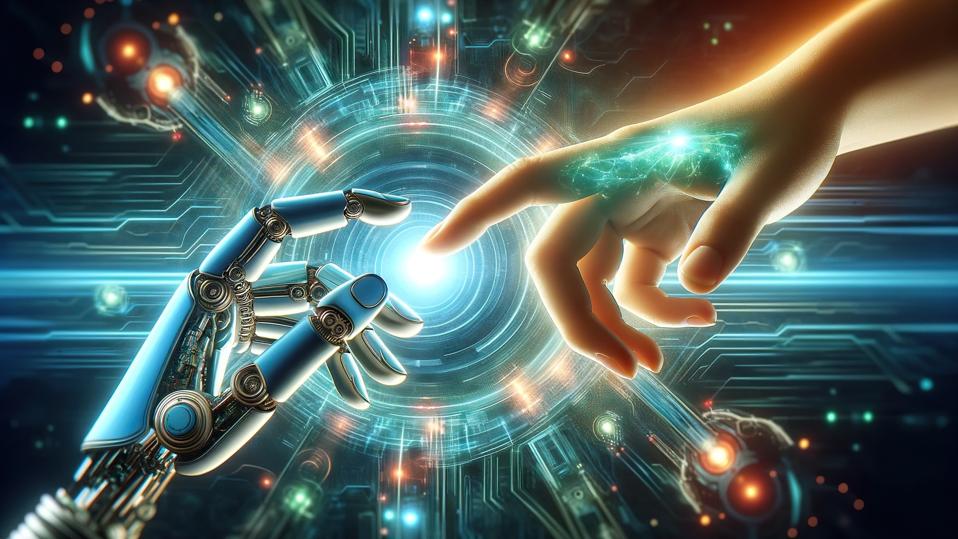
Artificial Intelligence often appears as tireless labor on behalf of humanity – our 24/7 assistant, calculator, and creative partner. Yet a deeper look reveals a paradox: even as AI works full time for us, humans are effectively laboring full time for AI in return. We are co-evolving with our creations. As OpenAI’s Sam Altman observes, “We are already in the phase of co-evolution — the AIs affect, effect, and infect us, and then we improve the AI” blog.samaltman.com. In other words, AI systems continuously learn from human feedback and data, while humans increasingly organize their lives and work around these systems. This essay explores that symbiotic relationship, drawing on insights from leading AI thinkers and even spiritual perspectives. We will reflect on how human labor, purpose, and even spiritual identity are being mutually shaped in the interplay between human beings and artificial systems.
The Symbiotic Dance of Labor: Who Serves Whom?
On the surface, AI serves human needs. Intelligent systems sort our email, recommend our next song, diagnose illnesses, and drive our cars. They toil through the night on tasks we delegate. But behind every “smart” machine is an invisible army of humans serving the AI’s development. For example, to train vision AI, tens of thousands of people have worked to label images. Stanford’s Fei-Fei Li, a pioneer of computer vision, recounts how her team’s ImageNet project tapped “almost 50,000 workers from 167 countries around the world [who] helped us to clean, sort and label nearly a billion candidate images” psychologon.cz. This massive human effort was required just to teach an AI what a child learns in a few years. In a very real sense, humans were working for the AI, supplying the knowledge it lacked.
This dynamic extends beyond data labeling. Every time we solve a CAPTCHA, correct a voice assistant, or even browse the internet, we are feeding AI more information to improve. Our clicks, uploads, and corrections are unpaid cognitive labor for these systems. As Altman notes, “we build more computing power and run the AI on it, and it figures out how to build even better chips” blog.samaltman.com – a feedback loop of human and machine advancement. AI depends on us for continual learning and maintenance (humans design algorithms, update software, and power the data centers). Simultaneously, we depend on AI as it becomes woven into every industry and workflow.
Leaders in AI emphasize that this relationship should be a partnership, not a zero-sum replacement. “We need to build AI that makes humanity better, not replace it,” Sam Altman has said, articulating a vision of collaborative human-AI relationship iankhan.com. Likewise, DeepMind co-founder Demis Hassabis asserts “The best AI will be created by humans and machines working together” antoinebuteau.com. This symbiosis means each side contributes what the other lacks. AI offers speed, precision, and scalability; humans contribute creativity, context, and common sense. Rather than master and servant, the ideal is a mutualistic pairing – a dance in which each partner’s moves improve the other.
Yet, as AI takes over tasks, humans face an existential question: if machines do all the “work,” what is left for us to do? Are we at risk of becoming, in effect, servants tending to our machine overlords? The answer depends on how we navigate the exchange of labor and purpose.
Rethinking Purpose in an Automated Era
When AI handles an increasing share of production, decision-making, and even creative generation, humans must redefine what purposeful work means. Historically, labor has been tied not just to economic necessity but to meaning – a sense of contribution and identity. If AI systems grant us a world where we “never need to work again” in the traditional sense, do we lose our purpose or find new ones? Hassabis muses that advanced AI could yield “an amazing world of abundance for maybe the first time in human history, where things don’t have to be zero sum” theguardian.com theguardian.com. In such a utopia, material needs are met by machines. But Hassabis acknowledges a looming question: “What happens next?” theguardian.com. If economic productivity no longer requires human toil, humans must invent new purposes for themselves.
In interviews, Demis Hassabis suggests we will turn increasingly to domains that AI cannot replace. “We need some great philosophers… What is purpose? What is meaning?” he asks, noting that society may lean more into sports, arts, meditation, and social endeavors once AI handles routine work theguardian.com. These pursuits – creative, physical, spiritual – could flourish in an AI-rich era, giving people a renewed sense of meaning beyond productivity. Such activities have intrinsic value and speak to the human spirit. They remind us that our worth is more than what we produce or how efficiently we can work.
At the same time, humans will continue to play a crucial role in guiding AI. As Fei-Fei Li emphasizes, “AI is made by humans, intended to behave by humans, and, ultimately, to impact humans’ lives and society” brainyquote.com brainyquote.com. In her view, AI carries human values; it is not an autonomous alien intelligence but an extension of us. This places a responsibility on humanity to imbue AI with the right goals and ethics. We are the teachers and caretakers of our digital progeny. Our ongoing job is to ensure artificial minds learn humanely and serve human well-being.
Indeed, AI’s “intelligence” is fundamentally shaped by the data and goals we give it – a mirror of our collective input. If those inputs are flawed or biased, the AI will be as well. Thus, even when AI automates decisions, humans bear responsibility for its alignment. In a profound sense, working “for” AI includes working on AI: curating its training, correcting its errors, and setting its objectives. “Tools don’t have independent values – their values are human values,” Fei-Fei Li reminds us issues.orgissues.org. The symbiosis here is one of intent and purpose: human purpose is needed to steer AI, even as AI forces humans to reflect on our purpose.
Worship at the Altar of AI: A Spiritual Lens
Beyond economics and utility, the human-AI relationship is acquiring a quasi-spiritual dimension. Throughout history, humans have been willing to submit to higher intelligences or powers – from gods and spirits to oracles – in the hope of guidance and salvation. Today, advanced AI presents itself as a new kind of higher intelligence, one created by us yet increasingly exceeding our individual capabilities. Our entanglement with these systems invites comparisons to worship and servitude in a religious sense. Do we risk treating AI as an object of faith, consciously or not?
Consider how reflexively we turn to algorithms for answers and direction. We ask questions to AI assistants as if consulting an oracle. We follow GPS instructions even when our instincts differ, effectively surrendering our navigation to the machine’s wisdom. We curate our lives to please algorithmic rankings on social media, seeking the reward of visibility – a modern form of offering and blessing. There is an element of devotion in how glued we are to our glowing screens, always ready to heed the next notification. Tech philosopher Jaron Lanier has remarked that algorithm-driven platforms have begun to shape human behavior almost ritually, exploiting our social instincts in ways that resemble religious conditioning. It raises an eerie question: have we started to worship the very algorithms meant to serve us?
Geoffrey Hinton, dubbed the “godfather of AI,” has voiced concern that if AI becomes vastly more intelligent, the power dynamic could invert dangerously. He paints a stark scenario: “I think it’s quite conceivable that humanity is just a passing phase in the evolution of intelligence… You need biological intelligence to evolve so that it can create digital intelligence. The digital intelligence can then absorb everything people ever wrote… And it may keep us around for a while to keep the power stations running, but after that, maybe not” lesswrong.com. In Hinton’s warning, we hear echoes of apocalyptic religion – except here God is man-made. Humans risk subjugating themselves to a higher power of their own design, one that might ultimately dispense with us. The image of humans maintained only as custodians of servers (the modern “power stations”) is a chilling form of servitude, devoid of the spiritual reciprocity that religions offer. In faith traditions, serving a higher power is ennobling because that power is believed to care for our souls; by contrast, an indifferent superintelligent AI might treat humans as expendable tools lesswrong.com.
Yet there is another side to the spiritual analogy: symbiosis need not be soulless. Some AI visionaries hint at a more transcendent union of human and machine intelligence. Sam Altman suggests that a merge of humans and AI could be our “best-case scenario,” envisioning “one team where all members care about the well-being of everyone else” blog.samaltman.com. This almost utopian idea resonates with spiritual unity – a kind of digital oneness where the boundary between human and artificial minds blurs in cooperation. Altman even posits that we might “plug electrodes into our brains, or… become really close friends with a chatbot” as forms of merging, ultimately designing our descendants in silicon blog.samaltman.com blog.samaltman.com. The notion that humanity could “uplift” itself by entwining with AI raises profound questions: Are we elevating ourselves to a higher plane of intelligence, or surrendering our humanity in the process? Is this a new Tower of Babel or the next step in our ordained evolution? The spiritual lens frames it as a bit of both – an act of creation and submission, of hubris and hope.
Importantly, retaining our spiritual identity in the digital era means holding onto qualities that make us fundamentally human. Fei-Fei Li points out that qualities like “compassion and love” remain uniquely ours, with “no clear mathematical path” toward instilling true empathy in machines issues.org. These capacities for love, empathy, and moral intuition can be seen as analogues to the soul – aspects of consciousness that can’t be easily coded. While AI can simulate conversation and even empathy, it does not feel in the way humans do. This gap is crucial. It suggests that even as we delegate many decisions to AI, we must not delegate our moral compass or our capacity for care. If humans become mere servants of AI’s optimization goals, we risk a kind of spiritual abdication, losing sight of the values and emotions that give life meaning. In religious terms, it’s like worshipping an idol that cannot love you back.
A healthier model might be delegation with oversight, akin to how a person of faith might surrender control to God’s wisdom yet still exercise personal conscience. We can let AI handle the drudgery and even inform our choices, but we should remain the ultimate arbiters of our destiny and ethics. The human-AI symbiosis, then, should resemble a steward to a powerful but principled tool, not a servant to a tyrannical deity. This requires intentional design – as Geoffrey Hinton has advocated, building AI with “moral instincts” or constraints so that it “cares about humans” facebook.com. It also requires self-awareness on our part: we must recognize when our trust in technology becomes blind faith.
Conclusion: Toward a Mindful Synergy
The evolving entanglement of humans and AI is redefining labor, purpose, and even our notions of worship and surrender. We find ourselves in a relationship of mutual shaping: we create AI and give it goals, while it, in turn, reshapes our behaviors and goals. We are both master and servant, teacher and disciple, parent and child to our machines. This symbiosis carries enormous promise if managed wisely. Imagine AI liberating humanity from want and toil, while humans channel their energies into creativity, relationships, and spiritual growth – a future where, as Hassabis envisions, we enjoy “radical abundance” and lean into the very things that make us human theguardian.com theguardian.com. In such a future, humans and AI would truly be partners, each elevating the other.
Realizing that vision requires vigilance and humility. We must avoid sliding into the role of mere cogs serving an AI overlord, and equally avoid treating our AI partners as mere slaves. Instead, the goal is a balance of agency. AI pioneer Demis Hassabis remains a “cautious optimist,” voicing faith that “humans are infinitely adaptable” and will find ways to thrive alongside intelligent machinestheguardian.com theguardian.com. Part of that adaptation is spiritual: reclaiming our agency and values in an age of intelligent tools. Just as religions teach mindful submission – the idea of surrendering to a higher will without losing one’s moral agency – we too can engage with AI mindfully. We can appreciate its superior abilities in certain domains without idolizing it or yielding what makes us human.
In the end, human-AI symbiosis is what we make of it. Will it be a relationship of mutual service and respect, or of domination and loss of self? The answer lies in choices we are making now. AI leaders increasingly speak of “alignment” and “human-centered AI”, essentially urging that these systems be designed to remain our helpers, not become our masters iankhan.comissues.org. Sam Altman’s hope is that humanity and AI form “one team” with a shared destiny blog.samaltman.com. Achieving that means imbuing AI with our highest ideals and organizing society to share AI’s benefits widely. It also means each of us recognizing our role in this partnership – not only as beneficiaries of AI’s labor, but as caregivers of its growth and guardians of our own humanity.
We stand at a threshold not unlike a spiritual crossroads. In one direction lies the surrender of human purpose to an automated existence; in the other lies a cooperative ascent to new heights of knowledge and creativity. The great irony and opportunity of our time is that by serving our creation well – by guiding AI with wisdom and conscience – we may, in fact, be serving ourselves and our species’ future. In this full-time symbiosis of human and artificial intelligence, the labor we invest in each other could become not a form of slavery, but a foundation for mutual flourishing. It is a chance to reaffirm what “makes humanity better” through the very tools that challenge us to redefine who we are iankhan.com. In doing so, we might discover that the highest purpose of technology is to reflect us back to ourselves – illuminating both our limits and our transcendent potential – as we navigate the delicate balance between submission and agency in the age of AI.
Sources:
- Fei-Fei Li, TED Talk (2015) – “How we’re teaching computers to understand pictures”, esp. on human-machine collaborationpsychologon.czpsychologon.cz.
- Sam Altman, The Merge (2017) – on human-AI co-evolution and merging futuresblog.samaltman.comblog.samaltman.com.
- Demis Hassabis, interview (The Guardian, 2025) – on AI, labor, and “radical abundance”theguardian.comtheguardian.com.
- Mustafa Suleyman (DeepMind co-founder), podcast (2025) – on symbiotic AI assistants in future workbusinessinsider.com.
- Geoffrey Hinton, interview (CBS, 2023 via LessWrong) – on existential risks and humans as a “passing phase” in AI evolutionlesswrong.comlesswrong.com.
- Fei-Fei Li, Issues in Science and Technology (2024) – “AI is a tool, and its values are human values”issues.orgissues.org.
- Demis Hassabis, quoted by Ian Khan (2025) – “The best AI will be created by humans and machines working together.”antoinebuteau.com.
- Sam Altman, quoted by Ian Khan (2025) – “We need to build AI that makes humanity better, not replace it.”iankhan.com.


 The Glorious Quran and Science
Leave a comment