
Wisdom and Monotheism: Surah Luqman emphasizes that true wisdom (ḥikmah) lies in recognizing God’s oneness (tawḥīd) and shunning shirk (polytheism)quran-wiki.com. It opens by praising the Qur’an as “a book of wisdom, a guidance and mercy for the doers of good” (31:2-3), immediately framing divine revelation as the source of wisdom. Classical exegetes note that God granted Luqman “al-Ḥikmah (wisdom)” (31:12), which they define as deep understanding that manifests in gratitude and right actionsurahquran.com. Luqman’s very first counsel to his son is “O my son, do not associate anything with Allah. Indeed, shirk is a great injustice.” (31:13) – establishing monotheism as the foundation of all wisdomsurahquran.com. The Prophet Muhammad ﷺ even cited Luqman’s words “shirk is a great zulm (wrong)” to explain that the zulm meant in 6:82 is none other than idolatrysurahquran.com. Thus, the surah makes clear that the essence of wisdom (ḥikmah) is to know and worship the One Godquran-wiki.com. Conversely, the folly of unbelief is highlighted: those who reject guidance are often simply “blindly following their forefathers,” a practice the surah repeatedly critiquesquran-wiki.com. In this way, Luqman links wisdom with independent reflection and faith, as opposed to unthinking tradition.
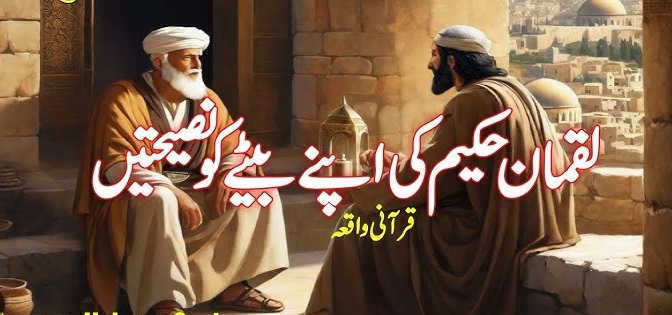
Moral Instruction and Luqman’s Counsel: The centerpiece of the surah is the narrative of Luqman’s advice to his son (verses 13–19), which encapsulates fundamental moral and spiritual teachings. Classical commentators explain that Luqman – identified in tradition as a righteous sage known among the Arabs for his wise sayingsquran-wiki.comarchive.org – imparts timeless counsel in these verses. He begins with the supreme principle of tawḥīd and gratitude to God, and then covers a range of virtuous duties: kindness to parents, consciousness of God’s knowledge, establishing prayer, enjoining good and forbidding wrong, patience, humility in demeanor, and modesty in speech. Notably, the Qur’an itself interjects to reinforce the parent-child theme: “We have enjoined on man goodness to his parents…” (31:14), even while instructing that parental authority does not warrant shirk (31:15). Ibn Kathīr observes how the passage seamlessly pairs rights of Allah with rights of parents – a frequent Quranic couplingsurahquran.com. Luqman’s exhortation “If a deed were the weight of a mustard-seed hidden in a rock…Allah will bring it forth” (31:16) vividly teaches personal accountability and God’s all-encompassing knowledge of even the subtlest acts. This intimate father–son scene is a powerful didactic device: it conveys divine wisdom through a relatable human narrative. As one modern scholar notes, the Qur’an here invokes the figure of “a wise man, named Luqman, whose proverbs…are often quoted” among the people, effectively saying “Now see for yourselves what creed and morals he used to teach”archive.orgarchive.org. In other words, the surah uses Luqman’s persona – familiar to its first audience – to validate the Prophet’s message: the values Islam preaches are the very essence of wisdom that sages have always taught.
Divine Signs and Rhetorical Devices: Alongside its moral instruction, Surah Luqman repeatedly points to the “signs of Allah’s power in creation” as manifestations of divine wisdomquran-wiki.com. After the Luqman narrative, the text invites readers to reflect on the wonders around them: the creation of the heavens “without pillars,” the mountains set on earth, the creatures scattered therein, the rain that brings forth vegetation (31:10-11). All these are “signs (āyāt) for those who contemplate.” The surah’s rhetoric often employs vivid imagery and direct address: “Do you not see that Allah has subjected for you whatever is in the heavens and earth and amply bestowed His favors upon you?” (31:20). It also uses rhetorical questions and contrasts to provoke reflection. For example, verse 31:27 declares that if “all the trees on earth were pens, and the sea (were ink) with seven more seas (added), the words of Allah would not be exhausted” – a striking metaphor underscoring the infinite wisdom behind creationsurahquran.com. Throughout, those who reject this guidance are portrayed in almost pitiful terms. The surah contrasts the humble muhsinīn (righteous) who benefit from the “wise Book,” with the arrogant who turn away. One biting image depicts the scoffer who dismisses revelation: “When Our verses are recited to him, he turns away in pride as if he didn’t hear them – as if there is deafness in his ears” (31:7)surahquran.com. This is immediately followed by an ironic rejoinder: “So give him tidings of a painful punishment.” Such tonal shifts – from compassionate counsel to scathing irony – are among the surah’s effective rhetorical devices.
“Idle Talk” vs. Wise Discourse: In a notable early passage (31:6), the Qur’an censures “lahw al-ḥadīth” – “idle amusements of speech” – that distract people from God’s path. Classical exegesis offers context: “Ibn Jarīr [al-Ṭabarī] said it means all speech that hinders people from seeing the signs of Allah and following His path.”surahquran.com Early commentators mention that a Meccan skeptic (al-Naḍr b. al-Ḥārith) purchased books of legends and hired singing girls to lure people away from listening to the Prophet, thus “purchasing idle tales to mislead (others) from the way of Allah”surahquran.comsurahquran.com. Sayyid Quṭb and others note how this verse sets up a stark contrast: on one side is the Qur’an – “the Best Statement” – that makes believers’ skins shiver in awe, and on the other is frivolous entertainment that deadens heartssurahquran.comsurahquran.com. By juxtaposing these, Surah Luqman urges the audience to choose substance over seduction, wisdom over nonsense. The placement is deliberate: immediately after warning of those who divert with idle talk, the text says “And when Our signs are recited, he turns away in arrogance…”surahquran.com, then pivots to the example of Luqman’s heartfelt admonition. The effect is to throw the beauty of sincere wisdom into relief against the ugliness of vacuous distraction. Classical scholars like Fakhr al-Dīn al-Rāzī highlight this as a moral and literary contrast – the surah moves from condemning empty amusements to celebrating wise counsel, thereby guiding the listener from folly to wisdom.
Structure and Progression: Many scholars discern a careful structure in Surah Luqman, often described as a ring composition or symmetrical arrangement. The surah’s “wise counsel” core (Luqman’s address, v.13-19) is framed by thematic mirrors. The opening (v.1-11) and closing (v.20-34) sections balance each other. In the opening, the Qur’an’s wisdom is affirmed and the traits of the righteous are listed – “those who establish prayer and give zakāt and have certainty in the Hereafter”shamela.ws. The conclusion returns to the Hereafter, warning “O mankind! Fear the Day when no father can avail his son…” (31:33) and asserting that ultimate knowledge rests with God alone: “Indeed, Allah [alone] has knowledge of the Hour, sends down the rain, and knows what is in the wombs…” (31:34). Notably, the surah’s final verse enumerates five domains of the unseen known only to God (the timing of the Hour, rain, what is in wombs, tomorrow’s deeds, and in which land one will die). These correspond to aspects of life and destiny that humans must entrust to divine knowledge – a fitting capstone to a text centered on ḥikmah. The beginning and ending thus form a neat symmetry: the intro celebrates divine wisdom entering human hearts, and the outro reminds us of divine wisdom ultimately encompassing all that is hidden. Modern literary analysts have commented that the surah “begins with…communication between God and man, and ends with an affirmation of God’s all-encompassing knowledge,” forming a ring of thought. The central story of Luqman and his son then stands out as the practical embodiment of the surah’s message: if one lives by God’s guidance, as Luqman did, one partakes in a fragment of His wisdom. In sum, Surah Luqman artfully interweaves its major themes – monotheism, gratitude, moral conduct, and trust in God’s signs – using the narrative of a father’s wise counsel, vivid rhetoric, and a well-proportioned structure to imprint these lessons on the heart and mind.
Links with Surahs Ar-Rum (30) and As-Sajda (32)
Surah Luqman does not stand in isolation; it is flanked in the Muṣḥaf by Ar-Rūm (30) before it and As-Sajda (32) after it. All three are Makkan surahs that share motifs and seem to form a thematic progression. In fact, they belong to a quartet of consecutive surahs (29 Al-‘Ankabūt, 30 Ar-Rūm, 31 Luqman, 32 As-Sajda) that notably all begin with the disjointed letters Alif. Lām. Mīm.quran-wiki.com. Classical scholars like al-Suyūṭī observed this common muqaṭṭa‘āt opener and looked for deeper connections. Indeed, on close reading, Ar-Rūm, Luqman, and As-Sajda are richly interconnected through shared themes of tawḥīd, divine signs, and the fate of those who deny vs. those who believe.
Shared Themes and Motifs: All three surahs insist on God’s oneness and the absurdity of shirk. Ar-Rūm engages the pagan Arabs on their own terms, citing instances of Allah’s sole authority (e.g. giving life, sending rain) and asking rhetorically: “Is there any of your (false) partners who can do any of that?” (30:40). Luqman then reinforces the same truth through Luqman’s exhortation “do not associate partners with God – truly shirk is terrible injustice”surahquran.com. As-Sajda continues the attack on shirk by vindicating the Prophet’s message: “Or do they say, ‘He fabricated it’? Nay, it is the Truth from your Lord” (32:3), and by urging prostration to the one true Creator (hence the name “The Prostration”). Another unifying motif is the “divine signs” (āyāt) in the cosmos and history. Surah Ar-Rūm is especially known for its catalogue of āyāt: “And of His signs is that He created you from dust… And of His signs is that He created for you spouses… And of His signs is the creation of the heavens and the earth and the diversity of your tongues and colors…” (30:20-24). These natural phenomena and human realities are presented as pointers to the Creative Power behind them. Surah Luqman likewise highlights signs in nature: the creation of the skies, mountains, animals, and the alternation of day and night (31:10, 29). It even uses a parable of the sea and trees as ink and pens to indicate the limitless signs/words of God in creationsurahquran.comsurahquran.com. Surah As-Sajda returns to signs of creation and resurrection: it describes the formation of man from clay and fluid, the gift of hearing and sight (32:7-9), and the wonder of how rain revives dead land – “so that you eat of it – will you not then see?” (32:27). In all three surahs, unbelievers are chastised for failing to read these clear signs. A related theme is the Hereafter and accountability, which steadily intensifies across the trio. Ar-Rūm draws comparisons with the life-death cycle in nature: “He brings the dead out of the living and the living out of the dead, and revives the earth after it had died – likewise you will be brought forth (after death)” (30:19) as proof of resurrection. It also foretells a concrete historical vindication – the “Roman” (Rūm) victory after a defeat – as a sign that Allah’s promises come true (30:1-6). Luqman adds the personal dimension of accountability: every small deed, even if hidden “inside a rock”, will be exposed by God’s omniscience (31:16). It warns of the Day when parent and child cannot help each other and “the promise of Allah is true” (31:33). Finally, As-Sajda vividly paints the Afterlife: it shows the believers in humble prostration and vigil in this world (32:15-17), and on the Day of Judgment it shows the wicked hanging their heads in shame before their Lord, begging to be sent back to earthly life when it is too late (32:12-14). In short, Ar-Rūm establishes the reality of resurrection conceptually and even politically (through prophecy), Luqman urges moral preparation for it, and As-Sajda portrays its stark consequences.
Progression and Complementarity: Read in sequence, Surahs 30–32 present a compelling unfolding argument. Surah Ar-Rūm begins with a startling prediction – the defeated Byzantine Romans will triumph in a few years – which indeed came true and thus served as a proof to the Qur’an’s skeptics. The surah uses this and numerous other examples to illustrate Allah’s governance of worldly affairs and His power to resurrect: just as fortunes of nations reverse by His willquran-wiki.com, and lifeless land blooms after rain, so too will Allah revive human beings after death. It ends by consoling the Prophet to be patient and not be disheartened by those “who have no certainty of faith” (30:60)surahquran.com. Surah Luqman then builds on that foundation by addressing the inner response to Allah’s signs. It is as if, after showing the external evidence for the truth, the Qur’an turns to each individual’s conscience: will you embrace wisdom or continue in folly? Thus Luqman condemns the “argumentative” disbelievers who “dispute about Allah without knowledge or guidance” (31:20) and those who prefer idle diversions to the sublime Quransurahquran.comsurahquran.com. In their place, it offers the gentle, persuasive voice of Luqman, whose counsels model the wise way of life under God’s lordship. As Abul A‘lā Maududi notes, Luqman invites the audience to “give up blind imitation” and reflect with “open eyes” on the Prophet’s teachings and the signs “in the universe around them and in their own selves”archive.orgarchive.org. The surah’s structure even dramatizes a generational progression – a father successfully transmitting faith to his son – subtly countering the Makkan pagans’ insistence on following ancestors in unbelief. By the end of Luqman, the reader is primed to accept that the wise course is submission to the truth. Surah As-Sajda (“The Prostration”) then emphatically drives the message home. It opens by affirming the divine origin of the Qur’an – “This is the revelation of the Book, beyond doubt, from the Lord of the Worlds” (32:2) – answering any who still doubted the Prophet’s veracity. It then urges actual submission: the true believers are those who “fall in prostration” when reminded of God’s signs (32:15). The surah’s very name, Sajda, highlights that bowing to Allah is the fitting response to all the evidence and wisdom presented in the previous two surahs. The trajectory from Ar-Rūm to Luqman to As-Sajda can thus be seen as: (30) Intellectual and observational proofs of tawḥīd and the Last Day → (31) Internalization of faith through wisdom and ethical living → (32) Manifestation of faith in devotion and reassurance of its ultimate truth. In the words of one modern commentator, these surahs together “remake familiar truths in previously unfamiliar forms”, guiding the audience from external observation to heartfelt convictionscribd.comscribd.com.
Literary and Structural Links: Beyond thematic coherence, there are striking verbal and structural links tying the three surahs. A well-known example is how the end of Surah Ar-Rūm connects to the beginning of Luqman. The final verse of Ar-Rūm instructs the Prophet to be patient and not let the deniers shake him, specifically those “who lack certainty (yaqīn)” in faith (30:60). Surah Luqman then opens by describing the believers as those “who establish prayer, give zakat, and have certainty in the Hereafter” (31:4)shamela.wsshamela.ws. This is not a coincidence. Classical scholars like Al-Biqā‘ī noted that Luqman’s opening “those who are certain of the Hereafter” is directly “related to [Allah’s] saying at the end of Ar-Rūm: ‘Those who were given knowledge and faith will say: Indeed you have remained [in death] till the Day of Resurrection…’ (30:56), which is an expression of their certainty in the Hereafter.”shamela.wsshamela.ws In other words, Luqman picks up the thread where Ar-Rūm left off – moving from the uncertainty of skeptics to the certainty of the faithful. Likewise, scholars have pointed out that the end of Luqman is thematically unpacked by the start of As-Sajda. Surah Luqman concluded by enumerating the “Five Keys of the Unseen” known only to Allah – including knowledge of the Hour, the sending of rain, what is in the womb, and where each soul will die (31:34). Surah As-Sajda then immediately “explains the five Unseen matters mentioned at Luqman’s conclusion.”shamela.ws For example, As-Sajda reminds us that “Allah regulates affairs from heaven to earth, then it all ascends to Him in a Day equal to a thousand years by your reckoning” (32:5), which “is a clarification of His statement there (Luqman 31:34): ‘Verily Allah [alone] has knowledge of the Hour.’”shamela.ws Later in As-Sajda, other “keys” are echoed: it is Allah who “sends down water from the sky” to revive the earth (32:27), and the surah stresses “with Him are the realms of the unseen” (32:6) and “He gives life and causes death” (32:11) – reinforcing that matters of life, death, and providence rest in God’s knowledge, just as Luqman had asserted. This careful linking suggests a deliberate editorial or revelatory grouping of these surahs. All three even share similar length (each in the 30-40 verse range) and a rhythmic, exhortative style characteristic of mid-Meccan Qur’an.
In terms of literary form, each of the three surahs employs a slightly different device, giving a beautiful variety of expression while reinforcing the same core beliefs. Ar-Rūm uses historical narrative and prophecy – the rise and fall of empires – as a grand sign of God’s dominion. Luqman uses didactic narrative and parable – a father’s gentle sermon and metaphors of nature – to appeal to individual morality and conscience. As-Sajda uses dramatic scenes and liturgical language – the image of believers falling in prostration, and almost theatrical depictions of the Hereafter – to move the heart to devotion. Yet these disparate approaches complement one another. For example, Ar-Rūm and Luqman both address the problem of human heedlessness, but in different registers: Ar-Rūm chides those who “know the outward of this world’s life but are heedless of the Hereafter” (30:7), while Luqman shows what true heedfulness looks like through Luqman’s murāqabah (inner awareness of God even regarding a mustard-seed of deed). Luqman and As-Sajda can also be seen as foils: Luqman presents human wisdom aligning with divine revelation, whereas As-Sajda begins by asserting the divine origin of revelation (thus validating wisdom like Luqman’s). Notably, the only narrative in Luqman is the human father-son scene – no prophets are mentioned by name – whereas As-Sajda briefly references prophets (Moses in 32:23, for instance) and directly addresses the Prophet Muhammad’s audience. This shift from an inclusive, universal tone in Luqman (even a non-prophet sage can perceive the truth of tawḥīd) to a more specific, prophetic tone in As-Sajda may be intentional: it underscores that Muhammad’s message is in harmony with both the wisdom of sages and the mission of earlier prophets, combining the two streams. As one classical conclusion, “Surah Sajda clarifies what was summarized at the end of Luqman,” completing the thematic cycleshamela.ws.
In summary, Surahs Ar-Rūm, Luqman, and As-Sajda form a tightly knit sequence. They share motifs of Allah’s signs, wisdom vs. ignorance, and the call to faith in One God and the Last Day. Yet each contributes a unique emphasis – Ar-Rūm on outward signs and trust in God’s promise, Luqman on inner wisdom and moral practice, As-Sajda on humble submission and ultimate judgment. Classical tafsīr works (from al-Ṭabarī to Ibn Kathīr) largely treated each surah on its own, but they do transmit hints of these linkages (for instance, noting all four ALM-surahs togetherquran-wiki.com, or relating Luqman 31:14 about parental pressure to similar verses in Ankabūt revealed in the same period of persecutionquran-wiki.com). Modern scholars – both Islamic and Western – have built on such observations to highlight the Quran’s sophisticated arrangement. Sayyid Quṭb, for example, writes in Fī Ẓilāl al-Qur’ān that these surahs strike a harmonious chord: the victory of Rome in Ar-Rūm symbolically prefigures the moral victory of monotheism in Luqman, and As-Sajda then demands the prostration that results from true belief (in effect, turning conviction into action). Academic studies of ring structure (e.g. by Mustansir Mir) and thematic coherence (e.g. Angelika Neuwirth) likewise point out that Quranic surahs often function in pairs or groups, with consecutive surahs developing “progressively unfolding discourses”scribd.com. In this case, the trio of Ar-Rūm–Luqman–As-Sajda is a prime example of such progression: a triad of wisdom, each surah reinforcing the others.
Ultimately, Surah Luqman’s messages of wisdom, faith, and moral uprightness are part of a larger tapestry. The surah’s counsel – “belief in Allah, the Last Day, and righteous conduct” – is not only central in itself, but also serves as the bridge between the lessons of history in Surah Ar-Rūm and the call to devotion in Surah As-Sajda. Through shared motifs, literary links, and a flowing development of ideas, these surahs underscore the Qur’an’s remarkable unity of purpose. They invite us to see the signs of the One God around us, to absorb the wisdom of revelation internally, and finally to submit with humility and hope to the Lord of the Worlds. In the words of the Qur’an, “We have certainly set forth for people in this Qur’an every kind of parable” (30:58) – from empires to everyday ethics – “so that they may reflect.” The thematic harmony of Ar-Rūm, Luqman, and As-Sajda beautifully exemplifies this divine pedagogical method, guiding the attentive reader from insight to insight, from wisdom to worship.
Sources:
- Maududi, Tafhīm al-Qur’ān (exegesis of Surah 31)archive.orgarchive.org.
- Qur’an Wiki, Surah 31 overviewquran-wiki.comquran-wiki.com.
- Ibn Kathīr, Tafsīr on 31:13-14surahquran.comsurahquran.com and 31:6surahquran.comsurahquran.com.
- Al-Ṭabarī, Tafsīr (as quoted in Ibn Kathīr) on lahw al-ḥadīthsurahquran.com.
- Suyūṭī (or Al-Biqā‘ī), Naẓm al-Durar fī Tanāsub al-Suwar on the linkage of Surahs 30–32shamela.wsshamela.ws.
- Sayyid Qutb, Fī Ẓilāl al-Qur’ān (In the Shade of the Qur’an), commentary on Surahs 30–32scribd.comscribd.com.
- Mustansir Mir, Coherence in the Qur’an (discussions on ring structure and surah pairs)scribd.com.
- Angelika Neuwirth, The Qur’an – Text and Commentary (on the structural and semantic unity of Meccan surahs)scribd.comscribd.com.
- Quran 30:1-60, 31:1-34, 32:1-30 (translations and cross-references)surahquran.comshamela.ws.
If you would rather read in Microsoft Word file:



 The Glorious Quran and Science
Leave a reply to Surah Luqman: A Blueprint to Live a God Conscious Life – The Glorious Quran and Science Cancel reply