

Presented by Zia H Shah MD
Abstract: This article explores the Ismaili Muslim tradition of understanding and commenting on the Qur’an, focusing on its emphasis on esoteric interpretation and the role of the Imam (spiritual leader) in guiding believers to deeper meanings. It examines whether the Qur’an’s full wisdom is accessible to all or reserved for a spiritual elite, as viewed through Ismaili theology and history. The discussion covers the concept of ẓāhir (outer, exoteric meaning) versus bāṭin (inner, esoteric meaning) in Ismaili thought, the authority of the Imams in unveiling Quranic knowledge, examples of Ismaili Quranic commentary, and modern perspectives from Aga Khan IV. An introduction to core Ismaili principles is provided, followed by an analysis of how Ismaili thinkers have historically approached Qur’anic exegesis (ta’wīl) with a blend of spiritual insight and philosophical reasoning. A concluding thematic epilogue reflects on the balance between universal and exclusive knowledge in the Ismaili interpretive tradition.
Introduction: Esoteric Interpretation and the Centrality of the Imam
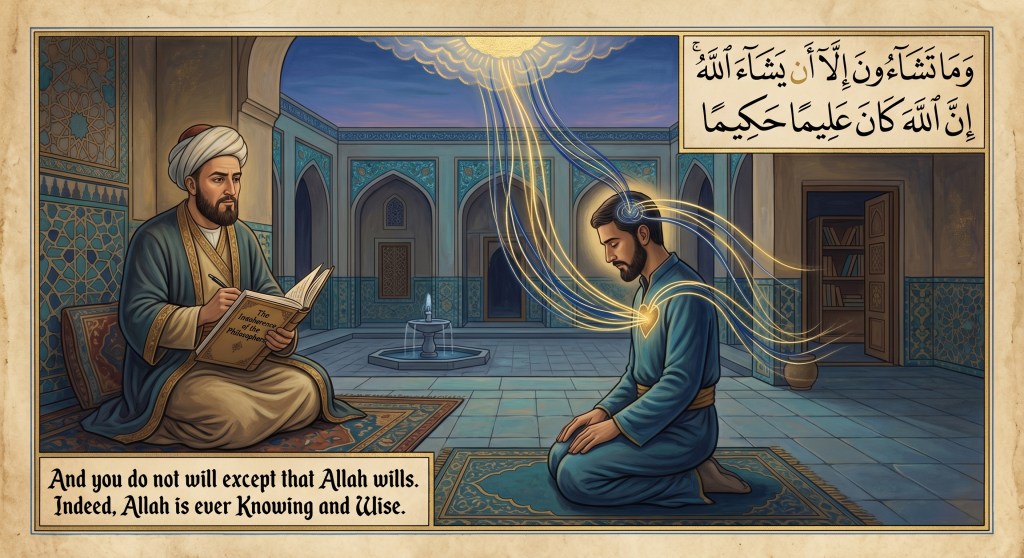
Ismaili Shi‘ism is a branch of Shia Islam known for its emphasis on the esoteric interpretation of scripture and the centrality of the Imam in guiding the communitythemuslimtimes.info. Like other Muslims, Ismailis revere the Quran as divine revelation, but they maintain that the Quran contains multiple layers of meaning. Every Quranic verse has an obvious, literal meaning for all believers, and a hidden meaning accessible only to those with deeper insight or initiationthemuslimtimes.info. In Ismaili doctrine, the Imam – a descendant of ʿAlī ibn Abī Ṭālib (the Prophet’s cousin and son-in-law) – is regarded as the divinely guided authority who can unveil these inner meanings and provide authoritative commentary on the Quran. This belief reflects a broader Shi‘a ethos that true understanding of the Quran often requires the guidance of the Prophet’s family (Ahl al-Bayt) or other divinely favored individuals. Indeed, classical Islamic tradition has long spoken of certain gifted individuals – Prophets, the Prophet’s Companions, the Imams of Ahl al-Bayt, or saintly scholars – as uniquely endowed with Quranic insight, suggesting that higher knowledge is not attained by everyone equally. This raises the question central to our discussion: Is Quranic knowledge meant for all believers, or is its full depth reserved for an enlightened elite under the Imam’s guidance?
To address this, we delve into the Ismaili way of Quranic commentary, known as ta’wīl (literally “to take back to the origin”), which seeks to uncover the spiritual and philosophical truths beneath the surface of the text. We will outline the historical development of Ismaili exegesis, how it diverges from more literalist approaches, and how modern Ismaili leadership continues to interpret the Quran in a manner that harmonizes faith with intellectual inquiry. Throughout, we will see that the Ismaili tradition envisions the Quran as a living repository of wisdom with inexhaustible meanings – a scripture whose secrets are gradually disclosed by those firmly rooted in knowledge, foremost among them the Imam.
Ẕāhir and Bāṭin: Layers of Meaning in the Qur’an
A cornerstone of the Ismaili interpretive approach is the distinction between ẓāhir (the outward, literal meaning of the Quranic text) and bāṭin (the inward, hidden meaning). Ismailis firmly believe that the Qur’an operates on these dual levels, an idea encapsulated in a famous teaching attributed to the Prophet and Imams: “The Qur’an has an outer meaning and an inner meaning, and this inner meaning itself has an inner meaning – up to seven layers of depth.” While all Muslims have access to the ẓāhir of the Quran, the bāṭin is accessible only through proper spiritual insight or guidance. This perspective is not unique to Ismailis – Sufi mystics and other esoteric commentators throughout Islamic history have similarly held that the Word of God carries virtually infinite layers of significance. As scholar Toby Mayer notes, Muslim mystics cherished the Quran’s “boundless meaningfulness,” viewing it as “a portal within the finite into a transfinite, Divine dimension.” They believed that underlying every letter of the Quran is “an ocean of secrets and a river of lights,” such that none of God’s creation could ever exhaust its meaningsthequran.lovethequran.love. In other words, because the Quran is of divine origin, its depths are inexhaustible – any literal reading is but the surface of a vast ocean of wisdom.
This ethos contrasts sharply with fundamentalist or strictly literalist approaches, which insist that the Quran’s meaning is unitary and wholly apparent in its text. Ismaili and other esoteric traditions reject the notion of a single, simplistic interpretation, arguing instead that certainty in the Quran does not preclude mystery. They often cite Quran 31:27, which says: “If all the trees on earth were pens and all the seas, with seven more seas besides, were ink, the Words of God would not be exhausted.” This verse is taken as evidence that God’s words have endless facets. Rather than seeing multiple interpretations as a source of doubt, Ismaili hermeneutics view them as a testament to the Quran’s divine depththequran.lovethequran.love. Deep faith in the text historically meant embracing its multivalence, not restricting itthequran.love. Thus, Ismaili commentators approach the Quran with the expectation that beneath the clear stipulations of the law and narratives of the prophets lie higher spiritual truths – truths that may be unveiled progressively as one advances in knowledge and piety.
The Imam’s Authority and “Elite” Knowledge
Central to Ismaili Quranic commentary is the role of the Imam of the Time – a living spiritual guide who is believed to be divinely inspired and infallible in matters of faith. Ismaili doctrine stresses the permanent need of humankind for a divinely guided leader (Imam) to teach and govern with justicethequran.love. In Ismaili belief, after Prophet Muhammad as the final messenger (nāṭiq), Imam ʿAlī and his successors inherited the Prophet’s spiritual authority to interpret and safeguard the revelation. These Imams are seen as the “rope of God” and the heirs of the Prophet’s knowledge, capable of revealing the Quran’s inner meanings which are inaccessible to those outside this lineage. This implies that, to some extent, Quranic knowledge is stratified: the general Muslim community benefits from the Quran’s evident guidance, but the full depth of the Quran’s wisdom is unfolded only through the teaching of the Imams and their appointed scholars.
Historically, Ismaili communities developed structured systems of religious instruction that reflected this hierarchical dissemination of knowledge. During the Fatimid era (10th–12th centuries), for example, Ismaili missionaries (dā‘īs) taught believers at different stages of initiation. Ranks such as ḥujja (proof), dā‘ī (missionary), and rafīq (companion) marked levels of esoteric understanding; at each rank, a disciple was entrusted with deeper teachingsthemuslimtimes.info. The idea was that one should receive knowledge appropriate to one’s capacity – an approach rooted in the Quranic concept that God does not burden souls beyond their scope, and in a saying of ʿAlī ibn Abī Ṭālib, “Speak to people according to the level of their understanding.” Ismaili Imams thus revealed profound interpretations (ta’wīl) gradually, “according to the capacity of minds and the needs of the time.” The Imam is believed to know the full truth (ḥaqīqah) of the Quran but unveils it in stagesthemuslimtimes.info, so that the community can absorb it without confusion or misguidance. This principle suggests that certain Quranic knowledge has indeed been reserved for an enlightened elite—not in the sense of a privileged class for its own sake, but in the sense of those who are spiritually prepared and divinely guided to comprehend it.
It is important to note that this concept of elite knowledge is balanced by an ultimate universalist vision. In Ismaili eschatology, it is said that in the time of the Qā’im (the messianic Imam or Mahdi), the inner meaning of all things will be made plain and accessible to all believersthemuslimtimes.info. Until that messianic age of complete enlightenment, however, the Imam of each era serves as the custodian of the Prophet’s knowledge and the authoritative teacher of the community. This view diverges from Sunni Islam, where no single figure has exclusive interpretive authority after the Prophet, and where scholars (`ulamā’) collectively derive guidance from the Quran and Hadith. In fact, the difference can be succinctly described as follows: Sunni Islam emphasizes the combination of scripture and scholarly consensus (or caliphal leadership) as guiding sources, whereas Ismaili Shi‘ism emphasizes the Imam and his inspired ta’wīl as the source of guidancethemuslimtimes.info. Sunni interpreters, generally speaking, hold that the Quran is intended to be understood and followed by all Muslims (with the help of scholarship), and they may be wary of the notion that its true meanings are locked behind esoteric interpretations. Mainstream Sunnis do not share the Ismaili view of a present, living infallible guide who can unveil hidden meaningsthemuslimtimes.info. This historical Sunni-Shia difference underlies the very question of whether Quranic knowledge is equally open to everyone or tiered by divine appointment. For Ismailis, the Imam’s guidance ensures unity of interpretation and guards against the errors of personal or purely rational interpretation unguided by divine light.
In Ismaili theology, the Imam’s authority in interpretation is further justified by a cosmological hierarchy. Classical Ismaili teachings describe a chain of prophetic and spiritual authority: great prophets called nāṭiqs (Enunciators) brought major revelations (e.g., Adam, Noah, Abraham, Moses, Jesus, Muhammad), and each was succeeded by a waṣī or asās (Foundation) who disclosed the inner meanings of that revelationthemuslimtimes.info. Imam ʿAlī is seen as the asās to Prophet Muhammad’s nāṭiq. In this schema, the Imam is indispensable – just as the body needs a soul, the law needs an inner meaning. The Ismaili Imams are thus viewed as inheritors of the Prophet’s ḥikmah (wisdom) and as repositories of “special knowledge” (ʿilm) granted by God. By guiding their community with authoritative commentary, they ensure that the Qur’an’s message remains living, dynamic, and correctly understood in each era.
Esoteric Commentary in Practice: Philosophy and Allegory in Ismaili Tafsīr
The Ismaili approach to Quranic commentary is characterized by rich allegorical and philosophical interpretations that go far beyond the literal text. Ismaili scholars, especially during the medieval period, engaged deeply with philosophy (particularly Neoplatonic ideas) to elucidate Quranic concepts. They developed a sophisticated cosmology to bridge Quranic revelation with reason and metaphysicsthemuslimtimes.infothemuslimtimes.info. For example, Ismaili philosophers like Abū Ya‘qūb al-Sijistānī and Ḥamīd al-Dīn al-Kirmānī described creation as a series of emanations originating from an utterly transcendent God: from God’s command emerged the Universal Intellect, then the Universal Soul, and through the Soul the material worldthemuslimtimes.infothemuslimtimes.info. In their Quranic exegesis, these thinkers re-read scriptural narratives in symbolic terms to match this cosmology. The Qur’an’s spiritual truths were expressed in stories and laws that had outer forms but inner referents. Ismaili tafsīr, therefore, often operates by “decoding” the symbols in the Quran to reveal abstract philosophical or mystical truths.
Concrete examples help illustrate this method. Below are a few typical ways Ismaili commentators interpret Quranic passages beyond their surface meaning:
- Cosmological Allegory: The story of Adam and the Garden is not seen merely as a tale of the first human, but can be read as an allegory for metaphysical realities. An Ismaili esoteric reading might interpret Adam’s descent as symbolizing the emanation of the Intellect and its fall into the material realm. In this view, Adam represents the Universal Intellect and Eve the Universal Soul; the Garden of Eden signifies the spiritual world, and the expulsion reflects the Soul’s descent towards matter. Such an interpretation looks past the historical narrative to find a deeper lesson about the origin of intellect and soul in the cosmosthemuslimtimes.info.
- Symbolic Law and Ethics: The Quran’s legal and dietary injunctions are acknowledged at the ẓāhir level (Ismailis historically practiced Islamic law under the Fatimid Imams), but Ismaili exegesis often ascribes ethical or spiritual symbolism to them. For instance, a commandment about forbidden foods or purity rules might be explained in ta’wīl as an instruction to avoid certain unethical behaviors or spiritual impurities, rather than only literal substancesthemuslimtimes.info. By interpreting law in this inner way, Ismaili teachings aim to show that the Shariah (religious law) itself points to a deeper moral and mystical ḥaqīqah (truth). The outer practice is a means to internalize virtue and knowledge.
- Quranic Figures as Metaphors: Ismaili commentators sometimes interpret Qur’anic personalities or terms as metaphors for spiritual concepts. For example, Qur’anic references to “light” (nūr) have been read as symbols of the Imam or the prophet’s wisdom illuminating the world. The Qur’anic “Throne” (ʿarsh) of God can be seen not as a physical seat but as a metaphor for the Universal Intellect or the totality of creation sustained by God’s command, in line with Ismaili cosmology. Such readings align with broader Sufi interpretations but are often systematized in Ismaili thought.
- Verses Alluding to Imams: In Shia traditions, including Ismailism, certain Quranic verses are understood to allude to Imam ʿAlī or the lineage of Imams, even if the literal wording does not mention them by name. For instance, the verse of Wilāyah in the Quran — “Your guardian (walī) is only Allah, His Messenger, and those who believe: those who establish prayer and give alms while bowing (in prayer)” (Quran 5:55) — is taken by Shia exegetes as referring to an incident where ʿAlī ibn Abī Ṭālib gave charity (a ring) while in the state of bowing. Ismaili commentators interpret this verse as a divine indication of ʿAlī’s spiritual leadership after the Prophet, since he is “the believer who gave alms while bowing.” Thus, “5:55 confirms ʿAlī as the rightful spiritual leader (walī) after the Prophet, and by extension, validates the line of Imams from him.”thequran.love This interpretation isn’t apparent from the ẓāhir alone, but through hadith and ta’wīl it becomes a cornerstone proof-text for Imamate. Likewise, other verses – such as the verse of Mubāhala (Quran 3:61, where the Prophet brings “our souls and your souls” to a contest of prayer) – have been read as implying ʿAlī is like the Prophet’s own soul, underscoring his unique statusthequran.love. Positive Quranic statements about the “believers” are often seen as coded references to ʿAlī, the Imams, and their purified followers, whereas warnings about the treacherous or impious are sometimes interpreted as referring to those who opposed the Imamsguweb2.gonzaga.edu. This interpretive tendency demonstrates how Ismailis (and Shia more broadly) find the Imam’s presence woven into the Qur’an’s subtext, affirming that allegiance to the Imam is part of the faith’s very foundation as encoded in scripture.
It should be noted that while Ismaili ta’wīl can be highly philosophical or symbolic, it is not arbitrary. Ismaili scholars operated within certain boundaries set by the Imams and by the broader Islamic revealed truth. The Imam’s guidance was considered a check against fanciful or incorrect interpretations. In Ismaili belief, because the Imam is protected from error, the inner meanings he imparts must cohere with the true intent of Allah’s revelationthemuslimtimes.info. This provides devout Ismailis confidence that their esoteric readings, however elaborate, remain anchored to divine truth rather than personal whim. In sum, Ismaili Quranic commentary transforms the text into a map of the spiritual universe: history, law, and doctrine all possess deeper spiritual correspondences, and discovering those correspondences is the very purpose of revelation. Knowledge (`ilm) thus has a sacred, salvific quality – it is through unlocking the Quran’s hidden knowledge (with the Imam as guide) that one’s soul ascends and draws nearer to God.
Aga Khan IV’s Contemporary Vision of Quranic Understanding
In the modern era, the Ismaili tradition of Quranic interpretation continues under the guidance of the Aga Khans – the hereditary Imams of the Nizārī Ismaili community. Prince Shah Karim al-Husayni Aga Khan IV, who led the community from 1957 until stepping down in 2024, articulated an understanding of the Quran that stays true to Ismaili principles while engaging with contemporary values of education, pluralism, and science. His perspective helps illustrate how an esoteric tradition operates in today’s context, emphasizing that Quranic wisdom must speak to modern life rather than remain cloistered knowledge. Key themes Aga Khan IV emphasized include:
- Continuous Creation and Science: Aga Khan IV taught that Islam encourages an outlook of continuous discovery in creation. He highlighted the Quranic insight that creation is dynamic and ongoing, not a closed past event. “One strength of Islam has always lain in its belief that creation is not static but continuous,” he said, noting that scientific endeavors are a way God “opens new windows for us to see the marvels of His creation.” This view urges Ismaili Muslims to actively engage in scientific inquiry as a means of appreciating God’s work in the universethemuslimtimes.info. Quranic interpretation, in this light, must be expansive enough to incorporate scientific understanding – seeing no conflict but rather a harmony between religious truth and scientific truth.
- Pluralism and Ethical Interpretation: Acknowledging the diversity within the Muslim ummah, Aga Khan IV often noted that “there are many interpretations of Islam within the wider Islamic community.” Rather than seeing this as a problem, he emphasized a unifying ethical core: all interpretations should inspire believers to “leave the world a better place than it was when we came into it.”themuslimtimes.info In practice, this means the Ismaili Imam encourages respect for different schools of thought (including Sunni and other Shia perspectives) and focuses on the Quran’s universal ethical teachings—such as compassion, charity, and justice—as the measure of any interpretation. The Quranic message, to him, is not monopolized by one group; yet as Imam he guides his community’s interpretation in a manner that is outward-looking and constructive. This pluralistic outlook ties back to the Ismaili idea that while there is a special entrusted knowledge, the purpose of that knowledge is the betterment of humankind.
- Education and Intellect: Consistent with the long Ismaili tradition of venerating the intellect (`aql), Aga Khan IV stressed the Quran’s call for education and reason. “The Qur’an itself repeatedly recommends Muslims to become better educated in order better to understand God’s creation,” he observedthemuslimtimes.info. He has invested heavily in institutions of learning (such as the Aga Khan University and Institute of Ismaili Studies) to ensure that Ismaili interpretations of Islam are informed by scholarship and that Ismailis can engage the modern world through knowledge. This modern take echoes the medieval Fatimid motto of Ismailism as “the religion of the intellect (dīn al-ʿaql)”: understanding God’s word requires active, enlightened minds, and studying the Quran is a perpetual intellectual journey.
- Nature as Divine Signs: Aga Khan IV frequently drew from the Quran the theme that the natural world is full of signs (āyāt) of God. He reminds believers that the Quran itself directs attention to “the heavens and the earth, the night and the day, the winds and the waters” as manifestations of Allah’s powerthemuslimtimes.info. This appreciation for nature reinforces an esoteric sensibility: one can read the “book of nature” alongside the Quran, seeing a harmony between God’s physical creation and the scripture. It also underpins environmental consciousness as a spiritual duty, interpreting stewardship of the earth as part of Quranic ethics.
- Balancing Tradition and Modernity: Throughout his leadership, Aga Khan IV urged that Islamic teachings be interpreted in the context of modern times without sacrificing fundamental principles. He advocated a balance where Ismailis remain rooted in their traditional values and heritage, yet are flexible and forward-thinking in how they apply Quranic guidancethemuslimtimes.info. In practice, this means that Ismaili Quranic commentaries or community sermons might address contemporary issues – such as financial ethics, healthcare, or secular education – drawing on the Quran’s inner principles to offer solutions compatible with modern knowledge and social progress. This approach keeps the Quran relevant to younger generations and diverse societies, reflecting the Ismaili conviction that faith is a living, dynamic force.
In sum, Aga Khan IV’s approach exemplifies how an esoteric tradition can engage with the modern world: Quranic knowledge is not seen as a static set of interpretations handed down unchanged, but as a continuing dialogue between eternal truths and present contexts. While the Imam still holds final interpretive authority for the community, the mode of interpretation encourages each individual to think, learn, and observe the world – effectively making every earnest seeker a participant in uncovering the Quran’s guidance. The Imam’s role as teacher remains paramount, yet he teaches that all believers should use their God-given intellect and strive for understanding. This reflects an important nuance: although certain deep truths might be for the spiritually elite, Ismailism also teaches the democratization of enlightenment through education and effort, in line with the Quranic promise that “Allah will raise in rank those of you who believe and those who have been given knowledge” (58:11).
Epilogue: Between the Universal and the Esoteric
The Ismaili way of understanding the Quran presents a fascinating interplay between universality and exclusivity in religious knowledge. On one hand, the Quran’s guidance is for all humanity – its outer teachings form a common ground that any reader or listener can benefit from. Ismailis uphold all the essential pillars of Islam (prayer, fasting, charity, etc.) based on the Quran’s explicit instructions, affirming that the scripture’s basic message of monotheism and righteousness is plain and meant for everyone. On the other hand, Ismaili tradition clearly posits that there are deeper dimensions of the Quran that are unveiled only to those whom God elects for special understanding – notably the Imams and, through them, those who seek wisdom under their tutelage. This does create a tiered model of knowledge: an elite of sorts (the Imams and their close circle of learned devotees) have access to profound esoteric insights, whereas the majority of believers receive distilled guidance appropriate to their level. Yet, importantly, this hierarchy is not viewed as a separation between saved and unsaved, nor a secretiveness for power’s sake; rather, it is seen as a merciful pedagogy. Just as a teacher does not burden beginners with advanced theory, the Imam imparts knowledge gradually, “each according to their capacity”themuslimtimes.info, to ensure the wellbeing of the community’s faith and unity.
From a thematic standpoint, the Ismaili approach underscores that truth in the Quran is both multifaceted and purposive. The multifaceted nature means no single community or person can claim to have exhausted what the Quran can teach – there will always be new insights as circumstances change and as one’s soul matures. The purposive nature means that knowledge is not pursued for intellectual vanity but for moral and spiritual upliftment. The Imam’s guidance is aimed at leading the community toward the ultimate truth (ḥaqīqah) and closeness to God, which in Ismaili belief will culminate in an era when all humanity can comprehend the inner message of the Quran openly. In that awaited time, the divide between elite and common knowledge will dissolve – the ẓāhir and bāṭin of religion will become one and the same, as the world is filled with divine light and understanding. In this sense, even the “elite-only” knowledge of today serves a universal end.
For general readers and Muslims of other interpretations, the Ismaili tradition offers a reminder that the Quran has profound spiritual reservoirs that have inspired centuries of thought, art, and devotion in Islam. It challenges us to appreciate that beyond the legal and literal injunctions lie transcendent themes – the oneness of God, the reflection of the divine in the cosmos, the quest for knowledge, and the refinement of the soul. Whether or not one subscribes to the Ismaili specific beliefs about the Imam, the idea that “not all knowledge is equal” resonates in many Islamic sayings (for example, the Prophet’s prayer, “O God, grant me knowledge of the deeper meaning of things”). The Ismaili emphasis on an inner Quran invites a respectful dialogue on how Muslims can approach their holy text: Is the Qur’an a book to simply be followed to the letter, or a vast ocean of wisdom to be explored with both humility and intellectual bravery?
In conclusion, the Ismaili way of Quranic commentary exemplifies a rich tapestry of Islamic thought in which revelation and reason, exoteric law and esoteric truth, teacher and student all intertwine. It shows that Quranic knowledge, while accessible on a basic level to all, contains infinite horizons that open gradually to those who seek enlightenment with the right guidance. The Qur’an in Ismaili understanding is indeed for everyone – but like a multilayered pearl, its full luster shines for those willing to dive deep. The balance struck by the Ismaili tradition is a delicate one: it preserves a reverence for authority and tradition through the Imamat, while also fostering personal growth and universality through the eventual goal of making inner truth manifest to all. In the words of the Aga Khan IV, Islam’s intellectual strength has been its ability to “aspire to enlighten the mind and ennoble the soul”, a task that continues in each generation. The Qur’an, as understood by Ismailis, speaks to every seeker at the level they can grasp, but always beckons them to ascend from the literal to the luminous – from the accessible guidance for all, to the elite knowledge that ultimately uplifts all.
Sources:
- Mayer, Toby. Traditions of Esoteric and Sapiential Quranic Commentary. In The Study Quran, ed. S. H. Nasr. (2015)thequran.lovethequran.love
- Shah, Zia H. “The Essence of Islam in the Ismaili Shi‘ite Tradition.” The Muslim Times, March 6, 2025themuslimtimes.infothemuslimtimes.info
- Shah, Zia H. “Who Is Gifted with Understanding and Commentary of the Quran? An Inter-Sectarian Exploration.” The Glorious Quran and Science, Sept 20, 2025themuslimtimes.infothemuslimtimes.info
- Shah, Zia H. “Quranic Verses Interpreted as Referring to Ali ibn Abi Talib.” The Glorious Quran and Science, May 6, 2025thequran.love
- Aga Khan IV’s Understanding of the Quran. The Muslim Times, Feb 6, 2025themuslimtimes.infothemuslimtimes.info
- Ismāʿīlīyyah. Encyclopaedia Britannica (online), accessed 2025themuslimtimes.info
If you want to read in Microsoft Word file:




 The Glorious Quran and Science
Leave a comment