
Written and collected by Zia H Shah MD
Historical Account in Judeo-Christian Tradition
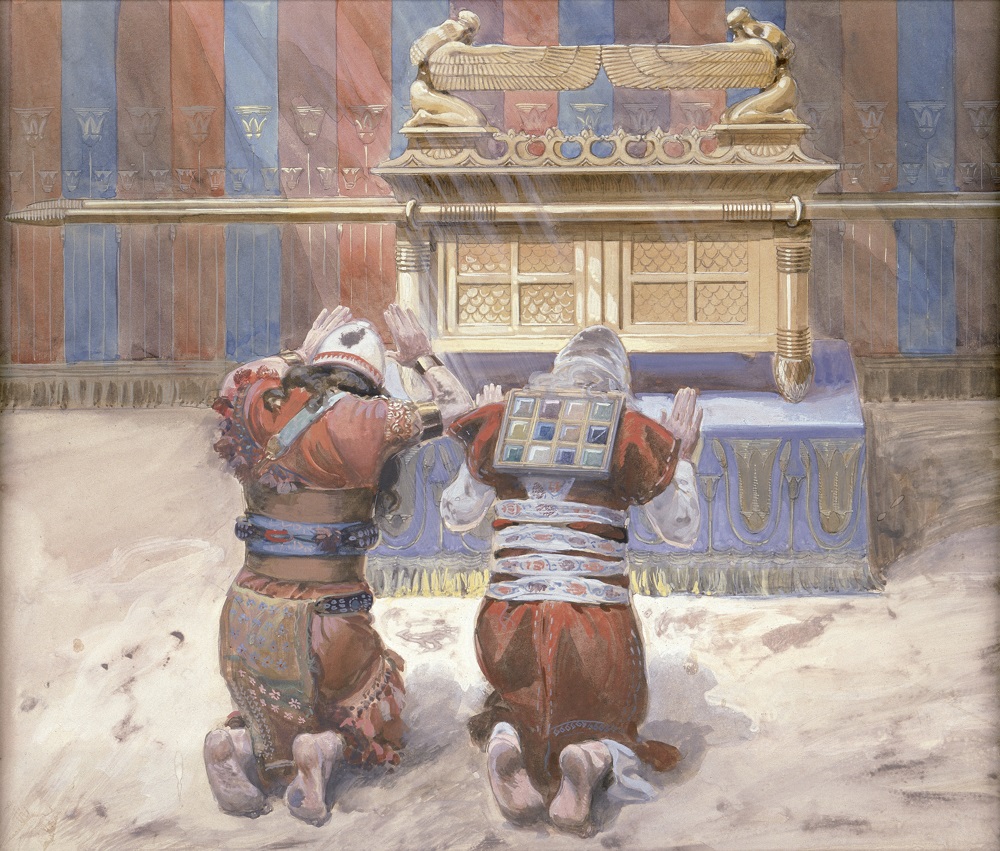
Construction and Early History: According to the Hebrew Bible, the Ark of the Covenant was built about one year after the Exodus from Egypt en.wikipedia.org. God instructed Moses at Sinai to construct the Ark from acacia wood, with precise dimensions: “two cubits and a half shall be its length, and a cubit and a half its breadth, and a cubit and a half its height” biblehub.com (approximately 3.75 × 2.25 × 2.25 feet). The Ark was overlaid entirely with gold inside and out biblehub.com, and fitted with carrying poles and a golden cover called the “mercy seat” adorned by two golden cherubim (angelic figures) facing each other biblehub.com. God told Moses, “There I will meet with you… from above the mercy seat, from between the two cherubim that are on the ark of the testimony” biblehub.com, indicating the Ark as the earthly focal point of His presence. Moses obeyed: “So I made an ark of acacia wood…and went up the mountain with the two tablets in my hand” (inscribed with the Ten Commandments) biblehub.com, which were then placed inside the Ark biblehub.com. Thus, from the start the Ark housed the stone tablets of the covenant law. It was carried at the head of Israel’s journey, borne by Levites on poles, as a sacred chest wherein “the LORD of Hosts, who sits enthroned between the cherubim,” manifested His guidance biblehub.com.
Wilderness Wandering and Conquest: Throughout Israel’s desert wanderings, the Ark signified God’s guiding presence. For example, when the Israelites reached the Jordan River on the verge of the Promised Land, the priests carrying the Ark stepped into the flood-swollen river – and the waters miraculously parted. “During the crossing, the river grew dry as soon as the feet of the priests carrying the Ark touched its waters… until the people had passed over” en.wikipedia.org. The Ark was then carried in a procession for the Battle of Jericho: for six days it was paraded around the fortified city with priests blowing trumpets. On the seventh day, after circling the city seven times, “with a great shout, Jericho’s wall fell down flat and the people took the city” en.wikipedia.org. These events established the Ark’s role as a vessel of divine power in Israel’s early victories, reinforcing that it was not a mere relic but central to sacred history – a tangible sign that God was with His people in battle and covenant.
Settlement, Captivity, and Return: After the conquest, the Ark resided at Shiloh during the period of the Judges (circa 12th–11th century BCE) en.wikipedia.org. It was consulted as an oracle of God’s will during crises (e.g. in Judges 20:27). However, during a war with the Philistines the Israelites presumptuously carried the Ark into battle, hoping its presence would guarantee victory. Instead, Israel was defeated and the Ark was captured by the Philistines, marking a great national tragedy (the high priest Eli died upon hearing the news, lamenting that “the glory has departed from Israel” with the Ark’s loss) en.wikipedia.org. The captured Ark was taken into the temple of the Philistine god Dagon – whereupon “the next morning Dagon was found prostrate…bowed down before it…broken” on the ground. The Philistine cities that housed the Ark were then struck with plagues and “tumors,” interpreted as divine judgment en.wikipedia.org. After seven months of calamity, the Philistines returned the Ark to Israelite territory with offerings of gold, having recognized its power en.wikipedia.org. According to the biblical account, they set the Ark on a driverless cart pulled by cows, which carried it back to Israel – an event some Judeo-Christian commentators compare to the Quran’s mention of angels delivering the Ark (since no human guided the cart)myislam.org.
The Ark was received with joy by the Israelites at Beth-shemesh, though some men were struck dead for irreverently peeking inside en.wikipedia.org. It was then taken to Kiriath-Jearim, to the house of Abinadab, where it stayed for twenty years en.wikipedia.org. During King Saul’s reign, the Ark was largely neglected (people “did not inquire of it in the days of Saul” biblehub.com). But Saul’s successor King David eagerly restored the Ark to prominence. David transported the Ark to his new capital, Jerusalem, with a grand procession. Along the way, one of the attendants (Uzzah) touched the Ark to steady it and was struck dead on the spot for his irreverence, underscoring its sanctity en.wikipedia.org. This shocked David; he temporarily left the Ark in the house of Obed-Edom, where its mere presence brought such blessing that David gained new respect for its power en.wikipedia.orgen.wikipedia.org. Three months later, David brought the Ark into Jerusalem amid great rejoicing, music, and sacrifice. He “danced before the Lord with all his might” in priestly attire as the Ark entered the city, symbolizing the nation’s worship focused around God’s throne (the Ark) en.wikipedia.org. David pitched a special tent for the Ark in Jerusalem (sometimes called David’s tabernacle), distinct from the Mosaic Tabernacle still at Gibeon.
Temple Period and Disappearance: Under King Solomon (10th century BCE), a permanent Temple was built in Jerusalem to house the Ark. In Solomon’s Temple the innermost chamber, the Holy of Holies, was designed specifically for the Ark en.wikipedia.org. When the Temple was dedicated, the Levites brought the Ark into the Holy of Holies and placed it beneath large golden statues of cherubim that Solomon had made, whose wings overshadowed the Ark en.wikipedia.org. At that moment, the Temple was filled with a cloud of God’s glory en.wikipedia.org. “When the priests brought the ark of the covenant of the LORD to its place… the cloud filled the house of the LORD” (1 Kings 8:6–11), signifying God’s presence enthroned upon the Ark. Inside the Ark at this time were the two stone tablets of the Law; the Bible notes that “There was nothing in the ark except the two tablets of stone Moses had placed in it” (1 Kings 8:9). (Earlier in the desert, a golden pot of manna and Aaron’s budded staff were laid before the Ark as memorials, and by New Testament times it was believed these items had been preserved “inside” the Ark as well biblehub.com – see more under Physical Attributes below.) The Ark remained in Solomon’s Temple for over three centuries as the spiritual center of Judah.
During the reign of the righteous King Josiah (7th century BCE), there is a brief biblical note suggesting the Ark had been moved during prior wicked reigns and Josiah ordered it returned to the Temple (see 2 Chronicles 35:3) en.wikipedia.org. Sometime thereafter, the Ark mysteriously vanished from recorded history. When Jerusalem was conquered by the Babylonians in 587 BCE and Solomon’s Temple was destroyed, the Ark was no longer mentioned among the spoils. Judeo-Christian tradition offers various theories: that the Ark was hidden by King Josiah or the prophet Jeremiah in a safe place (a cave or tunnel) just before the Babylonian invasion en.wikipedia.org; or that it was taken to Babylon and later lost; or that it was divinely removed. One later Jewish text (2 Maccabees 2:4–8, not in the Hebrew canon but in the deuterocanonical literature) claims Jeremiah hid the Ark in a cave on Mount Nebo. To this day the Ark’s earthly fate remains unknown and it is counted among history’s great mysteries – no confirmed evidence has surfaced of its location en.wikipedia.org.
Mentions in the New Testament: The Ark’s legacy continued into the Second Temple period and the time of Jesus, even though the Ark itself was no longer present in Herod’s Temple. The New Testament Book of Hebrews looks back on the Ark to explain the Old Covenant worship: “the ark of the covenant covered on all sides with gold, in which was a golden urn holding the manna, and Aaron’s staff that had budded, and the stone tablets of the covenant. Above it were the cherubim of glory overshadowing the mercy seat” biblehub.com. This description (Hebrews 9:4–5) affirms the sacred contents and the belief that God’s glory was present above the Ark’s cover. The letter to the Hebrews uses the Ark to symbolize God’s ultimate throne of grace, comparing the Ark’s mercy seat (where atonement was made with sacrificial blood) to the atoning work of Christ.
Finally, the Book of Revelation contains a prophetic vision linking back to the Ark. The Apostle John writes: “Then God’s temple in heaven was opened, and the ark of His covenant was seen within His temple. And there were flashes of lightning, rumblings, peals of thunder…” (Revelation 11:19) biblehub.com. In Christian theology, this dramatic image suggests that the Ark’s significance transcends its earthly existence – it is seen as a heavenly reality, a symbol of God’s enduring covenant and presence. Some Christian commentators even view the Ark as a foreshadowing “type” of Jesus Christ or the Virgin Mary (who bore Christ, analogous to the Ark bearing the divine Word) en.wikipedia.org. In any case, the Ark of the Covenant stands as a unifying thread through the biblical narrative: from Sinai to Solomon, and in spiritual symbolism through the New Testament and beyond.
Read further in Microsoft word file:

 The Glorious Quran and Science
Leave a comment