
Epigraph
وَمَا لَهُم بِهِۦ مِنْ عِلْمٍ إِن يَتَّبِعُونَ إِلَّا الظَّنَّ ۖ وَإِنَّ الظَّنَّ لَا يُغْنِي مِنَ الْحَقِّ شَيْـًٔا
“But they have no knowledge thereof. They follow nothing but conjecture; and conjecture avails naught against the truth.” (Qur’an 53:28) thequran.love
وَمَا يَتَّبِعُ أَكْثَرُهُمْ إِلَّا ظَنًّا ۚ إِنَّ الظَّنَّ لَا يُغْنِي مِنَ الْحَقِّ شَيْئًا ۚ إِنَّ اللَّـهَ عَلِيمٌۢ بِمَا يَفْعَلُونَ
“And most of them follow nothing but conjecture. Surely, conjecture avails nothing against the truth. Indeed, Allah is well aware of what they do.” (Qur’an 10:36) thequran.love
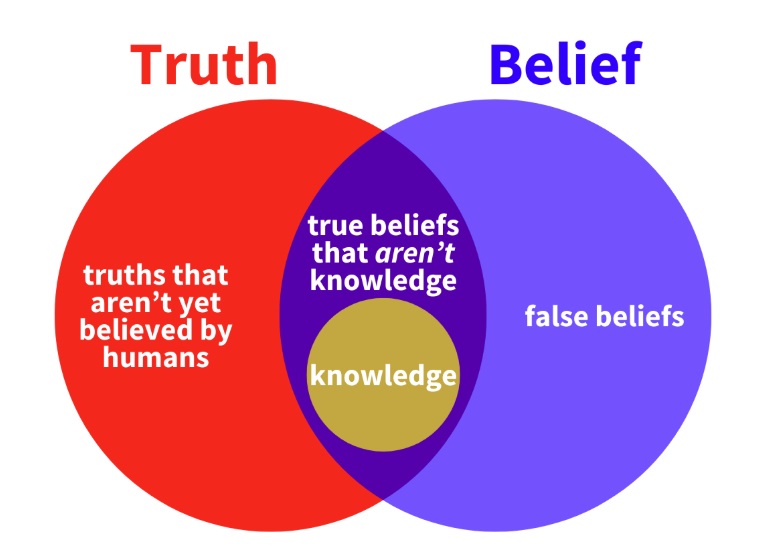
Written and collected by Zia H Shah MD
Abstract: This article explores three interrelated Quranic concepts – conjecture (الظَّنّ, az-zann), knowledge (العِلْم, al-‘ilm), and truth (الْحَقّ, al-haqq) – and how the Quran contrasts and “pitches” them against each other. We examine Quranic verses (notably 53:28, 10:36, and 2:78) and others that highlight the distinction between baseless assumption and authentic knowledge, ultimately pointing to al-haqq (the Truth) as the Quran’s core message. Our commentary is multidisciplinary: scientifically, we discuss how the Quran’s emphasis on evidence and knowledge aligns with the scientific method and the laws of nature; philosophically, we consider the epistemological distinction between conjecture and justified true belief; and theologically, we reflect on why the Quran repeatedly warns against following conjecture in matters of faith and emphasizes that ultimate truth comes from Allah’s perfect knowledge. Through exact Quranic quotes (with Arabic originals) and insights from contemporary Quran-and-science writings by Zia H Shah MD, we show how the Quran delineates conjecture, knowledge, and truth – urging believers to ground their understanding in evidence and divine guidance rather than speculation. An epilogue concludes with reflections on the harmony between faith and reason when one heeds the Quranic call to pursue true knowledge and avoid conjecture.
الظَّنّ – What the Quran Means by “Conjecture” (Baseless Assumption)
In Arabic, ظن (zann) generally means assumption, conjecture, or speculation. The Quran uses this term often to describe beliefs or assertions that lack true knowledge or evidence. In the Quranic worldview, following zann is following a guess – something not grounded in certain knowledge (عِلْم). As highlighted in the epigraph, Allah warns that most people “follow nothing but conjecture” and that such conjecture “is of no avail against the truth” thequran.love. In other words, no amount of baseless speculation can substitute for the reality of al-haqq (truth).
The Quran pointedly criticizes those who make confident claims about theological or unseen matters based only on conjecture. For example, regarding the afterlife, disbelievers in the time of the Prophet would say life is only worldly and there is no resurrection – a claim the Quran dismisses as an unsupported guess: “They say, ‘There is nothing but our life of this world: we die and we live, and nothing but time destroys us.’ Yet the fact is that they know nothing about this and are only conjecturing.” islamicstudies.info ahl-alquran.com Here the Quran exposes that such people “have no knowledge” of what they assert, merely indulging in assumptions. Similarly, in another verse the Quran declares: “If you were to obey most of those on earth, they would lead you away from Allah’s path. They follow nothing but speculation, and they do nothing but guess.” ahl-alquran.com. This emphasizes that popular opinion or majority belief is not a reliable guide if it’s based on conjecture rather than knowledge.
A striking illustration is found in the story of Jesus’ crucifixion. The Quran states that those who argued about Jesus’ fate “have no knowledge thereof but follow only conjecture”, for in reality “they did not kill him for certain” ahl-alquran.com. By accusing the Christian narrators of possessing only zann (guesswork) about the crucifixion, the Quran again underscores the difference between human speculation and divine truth. In matters of theology – for instance, claiming angels to be God’s daughters, or asserting whom God loves or punishes – the Quran says disbelievers were just “following assumptions and what their own souls desired”, despite clear guidance having come from the Lord ahl-alquran.com. Conjecture, especially about the unseen (al-ghayb), is thus a hallmark of human ignorance in the Quran’s depiction.
From a philosophical perspective, we can relate this to the concept of epistemology, the theory of knowledge. A belief based on conjecture would, in Western philosophy, lack justification – it is akin to a mere opinion or hypothesis without proof. The Quranic critique of following conjecture anticipates the insistence that beliefs, especially about ultimate truths, should be substantiated. In modern terms, the Quran is warning against cognitive biases and unfounded assumptions that people often hold. Scientifically, one might compare zann to a hypothesis that has no evidence – an idea not yet tested or confirmed. The Quran encourages abandoning such baseless ideas when assessing truth. As Zia H Shah MD notes in a commentary, a large number of people (even educated scientists or philosophers) may cling to ideas – for example, absolute materialistic determinism or denial of free will – without definitive proof, essentially “resorting to conjecture” in areas beyond their knowledge thequran.love. The Quran’s timeless caution is to not be swayed by the prevalence of an idea if it stands on speculative ground alone.
Importantly, zann in the Quran is often paired against ‘ilm (knowledge). One verse challenges those who justified idol worship by saying “Had Allah willed, we wouldn’t have done this or that,” by asking: “Say, do you have any knowledge that you can produce for us? You follow nothing but conjecture, and you do nothing but guess.” ahl-alquran.com. Here the Quran demands evidence (“knowledge that you can produce”) and labels the excuses of the polytheists as pure guesswork. This clear dichotomy – knowledge vs. conjecture – shows that in the Quranic framework, truth claims require solid grounding. Conjecture is portrayed as not just an inadequate basis, but even a sin when it comes to fabricating religious claims. For instance, some among the Jews in Medina are described as “illiterate (unlettered) people who do not know the Scripture except from wishful thinking (أَمَانِيّ) and are only guessing.” ahl-alquran.com In this context (Quran 2:78), their understanding of scripture isn’t based on true knowledge, only on hearsay and wishful conjecture. The verse admonishes that religion should not be reduced to folk tales or wishfully made-up doctrines – doing so is merely following zann, not haqq.
In summary, “conjecture” in the Quran means any belief or assertion not backed by knowledge – a subjective notion taken as truth without evidence. The Quran consistently tells us that such conjecture has no power or validity against the Truth. Whether it’s about God, the afterlife, or other unseen realities, one’s personal or cultural guesses don’t change reality. This principle aligns with a rational approach: reality is independent of our unfounded beliefs. Thus, the Quran invites its audience to move from conjecture to certainty – a theme we will see reinforced by its praise of knowledge and truth.
العِلْم – What the Quran Means by “Knowledge” (Evidence and Certitude)
In stark contrast to zann, the Quran celebrates ‘ilm (knowledge) as the basis for true understanding. In Quranic terminology, ‘ilm signifies certain knowledge, awareness, or learning – often knowledge that is either observed, reasoned, or received through authentic divine revelation. The Quran portrays Allah as the source of all knowledge, and human beings are urged to seek knowledge and not assert what they cannot know. “Do not pursue that of which you have no knowledge,” the Quran instructs, “Indeed, the hearing, the sight and the heart – about all those [one] will be questioned.” (Qur’an 17:36) islamawakened.com. This powerful verse imposes an ethical responsibility to use one’s faculties to attain knowledge before claiming or acting on something. From a scientific standpoint, this almost foreshadows the empirical mindset: don’t make claims without evidence (no knowledge), and use your God-given tools of perception and intellect (hearing, sight, heart) to ascertain the truth.
When the Quran criticizes conjecture, it implicitly extols knowledge. For example, as noted earlier, Allah asks, “Do you have any knowledge for that?” when refuting false religious claims ahl-alquran.com. The implication is that only with sound knowledge can one speak about reality or faith. In the Quran, Prophets are often made to say, “Do you say about Allah that which you do not know?” – rebuking people for attributing things to God without knowledgeahl-alquran.com. Thus, in theology the Quran insists on grounding belief in revelation (wahy, which it considers a form of granted knowledge) rather than conjectural myth.
It is noteworthy that the Quran uses ‘ilm not only for religious knowledge but also for knowledge of the natural world. It encourages reflection on the signs (ayat) in the heavens and earth as a means to attain certainty in faith. The verse “We will show them Our Signs in the universe and in their own selves, until it becomes manifest to them that the Quran is the Truth” (41:53) promises that evidence in nature and within the human being will lead to recognition of the truth of the Quran themuslimtimes.info. This intertwining of empirical observation with spiritual truth is a hallmark of the Quran’s approach: knowledge gained from studying creation can and should reinforce one’s understanding of divine truth.
From a philosophical angle, knowledge in the Quran aligns with what epistemologists call justified true belief. The Quran wants beliefs about God or the unseen to be justified – either by rational evidence, personal experience, or reliable testimony (in this case, God’s revelation). Mere conjecture is not justified, and a claim that happens to be true but is only guessed is not truly ‘ilm in the Quranic sense. The Quran in verse 4:157 (about the crucifixion) highlights that those who thought Jesus was killed only had conjecture – even if they witnessed an event, they misinterpreted it without divine knowledge, thus they did not have yaqeen (certainty) ahl-alquran.com. Quranic knowledge, therefore, often implies certainty. Indeed, the Quran often uses the word yaqeen (certainty) in conjunction with ‘ilm – for example describing the Quran itself as “guidance and mercy for those who have certainty” or praising those who have “knowledge with certainty.”
Theologically, al-‘ilm is one of Allah’s attributes (Al-‘Aleem – the All-Knowing). Human knowledge is always limited, and the Quran reminds us of this: “They ask thee concerning the soul. Say: ‘The soul is by the command of my Lord, and of knowledge you have been given only a little.’” (17:85) themuslimtimes.info. By acknowledging the limits of human knowledge, the Quran sets a boundary to conjecture – much of the unseen world is beyond unaided human reach, so either one refrains from assertive claims or relies on divine revelation for insight.
At the same time, the Quran elevates the pursuit of knowledge. The first word revealed was “Iqra’” (“Read!” or “Recite!”), heralding a faith built on learning. Numerous verses invite humans to observe nature, study history, and think deeply, implying that empirical and rational knowledge can lead one to truth. In fact, the Quran declares that Allah created the natural world “with truth (bil-haqq)” (e.g. Quran 16:3 and 15:85), meaning with order and purpose thequran.love. One verse states: “We have not created the heavens and earth and all that is between them except with truth (بِالْحَقِّ)” (15:85) thequran.love. Commentators have noted that this “implies that the laws of nature are inviolable”, a foundation which set the stage for the scientific revolution by assuring that the universe is orderly and truth-based thequran.love thequran.love. In other words, because the creation operates on truth (fixed principles), human knowledge can progressively uncover that truth – which is precisely what science does. It’s fascinating that a religious scripture would so boldly insist that nature follows truth and not caprice, a notion that gave Muslim scientists of the past the confidence to seek physical laws (sunnat Allah).
Zia H Shah MD, in reflecting on such verses, argues that God’s ‘ilm (knowledge) of “the secrets of the heavens and the earth” is manifest in the Quran thequran.love thequran.love. For instance, the Quran contains statements about natural phenomena (astronomy, biology, etc.) that were not known to 7th-century Arabs, which, Shah suggests, not only serve as a proof of the Quran’s truth but also help us understand the universe in light of that truth thequran.love. This interplay of divine knowledge and human discovery means that as science advances, Muslims see more signs of al-haqq in creation, fulfilling the promise of 41:53 that eventually it will become clear the Quran is true themuslimtimes.info. Thus, ‘ilm bridges faith and reason: authentic knowledge, whether derived from revelation or empirical study, all points to the same truth in the Quranic view.
In practice, the Quran wants believers to have evidence-based belief. It praises those “firm in knowledge” (رسخون في العلم) and upholds that claims about God should not be made without knowledge. Blind following of tradition (taqlid) or majority views is criticized unless it stands on knowledge. Quran 6:116, as mentioned, is explicit that numbers don’t equate to truth if those numbers follow only assumption ahl-alquran.com. Only knowledge – ultimately, knowledge that aligns with Allah’s knowledge – is a dependable guide.
To summarize, “knowledge” in the Quran means a confident awareness of truth grounded in evidence or revelation. It is the antidote to conjecture. While human knowledge is limited, the Quran encourages us to use it to the fullest: to study the world, to reflect, and to accept revealed guidance, so that our beliefs are not mere guesses but are firmly rooted in reality. In an age of information (and misinformation), this Quranic principle is ever-relevant: distinguish between what you truly know and what you only think or assume. As the Quran asks in a challenge to all humanity: “Are those who know equal to those who do not know?” (39:9). The clear answer is no – it is knowledge that elevates us and enables us to grasp al-haqq.
الْحَقّ – What the Quran Means by “The Truth”
Al-Haqq (الْحَقّ) in the Quran is a richly layered term usually translated as “the Truth” or “the Reality”. It encompasses the meaning of truth as opposed to falsehood, reality as opposed to illusion, right as opposed to wrong, and even purpose (as in something created with truth means it has a wise purpose). Theologically, Al-Haqq is one of the Beautiful Names of God – “That is because Allah is the Truth, and He gives life to the dead and has power over all things” (Qur’an 22:6) thequran.love. To say Allah is the Truth is to say that He alone has ultimate reality and perfection; everything He decrees or informs is true. Thus, al-haqq in the Quran often refers to divine truth – especially the message of the Quran itself.
The Quran pointedly describes itself and its message as al-haqq. For instance: “الٓمّٓرٰ. تِلْكَ آیَاتُ الْکِتَابِ ۗ وَالَّذِيٓ أُنزِلَ إِلَيْكَ مِن رَّبِّكَ الْحَقُّ, وَلٰکِنَّ أَکْثَرَ النَّاسِ لَا يُؤْمِنُونَ” – “Alif, Lam, Mim, Ra. These are the verses of the Book; and what has been sent down to you from your Lord is the Truth, but most people do not believe.” (Qur’an 13:1) thequran.love thequran.love. Here, the Quran asserts its own truthfulness in contrast to the conjectures or doubts of disbelievers. Recall the verse 53:28 from the epigraph: it said conjecture does not avail against the Truth – implicitly, the “truth” there is referring to the reality of God’s knowledge and His revelation. In fact, the verses immediately before 53:28 talk about people’s unfounded ideas regarding angels being divine; the Quran corrects them by stating these are names they invented and “They have no knowledge – they follow only conjecture”, then concludes “and conjecture is no substitute for the truth” islamawakened.com ahl-alquran.com. The “truth” in that context is the true knowledge that only God possesses about the unseen.
One of the most important usages of al-haqq is in the context of guidance vs. misguidance. The Quran frequently contrasts al-haqq (truth) with al-batil (falsehood). “Truth has come, and falsehood has perished; indeed falsehood is bound to perish!” (17:81) is a famous proclamation the Quran teaches, encapsulating the triumph of reality over delusion. When the Prophet Muhammad presented the Quran, it was seen as al-haqq confronting the many batil beliefs of pagan Arabia (idol worship, denial of afterlife, etc.). Thus, “the Truth” often means the Quranic message or Islam itself in these verses, as the God-given true religion. “The truth is from your Lord, so be not of those who doubt” (2:147) is another directive underlining that what comes from Allah is by definition true and one should have conviction in it.
From a philosophical perspective, al-haqq aligns with the correspondence theory of truth – it is that which corresponds to reality. The Quran implies that ultimately haqq = reality = what God knows and has decreed. Human conjectures (zann) do not change reality; they do not make something true or false. There is an objective truth. The Quranic usage also has a moral dimension: haqq is something one must stand by and bear witness to, while batil (falsehood) must be rejected. This is why the Quran so strongly condemns speaking without knowledge or following conjecture – because it deviates from al-haqq.
Interestingly, haqq also has the nuance of rightful due. For example, the Quran says the poor have a haqq (due/true right) in the wealth of the rich (51:19). This implies haqq is not only abstract truth but carries the sense of justice, the right order of things intended by God. In the grand scheme, the greatest haqq is Allah’s right to be worshipped as the only God, and the truth of tawhid (Divine oneness) as opposed to the falsehood of shirk (polytheism). That is why Allah being Al-Haqq is significant: worshipping Him is aligning with truth, whereas worshipping anything else is following illusion.
Scientifically, when the Quran says Allah created everything “in truth” (e.g. 45:22, 46:3), it implies an underlying order and purpose in the universe islamicstudies.info thequran.love. We touched on this earlier: the laws of nature are a manifestation of al-haqq. This has profound implications. It means a believer can study physics, biology, astronomy, etc., with the confidence that these disciplines are uncovering how God realizes truth in the world. Many early Muslim scientists indeed saw their work as discovering the sunan (patterns) of Allah in nature – effectively, learning truth from the creation. The Quran even challenges skeptics to examine the creation for any flaws or inconsistencies (67:3-4); none will be found, it assures, because consistency is a mark of truth.
Moreover, the Quran asserts that ultimately, truth prevails. “Nay, We hurl the truth against falsehood, and it crushes it, so behold, falsehood perishes!” (21:18). This metaphorical language resonates with both theology and science: false ideas can spread (people can follow conjecture in droves), but they do not endure when reality comes to light. For instance, scientifically, many conjectures or pseudoscientific notions eventually collapse when tested against empirical truth. Likewise, the Quran suggests that on the Day of Judgment (the ultimate reality), all the false beliefs will vanish and the truth will be undeniable to everyone. In this life too, the Quran invites testing its claims. As Dr. Zia H Shah often notes, the Quran contains verses that almost falsify themselves – such as inviting people to find contradictions in it (4:82) or produce a chapter like it if they claim it’s human-made (2:23). These can be seen as ways the Quran establishes its truth. An example Shah gives is the Quran’s engagement with scientific truths unknown at the time of its revelation: these serve as signs that this is haqq from the All-Knowing thequran.love.
The intimate connection between ‘ilm and haqq is also worth reiterating: true knowledge leads to recognizing the truth. In Quran 10:36 and 53:28 (our epigraph verses), conjecture has no power in face of al-haqq. Implicitly, once one attains knowledge (‘ilm) of something real, that knowledge merges with haqq. For example, once one knows (with evidence) that the universe had a beginning (Big Bang) and was not eternal, that scientific knowledge dovetails with Quranic truth that Allah created the heavens and earth. In this way, every piece of genuine knowledge is a fragment of haqq. The Quran even says, “And say, ‘The truth is from your Lord; let whoever will, believe, and whoever will, deny’” (18:29), indicating that truth stands on its own from God, and human acceptance or denial doesn’t change it – though it does change one’s fate.
Finally, in a deeply spiritual sense, al-haqq is that which truly benefits the human soul. The Quran often uses haqq in phrases like “they deny the truth when it comes to them” to mean they deny the Quran or the Prophet’s message. Accepting al-haqq is portrayed as the way to salvation, whereas clinging to conjecture or falsehood leads to ruin. Consider how Quran 2:78–79 (cited earlier) condemned those who only knew wishful tales and then “woe to those who write the scripture with their own hands and say ‘This is from Allah’” ahl-alquran.com. Fabricating or following false “truths” in religion is seen as a grave injustice, because it leads people away from the real truth that can save them.
To conclude, “the Truth” in Quranic parlance is ultimately the objective reality as given and known by Allah – whether in matters of creed, moral law, or the fabric of the cosmos. Everything God reveals is al-haqq, and it dispels zann (conjecture) and batil (falsehood). For a believer, aligning with al-haqq means basing one’s faith on clear knowledge and evidence, and living in accordance with reality and justice. In the broadest sense, God’s existence and oneness is the supreme Truth, and all true knowledge (scientific or spiritual) points toward that Truth. Thus, the Quran’s repeated refrain that conjecture is no match for truth is both a theological statement and practically a call for intellectual integrity: Seek the truth, because only the truth will ultimately prevail and benefit. As Allah says: “Say, ‘Truth has come, and falsehood has vanished. Falsehood is surely bound to vanish.’” (17:81).
Epilogue
The Quran’s nuanced interplay of conjecture, knowledge, and truth carries timeless wisdom that resonates with both faithful and critical minds. In an age where information is abundant but verified truth can be elusive, these Quranic principles are especially pertinent. We learn that not all opinions are equal – a claim rooted in mere conjecture should not sway us, especially in crucial matters of worldview. Instead, we are urged to use our senses, intellect, and available evidence (our sources of ‘ilm) to discern the reality of things. This approach creates a natural convergence between Islamic faith and reason: the sincere seeker of knowledge in any field is, in essence, on a journey toward haqq.
On the scientific front, a Muslim scientist can take heart that the Quran encourages exploring the world, confident that true discoveries will never conflict with divine truth – rather, they will unveil more of it thequran.love. On the philosophical front, the Quranic stance reinforces a healthy skepticism toward baseless assertions and emphasizes an epistemology of humility: know what you know, and admit what you do not. And on the spiritual/theological front, the message is clear that one’s salvation and moral guidance hinge on following al-haqq (the truth from God) and not one’s whims or popular guesses. From a scientific and philosophical standpoint, the Quranic approach aligns with a healthy rational mindset: value evidence over conjecture, knowledge over ignorance, reality over wishful thinking. It is remarkable that a 7th-century scripture would articulate these principles so clearly – urging its listeners to observe the world, think critically, and demand proofs for claims. This attitude laid the groundwork for the Islamic Golden Age of science and scholarship, and it remains a vital key for any community that seeks progress. When Muslim thinkers insist that Islam is not at odds with science, they can point to these very verses and their commentaries: a faith that says “do not pursue what you have no knowledge of” is a faith that inherently values intellectual integrity and empirical truth.
In light of Quran 53:28, 10:36, 2:78 and many related verses, we can conclude that the Quran does not ask for blind faith, but informed faith. It differentiates between those who blindly follow ancestral traditions or personal surmises, and those who acknowledge the truth when clear evidence and knowledge reach them. The former remain in orbit of conjecture; the latter submit to the truth. The Quran assures that conjecture, no matter how widespread, “avails nothing against truth” thequran.love – much like darkness vanishes when light appears, false notions dissolve when reality is encountered. Our task, as readers and thinkers, is to earnestly seek that reality. In doing so, we embody the Quranic ideal of the al-‘alim (the knowledgeable one) who, by Allah’s grace, rises above mere opinion to insight, from doubt to certainty, and from the clutches of myth into the liberating embrace of Truth.
Theologically, the Quran consoles the heart of the believer with the assurance that truth will ultimately prevail. Falsehood, no matter how pompous or pervasive, is destined to fade, because it lacks the substance that truth has. This instills patience and steadfastness. Believers are to stand with truth – speak truth, act with justice, seek truth in creed – even if it seems at times that falsehood has the upper hand. In personal life too, one gains serenity by distinguishing baseless fears or hopes (conjectures of the mind) from the reliable promises of God and the moral truths He has revealed. The Quran thus guides not only communities but also individual souls from confusion to clarity, from doubt to conviction.
Ultimately, the journey from * الظَّنّ* to الْحَقّ – from conjecture to truth – is the journey of every sincere soul in search of meaning. The Quran’s enduring miracle is that it lights the way, insisting that reason and revelation, science and spirituality, can unite in the pursuit of al-haqq. And as it promises, “Those who have faith and do not mix their faith with injustice (falsehood), they are the ones who will be secure and rightly guided” (6:82). Security and guidance lie in truth alone. May we all be given the wisdom to discern conjecture from knowledge, and the courage to follow the truth wherever it leads, for “the truth from Allah” – as the Quran has assured us – will always prevail ahl-alquran.com ahl-alquran.com.
As we conclude this commentary, we reflect on how these concepts weave together into a comprehensive worldview. Conjecture (ẓann) was shown to be an unreliable guide – it may fill gaps in our understanding temporarily, but we are called to move beyond it. Knowledge (ʿilm) is the honorable path – through learning, reflection, and openness to truth, we inch closer to a true understanding of ourselves, the universe, and our Lord. And when knowledge is attained and acted upon, it leads to Truth (al-Ḥaqq) – a truth that is not relative or transient, but absolute and triumphant. Living in alignment with the truth is portrayed as the highest good, the very purpose of revelation and prophecy.
In our contemporary context, embracing the Quranic triad of truth-seeking means fostering a culture that prizes education, critical thinking, and honesty. It means being unafraid to question inherited assumptions (even within the Muslim tradition) and separating the wheat of true teachings from the chaff of cultural accretions or unfounded dogmas. It also means engaging with the modern world confidently: every scientific discovery can be seen as uncovering another layer of Allah’s ḥaqq in creation, and every rational insight can deepen one’s faith rather than threaten it, as long as one’s faith is indeed grounded in Quranic truth and not in human conjectures.
In conclusion, the Quran invites humanity to a profound harmony of faith and reason under the canopy of truth. It calls us from the cacophony of conjectures – whether superstitions, or secular ideologies built on unproven claims – into the clear, melodious realm of truth. Those who answer this call embark on what the Quran terms ṣirāṭ al-mustaqīm (the straight path), a path illuminated by both revelation and intellect, where each step towards knowledge is a step towards God. In an era when truth is too often obscured by the noise of opinions, the Quran’s voice rings out like a clarion: “Conjecture is no substitute for truth” islamawakened.com. If we take this to heart, we become, in the Quran’s vision, bearers of truth (ḥāmilū al-ḥaqq) and beneficiaries of the promise that, ultimately, “Truth has come and falsehood has vanished. Indeed, falsehood is ever bound to vanish.” (17:81). In that is a hope and a challenge – a hope that truth will always resurrect despite being buried, and a challenge for us to side with truth through knowledge, in service of the All-Knowing, All-True God.
Sources: The Holy Quran islamawakened.com islamawakened.com islamawakened.com islamicstudies.info; Tafsir and scholarly articles by Zia H. Shah MD thequran.love thequran.love thequran.love; IslamAwakened Quran translations for 2:78, 4:157, 10:36, 6:116, 45:24, and 5:28islamawakened.com islamawakened.com islamawakened.com islamawakened.com islamawakened.com corpus.quran.com; The Glorious Quran and Science blog articles exploring Quran and science themes thequran.love thequran.love thequran.love.
If you choose to read the article in the Microsoft Word file:



 The Glorious Quran and Science
Leave a reply to Video: What is Truth? | Episode 1405 | Closer To Truth – The Glorious Quran and Science Cancel reply