
Epigraph
هُوَ اللَّهُ الْخَالِقُ الْبَارِئُ الْمُصَوِّرُ ۖ لَهُ الْأَسْمَاءُ الْحُسْنَىٰ ۚ يُسَبِّحُ لَهُ مَا فِي السَّمَاوَاتِ وَالْأَرْضِ ۖ وَهُوَ الْعَزِيزُ الْحَكِيمُ
He is God: the Creator, the Originator, the Shaper. The most beautiful names belong to Him. Everything in the heavens and earth glorifies Him: He is the Almighty, the Wise. (Al Quran 59:24)
Written and collected by Zia H Shah MD, Chief Editor of the Muslim Times
Introduction
Beauty in the natural world has long evoked wonder, prompting humanity to seek deeper meaning beyond the material. In Islamic thought, the majestic harmony and aesthetics of creation are seen as unmistakable signs (āyāt) pointing to the wisdom and presence of the Creator. The Qur’an declares that God “perfected everything which He created.” and extols Him as “Al-Muṣawwir” – “The Fashioner, the Bestower of Forms” (Qur’an 59:24). Such verses highlight an Islamic worldview in which every aspect of nature, from the grandeur of the galaxies to the intricacy of a leaf, reflects intentional design and divine beauty. This article explores how beauty in nature leads to God by examining Qur’anic insights, classical Islamic exegesis (tafsīr), and perspectives of both classical and modern Muslim thinkers. We will integrate scientific findings from biology, cosmology, and aesthetics to show how the order and elegance in creation inspire awe, philosophical reflection, and spiritual recognition of God. Throughout, the Qur’an’s emphasis on observing the natural world will be our guide – inviting both general readers and academics to contemplate the intimate relationship between the beauty of creation and the reality of the Creator.
Qur’anic Insights: Beauty as a Sign of the Creator
The Qur’an repeatedly directs human attention to the natural world, presenting its beauty and order as outward signs of God’s creative perfection. In one verse, Allah proclaims: “He who perfected everything which He created” (Qur’an 32:7). Classical commentators explain that this perfection means every creature is made in the most fitting manner, with nothing “ugly or ill-shaped” – “everything has its own special beauty: everything is proportionate and symmetrical in its own way. Whatever He has made for a particular purpose, He has given it the most appropriate form.” Thus, even aspects of creatures that might seem unbeautiful to us (for example, the rear of a monkey, as one exegete quipped) are perfectly fashioned for their purpose. The emphasis here is that God’s creative act marries function with form in an excellent balance, which itself is a beauty. The Qur’an reinforces this idea in another verse: “[Allah] has given you shape and made your shapes beautiful” (Qur’an 40:64), indicating that humans were endowed with an upright form and noble features as a mark of divine favor. Indeed, humanity is described as created “in the best of molds” (Qur’an 95:4), underscoring that our design – physical, intellectual, and spiritual – embodies a deliberate excellence.
Another Name of God in the Qur’an is Al-Muṣawwir, “The Fashioner” or shaper of forms (59:24). In Islamic theology, this denotes God’s role in giving every creation its distinct appearance and anatomy. A classical commentary highlights the astounding diversity and uniqueness resulting from this divine attribute: every species has distinguishing features, and even within a species no two individuals are exactly alike. For instance, billions of human beings share the same basic body plan, yet “the shapes of zillions of men and women are different… no face is an absolute copy of another.” Such infinite variety within patterned order points to an artistry far beyond random chance. The Qur’an (30:22) invites us to reflect on this: “And of His signs is the creation of the heavens and the earth and the diversity of your languages and your colors. Indeed in that are signs for those of knowledge.” The rich diversity of human physiognomies, complexions, and tongues is not a mere biological accident; it is a sign of a Creator who loves variety and configures each being with intentional detail. Islamic thought thus sees beauty in diversity – the myriad forms in nature – as a reflection of God’s own infinite attributes, rather than a haphazard outcome of material processes.

Perhaps nowhere does the Qur’an more powerfully link nature’s perfection with the recognition of God than in its descriptions of the heavens. “[God] created seven heavens in layers. You do not see in the creation of the Most Merciful any inconsistency. So look again: do you see any flaw?” (67:3). This bold challenge is followed by the command to look repeatedly at the sky: “Then return your vision twice again – [each time] your vision will return to you humbled and exhausted” (67:4). Classical exegetes unanimously see here a call to rigorous observation leading to an almost forced admission of cosmic order. Ibn Kathīr comments that an observer, scrutinizing the heavens, will find “no discrepancy or disproportion in the creation of Allah” – the heavens have “no cracks or splits, only a perfect, masterful creation.” Imām al-Ṭabarī and others likewise note that the smooth perfection of the sky, utterly free of rifts (fuṭūr), is a sign of God’s “flawless craftsmanship.” Fakhr al-Dīn al-Rāzī, a towering 12th-century theologian, delves deeper: the very absence of any inconsistency in the cosmos manifests an underlying order and wisdom, reinforcing belief in an All-Wise Creator. In essence, by directing us to search for imperfections and finding none, the Qur’an uses the beauty of harmonious law in nature as evidence of a singular, omnipotent Designer. The heavens are a “seamless dominion of God,” as one commentary beautifully put it, humbling the human gaze and directing it back to the Almighty.
Beyond the grand scale of sky and stars, the Qur’an also draws attention to everyday beauties. It speaks, for example, of cattle – a mundane sight in a pastoral society – and says, “In them there is beauty for you when you bring them home in the evening and when you lead them out to pasture in the morning” (16:6). This verse acknowledges the aesthetic pleasure and sense of peace that comes with routines of nature: the sight of animals grazing in golden sunlight or returning at dusk, a graceful rhythm that adorns human life. By mentioning this “enjoyment of beauty,” the Qur’an teaches that beauty is not superfluous but an intended part of creation, permeating even practical aspects of life (such as domesticated animals). It invites us to perceive the hand of the Divine Artist in scenes of rustic tranquility just as in the cosmic panorama.
Crucially, the Qur’an uses the term āyah (plural: āyāt) for both its revelations and the phenomena of nature. An āyah means sign, indication, or miracle. The universe is thus presented as a vast book written in the language of beauty, order, and purpose, parallel to the written verses of scripture. “We shall show them Our signs in the horizons and in themselves until it becomes clear to them that this [revelation] is the truth” (Qur’an 41:53). Every sunrise, every flowering plant, every harmonious ecosystem is an āyah – a pointer beyond itself. As one contemporary Muslim author writes, “All things of beauty reflect al-Jamīl (The Most Beautiful One),” using one of the Prophet Muhammad’s reported sayings that “God is Beautiful and loves beauty.” In Islamic theology, Beauty (al-Jamāl) is considered one of the attributes of God, and the beauty observable in creation is seen as a reflection of that divine quality. Nature is a mirror held up to God’s Names: “The whole universe is the result and reflection of al-Khāliq (The Creator)… The uniqueness of all living things with their variety of shapes reflects al-Muṣawwir (The Fashioner). All things of beauty reflect al-Jamīl (The Most Beautiful One).”
This reflective principle is carefully distinguished from pantheism – the world is not God, but it manifests His attributes as a mirror reflects light. Therefore, when we experience the symmetry of a snowflake, the radiance of a rose, or the generosity of a fruit-bearing tree, Islam encourages us to see God’s signature in these phenomena. As Seyyed Hossein Nasr notes, since the world is God’s creation, “it must reflect His Qualities… the whole universe is nothing but the interplay of the reflections of God’s Names and Qualities. Therefore His Names of Beauty and Mercy must be reflected in His creation.” Beauty in nature, in this view, is deliberately placed to delight our senses, engage our minds, and elevate our souls – ultimately guiding us to remember and love the Source of all beauty.
Signs of Beauty in Living Creatures: A Biological Perspective
From the elegant choreography of galaxies, we turn to the intricate world of living creatures, where beauty manifests in form, function, and behavior. Biology offers countless examples of complexity and aesthetic harmony that have long been interpreted by Muslim thinkers as signs of an Intelligent Creator. The Qur’an often invites believers to observe animals and plants for lessons of wisdom. “Do they not see how the camel was created?” asks Surah al-Ghāshiyah (88:17), prompting reflection on the camel’s suitability to its environment – its wide feet for desert sands, its water-storing hump, its gentle, utile nature. Such adaptive perfection can be appreciated as beauty of design. In modern terms, every organism carries the imprint of sophisticated information (in DNA) and engineering (in anatomy and physiology) that evokes awe.
One striking aspect of biological beauty is symmetry and proportion. The face of a flower, the wings of a butterfly, the body of a gazelle – all display symmetry that pleases the eye and serves a purpose. A recent scientific study noted that “from snowflakes to sunflowers, starfish to sharks, symmetry is everywhere in nature”, far more common than random chance would dictate. We find bilateral symmetry in most animals, radial symmetry in many flowers and sea creatures, and even rotational symmetry in microscopic organisms. This prevalence of orderly patterns hints that natural processes are not chaotic but tend toward elegant solutions. The Qur’an implicitly alludes to this in describing how God “proportioned” His creations. For example, humans are endowed with a balanced physique: two eyes, two ears, upright stature – a form both functional and beautiful. The medieval scholar Al-Qurṭubī commented that when God perfected everything He made (32:7), it included giving each creature a suitable form and symmetry. Modern Muslim scientists often cite such facts as the fine-tuning evident in biology: if our bodies were not symmetric, or if our proportions were off, life would be difficult. Beauty and survival frequently coincide.
Furthermore, living beings often produce beauty beyond strict necessity, which many Muslims interpret as an additional sign of the Creator’s grace. Consider the spider’s web: the orb-weaver spider spins nearly perfect circular webs with radial spokes and spiral threads that resemble meticulous geometry. Interestingly, biologists have found that this geometric precision is not strictly more efficient at catching prey than messy webs – “tests have shown that orbed webs don’t ensnare food any better than irregularly shaped webs.” So why does the spider bother with such symmetry? One author muses that this reflects an innate guidance from God: “We as Muslims believe that Almighty Allah has created these fascinating and sophisticated creatures and shapes to enable people to know, love, and believe in Him.”
In other words, the spider’s beautiful web might be as much about inspiring human awe as about utility for the spider. Similarly, consider the honeycomb of the honeybee. Bees construct hexagonal wax cells – a shape proven to be the most efficient for storing honey (circles or squares would either waste space or materials). The 16th-century Ottoman scholar Bediüzzaman Said Nursi pointed to the honeybee as a tiny engineer following divine instruction, and modern science echoes this: how did bees “know” the optimal shape? The Qur’an (16:68-69) says God inspired the bee to build its hives in the mountains and trees. Today we observe that “the genes inside the bodies of bees” somehow lead them to produce “the perfect shape to store the largest possible amount of honey while using the least amount of wax.” Humans, for all our ingenuity, “can only reproduce hexagonal figures with a ruler and compass,” notes one commentator with admiration. The beauty of the honeycomb – uniform hexagons tessellating flawlessly – thus becomes a sign of divine guidance in nature. These examples illustrate a principle in Islamic theology: creatures are given instincts and patterns of behavior by their Creator (Qur’an 20:50 – “Our Lord is He who gave everything its form and then guided it,” and often that guidance results in beautiful outcomes that transcend what blind chance alone might achieve.
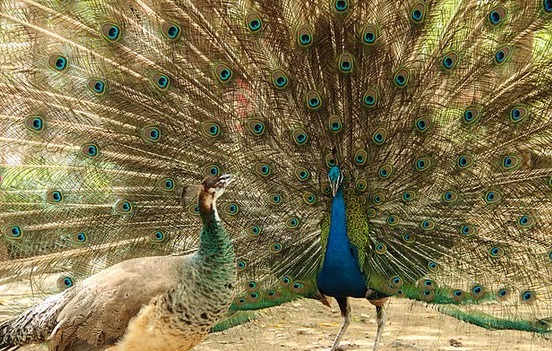
Beyond symmetry, the living world is replete with color and pattern that delight the human observer. The peacock’s iridescent train of feathers, marked with “eyes,” has been a classical example of beauty – even Charles Darwin admitted that the sight made him “sick” with wonder because it seemed excessive for mere survival. Flowers bloom with vivid hues and symmetrical petal arrangements to attract pollinators; yet they also attract human hearts and are mentioned in poetry and scripture as emblems of beauty and transience. The Qur’an likens the fleeting life of this world to the plant that “puts forth its adornment” but soon withers (10:24), implicitly acknowledging how attractive that adornment is. Human appreciation of such beauty is, from an Islamic perspective, not arbitrary: it is intentionally woven into the fabric of life. As one modern Muslim writer put it, nature’s positive aspects showcase God’s attributes – for example, the nurturing provision for creatures reflects Al-Razzāq (The Provider), and “the love in the universe, from motherly care to animal affection, reflects Al-Wadūd (The Loving One).” In the same way, the loveliness found in living organisms reflects Al-Jamīl, God’s beauty. There is, in Islamic thought, a profound unity between truth, goodness, and beauty (ḥaqq, khayr, jamāl): what God creates is true (real and purposeful), good (beneficial and balanced), and beautiful (aesthetically and harmoniously made).
Modern biology has only deepened the sense of amazement at life’s complexity – which, for believers, translates to amazement at the Creator’s artistry. Microscopic examination reveals “molecular machines” inside cells that are elegantly structured and highly efficient, akin to tiny engines and factories. The DNA molecule is often described as a genetic script or language – an information beauty – that to Muslims signifies the “Word” of God’s command (“Be, and it is”). The interdependence in ecosystems, where every species has a role (often beautiful, like bees pollinating flowers), speaks to a planned web of life. None of this is lost on Islamic scholarship. Centuries ago, Imam al-Ghazālī in his Iḥyā’ ‘Ulūm al-Dīn encouraged contemplating the wonders of the human body and animal kingdom as a way to increase faith in God. In recent times, thinkers like Said Nursi have written almost poetic theology about nature: “The universe is a great book and a marvelous work of God’s art; it is like a mirror that reflects the beauty of its Creator.” This metaphor of the “Book of Nature” implies that studying biology (or any science) can be an act of reading divine signs. Every leaf, feather, and fin is like a letter in that book, conveying meaning. If one approaches with an open heart and mind, the Qur’an promises that these signs will speak: “Indeed, in the creation of the heavens and earth, and the alternation of night and day, and the creatures God has spread on earth, are signs for people who use reason” (paraphrasing 45:3-5). Thus, the Islamic perspective does not see science and faith at odds; rather, scientific insights into life’s beauty enrich the spiritual narrative. When we marvel at a biological phenomenon – say the navigation of migrating birds by the stars, or the metamorphosis of a caterpillar into a butterfly with dazzling wings – we are, knowingly or not, stepping onto a path of wonder that can lead to God. As the Qur’an asks rhetorically, “Who is it that created and proportioned, who measured and guided?”
There is, ultimately, only one answer that satisfies both mind and soul.
The Cosmos: Order, Elegance, and the Sublime
If living organisms display micro-level beauty, the cosmos at large provides a spectacle of beauty on the grandest scale. The night sky spangled with stars, the graceful dance of planets, the structure of galaxies, and the laws that govern the universe all evoke what philosophers call the sublime – a mix of awe and almost fear at the vastness and majesty of it all. The Qur’an frequently points to celestial phenomena as signs of God. “He raised the sky and set the balance” (55:7) speaks to an ordered cosmos established with measure and justice. “The sun and moon [move] by precise calculation” (55:5) highlights the regularity of heavenly bodies – an idea confirmed by astronomy, where we see planets orbiting the sun with clockwork precision and galaxies rotating in elegant forms.
One of the most intriguing aspects of modern cosmology, from a theological perspective, is the fine-tuning of the universe. Scientists have discovered that the fundamental constants and initial conditions of the universe are astonishingly well-suited for the emergence of complex matter, life, and consciousness. If the strength of gravity, or the charge of an electron, or dozens of other parameters were even slightly different, stars might not form, the universe might collapse or expand too fast, atoms might not hold together – in short, we would not be here. Physicists describe this unlikely set of conditions as the “anthropic fine-tuning” of the cosmos. As one science writer summarized: “Physicists have recognized that the initial conditions and the laws and constants of physics are finely tuned, against all odds, to make life possible.” Even minute alterations in values (the expansion rate of the Big Bang, the mass of quarks, the strength of forces) would render the universe lifeless. Such facts have led many scientists to philosophical reflection. The distinguished astrophysicist Paul Davies openly states that “the impression of design is overwhelming” when examining the cosmos. Another, Sir Fred Hoyle, famously said that it was as if “a super‑intellect has monkeyed with physics.” For believers, this fine-tuning is nothing surprising – it is exactly what one would expect of a Creator described in the Qur’an as Al-Ḥakīm, the All-Wise, who creates with purpose and precision. The Qur’an asks: “Have they not looked at the sky above them – how We built it and adorned it, and [see] no rifts therein?” (50:6-7). The “no rifts” or no defects idea is very much in line with what modern cosmology finds: despite probing the vastness of space from the largest scales down to subatomic levels, scientists have not found any region where the basic laws of physics break down or become chaotic. Instead, there is a consistent unity of physical law everywhere we look, suggesting a single origin and governance. In Quranic terms, the heavens and earth “stand by His command” (30:25) – that is, they obey uniform divine laws.
Looking at the structure of the universe, we encounter more sources of wonder. Telescopic surveys have mapped galaxies across billions of light-years, revealing a weblike pattern: galaxies are clustered along filaments with huge voids in between, often described as a cosmic web. This is eerily reminiscent of the Qur’anic term “heaven with pathways” (51:7) and the classical notion (mentioned by early commentators) that the sky is “woven” like fabric. While we must be cautious not to over-interpret scripture with every new scientific discovery, the correspondence between the Qur’an’s imagery of a woven sky and the observed filamentary web of galaxy clusters is fascinating. At the very least, both convey a sense of organized complexity – a cosmos that is not a random sprinkling of matter, but has a patterned architecture. Moreover, our own galaxy, the Milky Way, is now known to be a near-symmetric spiral, with matching arms on either side. Recent data, as cited by an astronomy news source, show that the Milky Way is “a near-perfect mirror image of itself.”Such symmetry on the galactic scale resonates with the Islamic belief in a cosmic order reflecting divine order. The Qur’an’s frequent oaths by the sun, moon, stars, and sky (for example, see Surahs 91, 84, 53, etc.) serve to draw our attention to these heavenly beauties and underscore their significance as signs. By swearing upon them, God invites us to contemplate why they deserve an oath – what truth do they point toward? The answer given is that they point to His own reality and the truth of the message (for instance, the oath by the star in Qur’an 53 precedes the affirmation that the Prophet is indeed receiving revelation).
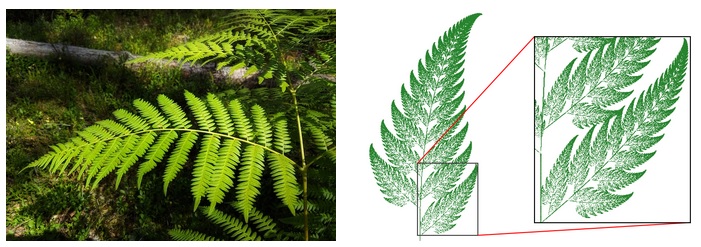
Fractal patterns – shapes that echo themselves at different scales – abound in nature, from the branching of ferns and trees to the structure of coastlines and clouds. The prevalence of such mathematical elegance in the natural world suggests an underlying order and intentionality, delighting both scientists and theologians.
Another dimension of cosmic beauty lies in mathematics – the abstract patterns that underpin physical reality. It has often been noted that nature seems to follow mathematical principles, which themselves are elegant and beautiful. Symmetry is one example we discussed; another is fractals and patterns in nature. A fractal is a structure that shows self-similarity on different scales. Remarkably, nature is full of fractals: the outline of a mountain range or a coastline, when viewed from afar, has a roughness and jaggedness that looks similar even when you zoom in to a small portion of it. Plant structures are classic examples: “many of nature’s objects are fractal, featuring patterns that repeat at increasingly fine magnifications. For example, think of a tree – big branches sprout from the trunk, then smaller branches from the big ones, then twigs from the branches. Other examples of nature’s fractals include clouds, rivers, coastlines and mountains.” The fern leaf in the figure above illustrates this: each leaflet is shaped like a miniature version of the whole frond. The Romanesco broccoli (an edible plant) is another famous example – its cone-shaped head is covered in spiral nodules, each of which is a smaller cone with its own spirals, and so on, creating a mesmerizing near-perfect fractal. Such patterns are useful (a branching tree maximizes sunlight exposure, a lung’s branching bronchi maximize air intake surface), but they are also visually striking. Why should utility and beauty coincide so often? To a believer, this is no coincidence at all. It speaks of a Designer who has imbued the universe with both pragmatism and aesthetics.
Mathematical elegance appears even in the laws of physics. The equations that describe gravity, electromagnetism, or quantum mechanics are often hailed as beautiful by physicists – a kind of intellectual beauty marked by symmetry, simplicity, and depth. This hearkens back to the Islamic conviction that Allah created everything with miẓān (a balance/measure, 55:7) and that He has ordained all things with precise measure (Qur’an 54:49). A contemporary Muslim scientist, Ard Louis, and colleagues at Oxford University found evidence that the space of possible forms is biased toward simpler, symmetric ones, leading them to suggest that “Mother Nature plays favorites and believes in the elegance of simplicity.” In their research on protein structures and RNA, they observed a “startling bias towards simple structural symmetry” in what actual nature produces, compared to the countless chaotic possibilities that are theoretically available. This is a scientific way of saying: nature seems to prefer beauty. In Islamic terms, one might say Allah’s sunna (way) in creation is to favor iḥsān – excellence and beauty. Such findings delight Muslim thinkers because they bridge the empirical with the spiritual: they show a tangible tendency toward order, hinting that the universe is not random at its core but lovingly crafted.
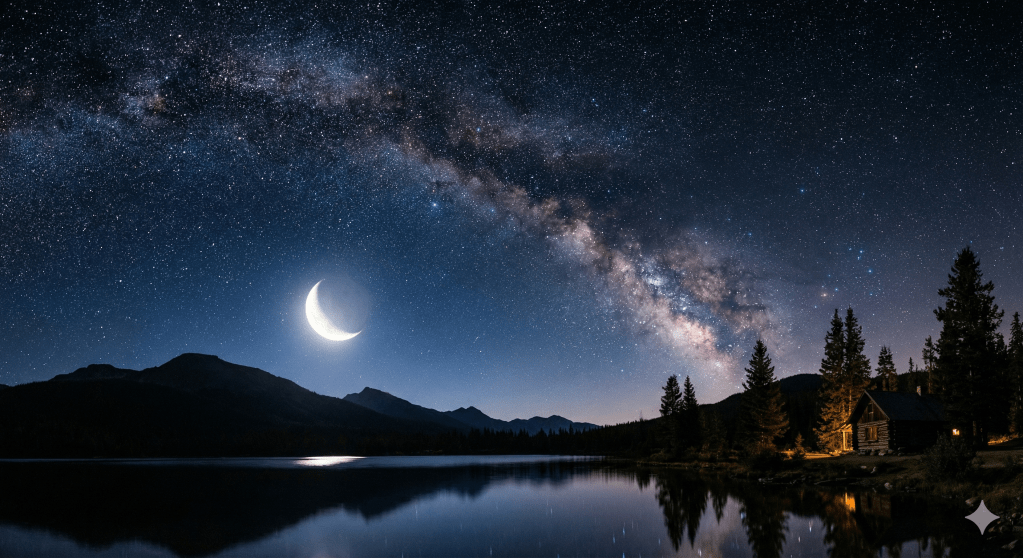
Finally, when speaking of the cosmos, we must mention the sense of awe it instills. The Qur’an encourages a kind of cosmic spirituality. “Indeed, in the creation of the heavens and the earth and the alternation of night and day are signs for those who reflect. Those who remember Allah standing, sitting, and lying on their sides and reflect on the creation of the heavens and the earth [saying]: Our Lord, You did not create this in vain, glory be to You!” (3:190-191). This passage ties together rational reflection, spiritual remembrance, and moral conclusion – the believers conclude that such a magnificent creation cannot be purposeless or devoid of truth. The night sky in particular has humbled humans in every age. We now know the stars are suns like our own, scattered across unimaginable distances, and that we inhabit one galaxy among billions. Yet, as our knowledge grows, so can our wonder. A believer sees in the vastness of space a reflection of the divine attribute al-Kabīr (The Incomparably Great) and in the brilliance of stars a reflection of al-Nūr (The Light, another Name of God). The American astronomer Allan Sandage, a pioneer in cosmology who converted to Christianity late in life, said science can only explain so much: “It was my science that drove me to the conclusion that the world is much more complicated than can be explained by science… It is only through the supernatural that I can understand the mystery of existence.” Likewise, many Muslim scientists historically pursued astronomy not only for calendars and navigation, but to “know God” through His creation – a tradition going back to Qur’anic verses and the injunctions of the Prophet to contemplate nature.
Patterns and Aesthetics in Nature: Symmetry, Fractals, and Beyond
Delving further into the notion of aesthetics in nature, we find that the natural world doesn’t just function well – it looks and feels spectacularly beautiful to the human observer. This aesthetic dimension is itself a sign of the spiritual linkage between human beings and the rest of creation. Islamic thought posits that humans, being endowed with a soul and an innate disposition (fiṭrah), are naturally inclined to appreciate beauty and to be moved by it towards truth. The Prophet Muhammad ﷺ said: “God is Beautiful and loves beauty,” and by extension, God placed in human hearts a love for beauty. When we encounter certain patterns or scenes in nature, it resonates at a deep level – almost as if we recognize a part of our original home (the abode of the Creator’s beauty). Philosophers and psychologists today observe a similar phenomenon: experiences of awe and beauty in nature can have profound effects on the human psyche. They often trigger a sense of connectedness and meaning. Research has shown that “experiences of awe in nature can boost both our feeling of connectedness to others and also a sense of spiritual fulfillment.” Crucially, these experiences motivate us to search for explanations beyond ourselves. One psychologist describes awe as an “epistemic” (knowledge-seeking) emotion: it “challenges a person’s existing understanding of things and motivates a search for explanations, both scientific and religious.” How fascinating that secular studies confirm what revelation has been saying: that wonder can be a pathway to knowledge and to God.
Consider how universal this response to natural beauty is. People from any faith or even no faith at all often describe spiritual-like feelings when standing before a grand canyon, a tranquil forest, or a starry firmament. A recent Pew Research Center study found that 93% of Americans, for example, report feeling a sense of awe in nature at least a few times a year, and a majority associate those moments with spiritual peace and wonder. Such statistics illustrate that the “Book of Nature” speaks a common language, touching the soul irrespective of formal creed. Islam teaches that this is part of God’s mercy: He has made the signs so plentiful and accessible that any sincere seeker can find pointers to Him. The beauty in nature is like a gentle invitation, a constant reminder that “this is not all there is – look higher!” The Qur’an often uses the beauty of nature as a prelude to talking about the Hereafter or higher realities, precisely because it lifts the gaze from worldly preoccupations. The lush descriptions of paradise in the Qur’an (gardens beneath which rivers flow, fruit-laden trees, pleasant shade, etc.) also indicate that what we find beautiful here is a mere preview of the perfect beauty in the presence of God.
Muslim philosophers have long reflected on why humans find certain patterns beautiful. Symmetry is one; order within complexity is another. We’ve discussed symmetry and fractals; let’s also note geometric patterns and rhythms. Snowflakes are exquisitely patterned crystals of water, each unique but all six-pointed – one might see in that a tiny signature of the Divine Artisan. Seashells often follow a logarithmic spiral, a form that mathematicians find in many growth patterns; it’s both efficient for the mollusk and elegant in shape. The field of biomimetics (design inspired by nature) often succeeds because nature’s designs are both effective and aesthetically optimized. For example, the structure of a lotus leaf, which causes water to bead and roll off (self-cleaning), has inspired water-repellent coatings; interestingly, the lotus is also a symbol of purity and beauty in many cultures. To a believer, it is not coincidental that something functional is also beautiful – it is by divine design. The Islamic arts themselves reflect this philosophy: Muslim architecture and decoration favor geometric patterns, calligraphy, and arabesque designs (stylized plant motifs). These forms echo natural patterns (stars, flowers, vines) and are meant to draw the mind toward the infinite and the perfect. In mosques, such art creates an ambience where the worshipper senses the order and beauty of the universe and thus the greatness of the Creator. In fact, the very avoidance of realistic images in Islamic art (partly due to religious discouragement of idolatry) led to a flowering of geometric and arabesque art, which can be seen as an extension of the mathematical beauty of nature. The muqarnas (stalactite vaulting) in mosque domes, the intricate tile work, the rosette patterns – all these mirror natural symmetry and complexity, effectively bringing the outside “signs” inside a sacred space.
From a theological angle, all these patterns and aesthetics serve as reminders of God (tadhkira). The Qur’an says, “And whatever He has multiplied for you on earth of varying colors (and patterns), surely in that is a sign for people who take heed” (16:13). Colors and patterns are explicitly mentioned as containing signs. The late scholar Said Nursi wrote that every species in nature is like a letter from God, teaching us something about Him: the beauty of a rose teaches about His mercy and gentleness, the might of a lion about His majesty, the order of the heavens about His knowledge and power, and so on. In the Islamic spiritual tradition (Sufism), followers are often encouraged to engage in contemplation of nature (tafakkur) as a practice to sharpen their awareness of God. There is even a saying attributed to the Prophet (though its chain of narration is debated) that “An hour of reflection on the signs of God is better than a year of voluntary worship.” While the authenticity of this statement is unsure, its wisdom resonates with Qur’anic teachings. Through observing the beauty of a sunset, the pattern of leaves, or the cycle of seasons, a person can experience khashyah (reverent awe) of Allah, which the Qur’an often says is the mark of the true scholar of nature: “Indeed, of God’s servants, only those with knowledge truly fear Him” (35:28). Interestingly, that verse comes right after mentioning the marvels of rain, plants, and color diversity in nature – implying that studying these marvels leads to a heartfelt awe of God.
Philosophical and Theological Reflections: From Aesthetic Awe to the Divine
What is it about beauty that makes it such a powerful pointer to God? Philosophically, one could argue that beauty implies meaning. When we perceive beauty – say the graceful motion of galaxies or the complexity of a living cell – we intuit an underlying order and rightness. Beauty has a way of assuring us that there is purpose and coherence in what we are seeing. As some philosophers have put it, beauty is “goodness made manifest to the senses.” In Islamic theology, the concept of Ḥikmah (wisdom) is very close to this idea: everything God creates has wisdom and reason behind it, and beauty is often the garb of that wisdom. The orderliness of the universe (what philosophers call the cosmos as opposed to chaos) naturally suggests an orderer. This is essentially the classic teleological argument (argument from design) for God’s existence, which was articulated by Muslim thinkers centuries ago (often termed dalīl al-ʿināyah, the argument from providence, by thinkers like Ibn Rushd/Averroes). They observed that inorganic nature follows laws (like water cycling, winds bringing rain to revive dead land, as mentioned in Qur’an 30:48), and organic nature follows patterns (like animals having the tools to live in their environments), all of which indicate “ʿināyah” – care or providence – a sign of an ʿAlīm (All-Knowing) and Raḥīm (Merciful) Creator. Beauty strengthens this argument by adding an emotional and experiential dimension to what might otherwise be a dry rational inference. It’s one thing to argue that the eye’s complex design implies a designer; it’s another to stand in awe of a magnificent sunset and feel in your soul that “this cannot be an accident.” Both are valid insights, and together they appeal to the whole human being – mind and heart.
Seyyed Hossein Nasr, a prominent contemporary Islamic philosopher, touches on this in an interview: he describes how natural scenes like “the tranquility of a placid lake or the vibrating rays of the morning sun on mountain peaks” can “evoke in man a sense of peace and the joy of a beauty which melts the hardness of the human soul.” He calls this joy “the mark of eternity as it touches the human soul.” Nasr’s insight is that the experience of beauty in nature is a moment of transcendence – our soul recognizes something eternal (God’s attributes) shining through the temporal. It softens our hearts, making us more receptive to spiritual truths. Many people have reported that moments of natural beauty spontaneously made them “feel close to God” or prompted them to pray after a long time of neglecting prayer. Such is the gentle but profound effect of beauty. It bypasses intellectual defenses and speaks directly to the spirit. The Qur’an alludes to this transformative power in verse 67:4 when it says the gaze will return “humbled” – the root kh-sh-ʿ in Arabic implies awe that leads to submission or humility. When one truly senses the vastness and perfection of creation, pride and heedlessness are shaken off; what enters is a reverence and readiness to acknowledge a higher power.
For a general audience, one might simply note: when we see a beautiful painting, we naturally infer a talented painter; when we hear a moving symphony, we assume a skilled composer. How much more, then, when we witness the Symphony of Life or the Canvas of the Cosmos – should we not naturally be led to the supreme Composer and Artist? The Qur’an actually uses a similar line of reasoning: “[Allah is] the One who made for you the earth as a carpet and the sky as a canopy, and formed you and perfected your forms” (40:64). By pairing the environment and our own form in one statement, it’s drawing attention to an integrated artistry. We are part of this artwork, and uniquely, we can appreciate the artwork. This self-referential ability (the universe beholding itself through our eyes) is itself seen by some Muslim thinkers as a sign that the Creator intended to be known. The universe is not just beautiful; it births conscious beings who can perceive that beauty – a double miracle, so to speak. This idea resonates with the anthropic principle in cosmology, which notes the universe seems set up for observers. From the Islamic viewpoint, God created the world to be known and loved, and created humans with the capacity to know and love Him. Natural beauty is one of the meeting points of this relationship: we see the traces of the Beloved’s attributes in nature and are drawn to Him.
Modern Muslim thinkers often emphasize environmental consciousness and appreciation of nature as a form of worship. The environmental crisis has spurred a return to teachings that humans are stewards (khalīfa) of the earth, and that respecting the beauty of creation is respecting the signs of God. Fazlun Khalid and other Islamic environmentalists cite Qur’anic verses about the balance of nature and warn that when we damage the beauty and balance of ecosystems, we are in fact disregarding God’s signs and trust. This contemporary development shows that the sense of sacredness and beauty in nature has practical implications: it calls for gratitude (shukr) and responsible action (amānah). If an artist loaned you a magnificent artwork, you would handle it with care – so how about the artwork all around us created by God?
In summary, beauty in nature serves as a gentle yet persistent call toward faith. It engages the aesthetic, rational, ethical, and spiritual dimensions of the human being: the eyes delight, the mind discerns patterns, the conscience feels grateful and responsible, and the soul senses the divine. The Qur’an encapsulates this in verses like: “And on the earth are signs for the certain [of faith], and in yourselves – do you not see?” (51:20-21). To “see” in this context is to perceive with insight (basīrah), not just physical sight (baṣar). When a person trains themselves to look at a garden, a forest, or a night sky and see more than just matter – to see a sign – they are walking the path of the prophets and sages. The world becomes transparent, as it were, to the Light of God that sustains it.
Conclusion
Islamic tradition, from the Qur’an through classical scholarship to modern thought, presents the natural world as a meaningful and beautiful tapestry woven by God. The beauty in nature leads to God in multiple, reinforcing ways: through intellectual inference of design, through spiritual awe and intuition, through moral lessons drawn from natural phenomena, and through the sheer gratitude inspired by living in such a well-crafted cosmos. Qur’anic verses like 32:7 and 59:24 remind us that the Creator has perfected and formed every thing, which encourages the believer to expect – and seek out – perfection and purpose everywhere around us. Classical tafsīr scholars pointed to the meticulous ordering of the heavens and the careful proportioning of creatures as evidence that “none of this is in vain.” Modern Muslim thinkers, engaging with science, have only amplified this chorus by highlighting discoveries like DNA’s information code or the fine-tuning of physical constants, seeing in them the updated “signs on the horizons and within ourselves.”
In a time where some dismiss the world as an accident of blind forces, the Islamic perspective offers a refreshing alternative: the world is a painting of God, beautiful and intentional. Our role is to be the appreciative spectators who then turn that appreciation into worship of the Artist. As one Muslim author wrote, God “has created these fascinating and sophisticated creatures and shapes to enable people to know, love, and believe in Him.” In other words, beauty is a bridge from creation to the Creator. Each of us has the capacity to walk that bridge – to let the quiet majesty of a forest or the intricate design of a butterfly wing remind us of truths sometimes forgotten in daily life. The next time one feels a surge of awe at a scenic vista or a microscopic marvel, Islamic wisdom would whisper: don’t stop at the creation, let your heart fly to the Creator. Like a signpost, the beauty before you points beyond itself.
The Qur’an beautifully states: “Allah is the Light of the heavens and the earth” (24:35). Many have interpreted this to mean that God is the source of all illumination – physical and metaphysical – in the universe. Beauty is a form of light that illuminates the soul. By appreciating the beauty in nature as a sign of God, one’s journey through the world becomes peppered with moments of transcendence. Rather than an aimless meander, it becomes a purposeful trek toward knowledge (maʿrifah) and love of the Divine. This integrative vision, accessible to both the layperson and the scholar, is one of Islam’s enduring contributions: to heal the rift between science and spirit, between understanding the world and revering the One who made it.
If the anesthesia of familiarity does not numb us, the world’s beauty is not merely eye-candy; it is soul-food – nourishing the deepest hunger of the human spirit, which is to know Why and Who. And for those who listen, every rustling leaf and shining star can be heard reciting, in silent witness, the words: “This is the handiwork of Allah, who has perfected all things.”
Sources:
- The Qur’an, translated (32:7, 59:24, 67:3-4, 30:22, 16:6, 95:4, 40:64, etc.)
- Tafsir al-Qurtubi and other classical commentaries on Qur’an 32:7islamqa.info and 67:3-4 thequran.love.
- Maududi, Tafheem al-Qur’an, commentary on 32:7 (footnote) islamicstudies.info.
- Zeki Saritoprak, “Nature: a book to be contemplated” – The Fountain Magazine fountainmagazine.com.
- Wisconsin Muslim Journal, “Symmetry: Perfections of Nature & Beauty of Science” (Islamic perspectives on symmetry in nature) wisconsinmuslimjournal.org.
- Seyyed Hossein Nasr, Knowledge and the Sacred (on beauty and the sense of the eternal) shiavault.com.
- Bediüzzaman Said Nursi, Risale-i Nur (on the universe as a mirror to God’s beauty) ejournal.stainkepri.ac.id.
- Richard Taylor, “Fractal Patterns in Nature and Art…” – Smithsonian Magazine smithsonianmag.com (on fractals in nature).
- John Walker, “Fractal Food – Romanesco Broccoli” (fractal patterns from cosmos to cauliflower) fourmilab.ch.
- Oxford University news, “Nature prefers symmetry and simplicity” (study on symmetry bias in evolution) ox.ac.uk.
- Stephen Meyer, Evolution News, “Anthropic Fine-Tuning as Evidence of Design” evolutionnews.org.
- T. Ryan Byerly, Psyche article on awe in nature and spirituality psyche.copsyche.co.
- Quranic commentary – The Glorious Quran and Science (thequran.love) on Quran 67:3-4 thequran.love.
- Islam Q&A fatwa 248116 (commentary on 32:7) islamqa.info.
These sources and reflections collectively illustrate how, in the Islamic worldview, the beauty woven through nature’s every fiber is one of the surest guides leading humanity to an appreciation of God’s glory, wisdom, and love. Through observing, studying, and reflecting on these signs, one finds that the journey to understanding the creation becomes a journey to knowing the Creator – a journey that is both rational and deeply poetic, scientific and profoundly spiritual.




 The Glorious Quran and Science
Leave a reply to Zia H Shah Cancel reply