
Written and collected by Zia H Shah MD
Abstract
This article presents a comprehensive commentary on Ayat al-Kursī (Qur’an 2:255), famously known as the “Throne Verse” and regarded as the greatest verse of the Qur’anabuaminaelias.com. We examine its profound theological affirmations – God’s absolute oneness, eternal life, omnipotence, omniscience, and all-sustaining power – through classical Islamic teachings and modern intellectual lenses. The commentary highlights how this single verse encapsulates tawḥīd (Divine Unity) in its purest form and anticipates the philosophical doctrine of Occasionalism – the idea that no created thing has independent causal power and that all events occur by God’s direct willthequran.lovethequran.love. Drawing on scholarly insights (notably the works of Zia H. Shah MD) and scientific reflections, we explore how Ayat al-Kursī portrays Allah as the moment-to-moment sustainer of reality, not a distant clockmaker who set the universe in motion and left it to runthequran.love. We relate this to modern science and cosmology: the verse’s implication that the cosmos would collapse without God’s preserving command resonates with contemporary notions of a finely tuned universe dependent on precise constantsthequran.love. Throughout, we integrate classical exegesis with philosophy and science – discussing how natural laws can be seen as sunnat Allāh (God’s customary practice) rather than autonomous forcesthequran.lovethequran.love. In conclusion (the Epilogue), we reflect on the enduring relevance of Ayat al-Kursī’s message. It inspires intellectual humility and spiritual awe: encouraging us to study the patterns of nature scientifically, yet always remaining conscious of the Divine agency behind all phenomena. This holistic commentary thus bridges traditional theology, philosophical thought, and scientific insight to appreciate the timeless wisdom of the “Crown Verse” of the Glorious Qur’an.
Introduction
Islamic tradition holds Ayat al-Kursī in unparalleled esteem. The Prophet Muhammad (peace be upon him) directly identified this verse as the greatest in the entire Quran – when he asked his companion Ubayy ibn Ka’b which Qur’anic verse was supreme, Ubayy recited Ayat al-Kursī, and the Prophet rejoiced at his knowledgeabuaminaelias.com. The verse is treasured for its comprehensive description of Allah’s transcendence and immanence. It is often called the “Throne Verse” (Āyat al-Kursī) because it mentions God’s Kursī (often translated as “Throne” or dominion) extending over the heavens and earth. Many Muslims memorize and recite it daily for spiritual protection and reflection, as it is said to ward off evil and encapsulate the essence of tawḥīd (pure monotheism)yaqeeninstitute.orgislamqa.info. Below, we quote the verse in the original Arabic, alongside the English translation by M.A.S. Abdel Haleem, before delving into a detailed analysis:
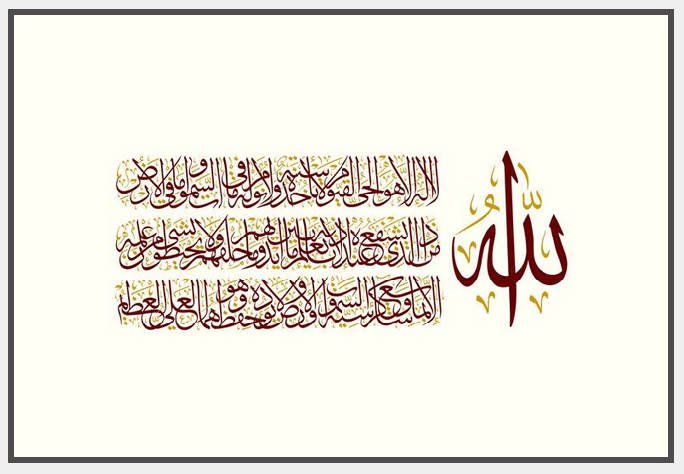
اللَّهُ لَآ إِلَـٰهَ إِلَّا هُوَ ٱلْحَىُّ ٱلْقَيُّومُۚ لَا تَأْخُذُهُۥ سِنَةٌۭ وَلَا نَوْمٌۭۚ لَّهُۥ مَا فِى ٱلسَّمَـٰوَٰتِ وَمَا فِى ٱلْأَرْضِۗ مَن ذَا ٱلَّذِى يَشْفَعُ عِندَهُۥٓ إِلَّا بِإِذْنِهِۦۚ يَعْلَمُ مَا بَيْنَ أَيْدِيهِمْ وَمَا خَلْفَهُمْۖ وَلَا يُحِيطُونَ بِشَىْءٍۢ مِّنْ عِلْمِهِۦٓ إِلَّا بِمَا شَآءَۚ وَسِعَ كُرْسِيُّهُ ٱلسَّمَـٰوَٰتِ وَٱلْأَرْضَۖ وَلَا يَـُٔودُهُۥ حِفْظُهُمَاۚ وَهُوَ ٱلْعَلِىُّ ٱلْعَظِيمُ
“God: there is no god but Him, the Ever Living, the Ever Watchful. Neither slumber nor sleep overtakes Him. All that is in the heavens and in the earth belongs to Him. Who is there that can intercede with Him except by His leave? He knows what is before them and what is behind them, but they do not comprehend any of His knowledge except what He wills. His throne extends over the heavens and the earth; it does not weary Him to preserve them both. He is the Most High, the Tremendous.”islamawakened.com
In this single verse, the Qur’an conveys a panorama of theology: Allah’s exclusive divinity, His eternal life and self-sustaining nature, His unfailing vigilance, total sovereignty, limitless knowledge, and effortless power over the universe. These attributes establish a worldview in which every aspect of existence is undergirded by God at every moment. Classical Islamic scholars have written extensively on Ayat al-Kursī’s meaning, often noting how it negates any notion of weakness or limitation in God and excludes any rival to His rule. For example, the verse declares that God never tires or sleeps, subtly contrasting the Islamic God with deities of other traditions who rest or sleep. It emphasizes that nothing – not even the subtlest motion of a particle or the plea of a supplicant – lies outside His ownership and permission.
Notably, Ayat al-Kursī has also attracted philosophical commentary because it so powerfully asserts continuous divine sustainment. Islamic theologians of the Ash‘arī school (like Imām al-Ghazālī) saw in verses like this a confirmation that causality itself is rooted in God’s constant will, not in created objects. In other words, it is not merely that God created the universe and endowed it with fixed laws; rather, God actively maintains and governs every event in the universe at each instantthequran.lovethequran.love. This view, known as Occasionalism, holds that what we call “natural laws” or cause-and-effect are ultimately the habits of Allah – regularities He continuously ordains, which could be altered at any time according to His wisdomthequran.lovethequran.love. As we explore the components of Ayat al-Kursī in detail, we will see how its language vividly supports this perspective. We will also draw parallels to modern scientific insights: for instance, how the verse’s depiction of a universe upheld solely by God’s command finds an unexpected resonance in contemporary discussions about the fine-tuned cosmos and even the “Simulation Hypothesis” in philosophy – the idea that our reality might be like a computer program that requires a continuous Programmer to runthequran.love. Through this interdisciplinary approach, we aim to appreciate the Crown Verse of the Qur’an as not only a pillar of Islamic spirituality, but also a rich text engaging enduring questions in metaphysics and science.
In the following sections, we break down the verse’s phrases and themes, analyzing each through three lenses: (1) classical Islamic theology and Qur’anic exegesis, (2) philosophical implications (with a focus on Occasionalism and the nature of causality), and (3) reflections in light of modern science and reason. Finally, a thematic epilogue will tie together these insights, reflecting on what Ayat al-Kursī means for believers today in balancing scientific inquiry with faith in the ultimate Divine Agency.
Read further in Microsoft Word file:

 The Glorious Quran and Science
Leave a comment