
Written and collected by Zia H Shah MD, Chief Editor of the Muslim Times
Abstract
The story of Moses leading the Israelites out of Egypt (“the Exodus”) is recounted in both the Bible and the Quran, but with notable differences. One striking divergence is the number of people said to participate. The Bible explicitly numbers the Israelites in the hundreds of thousands, implying a total population of over two million, whereas the Quran never quantifies the Israelites and even portrays them as a relatively small group. This report summarizes the Exodus narrative as described in the Bible and the Quran, then presents evidence — demographic, historical, and archaeological — showing that the biblical figure (around 2–3 million people) is highly implausible for the time. The analysis supports the Quran’s account by highlighting that it avoids the numerical exaggeration found in the biblical tradition.
The Exodus in the Bible
In the Biblical account, the Israelites had lived in Egypt for generations and grown numerous, which alarmed the Pharaoh (Exodus 1). God sent Moses to demand their release, and when Pharaoh resisted, Egypt was struck by ten divine plagues. Finally, Pharaoh let the Israelites go, and they departed en masse. The Bible famously records specific numbers for this Exodus: “about six hundred thousand men on foot, aside from children” left Egypt with Moses (Exodus 12:37)hermeneutics.stackexchange.com. This count of 600,000 adult males does not include women and children. In the Book of Numbers, a census of the tribes confirms “all the numbered men were 603,550” (Numbers 1:46)hermeneutics.stackexchange.com, not counting the Levites. These figures have led to the common interpretation that the total Israelite population exiting Egypt was on the order of two to three million people when women and children are included hermeneutics.stackexchange.com.
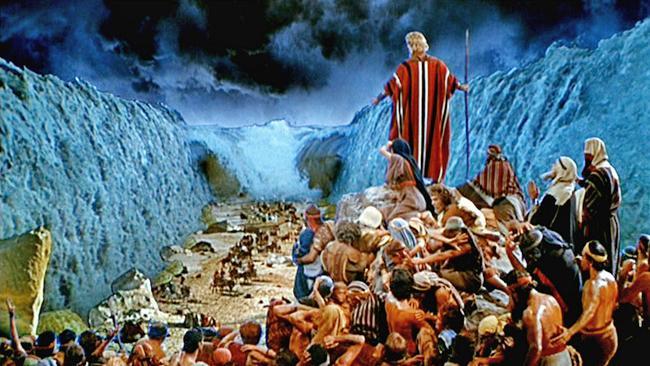
After leaving, according to Exodus, the Israelites camped by the Red Sea. Pharaoh’s army pursued them, but Moses parted the sea with divine help, allowing the Israelites to cross on dry ground; the waters then rushed back, drowning Pharaoh’s chariots and troops ehrmanblog.orgehrmanblog.org. The Israelites then journeyed through the Sinai wilderness toward Canaan. Notably, the biblical narrative repeats the huge numbers in various ways: for example, Moses later remarks, “The people with me are 600,000 men on foot” (Numbers 11:21) hermeneutics.stackexchange.com. The Torah even gives the number of firstborn Israelite males (about 22,273 – see Numbers 3:43), which, when compared to the 600,000 figure, implies astonishingly large family sizes thetorah.com. Despite these multitudes, the Bible describes the Israelites as a people chosen by God not for their numbers but by grace, calling them “the fewest of all peoples” (Deuteronomy 7:7) thetorah.com – a statement that sits oddly beside the idea of a nation of millions.
The Exodus in the Quran
The Quranic account of Moses and the Exodus appears across multiple chapters (Surahs), conveying the same basic storyline – Pharaoh’s oppression of the Israelites, God’s command to Moses to lead them out, the miraculous parting of the sea, and the destruction of Pharaoh’s forces – but without any numerical figures for the Israelite population. The Quran focuses on the signs and lessons of the story rather than demographic details. For example, the Quran relates that God inspired Moses, “Set forth with My servants by night, for you will be pursued,” and Pharaoh indeed mobilized his forces to catch them islamicstudies.info. At this point the Quran has Pharaoh’s couriers announce: “These Israelites are only a small band of people, and they have surely enraged us; but we are a multitude on our guard” islamicstudies.info. In other words, the Quran portrays the Israelites as a modest-sized group, especially in comparison to Pharaoh’s hosts. The escape then unfolds similarly to the Bible: Moses strikes the sea with his staff at God’s command, “thereupon the sea split, each part like a towering mountain,” and the Israelites pass through safely, after which “We drowned the others (Pharaoh’s army)” islamicstudies.info. The Quran recounts that the Children of Israel were delivered from Pharaoh’s tyranny and inherited the land, without ever attaching a number to their multitude. This absence of exaggerated numbers in the Quranic narrative means it does not encounter the historical problems that arise from the biblical numbers. The emphasis is on God’s deliverance and the moral/spiritual lessons (faith in God, arrogance of Pharaoh, etc.), rather than on census data.
Summary of Key Differences: In the Bible’s Exodus, the text explicitly numbers the Israelites (600,000 fighting men, suggesting 2+ million people total) hermeneutics.stackexchange.com hermeneutics.stackexchange.com. In the Quran, the Exodus story is told multiple times with great detail about the confrontation with Pharaoh, the parting of the sea, and the salvation of the Israelites, but it never specifies how many Israelites fled Egypt. On the contrary, the Quran implies the group was not large by using phrases like “small band” for the Israelites islamicstudies.info. This difference has significant implications when we consider historical and scientific evidence, as discussed next.
Historical Impossibility of a 2-Million Person Exodus
Scholars and historians have long noted that if the biblical number of Israelites is taken literally, it presents serious demographic and historical implausibilities. Here are several evidence-based points that demonstrate why an exodus of ~2 million people is highly problematic given the context of the Late Bronze Age (the era in which Moses is usually placed):
- Unprecedented Population Growth: The Bible says the Israelites in Egypt descended from a family of just “70 persons” (Exodus 1:5) who originally migrated in Jacob’s time ehrmanblog.org. Yet by the time of Moses (just a few generations later, according to the Bible’s own chronology) they supposedly numbered well over two million. Such explosive growth is biologically and historically implausible. Even with unusually high birth rates, expanding from dozens to millions in only a few centuries (or in four generations, as Exodus 6:16–20 traces Moses’ lineage ehrmanblog.org) would far exceed normal population dynamics. The Torah’s later attempt to explain this by suggesting extraordinarily large families (e.g. a single mother bearing 30 or more sons on average thetorah.com) strains credulity. No other population in antiquity is known to have grown at anything close to this rate.
- Out of Scale with Ancient World Populations: A group of 2–3 million Israelites around 1200–1400 BCE would have constituted a very large proportion of the entire world’s population at that time. Modern estimates suggest the world population in the Late Bronze Age was on the order of only tens of millions in total (perhaps ~40–50 million) accuracyingenesis.com. Closer to home, Egypt’s population during the New Kingdom period is estimated at roughly 2.5 to 4 million people in total thetorah.comehrmanblog.org. It beggars belief that a subjugated minority within Egypt could itself number ~2 million (meaning they would be the majority of Egypt’s inhabitants!). Indeed, Egyptological studies put the number of all slaves in Egypt far lower – on the order of perhaps a couple hundred thousand at most thetorah.comthetorah.com – and the Israelites would have been only a fraction of the slave population. In short, the biblical figure would imply the Israelites were a nation as large as or larger than Egypt itself, which is not supported by any demographic data. As one historian notes, the entire Egyptian populace at that time was only “somewhere between two and four million people” ehrmanblog.org – obviously they could not all have been Israelites who left.
- Militarily Inconceivable: 600,000 adult male Israelites implies an army of over half a million fighting men. To put this in perspective, no known army in antiquity ever approached such a size. Ancient empires like Egypt, the Hittites, or Assyria could field armies in the tens of thousands at most – a force of ~20,000 soldiers was considered a large army in that era ehrmanblog.org. The idea that an enslaved people could secretly harbor a military-age male population of over 600,000 is extremely dubious. Even the Bible itself elsewhere portrays Israel as small and weak compared to other nations (for example, “the fewest of all peoples” as mentioned in Deuteronomy 7:7) thetorah.com. If Israel really had a population in the millions and an army larger than any on earth, that description would make little sense. Furthermore, had 600,000 armed Israelites existed, they could have overwhelmed Egypt or Canaan with ease, yet the biblical story emphasizes their fear and inability to enter Canaan without divine help, again underscoring the inconsistency. Modern scholars generally conclude that the “600,000” figure is symbolic or exaggerated thetorah.com thetorah.com, possibly a later scribal addition or misunderstanding (the Hebrew word “elef” might have originally meant a smaller unit like a clan or troop rather than “thousand” thetorah.com gotquestions.org). Some proposals suggest the actual number of escaping Israelites could have been only a few thousand or even a few hundred people – much more in line with historical plausibility en.wikipedia.org.
- No Historical Records of a Collapse: If two to three million people had fled Egypt in one mass migration, and if Pharaoh’s entire army was destroyed in pursuit (as Exodus relates), we would expect some record or reaction in the broader history of the region. Egypt was one of the great powers of the world at the time, and the sudden loss of perhaps half its population and its military would have been an earth-shaking event. Neighboring nations – the Hittites, Canaanites, Assyrians, etc. – would surely have taken note if Egypt had essentially imploded. As one scholar points out, rival powers “would have been ecstatic to learn that Egypt could no longer field an army” and would have rushed in to exploit the power vacuum ehrmanblog.org. Yet we have no writings from other civilizations remarking on Egypt’s sudden downfall, nor evidence of an invasion of a weakened Egypt. On the contrary, Egyptian records and neighboring histories show Egypt continuing as a strong kingdom in the presumed time after the Exodus. For example, Pharaoh Ramses II (often associated with the Exodus story) and his successors like Merneptah remained powerful – indeed, Merneptah’s own stele boasts of military victories in Canaan around 1207 BCE, with “Israel…wasted, its seed is not” (the earliest mention of Israel in Egyptian records) but no hint that Israel had just departed from Egypt in vast numbers biblicalarchaeology.org biblicalarchaeology.org. If Pharaoh’s army had really been annihilated in the sea and Egypt stripped of its slave workforce, such accomplishments would be inexplicable. The logical conclusion is that no such catastrophic exodus occurred as described by those numbersehrmanblog.org ehrmanblog.org.
- Lack of Archaeological Evidence: Perhaps most telling, extensive archaeological investigations have found no trace of an event of the biblical Exodus’s scale. The Israelites are said to have wandered in the Sinai Desert for 40 years. A population of 2 million camping for decades in any region would leave behind enormous amounts of physical evidence – pottery shards, campsites, graves, remnants of food and livestock, tools, weapons, and so on. Archaeologists have intensively surveyed likely routes of the Exodus (the Sinai Peninsula and adjoining areas) and have not discovered remains consistent with a migrating nation of that size thetorah.com ehrmanblog.org. As Professor Avraham Faust notes, “such a massive amount of people living [in the desert] for forty years would have left a trace” thetorah.com – yet no such trace has been found. Similarly, no underwater evidence of chariots or weapons has surfaced at the Red Sea (or Sea of Reeds) crossing site ehrmanblog.org, despite some popular fringe theories. The archaeological silence strongly implies that the wilderness was never host to millions of Israelites. (This doesn’t rule out that a smaller group may have made an exodus; indeed, many scholars think a small band of Semitic travelers could lie behind the story en.wikipedia.org, which would leave little archaeological footprint. But the biblical numbers in the hundreds of thousands are not supported by the physical evidence.)
- Internal Biblical Clues: Even within the Bible, certain details conflict with the idea of an Israelite multitude in the millions. We have already mentioned God’s words in Deuteronomy that Israel was “the fewest of all peoples,” and the song of Deborah in Judges 5 which musters only 40,000 Israelite warriors generations after the Exodus thetorah.com. Another internal inconsistency is the number of firstborn males. Numbers 3:43 records that, shortly after the Exodus, there were 22,273 firstborn sons among the Israelites. If there were ~600,000 adult men, one would expect far more firstborns (roughly one firstborn son per family). Yet 22k firstborns among 600k men implies that an average Israelite family had around 27 or 30 sons (!), which is biologically absurd thetorah.com gotquestions.org. This suggests the 600,000 figure and the firstborn figure cannot both be literal – something doesn’t add up. These kinds of anomalies hint that the large numbers might be figurative, corrupted, or misunderstood in the text, rather than actual head counts.
Taken together, these points make it clear that the biblical Exodus as popularly understood – with over two million Israelites trudging out of Egypt – is not feasible when scrutinized with historical and scientific tools. Modern Egyptology and Near Eastern history have found no corroboration for such a massive event, and the consensus of most scholars (including many religious historians) is that if an exodus occurred, it was likely on a much smaller scale en.wikipedia.org. Some even regard the entire story as a later national mythology rather than a literal history ehrmanblog.org ehrmanblog.org. While the religious significance of the Exodus story doesn’t depend on numbers, from a factual perspective the “600,000 men” figure appears to be a later exaggeration or a mistranslation in the biblical tradition thetorah.com gotquestions.org.
The Quran’s Account and its Plausibility
Crucially, the Quran does not include this numerical flaw. The Quran’s retelling of Moses’s exodus stays true to the core elements (divine deliverance, the parting of the sea, etc.) but omits any mention of 600,000 or other specific population figures. This absence is important. It means the Quranic account does not pit itself against historical evidence in the way the biblical numbers do. In fact, one could argue the Quran’s depiction is inherently more plausible: it does not require us to believe in a literally unprecedented population explosion or the overnight migration of a nation the size of a small continent. When Pharaoh’s courtiers call the Israelites “a small band” in the Quran islamicstudies.info, this resonates with what the evidence suggests – that if a group of Hebrews left Egypt, it was likely modest in size. The Quran thus avoids the historical and logistical problems that have led many to question the Bible’s version.
It’s also noteworthy that many biblical scholars today, including those of faith, readily acknowledge that the 600,000 figure in Exodus is not meant to be taken literally thetorah.comthetorah.com. Various theories have been proposed (copyist error, misinterpretation of ancient Hebrew terms for numbers, or symbolic hyperbole gotquestions.org gotquestions.org) to explain it. The Quran, revealed centuries later, contains no such questionable detail that needs explaining away. From a Muslim perspective, this is seen as a sign of the Quran’s divine insight – it relates the essential truth of the Exodus story “in truth” (as the Quran says of itself) without importing earlier scribal mistakes or legendary embellishments. In other words, the Quranic narrative can be accepted without forcing one to believe in impossible demographics.
Epilogue
Both the Bible and the Quran cherish the Exodus of Moses as a foundational narrative, rich in spiritual lessons of freedom, faith, and divine justice. However, as we have shown, the Bible’s mention of an exceedingly large number of Israelites has long been a point of contention, appearing to conflict with empirical data. The Quran’s account, by contrast, stays clear of that pitfall – it neither gives a headcount nor suggests anything implausible about the Israelites’ numbers. This difference is more than trivia; it speaks to a broader theme. The Quran, in Islamic belief, aims to confirm the truth in previous revelations while correcting human additions or errors islamicstudies.info en.wikipedia.org. In the case of the Exodus, the Quran affirms that Moses did lead the Israelites out of bondage by God’s will, and that Pharaoh’s forces were vanquished – core truths also in the Bible – but it omits the exaggerated numbers that likely accrued in Jewish oral tradition. The result is a narrative that aligns more comfortably with historical reality, yet loses none of its theological impact.
In conclusion, the Exodus as presented in the Quran stands as a coherent and credible account: it conveys the moral and miraculous nature of the event without entangling itself in demonstrable historical impossibilities. By not numbering the fleeing Israelites in the millions, the Quran avoids an error that has troubled readers of Exodus for centuries. This not only bolsters the Quran’s reliability in the eyes of those comparing the texts, but also underscores a thematic point – that the lessons of God’s guidance and Pharaoh’s downfall do not depend on overwhelming human numbers. In the Quranic vision, “truth has come and falsehood has vanished” (Quran 17:81), and in this context the truth of the Exodus shines clearer when stripped of unrealistic embellishments. The story of Moses can thus be appreciated for what it was always meant to be: a testament to faith and divine power, rather than a numbers game.
Sources: The Holy Bible (Exodus–Numbers); The Quran (various Surahs) islamicstudies.info islamicstudies.info; scholarly analysis on biblical demographics and history ehrmanblog.org ehrmanblog.org ehrmanblog.org thetorah.com; Biblical and Egyptological research on population and Exodus historicity thetorah.com ehrmanblog.org ehrmanblog.org ehrmanblog.org; modern commentaries and articles on reconciling Exodus numbersgotquestions.org gotquestions.org thetorah.com gotquestions.org.


 The Glorious Quran and Science
Leave a comment