
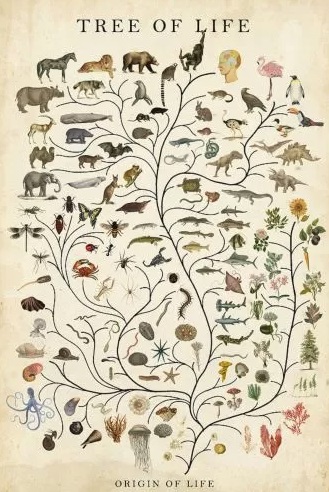
Epigraph:
What is the matter with you? Why will you not fear God’s majesty, when He has created you stage by stage? Have you ever wondered how God created seven heavens, one above the other, placed the moon as a light in them and the sun as a lamp, how God made you spring forth from the earth like a plant, how He will return you into it and then bring you out again, and how He has spread the Earth out for you to walk along its spacious paths? (Al Quran 71:13-20)
I call to witness the post-sunset glow, and the night and all that it envelops, and the moon when it becomes full, that you shall assuredly ascend from stage to stage. (Al Quran 84:16-19)
Man, what has emboldened you against your Gracious Lord, who created you, then perfected you, then proportioned you right? He fashioned you in whatever form He pleased. (Al Quran 82:6-8)
Written and collected by Zia H Shah MD
Abstract
This essay explores the convergence of cutting-edge scientific insights into human evolution with a theological framework of guided (theistic) evolution. It synthesizes the main arguments from a recent Closer To Truth discussion on the evolution of cognition and emotion with the perspective of Dr. Zia H. Shah MD, who advocates that biological evolution is a divinely guided process consistent with Islamic thought. We review the science of human origins – how Homo sapiens emerged over millions of years with advanced cognitive and emotional capacities – and then align these findings with Quranic concepts and philosophical reasoning that see evolution as Allah’s chosen method of creation. The narrative emphasizes harmony between science and faith, arguing that evolution need not be a “blind” or purposeless process but can be understood as unfolding under a wise divine plan. In conclusion, we reflect on the broader implications of this synthesis for both religious believers and the scientific community, proposing that embracing theistic evolution enriches our understanding of human origins and fosters mutual respect between scientific inquiry and spiritual belief.
The Evolutionary Emergence of Homo sapiens: Science of Human Origins
Modern science depicts human origins as a gradual, branching process spanning millions of years. Human evolution is the lengthy process by which our species originated from apelike ancestors over roughly six million yearshumanorigins.si.edu. During this time, key human traits evolved in stages: for example, early hominins developed bipedalism (walking on two legs) over 4 million years ago, while much later our lineage experienced a dramatic expansion of brain size and cognitive abilitieshumanorigins.si.edu. These developments set the stage for uniquely human behaviors – tool-making, language, abstract thought – which became fully pronounced relatively recently. Indeed, evidence suggests that many advanced traits of human culture, such as complex symbolic expression, art, and elaborate social structures, emerged mainly in the past 100,000 yearshumanorigins.si.edu. In short, the journey from primitive ancestors to modern humans was incremental, not instantaneous, with nature “sculpting” our physical and mental capacities step by step.
Crucially, humans are biologically part of the primate family. Genetic and fossil evidence shows that Homo sapiens shares a common ancestor with the African great apes, an ancestor that lived approximately 6–8 million years agohumanorigins.si.edu. Our species first evolved in Africa – all of the oldest hominin fossils (between 6 and 2 million years old) come from therehumanorigins.si.edu. From Africa, early humans later dispersed across the globe in multiple waves. By around 300,000 years ago (per fossil discoveries in Africa), anatomically modern humans had arisen; by 60,000–70,000 years ago, some of these humans migrated out of Africa, eventually populating Asia, Europe, Australia, and the Americashumanorigins.si.edu. During this expansion, Homo sapiens encountered other humanlike species (such as Neanderthals and Denisovans), occasionally interbreeding with them, but ultimately becoming the sole surviving human species. The scientific consensus recognizes 15 to 20 different species of early humans that existed at various timeshumanorigins.si.edu, though not all were our direct ancestors. Many lineages died out, while one lineage – ours – carried forward, evolving greater cognitive sophistication and adaptability.
One of the most fascinating aspects of human evolution is the development of our mind and emotions. The Closer To Truth video discussion, “How Did Cognition and Emotion Evolve?”, delves into how thinking and feeling co-developed over evolutionary time. Scientists and philosophers point out that the mental gap between humans and animals is one of degree, not kindplato.stanford.edu. Charles Darwin himself observed that if we look across species, we find a continuum of mental abilities – differences in intelligence and emotion are quantitative and contextual, not absoluteplato.stanford.edu. In other words, human faculties like reasoning, language, or empathy did not erupt from nowhere; they are built upon more rudimentary capacities present in our ancestors. For example, many animals demonstrate basic problem-solving or communication skills, and many experience emotions such as fear, attachment, or joy. Modern research in comparative cognition has revealed surprising abilities in animals once thought uniquely human, reinforcing Darwin’s thesis of mental continuity across speciesplato.stanford.eduplato.stanford.edu. Likewise, neuroscientists have identified deep evolutionary roots of our emotional brain: the core neural systems that govern emotion in humans are found in other mammals as well. Studies in affective neuroscience show that fundamental emotional circuits reside in brain regions shared widely among mammals, meaning the “ancestral mammal brain” remains active within our own higher brainsaeon.co. This indicates that primal feelings (such as fear, desire, care) evolved long before humans, later augmented by higher cognition in primates and especially in Homo sapiens. Thus, over millions of years, cognition and emotion co-evolved, each influencing the other – early mammals’ emotions drove learning and survival behaviors, while developing cognition allowed more complex social emotions and problem-solving, which in turn conferred survival advantages.
By the time Homo sapiens emerged, evolution had equipped our species with an exceptional mind: capable of self-awareness, reasoning about the world, creating art and technology, and experiencing a rich spectrum of emotions. Yet, as science emphasizes, none of these appeared as a sudden miracle. They are the outcome of a long natural history. Every faculty in humans has antecedents in earlier creatures. Our capacity for language, for instance, likely built upon primate communication systems; our moral emotions (like empathy or fairness) may have origins in the social behaviors of earlier mammals and primates. The video discussion highlights that thinking and feeling developed hand-in-hand: as early humans became more intelligent, they could form deeper social bonds and emotions; conversely, stronger emotions (such as parental love or tribal loyalty) favored greater cooperation and knowledge transmission, spurring cognitive development. Evolution, therefore, wove cognition and emotion together to eventually produce the human mind – a mind that is remarkably advanced yet still a continuation of the animal mind in evolutionary terms. As one expert noted, we see “numberless gradations” bridging simple life forms and humansplato.stanford.edu, so that what separates us from bacteria or fish is not an unbridgeable chasm, but a series of small steps accumulating over eons under natural selection.
Read further in Microsoft Word file:




 The Glorious Quran and Science
Leave a comment