
Belief in Angels, Demons, and Jinn: A Demographic and Scientific Critique

Written and collected by Zia H Shah MD
Abstract
Belief in invisible supernatural beings – such as angels, demons, and jinn – remains pervasive across the world, especially among Christian and Muslim populations. This article provides a comprehensive analysis of global demographics of these beliefs, drawing on survey data from North America, the Middle East, Sub-Saharan Africa, and beyond. Major polls show that large majorities of people in many societies profess belief in angels and other spirits, though with significant regional variation. We then critically examine these beliefs through scientific and psychological lenses. Historical insights from the field of neurology – exemplified by Jean-Martin Charcot’s 19th-century investigations of hysteria – reveal how phenomena once attributed to demonic possession or divine ecstasy were reinterpreted as natural, neurological events. Modern cognitive and psychological research further illuminates the roots of supernatural belief in human perception, cognition, and culture. Taken together, the evidence suggests that angels, demons, and jinn are better understood as products of the human mind and culture rather than as objective metaphysical entities. We argue that while such beliefs have deep historical and cultural foundations, advances in science and psychology provide non-supernatural explanations for experiences once deemed otherworldly. In conclusion, recognizing the psychological origins of these beliefs can demystify them without negating the profound human longings they express.
Introduction
Throughout history, humans have believed in supernatural beings that intervene in the world. In the Abrahamic religions, two broad classes of such beings are especially prominent: beneficent angels and malevolent demons in the Judeo-Christian tradition, and angels and jinn (spirits) in the Islamic tradition. These entities populate sacred texts – from the Bible’s angels and demons to the Qur’an’s angels and jinn – and have been part of popular belief for millennia. Even in the modern era, with the rise of science and secularism, belief in invisible spiritual entities remains remarkably widespread. Large segments of Christian and Muslim populations around the globe continue to affirm that angels and similar spirits are real. This persistence invites investigation: How prevalent are these beliefs in different regions and cultures, and what might explain their origins and endurance?
This article first presents a global demographic overview of belief in angels, demons, and jinn among Christian and Muslim populations. Drawing on international survey data, we highlight regional patterns – from North America’s high levels of belief in angels, to the near-universal acceptance of angels and jinn in much of the Muslim world, to pockets of skepticism in secularized Europe. Next, we turn to a scientific and psychological analysis of these beliefs. We explore how advances in neurology and psychology have recast our understanding of experiences once attributed to supernatural forces. In particular, we focus on the history of neurology and the work of Jean-Martin Charcot in the 19th century, which helped transform cases of apparent demonic possession or saintly visions into diagnosable medical conditions like hysteria or epilepsy. We then discuss cognitive and cultural factors – from neurological phenomena (e.g. seizures or sleep paralysis) to cognitive biases and social influences – that can give rise to sincere belief in otherworldly beings. By integrating these perspectives, we argue that angels, demons, and jinn are best understood not as literal metaphysical beings, but as products of the human mind – constructs arising from our brain’s propensity to perceive agency and from cultural narratives passed down through generations.
Ultimately, confronting these beliefs with critical inquiry does not merely debunk; it also sheds light on the profound psychological and existential needs they have served. In the epilogue, we reflect on what the enduring allure of invisible agents tells us about the human condition, even as we conclude that such entities have no empirical reality outside human imagination.
Global Demographics of Belief in Angels, Demons, and Jinn
Beliefs in angels, demons, and jinn are common to billions of Christians and Muslims worldwide, but their prevalence varies widely by region and culture. In this section, we survey data from major regions – including North America, Europe, the Middle East-North Africa, Sub-Saharan Africa, Asia, and Latin America – to quantify how many people affirm these supernatural beings. The data show that while belief is high in most religious societies, there is a notable gap between more religious regions (where such beliefs are near-universal) and more secular settings (where they are far less common).
Belief Among Christian-Majority Populations
In predominantly Christian societies, belief in angels and demons remains robust overall, though with differences between regions. North America stands out for its high levels of belief. A 2023 Associated Press/NORC poll found that about sixty nine percent of U.S. adults say they believe in angels apnorc.org. Belief in the devil (a figure synonymous with a chief demon) is a bit lower but still held by a majority (56% of Americans) apnorc.org. Similarly, around 58% believe in hell – a place of punishment often associated with demonic forces apnorc.org. These numbers indicate that even in a technologically advanced society, roughly two-thirds of the populace affirm the reality of benevolent and evil spiritual entities. Canada shows a somewhat lower but still substantial level of belief (data not cited here, but surveys have historically shown a majority of Canadians believe in God and significant fractions in angels or demons, reflecting Canada’s slightly more secular tilt compared to the U.S.).
In Latin America, which is heavily Christian (mostly Roman Catholic and Pentecostal Protestant), belief in supernatural beings is high to near-universal. For example, in Brazil – the largest Latin American country – a 2009 national survey reported that ninety seven percent of Brazilians believe in God, and 75% believe in the Devil en.wikipedia.org en.wikipedia.org. Majorities also accept specifically Christian tenets like the resurrection of Jesus and the existence of miracles en.wikipedia.org, indicating a pervasive acceptance of the supernatural. The strong belief in the Devil (three-quarters of Brazilians) underscores that for most people, Satan or demons are not mere symbols but real entities en.wikipedia.org. Similar patterns are found throughout Central and South America; the Pew Research Center’s 2014 survey of Latin American religions noted that large majorities in nearly every country believe in the “spirit world.” Many Latin Americans, especially those in Pentecostal or charismatic churches, not only believe in demons but also report direct experiences such as witnessing exorcisms or “evil spirits” being cast out foxnews.com patheos.com. Such experiences reinforce belief and blur the line between survey response and lived reality – if a person believes they have seen a demon expelled, that belief is deeply confirmed.
Belief in angels and demons among African Christians is likewise extremely widespread. Sub-Saharan Africa is often cited as the world’s most religious region, and surveys bear this out. For instance, a Pew Forum study of 19 African countries found overwhelming levels of belief in both benevolent and malevolent spirits among Christians. In Tanzania, where Christians and Muslims both form large parts of the population, ninety five percent of Tanzanians believe in angels catholicsandcultures.org. The same high percentage (95%) believe in miracles, and ninety six percent say they believe in evil spirits catholicsandcultures.org. Strikingly, 9ninety three percent believe in witchcraft as a real phenomenon catholicsandcultures.org – a belief that often entails accepting the reality of demons or spirits who can possess or be channeled by witches. These Tanzanian figures are among the highest in Africa (in fact, the highest recorded in that Pew survey) catholicsandcultures.org, but they illustrate a broader trend: across much of sub-Saharan Africa, Christian populations integrate traditional spiritual beliefs (like witchcraft or ancestral spirits) with Christian cosmology, resulting in near-universal belief in a populated spirit world. Even in countries with somewhat lower percentages, majorities still affirm these beliefs. Pew found that in countries such as Nigeria, Kenya, Ghana, and South Africa, solid majorities of Christians believe in angels, divine miracles, and the active existence of evil spirits catholicsandcultures.org. The African context shows how Christian belief in angels/demons often coexists with indigenous concepts of spirits, yielding a very rich supernatural worldview.
In contrast, Europe – with its long Christian heritage but now largely secular societies – exhibits much lower belief in angels and demons among the general public. European Christians, especially in Western Europe, tend to be more skeptical or view these beings in symbolic terms. For example, in Britain, only about 35% of self-identified Christians say they definitely believe in angels, and even fewer (around 24%) say they definitely believe in the devil yougov.co.uk. A YouGov survey in 2016 revealed that British people overall were more likely to believe in ghosts or fate than in Christian figures like a Creator or the devil yougov.co.ukyougov.co.uk. Similarly low levels are found in Scandinavia, France, and other highly secular European countries. In Eastern Europe, where religiosity has seen some revival, belief rates are somewhat higher but still moderate. For instance, Poland and Italy (more devout Catholic cultures) have higher shares believing in angels than, say, Sweden or the UK. But even in Eastern Europe, Muslims surveyed tend to have higher rates of belief in spirits than the historically Christian populations of the same country (this will be discussed below in the Muslim section). Overall, Europe represents the low end of the spectrum: in some countries, belief in angels struggles to reach one-third of the population (e.g. only ~27% of people in secular Belgium believe in heaven and similarly low numbers for angels ipsos.com). A global poll by Ipsos in 2023 found that Western Europe had the lowest average levels of belief in heaven, hell, and supernatural beings: Belgium was among the lowest, with only about 26% believing in heaven and similarly around 16–22% believing in hell or supernatural spirits ipsos.com ipsos.com. By contrast, in Catholic Latin America or devout parts of Africa, belief in such entities is higher by as much as 50–60 percentage points ipsos.com. In short, the Christian-majority world shows a split: the Global South (Africa, Latin America, parts of Asia) maintains very high belief in angels and demons, often upwards of 70–90%, whereas the post-Christian West (Europe, to a lesser extent North America) shows lower though still significant levels, ranging from roughly one-quarter to two-thirds of the population.
Belief Among Muslim-Majority Populations
Belief in supernatural beings is deeply ingrained in the Islamic faith and cultures. In Islam, believing in angels is a core article of faith (one of the six articles of Islamic belief), and the Qur’an explicitly affirms the existence of jinn as creatures made from smokeless fire. It is therefore not surprising that surveys find overwhelming majorities of Muslims worldwide believe in these entities. However, there is regional variation, often reflecting differing levels of religious education or influence of secularism/modernization.
Middle East and North Africa (MENA): In the heart of the Muslim world, belief in angels approaches unanimity. Pew’s landmark survey “The World’s Muslims: Unity and Diversity” (2012) reported that in all MENA countries surveyed, solid majorities profess belief in angels, and in several countries this belief is nearly universal pewresearch.org. For example, in countries like Tunisia, Egypt, Jordan, Iraq, Morocco, etc., roughly ninety percent or more of Muslims affirm the existence of angels pewresearch.org. Even in Lebanon – a country with a mix of Muslims and more secular outlook among some – the rate was very high (in the 90% range). On average, across the Middle East-North Africa region, belief in angels is one of the most widely held tenets of Islam pewresearch.org. Belief in jinn, while slightly less universal than belief in angels, is still extremely prevalent in MENA. Depending on the country, roughly 55% to 86% of Muslims say they believe jinn exist pewresearch.org. For instance, Morocco topped the list at 86% affirming jinn, while Iraq was lower at 55% (perhaps due to different interpretations or survey context) pewresearch.org. In Egypt, Jordan, and the Gulf states, belief in jinn also tends to be high (often well above half). It’s important to note that in Islam, acknowledging jinn is not considered heterodox – the Qur’an mentions jinn, and many Muslims view them as part of reality, though there is debate in Islamic theology about interaction with jinn. In the MENA data, we see a consistent picture: belief in angels is essentially part of orthodoxy and thus above 90% in most places, while belief in jinn and related supernatural forces like the evil eye or sorcery is widespread though slightly more variable pewresearch.org pewresearch.org.
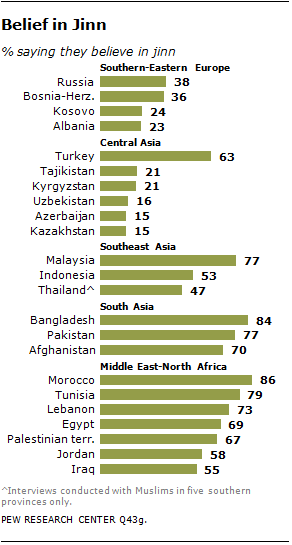
Figure 1: Belief in jinn among Muslims by country. Survey data show that more than half of Muslims in 13 of the 23 countries polled affirm the existence of jinn, with particularly high levels in South Asia, Southeast Asia, and parts of the Middle East (e.g. 84% in Bangladesh; 77% in Malaysia; 86% in Morocco). In contrast, Muslims in Central Asia and Europe are much less likely to believe in jinn pewresearch.org pewresearch.org. (Source: Pew Research Center)
Read further in Microsoft Word file:



 The Glorious Quran and Science
Leave a comment