
Presented by Zia H Shah MD
Qur’anic Verses on Creating Darkness and Light
“Praise be to God, Who created the heavens and earth and made the darknesses and the light…” (Qur’an 6:1) scribd.com. In this opening verse of Surat al-An‘am, the Qur’an explicitly mentions God “appointing darknesses and light” as part of creation. Similarly, Surat al-Nazi‘at describes the formation of the heavens: “He dimmed its night and brought forth its daylight.” (Qur’an 79:29) quran.com. Notably, darkness is mentioned before light in both verses. This sequence invites reflection: Why would scripture emphasize the creation of darkness prior to light? Classical Islamic commentators observed a subtle indication of order here – darkness representing a primordial state, and light symbolizing the emergence of illumination or life scribd.com. As the 12th-century scholar Fakhr al-Din al-Rāzī notes, the Qur’an often lists night before day “to indicate that darkness is non-existence and light [is] existence… Now non-existence precedes existence, [thus] indicating the origin (innovation) of things.” scribd.com. In other words, the primordial nothingness (symbolized by darkness) logically comes before the actual being (symbolized by light).
While these verses have spiritual and natural dimensions (night and day, guidance and misguidance), they also resonate in an intriguing way with modern cosmology’s account of the universe’s beginning. After the Big Bang, our universe indeed went through a profound “darkness before light” phase. Let us first explore this scientific perspective – the cosmic “Dark Ages” – and then return to how Qur’anic commentators and mystical traditions understand the meaning of darkness and light.
The Cosmic “Dark Ages” After the Big Bang
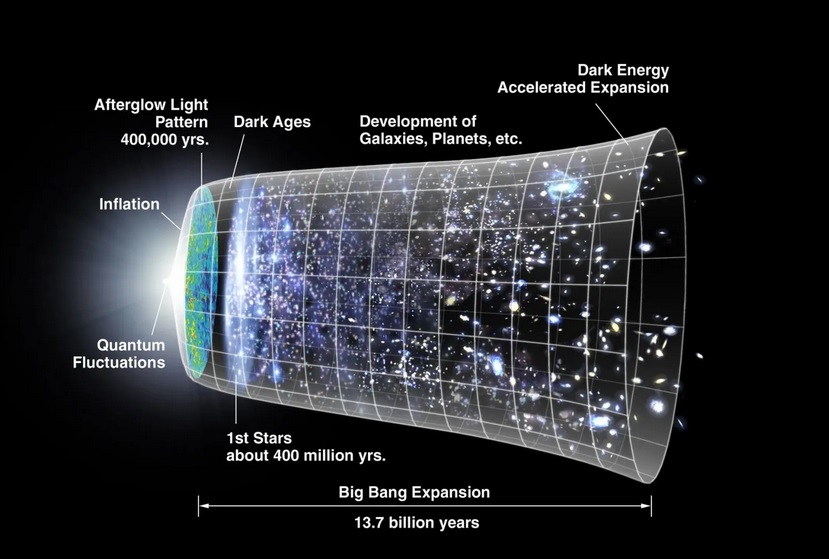
Contemporary astrophysics teaches that the early universe was initially hot and bright, filled with a glowing plasma. But after about 380,000 years, as the universe expanded and cooled, it entered a dark era science.nasa.gov science.nasa.gov. During this period – known to astronomers as the cosmic Dark Ages – no stars or galaxies existed yet. The universe had become transparent (light from the Big Bang’s afterglow decoupled and streamed freely as the cosmic microwave background), but there were not yet any new light sources. As NASA explains, “Following this [recombination] are the cosmic dark ages – a period of time after the Universe became transparent but before the first stars formed. Until a few hundred million years after the Big Bang, the universe was a very dark place. There were no stars, and there were no galaxies.” science.nasa.gov science.nasa.gov. In this cold, dark expanse, matter was mostly neutral hydrogen gas, clumping gradually under gravity. Eventually, gravity did its work: the first stars ignited perhaps 200–400 million years after the Big Bang, marking the end of the Dark Ages science.nasa.gov science.nasa.gov. With those first stars’ light piercing the darkness, the universe experienced its “cosmic dawn.” Galaxies began to form, and the process of reionization (the ultraviolet light from new stars stripping electrons from hydrogen atoms) commenced, bringing an end to the dark epoch science.nasa.gov science.nasa.gov.
In simple terms, science has confirmed a literal period of darkness before light in the chronology of creation: a cosmic night followed by a cosmic morning. This timeline strikingly mirrors the poetic language of Qur’an 79:29 – “He darkened its night and brought forth its daylight.” One could say that, after the Big Bang, the “night” of the universe prevailed until the “daylight” of the first stars shone. Of course, the Qur’an is not a science textbook detailing cosmological epochs. Yet the thematic parallel is thought-provoking: the scripture’s sequence of darkness-then-light at creation is exactly how modern cosmologists describe the universe’s earliest chapters. The Dark Ages in cosmology – that long, starless night – may thus be seen as a concrete physical counterpart to the Qur’anic motif of initial darkness giving way to light.
It’s important to clarify that classical Qur’anic commentators did not know of the cosmic Dark Ages as we do today. When they read verses like 6:1 or 79:29, they primarily understood “darkness and light” in reference to night and day, or metaphorically to ignorance and guidance. Nonetheless, the Qur’an’s phrasing is broad and deep enough that believers today can marvel at how it “captures the principle of an ordered creation, even if not detailing scientific timelines.” Many ancient creation myths spoke of chaotic beginnings, but the Qur’an emphasizes an intentional, staged creation thequran.love thequran.love. The idea that darkness precedes light fits into this orderly unfolding. In what follows, we will explore theological and philosophical reflections on these verses – from mainstream Sunni exegesis to mystical insights – and see how they enrich our understanding of “darkness” beyond the physical sense alone.
Read further in PDF file:

 The Glorious Quran and Science
Leave a comment