
Promoted post: From Buddha to Allah: A Chinese Buddhist’s Journey to Islam
Presented by Zia H Shah MD
Demographics of Buddhists in China
Current Statistics: Measuring the Buddhist population in China is challenging due to overlapping religious practices and the lack of exclusive affiliation requirements pewresearch.org. Surveys indicate that only about 4% of Chinese adults formally identify as Buddhist, yet up to 33% profess belief in Buddhist figures (Buddha or bodhisattvas), reflecting Buddhism’s broad cultural influence en.wikipedia.org pewresearch.org. Official estimates vary; for example, the state-backed Buddhist Association of China in 2017 claimed over 100 million Buddhists (roughly 9% of the adult population) pewresearch.org. Overall, China likely has the world’s largest Buddhist-affiliated population – anywhere from 42 million to 362 million people (about 4% to 33% of the population) depending on the criteria used cfr.org. This wide range underscores that many Chinese engage in Buddhist beliefs or rituals without formal membership, often alongside Taoist or folk practices pewresearch.org pewresearch.org. For instance, roughly one-third of Chinese burn incense to honor Buddha or other deities at least annually pewresearch.org, and veneration of bodhisattvas like Guanyin (the “Goddess of Mercy”) is common in folk religion pewresearch.org. Buddhists in China do not typically register with congregations, and Buddhism permits multiple religious observances, unlike Christianity or Islam which demand exclusive adherence pewresearch.org. This inclusivity means Buddhism often blends into China’s religious landscape rather than standing as a sharply defined group.
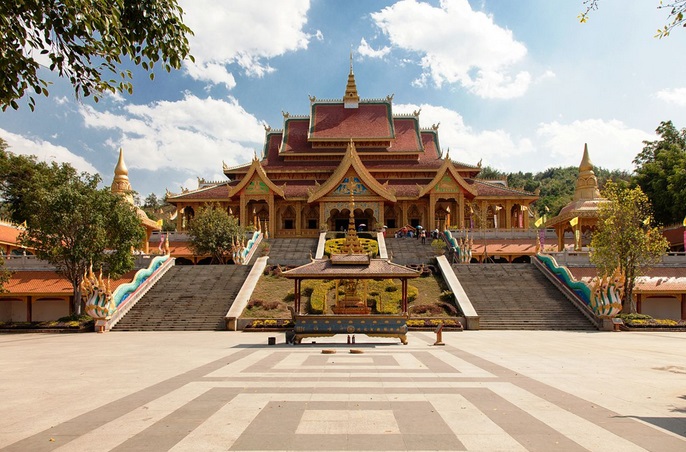
Historical Trends: Buddhism was introduced to China around the 1st century CE during the Han Dynasty, entering as a “foreign” religion via Silk Road monks and merchants pewresearch.org si.edu. It spread gradually, gaining Chinese converts by the late Han and especially flourishing during periods of disunity (3rd–6th centuries) when native elites and commoners sought comfort amid chaos afe.easia.columbia.edu. By the Tang Dynasty (618–907), Buddhism had become deeply rooted and enjoyed imperial patronage; this era is considered the height of Buddhist influence in China afe.easia.columbia.edu. Countless temples, monasteries, and colossal cave shrines (like those at Longmen and Dunhuang) were built across the country under Tang support pewresearch.org. However, Buddhism’s growing wealth and power also sparked backlashes. In 845 CE, Emperor Wuzong launched a Great Anti-Buddhist Persecution, destroying thousands of monasteries and statues and forcing monks and nuns back to lay life en.wikipedia.org education.asianart.org. This dealt a sharp blow to Buddhist institutions and curtailed its influence at court, though the faith survived and persisted among the populace en.wikipedia.org. Subsequent dynasties saw Buddhism rebound in new forms: Song-era (960–1279) society, while officially Confucian, embraced Buddhism as part of popular religion after it lost exclusive state sponsorship education.asianart.org. The Yuan Dynasty (1271–1368) under Mongol rule patronized Tibetan Buddhism and spread its lamas’ influence into the north pewresearch.org. The Ming (1368–1644) and Qing (1636–1912) dynasties maintained Buddhism as a fixture of religious life (the Qing emperors even supported Tibetan and Mongolian Buddhist traditions as a political strategy pewresearch.org), though Neo-Confucian ideology dominated governance. In the modern era, Buddhism suffered greatly during the mid-20th century—most notably under Communist rule during the Cultural Revolution (1966–1976), when temples were wrecked and clergy defrocked pewresearch.org. Despite this near destruction, Buddhism has revived since the 1980s as China relaxed religious controls en.wikipedia.org. Today, it remains the country’s largest organized religion, with tens or even hundreds of millions of adherents (loosely defined) and over 34,000 officially registered temples (28,000+ Han Chinese Buddhist, ~3,800 Tibetan, ~1,700 Theravada) pewresearch.org. Unregistered folk shrines containing Buddhist deities are even more numerous, reflecting Buddhism’s enduring grassroots presence pewresearch.org.
Read further in PDF file:





Leave a Reply