

Written and collected by Zia H Shah MD, Chief Editor of the Muslim Times
The Sun as a Qur’anic Sign of Divine Power
In the Quran, Allah often swears oaths by majestic creations to draw attention to His message. One striking example is “By the sun and its brightness” (وَالشَّمْسِ وَضُحٰىهَا) at the start of Surah ash-Shams (91:1), and similarly “By the morning brightness” (وَالضُّحَىٰ) at the start of Surah ad-Duha (93:1). In classical Arabic oratory, such oaths (qasam) serve to emphasize the importance of what follows thequran.love. By invoking the sun and the glowing forenoon light, the Quran highlights these phenomena as powerful signs (āyāt) of Allah’s creative power. Indeed, the Quran explicitly names the sun among God’s signs: “Among His signs are the day and the night, and the sun and the moon. Do not prostrate to the sun or the moon, but prostrate to Allah, Who created them all” quran.com. In other words, the sun’s grandeur points beyond itself to the glory of its Creator – it is not to be worshipped, but it testifies to the One worthy of worship.
Classical Muslim commentators reflected deeply on these verses. Al-Tabari (d. 923) reports early authorities like Mujāhid explaining “by the sun and its brightness (ḍuḥāha)” to mean “the sun and the daylight it causes,” and “by the moon as it follows it” to refer to the moon following the sun (i.e. reflecting its light and coming after it at night) honeyfortheheart.wordpress.com. In other words, the Quran is drawing our attention to the cycle of day and night governed by the sun and moon. Ibn Kathīr (d. 1373) notes that Allah’s swearing by these great creations underscores the truth that “the person who purifies himself will be successful, and the person who corrupts himself will fail,” which is the central lesson of Sura ash-Shams thequran.love. By swearing on the sun, the moon, the day, night, sky, and earth in Sura ash-Shams (91:1–6), Allah establishes a cosmic backdrop for a moral message: just as light and darkness are opposites, so are righteousness and wickedness – “Successful indeed is the one who purifies the soul, and ruined is the one who corrupts it” (91:9–10). The parallel between the natural order and the moral order is thus powerfully drawn thequran.love.

Moreover, classical exegetes saw in these oaths an invitation to reflect on the splendor of creation. A Quran study circle notes: “In these āyāt Allah, exalted be He, swears by His creation, drawing man’s attention to them. Man ought to reflect on these objects and appreciate their value and the purpose of their creation.” versebyversequranstudycircle.wordpress.com When Allah swears “by the sun and its radiant morning”, it commands the listener’s focus on the sun’s light that makes everything visible and alive. The Arabic word ḍuḥā (brightness) refers to the mid-morning light shortly after sunrise, when the sun’s rays fully unveil the world. Classical commentators described how this gentle morning sunshine illuminates the earth, bringing clarity and warmth – a daily reminder of emerging light after darkness. Fakhr al-Dīn al-Rāzī (d. 1209) and others remarked that by opening with oaths on “mighty creations” like the sun, the Quran is indicating “the brilliant way in which Allah… shaped them.” dorar.net Each of these creations attests to God’s perfect design. For example, one tafsīr note on 91:5 observes: “If the sky is such a magnificent spectacle… then how remarkable its Creator must be.” In short, the classical understanding is that the rising sun, the bright day, the still night – all of these are signs (āyāt) meant to turn our thoughts to Allah’s power, wisdom, and care in governing the universe.
The Sun’s Physics as a Fine-Tuned Stellar Furnace
Fourteen centuries after the Quran highlighted the sun’s splendor, modern science has uncovered details about the sun that amplify our awe for this “brilliant lamp.” The sun is no mere burning disk; it is an enormous nuclear furnace operating under exquisitely balanced physical laws. Astronomers classify our sun as a G2V yellow dwarf star – essentially a gigantic sphere of hot plasma held together by gravity. Its basic characteristics are staggering: about 109 times the Earth’s diameter and some 333,000 times Earth’s mass, with an estimated age of 4.5–4.6 billion years surahquran.com science.nasa.gov. At the core of the sun, temperatures reach approximately 15 million°C (around 27 million°F) with pressure over a quarter trillion kilopascals phys.org. Under these extreme conditions, hydrogen nuclei are forced to fuse into helium – the process of nuclear fusion that powers the sun thequran.love phys.org. This fusion furnace converts mass into energy in accordance with Einstein’s equation E = mc². Every second, the sun converts about 4.26 million tons of its mass into pure energy. This yields an immense radiant power output of roughly 3.846 × 10^26 watts phys.org – equivalent to detonating 1.8 billion of the largest atomic bombs per second! Little wonder the Quran calls the sun “a blazing lamp” (sirāj wahhāj) surahquran.com.
Crucially, the sun’s energy is not an erratic blaze but a finely tuned, sustained output. Only in the inner ~25% of the sun’s radius does fusion actively occur, and a self-regulating balance (hydrostatic equilibrium) is maintained between the outward pressure of energy and the inward pull of gravity. This delicate balance keeps the sun stable over billions of years. According to NASA, our sun – currently about halfway through its ~10-billion-year main-sequence lifespan – has been shining steadily for about 4.5 billion years, and “without the Sun’s energy, life as we know it could not exist on our home planet.” science.nasa.gov Indeed, Earth benefits from the sun’s steady light and heat from an ideal distance. At ~93 million miles (150 million km) away, Earth sits in the habitable zone where sunlight is neither too intense nor too feeble. As one commentary notes, “it is only Allah Who by His wisdom has placed the earth at the right distance from [the sun], neither too hot for being close to it, nor too cold for being far away. For this very reason life of man, animal and vegetation became possible on it.” In fact, the sun showers Earth with “measureless treasures of energy,” driving our climate and even the water cycle (sun-driven evaporation and rain) that sustains life.
Modern astrophysics has revealed that the sun’s ability to burn stably is rooted in a suite of finely tuned parameters in the universe. The forces of nature are precisely set so that stars like the sun can undergo controlled fusion rather than blowing apart or fizzling out. Even slight deviations in the strength of gravity, electromagnetism, or the strong nuclear force could have rendered long-lived stars impossible intelligentdesign.org. As physicist Stephen Hawking admitted, “the values of these [physical constants] seem to have been very finely adjusted to make possible the development of life” intelligentdesign.org. The sun’s mass and composition, for example, enable a steady proton-proton fusion cycle that converts hydrogen to helium at a gentle rate, providing a nearly constant luminosity for eons. A much larger star would burn fuel too rapidly and variably; a much smaller star might not provide sufficient warmth or would subject any habitable planets to harmful flares. Our sun appears “just right” in many ways – a fact not lost on those who see design in the cosmos. Astrophysicists have marveled at the sun’s “intricate design” and “delicate balance”, which allow it to continuously generate life-giving light. From an Islamic perspective, these scientific discoveries are not merely cold facts; they deepen our appreciation of verses like “By the sun and its bright morning,” strengthening the argument that such an elegant star is a sign of intentional creation rather than random coincidence. As one modern scholar put it, the sun “displays the incredible intelligence of its Designer.” icr.org
Striving to Replicate the Sun’s Power: The Challenge of Nuclear Fusion
The Quran’s implicit invitation to ponder the sun becomes even more impactful when we consider how difficult it is for humans to replicate even a fraction of the sun’s processes. The sun’s core effortlessly fuses hydrogen, but on Earth scientists have spent decades trying to achieve controlled nuclear fusion – essentially, attempting to create an “artificial sun.” The effort highlights the immense gulf between this stellar power and human technology. Researchers have pursued two main paths to fusion energy: magnetic confinement (as in tokamak reactors) and inertial confinement (as in powerful laser implosions). Both approaches face daunting hurdles. To get hydrogen nuclei to fuse, one must recreate conditions akin to the sun’s interior – but without the sun’s enormous gravity. This means using other means to force nuclei together, reaching temperatures of over 100 million °C (far hotter than the sun’s core) and extreme densities, while confining the reactive plasma long enough for fusion to occur. No solid material can directly withstand such conditions, so scientists use clever substitutes: strong magnetic fields in doughnut-shaped tokamaks to bottle the charged plasma, or bursts of lasers to rapidly crush and heat a tiny fuel pellet. Even so, maintaining a stable fusion reaction is extraordinarily complex. As one science writer quipped, “Fusion is the holy grail of energy research” – tantalizing in theory, but “very difficult, scientifically and also in engineering” scientificamerican.com. Generations of optimists have predicted fusion breakthroughs “within decades,” only to be humbled by nature’s challenges scientificamerican.com.
Despite these challenges, progress is being made. Large international projects like ITER (the International Thermonuclear Experimental Reactor in France) are under construction to demonstrate a self-sustaining fusion reaction, and experimental reactors have achieved significant milestones. In 2022, researchers at the U.S. National Ignition Facility (NIF) used a laser-based approach to ignite a fusion target and produced more energy from fusion than the input energy – a historic first, though only for a split-second burst theguardian.com. More recently, in 2025, China’s Experimental Advanced Superconducting Tokamak (EAST), often nicknamed the “artificial sun,” sustained a high-temperature plasma for an astonishing 1,066 seconds (over 17 minutes) phys.org – a new world record in steady-state fusion operation.
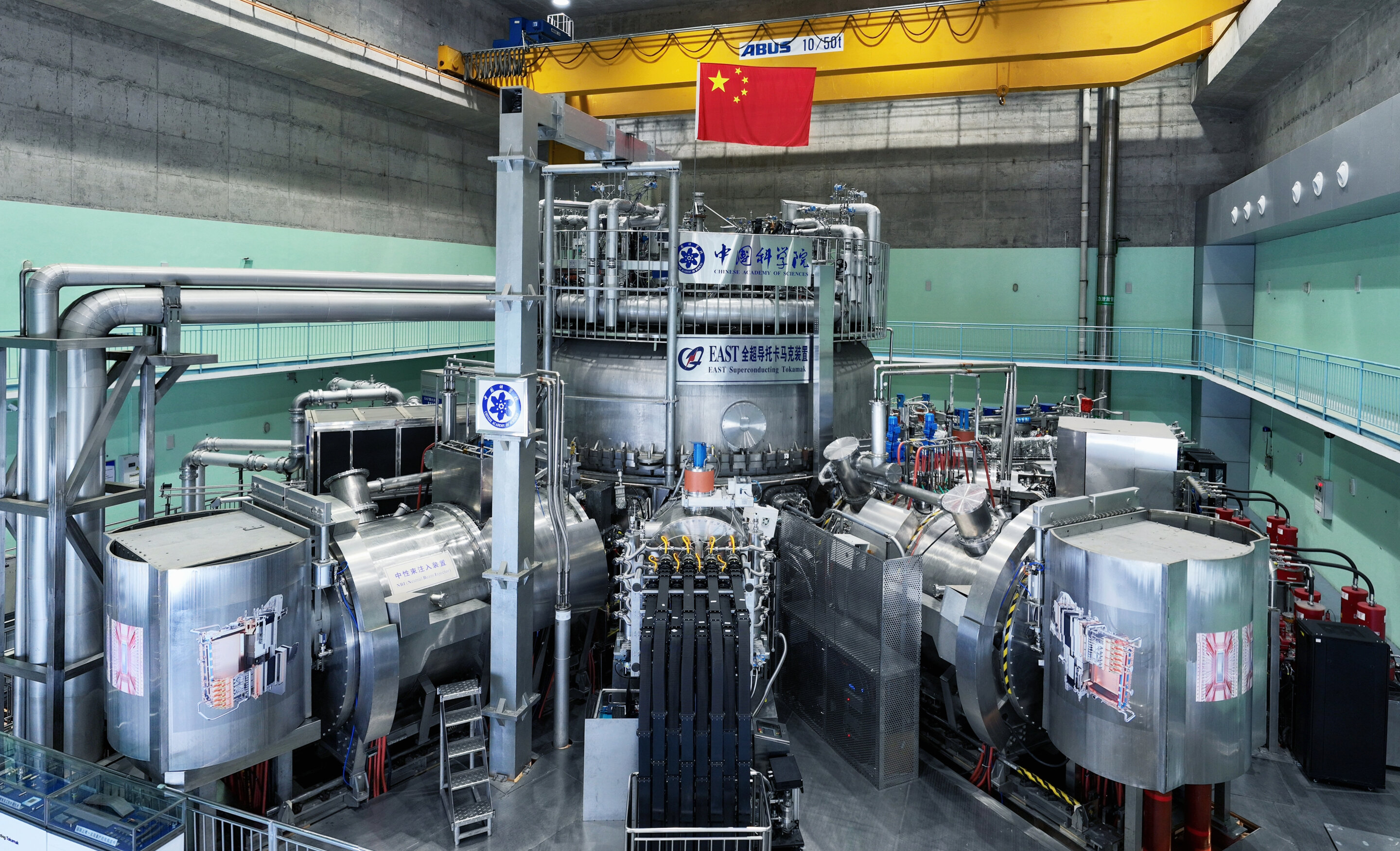
These achievements show that fusion is possible, but scaling them into a practical power plant is an enormous leap. Engineers must achieve continuous operation for thousands of seconds (not just minutes) and handle the intense heat and neutron radiation of fusion reactors before fusion power becomes commercially viable.
The difficulty of harnessing fusion underscores how astonishing the sun truly is. Our best laboratories, with billions of dollars and the world’s brightest minds, have only just begun to emulate what the sun does naturally every moment. Scientists have labored for over 70 years trying to bottle the sun’s power, and by their own admission, a fully functional fusion energy station may still be decades away. The sun, by contrast, has effortlessly sustained its fusion reactor for billions of years, outputting a steady flow of energy that makes life on Earth possible. In the Quranic view, this is no accident or mindless quirk of nature – it is a testament to Allah’s creative majesty. As the Quran says in Sura al-Furqan, Allah “blessed is He who placed in the sky a great constellation and placed therein a burning lamp (sirāj) and luminous moon” (25:61). The sun is described as a lamp – and remarkably, it is an inextinguishable lamp by human standards, one that humbles us when we try to imitate it. The fact that replicating a single star’s process requires such herculean effort from us can be seen as a modern confirmation of the sun’s special status. It is as if the more we learn and attempt, the more we appreciate what a “mighty furnace” Allah has kindled in the sun, “constantly radiating light and heat… for millions and millions of years.” surahquran.com
Modern Science Reinforces Quranic Wonder
In light of these insights, the Quranic oaths by the rising and shining sun take on even deeper meaning. Classical scholars like al-Tabari, Ibn Kathir, and al-Razi interpreted these oaths as emphatic reminders of Allah’s power and blessings manifest in creation. The sun’s daily journey – from the gentle glow of al-ḍuḥā (morning light) to the fading of dusk – was understood as a sign of hope, renewal, and divine order. Modern physics and cosmology, far from diminishing that sense of wonder, have embellished it with intricate detail. We now know that the sun is a precisely engineered stellar system: a mass of $2\times10^{30}$ kg of plasma controlled by fundamental forces set at just the right strengths, producing a perfectly calibrated light and heat output that Earth needs surahquran.com. We have learned that the sun’s energy derives from the fusion of hydrogen – a process so complex that replicating it has become the loftiest of scientific ambitions. Each of these discoveries adds new layers to our understanding of “the sun and its brightness”.
For believers, this convergence of scripture and science is profoundly affirming. The Quran invites humankind to reflect on the natural world – “(God) urges man to reflect upon the surrounding universe… so that he may appreciate its signs and understand its address” islamicstudies.info – and the more we reflect with tools of modern science, the more we find the signature of design and wisdom that the Quran has been pointing to all along. Rather than seeing the sun as a mundane ball of gas, we can echo the sentiment of the Quran: that the sun is an āyah, a signpost to the Creator’s grandeur. Classical tafsirs often ended such discussions by expressing amazement at Allah’s creation, and today’s scientific observers do much the same. Indeed, as we consider the sun’s massive energy, its fine-tuned position, and its critical role in sustaining life, we are led to the same humble conclusion expressed in the Quran: “This is Allah’s creation; so show Me what those besides Him have created” (31:11). Modern science, by unraveling the sun’s secrets, has not extinguished its divine light – it has made it shine even brighter as a testimony to Allah’s existence and creative majesty. The rising sun of each day thus carries a dual message: one of physical illumination, and one of spiritual illumination, reminding us of the Almighty who “perfectly designed all things” (27:88).
Sources:
- The Quran, Surah ash-Shams (91) and Surah ad-Duha (93), and classical commentaries by al-Ṭabarī, Ibn Kathīr, Fakhr al-Dīn al-Rāzī, et al.
- Phys.org – How does the Sun produce energy? (2015) phys.org
- Maududi, Tafhīm al-Qur’ān – commentary on Quran 78:13 surahquran.com (describing the sun’s properties and role as a “mighty furnace”).
- Institute of Creation Research – Our Sun, Finely Tuned for Life on Earth (Corrado, 2023) icr.org.
- Phys.org – Chinese “artificial sun” sets a record towards fusion power (Jan 21, 2025) phys.org.
- Scientific American – “Fusion’s Missing Pieces” (Sept 2022) scientificamerican.com.
- NASA Science – Sun Fact Sheet science.nasa.gov.
- IntelligentDesign.org – Fine-Tuning Parameters (Hawking quote) intelligentdesign.org.
- Verse by Verse Quran Study Circle – Tafseer Surah ash-Shams versebyversequranstudycircle.wordpress.com.
- Dorar.net Islamic Encyclopedia – Tafsir Ash-Shams (overview) dorar.net.



 The Glorious Quran and Science
Leave a reply to Video: Is Time an Illusion? – The Glorious Quran and Science Cancel reply