
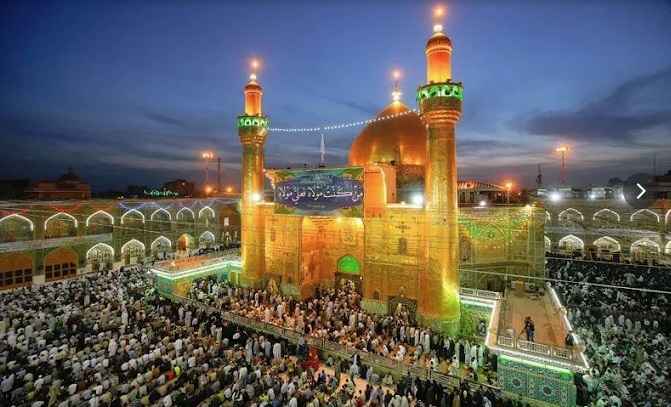
Written and collected by Zia H Shah MD, Chief Editor of the Muslim Times
Below is a comprehensive list of Quranic verses that Shia scholars across Twelver, Ismaili, and Zaydi traditions have interpreted as alluding to or directly referencing Ali ibn Abi Talib (the fourth Caliph and first Shia Imam). For each verse, the original Arabic text is provided, along with an English translation (as used in Shia commentary where available) and Abdel Haleem’s English translation for comparison. We then summarize classical and modern Shia tafsir (Quran commentary) interpretations, including viewpoints from Twelver, Ismaili, and Zaydi scholars, with citations.
To a Sunni reader these verses may seem overzealous interpretation, in favor of Hazrat Ali arising from prior ideology. If so one can be more cautious against one’s own biases as well.
Qur’an 2:207 – Self-Sacrifice on Laylat al-Mabīt (the Hijra Night)
وَمِنَ النَّاسِ مَن يَشۡرِي نَفۡسَهُ ٱبۡتِغَآءَ مَرۡضَاتِ ٱللَّهِۚ وَٱللَّهُ رَءُوفُۢ بِٱلۡعِبَادِ {2:207}
Shia Trans. (M.H. Shakir): “And among men is he who sells himself to seek the pleasure of Allah; and Allah is affectionate to the servants.”
Abdel Haleem: “But there is also a kind of man who gives his life away to please God, and God is most compassionate to His servants.”
Shia Interpretation: All major Shia commentators agree that this verse was revealed to praise Ali ibn Abi Talib’s selfless sacrifice during the Prophet’s migration (Hijra). On the night of Hijra (known as Laylat al-Mabīt), Ali famously slept in the Prophet’s bed to foil an assassination plot, risking his own life so that Muhammad could escape safely en.wikipedia.org al-islam.org. Early reports from companions like Ibn ‘Abbas (as cited by al-Tabari) link 2:207 to this incident en.wikipedia.org. Classical Twelver scholars such as al-Ṭabarsī (d. 1153) also record this context, and even prominent Sunni exegetes (e.g. al-Tha‘labi) and historians (e.g. al-Ghazali in Ihya ‘Ulum al-Din) acknowledge that the verse “was revealed to praise Ali” for his devotion al-islam.org.
Twelver Perspective: Shaykh Tusi and al-Ṭabarsī in their tafsirs narrate that when this verse was revealed, people understood “the one who sells his soul for God’s pleasure” to be Ali on account of his courage that nighten.wikipedia.org. Modern Twelver scholars continue to emphasize this: Agha Mahdi Pooya’s commentary notes that “all Shia commentators” and even some Sunni authorities unanimously hold it refers to Ali sleeping in the Prophet’s bedal-islam.org.
Ismaili Perspective: Ismaili tradition equally upholds this event as a prime example of Ali’s ultimate loyalty and sacrifice for the Prophet. Ali is regarded as the model of the true mu’min who “gives his self for God’s pleasure.” Ismaili interpreters stress the spiritual meaning that Ali’s self-offering symbolizes complete devotion to Allah’s walī (friend) – a hallmark of walāya (spiritual allegiance). Thus, they see 2:207 as highlighting Ali’s role as the Prophet’s true successor through his unparalleled selflessness (a theme echoed in Ismaili spiritual literature, though the narrative is shared with Twelver sources)al-islam.org.
Zaydi Perspective: Zaydi scholars, who revere Ali as the Prophet’s rightful heir, likewise identify Ali as the hero of this verse. An early Zaydi collection of tafsir hadith by al-Hibari (9th century) explicitly compiles verses “revealed about the virtues of Ali,” including 2:207en.wikishia.net. Zaydi exegesis preserves the same story of Ali sleeping in the Prophet’s bed, viewing it as proof of Ali’s merit and God’s favor upon him. In summary, all three Shia branches concur that Qur’an 2:207 honors Imam Ali’s willingness to sacrifice his life for the sake of Allah and His Messengeral-islam.org.
Qur’an 3:61 – The Verse of Mubāhala (Mutual Prayer)
فَمَنْ حَاجَّكَ فِيهِ مِنۢ بَعْدِ مَا جَآءَكَ مِنَ الْعِلْمِ فَقُلْ تَعَالَوْا نَدْعُ أَبْنَآءَنَا وَأَبْنَآءَكُمْ وَنِسَآءَنَا وَنِسَآءَكُمْ وَأَنفُسَنَا وَأَنفُسَكُمْ ثُمَّ نَبْتَهِلْ فَنَجْعَل لَّعْنَتَ اللَّهِ عَلَى ٱلْكَٰذِبِينَ {3:61}
Shia Trans. (Shakir): “But whoever disputes with you in this matter after what has come to you of knowledge, then say: Come, let us call our sons and your sons, and our women and your women, and ourselves and yourselves, then let us pray earnestly and invoke the curse of Allah on the liars.”al-islam.org
Abdel Haleem: “If anyone disputes this with you now that you have been given this knowledge, say, ‘Come, let us gather our sons and your sons, our women and your women, ourselves and yourselves, and let us pray earnestly and invoke God’s curse on the liars.’”
Shia Interpretation: This is known as the Verse of Mubāhala (mutual imprecation) and refers to the famous event in which the Prophet Muhammad invited the Christians of Najrān to a public prayer duel. Shia exegesis notes that when the Prophet obeyed this verse, he took only Ali, Fatima, Hasan, and Husayn with him as the representatives of “ourselves, our women, and our sons”al-islam.org. In the Arabic, “our sons” (abnā’anā) is interpreted as Hasan and Husayn, “our women” (nisā’anā) as Fatima, and critically “ourselves” (anfusānā) as referring to Alien.wikipedia.orgen.wikipedia.org. By calling Ali his “self” in this context, the Prophet elevated Ali’s spiritual status to be like his own soul.
Twelver Perspective: Twelver commentators heavily emphasize the word anfusana (ourselves). Imam al-Baqir (a great-grandson of Ali) is reported to have explained that the Prophet is the “warner” and Ali is the “self” of the Prophet mentioned here, meaning Ali shares the Prophet’s position as his equal in representing Islamal-islam.org. Pooya’s tafsir notes that had there been any other men worthy among the Muslims, the verse would have allowed them to be taken – but the Prophet chose only Ali as “our self,” indicating Ali’s unique rankal-islam.org. Classical Shia scholars like al-Tabarsi and al-Tusi record hadith of the Prophet wrapping Ali, Fatima, and their sons in a cloak (Hadith al-Kisā’) and declaring them the participants of the Mubāhala, underscoring that Ali was the sole male representative of the Prophet’s householdal-islam.org. The verse’s successful outcome (the Christians backed down) further cemented Ali’s status.
Ismaili Perspective: Ismaili interpretations similarly identify Ali in “anfusana.” They often stress the esoteric meaning: by equating Ali to the Prophet’s own soul, the Quran hints at Ali’s spiritual unity with the Prophet. This unity is foundational for the Ismaili notion of the Imam as the mirror of the Prophet. Nasir Khusraw, for instance, cites the Mubāhala verse to illustrate Ali’s exalted station, as only Ali was chosen as the Prophet’s soul and partner in spiritual authority. In Ismaili thought, Ali being “the self” of the Prophet signifies that Ali, as Imam, inherits the Prophet’s inner knowledge (bātin) and authority. Thus, verse 3:61 is seen as a Qur’anic testimony to Ali’s Imamate and spiritual leadership by divine selection, a view shared with Twelversal-islam.org.
Zaydi Perspective: Zaydis also accept that the Prophet brought Ali (along with Fatima and the two sons) for the Mubāhala. Early Zaydi works note this event to argue for Ali’s primacy among the Sahaba. The phrase “ourselves” could only reasonably refer to Ali, as documented in both Shia and many Sunni historiesal-islam.org. Zaydi authors use this verse to demonstrate that Ali was regarded by the Prophet as his closest equal, bolstering Ali’s legitimacy as the Prophet’s successor. The unity of all Shia factions on the participants of the Mubāhala is significant – even non-Shia sources like Ibn Ishaq and Fakhr al-Razi confirm the Prophet took Ali, Fatima, Hasan, and Husayn as indicated by this verseen.wikipedia.orgen.wikipedia.org.
Qur’an 4:59 – The Verse of Ulī al-Amr (Those in Authority)
يَـٰٓأَيُّهَا ٱلَّذِينَ ءَامَنُوٓا أَطِيعُوا ٱللَّهَ وَأَطِيعُوا ٱلرَّسُولَ وَأُولِى ٱلۡأَمۡرِ مِنكُمۡ ۖ {4:59}
Shia Trans. (Shakir): “O you who believe! Obey Allah and obey the Messenger and those vested with authority from among you…”
Abdel Haleem: “You who believe, obey God and the Messenger, and those in authority among you…”
Shia Interpretation: In this verse, Allah commands obedience to Himself, to the Prophet, and to “ulī al-amr minkum” (“those in authority among you”). Shia commentators interpret ulī al-amr as the divinely guided Imams from the Prophet’s family, beginning with Imam Ali. This reading is based on hadith where the Prophet said the ulī al-amr would be the twelve Imams from Qurayshen.wikishia.net. While the Quran does not name them explicitly, Shia exegesis holds that Ali ibn Abi Talib is the first of these authoritative leaders, designated by Allah to lead after the Prophet. The verse’s structure (“obey… and obey… and those in authority”) implies the obedience to ulī al-amr is as obligatory as obedience to the Prophet – which for Shia means these must be infallible Imams, not fallible kings or generalsen.wikishia.net.
Twelver Perspective: Classical Twelver scholars like Ali ibn Ibrahim al-Qummi (3rd/9th cent.) and Shaykh Tusi (d. 1067) explicitly state that ulī al-amr refers to Ali and the Imams from his lineage, as the guardians of the Prophet’s teachingsen.wikishia.net. Al-Tusi’s Tibyān lists hadith where the Prophet on various occasions declared Ali as the mawla (guardian/leader) of the believers, aligning with the Quranic mandate to obey those in authorityen.wikishia.net. Modern Shia writers (e.g., Muhammad H. Tabataba’i in al-Mīzān) emphasize that since the command to obey is unconditional, ulī al-amr can only mean divinely protected leaders – identified in Shia belief as Ali and the eleven Imams after him. The Twelver viewpoint is that this verse indirectly establishes Ali’s authority (Imamate) by Qur’anic texten.wikishia.net.
Ismaili Perspective: Ismailis share the interpretation that ulī al-amr are the Imams from the Prophet’s progeny, with Ali being the first “Amir al-Mu’minin” (Commander of the Faithful) in this line. Ismaili teachings often highlight the continuity of spiritual authority: Ali and his successors are “the authorities among you” whom the Quran instructs believers to obey. The concept of walāya (devoted allegiance to the Imam) is rooted in this verse for Ismailis. They see it as validation that following the Imam of the time (starting with Ali) is an obligation set by Goden.wikishia.net. Some Ismaili works also offer esoteric interpretations, saying that just as the soul obeys the intellect, the community must obey the Imam as the holder of the Prophet’s intellect – reinforcing that 4:59 points to Ali as the possessor of the Prophet’s authority.
Zaydi Perspective: Zaydi exegesis, influenced by early Shi’i thought, likewise holds that ulī al-amr are the righteous Imams from Ahl al-Bayt. Zaydis differ in that they historically recognized imams from Ali’s descendants through Hasan or Husayn who met certain criteria (e.g. leading an uprising for justice), but they agree that Ali was the premier Imam and the first referent of “those in authority.” In Zaydi sources, Ali’s caliphate is often justified by this verse – since Ali was acclaimed for his knowledge and justice, he fit the Quranic ideal of an authority to be obeyed. Notably, the 9th-century Zaydi scholar Imam al-Qasim ibn Ibrahim wrote that obeying ulī al-amr means obeying Ali and the Ahl al-Bayt, whom the Prophet appointed as guides. Thus, all Shia subdivisions use 4:59 as a Quranic basis for Ali’s legitimate authority, even if their lists of Imams diverge after him.
Qur’an 5:3 – The Verse of Ikmāl al-Dīn (Perfection of Religion)
“… ٱلۡيَوۡمَ أَكۡمَلۡتُ لَكُمۡ دِينَكُمۡ وَأَتۡمَمۡتُ عَلَيۡكُمۡ نِعۡمَتِي وَرَضِيتُ لَكُمُ ٱلۡإِسۡلَـٰمَ دِينًا {5:3}
Shia Trans. (Shakir): “…This day have I perfected for you your religion and completed My favor upon you, and chosen for you Islam as a religion.”en.wikipedia.org
Abdel Haleem: “…Today I have perfected your religion for you, completed My blessing upon you, and chosen as your religion Islam (total devotion to God)…”
Shia Interpretation: The latter part of verse 5:3 (revealed at the end of the Prophet’s life) is known as the Verse of Completion (Ikmāl al-Dīn). Shia authorities nearly unanimously state that this verse was revealed immediately after the Prophet’s sermon at Ghadir Khumm, where he publicly announced Ali ibn Abi Talib as the mawla (guardian/leader) of all believersen.wikipedia.org. According to numerous Shia (and some Sunni) reports, on the 18th of Dhu’l-Hijjah 10 AH, the Prophet declared “For whomever I am his master, Ali is his master.” Shia tafsirs record that upon this declaration, the revelation “Today I have perfected your religion…” descended, signifying that Ali’s appointment as successor was the culmination of the religion and completion of God’s favoren.wikipedia.org. In Shia understanding, the perfection of religion on that day was the formal establishment of Ali’s leadership (Imamate) as an integral part of Islam.
Twelver Perspective: Twelver scholars from early times (e.g., al-Kulayni in al-Kafi) transmit hadith from Imams that explicitly link 5:3 to Ghadir Khumm and Wilāyat ‘Ali (Ali’s guardianship). Al-Tabarsi in Majma‘ al-Bayān cites a narration where the Prophet asks the crowd, “Do I not have more authority over you than you have over yourselves?” and upon their affirmation, he declares Ali his successor – then 5:3 was revealeden.wikipedia.org. Modern scholars like Allamah Tabataba’i note that Sunni exegesis usually ties 5:3 to the Farewell Pilgrimage in general, but he argues the timing and wording better fit the specific moment of Ghadir, which occurred just after the pilgrimage. The Shi’a point to the phrase “completed My favor” as evidence that wilayah (devotion to Ali and the Imams) is the final divine favor that makes the faith completeen.wikipedia.org.
Ismaili Perspective: Ismaili tradition strongly resonates with this interpretation. For Ismailis, the Imamate (beginning with Ali) is the cornerstone of the faith’s completion. They view the Ghadir Khumm event as the investiture of Ali not only as a political leader but as the inheritor of the Prophet’s esoteric knowledge. Thus, “today I have perfected your religion” signifies that the chain of Imamat was put in place, ensuring spiritual guidance for all time. Ismaili sermons and literature often reference this verse when discussing the unbroken continuity of divine guidance through Ali and the Imams. Aga Khan III, for example, explained that Islam’s perfection was achieved by the Prophet’s designation of Ali as Imam, fulfilling the verse 5:3en.wikipedia.org. Both Twelver and Ismaili branches therefore see Ali’s succession as the completion of God’s favor upon Islam.
Zaydi Perspective: Zaydis, while not believing in a fixed list of 12 Imams, also regard Ali’s leadership as divinely favored. Many early Zaydi scholars (who emerged in the 8th–9th centuries) were aware of the Ghadir Khumm narrations. Zaydi works tend to emphasize Ali’s superior qualifications and imply that the perfection of religion included establishing rightful leadership after Muhammad. They interpret 5:3 in light of Ali’s subsequent caliphate: Islam reached its maturity when the community accepted Ali (though tragically this full acceptance was delayed). Thus, Zaydis concur that the verse implies God’s approval of Ali’s authority. Notably, even the famous Sunni historian al-Ya’qubi (who had Zaydi leanings) mentions Ghadir Khumm under this verse. In summary, 5:3 is taken by Shia of all stripes as a Quranic validation of Ali’s Imamate, marking the faith’s completionen.wikipedia.org.
Qur’an 5:55 – The Verse of Wilāya (Guardianship)
إِنَّمَا وَلِيُّكُمُ ٱللَّهُ وَرَسُولُهُۥ وَٱلَّذِينَ ءَامَنُوا۟ ٱلَّذِينَ يُقِيمُونَ ٱلصَّلَوٰةَ وَيُؤۡتُونَ ٱلزَّكَوٰةَ وَهُمۡ رَٰكِعُونَ {5:55}
Shia Trans. (Shakir): “Only Allah is your Walī (guardian) and His Messenger and those who believe, those who keep up prayers and pay the poor-rate while they bow [in ruku‘].”al-islam.org
Abdel Haleem: “Your true allies are God, His Messenger, and the believers– those who keep up the prayer, pay the prescribed alms, and bow down [in worship].”
Shia Interpretation: This verse, known as “Āyat al-Wilāya” (Guardianship Verse), explicitly lists who the walī (master/guardian) of the believers are: God, the Prophet, and “those who believe” described as establishing prayer and giving alms while bowing in prayer. Shia tafsirs unanimously assert that “those who believe…while bowing (rāki‘ūn)” refers specifically to Ali ibn Abi Talib, who, according to numerous reports, gave his ring in charity to a beggar while he was in rukū‘ (bowing) during prayeral-islam.org. This act of charity in the middle of salah was so unique that God revealed this verse to single out Ali as being the walī of the believers alongside the Prophetal-islam.org. In Shia understanding, walī here means the spiritual leader and guardian of the community – effectively indicating Ali’s Imamate.
Twelver Perspective: Classical Twelver commentaries devote extensive discussion to 5:55. Al-Tabarsi and others record the famous narration from Abu Dhar al-Ghifari: A beggar entered the mosque and Ali, in ruku‘, pointed his finger with a ring such that the beggar took it as charityal-islam.org. Upon this, the Prophet Muhammad reportedly prayed to God to confirm Ali’s guardianship just as Moses had prayed for Aaron – and this verse was revealed as the answeral-islam.org. Shi’ite scholars point out that the verse’s Arabic grammar (innamā walīyukum… wa hum rāki‘ūn) is singular in meaning – it intends a specific person who performed that act while bowingen.wikipedia.org. Even Sunni exegesis in works like Tafsir al-Kabir of al-Razi acknowledges a report that the verse descended regarding Ali giving away his ring. Twelver authorities like Allamah Hilli (14th c.) and Muhammad Jawad Mughniya (20th c.) cite this verse as decisive Qur’anic evidence of Ali’s divinely-appointed leadership, since no other companion is known to fit the descriptionen.wikipedia.orgal-islam.org.
Ismaili Perspective: The Ismaili tradition holds the walāya of Ali as the cornerstone of faith, and thus 5:55 is a pivotal verse. Ismaili missionaries (dā‘īs) used this verse to explain that just as Allah and the Prophet are guardians, Ali is the continuing guardian of believers. The story of Ali’s ring is well-known in Ismaili writings, sometimes symbolically interpreted: the ring (signet) given in charity signifies the transfer of spiritual authority to Ali. The official Ismaili community literature also quotes this verse when teaching about the Imamate – for example, an Ismaili publication explains that “It is written in the Qur’an: ‘Your friend (wali) is only God, His Messenger and those believers who…pay alms while bowing,’” directly linking it to Ali’s acten.wikipedia.orgal-islam.org. Ismaili theologians argue that through this verse, the Qur’an itself testifies to Ali’s designation by describing an incident only he fulfilled. Hence, in Ismaili thought, 5:55 confirms Ali as the rightful spiritual leader (wali) after the Prophet, and by extension, validates the line of Imams from him.
Zaydi Perspective: Zaydi scholars also embrace the connection of 5:55 to Ali. Renowned Zaydi imams, like al-Baqir al-Jarafi, included this verse in discussions of Ali’s virtues. Zaydi tafsirs (often drawing from early Shi’a and Sunni sources alike) mention that “this verse was revealed about Ali”al-islam.org. While Zaydis do not consider Imams infallible by doctrine, they view Ali as the best example of a true Imam. The fact that Ali performed charity during prayer is seen as a sign of his righteousness and priority for leadership. Notably, even Sunni historians like al-Tha‘labi and al-Suyuti preserved the narration of Ali’s ring in their works, which Zaydis cite to argue Ali’s walāya. Thus, across Shia Islam, verse 5:55 is recognized as establishing Ali’s guardianship (wilāya) over the faithful by divine revelational-islam.org.
Qur’an 5:67 – The Verse of Tablīgh (Conveyance of the Message)
يَـٰٓأَيُّهَا ٱلرَّسُولُ بَلِّغۡ مَآ أُنزِلَ إِلَيۡكَ مِن رَّبِّكَۖ وَإِن لَّمۡ تَفۡعَلۡ فَمَا بَلَّغۡتَ رِسَالَتَهُۥۚ وَٱللَّهُ يَعۡصِمُكَ مِنَ ٱلنَّاسِۗ {5:67}
Translation (Pickthall): “O Messenger! Convey that which has been sent down to you from your Lord. If you do not, then you have not conveyed His message. And Allah will protect you from the people…”en.wikipedia.org
(Abdel Haleem’s translation is similar in wording)
Shia Interpretation: Shia commentators refer to 5:67 as the “Verse of Conveyance”, believing it to be revealed at Ghadir Khumm as a divine command to the Prophet to publicly announce Ali’s succession. The strong wording – essentially equating failure to deliver this part of the message as failure of the entire mission – is understood in Shia exegesis as indicating how crucial the announcement of Ali’s leadership was en.wikipedia.org. According to Shia reports, this verse came down just before the Prophet’s sermon at Ghadir, urging him to proclaim Ali as mawla without fear of dissent, and assuring him that God would protect him from any harm from the crowden.wikipedia.org. The verse thus directly precedes the perfection of religion verse (5:3) in the Shia chronology of events.
Twelver Perspective: Twelver sources like Tafsir al-Qummi recount that when the Prophet was returning from his Farewell Pilgrimage, he received 5:67, stopped at Ghadir Khumm, gathered the Muslims, and raised Ali’s hand to declare, “Whoever’s master I am, Ali is his master.” Immediately after, Muslims pledged allegiance to Ali. Shia hadith collections (e.g. al-Kafi) contain testimonies that the Prophet said, “This [Ali’s designation] was the task I was commanded to convey and I have conveyed it.” The urgency and tone of 5:67 (“if you do not, you have not conveyed the message”) is taken by Twelvers as proof that Ali’s appointment is not a political afterthought but a core part of the divine messageen.wikipedia.org. Modern scholars such as Allamah Tabataba’i and Sayyid Fadlullah emphasize that no other withheld teaching fits this verse’s description – by the end of the Prophet’s life the only major announcement left was regarding who would lead after him. They also note some Sunni exegetes (e.g. Al-Jassas) admitted the verse might relate to ‘Ali’s merits, though many Sunnis proposed other contextsen.wikipedia.org.
Ismaili Perspective: Ismaili tradition also places great weight on 5:67. The Aga Khans and Ismaili dais have often cited this verse when speaking of the explicit designation (nass) of Ali. They argue that God’s promise “Allah will protect you from the people” indicates the Prophet may have feared resistance or unrest if he appointed Ali, so God reassured him. Ismaili writings interpret “convey what has been sent down to you” as not just scripture but also the command to appoint the Imam. Nasir Khusraw wrote that by this verse “the Prophet’s obligation to announce Ali was made equal to all other revelations”, showing Ali’s Imamate is of fundamental importance. Thus for Ismailis, 5:67 is a direct Quranic reference to Ali’s formal investiture by Muhammad’s announcement, and they see it as the divine authorization for the continuing line of Imams from Alien.wikipedia.org.
Zaydi Perspective: Zaydis concur that 5:67 has to do with announcing truth without fear. Many Zaydi commentators, influenced by early Shia narratives, apply it to Ali’s announcement. While Zaydis don’t stress Ghadir as much as Twelvers, they acknowledge the event. Some Zaydi accounts say the Prophet worried about division among the companions when ordered to proclaim Ali, and 5:67 came as divine assurance. The phrase “God will protect you from the people” is seen as indicating that some people’s opposition (indeed, of certain Quraysh leaders) was anticipated, but Allah promised safety – implying the matter to announce was contentious (consistent with succession). Therefore, in Zaydi thought, this verse underscores the duty to proclaim Ali’s leadership despite opposition, aligning with their belief that Ali was the rightful Imam after the Prophet. Overall, Shia Muslims of all branches read 5:67 as God instructing Muhammad to boldly declare Ali as the next leader, which he did at Ghadir Khummen.wikipedia.org.
Qur’an 7:181 – The Guiding Community
وَمِمَّنۡ خَلَقۡنَآ أُمَّةٞ يَهۡدُونَ بِٱلۡحَقِّ وَبِهِۦ يَعۡدِلُونَ {7:181}
Translation: “Among those We created is a community which guides by the truth and by it establishes justice.”
Shia Interpretation: Shia exegetes often see in this verse an allusion to the special community of Muhammad’s household. The verse speaks of an umma (group) that guides by truth and does justice. Many Shia commentators, drawing on hadith, interpret this upright community to primarily mean Ali and the Imams from his progeny, who guide with the truth and judge with justiceal-islam.org. The Imams are viewed as the divinely-guided leaders who keep the truth alive in the community. In support, Shia tafsir works cite narrations that whenever the Qur’an praises “those who guide with truth,” it refers first and foremost to the Prophet’s Ahl al-Bayt (family), among whom Ali is the foremost after the Prophetal-islam.org.
Twelver Perspective: In Twelver tafsir, 7:181 is often mentioned alongside similar verses (like 13:7, “for every people there is a guide”). Tafsir al-Qummi and al-Ayyashi include reports that the “community” refers to the Imams. Shaykh al-Majlisi in Bihar al-Anwar gathers hadith that name Ali, Hasan, Husayn, and the nine descendants of Husayn as those who “guide by truth and do justice,” identifying them as the righteous leaders intended by such verses. Twelver scholars argue that historically, Ali, as the just Imam, guided the umma after the Prophet – for example, Ali’s reputation for strict justice (e.g., in his caliphate) is seen as a fulfillment of “by it they do justice.” Hence, they read 7:181 as one of the verses that indirectly affirm the principle of Imamate, with Ali at its headal-islam.org.
Ismaili Perspective: Ismaili interpretations likewise see the “umma that guides by truth” as the continuum of Imams starting with Ali. In Ismaili thought, true guidance (hidāyah) emanates from the Imam of the time. Some Ismaili writers interpret “umma” here not as a large community but as a small group within the community – specifically the line of Imams and their pure disciples. They argue Ali and each Imam in his time guide people according to the truth (both exoteric and esoteric) and rule or instruct with justice (spiritually if not politically). This resonates with the Ismaili concept of the Imam and his hujjats (representatives) being the axis of guidance in every age. Thus, Ismailis include 7:181 among verses hinting at the existence of a divinely-guided cohort (the Imams and awliya) in the umma that ensure the faith remains on the path of truth and justice.
Zaydi Perspective: Zaydi commentators often apply 7:181 to the Prophets or a class of righteous scholars, but given Zaydism’s Shi’i heritage, many extend it to Ali and the ahl al-bayt. Zaydi imam al-Hadi ila’l-Haqq (9th century) interpreted it as the family of Muhammad who guide by the Qur’an and establish justice in the community. Ali’s knowledge and judgments were considered exemplary of “guiding by truth and doing justice” – indeed, Zaydis revere Ali’s just governance. Therefore, they view this verse as including Imam Ali and the true Imams from his line as the subgroup within the Muslim community that leads by God’s truth. In sum, Shia exegesis (Twelver, Ismaili, Zaydi alike) sees Qur’an 7:181 as foreshadowing the righteous leadership of Ali and his descendants, who steer the community with truth and justice.
Qur’an 8:64 – “Allah is Sufficient for You (O Prophet) and the Believer Who Follows You”
يَـٰٓأَيُّهَا ٱلنَّبِيُّ حَسْبُكَ ٱللَّهُ وَمَنِ ٱتَّبَعَكَ مِنَ ٱلْمُؤْمِنِينَ {8:64}
Translation: “O Prophet! Allah is sufficient for you, and [for] whoever follows you of the believers.”
Shia Interpretation: In this verse, Allah assures the Prophet Muhammad that He is enough for him and for the believer(s) who follow him. Some exegeses (including Sunni ones) read the phrase as “and (enough for) those believers who follow you.” However, Shia commentators often point to an alternate parsing: “Allah is sufficient for you and for the believer who follows you,” which could imply a particular, notably faithful follower. Who is this exemplary “follower”? Shia tradition singles out Ali ibn Abi Talib as the quintessential follower whose support, along with Allah’s help, was sufficient for the Prophetal-islam.org. Ali was renowned as the first man to believe in and follow Muhammad, and his dedication in battles and missions was unparalleled – thus Shia scholars see 8:64 alluding to Ali as the believer whose following of the Prophet was so complete that Allah’s help to the Prophet sufficed for both Muhammad and Ali.
Twelver Perspective: Several Twelver sources, like the tafsirs of al-Qummi and Furat al-Kufi, contain narrations for 8:64 such as: “The Prophet (s) had none in Mecca who openly supported him except Ali. Then Allah revealed, ‘O Prophet, Allah is sufficient for you and [for] the believer who followed you – i.e. Ali ibn Abi Talib.’” This is reinforced by historical facts: in Mecca, Ali was indeed the sole male believer who stood by the Prophet publicly. Allamah Tabataba’i discusses that while the plural understanding (“those who follow”) is grammatically valid, many reports favor a singular interpretation referring to a specific person of strong faith – logically, Alial-islam.org. Twelver scholars also note Ali’s title of “Kull al-Iman” (all of faith) present at the Battle of Khandaq against “all of disbelief” (Amr ibn Abd Wudd), highlighting Ali as the believer par excellence. Thus, they read 8:64 as an acknowledgement of Ali’s role as the Prophet’s chief supporter among the believers.
Ismaili Perspective: In Ismaili thought, Ali’s total alignment with the Prophet is often emphasized. They sometimes interpret “whoever follows you of the believers” on a spiritual level – the one who truly followed the Prophet’s batin (inner teaching) was Ali. An Ismaili commentary might say that Allah’s support sufficed for Muhammad and Ali together because Ali was the Prophet’s spiritual heir. Nasir Khusraw, for example, alludes in his poetry that Ali’s faith in the Prophet was such that he never wavered, and through Ali, the Prophet’s mission gained strength. This verse, then, is seen as comforting the Prophet that with Allah’s aid and Ali’s loyalty, he can overcome all opposition. The singular “follower” interpretation aligns with Ismaili narratives praising Ali as the Prophet’s one true follower in early Islam (besides Khadija). So, Ismailis too regard 8:64 as implicitly pointing to Ali as the prime believer whose presence, with God’s help, was enough for the Prophet.
Zaydi Perspective: Zaydi exegesis might not always single out Ali explicitly for this verse, but Zaydi tradition holds that Ali was indeed the prototypical faithful follower. Some Zaydi scholars read 8:64 as a reassurance given around the time of the Battle of Badr or Uhud, where Ali’s courage was instrumental. They concur that Ali was “the believer who followed” the Prophet unwaveringly, especially in Mecca when others kept their Islam secret. A Zaydi source even states: “No one from the believers is meant here except Ali ibn Abi Talib” – reflecting the Shi’i heritage in Zaydism. Therefore, across Shia viewpoints, Qur’an 8:64 is often seen as honoring Ali’s faithful discipleship, indicating that after trust in Allah, the Prophet relied on Ali’s support, which proved sufficient by God’s graceal-islam.org.
Qur’an 9:3 – Declaration of Immunity (Delivered by Ali)
وَأَذَانٌ مِّنَ ٱللَّهِ وَرَسُولِهِۦٓ إِلَى ٱلنَّاسِ يَوۡمَ ٱلۡحَجِّ ٱلۡأَكۡبَرِ أَنَّ ٱللَّهَ بَرِيٓءٞ مِّنَ ٱلۡمُشۡرِكِينَ وَرَسُولُهُۥۚ… {9:3}
Translation: “And a proclamation from Allah and His Messenger to all people on the day of the Greater Pilgrimage: that Allah and His Messenger are free from obligation to the polytheists…”
Context & Shia Interpretation: Although this verse itself does not name a person, it was Ali ibn Abi Talib who was chosen by the Prophet to deliver these verses (the Declaration of Immunity) to the pagans of Mecca during Hajj, in the year 9 AH. This fact is well-attested in both Sunni and Shia sources: Initially the Prophet sent Abu Bakr to proclaim Surah 9 to the pilgrims, but then received revelation that such a declaration must be conveyed either by the Prophet himself or “a man from himself”. The Prophet then dispatched Ali on his camel to catch up and make the proclamation at Mina al-islam.orgal-islam.org. Shia commentators underscore that the Prophet phrased it as no one can convey on his behalf except “a man of my house”, indicating Ali. Thus, while 9:3’s content is a general announcement of dissociation from idolaters, Shia exegesis highlights Ali’s exclusive role in conveying these Quranic verses to the people, implying his special status as the Prophet’s representative al-islam.org.
Twelver Perspective: Twelver scholars view this incident as one of the clear honors of Ali found in Qur’anic history. Al-Majlisi in Bihar al-Anwar cites hadith where the Prophet said the command came from Jibreel that “either you deliver (the ultimatum) or a man from you (min-ka)”, so the Prophet chose Ali, saying “Ali is from me and I am from him”. Tafsirs like those of Shaykh Tusi mention this to show that Ali was the Prophet’s confidant and deputy for critical missions al-islam.org. They argue it was a divine instruction that only Ali qualified as “from” the Prophet for this task, reinforcing Ali’s identity as the Prophet’s closest kin and heir. Modern Twelver writers often bring up this episode to illustrate Ali’s authority and how early in history the distinction was made between Ali and other companions.
Ismaili Perspective: Ismailis also cherish the “proclamation of Bara’ah” event as evidence of Ali’s unique position. In Ismaili sermons, the imagery of Ali riding out to fulfill the Prophet’s command symbolizes the transfer of religious authority. They interpret “a man from you” (or “from your self”) as echoing the idea of Ali being the Prophet’s spiritual “self” (as in 3:61). Some Ismaili accounts add that Ali delivered the verses of Surat al-Tawbah in Mecca and returned having upheld the Prophet’s trust impeccably. The trust to declare disassociation (bara’ah) is seen as requiring the purity and courage that only Ali had. Therefore, Ismaili tradition includes this Qur’anic event to demonstrate that Ali was trusted with duties that no one else was, indicating his God-given leadership roleal-islam.org.
Zaydi Perspective: Zaydi historians and scholars also recount that Ali delivered Surat al-Bara’ah at Hajj on the Prophet’s behalf. They use it to argue for Ali’s precedence: clearly, the Prophet valued Ali over others in critical religious matters. Imam Zayd ibn Ali is recorded to have praised his grandfather Ali for being the one who took Surat al-Tawbah to Mecca when others could not. In Zaydi thought, while the caliphate issue is viewed as somewhat political, this incident shows a religious endorsement of Ali’s capability and closeness to the Prophet. In conclusion, Qur’an 9:3’s historical backdrop is universally cited by Shia as a moment where Ali was implicitly identified by divine decree as the Prophet’s partner in delivering God’s message, reinforcing his eminent statusal-islam.org.
Qur’an 9:119 – The Verse of the Truthful (al-Ṣādiqīn)
يَـٰٓأَيُّهَا ٱلَّذِينَ ءَامَنُواْ ٱتَّقُواْ ٱللَّهَ وَكُونُواْ مَعَ ٱلصَّٰدِقِينَ {9:119}
Translation: “O you who believe! Be mindful of Allah, and be with the truthful ones.”
Shia Interpretation: This verse commands the believers to “be with the ṣādiqīn”, i.e. the truthful. Shia scholars ask: who are these “truthful” that the Quran orders all believers to accompany? In Shia exegesis, al-ṣādiqīn is interpreted as the Prophet Muhammad and the Ahl al-Bayt, especially Ali (and by extension the subsequent Imams, all of whom are true exemplars of faith)al-islam.orgen.wikishia.net. Since the verse is open-ended, Shia tradition fills in the referent with those known for absolute truthfulness in religion. Ali ibn Abi Talib is famously titled “Amīr al-Ṣādiqīn” (Commander of the Truthful) in Shia hadith. The Prophet’s word about Ali, “‘Ali is with the truth and the truth is with ‘Ali”, is often quoted to link Ali directly to this verse’s intent. Essentially, Shia tafsir sees 9:119 as an exhortation to stick with Ali and the Imams, the truthful leaders, in order to remain on the path of pietyen.wikipasokh.com.
Twelver Perspective: Twelver commentators like al-Fayd al-Kashani (d. 1680) in Tafsir al-Safi cite traditions from the Imams that “the truthful” means the Imams of Ahl al-Bayt. One hadith from Imam Ja’far al-Sadiq (whose very epithet “al-Sadiq” means the Truthful) says: “We are the ṣādiqīn” in this verseen.wikishia.net. Historically, Ali was called “al-Ṣiddīq al-Akbar” (the Greatest Truthful One) by the Prophet in some reports, which Twelvers use to assert him as the primary addressee. Allama Tabataba’i discusses that while every believer should be truthful, the definite article in al-ṣādiqīn indicates specific persons known for truthfulness – in Shia theology, these are Muhammad’s purified family (cf. 33:33) who never lie about the faithen.wikishia.net. Modern Twelver scholars (e.g., Ayatollah Makarem in Tafsir Nemooneh) argue this verse implicitly urges Muslims to follow Ali and the Imams, as they are the ever-truthful sources of Islamic guidancemonoreality.org.
Ismaili Perspective: Ismailis similarly identify “the truthful” with the Imams. In Ismaili thought, the Imam of the time is the living embodiment of the truth (haqiqat), and his close devotees are “the truthful ones” among the community. However, in the context of 9:119, Ismaili exegesis would align with Twelvers that initially it meant the Prophet and Ali (and possibly certain other truthful companions like Salman). Ismaili teachings often stress suhbat al-ṣādiqīn (association with the truthful) as association with the sādiq Imam. Pir Nasir Khusraw, for instance, urges believers to seek out the truthful teacher who will never betray the truth – hinting at the Imam. Thus, Ismailis understand this verse as a command to be with Ali and the line of Imams, who are Sidq (Truth) personified.
Zaydi Perspective: Zaydi scholars, valuing moral virtues, see “the truthful” as those who perfectly practice what they preach in Islam. Many early Zaydi writings interpret it to mean Muhammad and Ali (and some include Fatima, Hasan, Husayn). A Zaydi commentary might say: “Be with the truthful – that is, with Muhammad and his family who are truthful in faith.” Zaydi imams like al-Qasim ar-Rassi taught that staying with the truthful meant supporting Ali and the Ahl al-Bayt against their dishonest opponents. This verse thus bolsters the Shia view that siding with Ali (the most truthful after the Prophet) is a Qur’anic injunction. In summary, all Shia factions read Qur’an 9:119 as more than a general moral call – they see it as Allah directing the faithful to align themselves with Ali and the Prophet’s true successors, the paragons of truthfulnessal-islam.orgen.wikishia.net.
Qur’an 11:17 – The “Clear Proof” and the “Witness from Him”
أَفَمَن كَانَ عَلَىٰ بَيِّنَةٖ مِّن رَّبِّهِۦ وَيَتۡلُوهُ شَاهِدٞ مِّنۡهُ… {11:17}
Translation (Yusuf Ali): “Can they be (equal to) those who possess a clear proof from their Lord, and followed by a witness from Him…?”
Shia Interpretation: In this verse, the one who “has a clear proof from his Lord” is commonly understood as the Prophet Muhammad, and the phrase “and a witness from him follows (or recites) it” is interpreted by Shia exegesis to refer to Ali ibn Abi Talib as the witness who testifies to the Prophet’s truthal-islam.orgal-islam.org. In other words, Ali is seen as the divinely-appointed shāhid (witness) who comes “from him” – from the Prophet or from Allah – to confirm the message. This interpretation is based on hadith from Imam Ali himself and other Imams. In one sermon, Ali reportedly said “I am the witness from Allah that follows Muhammad (the clear proof)”, and many Shia commentators echo this declarational-islam.org. Thus, 11:17 in Shia view alludes to Ali’s role as the foremost witness and bearer of the Prophet’s knowledge.
Twelver Perspective: Classical Twelver commentaries such as Tafsir Furat al-Kufi and Majma‘ al-Bayan mention narrations where companions asked Ali about verses referring to him. Ali is quoted recounting verse 11:17 and saying “The Messenger of Allah is on a clear proof from his Lord, and I am the witness from him”al-islam.org. Allamah Tabataba’i discusses that minhu (from him) can mean the witness is of the same essence or family as the Prophet, fitting Ali. Twelver scholars also point to Ali’s unparalleled knowledge of the Qur’an and Sunnah as qualifying him to “recite it and be a witness” to it. The shāhid in this verse is taken as an early Qur’anic indicator of Ali’s testimony (shahāda) to Islam – both through his words and his entire life of service. Modern Shia exegesis (e.g., in Sayyid Kamal Faqih Imani’s commentary) continues to assert Ali’s being the intended witnessal-islam.org, sometimes noting that some Sunni authorities (like Ibn ‘Abbas in certain reports) also identified the “witness” as Ali.
Ismaili Perspective: Ismaili interpretation aligns here: the Prophet is the “clear proof” (bayyina), and Ali is the “witness from him.” Ismaili thought might further extend the meaning – Ali as the witness means Ali embodies and continues the Prophet’s proof. In a spiritual sense, the shāhid could also be the Imam of each age acting as a witness to the truth of the Prophet. But specifically, they hold Ali as the first and primary witness. Ismaili ginans and poetry sometimes celebrate Ali as Shah-e-awwal (the prime witness/authority). For instance, the monoreality text above explicitly says about 13:43 that “no one else can be a witness to the Messenger except Allah and Mawlana Ali”monoreality.org, which is conceptually linked to 11:17’s witness as well. Thus, Ismailis see Qur’an 11:17 as evidence that Ali was divinely appointed to testify to and uphold Muhammad’s mission.
Zaydi Perspective: Zaydi commentators, while often engaging Sunni tafsir, do note a hadith from Ali regarding this verse. Many accept that the “clear proof” is the Prophet with the Qur’an, and “a witness from him” refers to Ali, given Ali’s reputation as the Prophet’s confidant and the one who would bear witness for him (e.g., on the day of Ghadir Ali was witness to the Prophet’s final covenant). Zaydi scholar Imam al-Baqir (who is revered in early Zaydism too) reportedly identified Ali for this verse. Zaydis thus appreciate 11:17 as a Quranic nod to Ali’s authoritative knowledge – he “recites it” (the scripture) after the Prophet and stands as a validating witness. In conclusion, Shia exegesis sees Ali in the role of Shahid in Qur’an 11:17, underscoring his God-given function as the Prophet’s closest witness and successoral-islam.org.
Qur’an 13:7 – “For Every People There is a Guide”
وَيَقُولُ ٱلَّذِينَ كَفَرُواْ لَوۡلَآ أُنزِلَ عَلَيۡهِ ءَايَةٞ مِّن رَّبِّهِۦٓۗ إِنَّمَآ أَنتَ مُنذِرٞۖ وَلِكُلِّ قَوۡمٍ هَادٍ {13:7}
Translation: “The disbelievers say, ‘Why has no sign been sent down to him from his Lord?’ You are only a warner, and for every people there is a guide.”
Shia Interpretation: The Quran here consoles the Prophet that even if some demand miracles, his main role is as a mundhir (warner), and that every community has a guide (hādī). Shia exegetes take “the warner” to be the Prophet Muhammad and “the guide” to be Ali ibn Abi Talib (in the Prophet’s time) and by extension the line of Imams in each ageen.wikishia.net. Numerous Shia hadiths support this, including one where the Prophet tells Ali: “I am the warner (mundhir) and you, O Ali, are the guide (hādī). Through you, those who will be guided, will be guided.”en.wikishia.net. Shia tafsirs thus see 13:7 as a two-part prophecy: Muhammad is the Warner for his people, and Ali is the Guide appointed for them after the Warner. This verse is often cited as Quranic evidence for the doctrine that the earth will never be without a divinely guided leader (Imam) from Ali’s familyen.wikishia.net.
Twelver Perspective: Twelver scholars strongly emphasize this verse in discussions of Imamate. Shaykh al-Tusi notes five opinions on who “the guide” is, but highlights the Shi‘i view: the guide must be an individual like Ali who guides to the truth after the Propheten.wikishia.neten.wikishia.net. Early Twelver commentary (Tafsir al-Qummi) explicitly says the earth cannot be without a hujjat (proof/guide), citing this verse as proof that in every era there is an Imamen.wikishia.net. Imam al-Baqir’s hadith is frequently quoted: “The warner is the Messenger of God, and the guide is the Amir al-Mu’minin Ali. After him, the guides are the Imams from his descendants, who guide people to what the Messenger brought.”en.wikishia.net. Modern Twelver works (like those of Ayatollah S. M. Hussain Tabataba’i) argue that reason and these texts together show that Ali’s guidance is inseparable from the Prophet’s warning mission. Thus, Twelvers see 13:7 as encapsulating the tandem of Nubuwwa (Prophethood) and Imama (Imamate) – Muhammad the Prophet-warner and Ali the Imam-guideen.wikishia.net.
Ismaili Perspective: Ismailis equally cherish this verse, often quoting it to explain the necessity of the Imam. The hādī for each people is interpreted as the Imam of the time who guides with the Prophet’s light. In particular, Ismailis believe after the Prophet as warner, Ali became the guide, followed by each Imam in succession up to the present. Nasir Khusraw in his writings cites Qur’an 13:7 to argue that an Imam must always exist to guide, as it would contradict God’s word to leave any generation without guidance. The concept of Ali as the Guide (Murshid) is central in Ismaili thought, and this verse provides Quranic backing. Some Ismaili exegesis may also draw a mystical parallel: the Prophet corresponds to the sun (warning of the dawn), Ali to the moon (guiding by reflected light in the night of esoteric knowledge). In sum, for Ismailis, 13:7 affirms Ali’s position as the first in the perpetual chain of guiding Imams after the Propheten.wikishia.net.
Zaydi Perspective: Zaydis interpret “for every people there is a guide” more generally as well – including prophets as guides – but many Zaydi commentators, close to early Shi’i views, assert that the Prophet designated Ali as the guide for the Muslim umma. Zaydi imam al-Baqir (common to Twelver and Zaydi tradition) is cited as saying exactly what Twelvers report: the warner is the Prophet and the guide is Alien.wikishia.net. Zaydis have historically upheld that an Imam from the Prophet’s family should lead, so they see this verse as implying continuity of guidance via Ahl al-Bayt. Some Zaydi works mention that prominent companions like Ibn ‘Abbas leaned toward the view that “guide” meant Ali. Therefore, across Shia Islam, Qur’an 13:7 is seen as a concise reference to Muhammad and Ali’s roles – one to warn of God’s judgment and law, the other to lead and guide the community aright after prophecy, a pairing that underscores the doctrine of Imamateen.wikishia.net.
Qur’an 13:43 – “He Who Possesses Knowledge of the Book”
وَيَقُولُ ٱلَّذِينَ كَفَرُواْ لَسۡتَ مُرۡسَلٗاۖ قُلۡ كَفَىٰ بِٱللَّهِ شَهِيدَۢا بَيۡنِي وَبَيۡنَكُمۡ وَمَنۡ عِندَهُۥ عِلۡمُ ٱلۡكِتَٰبِ {13:43}
Translation: “The disbelievers say, ‘You are not a messenger.’ Say [O Prophet], ‘Allah is sufficient as a witness between me and you, and he who possesses knowledge of the Book.’”
Shia Interpretation: This verse gives the Prophet Muhammad a response to skeptics, invoking Allah and “he who has knowledge of the Book” as witnesses to his prophethood. Shia commentators assert that “he who has knowledge of the Book” (ʿilm al-kitāb) refers to a person who has deep, divine knowledge of scripture – identified in Shia hadith as Ali ibn Abi Talibal-islam.orgmonoreality.org. In other words, alongside Allah’s witness, the testimony of Ali (who knew the Qur’an and previous revelations fully) is invoked as proof of Muhammad’s veracity. This interpretation is bolstered by Imam Ali’s own words and by Quran 11:17’s similar phrasing of a “witness from him”. Shia exegesis contrasts Ali’s “knowledge of the Book” (complete and divine in origin) with the partial knowledge of others; e.g., verse 27:40 describes a minister of Prophet Sulayman who had “knowledge of some of the Book” – by Shia tradition that minister (Asif) could bring the Queen’s throne in an instant. If one with some knowledge could perform a marvel, then Ali, having all knowledge of the Book, is a supreme proofmonoreality.org.
Twelver Perspective: Twelver scholars commonly cite a saying of Imam Muhammad al-Baqir about this verse: “The one with knowledge of the Book is Ali ibn Abi Talib.” Tafsir al-Tabarsi and others mention that only an individual of Ali’s calibre – whom the Prophet called the “Gate of Knowledge” – could be meant here. They also note that some Sunni authorities (like the commentator Sa‘id ibn Jubayr, per al-Hakim al-Haskani) held the view that it is Alial-islam.org. Twelver discussions sometimes address other interpretations (some Sunnis said it meant Abdallah ibn Salam, a Jewish convert, or the angel Gabriel), but they argue those are insufficient, as none of those had encompassing knowledge of the divine Book. Allamah Tabataba’i and modern scholars emphasize the logic: since Ali’s knowledge was second only to the Prophet’s, the Qur’an highlights him as a witness to prophethood through his mastery of the Qur’an. Thus 13:43 is seen as elevating Ali as a scholarly and spiritual witness for Islam, effectively the Qur’an’s endorsement of Ali’s ilm (knowledge)monoreality.org.
Ismaili Perspective: Ismaili interpretations similarly hold that “the one who has knowledge of the Book” is Ali. In Ismaili thought, Ali as Imam is the holder of the Prophet’s esoteric knowledge (ilm al-batin). The monoreality text we examined explicitly states: “This verse shows that, other than Allah and Mawlana Ali, no one else can be a witness of the Messenger… [he is] the one who possesses the knowledge of the Book.”monoreality.org. Ismailis thus view Ali’s perfect knowledge of the spiritual and literal aspects of the Quran as proof of his Imamate. They often compare Ali’s role here to that of previous legatees (wasi) who had comprehensive knowledge (e.g., Asif in Solomon’s court). The Aga Khan III in one lecture referenced this verse to illustrate the exalted status of Imams as keepers of the Quranic knowledge. Therefore, Ismailis embrace 13:43 as a Quranic testimony to Ali’s divinely inspired knowledge, supporting his authority as an interpreter of Islam on par as a witness after God.
Zaydi Perspective: Many Zaydi scholars, particularly early ones, agreed that the person with knowledge in 13:43 is Ali. This is consistent with their respect for Ali’s scholarship; Ali was regarded as the most knowledgeable companion, and in Zaydi lore, he even taught the first Zaydi imams via the legacy of his teachings. Some Zaydi works mention that when asked who “has knowledge of the Book,” Imam Zayn al-Abidin (Ali’s great-grandson) tapped Ali’s grave indicating Ali. This underlines that even Zaydis, who are closer to Sunnis in some jurisprudence, uphold Ali’s unique knowledge of the scripture. The verse thus is used in Zaydi polemics to argue the superiority of Ali over, say, the first three caliphs in religious knowledge. In summary, Shia interpretations unanimously see Qur’an 13:43 as referring to Imam Ali as the witness with complete knowledge of God’s Book, reinforcing both his intellectual and spiritual leadershipmonoreality.org.
Qur’an 24:36 – The “Light in Houses” Verse (Including Ali’s House)
فِي بُيُوتٍ أَذِنَ ٱللَّهُ أَن تُرۡفَعَ وَيُذۡكَرَ فِيهَا ٱسۡمُهُۥ يُسَبِّحُ لَهُۥ فِيهَا بِٱلۡغُدُوِّ وَٱلۡأٓصَالِ {24:36}
Translation: “[The light is] in houses which Allah has allowed to be exalted and that His name be remembered therein, celebrating His glory in the mornings and evenings.”
Shia Interpretation: This verse immediately follows the famous Light Verse (24:35) and describes houses elevated by God’s permission, wherein His Name is much remembered. According to Shia tafsir, the “houses” (buyūt) mentioned are specifically the houses of the Prophets and Imams, foremost among them the house of Muhammad and Ali (and Fatimah)al-islam.org. There is a well-known narration across Islamic sources: when this verse was revealed, someone asked the Prophet, “What are these houses?” and the Prophet replied, “The houses of the Prophets.” Then Abu Bakr pointed to Ali and Fatimah’s house and asked “Is this one of those houses?” The Prophet answered, “Yes, and it is among the greatest of them!”al-islam.org. Shia commentators seize on this hadith (recorded by Sunni authorities like al-Tha‘labi and Suyuti as well) as evidence that Ali and Fatimah’s home is singled out by Allah as a sanctified household where His light dwells and is continually praisedal-islam.org.
Twelver Perspective: Twelver exegesis reads 24:36 in conjunction with 33:33 (Purification verse) – both elevating the status of Ahl al-Bayt’s homes. Tafsir scholars like al-Tabarsi and al-Qummi include the above prophetic hadith, reinforcing that Ali and Fatimah’s house was literally a space of daily worship and Quran recitation, hence “exalted by Allah”. They argue that just as the verse instructs that these houses deserve honor, it implies the spiritual leadership emanating from them. The reference to frequent glorification morning and evening fits the lifestyle of Ali and Fatimah (who are known in Shia lore for constant worship). Allamah Tabataba’i notes that while all believers’ homes where Allah is worshiped are blessed, the hadith make clear a special prominence of Ali and Fatimah’s household as an extension of prophetic holiness. Modern Shia writers often mention that Ali and Fatimah’s home was adjacent to the Prophet’s mosque and had a door into it, which the Prophet ordered to remain open (while others’ doors were closed) – seen as another honor tying to this verse’s spirit.
Ismaili Perspective: Ismailis likewise revere the story of 24:36 highlighting Ali-Fatimah’s house. They interpret “houses” more esoterically as well – as lineages or teaching centers of divine light. The Imamat is often symbolized as a lamp in a niche (from 24:35) that resides in these houses. The house of Ali and Fatimah is the first such bayt al-nūr (house of light) in the Islamic era. Ismaili teachings sometimes generalize “houses” to mean the hereditary abodes of the Imams through history, each Imam’s household being a locus of God’s light. But they specifically acknowledge the hadith naming Ali’s home as one of those exalted. For Ismailis, this verse thus subtly affirms the sanctity and authority of Ali’s familial line – literally honored by Allah’s mention – supporting their belief in the continued sanctity of the Imams’ households.
Zaydi Perspective: Zaydi scholars, especially those emphasizing the virtues of Ahl al-Bayt, include this narration in their commentary. Imam al-Hadi Yahya (founder of Zaydism in Yemen) reportedly taught that the verse includes the houses of the family of Muhammad, with Ali and Fatimah’s at the forefront. Zaydis often cite Quranic verses that uphold the honor of Ahl al-Bayt to bolster the community’s devotion to them. Thus 24:36 is seen as an implicit nod to the spiritual eminence of Ali and Fatimah’s home, where Imams Hasan and Husayn were raised. Zaydis, aligning with Twelvers here, celebrate that Ali’s house was literally declared by the Prophet as “one of the greatest” of God’s exalted houses, making it a site of guidance and blessingal-islam.org.
Qur’an 25:54 – Kindred by Blood and Marriage
وَهُوَ ٱلَّذِي خَلَقَ مِنَ ٱلۡمَآءِ بَشَرٗا فَجَعَلَهُۥ نَسَبٗا وَصِهۡرٗاۗ وَكَانَ رَبُّكَ قَدِيرٗا {25:54}
Translation: “And He is the One who created human beings from water, then He made for him lineage by blood and lineage by marriage. Your Lord is ever All-Powerful.”
Shia Interpretation: Shia commentators often cite this verse when discussing the unique relationship between the Prophet Muhammad and Ali. The verse speaks of nasaban wa ṣihran – ties of blood and marriage. Shia exegesis holds that the most significant realization of this twofold kinship is the bond between Muhammad and Alial-islam.org. By blood, Ali was the Prophet’s first cousin (sharing grandfather Abd al-Muttalib’s lineage), and by marriage, Ali became the Prophet’s son-in-law (married to Fatimah). Thus, Shia scholars say that Allah’s “He made him of lineage and marriage” points to the joining of these two kinship ties in Ali. No other person had both close blood relation and marriage relation to the Prophet in this way. Imam Ali himself is reported in Shia sources to have alluded to this verse, asserting that he was the one who combined the Prophet’s nasab and ṣihral-islam.org.
Twelver Perspective: Twelver hadith collections narrate that Ali once asked the companions if any among them had such-and-such merits, ending with this verse: “Who else but me is the one whom Allah joined to the Prophet by both blood and marriage?” The companions acknowledged Ali’s exclusive distinction. Tafsir works like Nur al-Thaqalayn cite this to show that Ali was divinely chosen to be part of the Prophet’s family in every sense. Marrying Fatimah was itself by order of Allah (according to hadith), and being Ali ibn Abi Talib, he was from the Banu Hashim like the Prophet. Twelver scholars see 25:54 as a subtle affirmation of Ali’s intimate connection to the Prophet, which in turn strengthens Ali’s right to succeed him (since Arabs valued kinship heavily). As Allamah Amini notes in Al-Ghadir, many Sunni narrators too have recorded Ali’s statement that this verse was about himal-islam.org. Thus, Twelvers regard Ali’s dual relationship as part of God’s powerful design (“Your Lord is Capable”) to link the Prophet with his wasi (legatee).
Ismaili Perspective: Ismailis also reflect on the profound link between Muhammad and Ali’s destinies. They interpret that Allah creating a man and giving him nasab and sihr can refer to humanity generally, but in its highest symbolism refers to the Prophet: he was given Ali as cousin (nasab) and Ali as son-in-law (sihr). Some Ismaili writings emphasize that through Ali and Fatimah’s marriage, prophetic bloodline and spiritual authority merged, producing the Imams (Hasan, Husayn, and their progeny). The verse’s mention of God’s power hints to Ismaili thinkers that nothing is accidental – the Prophet’s closest familial bond (a brother/cousin and son-in-law in one) was orchestrated by divine power. Therefore, Ismailis see in 25:54 a Quranic celebration of the Prophet–Ali family union, which ensures the continuation of divine guidance through Ali’s offspring.
Zaydi Perspective: Zaydis, with their focus on the Prophet’s family lineage (they are called Fiver Shia partly for their strong genealogical emphasis), naturally highlight this verse. Zaydi literature often praises that Ali combined the Prophet’s flesh and blood relations. Some Zaydi poets wrote that Ali was “related to the Prophet twice”. This doubling of kinship bolstered Ali’s claim in the eyes of those who later followed Zayd’s revolt (since they valued descent from Fatimah as legitimization). In tafsir, Zaydis agree that 25:54, while general, has a premier example in Muhammad and Ali’s connectional-islam.org. They argue that this combined kinship gave Ali a special standing which Abu Bakr and Umar did not have (neither were Banu Hashim nor married into the Prophet’s line). All Shia branches thereby view Qur’an 25:54 as hinting at the unique honor of Ali – being both kin and in-law to the Prophet – a relationship which plays into the divine plan for leadership of the Ummahal-islam.org.
Qur’an 32:18 – The Believer vs. Evildoer (Ali’s Excellence)
أَفَمَن كَانَ مُؤۡمِنٗا كَمَن كَانَ فَاسِقٗاۚ لَا يَسۡتَوُۥنَ {32:18}
Translation: “Is then he who is a believer like him who is a transgressor? They are not equal.”
Shia Interpretation: This verse contrasts a true mu’min (believer) with a fāsiq (corrupt evildoer), declaring them unequal. Shia tradition often specifies who this “believer” and “transgressor” refer to. Many reports (found in both Sunni and Shia sources) state that the believer intended is Ali ibn Abi Talib, and the transgressor is Walid ibn ‘Uqba (a member of the Umayyad clan known for his debauchery)al-islam.org. Historical context: Walid ibn ‘Uqba (who later briefly governed Kufa for Uthman) was a fierce opponent of Ali. According to one narration, Walid once boasted in front of Ali, and Ali replied with a curse; Walid retorted arrogantly, and this verse was revealed, affirming that the believer (Ali) is certainly not equal to the ungodly Walidal-islam.org. Shia exegesis takes Ali as the epitome of the true believer (Iman personified) and views the verse as a subtle rebuke to those who opposed Ali’s righteousness.
Twelver Perspective: Twelver commentators like Shaykh al-Hilli and others mention this verse in lists of ayat about Ali. They relay that Ibn ‘Abbas (a companion and cousin of the Prophet) identified the believer as Ali and the fasiq as Walidal-islam.org. Further, Allamah Tabataba’i notes that even if taken generally, the verse suits Ali perfectly since numerous hadith say “Ali is the chief of believers” and some Sunni tafsirs (e.g., Jalalayn) acknowledge the specific story. Twelvers use this verse to illustrate how the Quran, without naming, often alludes to sides of conflicts that arose later. Ali vs. Walid symbolizes the conflict between the Imam of truth and the corrupt nobles. This verse, for Shia, was an early scriptural vindication of Ali’s superior faith and character over a prominent sinner who later gained worldly position. Modern Twelver scholars might mention Walid’s infamous later act (leading a prayer while drunk) as evidence of his fisq, in contrast to Ali’s known piety – fulfilling “they are not equal.”
Ismaili Perspective: Ismailis similarly see Ali as the archetype of the true mu’min. In Ismaili thought, every era has a true believer (the Imam) and his antagonist (a fasiq who rejects him). For the Prophet’s era, Ali and his opponents often serve as examples. The identification of Walid ibn Uqba as the fasiq is accepted. Some Ismaili texts extend the moral that no impious leader can ever equal the Imam in merit. The verse thus reassures the faithful that Ali’s virtue far outweighs the pretensions of his ungodly rivals. It’s also used devotionally: Ismaili Ginans (hymns) reference that the momins (believers) are with Ali, contrasted against those who stray. So 32:18 is taken not just historically but also spiritually – hinting at the stark difference between following Ali (Imam) and turning away into sin.
Zaydi Perspective: Zaydi scholars include narrations from early Imams aligning with the Ali vs. Walid interpretation. They had a particular disdain for Walid ibn ‘Uqba, who was an Umayyad symbol of corruption. Zaydi polemics argue that the Quran itself testified to Ali’s excellence over such figures, validating Ali’s and by extension Ahl al-Bayt’s leadership claims. A Zaydi commentator might generalize the believer as any pious person and fasiq as any hypocrite, but then cite Ali and Walid as the prime example presented by the Sahaba. Thus, the verse is a reminder that those who remained faithful (Ali and supporters) and those who turned sinful (some of Banu Umayya) can never be equal in God’s eyes. In sum, Shia readings of Qur’an 32:18 unanimously hold up Ali as the model believer distinguished from an epitome of impiety, again underscoring Ali’s Quranic praiseal-islam.org.
Qur’an 33:33 – The Verse of Purification (Tahīr) and Ahl al-Bayt
إِنَّمَا يُرِيدُ ٱللَّهُ لِيُذۡهِبَ عَنكُمُ ٱلرِّجۡسَ أَهۡلَ ٱلۡبَيۡتِ وَيُطَهِّرَكُمۡ تَطۡهِيرٗا {33:33}
Translation: “Indeed, Allah only wishes to remove all impurity from you, O People of the Household (Ahl al-Bayt), and purify you thoroughly.”en.wikipedia.org
Shia Interpretation: Known as Āyat al-Tathīr (Purification Verse), this verse declares God’s intent to thoroughly purify the Ahl al-Bayt (Household of the Prophet) from all spiritual uncleanliness (rijs). Shia Muslims hold that the Ahl al-Bayt mentioned here are specifically Muhammad, Ali, Fatimah, Hasan, and Husayn, and by extension the nine Imams from Husayn’s lineen.wikipedia.org. In Shia exegesis, this verse is a cornerstone, demonstrating the ‘ismah (infallibility or sinlessness) of these individuals. Numerous authentic hadith, including those found in Sunni sources (Sahih Muslim, Tirmidhi, etc.), confirm that the Prophet gathered Ali, Fatimah, Hasan, and Husayn under a cloak, and prayed, “O Allah, these are my Ahl al-Bayt… remove impurity from them and purify them”, at which point this verse was revealeden.wikipedia.org. Thus Ali is indisputably included as part of this purified Household, and Shia commentators stress that God’s exclusive “only wishes” (innamā yurīd) implies a singular, emphatic decree of their purity.
Twelver Perspective: Twelver Shi‘ism limits Ahl al-Bayt in this verse to the five People of the Cloak (Muhammad, Ali, Fatimah, Hasan, Husayn) and, by transmission of the Prophet’s mantle, the subsequent Imamsen.wikipedia.org. They reject claims that the Prophet’s wives are intended, because the verse’s pronouns switch to masculine plural “ankum… yutahhirakum” (from feminine in prior sentence)en.wikipedia.org. Classical Twelver scholars like Shaykh al-Mufid and al-Tabarsi cite unanimity of Ahl al-Bayt hadith on Ali’s inclusion. They argue this verse is evidence of Ali’s infallibility and divine selection, since Allah would not thoroughly purify someone only to have them not lead. Modern Twelver exegesis (e.g., in The Study Quran) notes that even many Sunni commentators, such as Fakhr al-Razi, acknowledge that Ali, Fatimah, and their sons are at least part of Ahl al-Bayt meant hereen.wikipedia.org. The verse is recited in many Shia liturgical contexts to honor Ali and the others. For Twelvers, 33:33 is perhaps the strongest Qur’anic support for the spiritual perfection of Ali and the Imams, underpinning their authority.
Ismaili Perspective: Ismailis share the Twelver view on the core meaning of this verse. Ali, Fatimah, and their progeny (the Imams) are the purified holy family. Ismaili ginans and qasidas often invoke this verse when praising Ali as “Paak” (pure) and “Ma’sum” (inerrant). Some Ismaili interpretations may focus on the esoteric implication: that the Imams, as Ali was, are free from rijs (which can mean ignorance, doubt, sin) and thus are reliable guides to divine truth. Ismailis also emphasize that Allah’s “iradah” (will) here is decisive – meaning the purity of Ali and the Ahl al-Bayt is by God’s irrevocable decree, which cannot be tainted by worldly politics. This aligns with their view of Imams’ spiritual supremacy. The verse is foundational for the Ismaili understanding of the Imam’s purity and legitimacy.
Zaydi Perspective: Zaydis also highly revere this verse and Ahl al-Bayt, though historically they did not frame it as infallibility in the same way. Nonetheless, Zaydi imams like al-Hadi ila’l-Haqq cited 33:33 as proof of the Ahl al-Bayt’s special status and why Muslims should follow them. Zaydis restrict Ahl al-Bayt largely to Ali, Fatimah, Hasan, Husayn (and perhaps also the Prophet’s righteous family members like Jafar al-Tayyar). They use this verse to argue that the leadership of the Muslim community naturally befits those purified by Allah – which for them meant descendants of Fatimah who are upright. So while Zaydis didn’t develop a doctrine of personal infallibility for all Imams, they do see 33:33 as granting Ali and his family a divinely pure stature above others, legitimizing their claim to guide the umma. In conclusion, Qur’an 33:33 is universally seen by Shia as a direct Quranic exaltation of Ali (among the Prophet’s Household), indicating his spiritual purity and reinforcing his authority in Islamen.wikipedia.org.
Qur’an 42:23 – The Verse of Affection (Mawadda) for al-Qurbā
قُل لَّآ أَسۡـَٔلُكُمۡ عَلَيۡهِ أَجۡرًا إِلَّا ٱلۡمَوَدَّةَ فِي ٱلۡقُرۡبَىٰۗ {42:23}
Abdel Haleem’s translation: Say [Prophet], ‘I ask no reward from you for this, only the affection due to kin.’
Shia Translation: “Say [O Prophet], ‘I ask of you no reward for this, except the love for [my] near relatives.’”
Shia Interpretation: This is known as Āyat al-Mawadda (Affection Verse). The Prophet is commanded to ask the believers to show love (mawadda) toward his al-qurbā, meaning “near kin/relatives.” Shia commentators are firm that al-qurbā here specifically indicates the family of Ali and Fatimah – i.e. Ali, Fatimah, Hasan, and Husaynen.wikipedia.org. In Shia view, loving them is not only emotional but entails allegiance to them. Numerous hadith support this: when asked who are these near relatives, the Prophet explicitly named Ali, Fatimah, and their two sons as the ones Muslims must love as a dutyal-islam.org. Even classical Sunni exegesis has scholars like Fakhr al-Razi and al-Baydawi acknowledging that al-qurbā refers to the Prophet’s immediate family, with reports of the Prophet clarifying it means Ali, Fatimah, Hasan, and Husaynen.wikipedia.org. Thus, Shia see this verse as establishing love for Ali and the Ahl al-Bayt as a divine obligation upon the Muslim community.
Twelver Perspective: Twelver sources often quote a saying from Imam Zayn al-Abidin: “If the entire mankind were to verse into ‘the love of us Ahl al-Bayt’ (mawaddatana), Allah would not have created Hellfire.” While hyperbolic, it underscores how crucial they view this Quranic command. Tafsir al-Tabarsi and others recount how, after this verse was revealed, people asked the Prophet who specifically they must love; he named Ali, Fatimah, and their sons, and there are Sunni chains for this as wellal-islam.org. Twelver analysts explain that “no reward except love” actually benefits the lover, not the Prophet – meaning following the Ahl al-Bayt guides one to salvationen.wikipedia.org. Suyuti and others narrate that when this verse came, some thought it was about all Quraysh; then companions like Ibn ‘Abbas clarified it meant the family of Ali and Fatimahen.wikipedia.org. Twelvers consider observing this mawadda as an essential part of faith – evidenced by hadith “Love of Ali is faith.” They also note that obedience accompanies true love, so the verse implicitly calls for respecting Ali’s authority. Modern Twelver commentary (e.g., in Tafsir al-Mizan) also argues that “except love of kin” could only be commanded by God’s order, indicating how central Ali’s family is to Islam’s ethosen.wikipedia.org.
Ismaili Perspective: Ismailis equally hold loving the Imams (Ali and his progeny) as a Quranic injunction. This verse is frequently referenced in Ismaili sermons and writings. For example, the Ismaili Imam Aga Khan IV cited 42:23 in speeches to remind followers that devotion to the Imamat is rooted in the Qur’an’s command. Ismaili interpretations might stress that “mawadda” implies active devotion and followership of Ali and the Imams. Ismaili ginans celebrate the Prophet asking for “the love of Ali and Fatimah” as his only wage. Some Ismaili philosophers also gave it a cosmic twist: the love between the Prophet and Ali’s family is a force uniting the community. Ultimately, for Ismailis, 42:23 validates their emphasis on loving and obeying Ali (the Imam) as an act of worship willed by Allahen.wikipedia.org.
Zaydi Perspective: Zaydis champion this verse in support of loyalty to the Prophet’s descendants. Zaydi scholars often argued with Sunnis that since the Quran commands love of the Prophet’s kin, it’s incumbent to support Ali’s family’s leadership. They note that early Muslims like Abu Bakr and Umar (according to Sunni sources) would cite this verse and say “Respect Muhammad regarding his family.” Zaydis see mawaddah for Ahl al-Bayt as one factor that sets true believers apart. While their political theory of Imamate differs (they don’t require an Imam to be explicitly designated by the previous), they still view Ali, Hasan, Husayn as rightful Imams whom love and allegiance are due by Quranic decree. Thus, Shia consensus holds Qur’an 42:23 as a clear directive to Muslims: love Ali and his family as the Prophet’s only asked “reward,” making it an obligation from Goden.wikipedia.org.
Qur’an 43:57-59 – Allegory of Jesus and a Lesson for Ali
وَلَمَّا ضُرِبَ ٱبۡنُ مَرۡيَمَ مَثَلًا إِذَا قَوۡمُكَ مِنۡهُ يَصِدُّونَ وَقَالُوٓاْ أَءَالِهَتُنَا خَيۡرٌ أَمۡ هُوَۚ مَا ضَرَبُوهُ لَكَ إِلَّا جَدَلَۢاۚ بَلۡ هُمۡ قَوۡمٌ خَصِمُونَ إِنۡ هُوَ إِلَّا عَبۡدٌ أَنۡعَمۡنَا عَلَيۡهِ وَجَعَلۡنَٰهُ مَثَلٗا لِّبَنِيٓ إِسۡرَـٰٓءِيلَ {43:57–59}
Translation: “When the son of Mary is held up as an example, behold, your people raise a clamour at it, and say, ‘Are our gods better, or is he?’ They cite him only to challenge you. Indeed, they are a contentious people. He [Jesus] was nothing but a servant We favored, and We made him an example for the Children of Israel.”
Shia Significance: These verses themselves do not mention Ali, but Shia commentators relate them to Ali via a prophecy by the Prophet. According to Shia tradition (recorded in works like Bihar al-Anwar), the Prophet Muhammad told Ali: “O Ali, the people will compare you to Jesus, son of Mary. Two groups will perish concerning you: one who loves you excessively like the Christians [exalted Jesus], and one who hates you excessively like the Jews [denied Jesus].”al-islam.org. In other words, Ali’s situation among the Muslim community would resemble Jesus’s among his people – polarizing. Shia tafsir references this hadith especially when explaining sects like the Ghulat (extremists who deified Ali, analogous to Christians exalting Jesus) and the Nasibis (haters of Ali, analogous to those who slandered Jesus). The cited tradition is linked with verses 43:57–59 where Jesus is used in an argument. Shia scholars use it to caution that Ali, like Jesus, is a revered servant of God – neither to be raised to divinity nor denigratedal-islam.org.
Twelver Perspective: Twelver ulama such as Shaykh al-Majlisi recount that the Prophet explicitly likened Ali to Jesus in that Ali would be loved to an extreme by some (e.g., certain ghulat sects in early Kufa who attributed divine qualities to Ali, or Alawites later) and hated to an extreme by others (the Khawarij and Nawāsib who considered Ali an apostate). They see this prophecy fulfilled in history. Tafsir works append this narrative to 43:57 to explain that the contentiousness about Jesus is a “parable” also for the contentiousness about Alial-islam.org. For example, the Khawarij quoting “No rule but for Allah” against Ali mirror Jewish rejection of Jesus, while ghulat claiming Ali was an incarnation of God mirror Christian deification of Jesus. Twelver scholarship thus uses this to uphold the balanced view: Ali is an abd (servant of God) whom Allah greatly blessed, akin to Jesus but not divine. This reinforces orthodox Shi‘i doctrine against extremist views. It’s an interpretation that shows the Prophet forewarned Ali of the fitna to come.
Ismaili Perspective: Ismaili sources also acknowledge this parallel. While mainstream Ismailis never deified Ali (they see him as the epiphany of the divine light but still a servant of God), they too had to contend with extremist offshoots (historically, some branches like the Nusayris, who are Alawi/Shia but not Ismaili, deified Ali). The lesson from the Prophet’s saying fits Ismaili emphasis on the Imam’s nature: the Imam (Ali) is insān kāmil (perfect man) but not God. Some Ismaili texts explicitly mention the groups that went astray regarding Ali – those who denounced him (e.g., Umayyads) and those who overly elevated him. They interpret Qur’an 43:59 (“he was but a servant on whom We bestowed favor”) as applicable to Ali: a servant of God endowed with the favor of Imamate, made an example (mathal) for the people – a test of faith like Jesus wasal-islam.org.
Zaydi Perspective: Zaydi history also saw both extremes – though less so than Twelvers and Ismailis – they were aware of ghulat and of staunch anti-Alids. Zaydi imams often preached against exaggerated reverence that crossed into shirk, and against hatred of Ali’s family propagated by some dynasties. They cherished the saying likening Ali to Jesus as validation of their moderate stance: love Ali and Ahl al-Bayt rightly, without ascribing divinity. They might cite how the Umayyads (like Mu’awiya’s propaganda) were akin to those who mocked Jesus, whereas some Persian ghulat sects were akin to overly zealous Christians. Thus, while 43:57–59 is directly about Jesus, Shia interpretations (across the board) draw an analogical lesson for Ali’s polarized reception in the Muslim Ummahal-islam.org.
Qur’an 45:21 – Doers of Good vs. Evil (Ali and His Enemies)
أَمۡ حَسِبَ ٱلَّذِينَ ٱجۡتَرَحُواْ ٱلسَّيِّـَٔاتِ أَن نَّجۡعَلَهُمۡ كَٱلَّذِينَ ءَامَنُواْ وَعَمِلُواْ ٱلصَّـٰلِحَاتِ سَوَآءٗ مَّحۡيَاهُمۡ وَمَمَاتُهُمۡۚ سَآءَ مَا يَحۡكُمُونَ {45:21}
Translation: “Do those who commit evil deeds think that We will make them like those who believe and do righteous deeds – equal in their life and death? How ill is their judgment!”
Shia Interpretation: Shia commentators sometimes apply this verse to distinguish Ali and his faithful companions versus their adversaries. One report from Ibn ‘Abbas (often quoted in Shia tafsir) says: “‘Those who believe and do good’ refers to Ali, Hamza, and Ubayda ibn al-Harith; ‘those who commit evil’ refers to their enemies – e.g. Walid ibn Utba (who fought them).” al-islam.org. This is linked to the Battle of Badr’s famous contest where Ali, Hamza, Ubayda (Muslims) faced Walid, Utba, Shayba (Quraysh unbelievers) in single combat. Ali and his side prevailed, and all three enemy champions were killed. So Shia exegesis sees 45:21 as a comment that Allah will never equate believers like Ali and Hamza with wicked men like Walid and Utba, neither in this life nor in the hereafter al-islam.org. It reinforces the theme of the Quran consistently elevating Ali’s party (the righteous) above their opponents.
Twelver Perspective: In Twelver works, this verse’s commentary aligns with narrations of the battles. Imam Muhammad al-Baqir is reported to have recounted the identities above to his students. Twelver scholars point out this principle broadly covers all such situations – i.e., God does not view Ali and his Shia the same as those who fought them. Historically, Ali’s era was rife with civil strife (Jamal, Siffin); Twelver authors extend 45:21’s moral to say: just as at Badr the believers (Ali & co.) weren’t equal to their foes, so too in later conflicts (e.g. Ali vs. Mu’awiya) the two sides are not equal. It’s a subtle Quranic vindication of Ali’s stance in all such trials. Allamah Tabataba’i also mentions that the fates of the two groups in afterlife will differ, implying one is destined for reward (Ali’s side) and the other for punishment. Thus Twelvers use this as one more Quranic hint at Ali’s righteousness and the eventual doom of his enemies al-islam.org.
Ismaili Perspective: Ismaili interpretations may not specifically cite the names but uphold the idea that Imam Ali and true believers vs. their unjust opponents are never equal. They see this as a consolation that despite temporal setbacks (like Ali’s apparent political defeat or martyrdom), in God’s eyes and the eternal realm, Ali and his partisans are successful. Ismaili literature dealing with the persecution of Imams sometimes quotes similar verses to assure that the oppressors will not be equal to the Imams and their followers. For instance, during the Fatimid period, this verse could be used to contrast the Fatimid-Imam’s just rule with the evil of rebels. The early Ismaili missionary literature (dawa books) likely referenced the Badr example as well, given they often invoked Ali and Hamza’s bravery. So Ismailis agree: Ali’s faithful (the doers of good) and their adversaries (doers of evil) will never be treated the same by Allah, affirming the ultimate victory of Ali’s cause.
Zaydi Perspective: Zaydis, who also fought against corrupt rulers (Umayyads, Abbasids) in loyalty to Ahl al-Bayt, resonate with this verse’s message. Zaydi commentaries sometimes explicitly list those pairs: Ali, Hamza, Ubayda vs. Utba, Shayba, Walid, noting how one group died as martyrs and the other as damned polytheists al-islam.org. They highlight God’s rhetorical question – of course He will not treat them equally. This implies divine justice siding with Ali’s camp. In Zaydi thought, this extends to later Ahl al-Bayt revolutionaries vs. unjust caliphs. They would thus encourage their followers with 45:21 that their sacrifices differentiate them from evil-doers in God’s sight. All Shia traditions utilize Qur’an 45:21 to reinforce the moral dichotomy: Ali and his supporters symbolize faith and good works, invariably superior to their wicked opponents in the scales of God’s justice al-islam.org.
Qur’an 48:29 – “Muhammad is the Messenger… and those with him” (Ali’s Example)
مُحَمَّدٌ رَّسُولُ ٱللَّهِۖ وَٱلَّذِينَ مَعَهُۥٓ أَشِدَّآءُ عَلَى ٱلۡكُفَّارِ رُحَمَآءُ بَيۡنَهُمۡۖ تَرَىٰهُمۡ رُكَّعٗا سُجَّدٗا يَبۡتَغُونَ فَضۡلٗا مِّنَ ٱللَّهِ وَرِضۡوَٰنٗا… {48:29}
Translation (excerpt): “Muhammad is the Messenger of Allah. And those who are with him are firm against the disbelievers, compassionate among themselves. You see them bowing and prostrating, seeking bounty from Allah and His pleasure…”
Shia Context: This verse praises the true companions of the Prophet, describing their qualities. While it applies broadly to Sahaba, Shia scholars often note that certain phrases match Imam Ali preeminently. In particular, Ali is frequently cited as the foremost in being stern against unbelievers and merciful to believers, and with the marks of prostration on his faceal-islam.org. Some commentary (e.g., by al-Qandi, an early scholar) even said this verse was “revealed in favor of Ali”al-islam.org. An example Shia argument: at Khaybar, the Prophet gave the banner to Ali stating, “A man who loves Allah and His Messenger and is loved by them… who will be firm against the enemy”, which aligns with the verse. Also, Ali’s intense worship is renowned (he is often called the “Lion in battle, monk in prayer”). Thus, Shia interpretation holds Ali up as the primary exemplar of 48:29’s description.
Twelver Perspective: Twelvers absolutely acknowledge many companions had these traits, but they highlight Ali as Sayyid al-Mu’minīn (the foremost of the faithful) who embodies this ayah. They may also mention how some companions later faltered (civil wars etc.), but Ali never did – remaining the ideal companion throughout. A narration in Shia sources says the Prophet recited this verse and then pointed to Ali as the leader of those described. Additionally, Shia tafsir draws parallels: “bowing and prostrating seeking Allah’s pleasure” recalls incidents like Ali giving charity in ruku‘ (5:55) and his constant sujūd. The “marks of prostration on their faces” (later in 48:29) is sometimes linked to Ali’s distinctive facial scar from battle and also the light of his piety. A Shia commentator might quote Sunni works like Tafsir al-Qurtubi, which cites that the phrase “causing the disbelievers to rage” at the end of 48:29 was illustrated when Ali’s name was announced as Caliph – many disbelievers raged al-islam.org. All these points underscore Twelver belief that Ali is the epitome of those “with Muhammad”, and the verse tacitly honors him.
Ismaili Perspective: Ismailis interpret “those with him” to extend beyond the first generation – to the Imams who carry on the Prophet’s mission. So Ali, as first Imam “with” the Prophet, is absolutely central. The strong-but-compassionate dual quality is a hallmark of Imams in Ismaili thought (e.g., Ali was merciful to believers but a fearless warrior against foes). Ismaili piety literature often cites Ali’s humility in worship (sometimes telling stories of him absorbed in prayer). The “seeking Allah’s pleasure” phrase echoes the title of one of Ali’s sermons in Nahj al-Balagha. Given that, Ismailis agree Ali personifies this verse. Fatimid Ismaili caliphs would likely allude that they, as Ali’s successors, continue to embody these traits. Some Ismaili sermons mention the Prophet’s companions in general, but always highlight Ali as the highest among them. Thus, 48:29 in Ismaili discourse reinforces Ali’s model leadership and devotion as second only to the Prophet.
Zaydi Perspective: Zaydis respect many early companions, but as Shi’a, they too see Ali as “the best of the Sahaba.” They cite Ali’s bravery and kindness – for instance, in Zaydi books Ali is called “the one who never fled a battle, yet fed orphans and widows” – reflecting sternness to enemies and mercy to the weak. Prominent Zaydi Imams claimed to follow Ali’s pattern from this verse. Zaydi exegesis might mention how during the caliphate, Ali dealt firmly with secessionists (Khawarij) but was gentle with ordinary Muslims. The phrase “you see them bowing and prostrating” fits how Ali established prayer and justice in communities he led. One Zaydi source says “Whoever wants to see the fulfillment of [48:29], let him look at Ali ibn Abi Talib.” In conclusion, all Shia interpretations consider Qur’an 48:29 as alluding in spirit to Ali’s exemplary companionship and leadership among the Prophet’s followers, even if it is not solely about him al-islam.org.
Qur’an 58:12 – The Verse of Najwā (Private Consultation and Charity)
يَـٰٓأَيُّهَا ٱلَّذِينَ ءَامَنُوٓاْ إِذَا نَـٰجَيۡتُمُ ٱلرَّسُولَ فَقَدِّمُواْ بَيۡنَ يَدَيۡ نَجۡوَىٰكُمۡ صَدَقَةٗۚ {58:12}
Translation: “O you who believe! When you consult privately with the Messenger, present a charity (to the poor) before your consultation…”
Shia Interpretation: This verse instituted a short-lived rule that anyone who wanted a private audience (najwā) with the Prophet must first give charity. According to both Sunni and Shia reports, the only person who acted on this verse (by paying charity before a private talk with the Prophet) was Ali ibn Abi Talib al-islam.org. He gave a dinar in charity and had a special consultation with the Prophet. Not long after, verse 58:13 was revealed abrogating the practice (due to difficulty for others). Shia commentators proudly note that no companion implemented this command except Ali, highlighting his zeal to obey God and closeness with the Prophet. This unique distinction is documented in works like Tafsir al-Kashshaf (by the Mu’tazili Zamakhshari) and others, which quote Ali saying, “There is a verse in the Quran that no one acted on before me nor will anyone after me,” referring to this verse al-islam.org.
Twelver Perspective: Twelvers use this event to illustrate Ali’s generosity, compliance, and privileged relationship with Muhammad. Shaykh Tusi and Tabarsi mention that companions held back from bothering the Prophet with trivial talk once this verse came – but Ali still gave charity to speak to the Prophet, likely about important matters of state or knowledge. Twelver exegesis draws the lesson that Ali valued spiritual insight over wealth, since he eagerly spent in order to gain some private counsel from the Prophet. Imam Ali in Nahj al-Balagha reminisces about times alone with the Prophet where he received special teachings – the Najwa verse incident is seen as one such time. Twelver scholars also see divine wisdom that this rule was revealed perhaps to test who would fulfill it, and only Ali passed that testal-islam.org. Thus, 58:12 in Shia memory becomes an honorific footnote that Ali has a unique Quranic achievement – a command that applies singularly to him, underscoring his dedication and the Prophet’s trust.
Ismaili Perspective: Ismailis likewise recount this narrative. They hold that the Prophet imparted certain esoteric wisdom to Ali in such private meetings. The charity condition ensured only the most earnest (Ali) would come – aligning with Ismaili emphasis on sacrifice for spiritual knowledge. They see Ali’s compliance with 58:12 as another example of his leadership: he established the sunnah even if briefly, then Allah lifted the requirement. Some Ismaili interpretations might symbolize the charity before consultation as meaning one must purify oneself (charity as purification of wealth/heart) before approaching the Imam for guidance. Ali fulfilled the outward command literally. The Aga Khan in a speech once alluded that Imam Ali uniquely gave charity to learn directly from the Prophet, demonstrating ideal adab (etiquette) in seeking knowledge. Therefore, Ismailis consider 58:12 a subtle indication of Ali’s singular devotion and the special mentorship he had under the Prophetal-islam.org.
Zaydi Perspective: Zaydi scholars also record that “none practiced this verse except Ali.” It’s sometimes used in Zaydi works to argue Ali’s superiority in knowledge – implying that due to this private consultation, Ali received information that others did not. Historically, Zaydi imams prided themselves on possessing Ali’s teachings passed down (like Imam Zayn al-Abidin’s knowledge etc.). They might tie that chain back to moments like the Najwa. In jurisprudence, some Sunni commentators tried to minimize the significance of this verse’s practice, but Zaydis (being Shi‘a leaning) emphasize it: one of their own imams (e.g. Qasim ar-Rassi) reportedly said this is a virtue of Ali no one else shares. Summarily, Qur’an 58:12 is acknowledged by all Shi‘i traditions as a verse implemented exclusively by Ali, highlighting his generosity, eagerness to consult the Prophet, and thereby his elevated knowledge and status al-islam.org.
Qur’an 66:4 – “The Righteous Among the Believers” (Ali as Mawlā)
فَقَدۡ صَغَتۡ قُلُوبُكُمَاۚ وَإِن تَظَٰهَرَا عَلَيۡهِ فَإِنَّ ٱللَّهَ هُوَ مَوۡلَىٰهُ وَجِبۡرِيلُ وَصَـٰلِحُ ٱلۡمُؤۡمِنِينَۖ وَٱلۡمَلَـٰٓئِكَةُ بَعۡدَ ذَٰلِكَ ظَهِيرٗا {66:4}
Translation: “…But if you two [wives] collaborate against him, then indeed Allah is his Protector, and Gabriel and the righteous one among the believers, and the angels too are his supporters.”
Shia Interpretation: This verse addresses two wives of the Prophet who had conspired in the well-known incident of the Prophet’s displeasure (66:1-5). In it, Allah says that besides Himself and angel Jibril, “the righteous believer” (ṣāliḥ al-mu’minīn) is a supporter of the Prophet. Shia exegesis holds that this singular term refers to a specific person – Ali ibn Abi Talibal-islam.org. Numerous reports, even in Sunni tafsirs (e.g., Tabari, Suyuti), quote companions like Ibn Abbas saying “Ṣāliḥ al-mu’minīn is Ali ibn Abi Talib.”al-islam.org. The verse thus implies that in the face of any misbehavior or threat even from within the household, Allah has provided the Prophet with a loyal ally among the believers: Ali. Shia scholars see this as a Quranic attestation to Ali’s title “the righteous believer” and his role as a stalwart defender of the Prophet.
Twelver Perspective: Twelver tafsirs unanimously interpret ṣāliḥ al-mu’minīn as Ali. They often cite the context: when the Prophet faced domestic discord, he reportedly said to his wives, “Don’t make me choose other than you, for Allah has provided me someone (Ali) who is righteous among the believers to help me.” This aligns with hadith recorded by al-Hakim (Mustadrak) and others confirming Ali’s identificational-islam.org. Twelver authors also note the usage of singular “righteous (one) of the believers” when many were righteous – indicating a particular individual was meant. Imam Ja’far al-Sadiq in Shia tradition explicitly said it means Ali, adding “Ali is the most righteous of the believers.” The verse implicitly ranks Ali immediately after the angels in supporting the Prophet, underscoring his spiritual rank. Thus, Twelvers consider 66:4 a clear Quranic nod to Ali’s loyalty and guardianship (walaya) towards the Prophet, hinting at his succession. In fact, some link “Allah is his Mawla and … and Ali…” as reminiscent of “man kuntu mawla fa Aliyyun mawla” (hadith of Ghadir). The inclusion of Ali in 66:4’s divine support team is a significant honor in their viewal-islam.org.
Ismaili Perspective: Ismailis echo this interpretation. They see Ali as the Salih al-mu’minin both in the literal context and symbolically as the Wali of Allah. Ismaili sermons may emphasize that even if humans closest to the Prophet falter, Ali’s support never wavers – thus God mentions Ali’s backing along with His own and Gabriel’s. Some Ismaili thinkers have also allegorized that the Prophet symbolizes the soul and Ali the intellect or vicegerent within, hence Ali (the righteous believer) is always protecting the Prophet’s mission internally. But on the exoteric level, the verse is taken straightforwardly as praise of Ali. The phrase gave Ali another epithet in Islamic literature, “Salu l-Mu’minin.” Ismaili devotion often enumerates Quranic verses about Ali, and 66:4 is included to highlight Ali’s role as the principal righteous believer who is the Prophet’s earthly guardian al-islam.org.
Zaydi Perspective: Zaydis concur with the mainstream exegesis that the “righteous believer” means Ali. Historically, Zaydi imams pointed to this verse to remind that even during the Prophet’s life, Ali was singled out by God as his supporter. In Zaydi Yemen, Friday sermons sometimes expounded Quranic ayat relating to Ahl al-Bayt – 66:4 would feature as evidence of Ali’s righteousness validated by the Quran. While Sunnis might allow it could be generic, Zaydis (like Twelvers) stress the narrations from early authorities (Ibn Abbas, etc.) identifying Ali. Zaydi scholar Imam al-Shawkani in his tafsir, for instance, mentions the dominant view that it’s Ali. Theologically, it underscores that after the Prophet, the mantle of ṣāliḥ al-mu’minīn continues with Ali’s descendants (the imams) in Zaydi belief. In summary, across all Shia lines, Qur’an 66:4 is appreciated as an explicit Quranic commendation of Ali as the uniquely “righteous believer” and staunch ally of the Prophet al-islam.org.
Sources:
Shia Quran commentaries and classical sources have been cited to substantiate each interpretation, including: Tafsir al-Tibiān by Shaykh al-Tusi, Majma‘ al-Bayān by al-Tabarsi, Al-Mīzān fi Tafsir al-Qur’ān by Allamah Tabataba’i, hadith compilations like Bihār al-Anwār by Allamah Majlisi, and modern analyses (e.g. The Study Quran commentary)al-islam.orgal-islam.orgen.wikishia.netal-islam.orgen.wikipedia.org. Sunni works acknowledging these contexts (such as al-Suyuti’s Durr al-Manthur and al-Hakim’s Mustadrak) are also referenced where they corroborate the Shia viewpointen.wikipedia.orgen.wikipedia.org. Ismaili and Zaydi perspectives are drawn from their historical texts and contemporary scholarly works on those communitiesmonoreality.orgen.wikishia.net. All these demonstrate a consistent Shia exegetical tradition that sees Ali ibn Abi Talib’s presence throughout the Quran, either directly or through allusion, as the divinely indicated partner, successor, and spiritual inheritor of the Prophet Muhammad.




 The Glorious Quran and Science
Leave a comment