


Written and collected by Zia H Shah MD, Chief Editor of the Muslim Times
Introduction
The Qur’an is not a book of abstract philosophy, yet it offers profound guidance on fundamental questions about reality, human agency, and the nature of God. Through its verses – as elucidated by classical exegetes like al-Ṭabarī, Fakhr al-Dīn al-Rāzī, and Abū Ḥāmid al-Ghazālī, and by modern commentators – the Qur’an provides a framework that moves the seeker from skepticism to a confident affirmation of truth. This article examines three critical transitions inspired by Qur’anic teaching and commentary: (1) from anti-realism to realism in the philosophy of science, (2) from determinism to a view of free will informed by occasionalism in metaphysics, and (3) from atheism or Trinitarian theology to pure monotheism (tawhid). In doing so, we will critique alternative positions – scientific anti-realism (e.g. Bas van Fraassen), strict determinism (e.g. Spinoza’s or neurobiological determinism), and the Christian doctrine of the Trinity – using Qur’anic argumentation. Throughout, Qur’anic verses are quoted from the translation by M. A. S. Abdel Haleem and integrated into an analysis that highlights how the Qur’an’s metaphysical and epistemological framework supports an objective reality, human moral responsibility, and uncompromising monotheism. We will draw on classical tafsīr and contemporary philosophical insights to show the enduring relevance of the Qur’an’s guidance.
Science and Realism: Nature as Sign and Reality
One of the Qur’an’s central teachings is that the natural world is real, orderly, and intelligible, manifesting divine wisdom and thus inviting rational exploration. This stands in contrast to scientific anti-realism, which claims that science need not reveal true reality, only useful models or observable regularities. For example, the philosopher Bas van Fraassen famously argues that scientific theories need only be “empirically adequate” – meaning they correctly describe observable phenomena, without any commitment to underlying truths about unobservables. He rejects the notion that laws of nature indicate real necessary connections in the world, viewing them instead as convenient summaries of regularities. Earlier, David Hume had taken an even more radical anti-realist stance about causation: he argued that we never perceive necessary causal forces, only sequences of events, and that our idea of causality is merely a habit of thought. In Hume’s view, nature’s regularities are “brute facts” – patterns with no inherent power behind them. Such perspectives can lead to instrumentalism, where scientific theories are just instruments for prediction, not true descriptions of an independent reality.
By contrast, the Qur’an consistently urges a realist outlook: it presents the universe as actually existing by God’s creative command and governed by a reliable order, not a deceptive illusion or mere construct. The Qur’an describes the natural world as a collection of āyāt (signs) pointing to objective truths. It emphasizes that there is a stable “way of God” in creation: “one will never find in the way (sunnah) of Allah any change or alteration.” In other words, the patterns of nature are dependable by God’s will. Classical commentators note that this sunnat Allah (God’s consistent practice) is what makes science and knowledge possible. Fakhr al-Dīn al-Rāzī, for instance, interprets such verses to mean that since God has Himself chosen to act in the world with wisdom and consistency, the seeker of knowledge can trust that creation will not betray them with chaos or randomness. The medieval exegete al-Ṭabarī similarly highlights narratives where the Quran encourages observing the heavens and earth as real phenomena imbued with meaning by their Creator. The uniformity and law-like order of nature, the Qur’an teaches, are signs of intentional design, not unexplained coincidences.
Modern scholars have pointed out that the Qur’an effectively encourages an empirical, inductive approach to learning about the world. Muhammad Iqbal went so far as to argue that “the birth of Islam was the birth of the inductive intellect,” crediting Quranic teachings for stimulating the development of the scientific method in Islamic civilization. Instead of endorsing “blind imitation of ancestors,” the Qur’an condemns accepting assertions without evidence and invites humans to use reason and observation. For example, the Qur’an frequently commands people to “travel through the earth and observe how He began creation” (29:20) and to reflect on the orderly movements of celestial bodies (e.g. “It is He who created the night and day, the sun and the moon, each floating in its orbit”; 21:33). These invitations imply that through studying creation, one can grasp truths about reality – a clear endorsement of a realist epistemology in science. As one contemporary author summarizes, “The Quran emphasizes both [nature’s] inherent order and its role as a testament to divine wisdom, encouraging believers to observe and reflect upon the universe, viewing its consistent patterns as manifestations of God’s will.” In effect, the Qur’an assures us that the universe is intelligible because it was authored by an Intelligence, namely Allah, al-Ḥakīm (The Wise).
Furthermore, the Qur’anic worldview can be seen as providing a metaphysical grounding for scientific realism – the idea that the entities and laws described by science (even unobservable ones) genuinely exist. Since God “created everything with a precise measure” (54:49) and “not in vain” (3:191), there is an expectation that nature’s phenomena have objective being and purpose. This theistic grounding answers the concern of anti-realists about whether the success of science is miraculous if theories were not true. The Qur’an’s answer is that the success of science is no accident – it is possible precisely because a rational God made a rationally discoverable world. Unlike Kant, who doubted humans can know the “noumenal” reality behind appearances, the Qur’an implies that what we observe of nature is a real, intentional work of God – “We did not create the heavens and earth and everything between them playfully” (21:16). While human knowledge has limits (“You have been given only a little knowledge”; 17:85), what knowledge we do gain about nature can genuinely reflect reality, because Allah “created all this in truth” (ma khalaqa hadha illa bil-haqq) and “He taught Adam the names of all things”, symbolizing human capacity to know the world.
The Qur’anic perspective thus directly challenges positions like van Fraassen’s constructive empiricism. If a scientist following van Fraassen says, “We shouldn’t ask whether quarks or fields are really real, only whether our models predict observations,” the Qur’an would counter that the very reason our models work is that they latch onto the real patterns Allah has placed in creation. The Qur’an even provides a criterion: true signs of God in nature will “manifest the truth” and withstand falsification – “Had it been from anyone other than God, they would have found in it much inconsistency” (4:82) – a verse often applied to the Qur’an itself, but which also resonates with the expectation of consistency in God’s creation.
In sum, through its emphasis on āyāt (signs), sunnat Allāh (God’s consistent way), and the call to observe and reflect, the Qur’an and its classical and modern interpreters promote a transition from anti-realism to realism. Reality is not a mere projection of our minds or a set of useful fictions; it is the deliberate creation of God, knowable to an extent by His grace. The early scientists of the Islamic world operated with this conviction, seeing no conflict between believing in an unseen Creator and investigating the visible world. In fact, belief in a truthful God bolstered their confidence that the cosmos was worth studying – a stance diametrically opposed to the anti-realist’s hesitation to ascribe truth to scientific theories. The Qur’an thus provides a philosophical justification for scientific inquiry, insisting that the world’s order is “no brute fact but a meaningful fact” rooted in divine reason. This aligns with a robust scientific realism where the success of science is no miracle but expected in a universe designed to be understood.
Free Will and Occasionalism: Beyond Determinism
Closely tied to questions of natural order is the issue of causation and free will. Is the universe a closed deterministic system, or is there room for genuine human choice and divine discretion? The Qur’an charts a course that affirms both God’s omnipotent control and human moral responsibility. This approach undercuts strict determinism – whether the Spinozistic view that only one possible course of events can unfold from the necessity of God’s nature, or the modern neurobiological claim that human decisions are nothing more than electrochemical brain events fixed by prior states. The Qur’an leads its audience away from such determinism towards an outlook that allows free will under the umbrella of God’s all-encompassing will, an outlook often associated with Islamic occasionalism (the doctrine that God is the only true cause of events).
Deterministic philosophies hold that every event (including human actions) is necessitated by preceding causes, leaving no room for alternative possibilities. Spinoza, for example, taught that humans are “modes” of the one substance (God/Nature) and that our feeling of free choice is an illusion arising from our ignorance of causes. Likewise, some contemporary thinkers argue that since the brain obeys physical laws, our sense of choosing is merely the byproduct of neurons firing inevitably from prior conditions. In these views, moral responsibility becomes problematic – how can one be praised or blamed if one could not have done otherwise? Such concerns are not new: in early Islamic history, the Jabriyyah sect essentially held a form of fatalism (that humans are compelled by divine decree in all acts), while the opposite extreme, the Qadariyyah, posited almost complete human autonomy. The Qur’an, however, steers a balanced path. As one study of the issue notes, “The Qur’an and hadith recognize man as free and independent against [various forms of] determinism – environmental, historical, economic, political, etc.”. In fact, classical Islamic teachings often invoke the maxim of “al-amr bayna amrayn” – “a matter between two matters” – to describe the relationship between divine decree and human choice.
The Qur’an is unequivocal about human moral freedom and responsibility. It repeatedly states that humans are on trial in this life, responsible for choosing belief over disbelief and good over evil: “The truth is from your Lord: let whoever wishes believe, and whoever wishes disbelieve” (18:29). It describes Judgment Day as a time when each soul will be confronted with its deeds, implying those deeds were its own to decide (36:54). Perhaps the clearest narrative emblem of free will is that of Adam. God created Adam, honored him, taught him, but also gave him a command which Adam chose to violate. The Qur’an notes that Adam “disobeyed his Lord and went astray” but then “his Lord brought him close, accepted his repentance, and guided him” (20:121-122). As a commentary explains, “Adam was free to disobey his Lord…and afterwards free to repent”, illustrating that from the very beginning, humanity is endowed with choice. If deterministic forces (whether nature or fate) had irreversibly bound Adam, such moral drama would be senseless. Moreover, the Qur’an often addresses humans as accountable agents: “Whoever does good, it is for his own soul, and whoever does evil, it is against it” (41:46). This would be a cruel mockery if people truly had no freedom to act otherwise.
Yet, the freedom the Qur’an upholds is not the absolute, independent freedom of an unchecked power. It exists under the sovereignty of God’s will. How do classical Islamic scholars reconcile Allah’s qaḍā’ wa qadar (decree and destiny) with human choice? One influential solution was the theory of “occasionalism” championed by al-Ghazālī and the Ash‘arite theologians. In this view, Allah is the direct cause of every occurrence at every moment; what we call “natural causes” are merely the habitual sequence by which God chooses to act. For instance, fire does not have an intrinsic power to burn; rather, at each occasion of a flammable object touching fire, God creates the burning. Al-Ghazālī illustrated this by saying that cotton combusts when in contact with flame only because Allah wills the effect – He could withhold the burning, as He did for Abraham, whom the Qur’an says was miraculously protected in the fire (21:69). This doctrine was designed to affirm God’s omnipotence (nothing occurs outside His control) and the contingency of the world (nature has no necessary powers of its own).
At first glance, this might seem to undermine human free will: if God is doing everything, what role is left for us? The Ash‘arite response was the concept of kasb (acquisition): human beings “acquire” responsibility for actions via their intentions and choices, even though God creates the physical act. In simpler terms, when a person decides to do something, God creates the opportunity and outcome in line with that decision – thus the deed “belongs” to the human in terms of merit or blame, but it occurs only by God’s creative permission. The Qur’an itself hints at this dual attribution in verses like, “It was not you who threw [the spear], when you threw, but it was God who threw” (8:17), meaning the human act occurred, but God made it efficacious. Al-Rāzī and others interpreted such verses to illustrate that human actions have two sides: one due to the human (acquisition) and one due to God (creation and ultimate causation).
By denying intrinsic causative power to created things, occasionalism actually dismantles the kind of mechanistic determinism that would make free will impossible. If nature were a closed system of dominoes rigidly knocking each other down, then unless human souls were outside nature entirely, our choices would just be part of that domino chain. But in the occasionalist view, each “domino” falls only because God pushes it at that moment. This means the chain can be interrupted or re-routed by God at any time. And indeed, God can take into account human choices in deciding what to cause next. The Ash‘arites held that God, in His wisdom (ḥikma) and justice, generally commits to a stable order (so that, for example, fire almost always burns when it’s good that it should). Within that order, He has granted humans the faculty of volition (irada) and moral intuition. When a person freely wills to perform an action, God usually allows the action to happen in the world, thereby honoring the human choice. In this way, the world remains law-governed and predictable (“God’s custom is stable”), yet not a mindless automaton – it is continuously governed by a personal God who can respond to the choices of His creatures. This theistic model might be called “divine compatibilism”: it asserts compatibility between God’s total sovereignty and human responsibility, but unlike secular compatibilism, it does so by locating all power in God rather than in a determinist nature.
The Mu‘tazilite theologians (and the Islamic philosophers influenced by Aristotle like Ibn Sīnā) took a different approach: they affirmed that God created substances with stable natures and causal powers, so fire does burn by the nature God gave it, and the human soul has genuine power to initiate actions. They accused the Ash‘arites of turning humans into automatons and making God the author of evil acts. The Ash‘arites replied that their view better preserves God’s transcendence and the contingency of creation (since if fire burns by its own nature, isn’t God’s power limited?). This internal theological debate was rich and ongoing. Importantly, both sides agreed on human free will in a basic sense – that humans are responsible for their choices – even as they philosophized differently about how causes work. The Qur’an was the common ground that neither could deny: it so clearly praises, blames, commands, and prohibits human actions that any outright denial of free will was untenable. The Prophet Muhammad’s famous saying captures the balance: when asked to clarify destiny versus free will, he said, “Act, for each of you will have his path facilitated,” implying that we must act and will be judged, even though God’s decree underlies all reality.
In modern times, this balance is still pertinent. On one hand, strict materialist determinism has been challenged by science itself. Quantum physics, for instance, suggests that at fundamental levels, outcomes are not pre-determined – there is an irreducible element of probability or uncertainty. Some have even drawn parallels between quantum indeterminacy and Ghazālī’s occasionalism. Phenomena like quantum entanglement (where causality is non-local and mysterious) and quantum tunneling (where particles appear to bypass classical cause-effect rules) hint that the universe is not a clockwork mechanism. As one commentator put it, “if physical laws do not rigidly determine outcomes, that is precisely Ghazālī’s point – physical objects do not bring about effects by their own nature, but by the will of God.”. Of course, many physicists wouldn’t frame it in theological terms, but the upshot is that science no longer paints a picture of inexorable determinism that would contradict the possibility of free will. On the other hand, neuroscience and psychology have raised new puzzles (e.g. experiments showing brain activity preceding conscious decision). Yet, even here, scholars like al-Ghazālī anticipated that causation as perceived is not the full story – there could be a divine orchestration behind what we observe as neural impulses.
In summary, the Qur’an leads us from determinism to a view of free will within divine sovereignty. It forcefully rejects the idea that humans are helpless or that our actions have no value – this is evident in every moral exhortation and story of prophetic struggle. At the same time, it rejects a deistic universe where God sets up deterministic laws and steps back. Instead, the Qur’anic universe is radically theistic: “God has power over everything” (18:45), yet He “does not wrong anyone by as much as an atom’s weight” (4:40) – meaning He does not force our moral choices; those are our own, for which “no soul bears the burden of another” (6:164). Classical tafsīr works, whether Ash‘ari or Mu‘tazili in leaning, agree that the Qur’an establishes a middle path: humans have real agency, but within a world utterly dependent on God at every moment. This occasionalist-friendly framework defeats the despair of determinism while also preventing the hubris of thinking we are sovereign powers unto ourselves. In the Qur’an’s worldview, every human decision matters, and indeed our eternal destinies hang in the balance of those decisions – a notion irreconcilable with hard determinism. Thus, metaphysically, the Qur’an frees us to be responsible actors under a wise and watchful God, rather than cogs in a blind cosmic machine.
Tawhid: Pure Monotheism vs. Trinity and Atheism
The ultimate guiding principle of the Qur’an’s philosophy is tawhid, the uncompromising oneness and uniqueness of God. In the Qur’anic vision, recognizing the unity of God is the key to understanding reality and our place in it. This doctrine of pure monotheism stands in stark opposition to two major alternatives: atheism, which denies God’s existence altogether, and Trinitarianism, which compromises God’s unity by asserting a Godhead of multiple persons. The Qur’an, through both rational argument and poignant imagery, calls people to move away from these views toward a clear affirmation that there is only One God (Allāh) who alone deserves worship and absolute trust.
Atheism is rejected in the Qur’an not just as a theological error, but as a failure of reason and gratitude. The Qur’an’s approach to those who deny God is to ask probing questions: “Were they created out of nothing, or were they the creators [of themselves]?” (52:35). By such questions it invokes the principle of sufficient reason – nothing comes from nothing, and the existence of the world (and of human consciousness within it) demands an adequate explanation. Classical scholars often refer to this as the burhān al-ḥudūth (proof from origination): everything that begins to exist must have a cause. The Qur’an points to the heavens and earth as evidence: “This is the creation of Allah. Now show Me what those besides Him have created” (31:11). It also emphasizes the finely tuned order in the cosmos as indicative of purpose, not chance: “We did not create the heaven and earth and all that is between them in vain” (38:27). Modern defenders of faith often expand on these Qur’anic hints, arguing for the implausibility that the physical laws and constants necessary for life appeared by accident. The regularity and harmony of nature, which as discussed earlier serve as “signs” for minds that reflect, are presented as pointing beyond themselves. The Qur’an labels those who dismiss these signs as “a people who do not use their reason” (10:100). In classical tafsīr, scholars like al-Ghazālī echoed these arguments, contending that the denial of a Creator leaves one with an ultimately unintelligible reality – a point even some modern secular philosophers concede when they accept brute facts. The Qur’an challenges such scientific anti-realism or naturalistic atheism by insisting that the ultimate explanation for why there is an orderly universe lies in God’s creative will. In short, the Qur’an calls the atheist from a worldview of meaningless accident to one of intentional design.
If atheism fails to acknowledge any creator, Trinitarianism (as understood by Islam) fails in a different way: it acknowledges God but in a manner that compromises His oneness and transcendence. The Qur’an’s critique of the Christian Trinity is multi-faceted, combining philosophical reasoning with direct refutation of specific beliefs. At its core, the Qur’an asserts: “God is only one God.” This simple statement appears in several verses addressing Christian claims. For instance, “Those who say, ‘God is the third of three,’ have fallen into disbelief. There is no deity except the One God.”islam.stackexchange.com The classical term for associating others with God is shirk (ascribing a partner or equal to God), and the Qur’an regards the deification of Jesus (and, by misunderstanding, Mary) as examples of shirk. In Sūrat al-Māʾidah, the Qur’an warns Christians against excesses: “People of the Book, do not go to extremes in your religion… and do not say ‘Three’”islam.stackexchange.com. It then implores them to desist: “refrain – it is better for you – for God is only one God”islam.stackexchange.com. The verse goes on to state that God is far above having any child or partner, for “to Him belongs whatever is in the heavens and the earth”islam.stackexchange.com. The logic here is clear: how could any being be God’s equal or “partner” when everything in existence is already owned by God? There is nothing left outside His dominion that could independently form a second or third deity.
The Qur’an also uses a reductio ad absurdum style argument against the idea of multiple deities (which can apply to polytheism generally, including a plurality within the Godhead). In one striking verse it says: “Had there been in the heavens or earth any gods other than Allah, both [realms] would have fallen into ruin.”internetmosque.net. Classical scholars labeled this the dalīl al-tamānuʿ (proof from mutual hindrance): if there were more than one absolute God, conflicts of will would arise, resulting in cosmic chaos. Fakhr al-Dīn al-Rāzī, in his commentary on this verse (Q.21:22), elaborates: if two gods each had absolute power, what if one willed motion and the other willed rest for the same object? Both outcomes cannot occur; thus either one god is not truly omnipotent, or the scenario results in disorder – either way contradicting the notion of two co-equal Gods. The Qur’an encapsulates this by saying the heavens and earth would “disintegrate” or “be corrupted”internetmosque.netinternetmosque.net. In another verse (23:91), the Qur’an reasons that if there were multiple gods, “each god would have taken away what he created, and they would have tried to overcome one another,” again pointing to the impossibility of harmonious sovereignty in a multi-god scenario. These are rational critiques that resonate with what later philosophers (even in the West) would argue about the incoherence of more than one omnipotent being.
Beyond abstract philosophy, the Qur’an addresses the Trinity’s content – specifically the deification of Jesus Christ (and the perception that Mary is somehow part of the Godhead, a charge likely directed at certain folk devotions or misunderstandings at the time). The Qur’an quotes Jesus in an appeal to the Christians: “The Messiah, Jesus, son of Mary, was nothing more than a messenger of God… so believe in God and His messengers and do not say ‘Three’”islam.stackexchange.com. Jesus is accorded great honor in Islam – called Messiah, Spirit from God, Word from God – but emphatically not divinity. He repeatedly calls God “my Lord and your Lord” (3:51, 5:117), as the Qur’an reminds readers. In Sūrat al-Māʾidah 5:116, a scene is described where on the Day of Judgment God will ask Jesus: “Did you say to people, ‘Take me and my mother as gods besides God’?” and Jesus will answer, “Glory be to You! I would never say what I had no right to say… I told them only what You commanded me: Worship God, my Lord and your Lord.”islam.stackexchange.com. This imagined dialogue is a powerful vindication of tawhid: even Jesus, whom Christians adore, will deny ever claiming divinity, reaffirming that he taught pure worship of the One God. Muslim commentators like al-Ṭabarī and al-Rāzī often mention here that this verse is not suggesting mainstream Christians literally worship Mary as part of the Trinity, but is closing all doors to shirk – if anyone ever elevated Jesus and even his righteous mother to divine status, that is firmly rejected. It dramatizes that on the Last Day, any such doctrines will be repudiated by the prophets themselves.
The Qur’an also appeals to common ground and scripture in addressing Christians and Jews. It says: “Say: O People of the Book! Come to a common word between us and you: that we shall worship none but God, and not associate anything with Him…” (3:64). It acknowledges that previous scriptures taught God’s oneness (for example, the first commandment and the prophetic teachings), and it seeks to correct what it presents as later accretions or misunderstandings. The incarnation and sonship of Jesus are specifically refuted: “It is not befitting for Allah to take a son. He is far above that: when He decrees a matter, He only says ‘Be’ and it is” (19:35). The idea here is that God’s creatorship is so effortless and absolute that the notion of Him procreating a son (an anthropomorphic idea) is absurd – He can create a being by divine command; He does not need to literally beget. The Surah al-Ikhlāṣ (112) is perhaps the most eloquent, concise creed of tawhid, often seen as a direct response to various theological deviations: “Say: He is Allah, One; Allah, the Eternal. He begot no one, nor was He begotten. No one is comparable to Him.” This chapter negates the Trinity (by saying God is One and indivisible), negates any notion of God having offspring or origin (addressing both the Christian idea of divine sonship and pagan mythologies of gods’ genealogy), and affirms God’s transcendence (nothing can be likened to Him).
Classical Muslim theologians were well aware of the sophisticated formulations of the Trinity (one Being in three Persons) and the long history of Christian theology. Figures like al-Ghazālī and Ibn Taymiyyah wrote rebuttals to Christian doctrine, arguing that the Trinity either collapses into tritheism (if three “persons” are taken as three independent realities) or into absurdity if one insists three are really one. Al-Ghazālī, in “al-Radd al-Jamīl” (attributed to him), used Quranic arguments as well as the Gospel statements about God’s unity to appeal to Christians to return to pure monotheism. Fakhr al-Dīn al-Rāzī, in his commentary, engages with Christian theologians’ use of philosophical terms like “substance” and “accident” in explaining Trinity, but he maintains that any view that attributes divinity to other than Allah is unacceptable and logically untenable.
On the side of modern commentary, many Muslim scholars continue to dialogue with Christian thought. Some have noted that certain Christian theologians (like Arians or modern Unitarians) historically leaned toward more unitarian conceptions of God, which Muslims see as closer to the truth. But the Qur’an’s stance is non-negotiable: Jesus was a prophet and Messiah, not God or part of God. The Qur’an invites Christians to reflect on the humanity of Jesus – for example, highlighting a simple human reality: “the Messiah son of Mary was only a messenger… and his mother was a woman of truth; they both used to eat food.”islam.stackexchange.com. The fact that Jesus and Mary ate, digested, needed sustenance – a mundane detail – is a Quranic argument aimed at dissolving any aura of divinity around them: God, in Islamic understanding, is the sustainer of all and in need of nothing (Q. 6:14), so the image of a God who eats (and by implication excretes) is jarring and inconsistent with His necessary existence. This earthy argument, mentioned by classical mufassirūn like al-Bayḍāwī, strikes directly at the heart of the matter: the infinite gulf between the Creator and any created being.
Finally, the Qur’an extols tawhid not only as an abstract truth but as the core of spiritual life. It is tied to trust and reliance on God alone (tawakkul) and to a sense of ultimate purpose. In rejecting atheism, the Qur’an gives humans a higher purpose than mere material existence: to know and worship their Lord (“I did not create jinn and humans except to worship Me”; 51:56). In correcting Trinitarianism, it purifies the concept of God so that worship can be given without intermediary or confusion: the believer stands directly before the One, without needing a “God the Son” as bridge, for the Most Merciful is ever near to His servants (50:16). Theologically, tawhid is also what underpins the earlier discussed issues of reality and free will: a single, sovereign God is the source of all reality (grounding realism) and the guarantor that moral choices matter (for He is the judge). Thus, tawhid weaves the entire Qur’anic worldview together – God is the sole creator and lawgiver in nature (opposing any form of naturalistic or polytheistic anti-realism), the sole author of destiny who yet grants humans freedom (opposing fatalism and mechanistic determinism), and the sole object of worship and devotion (opposing atheism and associating partners with God).
Conclusion
Through the lenses of classical and modern interpretations, we find that the Qur’an provides a cohesive intellectual and spiritual framework addressing some of humanity’s deepest philosophical questions. It guides the mind from doubt to confidence: from the skepticism of anti-realism to a trust that the external world is real and knowable by God’s design; from the helplessness of determinism to the dignity of having free will under a just and omnipotent God; and from the confusion of atheism or theological complexity of Trinitarianism to the clarity of pure monotheism. The Qur’an does so by appealing both to our reason and our fitra (innate disposition). Its verses often advance rational arguments – implying principles akin to the sufficient reason and the law of non-contradiction – and at the same time speak to the heart’s intuition that there is a higher meaning and a single ultimate source of all that is.
Classical scholars like al-Ghazālī and al-Rāzī appreciated this rich approach; they often unfolded Quranic arguments in philosophical terms, showing that the revelation can engage with Aristotle, Hume, Kant, or any other thinker on profound questions. Modern commentators continue in their footsteps, finding in the Qur’an not only spiritual guidance but answers to the “elephants in the room” of modern thought – be it the question of why scientific laws exist at all or whether moral responsibility is viable in a world seemingly governed by neurons and quarks. Notably, far from being antiquated, the Qur’an’s perspective often anticipates or mirrors cutting-edge discussions: for example, the collapse of strict determinism in quantum physics lends credence to the idea that the universe is best understood as a dynamic story authored by a free will (God) rather than a fixed algorithm. Likewise, the emphasis on observable signs and consistency in nature prefigures the scientific mindset, while insisting that empiricism must be wedded to metaphysics – observation leads to truth only if one is willing to see the divine fingerprints that make observation worthwhile.
In the end, the Qur’an’s call is transformative. It does not ask us to philosophize for sport, but to arrive at a worldview that recognizes Reality with a capital R – which is God, al-Ḥaqq (the Truth) – and the reality and responsibility of our own existence as His creatures. The shift from anti-realism to realism reflects a move from doubt to belief in truth; the shift from determinism to free will is a move from irresponsibility to moral agency; and the shift from shirk or denial to tawhid is a move from misguidance to ultimate truth and salvation. This integrated framework, supported by both classic and modern insights, shows the Qur’an to be not only a scripture of religious doctrines, but a profound guide in the philosophical and theological journey of the human mind. It invites every seeker to a reasoned faith in which science, metaphysics, and theology are harmonized by the defining principle that God is One, the Creator of an ordered world, who made humans with a purposeful freedom to recognize and worship Him. As the Qur’an so succinctly puts it: “Truth has come and falsehood has vanished; surely falsehood is ever bound to vanish” (17:81). The Qur’anic truth of a single, wise, and willing Creator offers a coherent alternative to the intellectual positions that fall short, and it continues to inspire a trajectory from confusion to clarity for those who ponder its verses.
Sources:
- The Qur’an, translated by M. A. S. Abdel Haleem (Oxford University Press, 2004).
- Al-Ṭabarī, Jāmiʿ al-Bayān fī Tafsīr al-Qurʾān.
- Fakhr al-Dīn al-Rāzī, Mafātīḥ al-Ghayb (al-Tafsīr al-Kabīr).
- Abū Ḥāmid al-Ghazālī, Iḥyāʾ ʿUlūm al-Dīn and Tahāfut al-Falāsifa.
- Zia H. Shah, “The Elephant in Atheists’ Rooms: The Laws of Nature – Brute Fact or Mindful Design?” in The Glorious Quran and Science.
- Mohammad Mahdi Gorjian, “Determinism and Free Will in the Qur’an”.
- “Quantum Mechanics and al-Ghazali’s Occasionalism” in The Glorious Quran and Science.
- Ahmed Afzaal, “A Muslim View of the Trinity (Part 1 & 2)” islam.stackexchange.com.
- Yaqeen Institute for Islamic Research (various articles on theology and philosophy).
- Stanford Encyclopedia of Philosophy entries on Scientific Realism, Free Will, and Philosophy of Religion (for contextualization of Bas van Fraassen, Spinoza, etc.).

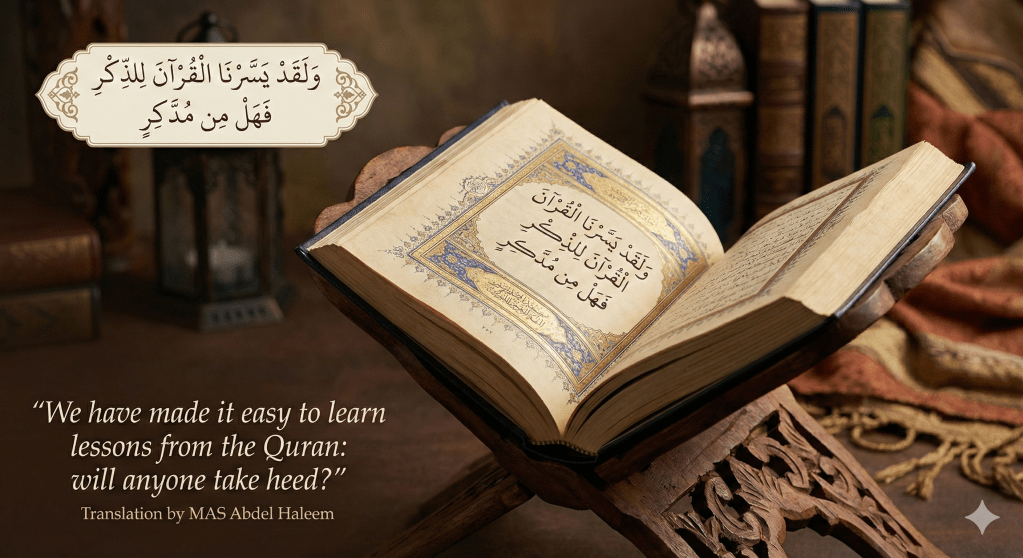
 The Glorious Quran and Science
Leave a comment