
Introduction
Iron (chemical symbol Fe) is one of the most abundant and indispensable metals on Earth. It forms the backbone of our planet’s core and is critical for technologies and biological processes (for example, oxygen transport in blood via hemoglobin). But the story of iron stretches far beyond Earth, into the life and death of stars. Understanding the scientific origin of iron reveals how this element was forged in stellar furnaces and delivered to young planets. Fascinatingly, iron is also prominently mentioned in ancient scriptures, including the Qur’an and the Bible. These texts, compiled long before modern science, refer to iron in ways that invite comparison – whether as a material blessing, a symbol of strength, or even something “sent down” from the heavens. This article will first explore how iron is formed through nucleosynthesis in stars and how it arrived on Earth through planetary formation and meteorites. It will then compare and contrast references to iron in the Qur’an and the Bible, examining the context, meaning, and possible interpretations (both symbolic and scientific) from scholarly perspectives in theology, history, and science.
Scientific Origins of Iron in the Universe
Stellar Nucleosynthesis – Forging Iron in Stars: In the aftermath of the Big Bang, the universe contained mostly hydrogen and helium, with virtually no heavy elements like iron. Heavier elements were forged later inside stars through nuclear fusion. In the cores of massive stars, lighter atoms fuse into heavier ones in a sequence of reactions. As a star ages, it produces progressively heavier elements – fusing hydrogen into helium, helium into carbon, oxygen, and so on. Eventually, in the most massive stars, the core fusion reactions produce elements as heavy as iron. This process requires extremely high temperatures (on the order of hundreds of millions of degrees), far hotter than what our Sun can attain islamreligion.com. Indeed, the Sun’s core (~15 million °C) is not hot enough to synthesize iron; iron can only be produced in the cores of much larger stars islamreligion.com. Iron-56 is the most stable nucleus, which means that fusion reactions stop at iron – beyond this point, fusing nuclei no longer releases energy. When a massive star builds up an iron core, it reaches the end of its life cycle. The core cannot sustain further fusion to produce energy, so a catastrophic collapse ensues.
Supernova Explosions – Dispersing Iron Across Space: The collapse of a massive star’s iron core triggers a violent rebound – a supernova explosion. In these titanic blasts, the star’s outer layers (now enriched with iron and many other newly-formed heavy elements) are hurled into space. The supernova not only scatters the iron that was created in the star’s core, but the extreme conditions of the explosion also enable the formation of elements heavier than iron (through rapid neutron-capture processes). Thus, supernovae are responsible for distributing iron throughout the galaxy, seeding the interstellar clouds with this metal islamreligion.com. There is even geological evidence on Earth of past nearby supernovae: scientists have found enhanced levels of the radioactive isotope iron-60 in deep-sea sediment layers, indicating that a supernova occurred within about 90 light years of our solar system roughly 5 million years ago islamreligion.com. This iron-60 (with a half-life of 1.5 million years) would have arrived on Earth as fallout from the supernova, perhaps in the form of dust grains islamreligion.com. Such findings dramatically illustrate that supernova explosions have “rained down” heavy elements, including iron, into the material that forms planets.
From Stardust to Planets – Iron’s Incorporation into Earth: Our own planet owes its iron content to these earlier generations of stars. The solar system formed about 4.6 billion years ago from a rotating nebula of gas and cosmic dust – dust that was enriched by the heavy elements produced in countless supernovae before the Sun was born. Most of the iron on Earth was already present in that primordial planetary dust cloud. As the proto-Earth grew by accretion, iron – being a dense, siderophile (iron-loving) metal – was drawn to the center of the young molten Earth under gravity skeptics.stackexchange.com. Geophysicists refer to this rapid separation of metal and silicate as the “iron catastrophe,” which occurred within the first 10 million years of Earth’s formation skeptics.stackexchange.com. The result was a differentiated planet with an iron-rich core and a silicate mantle and crust. This was a crucial event: the molten iron core generated a magnetic field (a dynamo effect) that has shielded the Earth from harmful cosmic radiation and helped retain our atmosphere islamreligion.com. In fact, the presence of abundant iron was pivotal for making Earth a habitable planet. As one scientist observed, it was the gravitational drawing of iron into Earth’s core that “generated the heat which caused the initial chemical differentiation of the earth, the outgassing of the early atmosphere, and ultimately the formation of the hydrosphere”islamreligion.com. Without iron, Earth might never have developed a protective atmosphere or oceans. Moreover, the iron core’s magnetic field today deflects solar wind and cosmic rays, preventing them from stripping away the ozone layer and ensuring the surface is not sterilized by radiation islamreligion.com.
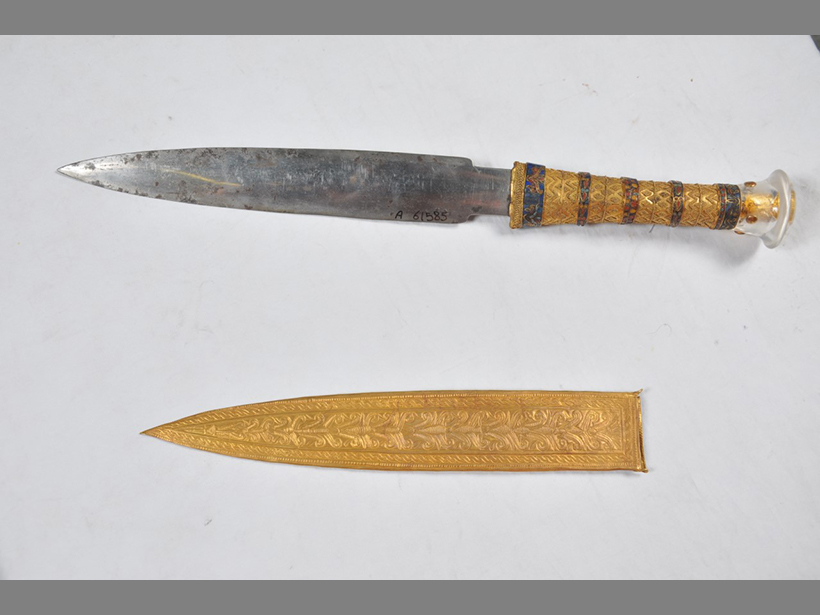
Meteorite Delivery – Iron “Sent Down” to Earth’s Surface: While Earth’s original endowment of iron came from its formation out of cosmic debris, meteorites have continued to deliver iron to Earth throughout its history. Many meteorites are rich in iron and nickel; these are fragments of shattered planetary bodies (asteroids) that had metal cores. When such iron meteorites fall to Earth, they literally bring extra-terrestrial iron down to the surface. In fact, a portion of the easily accessible iron in Earth’s crust (especially in the early crust after Earth had solidified) likely arrived via bombardment by meteorites. Researchers refer to a “late veneer” of meteorite impacts, about 4.0–4.3 billion years ago, which could have added siderophile elements (metals like gold, platinum, and additional iron) to the crust after the core was already formed and locked away most of the planet’s original iron deep below. In any case, meteorites provided ancient humans with their first pieces of workable iron metal long before smelting was developed. Meteoric iron can often be recognized by its high nickel content and was highly prized by early civilizations. For example, the ancient Egyptians referred to iron as the “metal of heaven” due to its meteoritic origin eos.orgeos.org. One spectacular artifact is the iron dagger found in the tomb of Pharaoh Tutankhamun (14th century BC). Modern analysis confirmed that King Tut’s dagger was forged from meteoritic iron, containing about 11% nickel and cobalt – a composition matching that of iron meteorites eos.orgeos.org. Because true iron smelting was not yet common in Egypt at that time, the dagger’s iron had to have come from a fallen meteorite. Ancient smiths could hammer the metal from meteorites into tools or ornaments, regarding it as a rare and precious material eos.orgeos.org.
In summary, modern science shows that Earth’s supply of iron is a direct gift from the stars. Long before Earth existed, massive stars forged iron in their cores and cast it into space through supernovae. Our planet formed from this iron-rich cosmic dust, and meteorite impacts supplemented additional iron at the surface. This grand origin of iron provides a scientific backdrop for reflections on iron’s special role – a backdrop against which we can examine what ancient scriptures said about iron. It is remarkable that iron’s journey – from stellar furnaces to “falling” onto Earth – finds a resonance (perhaps coincidental, perhaps insightful) in certain scriptural language, as we will see next.
Iron in the Qur’an: “Sent Down” from Heaven?
Iron is one of the very few elements explicitly mentioned in the Qur’an, and it carries a notable emphasis. In fact, Chapter 57 of the Qur’an is titled Al-Ĥadīd (الحديد), which means “The Iron.” A key verse in this chapter states: “And We sent down iron, wherein is great military might and benefits for the people…” (Qur’an 57:25). In the original Arabic, the phrase “anzalnā al-ḥadīd” is used, with anzalnā meaning “We sent down.” This wording has intrigued many readers and scholars. The context of the verse is that God is recounting His favors to humanity: the same verse mentions God sending messengers with clear signs, sending down the Scripture and the balance (scale of justice), and then “sending down iron” for mankind’s benefit legacy.quran.com. Classical Islamic scholars understood “sending down” in this context as a way of saying that iron is a provision from God for human use. For example, the renowned commentator Abū al-Aʿlā Maududi explains that “sending down iron” means creating or bestowing iron for humans, just as God “sent down” cattle or rain for human benefit islamicstudies.info. In other words, iron is viewed as a divinely provided resource endowed with strength and usefulness. Maududi further notes that iron’s mention immediately after justice (“the Balance”) hints at a symbolic meaning: iron represents power and might to enforce justice islamicstudies.info. In this interpretation, the verse emphasizes that along with spiritual guidance, God provided humanity the material means (like iron weapons or tools) to uphold justice and defend truth. Thus, many Islamic theologians have traditionally seen the “descent” of iron as a poetic or metaphorical expression of divine provisioning and the enabling of earthly power to do good.
In modern times, however, some writers and scholars have drawn attention to the literal wording “sent down from the sky” and found it uncannily concordant with scientific facts. It is now known that iron on Earth did originate from outside – it was not produced on our planet but rather arrived from stellar processes. The temperature of Earth (and even of the Sun) is far too low to form iron atoms; instead, as science reveals, the iron in the entire solar system was synthesized in ancient supernova explosions. In that sense, iron really was “sent down” to Earth from the heavens, via meteorites and interstellar dust. This has led some to marvel at the Qur’an’s choice of words. For instance, one source notes that “modern astronomical findings have disclosed that the iron found in our world has come from giant stars in outer space” islamreligion.com, and thus the Qur’anic phrase in the 7th century seemingly “implies a very significant scientific miracle” islamreligion.com. Apologists often argue that such knowledge of iron’s cosmic origin would have been beyond human reach in the Prophet Muhammad’s time, and they see this as a sign of the Qur’an’s divine insight. It should be said, however, that mainstream Islamic scholarship typically does not rest theological arguments on scientific marvel claims alone. While it is intriguing that Al-Ĥadīd 57:25 aligns with what we now understand about meteorites and the extraterrestrial origin of iron, many scholars caution against overextending this as “proof” of revelation. The Qur’an’s primary intent with such verses is often moral or symbolic. Indeed, the context of Surah Al-Ĥadīd is about spiritual guidance, justice, and struggle; mentioning iron’s strength and benefits likely serves to remind people of God’s blessing and the power granted to them.
Aside from the famous 57:25, the Qur’an refers to iron (or iron tools) in a few other places in passing. For example, iron armor is mentioned in the story of David: “We made iron soft for him” (Qur’an 34:10) – describing how Prophet Dawud (David) was given the skill to make chain mail. Iron is also alluded to in descriptions of Hell, such as iron hooks or molten iron punishment (e.g., Qur’an 22:21 mentions “maces of iron” for torment in Hell). These references reinforce that iron was known as a strong, formidable material. But it is Al-Ĥadīd (Chapter “Iron”) that stands out for treating the metal with almost metaphorical significance. In summary, the Qur’an presents iron as a heavenly gift to mankind, endued with strength and utility. The phrase “We sent down iron” elegantly encapsulates both a theological idea (God’s providence in furnishing humans with resources and power) and – from a modern viewpoint – a scientifically accurate statement (iron literally came to Earth from the sky). This dual aspect has been the subject of much discussion in Islamic thought, bridging scripture and science.
Iron in the Bible: Earthly Metal and Symbol of Strength
The Bible contains numerous references to iron, reflecting its importance in the ancient Near East, especially from the late Bronze Age into the Iron Age. Unlike the Qur’an, the Bible does not explicitly describe where iron came from cosmically – there is no direct statement about iron “coming down” from heaven. Instead, iron is generally treated as a part of the natural world that people discovered and utilized. The earliest mention of iron in the Bible occurs in Genesis 4:22, which names Tubal-Cain as “the forger of all instruments of bronze and iron.” This portrays iron-working as known in humanity’s early generations. Historically, the setting of Genesis 4 (antediluvian times) is much earlier than actual iron smelting was developed (archaeology suggests iron metallurgy became widespread around 1200 BC, at the start of the Iron Age). Biblical tradition, however, often telescopes technological knowledge anachronistically into its narratives. The mention of Tubal-Cain likely serves to credit a proto-figure with introducing metalwork arts, indicating by the time of the biblical writers, iron craft was a familiar part of culture biblegateway.com. Later books of the Bible contain many practical references to iron: for example, by the time of the Exodus (~15th–13th century BC), the Israelites knew of iron – “the rocks are iron” in Canaan, and copper can be mined from its hills biblehub.com. Moses assured the people that the Promised Land would be rich in resources, “a land whose stones are iron, and out of whose hills you can dig copper” biblehub.com. This indicates an understanding that iron was literally in the ground, to be dug up or mined – a thoroughly naturalistic description. Indeed, archaeological findings show iron ore extraction and processing in ancient Israel and surrounding regions. By King David’s era (~1000 BC), iron was so common that David amassed large quantities of iron for temple construction (for nails, fittings, etc., 1 Chronicles 22:3).
Throughout the historical and wisdom books of the Bible, iron is frequently cited as a material for tools and weapons. Goliath’s spearhead was made of iron (1 Samuel 17:7), and the Philistines’ monopoly on iron technology is noted as a strategic advantage (1 Samuel 13:19–22). These incidental mentions underscore that iron was a prized metal for its hardness. The Bible also uses “iron” as a benchmark of strength or hardness in figurative language. Biblical poets and prophets draw similes and metaphors from iron’s properties: “a yoke of iron” signifies an especially grievous bondage or hardship biblegateway.com; “breaking with a rod of iron” symbolizes absolute power or harsh rule (as in Psalm 2:9, envisioning a king who rules decisively); “an iron furnace” represents severe trial or oppression (Deuteronomy 4:20 compares the Israelites’ slavery in Egypt to an iron-smelting furnace); “iron sharpening iron” is used in Proverbs 27:17 as a metaphor for how people can improve one another through constructive criticism, much as the whetting of one iron blade sharpens another. The firmness of iron also made it a metaphor for strength of character or obstinacy: God tells Jeremiah, “I have made you an iron pillar” to resist opposition (Jeremiah 1:18). These symbolic uses show that in the biblical mindset, iron was synonymous with strength, durability, and at times, severity. Crucially, the Bible’s perspective on iron is terrestrial and utilitarian – it is part of God’s creation, but its origin is not elaborated beyond the implication that God created all materials in the beginning. In the biblical creation narrative, the Earth (and everything in it) was made by God (Genesis 1), so naturally that includes metals in the earth’s crust. For example, a later biblical author, reflecting on God’s providence, states that God “made… iron in the earth” (paraphrasing Job 28 or other passages about mining). Deuteronomy 8:9 (cited above) explicitly locates iron in the stones of the earth, ready for human extraction. There is no suggestion that iron was sent from heaven; instead, the Bible frames iron as a resource to be mined from the ground, a provision within the promised land itself.
It is also interesting from a historical perspective that early peoples often distinguished between “iron from the sky” and “iron from the earth.” The Bible doesn’t overtly make this distinction, but other ancient cultures did. For instance, the ancient Egyptian term for iron, as noted, referred to sky-origin (meteorites). The Bible’s silence on meteorites may be simply because iron became common through mining by the time most of the biblical texts were composed (during or after the Iron Age). By then, the novelty of meteoritic iron had faded compared to smelted iron from ore. One could argue that at least one biblical episode hints at meteoric phenomena: in the Book of Judges, the victory of Deborah and Barak over Sisera (Judges 5:20–21) poetically says, “the stars fought from heaven… the torrent swept away [the enemy].” Some have speculated this could refer to a meteor shower causing confusion, but this is conjectural and not an explicit reference to iron. In general, the Bible treats iron as an earthly substance known to be accessible through human effort (digging, mining, smithing), and it emphasizes the symbolic meaning of iron’s hardness in moral and spiritual analogies.
Comparative Perspectives: Iron in Qur’anic and Biblical Thought
Putting these findings together, we can see both similarities and differences in how the Qur’an and the Bible speak about iron. On a basic level, both scriptures acknowledge iron as an important material endowed with great strength and many uses for humanity. Both describe people using iron for tools, weapons, or construction, reflecting the technology of their times. The use of iron as a symbol of strength is common to both traditions: the Bible’s metaphors (iron yoke, rod, pillar, etc.) have their counterpart in the Qur’an’s portrayal of iron as having “great might” or “awesome power” (ba’sun shadīd in Qur’an 57:25) for mankind. Thus, conceptually, iron is associated with power, whether it be the power to oppress, to endure, or to enforce justice.
However, a striking difference lies in the cosmic framing (or lack thereof) of iron’s origin. The Qur’an’s statement “We sent down iron…” is unique in religious literature. It casts the existence of iron as an almost deliberate act of divine bestowal from above. Many modern readers interpret this literally – aligning it with the scientific fact that iron came to Earth from celestial sources (supernova remnants and meteorites). Some Islamic thinkers welcome this harmony between scripture and science, considering it a sign of the Qur’an’s miraculous knowledge islamreligion.com. Traditional exegesis, on the other hand, did not know of supernova nucleosynthesis, so it understood “sent down” in a figurative or theological sense (everything ultimately comes from God). As noted, classical tafsīr often explains Qur’an 57:25 by saying “sent down” means God created iron for human benefit islamicstudies.info. Nonetheless, the mere choice of the verb “send down” (nazala) is thought-provoking – it is the same verb used for sending down rain or revelation in the Qur’an, which usually implies a descent from the sky. This gives the Qur’anic reference a layered depth: spiritually, iron is a gift to enforce justice; physically, it did “fall” to Earth in meteorites. In contrast, the Bible does not explicitly tie iron to a heavenly origin. There is no biblical verse that suggests iron came from the stars or was sent by God from the sky. Instead, the Bible’s references stay grounded (quite literally) in earthly geology – e.g., iron is something to be dug from rocks biblehub.com. The biblical worldview in ancient Israel likely assumed that God’s creation furnished iron ore in the ground as part of the natural riches of the land (as per Deuteronomy 8:9). The idea that iron came via meteorites was not a part of Hebrew scripture’s discourse, even if people occasionally found “stones” of iron that fell from the sky. This reflects a difference in emphasis: the Bible is more historical/earthly in its descriptions of materials, whereas the Qur’an in this case gives a more cosmic or universal perspective, linking material provision with divine cosmology.
From a symbolic and theological standpoint, each scripture uses iron to convey certain lessons. In the Qur’an, the prominent mention in Surah Al-Ĥadīd occurs in a context of balancing justice and might. The verse suggests that even as prophets bring scriptures of guidance, worldly authority (symbolized by iron) is part of God’s plan for humans to uphold justice and defend truth islamicstudies.info. Some scholars infer that Islam encourages using knowledge (the Book) and power (iron) together in a just cause. The Quranic name “Iron” for Chapter 57 itself highlights the element’s significance as a divine blessing with profound impact on civilization (indeed, the development of iron metallurgy revolutionized warfare, agriculture, and infrastructure). The Bible, while not having a chapter named after iron, weaves iron into its narrative and poetry to illustrate human civilization and God’s power. For example, in biblical prophecy, iron can represent kingdoms or divine rule: The Book of Daniel interprets a statue with legs of iron as an empire characterized by strength and toughness (Daniel 2:40), and the New Testament echoes the Messianic prophecy of ruling “with an iron scepter” (Revelation 12:5, referencing Psalm 2:9), symbolizing an unbreakable, just dominion. These usages are metaphorical, teaching about resilience and authority. The shared cultural understanding is that iron = strong. Neither text attributes any spiritual weakness or negativity to iron itself (though iron can be used by oppressors or for idols, the metal is morally neutral but potent).
On the matter of science and historical knowledge, it is intriguing to consider what people of biblical or Quranic times understood about iron’s source. By the time of Muhammad (7th century Arabia), iron was well known and widely used (the Iron Age in the Middle East had long been underway). Meteorites were also observed – in fact, a meteorite (the “Black Stone”) is revered in Islamic tradition, though not in the Qur’an itself. Did people in antiquity know iron came from meteorites? They certainly knew some iron objects fell from the sky (shooting stars leaving iron meteorites). The ancient Egyptians, as mentioned, called meteoric iron ba-en-pet (“iron from heaven”) eos.orgeos.org, and other cultures had similar notions. However, they also mined iron from the ground. The Bible’s authors, living in iron-rich regions, focused on the latter. The Qur’an’s wording might be seen as aligning more with that older concept of “heavenly iron,” albeit given a monotheistic twist (God sent it). Whether one sees Qur’an 57:25 as a coincidence or revelation of scientific truth depends on interpretive stance. Academic historians caution that one verse shouldn’t be isolated as “science” without context – in context, the verse is as much about societal strength and divine favor as about material origin.
In summary, the Qur’an and Bible both recognize iron as a crucial element for human civilization, but they frame its origin and significance differently. The Qur’an’s notable phrase “sent down” can be appreciated today in light of astrophysics, while the Bible’s treatment of iron stays within the realm of earthly experience and metaphor. Both scriptures use iron to symbolize power – the ability to wage war, to build, to punish, or to protect. This power can be positive (just rule, stability) or negative (oppression, violence) depending on context. Scholarly insights from theology highlight that in the Qur’an, iron’s divine “sending” underlines a theological point: material power is given by God for humans to use responsibly islamicstudies.info. In the Bible, theological reflections on iron often concern moral strength or the hardship required to refine character (as iron sharpens iron). From a scientific perspective, modern readers can’t help but find it fascinating that one scripture (Qur’an) uses language that resonates with the idea of meteorite delivery, whereas the other (Bible) explicitly talks about digging iron from the earth – essentially the sky versus the soil as the source of iron. This contrast provides a rich dialogue between science, history, and faith: it reminds us that ancient people interacted with the natural world in different ways, and their descriptions, while not “scientific” in our modern sense, sometimes align with scientific truths in unexpected manners.
Conclusion
Iron’s story is truly cosmic. Science has shown that the iron so fundamental to our planet and life itself was forged in the hearts of exploding stars and sent across the universe to become part of new worlds. On Earth, iron shaped human history – enabling stronger tools and weapons, thus transforming agriculture, warfare, and industry. When we turn to the sacred texts, we find that iron also left a deep impression on the religious imagination of ancient peoples. The Qur’an encapsulates iron’s importance by reminding believers that this mighty metal was “sent down” by God for their benefit, a phrase that intriguingly dovetails with the scientific narrative of meteorites and cosmic origin. The Bible, rich with references from an earlier era, reflects iron’s entrenched role in human society – from the forge of Tubal-Cain to the iron yoke of captivity – and uses it to signify strength, oppression, or resilience in various lessons and prophecies. Both scriptures, in their own ways, acknowledge that iron is a blessing to humanity, albeit one that must be wielded with wisdom and justice (as it can be a tool for construction or destruction).
Scholarly perspectives help us appreciate these references on multiple levels. Historically, we see how the coming of the Iron Age was remembered and interpreted in cultural memory – as a God-given advancement for some, or simply as part of the natural order for others. Theologically, iron in scripture symbolizes the interplay between material power and moral responsibility: the Qur’an positions it as part of God’s plan to test and aid humankind islamicstudies.info, while the Bible often uses it to illustrate the need for God’s guidance to temper human strength (since even “iron” kings can be broken without righteousness). Scientifically, while neither the Bible nor Qur’an is a science textbook, it is noteworthy that a Quranic verse can be read in light of modern cosmology in a way that enriches faith for some, and that the Bible’s down-to-earth depictions indirectly align with the fact that iron is literally in the “stones” of the earth to be mined. Ultimately, the convergence of science and scripture on the topic of iron invites a holistic reflection: we are connected to the stars through elements like iron, and for millennia humans have sensed something almost providential about the materials that empower our civilization. Whether one looks at iron as a gift from God or a natural result of stellar evolution – or both – it remains a potent symbol of strength and an essential foundation for life on Earth. As one scientist eloquently noted, there is an “intriguing and intimate relationship between life and iron, between the red color of blood and the dying of some distant star” islamreligion.com. Such insights beautifully meld the scientific and the spiritual, deepening our awe at how the origins of iron tie together the fate of stars, the formation of planets, and the narratives that ancient peoples preserved in their holy books.
Is the scientifically accurate mention of iron in the Quran a one-time fluke or has greater religious and spiritual implications? For this discussion, go to: Maurice Bucaille’s Analysis of the Glorious Quran — A Three-Minute Reading.
Sources:
- Priscilla Frisch, “The Galactic Environment of the Sun,” American Scientist 88(1), 2000islamreligion.com.
- Michael J. Denton, Nature’s Destiny: How the Laws of Biology Reveal Purpose in the Universe, Free Press, 1998islamreligion.comislamreligion.com.
- Quran 57:25 (Translation: Sahih International)legacy.quran.com; Tafheem al-Qur’an by Abul A’la Maududi (commentary on Quran 57:25)islamicstudies.infoislamicstudies.info.
- Easton’s Bible Dictionary, “Iron”biblegateway.combiblegateway.com; Holy Bible, Deuteronomy 8:9biblehub.com, Genesis 4:22, Psalm 2:9, etc.
- E. Deatrick, “Pharaoh’s Iron Dagger Made from a Meteorite, Study Confirms,” Eos/AGU News (1 June 2016)eos.orgeos.org.
- Stack Exchange: “Did all iron on Earth come from outer space?” – Skeptics Q&A (2018)skeptics.stackexchange.comskeptics.stackexchange.com.



 The Glorious Quran and Science
Leave a comment