
Epigraph:
People remember, if you doubt the Resurrection, that We created you from dust, then a drop of fluid, then a clinging form, then a lump of flesh, both shaped and unshaped: We mean to make Our power clear to you. Whatever We choose We cause to remain in the womb for an appointed time, then We bring you forth as infants and then you grow and reach maturity. Some die young and some are left to live on to such an age that they forget all they once knew. You sometimes see the earth lifeless, yet when We send down water it stirs and swells and produces every kind of joyous growth: this is because God is the Truth; He brings the dead back to life; He has power over everything. (Al Quran 22:5-6)
By Zia H Shah MD
Charles Darwin’s theory of evolution restructured comparative embryology and gave it a new focus. After reading Johannes Müller’s summary of von Baer’s laws in 1842, Darwin saw that embryonic resemblances would be a very strong argument in favor of the genetic connectedness of different animal groups. “Community of embryonic structure reveals community of descent,” he would conclude in On the Origin of Species in 1859.[1]
Embryology is important to understanding a species’ evolution, since some homologous structures can be seen only in embryo development. For example, all vertebrate embryos, from humans to chickens to fish, have a tail during early development, even if that tail does not appear in the fully developed organism.
Likewise, vestigial structures serve little or no present purpose for an organism. The human tail, which is reduced to the tailbone during development, is one example. Vestigial structures can provide insights into an organism’s ancestry. For instance, the tiny vestigial leg bones found in some snakes reflect that snakes had a four-legged ancestor.
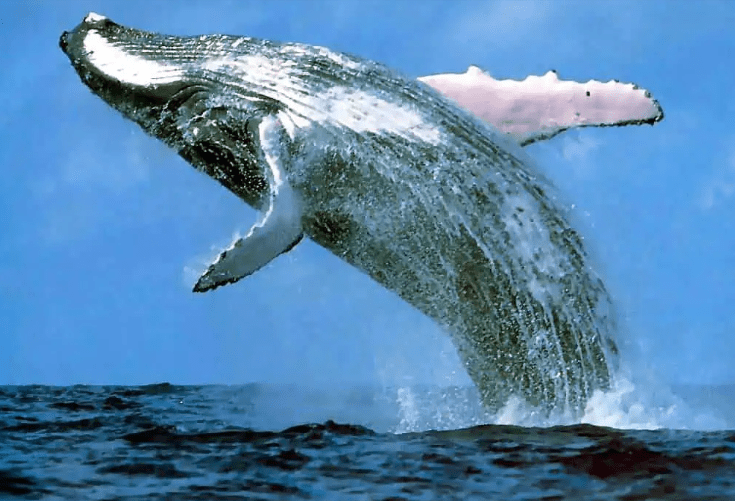
Baleen whales, which include the blue whales, split from toothed whales (Odontoceti) around 34 million years ago.

Baleen whales range in size from the 6 m (20 ft) and 3,000 kg (6,600 lb) pygmy right whale to the 31 m (102 ft) and 190 t (210 short tons) blue whale, the largest known animal to have ever existed.[1][2] They are sexually dimorphic. Baleen whales can have streamlined or large bodies, depending on the feeding behavior, and two limbs that are modified into flippers. The fin whale is the fastest baleen whale, recorded swimming at 10 m/s (36 km/h; 22 mph). Baleen whales use their baleen plates to filter out food from the water by either lunge-feeding or skim-feeding. Baleen whales have fused neck vertebrae, and are unable to turn their heads at all. Baleen whales have two blowholes. Some species are well adapted for diving to great depths. They have a layer of fat, or blubber, under the skin to keep warm in the cold water.
Look at the feeding of the gigantic blue whales in the video below, they have no use for any teeth, as they consume millions upon millions of small fish:
Even though adult Baleen whales do not have teeth, in embryological life they do, perhaps a subtle proof of God’s grand plan of creation of all the nine million life forms on planet earth through a common ancestry, by means of guided evolution. Darwin noted in his epic making book on evolution that embryonic organisms sometimes make structures that are inappropriate for their adult form but that show their relatedness to other animals. He pointed out the existence of eyes in embryonic moles, pelvic rudiments in embryonic snakes, and teeth in embryonic baleen whales.[1]
The extant and the extinct life forms are all descending from a single organism, from whom Allah created its mate. There are at least four verses of the Quran referring to this great grand single cell progenitor.[2]
There are at least three places that the Quran describes embryology. The first reference is from Surah Hajj and is described as epigraph to this article and other two are quoted below. Firstly, from the chapter the Believers or Surah Moominoon:
We created man from an essence of clay, then We placed him as a drop of fluid in a safe place, then We made that drop into a clinging form, and We made that form into a lump of flesh, and We made that lump into bones, and We clothed those bones with flesh, and later We made him into other forms –– glory be to God, the best of creators! –– then you will die and then, on the Day of Resurrection, you will be raised up again.
We created seven levels above you: We are never unmindful of Our creation. We sent water down from the sky in due measure and lodged it in the earth––We have the power to take it all away if We so wish –– with it We produced for you gardens of date palms and vines, with many fruits there for you to eat. (Al Quran 23:12-19)
Secondly from Surah Zumar:
He created the heavens and earth for a true purpose; He wraps the night around the day and the day around the night; He has subjected the sun and moon to run their courses for an appointed time; He is truly the Mighty, the Forgiving. He created you all from a single being, from which He made its mate; He gave you four kinds of livestock in pairs; He creates you in your mothers’ wombs, in one stage after another, in threefold depths of darkness. Such is God, your Lord; He holds control, there is no god but Him. How can you turn away? (Al Quran 39:5-6)
In all these three references, Allah describes embryology in a broad context of not only the creation of the heavens and the earth but all the different life forms, both animals and plants. In Surah Hajj Allah says that He created mankind from Turab and in Surah Moominoon, He says He created from Teen. These have been translated as dust or clay. In the past centuries the Muslim commentators have read in these verses a creation story of Adam from a statue of mud. Such a narration is not only scientifically wrong, but can be shown to be theological wrong from the Quran itself as well, for at least two reasons. Firstly, the Quran says in the very first verse of Surah Nisa that the single soul that mankind came from was a female and not a male, hence not Adam. This is examined in a separate detailed article.[3] Secondly, because of all the other verses that are better interpreted in the light of evolution. These verses are described in a book: A New Book: The Quran and the Biological Evolution.
When we begin to dwell deeper into the choice of the Quranic words Turab and Teen in the context of evolution, new domains of knowledge and insights open up and we can truly begin to appreciate the expression فَتَبَارَكَ اللَّهُ أَحْسَنُ الْخَالِقِينَ, ‘glory be to God, the best of creators!’ which is part of the verses quoted above from Surah Moominoon. The grand unfolding of the creative drama spread over four billion years and creation of nine million extant species from a single being certainly qualifies for the expression of the best of creators. The magical conversion of a mud statue into Adam and then creating his wife from his rib does not rise to the compliment of فَتَبَارَكَ اللَّهُ أَحْسَنُ الْخَالِقِينَ ‘glory be to God, the best of creators!’ in my estimation and the Western philosophers or scientists. But, no one can refuse to stand in awe of the glorious achievement of the evolutionary process. In fact Richard Dawkins, the most well known spokesperson for atheism, has written a book about it titled: The Greatest Show on Earth: The Evidence for Evolution.
In Surah Rome, Allah calls the creation from dust (Turab) a miracle or a Sign of Allah: “Of His Signs is that He created you from dust, and lo! you are human beings spread over the earth.” (Al Quran 30:20) It is for each of us to decide, which is a greater miracle, magically converting a mud statue into a human being or laying out an elaborate plan for creation of millions of wonderful plant and animal species through the process of guided evolution over billions of years and creating a living and a gorgeous planet that we never tire of traveling and site seeing.
Let me quote here the concluding paragraph, in the later editions of the legendary book of Charles Darwin, on the Origin of Species that can make one quickly conceptualize the role of suffering in the grand scheme of things and in the creative miracle of Allah:
From the war of nature, from famine and death, the most exalted object which we are capable of conceiving, namely, the production of the higher animals, directly follows. There is grandeur in this view of life, with its several powers, having been breathed, by the Creator, into a few forms or into one; and that, whilst this planet has gone cycling on according to the fixed law of gravity, from so simple a beginning endless forms most beautiful and most wonderful have been, and are being, evolved.
In the past the Muslim writers have written articles about the verses pertaining to fetal development, describing the accuracy of embryological details highlighted in these that were an unknown and unsought subject in the 7th century Arabia, while the detractors of Islam argue with them.[4][5] I endorse such reading of these Quranic verses, by the Muslim scholars, but here I am suggesting two totally new ideas about these verses.
Firstly, in these verses Allah is not only talking about embryology but is linking the subject matter with the broader discussion of evolution and creation. There is perhaps a subtle hint that embryology provides evidence for evolution. The words Turab and Teen are then symbol of how amino acids came to be from inorganic materials in a slimy environment some four billion years ago and possibly different other stages of evolution later.
Secondly, in all these verses and in their context, Allah presents His creativity and beauty of all his creation including embryology and all the life forms as proof for Afterlife. How can the One who caused the First Creation be not able to recreate it or cause a Second Creation?
The link between embryology and evolution opens new arenas of scientific and philosophical discussions and the use of the words Turab and Teen does the same about origin of life. These discussions and details will extend over months and years to come. A short video for today:
The miracle of uterus and placenta is examined in a separate article and that is also very relevant to the Quranic verses examined in the present article: Our mammalian family and placenta: What a retrovirus did, humanity cannot.
References and Archives
- https://www.ncbi.nlm.nih.gov/books/NBK10049/#:~:text=Charles%20Darwin’s%20theory%20of%20evolution,connectedness%20of%20different%20animal%20groups.
- 2. Al Quran 4:1; 7:189 and 39:5. And: https://themuslimtimes.info/2022/04/19/the-single-quranic-verse-that-can-convince-you-about-evolution-2/
- https://themuslimtimes.info/2016/12/21/biology-of-our-human-family-who-are-we-related-to/
- https://www.ncbi.nlm.nih.gov/pmc/articles/PMC3068791/
- https://www.cmf.org.uk/resources/publications/content/?context=article&id=585


 The Glorious Quran and Science
Leave a reply to Why Javed Ahmad Ghamidi’s Literal Reading and Commentary of the Glorious 32:7 is Not Coherent? – The Glorious Quran and Science Cancel reply