
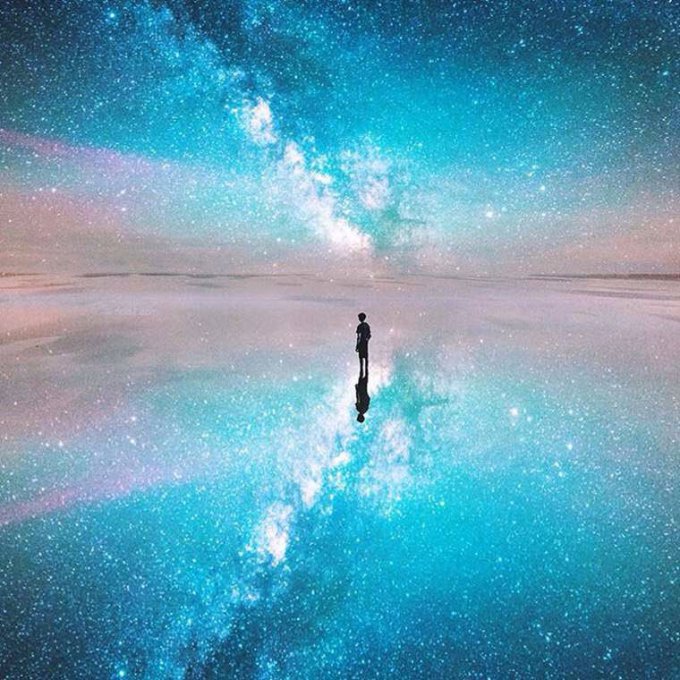
Written and collected by Zia H Shah MD, Chief Editor of the Muslim Times
The Qur’an contains numerous qasam (oaths) in which God swears by various created things – from cosmic bodies to earthly elements. These oaths serve to grab attention, underscore the importance of the message to follow, and invite the reader to reflect on the significance of the entities sworn upon . Unlike humans (who in Islamic teaching should only swear by God), God may swear by any aspect of creation to assert His authority over it and highlight its value . The entities chosen – the sun, moon, stars, sky, earth, wind, night and day, mountains, oceans, etc. – are themselves signs of divine wisdom and power in nature. In this report, we collect all such Qur’anic oaths by natural phenomena, providing the Arabic text and Abdel Haleem’s English translation for each, along with an analysis of their scientific, philosophical, and theological significance. Through these oaths, the Qur’an not only draws attention to the order and purpose in nature but uses it as evidence of the truth of God’s message.
The Sun (الشَّمْس)
Arabic: وَالشَّمْسِ وَضُحَاهَا
Translation: “By the sun in its morning brightness,” (Qur’an 91:1)
Scientific perspective: The sun is a massive star of hot plasma that is the engine of our solar system. It produces energy by nuclear fusion in its core, fusing hydrogen into helium at about 15 million °C, and releasing light and heat that radiate through the solar system . This process (the proton–proton chain) converts mass to energy (as per E = mc²), powering the sun’s luminosity . Scientifically, life on Earth depends entirely on the sun’s energy: it drives photosynthesis, weather patterns, and the day-night cycle. The sun’s gravitational pull also anchors the planets in their orbits . In short, the sun is the source of light and life for our planet – a fact that a 7th-century audience would intuitively appreciate (seeing how sunrise brings warmth and activity) and that modern astrophysics richly confirms in detail. The Qur’anic oath by the sun draws attention to this central role. Without the sun’s steady output, Earth would be cold and lifeless. By swearing “by the sun and its brightness,” the Qur’an may be directing us to contemplate how this ordinary yet crucial star is finely tuned to benefit life on Earth, from the physics of fusion in its core to the illumination of each new day.
Philosophical perspective: The sun has always been a symbol of illumination, clarity, and knowledge. In the Qur’an, the sun’s bright radiance is immediately paired with the moon’s reflected light, the day that displays its glory, and the night that conceals it . This pairing of opposites is deliberate. Philosophically, it highlights a cosmic order of cycles: light and darkness, revelation and concealment, knowledge and ignorance. Just as the sun chases away darkness every morning, truth dispels falsehood. The surah named “The Sun” (Ash-Shams) opens with seven oaths by the sun, moon, day, night, sky, earth, and soul – effectively elevating these cosmic phenomena as witnesses to a profound truth. The passage culminates in the statement that the successful are those who purify their souls and the failures are those who corrupt them (91:9–10). The radiant sun and the dark night are thus metaphors for the human condition . Daylight symbolizes guidance, growth, and enlightenment, whereas night represents the possibility of error or rest. The sun’s regular rising also suggests purpose and reliability in the cosmos – a philosophical indication (to “the rational person”) that this universe is not chaotic but follows laws and rhythms. Indeed, the Qur’an asks, “is this oath strong enough for a rational person?” – implying that anyone of understanding should reflect on the daily miracle of sunrise as a sign of intentional design.
Theological perspective: Theologically, by swearing upon the sun, the Qur’an underscores God’s power as Creator of the greatest light we know. The sun was worshipped in various ancient cultures; the Qur’an redirects that awe to God who “made the sun a radiant lamp” (71:16). The sun’s precise properties – mass, luminosity, distance from Earth – enable life, which believers interpret as part of Allah’s providence rather than random chance. As one commentary notes, “the brilliance of the sun, the serenity of the moon… all serve to prepare the soul for the pivotal call to righteousness” . In other words, the majestic order in nature (anchored by the sun’s light) is used as evidence for the truth that the Qur’an is conveying about moral order . God’s swearing “by the sun” also establishes the sun’s importance as a sign: it is not an object of worship, but a creation under God’s command, ceaselessly obeying His laws of physics. In Islam, the regularity of the sun’s rising and setting is a daily reminder of God’s reliability and mercy – symbolized further in obligatory prayers that pivot around sunrise, noon, and sunset times. Thus, the oath by the sun points to God’s sovereignty over even the mightiest objects in our sky, bolstering the Quran’s claim that its message comes from the Lord of all such phenomena.
The Moon (الْقَمَر)
Arabic: وَالْقَمَرِ إِذَا تَلَاهَا
Translation: “and by the moon as it follows it [the sun],” (Qur’an 91:2)
Scientific perspective: The moon, Earth’s lone natural satellite, is essential in stabilizing our planet’s environment. It shines with reflected sunlight, “following” the sun by night – an observation the Qur’an makes literally (the new moon rises after sunset) and metaphorically. Modern astronomy reveals the moon’s critical role: it stabilizes Earth’s axial tilt through its gravitational pull. Without the moon, simulations predict Earth’s tilt could oscillate wildly (by up to 85°), causing the sun to shift from over the equator to over the poles and wreaking havoc on climate and seasons . In fact, our moon is unusually large relative to Earth, and less than 10% of Earth-like planets may have such a stabilizing satellite . The moon’s gravity also causes the ocean tides, which may have been crucial for life’s emergence. Tidal flows distribute nutrients and heat; some scientists suggest that the moon-driven tides created intertidal zones that could have jump-started biological evolution . The Qur’an’s oath by the moon invites us to marvel at how this seemingly small, cool orb is finely tuned for life on Earth – from calming the planet’s wobble to pulling the world’s oceans. Additionally, the moon’s phases have made it a natural calendar for human societies (and indeed the Islamic calendar). Scientifically and culturally, the moon “following” the sun is a marker of time and cycles. Thus, when God swears by the moon, we are prompted to consider the precise cosmic choreography of the sun and moon that yields the stable rhythms of months, tides, and seasons on Earth – all of which point beyond themselves to a wise Designer.
Philosophical perspective: Philosophically, the relationship of the moon to the sun can symbolize derived light (the moon has no light of its own, it reflects the sun’s). This resonates as an allegory: just as the moon illuminates the night with borrowed light, guidance and wisdom can illuminate the darkness of ignorance by reflecting divine truth. Classical commentators noted that “the moon follows the sun” in that the crescent becomes visible after sunset – a subtle reminder that one source of light sets, but another gentler light appears by God’s grace . The moon’s cycle from new to full and back has also suggested the cyclical nature of time and renewal. In the Qur’anic context, the sun and moon are often mentioned together as signs of duality and balance. Surah 91 pairs sun vs. moon, day vs. night, sky vs. earth – “each pair representing opposites or complements in creation, reinforcing the theme of duality” . The moon, being a cool, serene light, balances the sun’s intense brightness. It provides beauty and comfort in darkness, inviting philosophical reflection on the need for both activity and rest, both revelation and contemplation. The moon’s smooth transitions through phases teach patience and the ebb and flow of life. Many cultures associated the moon with the feminine or with emotion in contrast to the sun’s rational clarity – interestingly, Arabic grammar genders the sun as feminine and the moon as masculine, yet the Qur’an uses feminine pronouns for the sun such that even the moon’s light is described in relation to “her” (the sun’s) radiance . In sum, the moon in Qur’anic oaths represents complementarity: it is the lesser light that is nonetheless crucial. Its presence philosophically underscores that even in the absence of direct light (truth), a reflected reminder remains for those who seek guidance in the gloom.
Theological perspective: Theologically, swearing by the moon highlights it as one of the great signs (āyāt) of Allah in creation. The Qur’an explicitly points out that the sun and moon run on precise courses according to God’s decree (e.g. 21:33, 36:39). When God says “By the moon!” (as in Qur’an 74:32, an emphatic standalone oath ), it comes in the context of warning about the gravity of Judgment Day. The crescent and full moon have no power of their own; they are subject to Allah’s command, thus He alone is worthy of worship – a subtle polemic against moon-worship or astrology. Instead, the moon is a witness to God’s providence: it marks the months of worship (Ramadan begins and ends with a moon sighting), and its reflected light symbolizes prophetic guidance (some scholars liken the Prophet Muhammad to the moon reflecting the Sun of divine light). By linking the moon with “the city of security” (Mecca) and “Mount Sinai” in Surah 95 , some scholars see an allusion to lands of prophets (many prophets lived in the olive-rich Levant, symbolized by the olive and perhaps the fig; Moses received revelation on Sinai; Muhammad in Mecca). Thus, the moon connects to prophecy – for example, a famous incident during Muhammad’s time was the splitting of the moon, seen as a miracle (Surah 54 is titled “The Moon”). Swearing by the moon, then, reinforces the Qur’an’s claim that “Indeed it (the Quran) is no less than a reminder to all the worlds – by the moon! and by the dawn… it is one of the mighty signs” (paraphrasing 74:32–35) . In Islam, every lunar cycle that passes and every full moon that shines is a testimony to the consistency of Allah’s creation, encouraging the believer’s heart that the same God who controls these celestial bodies has sent down the Qur’an as guidance. The oath by the moon ultimately points to Allah’s mastery over time and light, bolstering the credibility of the Quranic message that comes from the Creator of the moon.
The Stars and Constellations (النُّجُوم / الْبُرُوج)
Arabic: وَالنَّجْمِ إِذَا هَوَىٰ
Translation: “By the star when it sets!” (Qur’an 53:1)
Another striking oath is when God swears “by the star as it falls/sets.” According to early Muslims, this may specifically refer to Sirius (the brightest star) which some pagan Arabs worshipped – making the oath a direct challenge to idolatry, or it may refer to any shooting star in the night sky.
Scientific perspective: Stars are colossal nuclear furnaces like our sun, but at incomprehensible distances. When we look at the night sky, we see ancient light – some stars are hundreds or thousands of light-years away. A star “setting” or a meteor (“falling star”) streaking and vanishing highlights the transient nature of what seems eternal. Modern astronomy has uncovered that stars have life cycles: they form from nebulae, shine for millions or billions of years, and eventually exhaust their fuel and die – sometimes in spectacular supernovae or by fading out. The oath “by the star when it sets” thus accords with the reality that even stars are not everlasting; they obey physical laws and timelines. Moreover, the Qur’an in another verse swears, “I swear by the positions of the stars – and, if you only knew, that is indeed a mighty oath” (56:75-76) . Scientifically, the positions of the stars are fixed in patterned constellations from our viewpoint, aiding navigation for millennia; but they also hint at the vast scale of the cosmos (we now know those pinpoints are suns scattered across a galaxy). The phrase “mighty oath” is apt – humans only recently realized how immense and far-flung those star positions are. Today we understand that what looks like a simple dot (a star) is in fact an enormous sphere of plasma often far larger than our sun, and that constellations are arbitrary groupings of stars at different distances. The cosmic web connecting galaxies (discovered through modern cosmology) literally presents “a sky full of pathways” of clustered matter . In swearing by the stars, the Qur’an effectively invites us to ponder astronomy: the guidance stars provided to travelers, the way they adorn the sky like “lamps”, and the way each is subject to cosmic order. Scientifically, reflecting on stars underscores the Qur’an’s message of immensity and precision in creation – which ancient people sensed by observing star patterns, and which modern science confirms at scales beyond ancient imagination (on the order of 10^24 stars in the observable universe) .

Philosophical perspective: Stars have always provoked questions of destiny and divinity. Philosophically, to swear by the starry sky is to call as witness the awe-inspiring order and beauty of the night. In Surah 85, God swears “By the sky with its constellations (al-burūj)” . Constellations are human-imposed patterns (Orion, Ursa Major, etc.) that gave meaning to the random scatter of stars, used for navigation and storytelling across cultures . The Qur’an’s oath by constellations acknowledges this human experience of finding meaning in the heavens. It suggests that the patterns in the sky are not meaningless – they are part of a divine sign. The regular motion of stars (rising, culminating, setting) every night gave ancients a sense of time and direction. Philosophically, stars evoke the sublime: their light reaches us across the void, implying a cosmos much larger than our earthly concerns. The setting of a star (as in 53:1) can symbolize the fading of false gods or false hopes – indeed, some commentators note that the Arabs worshipped Sirius (the “Dog Star”), so the verse subtly hints: by that very star you revere which disappears from sight, Muhammad is not misguided (the next verses affirm the Prophet’s truthfulness ). Thus, there is a philosophical contrast: even the stars vanish, but the truth sent by the Eternal God remains. The stoic constellations also invite reflection on fate: they seem fixed and permanent, yet the Qur’an says they too are created signs. In fact, by coupling “the Lord of the Heavens” with imagery of starry order, the Qur’an positions God as the author of a grand story in the sky, not fate determined by astrological deities. Swearing by the stars and their well-known groupings reinforces the idea of a meaningful universe – an intelligible order humans can perceive (we can map the sky, after all) that points to higher purposes rather than chaotic chance.
Theological perspective: In Islamic theology, the stars are among the clearest signs of Allah’s artistry. The Qur’an states that God decorated the lowest heaven with lamps (stars) (67:5) and guided people by them (16:16). When God swears by “the star when it sets,” it precedes a declaration of the Qur’an’s divine origin (53:2-4) – essentially calling the setting star as witness that Muhammad is neither astray nor speaking of his own accord . The intended effect is to make the listener consider: He who controls the stars attests to the truth of this revelation. The “positions of the stars” being a mighty oath can also be read theologically: some scholars say it refers to the arrangement of the Qur’anic verses as well (metaphorically called stars by some), but in context it draws attention to how precisely calibrated the cosmos is. The Bedouin in the desert, using star positions to travel by night, would appreciate this oath’s weight – it is as if God is saying: By all the stars in their perfect places – this Qur’an is truly a noble message (see Qur’an 56:75–77). Indeed, the very next verses assert the Qur’an is a “noble Recital” protected in a heavenly registry . Thus, the stars are invoked to authenticate the Quranic message. Theologically, this means the order in creation (here, the starry heavens) is presented as evidence for the order in revelation (the Qur’an). Furthermore, Surah 85’s oath “By the sky with constellations” comes right before a reference to “the promised Day” and “the witness and the witnessed” (85:2-3), linking the stars to eschatology – possibly alluding that as fixed as the stars seem, even they stand as silent witnesses to the coming Judgment. In fact, elsewhere the Qur’an says that when the Hour comes, “the stars will be dimmed” (77:8) or “fall, losing their luster” (81:2). So, swearing by the stars also underscores God’s control over time: He who set the stars in place can also extinguish them at the end of days. All told, these oaths elevate the stars from objects of superstition to symbols of God’s majesty. They verify that the Quranic call to faith is backed by the very heavens – fulfilling the Qur’an’s own statement: “In the creation of the heavens and earth… are signs for those of understanding” , signs that the cosmos is purposeful and so is the Qur’an.
The Sky and “Raised Canopy” (السَّمَاء)
Arabic: وَالسَّمَاءِ ذَاتِ الْحُبُكِ
Translation: “By the sky full of pathways,” (Qur’an 51:7)
Scientific perspective: The Arabic word ḥubuk (translated “pathways” or “woven structure”) is striking – it implies the sky is not empty but has an ordered structure, like woven fabric or paths. Modern cosmology reveals a “cosmic web” structure to the universe: galaxies are arranged in filaments and clusters with vast voids between, resembling a spiderweb or weave . On a nearer scale, “paths” in the sky can also refer to the orbits of celestial bodies or the trajectories of cosmic objects. Qur’an 51:7’s oath “by the sky with its pathways” is remarkably evocative of these ideas. It comes in a passage about the truth of Resurrection, perhaps implying that the very heavens are orderly and thus resurrection is not difficult for the One who ordered the cosmos . Scientifically, we also understand the “sky” (atmosphere) as a protective ceiling. Qur’an 52:5 swears “by the raised canopy,” often understood as the sky . Earth’s atmosphere is indeed like a canopy that shields life from harmful radiation and meteorites – as science confirms, the precise composition and magnetic field protect us by burning up meteors and blocking UV radiation . The sky also contains paths of winds and cycles (jet streams, etc.), and for millennia humans have seen the sky as the realm of fixed stars marking routes. The scientific realization that the sky is not a solid dome but an expansive universe with galaxies billions of light years away only amplifies the sense of ḥubuk – there are literal pathways (orbital routes, light rays) and a tapestry of matter and energy. So, when the Qur’an invites us to consider the sky in its oath, scientifically we see a finely tuned system: from the blue sky that disperses light and sustains climate, to the cosmic architecture at large scales. This engenders appreciation for the stability and protection the sky provides (without which Earth would be uninhabitable), aligning with the Qur’anic description of the sky as a well-built structure without cracks .
Philosophical perspective: Philosophically, the “heavens” have always provoked questions of transcendence – what is above us, who built it, and why is it so orderly? Calling the sky a “raised canopy” suggests intentionality, as if stretched out for a purpose. It invokes an image of shelter – the sky shelters us, just as a tent’s canopy shelters its inhabitants. For the nomadic Arab, this comparison would be vivid: God erected the sky like a Bedouin erects his tent. Such an ordered canopy implies a Cosmic Host who set up the cosmos for His creatures. The mention of paths in the sky (51:7) also speaks to a philosophical idea: the universe has routes and laws, not chaos. The ancients saw the skies as moving in repetitive patterns (seasons, constellations), which gave rise to the concept of a “music of the spheres” – a harmony in the cosmos. The Qur’anic term ḥubuk (woven) philosophically hints at interconnectedness: no part of the universe is isolated; everything is part of a grand design. This is a remarkably modern concept (akin to the fabric of spacetime or ecological connectivity) present in a 7th-century text. Philosophically, it bolsters a teleological view of nature: the sky’s design points to meaning. The sky also symbolizes loftiness. Swearing by the sky can be seen as invoking the highest, most universal witness. It draws our eyes upward – a classic philosophical and spiritual move to contemplate higher reality. Additionally, seeing the sky as a tapestry could imply that if we “read” it correctly, it tells a story. In modern terms, we might say the laws of physics and the fine-tuned constants that govern the heavens are like a language of God. The oath by the sky full of paths encourages pondering questions like: How did these laws and patterns come to be? Philosophers and scientists who reflect on this often conclude it’s “not created in vain” – precisely the reflection the Qur’an praises in 3:191. Thus, philosophically the heavens testify to an intelligible order, inviting us to be mindful and grateful (as Qur’an 25:61-62 says after mentioning constellations, sun, and moon) .
Theological perspective: Theologically, the sky is one of the most frequently cited evidences of God in the Qur’an. “Have they not looked at the sky above them – how We built it and adorned it with no rifts?” (50:6) is a typical verse. By swearing “By the sky!”, God is effectively saying “Look up and witness My power.” The vastness of heaven humbles man and exalts the Creator. In Islam, God is often called “Lord of the heavens and the earth.” The sky’s expanse signifies His majesty, and its protective functions His mercy. Surah 52’s series of oaths (mount, scroll, house, sky, sea) uses the sky to emphasize that God’s punishment will certainly come – i.e. the stability of the sky is as certain as the eventual upheaval described (52:9–10 speaks of the sky shaking on the Day of Judgment). In fact, linking an oath on the sky to the inevitability of Judgment leverages theology: the sky now is firm and reliable by God’s grace, and at His command it will be destroyed and “folded up” (as Qur’an 21:104 and 81:1-2 describe). Thus, the oath by the sky underscores God’s sovereign control over the cosmos. It also affirms tawḥīd (oneness of God) – the unity of the fabric of heaven reflects the unity of its Maker. Some classical scholars interpreted the “woven sky” (51:7) to even allude to the angelic pathways or the spiritual realm beyond – tying physical cosmology to metaphysics. The Qur’an also calls the sky ‘sama’ which can mean universe or just the atmosphere. Both senses are theologically rich: the lower sky contains air and rain clouds by which God “gives life to a dead land” (a sign of Resurrection), and the higher skies contain the stars and galaxies, all “held up without pillars” (13:2) by God’s command. Swearing by the sky draws all these themes in. It is as if God summons the entire heavens as a witness to His message, reminding us that “to Him belongs the dominion of the heavens and the earth” . The canopy above, which we take for granted, is finely balanced for our existence – a testament to the Creator’s foresight. Ultimately, in Quranic theology, the sky’s beauty and order should lead the human mind to glorify Allah, not to forget Him. The oath thus supports the Qur’an’s truth claims: the one who reveals these verses is He who “shows you His signs in the horizons (afaq) and in yourselves until it becomes clear that it (the Qur’an) is the Truth.” (41:53)
The Earth (الأَرْض)
Arabic: وَالْأَرْضِ وَمَا طَحَاهَا
Translation: “and by the earth and how He spread it,” (Qur’an 91:6)
Scientific perspective: The Qur’an frequently describes Allah making the earth firāsh (a spread, 2:22) or miḥād (a resting place, 78:6), indicating an environment laid out for creatures. The oath “by the earth and how He spread it” corresponds to the observable fact that Earth’s surface is spread out with diverse terrain (land and sea, plains and mountains) suitable for life. Modern geology reveals that Earth’s crust is constantly being recycled and “spread” via plate tectonics (e.g., seafloor spreading), keeping the planet habitable. Meanwhile, soil science shows that topsoil – the thin “spread” over the ground – is precisely composed to support plant life. The Qur’an also alludes to another phenomenon: “By the sky that brings back [rain], and by the earth that cracks open!” (86:11-12). When God swears by the earth in that context, it’s referring to the way rain causes the soil to split and sprout vegetation . Scientifically, this invokes the germination process – dry earth opens to allow seedlings to emerge after rainfall. It is a small everyday miracle of biology and physics (seed pressure, soil hydration, etc.). The Earth is uniquely suited for this cycle, with a fine-tuned water cycle and soil rich in nutrients. Furthermore, Earth is the only known planet with a biosphere. It has a breathable atmosphere, liquid water, and a magnetic field – all making it a congenial “spread” for living beings. About 71% of Earth’s surface is covered by water, and the rest by continents that have been “spread out” and smoothed in many places to form valleys and plains . This balance of land and sea is critical: if the land were too mountainous or the oceans too shallow or too deep, stable life zones would shrink. From a scientific viewpoint, Earth’s habitability is an anomaly – a fact many see as evidence of providence. Thus, “how He spread it” invites us to consider everything from plate tectonics (which regulate carbon and climate) to the rich, life-supporting soils and diverse biomes spread across the globe. All these features point to Earth being engineered for life, aligning with the Qur’anic assertion that God fashioned the earth as our cradle and sustenance source (20:53, 55:10). Indeed, the verse immediately after the oath says, “and by the soul and how He formed it…” – linking the nurturing earth to the creation of conscious life.
Philosophical perspective: To the human eye, the earth feels solid, reliable – our common ground. Philosophically, swearing by “the earth” focuses attention on our immediate reality (in contrast to the sky which is the higher reality). The earth is where human history unfolds. Notably, Surah 91’s sequence of oaths moves from the cosmic (sun, moon, sky) to the terrestrial (earth) to the human (soul). This suggests a great chain of being, with earth as the meeting point of heaven and life. The phrase “how He spread it” can also carry the sense of spaciousness – the world is wide enough for mankind to thrive and scatter in. This evokes the philosophical theme of hospitality of nature: the world offers itself to us as a home. We find ground to walk on, fields to till, minerals to extract – the earth provides. In a sense, it undergirds natural law (gravity, physics) that allows us to function. Philosophically, one might ask: why should the earth be so well-suited to us? The oath pushes us to see that as no coincidence. Additionally, the cracking open of earth to bring new life (86:12) can symbolize resurrection – both literally (the dead will rise from the earth, an oft-repeated Quranic motif) and metaphorically (personal renewal, growth through struggle). There is a quiet symbolism in soil: a seed buried in darkness emerges into light. This resonates with human experiences of spiritual awakening. The oath by the earth that splits could be hinting that just as rain revives dead soil, divine revelation revives dead hearts – a common Qur’anic analogy. Moreover, the earth’s expanse also points to the temporary nature of material life. We are made from this earth (as clay) and return to it (in burial). Philosophers like to remind that “dust thou art, to dust returnest.” The Qur’an echoes this to humble man – and swearing by the earth underscores our earthy origin and destiny. It sets the stage for moral lessons: knowing we come from earth and live on its sustenance should make us grateful, not arrogant. Lastly, “spreading” the earth conveys order and intent rather than random chaos – a theme that overlaps with theological interpretation (teleology). In summary, philosophically the earth in Qur’anic oaths represents the nurturing, stable, and purposeful environment in which we live out our moral story, urging us to recognize it as a deliberate gift and not an aimless accident.
Theological perspective: Theologically, the earth is one of the greatest signs of Allah’s beneficence (raḥmah). Swearing by the earth emphasizes God’s role as Creator-Sustainer (rabb). In Islam, God is “Lord of the heavens and the earth,” often repeated to stress His lordship over both realms. The earth’s fecundity – yielding crops and fruits – is often cited as proof of God’s care (e.g. 80:24-32). When Allah says “By the earth and He who spread it,” the implicit agent (“He”) reminds listeners that the earth’s suitability is by design. It combats any notion that nature is independent or self-originating. In Islamic theology, the earth is also sacred in the sense that it is a mosque (al-arḍ kulluhā masjid – “the whole earth is a place of prostration,” said the Prophet). The oath by the earth may hint at respecting the earth as God’s creation. Furthermore, the earth “spread out” can be seen as an allusion to the story of creation – after creating the heavens and earth, God shaped the earth for habitation, “spread it out, brought forth water and pasture, and set the mountains” (79:27-33). Each of those acts is elsewhere invoked as an oath or sign. Notably, mountains in the Qur’an are called “pegs” that stabilize the earth (more on that below) – part of how the earth was spread and made secure. So, swearing by the earth connects to a host of theological teachings: God’s wisdom in creation, His mercy in providing sustenance, and His power to resurrect. In fact, nearly every time the Qur’an mentions rain reviving the earth, it draws a parallel to resurrection (e.g. 30:50 “He gives life to the earth after its death – thus you shall be raised”). So in 86:11-14, after swearing by rain and earth splitting, it says “this (the Qur’an) is a decisive word” about the truth – indicating that as sure as plants sprout, God’s word and the coming Judgment are sure . The fidelity of nature (earth reliably yielding life when watered) is taken as a guarantee of the fidelity of God’s promise. The oath by “the earth” thus supports the Qur’an’s truth claim by pointing to an everyday miracle authored by God. Finally, man’s vicegerency on earth is a Quranic concept – we are entrusted with this planet (2:30). Recognizing the earth as God’s spread gift carries a moral responsibility to care for it. The verse immediately after the oath in Surah 91 says “the one who purifies his soul succeeds” – implying that understanding our place in creation (earth below, sky above, soul within) should lead to ethical purification. The earth is our proving ground. God swearing by it highlights the seriousness of that trust: the Lord of the Earth is watching how we treat His spread. In essence, the oath by the earth drives home that the Quranic guidance is in harmony with the natural order we depend on, all originating from the same Creator.
Night and Day (اللَّيْل / النَّهَار)
Arabic: وَاللَّيْلِ إِذَا يَغْشَىٰ وَالنَّهَارِ إِذَا تَجَلَّىٰ
Translation: “By the enshrouding night, and by the radiant day,” (Qur’an 92:1-2)
Scientific perspective: The cycle of night and day is the most obvious natural rhythm governing life on Earth. Scientifically, it results from Earth’s rotation on its axis, exposing parts of the globe to sunlight (day) while the opposite side is in shadow (night). This 24-hour cycle has conditioned the biology of almost every living creature, leading to circadian rhythms – internal clocks regulating sleep, metabolism, and behavior in alignment with light and dark. When the Qur’an swears by night and day, it draws attention to this fundamental yin-yang of nature. The description used – “night as it covers (yaghshā)” and “day as it reveals (tajallā)” – is very apt: at sunset, darkness gradually blankets the world, and at dawn, daylight uncovers the world’s features again . Modern science can add that during night, the Earth’s surface cools, many plants and animals rest (conserving energy), and certain physiological repair processes in our bodies occur mostly during sleep. Daylight, on the other hand, triggers photosynthesis in plants (producing oxygen and food) and human activity (vitamin D synthesis in skin, for instance). If there were no night (imagine a tidally locked planet, or constant daylight), life would likely be drastically different or unsustainable due to continuous heat and lack of rest cycles . Indeed, commentators like Imam al-Razi, citing earlier authorities, noted that if the sun shone continuously with no night, the burning heat would destroy all living things . Science affirms this: prolonged light without darkness can disrupt ecosystems and organism health. Conversely, if darkness were constant, the cold and lack of photosynthesis would also doom most life. Thus the alternation is finely balanced. Astronomically, the regularity of day-night implies Earth’s rotation has been constant for billions of years, slowed only slightly by tidal friction (thanks again to the moon). The Qur’an’s portrayal of night and day as two phenomena that “follow each other” (25:62) and are governed (sun and moon’s movements, per 14:33) aligns with our understanding of a stable planetary system. We also now know that Earth’s 23.5° axial tilt causes variation in day/night length through seasons, contributing to climate cycles. This entire setup can be seen scientifically as a condition for diverse climates and agriculture. In short, the night-day cycle is an essential mechanism that sustains life’s balance – a fact that a 7th-century person observed empirically and that 21st-century science explains in detail. The oath by night and day, scientifically, underscores the precise calibration of Earth’s rotation speed and axial tilt that make our 24-hour rhythm and seasonal daylight changes just right for life. Any significant deviation (a much faster or slower rotation) would lead to severe storms or temperature gradients. Thus, these oaths invite reflection on the fortunate natural engineering behind something we experience every day.
Philosophical perspective: Night and day have always carried deep symbolic meaning in human thought. Philosophically, they represent duality and the dialectic of opposites: darkness vs. light, ignorance vs. knowledge, rest vs. work, concealment vs. clarity. The Qur’an often uses this contrast to sharpen moral and spiritual lessons. For example, Surah 92 (from which the above oath is quoted) uses the night/day contrast to introduce the contrasting destinies of the generous vs. the miserly . The night “covering” suggests how evil or ignorance can cast a veil, while the day “brightening” suggests enlightenment and truth coming to light . Another example: Surah 93 opens with “By the morning brightness, and by the night when it grows still” – here morning (ḍuḥā) is hope and illumination, and the still night is the silence of apparent abandonment, used to reassure the Prophet that God has not forsaken him . Philosophically, the cyclic nature of day-night teaches balance. Human life requires both activity (day) and repose (night); wisdom lies in embracing the proper time for each. It prevents extremism in lifestyle. There is also a psychological dimension: extended darkness can induce melancholy (symbolic of spiritual distance), whereas light cheers the soul (symbolic of divine presence). The oath calls attention to these natural “opposites” as part of a harmonious whole – an implicit suggestion that opposites in life (joy and sorrow, ease and hardship) also have their place and purpose. The way night “enshrouds” is almost maternal – covering the world like a blanket, allowing a reset for the next day. Day “revealing” is like a fresh page. Philosophically, this hints that each day is a new creation (as some philosophers say each morning we are reborn with new possibilities). The Qur’anic pairing of night and day also underscores time passing. It prompts one to think of the brevity of life (as every cycle of night-day is one less from our allotted days). Poets from antiquity to now have used the sunset as an image of death and sunrise as rebirth. The Qur’an similarly in Surah 74 swears “By the night as it retreats, and by the dawn as it breathes again” (74:33-34) – a profoundly poetic depiction of dawn as the “breath” of a new day, chasing away the dying night. Such language invites existential reflection on renewal and the mercy inherent in each dawn. In summary, night and day in philosophy teach the unity of opposites and the rhythm of life. The Qur’an’s oaths elevate this to a reminder that just as night and day serve deliberate roles, so too all aspects of creation (and our experiences) carry meaning and are orchestrated – a very teleological outlook.
Theological perspective: The alternation of night and day is frequently cited in the Qur’an as a proof of Allah’s wisdom and kindness: “He made the night for you to rest in and the day to see” (10:67). By swearing by night and day, God emphasizes that He alone controls time and rhythm. It is He who “wraps the night over the day and wraps the day over the night” (39:5). In Islamic doctrine, the precise orbiting of the sun and the rotation of Earth (though described phenomenologically in Qur’anic terms) are signs of tawḥīd – no one else could regulate this grand cosmic alternation. The fact that these cycles have never faltered throughout human history is seen as a sign of God’s reliability (one of the reasons we trust His promises). Theologically, night and day are also times for specific worship: the night for mystical vigil and the day for obligatory prayers and work. By invoking them in oaths, the Qur’an sacralizes these temporal phases. We see this in how Muslim practice developed: the five daily prayers punctuate day and night, recognizing dawn (Fajr), noon (Dhuhr), afternoon (ʿAsr), sunset (Maghrib), and night (ʿIshā). In a way, the oaths sanctify time itself – which is further explicit in Surah 103 (“By Time, verily mankind is in loss…”). Many hadiths talk about the blessing in early morning or the peace of last third of night for prayer. These resonate with the Qur’anic emphasis that Allah is the Lord of the two Easts and two Wests (55:17), i.e. of all points of sunrise and sunset through the year – a poetic way of saying Lord of all phases of time. The providential benefits of night and day noted in tafsirs (like providing peace, moderation of climate, etc.) show Allah’s care . From a theological perspective, the unchanging succession of night and day also hints at the Ayat (signs) of God’s promise of resurrection: “Allah causes the dawn to break… and makes the night for rest” (6:96) – He who can bring the dawn each day can bring the dawn of resurrection after the long night of death. In fact, the Qur’an ties the idea of an ultimate resurrection morning to the imagery of daybreak (e.g. 79:46 likens the disbelievers’ realization on Judgment Day to feeling they had slept only one night). Additionally, darkness is often used as a metaphor for disbelief and light for faith: “Allah is the Ally of those who believe; He brings them out from darknesses into light” (2:257). Thus the theological symbolism is that just as surely as morning follows night, guidance will triumph over misguidance and relief over difficulty (c.f. 94:5-6). When God swears by the night and day in Surah 92 and 93, it precedes assurances of guidance and divine favor . This bolsters the believer’s confidence: the Lord who reliably alternates night and day will reliably care for His servants and fulfill His word. In essence, the oaths by night and day remind humanity that time itself testifies to God’s truth. Every sunset and sunrise is like a cosmic prayer, a cycle that echoes the Quranic message that after hardship comes ease (94:5-6) – as night gives way to dawn. The continuous nature of this cycle also implies that God’s signs are ever-present and universal: no matter where or when one lives, the canvas of night and day is before them, declaring the power and mercy of the One who made it.
The Dawn (الفَجْر)
Arabic: وَالْفَجْرِ
Translation: “By the Daybreak (Dawn),” (Qur’an 89:1)
Scientific perspective: Dawn – the first light of morning – is a transitional period when the sun is just below the horizon and the sky begins to glow. It is caused by the scattering of sunlight in the upper atmosphere before the sun actually rises. Scientifically, this twilight period has unique qualities: the light is diffuse and rich in certain wavelengths (hence the reddish colors of dawn). Many animals are cued by dawn’s light to begin their activity (birds start singing, for instance, at first light). Humans too have hormonal changes at dawn (e.g. cortisol levels rise) signaling the body to wake. The Qur’an singles out al-Fajr (dawn) perhaps because it is a catalyst for life’s daily cycle – the boundary between night’s rest and day’s work. Interestingly, modern environmental science notes that dawn and dusk are vulnerable times for artificial light pollution impacts; the natural progression of increasing light at dawn is important for circadian alignment. Dawn is also typically cooler and often more humid, as the earth has cooled through the night – farmers know dawn’s dew is vital for some plants. In a sense, dawn “re-awakens” the natural world each day. It’s the daily renewal of Earth’s habitability (night’s cold and stagnation give way to warmth and air circulation). We might also consider that the term fajr literally implies “bursting forth” – at dawn, the sunlight bursts forth from the horizon. Scientifically, the sun’s rays that were traveling through space now begin to interact with Earth’s atmospheric particles, causing a gradual illumination. If Earth did not rotate (or rotated much slower), we wouldn’t experience this daily dawn; life might have evolved very differently (perhaps synced to other cues or not at all). The reliability of dawn – it has occurred every single day for all of Earth’s existence – demonstrates an underlying astronomical consistency. And if dawn marks the “reset” of our circadian rhythm, one could say each dawn is essential to our biological clocks staying accurate. Thus, when God swears “By the dawn,” scientifically one is invited to admire this critical, beautiful phase of the diurnal cycle that showcases the interaction of sunlight and atmosphere and signals the renewal of life every morning. It is a natural wonder how the dark of night can so regularly and gradually give way to light, without fail – something early humans could observe but modern science deeply explains (Earth’s axial rotation, atmospheric optics, etc.). The next verses in Surah 89 also mention “the ten nights” , possibly alluding to special seasonal dawns (e.g. dawns of early Dhu’l-Hijjah or Muharram), which could hint at subtle astronomical cycles like the lunar calendar or seasonal shifts. In sum, scientifically, dawn exemplifies the cyclical order of our planet’s systems and the fine balance enabling the start of each new day.
Philosophical perspective: Dawn has always been loaded with symbolism – hope, renewal, enlightenment. Philosophically, it represents the triumph of light over darkness, however temporary. The oath “By the dawn” at the opening of Surah 89 immediately sets a tone of new beginning and judgment, as that surah goes on to talk about the fates of past tyrants and ultimately the peaceful soul. Dawn is like the world’s daily resurrection – a time when possibilities that were shrouded by night become clear again. It has an almost spiritual freshness; many mystics and thinkers have considered dawn the best time for reflection, when the mind is rested and the day is pure. The Qur’an itself designates the pre-dawn hours for deep devotional prayer (17:79, 51:18), recognizing the philosophical truth that dawn’s quiet light is conducive to insight. There is also a melancholy in dawn – another day has come, which means time is passing. For some, dawn can mean the end of delightful dreams; for others, the end of a fearful dark. Thus dawn can philosophically signify both the inexorable passage of time and the constant opportunity for renewal. “By the dawn” as an oath compels one to think: what does each dawn mean for me? It underscores the idea of cyclical time vs linear time. Each dawn repeats, yet each moves us forward in life’s timeline. Philosophers may note that this tension invites us to find meaning: dawn says “you have another chance today.” It aligns with the Quranic theme that Allah’s mercy renews itself (each day we wake is a mercy). We might also consider the psychological effect of dawn’s early light – known to combat depression and set a positive mood. It’s no wonder many cultures celebrate dawn in poetry and song as a source of joy. The Qur’an coupling dawn with “ten nights” and “even and odd” and “passing night” in the same passage suggests a larger cycle (perhaps the end of night after a series of nights – possibly the end of some epoch of oppression, ushering a new era). Dawn philosophically is the moment of truth – in myth and literature, creatures of darkness flee at dawn, and hidden things become seen. It’s an unveiling. That resonates with the idea of truth (ḥaqīqah) dispelling falsehood (bāṭil), a core Qur’anic concept. On an existential level, each dawn reminds the mindful person that they have one less day in life; as such, it can spur one to urgent action or repentance. The oath by dawn, then, philosophically emphasizes awakening – not just from sleep, but awakening of the soul to reality. It’s an invitation to seize the day (a Quranic “carpe diem” underpinned by spiritual purpose). To paraphrase a hadith, “At every dawn, two angels call out: ‘O mankind, you have woken into a new day, what will you do in it?’”. In sum, dawn symbolizes hope, renewal, revelation, and accountability, making it a fitting subject for a solemn oath.
Theological perspective: In Islamic theology, dawn has special significance as a time of worship and divine grace. The Fajr prayer (performed at dawn) is one of the five obligatory prayers, and the Qur’an itself is recited aloud at that time because “the recitation of dawn is ever witnessed [by angels]” (17:78). By swearing “wal-Fajr” (by dawn), Allah highlights a sacred time He has appointed for humans to remember Him. It sacralizes the early morning hours. Dawn is also directly associated with deliverance in some Quranic stories – for example, the destruction of past peoples often came at daybreak after warnings (e.g. the people of Lot were seized “at dawn,” 15:73, and the Quran says “Isn’t the dawn near?” in context of Lot’s story, 11:81). Thus dawn can signal the time of God’s judgment or salvation. In fact, Surah 89’s context (“By the dawn…is this oath not enough for one who has sense?” ) leads into recounting how ancient tyrants were destroyed when they overstepped – implying that just as dawn inevitably comes, so does God’s justice. The “ten nights” after the oath of dawn are interpreted by many as the first ten nights of Dhul-Hijjah (culminating in the Hajj and the Festival, which is a kind of spiritual dawn for the believers) . Some also see a reference to the last ten nights of Ramadan, after which comes the Eid morning (a dawn of forgiveness). In each case, dawn is tied to religious rituals or divine moments. Theologically, light is one of the names of God (al-Nūr) or at least a primary attribute (24:35 calls Allah “the Light of the heavens and the earth”). Dawn’s light, then, is a daily sign of God’s light mercifully touching the world after darkness. This has eschatological resonance: Islamic tradition speaks of the end times and resurrection often using imagery of daybreak – for instance, the Prophet said the Day of Resurrection will happen on a Friday morning. Additionally, “al-Fajr” is the name of this surah and the oath, showing its importance. God’s swearing by it gives it honor; in Islamic thought, times of day can be blessed (it’s believed the Prophet made a supplication to bless his nation in its early mornings). The theological message is that the natural cycle is incorporated into the spiritual path laid out by God. There’s also a subtle point: dawn is transient (lasts a short while) yet pivotal – similarly, fitrah (the natural pure state) in a person can be like a dawn, easily lost if one doesn’t nurture it. So one must grasp it. On a communal level, Muslims believe after periods of decline (darkness), God sends revivals and guidance (a dawn). The ultimate dawn will be when the trumpet is blown and mankind is raised from the graves – the Qur’an compares that to emerging from the night of death. Thus, God swearing by dawn assures us that just as dawn never fails to arrive, God’s promises of rescue for the believers and punishment for wrongdoers will also unfailingly occur . In conclusion, the oath “By the Dawn” underscores Allah’s role as the bringer of light and new beginnings, and it serves as a divine guarantee that no matter how long or dark the night (literal or metaphorical), His mercy and justice will break through. This adds tremendous weight to the Quran’s truth claims, as reliable as the dawn.
The Winds (الرِّيَاح / الْمُرْسَلَات)
Arabic: وَالذَّارِيَاتِ ذَرْوًا
Translation: “By those [winds] that scatter far and wide,” (Qur’an 51:1)
Scientific perspective: Air is invisible, yet its movement – wind – has profound effects on our planet’s systems. The Qur’an includes oaths and descriptions of winds in action: scattering, lifting, driving, bringing rain. In Qur’an 51:1-4, God swears by winds that scatter dust, bear heavy loads (clouds), flow gently, and distribute rain by His command . This is essentially a summary of the water cycle as understood 14 centuries ago: winds pick up and carry moisture-laden clouds and then cause precipitation to fall in measured amounts . Modern meteorology confirms that wind is a key player in cloud formation and rainfall distribution. Winds transport water vapor from oceans across continents; when conditions are right, that vapor condenses into clouds (the “heavy loads” of water droplets) and eventually falls as rain. Different wind patterns (trade winds, jet streams, monsoons) indeed determine where rain falls lightly or in torrents . The phrase “scatter far and wide” evokes the way winds disperse seeds and pollen – essential for plant reproduction and biodiversity. It also calls to mind how winds churn the atmosphere, preventing stagnation of air. Scientifically, without wind, regions of the world would become uninhabitable (due to extreme heat or cold) and the oceans would stratify (reducing oxygen). Wind drives ocean currents (through surface friction), contributing to global heat redistribution. In surah 77:1-5, the Qur’an swears by winds “sent forth in succession, violently storming, scattering [clouds] widely, separating [rain from cloud], delivering a reminder (rain) either as excuse or warning” . This remarkably captures the sequential nature of a storm front or series of winds leading to rainfall – which can be a mercy (making the land fertile) or a warning (if it causes floods). Science today can describe these stages in terms of frontal systems, pressure gradients, etc., but the Quranic depiction is impressively accurate in essence . Winds are also vital for moderating climate by distributing heat and moisture; they even affect the Earth’s rotation slightly via atmospheric angular momentum exchange. Another scientific point: wind “separates” in the sense of cleaning or clearing – high winds can clear pollution (but also spread wildfires). On the whole, wind is a life-sustaining phenomenon, though too much (storms, hurricanes) can be destructive. The Qur’an calls favorable winds “bearers of good news” for rain and mentions that if He sent a bitter wind that destroyed crops, people would despair (30:51). Today, we understand how dependent agriculture is on the timely arrival of wind and rain (think of monsoon winds in South Asia). Without them, drought and famine result. Thus, the scientific perspective on these oaths is that they encapsulate the water cycle and ecological function of winds – a network of systems that show remarkable design and balance. The wind does not blow chaotically; it follows pressure gradients and Coriolis forces that emerge from Earth’s rotation and solar heating in a stable pattern. That underlying order makes climate and life possible. When God swears by the winds, scientifically we are invited to consider how something as intangible as moving air can carry such enormous weight – literally carrying clouds the size of cities – and how this interplay of air, water, earth, and sun forms an integrated system that sustains life. It’s a subtle prompt to recognize a fine-tuned climate system behind everyday breezes.
Philosophical perspective: Philosophically, wind has often been associated with the spirit (in many languages, the word for wind and spirit is the same or related) and with change or fate (the winds of change, the capricious wind). The Qur’anic oaths present wind in a more structured role – as emissaries of God’s mercy and power. The “winds sent forth” (al-mursalāt) implies intentionality, almost as if they are messengers fulfilling a task . This aligns with a worldview where even the seemingly haphazard forces of nature serve a purpose. Philosophically, this challenges the notion of randomness in nature and instead posits order and purpose: the winds are “ordered” by God, not wild. Surah 77’s oath sequence ends with “What you are promised will come to pass” , linking the reliability of the wind/rain cycle to the certainty of God’s promise. The idea is that as surely as morning breezes give way to gusts and then showers, so too events in history and in the afterlife follow a divine order. For a philosopher, wind also symbolizes unseen influence – you don’t see the wind itself, only its effects (moving clouds, swaying trees). This mirrors spiritual truths: you don’t see God or destiny, but you witness their effects in the world. The oath by wind invites contemplation of the invisible forces that shape our visible reality. In human life, wind can be gentle or harsh, beneficial or destructive – reflecting the dual potential in many things. The Qur’an says winds bring both hope (rain) and possibly warning (storm). This duality can be extended metaphorically: times of ease vs difficulty, both ultimately from one source and with purpose. Wind’s ephemeral nature (you can’t grasp it) also humbles human claims of control – a king cannot command the wind. Philosophically, acknowledging the wind is acknowledging a power greater than us that we must adapt to. Sailors, for instance, learned to work with wind, not against it – a lesson in humility and cooperation with nature’s laws. The Qur’an frequently contrasts the riyaḥ (winds of mercy) with rīḥ (singular, often used for punitive winds) – implying unity brings mercy, while singularity or imbalance brings harm, a subtle philosophical idea about harmony vs discord. Also, “delivering a reminder” (77:5) via wind is intriguing: rain is a reminder of resurrection or a reminder of God’s provision. So wind philosophically ties into the concept of remembrance – that natural phenomena can jog our memory of higher truths. We might also see in wind a symbol of communication (it carries scents, sounds, clouds – akin to broadcasting messages). Indeed, ancient philosophers like Socrates used wind analogies for unseen divine presence. In essence, the philosophical significance of the Quranic portrayal of wind is that it embodies dynamic unseen order – teaching us to perceive guidance and intention in the forces that surround us, and to find steadiness amid change by trusting the source of that change.
Theological perspective: In the Qur’an and Hadith, winds are described as a manifestation of Allah’s mercy when gentle and of His wrath when sent as gales upon past nations. For example, the people of ʿĀd were destroyed by a furious cold wind (51:41). In contrast, after the Flood, God caused a “wind” to recede the waters for Noah. Thus, winds are at God’s command entirely. Swearing by the winds underlines Allah’s agency: He is the one who “sends the winds” (30:48) . Islamic theology sees in beneficial winds a sign of God’s compassion – they pollinate plants (the Qur’an explicitly mentions “We send fertilizing winds” in 15:22) , and drive ships at sea (useful for trade and travel, as noted in 42:32-33). The Prophet Muhammad, when feeling a breeze before rain, would pray for it to be a mercy not a punishment. He taught, “Do not curse the wind, for it is from the Spirit of Allah,” showing a reverence for wind as God’s creation. The Qur’anic oaths in Surah 51 and 77 serve a theological assurance: just as the winds unfailingly obey God’s orders in nature, so will the promised Day of Judgment (or any divine decree) come to pass . In Surah 51:7, after swearing by the winds and the sky, it says “surely what you are promised is true and the Judgment will occur.” This use of nature’s reliability as a guarantor for prophecy is a recurring theme. Theologically, wind’s invisibility yet tangible results are likened to the workings of Qadar (divine predestination) – we don’t see God’s decree directly, but we see its effects unfolding in the world like the wind shaping clouds and fate shaping events. Additionally, the plurality “winds” often in Qur’an is contrasted with the singular “wind” when punishing (perhaps because mercies are many, punishment one). The oath “By the sendings of the winds” affirms that God’s mercy outweighs His wrath (He sends many merciful winds regularly, but only sent singular punishing winds rarely). Another theological point: wind = rūḥ in a linguistic sense, and Rūḥ in Islam can refer to the Spirit or the Archangel Gabriel who brings revelation. Some classical commentators even saw “those sent forth” (77:1) as possibly describing angels or verses of revelation metaphorically, not just literal wind . This dual interpretation shows how intertwined the ideas of physical wind and spiritual message are – both carry life (rain or guidance) from God to His creation. So when God swears by the winds, it could implicitly be swearing by the delivery of His commands, whether natural (rain) or verbal (revelation). Indeed, the winds delivering rain “as a reminder” parallel the prophets delivering scripture as a reminder. This theological layering enriches the meaning: the reliable winds that revive a dead land are a sign of the reliable revelation that revives dead hearts. Thus the truth of Islam is reinforced by the observable truth of the wind bringing new life. Lastly, the Prophet invoked wind in prayer: “O Allah, make the wind and the rain a mercy for us, not a torment,” showing total dependence on God’s grace for even the air we breathe. The oaths by wind remind the believer that every breeze is by Allah’s leave. It fosters an attitude of tafakkur (reflection) and tawakkul (trust): if God guides the winds, He can guide our affairs. In conclusion, these oaths integrate seamlessly into the Quran’s argument for its own divine origin: only the Lord who controls the winds, clouds, and rain could speak in the authoritative tone found in these verses. They urge the reader to recognize the Author of nature in the Author of the Qur’an.
The Mountains (الجِبَال / الطُّور)
Arabic: وَطُورِ سِينِينَ
Translation: “By Mount Sinai,” (Qur’an 95:2)
Scientific perspective: Mountains are the most massive features of Earth’s surface. They are formed by tectonic forces (continental collisions, volcanic activity) and undergo erosion. Scientifically, mountains play crucial roles: they stabilize climate by influencing atmospheric circulation, they store water as snow and ice (which melts into rivers), and their rock provides minerals to valleys below. There is a concept in geology that mountains have “roots” – deep keels of lighter crust extending into the mantle – which do add a measure of stability to continental crust (isostasy). The Qur’an alludes to mountains as “pegs” (awtād, 78:7) and says God “set firm mountains on earth so it would not shake under you” (16:15). While the interpretation of this has been debated, one understanding is that mountains, by penetrating deep, help stabilize the crust’s balance, reducing excessive terrain shifts (though plate tectonics is complex). We do know that without the rigidity provided by cratons (ancient mountain “roots”), Earth’s crust might be too malleable for large stable landmasses . The oath above references Mount Sinai (Tur Sinin) specifically – a mountain range in the Sinai peninsula which is geologically part of the Arabian-Nubian Shield (very ancient rocks). Sinai is where, according to scripture, Moses received the Ten Commandments. The inclusion of Sinai in an oath ties a geological object to a historic event. Scientifically, one might note that mountainous regions like Sinai can serve as natural monuments – they change far more slowly than human generations, thus a revelation given on a mountain has a kind of enduring witness (the mountain outlasts the generations, “remembering” so to speak the covenant). Another thought: mountains influence rainfall patterns (causing orographic rain on windward sides). They also act as barriers shaping distinct cultures and ecologies on either side. In human history, mountains often served as places of refuge and solitude – fitting for prophetic encounters (many prophets, not just Moses, have mountains in their story; Muhammad meditated in a cave on a mountain, etc.). From a natural perspective, mountains showcase Earth’s rock record – layers of strata uplifted to visible heights. A geologist might see in a mountain the history of Earth exposed, reinforcing the idea that mountains “tell stories” of the past, akin to how Sinai tells the story of Mosaic law. In summary, scientifically mountains can be seen as stabilizing, sustaining features (sources of rivers, climatic stabilizers) and as records of Earth’s history. The Qur’anic emphasis on mountains being firm and towering fits with the modern understanding that mountains, though eventually worn down, stand for millions of years and anchor ecosystems around them. Swearing by a specific mountain (Sinai) is less about geology and more about its historical significance, but it still draws attention to a mountain’s imposing, enduring nature. One could also consider: Sinai’s rocks are extraordinarily old and enduring; that durability symbolically underlines the permanence of the divine message given there – it’s “written in stone,” quite literally. Scientifically, though, one humbling fact: mountains do eventually erode, and continents drift – nothing physical is forever. Yet relative to a human, a mountain seems eternal. This contrast might be intended for reflection – even the great mountains are at God’s whim (He could crumble them, and indeed the Qur’an says mountains will be like wool on Judgment Day). For now, they stand immovable as evidence of a powerful Creator.
Philosophical perspective: Mountains have long represented steadfastness, majesty, and the meeting point of heaven and earth. Philosophically, swearing by “the Mount” (52:1, or specifically “Mount Sinai” as in 95:2) evokes the idea of a locus of truth – a high place from which enlightenment is gained. Many ancient traditions place divine encounters on mountains (Olympus, Sinai, etc.), perhaps because humans instinctively view mountains as closer to the heavens. So a mountain oath hints at the sacred. Surah 95 interestingly swears by the fig, the olive, Mount Sinai, and “this secure city (Mecca)” – tying together natural symbols and holy lands . Philosophically this could be seen as an argument: these things (fruit, tree, mountain, sanctuary) are meaningful in human experience (sustenance, longevity, revelation, security) and collectively point to a purposeful world. A mountain specifically symbolizes stability and permanence. In a world of change, mountains change slowly, thus representing reliability (hence the idiom “as solid as a rock”). Swearing by a mountain in effect says, “by the most unshakeable thing you know…” – adding weight to the subsequent statement. Mountains also invoke awe; they dwarf humans, reminding us of our smallness. Philosophically, confronting a mountain’s grandeur can lead one to existential thought – what is man’s significance compared to these ancient giants? It’s a trigger for the sublime experience (as Kant described: the sense of awe that overwhelms with both terror and beauty). The Qur’an uses that psychological effect: by invoking the mountain, it sets a tone of reverence and seriousness. Sinai in particular carries moral weight – it’s where a moral law was revealed. So ethically, the oath by Sinai reinforces moral realism: just as that mountain stands real and firm, so do the moral truths given to Moses and now confirmed by the Qur’an. Another perspective: mountains often mark boundaries (of regions, even between heaven and earth conceptually). Oaths by mountains highlight pivotal boundaries in human history – Sinai was a boundary between slavery and freedom for the Israelites, and between man and God’s direct interaction (God spoke “on the mountain”). Philosophy of history could see it as symbolizing civilizational leaps (the giving of law to a society). Additionally, mountains have inspiring calm; many sages and prophets sought solitude in mountains to gain clarity. So a mountain can stand for contemplation and unchanging truth found in stillness. By swearing by the mountain, the Qur’an could be signaling to the listener: reflect as the prophets did, stand in awe as they did, and acknowledge the higher law. Lastly, mountains are literally high; they urge one to lift one’s gaze upward. This physical upward gaze has always been linked to spiritual aspiration. Therefore the oath by the mountain nudges the soul to elevate its perspective, to consider lofty matters beyond the mundane. In essence, philosophically the mountain oath communicates solidity, sacredness, and summons us to an elevated viewpoint where one can perceive enduring truths.
Theological perspective: In Islam, mountains are often mentioned as symbols of God’s might. The Qur’an says if it were to send the Quran upon a mountain, the mountain would crumble out of humility (59:21) – showing that even these strong creations submit to Allah. Swearing by Mount Sinai explicitly ties into the continuity of revelation: it reminds the audience of the previous scripture and covenant given to Moses. In fact, classical commentators say the oaths in Surah 95 (“By the fig and olive, Mount Sinai, and this city”) symbolically refer to the regions of major revelations – the fig and olive representing the Holy Land of Jesus, Sinai for Moses, and Mecca for Muhammad . If so, the oath is a theological shorthand for God’s guidance through the ages. Mount Sinai in particular is where God spoke to Moses and gave the Torah. That event in Islamic belief was momentous – even the mountain, it is said, was covered in divine glory and crumbled (7:143 mentions Moses asking to see God and God manifested on the mountain, causing it to collapse and Moses to faint). So Sinai stands as a witness to God’s self-disclosure. By swearing on Sinai, God in the Qur’an is invoking that shared sacred history to validate the current message. It’s like calling Sinai as a witness that the same God now speaks in the Qur’an . Theologically, it also reinforces that Islam is not a new religion but a continuation (the Lord of Sinai is the Lord of Muhammad). Another theological aspect is covenant: Sinai is where the covenant between God and Israel was established. The Qur’anic oath might imply a new covenant is now offered (or the fulfillment of the original covenant). Regarding mountains generally, the Qur’an often calls them “rawāsi” (firm anchors) placed by God – so an oath by a mountain highlights God’s providence in making Earth hospitable. Islamic tradition also speaks of angels that oversee mountains; there’s a famous story of an angel of the mountains offering to collapse the mountains on Muhammad’s opponents, which he refused. This shows mountains as instruments of divine justice or mercy. Notably, Surah 52 (At-Tur) begins: “By the Mount, and by a scripture inscribed…” – linking the mountain to the scripture (here possibly the Quran itself or the heavenly book). This pairing is not coincidental: it evokes Moses receiving the tablets on the Mount and Muhammad receiving the Quran in the cave of Ḥirā on a mountain. It ties revelation to elevated places. Many Islamic rites also involve mountains (e.g., Mount Safa and Marwa in pilgrimage, Mount Arafat during Hajj). Thus, mountains are ingrained in theological praxis as well. By swearing on a mountain, Allah is effectively sanctifying it – and indeed many mountains are considered blessed (the Qur’an calls Mount Sinai “Tur Sinin” meaning “Mount Sinai” or possibly “mountain of olives” implying blessed with vegetation, and another name “Tur Sinai” in 23:20). This sanctity stems from God’s touch on them (the burning bush on Sinai, etc.). So the oath underscores holy ground – it’s as if Allah says, remember that holy mountain? It stands witness. Finally, eschatologically, the Qur’an says mountains will be destroyed on Judgment Day (20:105). So while now they symbolize permanence, they too will bow out when the true permanence (the Hereafter) arrives. The oath thus carries a nuance: these grand mountains are precious signs now – pay heed while they stand – for one day even they will vanish before God’s presence. The mountain’s current steadfastness guarantees the message’s truth now, but don’t mistake the sign for the Sign-giver. In sum, the theological resonance of the mountain oath is rich: it invokes past revelations, affirms the present one, symbolizes the durability of God’s law and grace, and simultaneously humbles the listener to submit as even a mountain would before God. It brilliantly knits together the continuum of faith using one powerful natural emblem.
The Sea (الْبَحْر)
Arabic: وَالْبَحْرِ الْمَسْجُورِ
Translation: “By the sea ever filled,” (Qur’an 52:6)
Scientific perspective: Earth’s seas and oceans cover about 70% of the planet’s surface and are filled with around 1.332 billion cubic kilometers of water . The Qur’anic phrase “al-baḥr al-masjūr” can be translated as “the sea filled (or replenished)” – which accurately describes the oceans as vast, brimful reservoirs of water. (Classical exegesis also offered the meaning “set ablaze” for masjūr, in an eschatological sense that the sea will catch fire on Judgment Day, but here we consider the apparent meaning of a brimful or constantly flowing sea .) Scientifically, the oceans are indeed ever-filled in that their level, while fluctuating over geologic time, remains within a range that allows life. The water cycle ensures that water evaporated returns as precipitation, keeping the sea “replenished.” If water were not recycled, oceans could either dry or overflow – but they stay relatively stable. The sea is also “filled” with life – marine life forms the majority of biomass on Earth. It’s teeming with countless creatures (many still undiscovered). Oceanographers marvel that in the great depths of the sea, life thrives even without sunlight, around hydrothermal vents, drawing energy from Earth’s interior – a testament to the adaptability of life that the Creator made. The sea’s volume and depth also moderate Earth’s climate (absorbing heat, transporting warmth via currents like the Gulf Stream). The phrase also evokes an image of a contained power. Scientifically, the ocean is a powerhouse: it drives weather (most rain originates from the sea), its currents shape climates, and it contains enormous energy (waves, thermal energy). Yet it’s constrained by gravitational forces and basins – “filled” but (usually) not spilling arbitrarily. In antiquity, some might have feared the ocean could just pour out – but we now know natural mechanisms prevent that (unless ice caps melt significantly, etc.). Another angle: the oceanic crust is constantly regenerated (sea-floor spreading at mid-ocean ridges, magma comes up and solidifies – interestingly this is “fire under the sea” which could connect to the “ablaze” interpretation; in a way, the seas sit atop ribbons of volcanic fire that God keeps in check). The coupling of mountain and sea in Surah 52’s oaths (the mount and the sea) also has a scientific echo: these are the two grandest features on Earth (vertical extremes). It’s like calling the two anchors of the earth – landmass and ocean – to witness. The seas are also the origin of life in most scientific theories – all life came from the primordial ocean. And they continue to sustain life by producing most of the oxygen (via phytoplankton) and absorbing CO₂. So when reflecting scientifically, swearing by the sea can direct our minds to the cradle of life and climate that the ocean is. It is effectively Earth’s life blood, circulating heat and nutrients around the globe. Another modern perspective: we have only explored a fraction of the ocean; it’s largely mysterious – humbling human knowledge. The description “ever-filled” might also hint at the surprising fact that even though water cycles, the sea doesn’t lose its fullness (a fact Ecclesiastes 1:7 also notes: “All the rivers flow into the sea, yet the sea is not full; to the place the rivers come, there they return”). The Qur’an asserting the sea is filled could subtly preempt that observation: yes, because of the cycle, it stays full by design. Overall, scientifically the sea oath brings to mind the immense, dynamic, life-supporting body of water that covers our planet – a potent evidence of Earth’s fine-tuning for life, given water’s unique properties (high heat capacity stabilizes climate, etc.). It invites appreciation of the interconnectedness of Earth’s systems (oceans, atmosphere, land, life).
Philosophical perspective: The sea has always been a symbol of the unknown, the infinite, the powerful and the perilous. Philosophically, swearing by the sea is swearing by something that evokes awe and fear. Unlike the land (firm and knowable), the sea is shifting and unfathomable, thus representing the mysterium aspect of nature. It reminds humans of our limits – at the mercy of waves if we venture out. Yet the Qur’an often reminds that God “subjects the sea so you may sail on it” (45:12), indicating human mastery (with God’s favor) over this dangerous expanse – a sign of civilization. The phrase “ever-filled” in a philosophical sense could imply abundance – the sea as a repository of endless resources and wonders. It is full of pearls, fish, beauty, and mystery. Swearing by it might be highlighting the generosity of the Creator: an ever-filled treasury given to mankind (seafood, pearls, trade routes). At the same time, the sea’s vastness can symbolize the collective unconscious or the unknown depths of the human soul. Many poets and philosophers liken the depth of the ocean to the depth of mind or the divine mysteries. An oath by the sea could stir that sense that deep truth lies beneath the surface. If we consider the alternate meaning of masjūr as “kindled, set afire,” the philosophical angle shifts to impermanence: something we think of as the epitome of water might one day burn – a paradox to shock us into realizing that the laws of nature are not absolute but contingent on God’s will. That no element (water or fire) is beyond His power to transform. In daily human experience, the sea delineates boundaries of nations and the known world for ancient people. Swearing by the sea might evoke the idea of far-off lands and unity (all continents connected by one ocean). Philosophically, it can hint at the onenness of humanity – all shores meet the same sea. The sea also stands for journey and adventure – it calls humans to exploration but demands respect. It’s like fate: calm one day, stormy the next. Many have compared life to a sea voyage. So God swearing by the sea could underscore that analogy: as inevitable as the sea’s presence on Earth is the truth of what He’s about to say (in context, it was about His impending judgment in Surah 52). It appeals to the primal emotions: the rhythmic waves can be comforting or ominous. Another philosophical note: water is often associated with purification and wisdom (flowing wisdom). An “ever-flowing sea” might poetically imply an ever-flowing source of wisdom or sustenance from the divine. It is also, interestingly, a great equalizer – the rich and poor face the same perils at sea, and one cannot drink the saltwater to survive (showing material wealth means nothing in face of nature’s fundamental rules). So it humbles pride. In literature, seas are where monsters lurk (Leviathan, etc.), embodying fears to overcome. The Qur’an drawing an oath from the sea calls those cultural archetypes into the listener’s mind – except here those monsters or storms are under God’s control. Philosophically then, the oath transforms the sea from a symbol of chaotic nature into a testament of cosmos (order) – it is ever-filled, doing its job, not running dry or drowning the world entirelyTheological perspective: In the Qur’anic worldview, the ocean is an embodiment of Allah’s power and a reservoir of His blessings. By swearing “by the sea,” God calls to mind the immense bounty He placed therein – countless fish to eat, pearls and resources to harvest, paths for ships to carry people and goods (as referenced in 16:14 and 45:12). The ever-filled sea is a sign of God’s continuous provision: despite all the rivers pouring into it, it doesn’t overflow or run dry, because the water cycle (evaporation and rain) is divinely managed . This balance points to Al-Razzāq (the Provider). The alternate implication of masjūr as “set ablaze” has theological significance too. The Qur’an elsewhere says “when the seas are set on fire” (81:6) regarding the end of the world . Many classical scholars reconciled this by explaining: currently the sea is filled with water, and on the Day of Resurrection, God will transform it into a sea of fire . Thus, the oath might carry a dual reminder: right now the sea is a mercy (full of life-giving water), but it can become a means of punishment if God so wills (a fire or a flood). This underscores God’s absolute dominion over the elements. Indeed, the flood of Noah and the parting of the Red Sea for Moses are scriptural examples of God using the sea as instrument of judgment or salvation. In Islamic eschatology, the oceans turning to flame signifies that even the mightiest creations will be humbled before Allah’s wrath on the Last Day . So swearing by the sea leads into the emphatic statement (in the next verse of Surah 52): “Verily, the torment of your Lord will come to pass – no one can avert it.” . Theologically, it’s as if the stable sea we rely on now guarantees the coming of the less stable event (Judgment), by the word of the One who controls both states. Additionally, water in the Qur’an is often a symbol of divine mercy (“We made every living thing from water”), and fire a symbol of punishment – the sea being convertible from one to the other shows God’s perfect justice and control. Early Muslim exegetes like Qatadah noted “masjur means filled sea” while others took it as “the sea will be lit with fire” ; both meanings reinforce that the seas exist by Allah’s command now and can be utterly changed by His command later. On a spiritual level, the vastness of the sea humbles man before God’s majesty – as the Qur’an says, if all the sea were ink for God’s words, it would run dry . This hyperbole (18:109) teaches that God’s wisdom and knowledge are “oceanic,” far beyond human limits. Finally, Islamic theology stresses gratitude for ni‘mah (blessings). The sea’s continuous fullness is one such ni‘mah we tend to take for granted. By swearing an oath on it, the Qur’an jolts us to notice this perpetual miracle. It aligns with verses like 55:19-22 which marvel at the meeting of salt and fresh seas and the extraction of pearls and coral – signs that the Creator tailor-made the oceans for our benefit . Thus, this oath contributes to the Qur’an’s larger argument: the natural world, in its grandeur and utility, attests to the truth of the One God and the truth of His message. The sea, ever-flowing and rich, stands as a witness that the Quranic warnings and guidance (issued by the Lord of the Sea) are likewise rich in truth and will flow forth just as surely.
Conclusion: Signs Pointing to the Truth
From the blazing sun to the gentle breeze, each natural phenomenon that God swears by in the Qur’an is loaded with meaning. Scientifically, these oaths anticipate a universe of order – the sun’s energy, the moon’s cycles, the stars’ fixed patterns, the sky’s protection, the earth’s hospitality, the rhythm of night and day, the rejuvenating dawn, the water-bringing winds, the stabilizing mountains, and the life-filled seas are all part of a finely tuned cosmos. The Qur’an draws our attention to these regularities and wonders, effectively saying: the same Author who upholds this natural order is revealing this scripture. Philosophically, these oaths weave a tapestry of purpose and meaning: light and darkness symbolize good and evil; the interdependence of sun and moon, or night and day, hints at duality resolving in a higher unity; the steadfastness of mountains and renewal of dawn inspire moral and spiritual lessons. We are urged to reflect – a rational, scanning mind (“a rational person,” 89:5 says) will see that these phenomena are ayāt (signs) and not random. Theologically, therefore, the oaths serve as evidence for faith. They bolster the Quran’s claims by appealing to common experiences that point toward transcendence. Just as one cannot deny the night or the dawn, one should not deny the truths God is underscoring with those very oaths. Indeed, after many of these series of oaths, the Qur’an delivers a powerful conclusion (e.g., “By the sun, moon, etc… [the conclusion:] the one who purifies his soul succeeds” (91:9) or “By time, humans are in loss except those who believe and do good…” (103:1-3)). The natural world is thus presented as a witness to the truth of the moral and spiritual world.
In swearing by creation, Allah is effectively saying that the created order itself testifies to the same truth as the revealed word. It creates a harmony between science (nature), philosophy (wisdom), and theology (revelation). Each oath invites the reader to contemplate at three levels:
- Empirical: What is this thing and how does it work? (Scientific truth)
- Reflective: What does it mean and signify? (Philosophical insight)
- Spiritual: What does it tell me about God and my duty? (Theological truth)
Through these oaths, the Qur’an asserts a bold claim: reality at all levels – from atoms to galaxies, from daybreak to tempest – bears witness to its own Author. The sun shines because God’s truth shines; the winds bring rain as God’s messages bring guidance; the mountain endures as God’s law endures; the sea teems with life as God’s mercy overflows. By recognizing the signs in nature, one is guided to recognize the signs in the Qur’an. This holistic interplay of natural signs and revealed signs is one of the hallmarks of the Qur’an’s appeal to humanity.
Ultimately, the Quranic oaths by natural phenomena serve to anchor faith in observable reality. They speak to all humanity – a desert Arab can relate to the cool night and dazzling stars; a modern scientist can appreciate the precision of celestial mechanics; a seeker of meaning can find metaphor and moral in them. The verses collect the entire cosmos as if to bear witness in a divine court that what follows is true. It challenges us: if we trust the daily sunrise to occur, the moon to follow its phases, the seasons to turn, should we not also trust the One who made these and trust His guidance about our purpose and destiny? Each oath, therefore, is not just a flourish of speech; it is a proof embedded in creation. The Qur’an’s message of monotheism, accountability, and righteousness is bolstered by every sunrise, every stirring breeze, every starry night. The more we understand these phenomena (scientifically and otherwise), the more these oaths ring with profundity. They lead the thoughtful observer to conclude, in the words of the Qur’an: “Our Lord, You have not created all this without meaning – Glory be to You!” (3:191). And just as night and day, or earth and sky, come together to sustain life, so do reason and revelation unite to sustain truth – a truth sworn by all of creation as witness.
Sources:
- Abdel Haleem, M.A.S., The Qur’an, A New Translation, Oxford University Press. (All Quranic translations are from Abdel Haleem’s translation).
- The Glorious Quran and Science – Surah Ash-Shams Commentary; “By the Sky Full of Pathways” Commentary; Celestial Signs Reflection; The Mystery of Time (analysis of Quranic oaths and scientific perspectives).
- Ibn Kathir Tafsir on Qur’an 52:6 (regarding “the sea filled or set ablaze”).
- Space science and earth science references on the sun, moon, winds and rain cycle, and oceanography have been incorporated to support the scientific analysis.


 The Glorious Quran and Science
Leave a reply to The Peril of Forgetting God (Atheism) and Remedy in Remembrance – The Glorious Quran and Science Cancel reply