
Promoted post: Ahmed Deedat on the “Swoon” Hypothesis of Jesus’ Crucifixion

Written and collected by Zia H Shah MD, Chief Editor of the Muslim Times
Introduction
The crucifixion of Jesus stands as a central and contentious event in Abrahamic theology. While universally acknowledged as a pivotal point in Christian tradition, the event is denied, reinterpreted, or allegorized in diverse ways across other religious communities. This essay compares and contrasts the theological, scriptural, and historical perspectives on the crucifixion of Jesus in Judaism, mainstream Christianity, Sunni Islam, Twelver Shi‘ism, Ismaili Shi‘ism, and the Ahmadiyya Muslim Community. By examining these views within their respective exegetical traditions, the essay highlights how the crucifixion functions as both a theological symbol and a historical event with varying implications across faiths.
1. Jewish View
Theological Position:
Judaism does not accept Jesus as the Messiah, divine, or a prophet. Therefore, his crucifixion holds no salvific or eschatological significance in Jewish theology. It is regarded as the unfortunate execution of a religious dissenter or charismatic figure under Roman authority.
Scriptural and Historical Perspective:
- The Hebrew Bible (Tanakh) makes no mention of Jesus.
- Jewish historical sources such as Talmudic passages (e.g., Sanhedrin 43a) allude to Jesus (Yeshu) being hanged on the eve of Passover. These references are cryptic and have been subject to scholarly debate.
- Josephus, a 1st-century Jewish historian, makes passing reference to Jesus’ crucifixion, though authenticity of certain passages is disputed.
Contemporary Interpretation:
Modern Jewish scholarship often acknowledges the crucifixion as a historical fact within the Roman judicial context, but firmly rejects its theological meaning. It is not viewed as divine punishment or martyrdom, nor is it integrated into Jewish eschatology.
2. Mainstream Christian View
Theological Position:
Mainstream Christianity, especially in its Catholic, Orthodox, and Protestant branches, regards the crucifixion as the central salvific event in human history. Jesus’ death is seen as a vicarious atonement for the sins of humanity, followed by his resurrection.
Scriptural and Doctrinal Basis:
- All four canonical Gospels affirm that Jesus was crucified under Pontius Pilate, died, and rose on the third day.
- Core doctrines such as the Nicene Creed (325 CE) affirm Jesus’ crucifixion, death, burial, and resurrection as foundational to Christian belief.
- The Apostle Paul emphasizes the theological meaning of the Cross: “Christ died for our sins” (1 Corinthians 15:3).
Historical and Contemporary View:
- The crucifixion is treated as both historical and redemptive.
- The cross serves as the symbol of Christianity, representing God’s love and sacrifice.
- While historical criticism has examined discrepancies in Gospel accounts, the majority of Christian denominations affirm the crucifixion as literal, redemptive, and prophetic.
3. Sunni Islamic View
Theological Position:
Sunni Islam denies the crucifixion of Jesus as a historical fact. It affirms that Jesus was neither killed nor crucified, but rather that it appeared so to the people, and that God raised him bodily to heaven.
Scriptural Basis:
- Qur’an 4:157-158: “They said, ‘We killed the Messiah, Jesus, son of Mary, the Messenger of Allah’—but they killed him not, nor crucified him; but it was made to appear to them… Rather, Allah raised him unto Himself.”
- Traditional Sunni tafsīr (e.g., al-Ṭabarī, al-Qurṭubī) often support the substitution theory, suggesting another individual (possibly Judas or a lookalike) was crucified in Jesus’ place.
Contemporary Views:
- While substitution remains dominant, some modern Sunni scholars explore figurative interpretations, viewing the Qur’an’s language as denying the success of the crucifiers, not necessarily the event itself.
- However, the belief in bodily ascension and future return of Jesus (as a sign of the Hour) remains orthodoxy.
4. Twelver Shi‘ite View
Theological Position:
Twelver Shi‘ism aligns with Sunni Islam in denying the crucifixion of Jesus and affirming his ascension and return, but with additional emphasis on mystical meanings and divine justice.
Scriptural Interpretation:
- Like Sunnis, Twelvers cite Qur’an 4:157-158 and 3:55, affirming that Jesus was raised and will return as part of the eschaton, accompanying the Mahdi.
- Classical Shi‘i exegetes (e.g., al-Ṭabarsī) support the view that Jesus was not killed, and that a substitute was made.
Distinctive Aspects:
- Twelver theology emphasizes divine protection for prophets (ʿiṣmah), hence denial of Jesus’ execution aligns with the broader doctrine that no prophet is abandoned to humiliation.
- Shi‘ism sometimes reads Jesus’ meekness and martyr-like narrative as foreshadowing the tragedy of Karbala, drawing literary parallels between Jesus and Imam Husayn.
5. Ismaili Shi‘ite View
Theological Position:
Ismaili thought—particularly in Nizari Ismailism—accepts the crucifixion as a historical event, but interprets it esoterically. The physical body of Jesus was crucified, but his spiritual essence (rūḥ or Logos) was beyond harm.
Scriptural Interpretation and Taʾwīl (Esoteric Exegesis):
- Ismaili readings of Qur’an 4:157 emphasize inner meaning: “they killed him not” means they did not kill his true spiritual reality.
- Thinkers like al-Sijistānī and Nasir Khusraw interpreted the crucifixion as a symbol of spiritual triumph, not defeat.
- The bāṭin (inner) reality of the crucifixion affirms the eternal nature of the Word of God (Kalimat Allah) that Jesus embodied.
Contemporary View:
- Modern Ismaili institutions (e.g., Institute of Ismaili Studies) affirm respect for the Christian narrative while upholding an esoteric Qur’anic reading.
- The present Imam, Aga Khan IV, promotes a pluralistic hermeneutic, where the crucifixion is seen as symbolic of eternal truths, rather than a point of theological contention.
6. Ahmadiyya Muslim View
Theological Position:
The Ahmadiyya Muslim Community rejects both the Christian and orthodox Islamic positions. They assert that Jesus was crucified but did not die on the cross. Instead, he survived, migrated east, and died a natural death in Kashmir, India.
Scriptural Basis and Interpretation:
- Qur’an 4:157–158 is interpreted as affirming that Jesus was not killed as the Jews intended, but does not deny the crucifixion attempt itself.
- They interpret “mutawaffīka” in Qur’an 3:55 as natural death, not bodily ascension.
- The Qur’an’s language is seen as denying death by crucifixion, not crucifixion per se.
Historical Argument:
- The founder, Mirza Ghulam Ahmad, claimed that Jesus migrated to India, lived out his life, and is buried in Srinagar.
- This view is supported by a combination of Qur’anic reinterpretation, non-canonical Gospels, and local Kashmiri traditions.
Contemporary View:
- The Ahmadiyya community strongly promotes this understanding globally as part of its mission of rationalizing religious belief, arguing it reconciles science, scripture, and history.
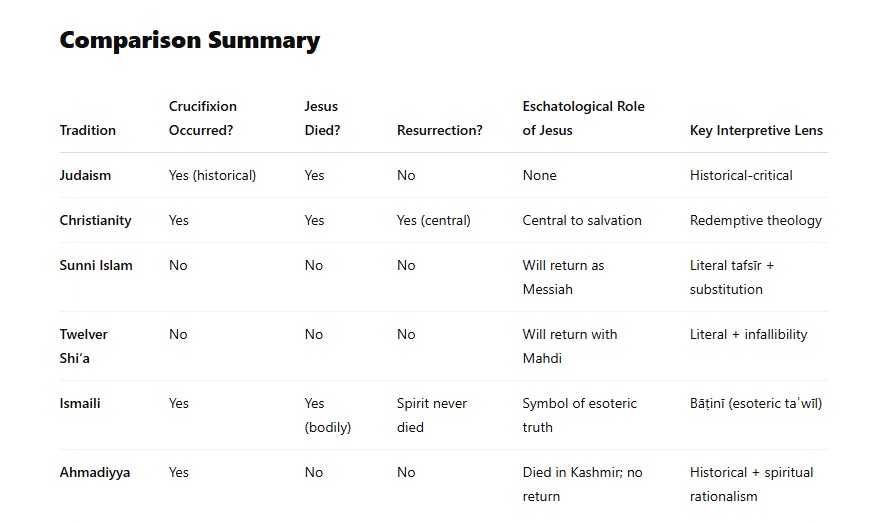
Summarizing all interpretations in a table
Conclusion
The crucifixion of Jesus functions as a theological watershed across Abrahamic faiths. For mainstream Christianity, it is the linchpin of redemption; for Judaism, it is the end of a false messianic figure; and for Islam, it is variously denied, reinterpreted, or spiritualized. Within Islam, Sunni and Twelver interpretations focus on bodily rescue, while Ismaili and Ahmadiyya views emphasize symbolism or historical rationalism. These diverse positions reflect each tradition’s hermeneutical priorities—whether legalistic, mystical, prophetic, or philosophical—and reveal how a single event can be transformed in meaning through the prism of theology and history. As such, the crucifixion remains not just a moment in time, but a mirror of religious self-understanding in the ongoing dialogue between faiths.



 The Glorious Quran and Science
Leave a reply to Ismaili Interpretations of Jesus’ Crucifixion – The Glorious Quran and Science Cancel reply