
Written and collected by Zia H Shah MD, Chief Editor of the Muslim Times
The First House of Monotheistic Worship
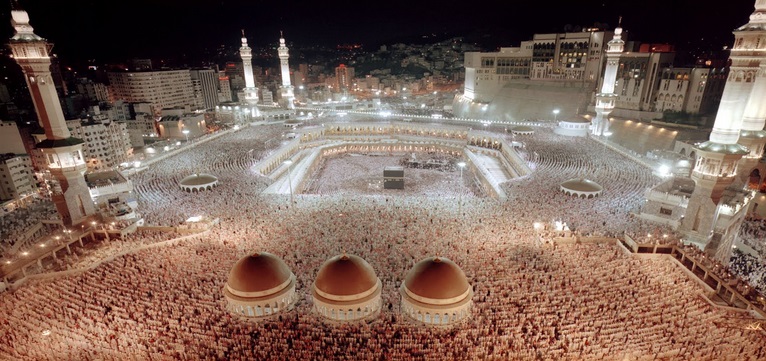
In the heart of Mecca stands the Kaaba – Islam’s most sacred sanctuary and a symbol of humanity’s earliest connection with the Divine. The Holy Quran honors this sanctuary, stating: “The first House ever established for mankind was that at Bakkah (Mecca), a blessed place and a guidance for the worlds.” In other words, the Kaaba was the first shrine of pure monotheism on earth, dedicated to the worship of One God from the very beginning. Muslim scholars note that this makes the Kaaba unique among all places of worship:
- Primacy: It was the very first house of worship devoted to Allah, built long before any other.
- Blessing: It is imbued with divine blessings (barakah) for those who turn to it.
- Guidance: It serves as a source of guidance for all peoples, inspiring faith across every land and generation.
From the dawn of humanity, the Kaaba has been revered as a primordial center of monotheism. Islamic tradition holds that even Adam, the first man, may have marked this sacred spot for God’s worship. Though historical details are lost in the mists of time, what endures is the Quranic message that the Kaaba was established “for mankind” – for all people, not one tribe or nation. It is, as one modern commentator observed, a house meant to welcome everyone, since the Qur’an’s call is to “mankind” at large. This universality is part of the Kaaba’s very DNA: it was destined from the start to be a beacon of pure faith for all humanity.
Abraham and Ishmael: Rebuilding a Legacy of Faith
After ages passed since Adam’s time, the mantle of restoring the Kaaba’s purity fell to Prophet Abraham (Ibrahim) and his son Ishmael (Isma’il). Nearly four thousand years ago – around 2000 BCE – Abraham journeyed to the barren valley of Bakkah (ancient Mecca) under God’s command. There, in a dry valley with no vegetation, Abraham left his infant son Ishmael and wife Hagar, trusting God to care for them. Hagar desperately searched for water, running between the hills of Safa and Marwa, until by God’s mercy the spring of Zamzam bubbled forth at her son’s feet. This miraculous well drew people to settle in the valley, laying the groundwork for a future community around the sacred site.
Years later, Abraham returned to find Ishmael grown. Father and son were then given a momentous mission: to rebuild the Kaaba as a shrine to the One God. Together they raised the cube-shaped House on the original foundations laid down in antiquity. The Qur’an captures the sanctity of this moment: “And when Abraham and Ishmael raised the foundations of the House [they prayed]: ‘Our Lord, accept [this service] from us. Indeed, You are the All-Hearing, the All-Knowing.’”
This humble prayer, preserved in verse 2:127, reflects their awareness that they were not just constructing a building, but renewing a legacy of faith for all future generations.
Abraham’s devotion went beyond physical building – he also prayed fervently for the future of the Holy City and its shrine. The Qur’an tells us Abraham supplicated: “My Lord, make this a secure city and provide its people with fruits” (Quran 2:126) and “Our Lord! I have settled some of my offspring in a barren valley near Your Sacred House so that, O Lord, they may establish prayer. So make the hearts of people incline towards them, and provide them with fruits, that they may be thankful.
Significantly, God instructed Abraham to proclaim the pilgrimage (Hajj) to all humanity once the Kaaba was rebuilt. “Proclaim to mankind the Hajj,” God told him, “they will come to you on foot and on every lean camel from every distant path.” It is striking that the Quran addresses this command to “mankind,” not merely a specific community. Classical and modern scholars have pointed out that this choice of words foretells the Kaaba’s global destiny: people of every race and nation would one day answer Abraham’s call. Abraham, standing in the silent desert, might not have seen how far his voice would carry – but he obeyed, and God caused the call to resonate through the centuries. The result is the Hajj, an institution that has indeed grown to include believers from the far corners of the world, just as God promised.
Divine Protection: The Story of the Elephant
Over the millennia, the Kaaba faced threats from those who did not grasp its spiritual significance. One of the most famous episodes demonstrating God’s special protection of this sanctuary is the Year of the Elephant. In the year 570 CE – the year the Prophet Muhammad was born – an ambitious Abyssinian governor named Abraha marched upon Mecca with a large army, intending to destroy the Kaaba and thereby divert Arabia’s religious center to his own kingdom. Abraha’s forces even included war elephants, a frightening sight for the desert Arabs who had never seen such beasts.
As this army approached the sacred city, the Quraysh (the guardians of the Kaaba) were powerless to stop it. But God’s protection was greater. Islamic history recounts that when Abraha’s lead elephant reached the boundary of Mecca, it suddenly halted and refused to advance further – no amount of prodding could compel it to violate the holy ground. Then, in a miraculous turn, flocks of birds appeared in the sky by God’s command, pelting Abraha’s army with small stones of baked clay. These seemingly simple pebbles proved lethal: the Quran describes that the invaders were left like scattered “straw” eaten up and destroyed by this divine strike (Quran 105:3-5). Abraha’s army perished before ever reaching the Kaaba.
This event, immortalized in Surah al-Fil (Chapter of the Elephant), became a vivid symbol of God’s promise to safeguard the Kaaba. It showed the world that this House, established in God’s name, would be defended by God’s might against any who sought to desecrate it. The Arabs of Mecca were astonished and humbled; many recognized that the Kaaba’s sanctity was not due to their own power but due to the Lord of the Kaaba. Ever since, the Year of the Elephant has been remembered as a year of divine intervention, and it reinforced the Kaaba’s status as a protected sanctuary under Allah’s care. As the Prophet Muhammad ﷺ would later say, God Himself made Mecca a sanctuary on the day He created the heavens and earth, and it shall remain sacred until the Day of Judgment. Through every upheaval of history, the Kaaba stands intact – a testimony to Allah’s commitment to this “first House” of monotheism.
From Caravan Paths to a Global Gathering
In the centuries that followed the Prophet Muhammad’s mission, the Kaaba grew from a regional shrine to the center of a worldwide faith community. Once idolatry was purged from the Kaaba by the Prophet in 630 CE, the annual pilgrimage was restored to its pure Abrahamic form. Year after year, Muslims from every corner of the expanding Islamic world began undertaking the journey of Hajj. In ancient times, this meant arduous travel spanning weeks or months: pilgrims crossed burning deserts on camelback, braved stormy seas in wooden ships, or trekked on foot over mountains. The hardship was great, but so was the devotion – drawn by the magnet of Abraham’s House, they came. As the Quran had foretold, “they will come from every distant mountain pass,” and indeed they did. By the Middle Ages, huge caravan processions would depart annually from cities like Cairo, Damascus, and Baghdad, carrying tens of thousands of pilgrims all chanting the same labbaik (response to God’s call). The Hajj routes became arteries of spiritual and cultural exchange, with scholars, sages, and seekers of all backgrounds meeting in Mecca’s plains.
Over time, despite wars and even plagues, the pilgrimage never ceased. It only grew. In the modern era, what was once a journey of months by camel can now be accomplished in hours by airplane. This ease of travel has opened Hajj to Muslims from virtually every country on earth. Where a few thousand pilgrims might have circled the Kaaba in medieval times, today the scene is truly global and awe-inspiring. Millions of believers flood into Mecca each year, reverently circling the Kaaba and performing the rites that Abraham and Muhammad once performed. In fact, in recent years the Hajj has repeatedly broken records for attendance. “This year, we will witness the largest Hajj pilgrimage in history,” announced Saudi officials in 2023, as more than 2.5 million pilgrims gathered in Mecca. From the remotest villages in Africa and Asia to the skyscrapers of New York and London, Muslims converged in unison, demonstrating that the ancient call of Abraham still resonates powerfully in the modern world.

The success and survival of Hajj through the ages is nothing short of extraordinary. It speaks to the deep spiritual pull the Kaaba exerts on Muslims’ hearts. Even under dire circumstances – such as the rare years of conflict or the recent global pandemic – the flame of desire to visit God’s House never diminishes. If anything, interruptions only make the hearts grow fonder. When Hajj resumed at full capacity after pandemic restrictions, the explosion of pilgrim numbers showed an undiminished thirst to answer the call of Allah. The sight of the Kaaba bathed in the tearful prayers of nearly three million souls is a moving testament to the living legacy of Abraham. His prayer “make the hearts of people incline towards them” is being fulfilled anew in every era, as the Kaaba continues to draw people from every walk of life into the fold of pilgrimage.
A Universal Message of Unity and Equality
Perhaps the most inspiring aspect of the Kaaba and Hajj is how they unite diverse peoples into one human family. Every year during Hajj, the world witnesses an unparalleled gathering of humanity – a meeting of races, languages, and cultures all joined in the worship of the One God. In the vast courtyards of the Grand Mosque and on the plain of Arafat, one can see a West African farmer standing next to an Indonesian businessman, or a European convert praying beside an Arabian Bedouin. All outward differences fade, as pilgrims don the same simple white garments of ihram, symbolizing a return to the pure equality of souls before their Creator. There is no rich or poor in those garments, no king or peasant; all are humbled servants of God, identical in their dress and rituals. This powerful visual equality fulfills the Prophet Muhammad’s words from his Farewell Sermon: “O people, indeed your Lord is One and your father (Adam) is one. An Arab has no superiority over a non-Arab, nor a non-Arab over an Arab, and a white has no superiority over a black, nor a black over a white, except by piety.” In the Hajj, this brotherhood is not just preached but lived, vividly and wholeheartedly.
Many who participate in Hajj or witness it are struck by this spirit of unity. One famous account comes from Malcolm X (El-Hajj Malik El-Shabazz), the American civil rights leader, who in 1964 left behind racial prejudice after experiencing the global brotherhood of Islam in Mecca. Describing the pilgrims he met, he wrote: “There were tens of thousands of pilgrims, from all over the world. They were of all colors – from blue-eyed blondes to black-skinned Africans – but we were all participating in the same ritual, displaying a spirit of unity and brotherhood that my experiences in America had led me to believe never could exist between the white and the non-white.”
He was “shocked” and deeply moved to see Muslims of every ethnicity treating each other as equals and embracing one another as family. “During the past eleven days here in the Muslim world,” Malcolm X continued, “I have eaten from the same plate, drunk from the same glass and slept on the same bed or rug – while praying to the same God – with fellow Muslims whose eyes were the bluest of blue, whose hair was the blondest of blond, and whose skin was the whitest of white. … We are truly all the same – brothers.”
Such testimonials illustrate the timeless and universal message that the Kaaba embodies: that all human beings are equal in the sight of God, and that we can indeed live as one community of mutual love and respect.
The rituals of Hajj themselves reinforce this unity. Pilgrims move in harmony around the Kaaba in the Tawaf, like stars orbiting a single center, symbolizing their shared focus on God. They stand shoulder-to-shoulder in prayer, without rank or distinction, reaffirming that faith transcends all ethnic or national identity. They camp together in the desert of Mina and beseech God together on the plain of Arafat, all wearing the same attire and uttering the same prayers. In those moments, human divisions melt away and what remains is the pure essence of humanity – humble servants remembering their Lord. It is a vision of universal peace and brotherhood that Islam aspires for all mankind, concentrated in the microcosm of Hajj. The Kaaba, as the physical focal point of prayer (qibla) and the epicenter of Hajj, is like a cosmic magnet pulling humanity into unity of purpose. As the Quran says, God made us “into nations and tribes that you may know one another” (49:13), and at the Kaaba this knowing and meeting one another reaches its peak. The black and white cloth covering the Kaaba (the kiswah) may contrast, but around its cube all colors of humanity join in a beautiful mosaic of faith.
The Kaaba and the Future of Islam’s Universal Call
Standing before the Kaaba, one cannot help but feel a sense of destiny and hope for the future. This ancient House has seen empires rise and fall, yet it remains the vibrant heart of a global faith community that only continues to grow. The message emanating from the Kaaba – the message of pure monotheism, peace, and human unity under One God – is as relevant and urgently needed today as ever. In an age of fragmentation and confusion, the Kaaba offers a timeless anchor of meaning and the Hajj offers a model of harmonious human congregation. It is no surprise, then, that Islamic scripture and tradition speak of a future where the Kaaba’s significance extends to all of humanity in an even more profound way.
Prophetic teachings assure us that Islam’s universal mission will reach every corner of the globe. The Prophet Muhammad ﷺ foretold: “Indeed, this matter (the faith of Islam) will reach everywhere the night and day have reached. Allah will not leave a dwelling – whether in a city or in the desert – except that He will cause this religion to enter it.” This incredible prophecy envisions Islam touching all households on earth, honoring the honorable and humbling the haughty, until no place is untouched by the light of faith. Such prophetic glad tidings give Muslims hope that the future will see Islam’s message of tawhid (oneness of God) and peace spread to all people, just as Abraham prayed. The Kaaba, as “the first House established for all mankind,” is at the center of that hope. It stands ready to welcome any soul who wishes to turn sincerely to the Creator. Its very existence calls out to humanity: come to the House of the One God, find peace in surrendering to Him, and find brothers and sisters in that surrender.
Classical and contemporary scholars have often commented that the universality of the Hajj is a sign of Islam’s destiny. Every year, the increasing diversity of pilgrims makes the crowd around the Kaaba look more and more like a miniature humanity. As one commentator noted, the Quran’s call to “mankind” to perform Hajj hinted that a time would come when pilgrims would represent “every section of mankind – every race, nation, color and language.” We are witnessing this today: from the Inuit of the Arctic to the Maori of New Zealand, there are Muslims coming to Mecca. The Hajj is no longer an affair of one region; it is truly global. This fulfills not only Abraham’s vision, but also the Islamic belief that Prophet Muhammad ﷺ was sent as “a mercy to all the worlds” and that Islam is the final religion for all humanity. The Kaaba, as the directional focus (qibla) of billions of daily prayers, already unites the faithful across continents in a single act of devotion. One can stand anywhere in the world, pray toward the Kaaba, and spiritually join a cosmic congregation bound by the same center. This remarkable unity in prayer prefigures a future unity in faith that Muslims ardently pray for – a time when belief in one God and service to one God unites all of humanity in peace.
As we look to the future, the Kaaba remains a source of spiritual renewal and hope. Its endurance through the storms of history teaches us that God’s truth is firm and unshakable. The increasing millions who answer the call to Hajj each year show that the thirst for truth and unity is alive in human hearts. And the scenes of Hajj – people forgiving one another, embracing across cultures, and crying out “Labbayk Allahumma Labbayk” (“Here I am at Your service, O God”) in unison – give a glimpse of what a world guided by faith and brotherhood could look like. It is a world where peace is not an abstract ideal, but a lived reality of diverse people coming together with a common purpose.
In Islamic tradition, Mecca is not only the navel of the earth but also a point where heaven and earth meet. The Kaaba’s Arabic title is Baytullah (House of God), and while God is not contained by any physical space, this honorific means it is a place on earth especially devoted to Him. To visit the Kaaba in Hajj is to leave behind worldly distractions and respond to the invitation of your Lord. Pilgrims often describe the experience as a rebirth – emerging from Hajj cleansed of sins and filled with new resolve, as pure as a newborn. They return to their homelands carrying the light of that experience, becoming ambassadors of the Kaaba’s lessons of unity, patience, and piety. In this way, the impact of Hajj ripples outward into families, communities, and societies.
A Hopeful Vision of Unity and Renewal
As this inspired journey through history and scripture shows, the Kaaba and Hajj hold enduring significance not just for Muslims, but for all humanity. They remind the world that despite our differences in color, language or nationality, we are truly one family, created by the One God. The Kaaba is a timeless symbol of unity, teaching by example that people can transcend barriers of race and culture through shared worship and values. The Hajj is a yearly rehearsal of a united human race, gathered in peace and humility – a powerful antidote to the forces of division and conflict that often plague our world.
Looking ahead, there is much reason for optimism. Islam continues to be a growing force, not through conquest or compulsion, but through the appeal of its truth and the evident brotherhood and sisterhood it creates. Each new year sees more hearts inclined toward the Kaaba, just as Prophet Abraham prayed so long ago. Each new generation of pilgrims carries the torch of faith forward, ensuring that the light kindled in ancient Bakkah never goes out. The divine promise is that this light will spread until it illuminates every home, offering guidance to all who seek it.
In a world searching for meaning, the Kaaba stands as a steadfast beacon, inviting humanity to the pure worship of God and the unity of all people. Its message is one of hope: that by turning to our Creator, we can find in Him the bond that links us all. The Hajj demonstrates that unity and peace are achievable – not as some utopian dream, but as a lived reality tasted by millions in the plains of Arafat and the valley of Mina. If such unity can blossom in the challenging rites of pilgrimage, it can surely take root in the wider world through the spirit of Islam.
And so we end on a note of inspiration and hope. The Kaaba, the first House of worship, continues to shine as a lighthouse for the spiritually lost, guiding them back to the Straight Path. The Hajj, established by Abraham and perfected by Muhammad, continues to rejuvenate faith and foster global brotherhood. These institutions have endured for thousands of years and will, by God’s grace, endure until the end of time – nurturing in each era the seeds of peace, unity, and spiritual renewal. In them lies a promise: that as long as humans turn their hearts sincerely toward their Lord, there is hope for harmony on earth. The Kaaba and Hajj are gifts from the Merciful to all mankind – a living legacy of monotheism that binds us in hope, uplifts us in spirit, and unites us as one human family under God.
All praise is due to Allah, Lord of the worlds.

 The Glorious Quran and Science
Leave a comment