
Epigraph:
بَدِيعُ السَّمَاوَاتِ وَالْأَرْضِ ۖ وَإِذَا قَضَىٰ أَمْرًا فَإِنَّمَا يَقُولُ لَهُ كُن فَيَكُونُ
He is the Originator of the heavens and the earth, and when He decrees something, He says only, ‘Be,’ and it is. (Al Quran 2:117)
Have they been created from nothing, or are they their own creators? Have they created the heavens and the earth? In truth they put no faith in anything. (Al Quran 52:35-36)
Written and collected by Zia H Shah MD, Chief Editor of the Muslim Times
The idea of a multiverse – countless other universes beyond our own – is sometimes hailed as the ultimate naturalistic explanation for why our cosmos is so special. If there are infinitely many universes with different properties, then of course one of them would by chance have the right conditions for life, and we just happen to live in that lucky one. Some atheists suggest this hypothesis “rescues” them from needing any divine Creator to explain our finely-tuned universe. But does it? This article will argue that even if the multiverse exists, it does not remove the rational basis for belief in God. We’ll explore scientific, philosophical, and theological reasons why the multiverse, far from eliminating God, still leaves the deepest questions unanswered – and perhaps even highlights the need for a transcendent source or necessary being.
The Fine-Tuned Universe: Why Our Cosmos is Puzzlingly “Just Right”
Modern physics has revealed that our universe is astonishingly fine-tuned for the existence of life. This means that the fundamental constants and initial conditions of nature fall within an extraordinarily narrow range that allows stars, planets, chemistry, and living organisms to exist. If those values were even slightly different, life as we know it would likely be impossible. A few classic examples of fine-tuning include:
- Strength of Gravity: Gravity had to be exactly the right strength for a life-permitting universe. If gravity were just a hair stronger, the early universe would have collapsed back on itself (a “Big Crunch”) before stars even formed; if a touch weaker, matter would not clump into stars and galaxies at all, leaving a cold, diffuse cosmos without planets. In fact, calculations show that even a tiny change (on the order of 10^−39 of the force’s strength) would render the universe lifeless – either by rapid collapse or by never forming any stars.
- Formation of Carbon: All known life is built on carbon, which is forged in the cores of stars through a delicate nuclear reaction (the triple-alpha process). This reaction requires the strong nuclear force and the electromagnetic force to be balanced just right. Any slight change in either of those forces’ strengths would prevent the efficient production of carbon (and other heavy elements), meaning the universe would lack the building blocks of life. It’s as if these forces were “dialed in” to allow abundant carbon to exist.
These are just two examples among many. Physicists have identified dozens of physical parameters (from the mass of the proton, to the cosmological constant, to the rate of cosmic expansion) that appear finely tuned for a life-friendly universe. As Nobel Prize-winning physicist Steven Weinberg (an agnostic) put it, “life as we know it would be impossible if any one of several physical quantities had slightly different values.” It is deeply surprising, on pure chance, that all these cosmic “dials” are set so precisely to allow creatures like us to exist. This puzzle has led many to ask: Why is our universe so improbably well-suited for life?
From this question, two broad explanations have been proposed:
- Design: Perhaps the universe is fine-tuned because it was intentionally crafted that way by a Designer (God). Just as a biosphere designed for life would have the right conditions, a universe designed by a Creator could have the precise laws and constants needed for life to emerge. Many theists see the fine-tuning as positive evidence of a cosmic architect – a rational mind behind the cosmos.
- Chance (with a Multiverse): Alternatively, perhaps we just got extremely lucky. Some atheists and agnostics shrug and say the universe “is what it is” with no further explanation. Others refine this chance idea with the anthropic principle: we shouldn’t be surprised the universe permits life, they argue, because only in such a universe could observers exist to notice the fact. After all, if the universe weren’t life-permitting, we wouldn’t be here to talk about it. On this view, fine-tuning might be a kind of cosmic coincidence that requires no design – it’s just a brute fact that we, as observers, find ourselves in a rare hospitable cosmos.
The anthropic reasoning, however, can feel unsatisfying when you consider an analogy. Philosopher John Leslie famously asked us to imagine a prisoner facing a firing squad of 50 expert marksmen. The guns fire, and somehow every single shot misses, leaving the prisoner alive. Technically, the prisoner shouldn’t be surprised to be alive (since if he weren’t, he couldn’t ponder it). But still – fifty trained shooters all missing is so implausible that you’d naturally seek a further explanation (maybe a conspiracy to spare him). In the same way, many argue that simply saying “if it weren’t tuned we wouldn’t be here” dodges the real question. The universe’s life-friendly setup cries out for an explanation beyond “we got lucky.” As astronomer Fred Hoyle quipped, “a common sense interpretation of the facts suggests that a super-intellect has monkeyed with physics.”
Enter the multiverse hypothesis as a bold attempt to make lucky accidents far less implausible.
The Multiverse: A Naturalistic Explanation for Fine-Tuning
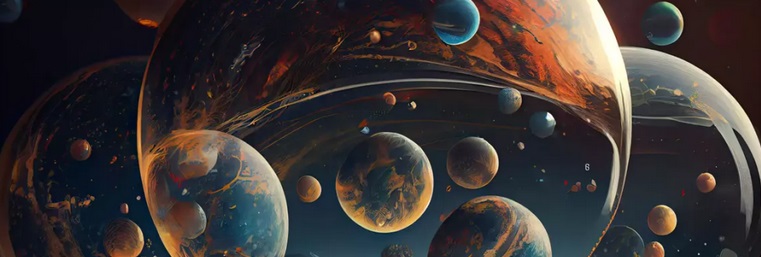
Illustration: An artistic depiction of a “bubble multiverse,” where our universe (left) is one bubble among many. In some cosmological models, such bubble universes could form through processes like eternal inflation, each bubble potentially having different physical constants and laws. If enough universes exist with varying properties, it becomes almost inevitable that some universe (like ours) will, by chance, have the right conditions for life. The multiverse idea is often used to argue that our universe’s fine-tuning is not miraculous design but rather a natural outcome of statistics in a vast ensemble of universes.
The multiverse hypothesis proposes that what we’ve been calling “the universe” – the totality of space, time, matter, and energy we see – might not be the only one. Instead, there could be many universes (perhaps even an infinite number) out there, collectively forming a multiverse. Each universe in the multiverse might have different fundamental settings: different physical constants, particle types, or even different laws of physics altogether. Our universe would just be one region in this much larger reality.
This concept has emerged from serious science, not just science fiction. Several theoretical physics frameworks imply some form of multiverse:
- String Theory Landscape: String theory, an attempt to unify all forces of nature, suggests a huge number of possible vacuum states – essentially different ways to “tune” the physics of a universe. The equations don’t pick out a single unique set of constants; instead there could be an astronomical number of self-consistent solutions, each corresponding to a different possible universe with its own laws. Our universe’s physical laws would then be just one winning ticket in a cosmic lottery of possibilities.
- Eternal Inflation (Bubble Universes): Inflation theory – the idea that our cosmos underwent a brief burst of exponentially fast expansion right after the Big Bang – is well supported by evidence (it explains observed properties of the cosmic microwave background). Intriguingly, many inflation models predict that inflation didn’t just happen once. Instead, it keeps happening in other regions of space: as our “bubble” universe stops inflating and forms galaxies, other bubbles are still inflating and budding off new universes. This bubble multiverse picture means our universe could be one pocket of space that cooled off, while outside it (in a larger spacetime), inflation continues generating new “bubble” universes. Each bubble might have random variations – different densities, different constants – arising from quantum fluctuations in the inflation process.
- Many-Worlds Interpretation of Quantum Mechanics: Another multiverse idea comes from quantum physics. The many-worlds interpretation of quantum mechanics posits that every quantum event that could happen does happen, in different branches of reality. This yields a kind of multiverse of branching alternate histories. (This is a bit different in character, since all branches share the same fundamental physics; they just play out different outcomes. It’s not usually invoked to explain fine-tuning, but it’s another way multiple universes come into physics discussions.)
The key point in using a multiverse to address fine-tuning is statistics. If there are vastly many universes, each with randomly set parameters, then it’s not so implausible that one of them falls into the life-friendly range by chance. Imagine buying not just one lottery ticket, but millions of them – suddenly hitting the jackpot is no surprise. In the multiverse scenario, we happen to inhabit the winning universe simply because only in a winning universe could observers like us exist (this is the anthropic principle at work). Thus, some atheists argue, there’s no need to invoke God to “rig” the lottery – if enough tickets are bought (enough universes exist), a winning one was almost inevitable.
At first glance, this multiverse hypothesis seems to offer a neat naturalistic escape from the improbability of fine-tuning. It effectively says: “Our universe isn’t special by design; it’s just one of zillions. We see it as special only because we couldn’t exist in the failures.” In this view, the multiverse serves as a kind of God substitute, taking over the role of creator and fine-tuner of worlds. Indeed, many proponents of the multiverse speak in almost theological terms about it. However, a closer look reveals that this “substitute” falls short in several ways.
Fine-Tuning Redux: Why the Multiverse Doesn’t Solve It All
The multiverse idea may dilute the improbability of a life-permitting universe, but it doesn’t actually eliminate the problem of fine-tuning – it only moves it to a new level. Here are several reasons why the multiverse hypothesis, even if true, does not ultimately dodge the need for explanation or make God irrelevant:
- The Multiverse Itself Would Need Fine-Tuning: Every multiverse model has to have specific laws or mechanisms in place. For example, in eternal inflation (a popular multiverse model), the process of “bubbling off” new universes depends on the properties of a hypothetical inflaton field and its potential energy curve. Those properties must fall within certain ranges to produce a multitude of universes with varying constants. In other words, to get a rich variety of bubble universes, the underlying physics that generates them has to be just right. Cosmologists have noted that inflation itself required very precise conditions to begin with. If the multiverse required, say, an inflationary expansion rate or a string theory landscape with particular features, one can ask: Who or what fine-tuned those? As one scientific summary puts it, inflationary multiverse models still require “certain parameters to take on particularly precise values” – the fine-tuning problem “is not eliminated; it is pushed a step back into the origin of the multiverse itself.” In short, the multiverse might just shift the question up one level: we explain the local fine-tuning by a larger system, but that larger system has its own “fine-tuning” that begs for explanation.
- “Infinite Universes” is a Bold Assumption: To really make the fine-tuning coincidence unproblematic, you often have to assume an enormous (potentially infinite) number of universes. If the multiverse is too small or limited, then having one life-friendly universe might still be extremely unlikely. The effectiveness of the multiverse explanation depends on the breadth of possibilities it realizes. But we have no direct evidence that a vast ensemble of varied universes actually exists – it’s a theoretical extrapolation. Invoking an infinity of unobservable entities to avoid one unobservable Creator might not be the paragon of parsimony. Critics have even suggested that appealing to a multiverse like this could be an “inverse gambler’s fallacy.” We see one highly improbable outcome (our fine-tuned universe) and assume there must be many unseen “dice rolls” to make that outcome likely. But that assumption itself is unproved; it could be a fallacy unless independent evidence for those other universes emerges. In other words, using the multiverse to explain fine-tuning might be trading one kind of leap of faith for another.
- Lack of Direct Testability: A strong scientific hypothesis can be tested or falsified. By definition, other universes (if totally disconnected from ours) are not directly observable. Some aspects of multiverse theories are indirectly testable – for instance, if eternal inflation happened, maybe our universe might bear subtle traces (scientists have even looked for hints that another bubble universe “bumped” into ours in the cosmic microwave background data). But so far, no conclusive evidence of other universes exists. This means the multiverse hypothesis often lives in the realm of inference and speculation. Some scientists are comfortable with this, arguing that if our known physics equations predict a multiverse, that’s enough. Others, however, worry that invoking unobservable universes is a step outside empirical science and into metaphysics. Ironically, one might say that using the multiverse to avoid “metaphysical” ideas like God just ends up introducing a different metaphysical assumption. As one cosmologist mused, multiverse talk is “their way of doing metaphysics without using the G-word.” In any case, because the multiverse idea isn’t a sure thing, resting the entire case for atheism on it is precarious. The evidence for fine-tuning is strong and widely accepted, whereas the evidence for a multiverse is presently tentative. It would be a strange inversion of reasoning to dismiss the clear appearance of design and order in our universe in favor of a highly speculative multitude of unseen universes.
- It Doesn’t Answer “Why These Laws?” Suppose our universe is just one of many produced under some higher-level law or theory (like a multiverse-generating mechanism). We can still ask: Why that higher-level law? Why is there a multiverse with those characteristics? The problem of “Why this and not something else?” remains. The multiverse, if it exists, would itself be a cosmos with particular properties. It would have to follow principles or laws that allow universes to come into being. We can inquire why those principles exist at all. As the late philosopher Antony Flew (a famous ex-atheist) noted, no matter how far you push back the chain of explanation – even to a multiverse – “their very emergence has to follow certain prior laws.” In other words, a deeper explanation is still needed for the whole system of universes and laws. You haven’t removed the need for explanation; you’ve only made the canvas larger.
In light of these points, the multiverse fails to completely “explain away” fine-tuning. At best, it addresses the probability aspect of why our universe is life-friendly by saying “lots of tries, one success.” But it does not explain the origin of the conditions that allowed those many tries to exist in the first place. It cannot answer why there is a multiverse with life-permitting possibilities at all, instead of nothingness or a sterile multiverse with no life anywhere. The fundamental mystery of cosmic order and existence remains.
The Question of Origins: Why Something (Even a Multiverse) Rather Than Nothing?
Beyond fine-tuning, many see the existence of the universe (or multiverse) itself as demanding an explanation. Where did reality come from? This is a classic philosophical and theological question, but it intersects with cosmology. If atheists invoke a multiverse to avoid a cosmic beginning that points to creation, they may be disappointed: a number of physicists have argued that even a multiverse likely had a beginning in the finite past.
Modern cosmology indicates that our universe had a beginning (the Big Bang, ~13.8 billion years ago). Could the multiverse be eternal, with no beginning, thus bypassing the need for a creation event? Possibly – but not necessarily. In fact, a well-known result called the Borde-Guth-Vilenkin (BGV) theorem suggests that any universe (or multiverse) which is, on average, expanding (like ours with its ongoing expansion, or an inflationary multiverse) cannot be extended infinitely into the past – it must have a past boundary or beginning. In plain language, eternal inflation is not truly eternal into the past. If our cosmic region and others are all expanding, time cannot go back indefinitely; eventually, you hit a beginning of expansion. Alexander Vilenkin, one of the authors of that theorem, put it bluntly: “all the evidence we have says that the universe had a beginning.” This beginning of the multiverse (if it exists) would be the ultimate “Big Bang” of the entire ensemble – a moment where physics as we know it breaks down. And that starting point itself calls for a cause or explanation.
Even if one finds speculative models to avoid an absolute beginning (some have tried with cyclic universes, etc.), you still face the contingency of existence. Why is there something rather than nothing? Why does anything (like a multiverse) exist at all? In a sense, proposing an elaborate multiverse magnifies this question rather than diminishes it, because now one has an even larger something whose existence cries out for explanation. The multiverse, if it contains every possible universe, is certainly an impressive structure – but why should such a structure exist?
Philosophically, many thinkers have argued that things which exist but could have been otherwise (what philosophers call “contingent” beings) require an explanation. A single universe with arbitrarily set laws is contingent – we can imagine it having been different or not existing. A multiverse with a specific mechanism is also contingent – we can imagine a different kind of multiverse or none at all. The typical way to ultimately explain contingent realities is to appeal to something that is not contingent but rather necessary – something that must exist by its very nature and thus provides a foundation for everything else. Classical theology identifies God as such a necessary being: an eternal, self-existent reality that is the reason anything else exists. In that view, God is the “uncaused cause” or the grounding explanation for why there is a world (or multiverse) and why it has order.
Now, the multiverse hypothesis doesn’t offer a substitute for a necessary being. It merely offers more contingent entities. If someone says, “The multiverse just exists inexplicably and that’s the end of it,” one could just as well say, “God just exists inexplicably.” In fact, the concept of God as a necessary being at least claims to be a self-explaining ultimate reality, whereas a multiverse is not typically claimed to be self-explanatory – it’s usually thought of as a physical system that would itself operate under higher laws or principles. In short, positing a multiverse does not answer the deepest existential question – it kicks the can down the road. So long as the question “but why is there something?” remains, the door is open to a transcendent explanation. The rational inference to a Creator or necessary reality isn’t negated by expanding the stage to a multiverse.
God and the Multiverse: A Theological Perspective
It’s also crucial to realize that the multiverse hypothesis and the idea of God are not mutually exclusive. The way some ardent atheists talk, you’d think we have to choose either multiple universes or a Creator. But there’s no logical reason one couldn’t have both – a Creator who brought about a multiverse. If anything, an all-powerful God could create not just one universe but a vast array of them. Some theologians have even mused that an infinitely creative God might delight in creating many worlds, not just one. Thus, the existence of other universes would not automatically nullify God’s existence or action; it would simply broaden our understanding of creation. As the Christian astrophysicist Deborah Haarsma points out, if a multiverse exists, it would still be within the realm of God’s creative power and intent – “even if a multiverse model were well-established on a scientific level, it would not and could not replace God.” It would, at most, describe how God’s creative act unfolded, not eliminate the possibility of a Creator behind it.
From a theological viewpoint, God is the ultimate Author of reality. Whether the story has one universe or many chapters of parallel universes, the Author remains essential. Discovering a natural mechanism by which God diversified creation (like a multiverse-generating process) would be akin to discovering any natural process in our single universe – it wouldn’t rule out the author of the process. For example, learning the scientific details of how stars form doesn’t eliminate God; for believers it simply shows the method through which God’s creative will is expressed. Similarly, if we learned that universes form via an inflationary multiverse, a person of faith could reasonably say, “So that’s how God creates multiple worlds.” The mechanism doesn’t replace the agency. Scientific explanations, no matter how complete, describe the workings of nature; theology addresses the ultimate ground and purpose of those workings. As BioLogos (an organization integrating science and faith) summarizes: scientific explanations cannot replace God – they simply uncover the processes of the world that God sustains.
It’s worth noting that belief in God is not solely based on the fine-tuning of physics or the origin of the universe. People find a rational basis for God in a convergence of many considerations: the existence of consciousness and moral values, the fact that the universe is governed by elegant mathematical laws, philosophical arguments about being and cause, personal and historical experiences, and so on. The fine-tuning argument is just one piece of a larger puzzle. Even if one were to grant that a multiverse lessens the force of the fine-tuning argument (a point we’ve challenged above), there would remain a suite of other arguments and evidences pointing toward a Mind behind the cosmos. The multiverse doesn’t address, for instance, the origin of consciousness or objective moral laws or the intelligibility of mathematics. It’s narrowly aimed at the physical constants question. Thus, atheism would still have many other phenomena to account for without God.
Finally, consider the practical effect if tomorrow scientists announced “strong evidence for a multiverse.” Would that decisively disprove God? Not at all. In fact, many religious believers (including Christian scientists working on these theories) would be excited, not fearful, about such a discovery – it would reveal a universe (or multiverse) even grander and more varied than we thought. They would still credit God as the ultimate source of that grandeur. They might echo physicist Gerald Cleaver’s sentiment that if multiverse theories are proven true, it would simply be “the next step in understanding the beauty, splendor, complexity, and vastness of God’s creation.” In other words, a multiverse could be seen as expanding our vision of creation, not abolishing the Creator.
Conclusion: A Multiverse Points to A God With Infinite Creativity
The multiverse hypothesis is a fascinating scientific idea and a testament to human imagination in grappling with the cosmos. It could indeed be true – we don’t know yet. But what we do know is that invoking a multiverse does not magically resolve the deepest puzzles about existence, purpose, and design. Even with infinite universes, one must still answer why any universe exists at all, why the multiverse’s laws are life-permitting, and why our experience of reality is so ordered and intelligible. The multiverse, even if true, would be part of creation in need of explanation, not the ultimate source of all explanations.
In their enthusiasm to find a purely naturalistic answer to the fine-tuning of nature, some atheists have treated the multiverse like a get-out-of-God-free card. We’ve seen that this move is premature and philosophically insufficient. The fine-tuning is not so easily disposed of – it reappears at the level of the multiverse’s setup, and the question of ultimate origins remains as profound as ever. At most, the multiverse might explain how life-friendly universes could come about without direct divine tinkering in constants, but it cannot explain why there is a multiverse with the potential for life in the first place. It cannot reach up to explain its own existence or the fundamental order behind it.
Belief in God, therefore, is not rendered irrational by the multiverse. On the contrary, one could argue that God is even more needed as the ultimate grounding of reality – the necessary being who gives existence to a multiverse or any universe. Atheism is not “rescued” by the multiverse; it still must confront the origin of all things and the remarkable fact that nature (or multiverse) follows orderly laws. As a result, a thoughtful person can accept all the scientific evidence and even entertain the multiverse as a serious possibility, and still reasonably infer a transcendent Mind behind the whole show. Far from eliminating God, an expansive multiverse could be seen as reflecting the creativity and majesty of God in an even more awe-inspiring way.
In summary, the multiverse hypothesis, if someday confirmed, would certainly change our perspective on cosmology. But it would not eliminate the rational foundations for theism. Whether there is one universe or ten billion universes, the profound questions of existence, fine-tuning, and purpose ultimately point us beyond blind chance. The multiverse, like the universe, would still sit within the framework of creation – a framework that finds its most coherent explanation in the existence of a transcendent, necessary source: in other words, God. Therefore, even with a multiverse, the statement “In the beginning, God created the heavens and the earth” can retain its meaning – with “heavens and earth” expanded to “all universes and realms of reality.” The multiverse is not the atheistic escape hatch it’s sometimes made out to be. Our curiosity and reason are still faced with a cosmos (or cosmoses) that arguably make the most sense when we allow for a Creator behind it all. In the end, multiverse or not, the case for a Creator remains as relevant, rational, and necessary as ever.
Sources:
- Fine-tuning examples and scientific recognition of this phenomenon biologos.orgbiologos.org
- Explanation of multiverse concepts from modern physics (string theory, inflation) biologos.orgbiologos.org
- The multiverse as an attempted “God substitute” to explain fine-tuning reasonablefaith.orgreasonablefaith.org
- Why the multiverse doesn’t remove the need for fine-tuning (just shifts it to the multiverse’s parameters)biologos.org
- Need for an ultimate explanation (first cause) even if a multiverse exists thinkingmatters.org.nz
- Limits of science regarding unobservable universes and the point that a multiverse (even if evidenced) cannot “replace God” biologos.org
- Visualization of the bubble multiverse concept (artist’s illustration)





 The Glorious Quran and Science
Leave a reply to Sunnie Moon Cancel reply