

Epigraph
“Do they not look at the camels, how they are created? – And at the sky, how it is raised? – And at the mountains, how they are erected? – And at the earth, how it is spread out?” (Qur’an 88:17–20)
Written and Collected by Zia H Shah, Chief Editor of the Muslim Times
Camels – the very symbol of deserts and caravan travel – have an origin story that defies expectation. Renowned for their drought-defying humps and sand-savvy feet, one might assume camels have always been creatures of the Old World deserts. Yet fossil evidence paints a much different picture: tens of millions of years ago, the ancestors of today’s camels roamed lush rainforests in North America. Over an immense span of time, these creatures evolved remarkable adaptations, journeyed across continents, and eventually came to serve humans – a journey so improbable and grand that it invites deeper reflection on chance and purpose in evolution.
North American Origins: Camels in a Rainforest World
It comes as a surprise to many that North America is the cradle of the camel family. The earliest known camelid, Protylopus, appeared about 45 million years ago (Ma) during the middle Eocene epoch. Fossils of Protylopus have been found in what is now the American Southwest, which at that time was not arid desert but a warm, humid rainforest environment. This diminutive proto-camel was no bigger than a goat and looked very unlike a modern camel. In fact, Protylopus more closely resembled a small deer – it walked on four tiny hooved toes on each foot, rather than today’s large, padded two-toed feet. It likely browsed on soft leaves and fruit in the dense rainforest, aided by a simple three-chambered stomach (unlike the complex four-chambered ruminant stomach). At first glance, one “would be forgiven for not seeing the family resemblance” to camels as we know them.
As climates gradually cooled and dried moving into the Oligocene epoch (around 34 Ma), North America’s rainforests gave way to patchy woodlands and open savannas. Camelids responded by diversifying into many forms. Paleontologists have identified at least 20 distinct camelid genera over the course of the Cenozoic era in North America. Some evolved to be as small and swift as gazelles, while others became giraffe-like browsers with long necks. There were snouted forms, stocky llama-like forms, and even giant camels: genera like Titanotylopus and Gigantocamelus that stood as tall as elephants. By the Miocene epoch (23–5 Ma), camels were among the most common large mammals in North America, thriving in the spread of grasslands. This “Camelid Explosion” peaked with nearly 30 genera grazing the Miocene plains.
Amid this evolutionary blossoming, the traits that define modern camels began to take shape. One lineage in particular, the Camelinae, started to develop the hallmarks we associate with camels today. Their legs lengthened for efficient running, and their necks grew more flexible and elongated – useful for browsing sparse foliage. Most importantly, their feet gradually changed: the side toes shrank and the central toes became larger and spread apart, evolving into a wide, cushiony pad suited for walking on soft substrates. This would later prove invaluable for treading on desert sand – but originally it was likely an adaptation for another kind of ground entirely.
Adapting for Survival: From Hooves to Humps
Through the late Miocene and into the Pliocene, camels continued to adapt as environments shifted. By around 7 Ma, some North American camels had evolved a fully split-foot posture with two large toes – the footprint of a camel we would recognize. Each toe still had a hoof-like nail at the tip, but the weight was carried on a broad, leathery sole. This provided excellent traction and weight distribution on soft ground. Interestingly, paleobiologists now believe this foot adaptation first evolved for walking on snow rather than sand. In 2013, a remarkable fossil discovery was made on Ellesmere Island in the high Arctic of Canada: fragments of a camel’s leg bone, 3.5 million years old, were found in what was once a boreal forest near the Arctic Circle. The ancient camel (Paracamelus) that lived there during a warm phase of the Pliocene was giant – 30% larger than modern camels – and it thrived in a forest that saw frigid, dark winters. This find extended the known range of camels 1,200 km farther north than previously thought, and led scientists to a fascinating hypothesis: many of the camel’s signature adaptations may have evolved for survival in cold, Arctic conditions.
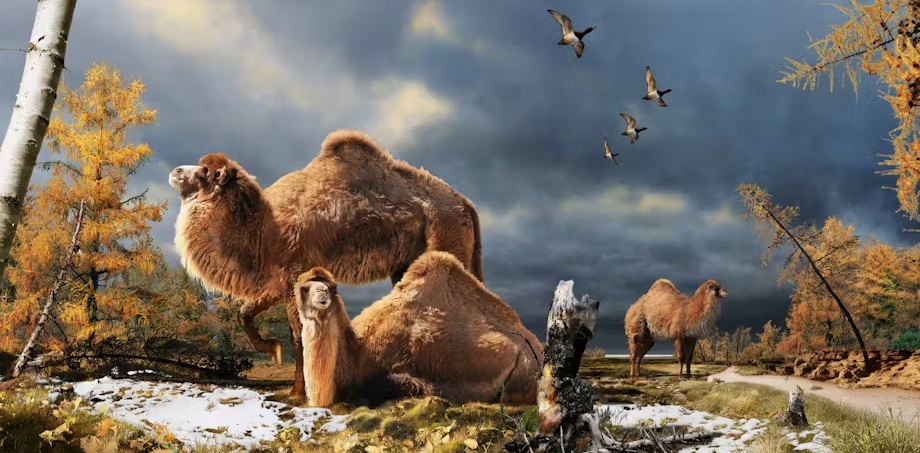
Consider the camel’s hump, for example. Today we know the hump is a reservoir of fat, enabling camels to go for long periods without food when resources are scarce. In Arctic Canada 3.5 million years ago, that fat would have been crucial to surviving long, bitter winters when food was scarce – effectively a portable energy reserve to carry the camel through until spring. Likewise, a thick coat and the ability to tolerate extreme temperatures would have benefited an Ice Age camel facing winter cold just as much as it benefits its desert-dwelling descendants facing daytime heat. The camel’s large eyes, often praised by desert travelers for their beauty, may have originally helped these animals see during the dim polar winter. And the famous wide, splayed feet – ideal for walking on loose sand – would have been just as useful for walking on soft snow in an Arctic climate. In short, camelids living in northern climates were pre-adapted in many ways for the desert conditions they would encounter later. Evolution had equipped them with a toolkit for extreme environments – though of course, there was no foresight or conscious design in this; it was natural selection at work in harsh climates, accidentally producing a desert-ready animal.
Other adaptations for aridity likely came later, as some camel populations moved into more water-scarce environments. By the time true camels (genus Camelus) appear in the fossil record, they had developed extraordinary physiological tricks to deal with drought. Modern camels can survive losing up to 30% of their body’s water – an astonishing feat given that a loss of more than 15% would be fatal for most mammals. They can drink dozens of liters of water in one session to rehydrate, and their kidneys concentrate urine to minimize water loss. Even at the cellular level, camels are unique: their red blood cells are oval-shaped, allowing blood to keep flowing when dehydration thickens their blood. These traits don’t fossilize, but genetic and physiological studies suggest such adaptations accumulated over hundreds of thousands of years as camelids ventured into increasingly arid regions. By evolving resilient hydration strategies and energy-storing humps, camels were poised to conquer the deserts – whenever and wherever those deserts might be found.
To summarize a few of the camel’s key evolutionary adaptations and how they served survival:
- Wide, padded feet – Evolved from multi-toed, hooved feet into two large toes with a connecting leathery pad. This adaptation helped distribute weight on soft terrain, acting like snowshoes on powdery snow and like sand shoes on desert dunes. Modern camels’ foot structure lets them tread where narrower hooves would sink.
- Fat-storing hump – A single (dromedary) or double (Bactrian) hump of fat evolved to store energy. This was likely advantageous for surviving seasonal food shortages (e.g. overwintering in cold climates) and later became vital for enduring long desert journeys. Contrary to popular myth, the hump stores fat, not water, but metabolizing that fat does produce water as a byproduct.
- Water conservation physiology – Camels developed the ability to withstand extreme dehydration. They can lose 25-30% of body mass in water without ill effect, thanks to efficient kidneys and heat-tolerant cells. They minimize sweating and can even reabsorb moisture from their breath via specialized nasal passages. These features allow camels to go several days to weeks without drinking in desert heat.
- Extreme temperature tolerance – A camel’s body can safely fluctuate by several degrees, avoiding sweating until very hot conditions. Their thick coat insulates from daytime heat and cold nights. Long eyelashes, ear hairs, and closable nostrils are additional adaptations that guard against sand and sun.
- Efficient food usage – Like all camelids, camels are primarily herbivores with a three-chambered stomach. They can eat tough, thorny plants that other animals avoid. The hump’s fat can be broken down when food is scarce. This thrifty metabolism means they maximize sparse desert vegetation.
These adaptations did not all arise at once. They accumulated over epochs as camel ancestors faced different challenges – from the rain-drenched Eocene to the snowy Pliocene Arctic to the dry Pleistocene steppes. By the late Tertiary period, the camel family had become a hardy, versatile lineage ready to spread far beyond its American homeland.
Crossing Continents: The Great Camel Migration via Beringia
By around 7 to 6 million years ago, some camelids in northwestern North America embarked on a momentous trek. Geologically, this was a time when Alaska was connected to Siberia by the Bering land bridge, a broad expanse of land that periodically appeared during ice ages (when sea levels dropped). Camel fossils tell us that herds of camels wandered across Beringia from Alaska into Eurasia during the late Miocene. The likely migrants were members of the genus Paracamelus – the very lineage that had thrived in Arctic Canada. Paleontologist Natalia Rybczynski notes that her research “shows that the Paracamelus lineage inhabited northern North America for millions of years,” and the simplest explanation is that Paracamelus originated there and then spread westward. In essence, North America exported camels to the Old World.
Once they entered Eurasia, camels radiated into new species. Fossils of camels appear across Eurasia in the Pliocene and Pleistocene: from Siberia and China down to the Indian subcontinent, across the Middle East, and even into Southern Europe and Africa. One species called Camelus thomasi is known from northern Africa, and camel remains have been found as far west as Spain. These discoveries confirm that the descendants of the North American migrants spread widely, adapting to local conditions along the way. In Syria, for example, fossils of an enormous camel dubbed the “Syrian camel” (Camelus moreli) were uncovered, dating to only ~100,000 years ago. This giant stood about 3 meters tall at the shoulder – almost twice the height of a modern camel – and weighed around a tonne. Its existence so recently in the Levant shows that large camel species were not exclusive to the Americas; even in the Late Pleistocene, camel diversity in the Old World was still high.
Meanwhile, back in the Americas, not all camels left. Several camelid lineages continued to flourish in North America through the Pleistocene. These included the true camels like Camelops – a genus of large camel that stood about 7 feet tall at the shoulder – as well as more llama-like camels such as Hemiauchenia. In fact, during the last ice age, camels roamed from Alaska to Mexico; their bones are common in Pleistocene fossil sites across the western U.S. and Canada. South America also gained camels in this period: a branch of North American camelids entered South America around 3 Ma once the Panamanian land bridge formed, giving rise to the lineage of llamas, alpacas, guanacos, and vicuñas (the so-called New World camelids).
For a time, North America was a crossroads of cameline traffic – sending camel ancestors both northwest into Asia and south into South America. But a twist of fate in the late Pleistocene brought the North American camel story to an abrupt end. Roughly 13,000 years ago, as the last glacial period waned, North America lost all its large camels. The exact causes are still studied, but this extinction coincided with the disappearance of many large Ice Age animals (megafauna) like woolly mammoths, horses, and ground sloths. Climate shifts, changing vegetation, and possibly overhunting by early humans are all potential factors in the camel’s American demise. By around 11,000–10,000 BC, camels were completely gone from the Americas, the very continent of their origin. It’s a poignant fact: not a single camel lived in its ancestral homeland when modern humans truly came to know these animals. Camels survived only in the Old World, where their kin had migrated.
Camels in the Old World: Survival and Domestication
Although camels vanished in the New World, they prospered in parts of Asia and Africa. By the time human civilization arose, wild camels – especially the one-humped Camelus dromedarius (dromedary) and the two-humped Camelus bactrianus (Bactrian camel) – were established in arid regions of the Old World. The dromedary likely ranged across the Arabian Peninsula and perhaps parts of North Africa/West Asia, while two-humped wild camels inhabited Central Asia (today’s Gobi Desert region). Notably, truly wild Bactrian camels (Camelus ferus) persisted into modern times in the Gobi, whereas the wild ancestor of dromedaries is extinct (today’s dromedaries are all domesticated or feral).
Humans eventually discovered the value of these hardy creatures. Compared to horses or cattle, camels were late to domestication – but once tamed, they revolutionized transport in harsh landscapes. Archaeological evidence suggests camels were first domesticated around 3,000 to 4,000 years ago. This likely occurred independently in two areas: Dromedaries in the Arabian Peninsula (perhaps around 1200–1000 BC, although some evidence hints at earlier camel pastoralism in southern Arabia), and Bactrian camels in Central Asia (Mongolia or Iran, maybe around 2500–2000 BC). By about 1000 BC, dromedary camels appear in the Near Eastern historical record as pack animals in Arabia and Egypt. Indeed, by ~900 BC the dromedary was in wide use for desert trade caravans across Arabia and North Africa, facilitating routes like the Incense Road. Bactrian camels, with their greater cold tolerance, were used in the steppes of Asia and played a key role in the Silk Road trade a bit later. Some historians note that camels are “the most recently domesticated” large mammals – unlike dogs, cattle, or horses which were domesticated many millennia earlier. Camel domestication may have begun with wild camels being hunted and then kept for meat and milk, and only later were they trained for carrying loads and riding.
Once domesticated, camels proved their worth many times over. They could carry heavy loads (200 kg or more) over long distances, go for days on little water, and thrive on sparse vegetation – making them ideal for connecting distant societies across deserts. From the Arabian dromedaries that carried Islam’s first armies, to the Central Asian Bactrians that bore traders’ silk and spice across Eurasia, camels became indispensable to human commerce and culture. They earned nicknames like “ships of the desert,” navigating oceanic sand dunes with ease. Camel caravans opened up trade across the Sahara in Africa around the first millennium AD, and they remained vital in desert economies well into the 19th and 20th centuries.
Today, the camel’s story has come full circle in some ways. While no wild camels roam North America now, feral camels do roam the Australian Outback, descendants of dromedaries imported by explorers and traders in the 19th century. In the Old World, most camels are domesticated, but a few thousand wild Bactrian camels still survive in the Gobi Desert, now critically endangered. Modern science, including genetic studies, has revealed that these wild camels are not simply feral escapees but a distinct lineage that diverged from domestic Bactrians long ago. Protecting these last wild camels is important, as they represent the untamed heritage of a creature that has otherwise become inseparable from human civilization.
Reflections on Evolutionary Coincidence and Purpose
The journey of the camel from rainforest dweller to desert icon is more than just an epic natural history – it’s also a story ripe with philosophical intrigue. We marvel at the series of developments that equipped camels for a desert life they hadn’t yet encountered: snow-born wide feet that later danced on dunes, fatty humps that sustained them through both winter famines and Saharan treks, and a hardy constitution that seems almost tailor-made for withstanding extreme thirst and heat. Such a concordance of traits and needs can prompt one to ask: was it mere coincidence, or something akin to a plan?
From a scientific standpoint, the camel’s evolution is a prime example of contingency and exaptation – features that evolved under one set of conditions finding new use under another. Scientists with agnostic and atheist bias assume that there’s no foresight in evolution; Protylopus and its kin did not sprout hooves and humps “knowing” that one day their descendants would need to cross deserts. Instead, natural selection in varied environments (forest, steppe, tundra) incrementally shaped a resilient animal. When camels later faced deserts, those pre-honed tools allowed them to survive and thrive. In evolutionary biology, this is often seen as a happy accident – nature’s bricolage repurposing old adaptations for new challenges. Had North American camels not experienced Arctic cold, perhaps modern camels would lack the hump that now so defines them. If the Bering land bridge had never formed, the creatures we call camels might have remained obscure American oddities – or died out entirely – and human history in the Old World would have been very different.
Many people throughout history have seen something more than accident at work. The camel’s proverbial hardiness has long been cited in arguments of design and providence. In religious and philosophical traditions, from ancient Middle Eastern cultures to European natural theologians, the camel often served as an example of an animal seemingly ordained for desert life – its anatomy too perfect for its role to be a fluke. Bedouin folklore and poetry praise the camel as a gift from God, perfectly equipped to sustain life in desolate lands. Even today, one can sense a hint of awe when encountering a camel: its stoic endurance, its sweeping eyelashes and sun-reflecting coat, the way it endures where others perish. Such awe easily kindles a sense of purpose behind it all.
So what might we conclude? The tale of the camel encourages a reflection on chance and necessity in the natural world. On one hand, it underscores what biologist Stephen Jay Gould emphasized about evolution – if you “replay the tape of life,” the outcomes can be radically different. Camels didn’t have to turn out as they did; they are the product of a specific and unlikely history. On the other hand, the camel’s story can also evoke a sense of wonder that borders on spiritual: an animal shaped in one context that turned out to be exactly what was needed in another, almost as if a hand had guided it. Whether one leans toward viewing this as a testament to nature’s ingenuity or to a deeper design, the camel’s journey from North America to Africa invites us to ponder big questions. How often does life stumble upon a combination of traits so well-suited for future circumstances? Did the harsh trials of ancient climates effectively “prepare” camels for their future, or was it pure luck that those pre-adaptations matched a new environment?
Such questions have no easy answer, but they remind us that evolution is not just a dry sequence of fossils – it’s a dramatic narrative. In the camel’s narrative we find adventure, adversity, and survival against odds. We also find a provocative metaphor: life, journeying into an unknown future, carrying within it the tools to thrive, should the need arise. Whether one interprets this metaphor in a spiritual light or as an emergent property of evolutionary processes, it adds a layer of meaning to the scientific facts.
Atheist scientists decide based on their ideology and theists have multiple reasons for their inclinations as it creates perfect coherence in the study of the cosmos and their inner most thoughts about purpose in their lives.
Epilogue
The camel remains a creature of great fascination. From its unassuming origins in prehistoric American forests to its iconic role in human caravans, it exemplifies both the unpredictability of evolution and the resourcefulness of life. The next time we picture a camel plodding across rippling desert sands, we might also imagine the echoes of its ancestors padding through leafy undergrowth or crunching over snow – a reminder that every living being carries the imprint of a remarkable history. And in that history, we may find not only scientific explanations but also inspiration to contemplate our own place in the tapestry of life.
Going back to the verses quoted as epigraph of this article:
Do they not look at the camels, how they are created? – And at the sky, how it is raised? – And at the mountains, how they are erected? – And at the earth, how it is spread out? (Qur’an 88:17–20)
A harmonious relationship between religion and science offers several benefits: Integrating scientific inquiry with religious perspectives can lead to a more holistic understanding, addressing both the physical mechanisms explored by science and the existential questions posed by religion.
When science and religion engage in dialogue, they can jointly address global challenges, such as environmental concerns, by combining empirical research with ethical guidance.
By fostering mutual respect and collaboration, science and religion can together contribute to the betterment of individuals and society.
God, who guided the evolution of camels for millennia as a gift to humanity, can certainly grant our earnest prayers for our future needs.
Sources:
- Honey et al. (1998), Rybczynski et al. (2013) – North American fossil camelid genera and Arctic camel discovery pmc.ncbi.nlm.nih.govaramcoworld.com
- National Park Service – Camelops and camelid evolution in North America nps.govnps.gov
- Rybczynski, N. et al. – Paracamelus fossils in Arctic Canada and interpretation of camel adaptations aramcoworld.comaramcoworld.com
- Harrigan, P. (2018). Camels: The Magnificent Migration, AramcoWorld – overview of camel evolution, migration, and domesticationaramcoworld.comaramcoworld.com
- Burger, P. et al. (2019). Animal Genetics 50(6) – evolutionary history and domestication of Old World camels (open-access review)pmc.ncbi.nlm.nih.govpmc.ncbi.nlm.nih.gov
- Wikipedia – “Camel” (accessed 2025) – general camel biology and adaptations en.wikipedia.orgen.wikipedia.org
- Mixlab (n.d.) – Camel dehydration tolerance (citing scholarly research) mixlab.com






Leave a Reply