
Epigraph
سَنُرِيهِمْ آيَاتِنَا فِي الْآفَاقِ وَفِي أَنفُسِهِمْ حَتَّىٰ يَتَبَيَّنَ لَهُمْ أَنَّهُ الْحَقُّ ۗ أَوَلَمْ يَكْفِ بِرَبِّكَ أَنَّهُ عَلَىٰ كُلِّ شَيْءٍ شَهِيدٌ
We shall show them Our signs in every region of the earth and in themselves, until it becomes clear to them that this is the Truth. Is it not enough that your Lord witnesses everything? (Al Quran 41:53)
Written and Collected by Zia H Shah, Chief Editor of the Muslim Times
Introduction
Qur’an 51:7 declares, “By the sky full of pathways,” swearing an oath by the heaven and its remarkable structure. This vivid phrase appears alongside other verses that describe the cosmos: Surah Qāf 50:6 urges us to look at the sky “how We built it and adorned it, with no rifts,” Surah adh-Dhāriyāt 51:47 speaks of the heaven’s creation “with might” and God “expanding” it, and Surah al-Mulk 67:3–4 describes “seven heavens in layers” with no flaw in the Merciful’s creation. Taken together, these verses portray a well-ordered, vast, and perfect cosmos. This commentary will explore how classical Islamic scholars understood these verses, and then reflect on modern scientific discoveries – such as the cosmic web of galaxies, the expanding universe, and the layered structure of the cosmos – to see if the Quranic imagery mirrors our current understanding of the universe.
In the Glorious Quran, divine oaths serve multiple purposes, primarily to underscore the significance and truth of the ensuing message. By swearing upon various elements of creation—such as celestial bodies, natural phenomena, and aspects of time—Allah draws attention to these signs as evidence of His power and the veracity of His revelations. These oaths aim to:
- Emphasize Core Beliefs: Oaths highlight fundamental tenets of faith, urging believers to reflect deeply on them. For instance, Allah swears by the angels in formation to stress His oneness: “By those [angels] lined up in rows… Indeed, your God is One.” (Quran 37:1-4)
- Affirm the Divine Origin of the Quran: By taking oaths of certain profound celestial realities, Allah underscores the Quran’s authenticity as His revelation: “Then I swear by the setting and location of the stars… Indeed, it is a noble Quran.” (Quran 56:75-77)
- Validate the Prophet’s Mission: Oaths serve to confirm the legitimacy of Prophet Muhammad’s role: “Ya, Seen. By the wise Quran. Indeed you, [O Muhammad], are from among the messengers.” (Quran 36:1-3)
- Highlight the Reality of the Hereafter: They draw attention to the tangible earthly phenomena and lead to the intangible and the certainty of the Day of Judgment and its consequences: “By those [winds] scattering [dust, pollens and more] dispersing… Indeed, what you are promised is true.” (Quran 51:1-5)
- Reflect on Human Nature: Oaths prompt introspection about human behavior and tendencies: “By the racers, panting… Indeed mankind, to his Lord, is ungrateful.” (Quran 100:1-6)
By invoking these oaths, the Quran not only captures attention but also encourages contemplation of the natural world as evidence of divine truth.
Classical Tafsir: Woven Sky, Flawless Heavens, and Divine Power
Qur’an 51:7 – “Sky Full of Pathways” (al-Samā’ dhāt al-Ḥubuk): Early Muslim exegetes offered several interpretations of the term al-ḥubuk. Linguistically, hubuk (plural of habīkah) refers to something woven or knit, such as the thin streaks in woven fabric. Al-Ṭabarī, for example, explained dhāt al-ḥubuk as “ذات الطرائق” – “possessing tracks or pathways”, likening the sky to a vast expanse marked with routes or orbits. Fakhr al-Dīn al-Rāzī in his grand commentary Mafātīḥ al-Ghayb examined the root meanings and supported the idea of an intricately ordered heaven, often marveling at how such order reflects Divine wisdom. Ibn Kathīr records that Ibn ‘Abbās said it means the sky is “full of beauty, grace, magnificence and perfection” – in other words, a masterfully woven design. Other classical authorities like Mujāhid, Qatāda, and al-Suddī agreed, describing the heaven as a beautiful, perfected creation with complex, braided patterns. Some early scholars also understood al-ḥubuk as referring to the tracks of angels or the orbits of stars and planets coursing through the sky. An illustrative explanation in Tafsīr al-Jalālayn likens these “tracks” to the trail marks wind leaves on sand or water, weaving delicate patterns. Despite varying details, all interpretations point to the heavens as a structured, well-ordered tapestry, not a chaotic expanse – a sky marked by beauty and purposeful design by God.
Qur’an 50:6 and 67:3–4 – “No Rifts” and “Seven Heavens in Layers”: In these verses, the Quran emphasizes the perfection and layered nature of the heavens. Classical commentators note that “seven heavens” means seven firmaments stacked in layers (ṭibāqan), one above the other, as part of the cosmology shared by the Quran and hadith. Each heaven is said to be immense yet precisely placed, “without touching” the next. The command “look again – do you see any flaw?” (67:3-4) is a challenge to find any crack, gap, or disharmony in the sky. Ibn Kathīr, for instance, remarks that an observer will find “no discrepancy or misproportion in the creation of Allah”; the heavens have no “cracks or splits”, only a “perfect, masterful creation.” Al-Ṭabarī and others similarly comment that the sky’s smooth perfection – “no rifts (fuṭūr)” – is a sign of God’s flawless craftsmanship. The seven-layered heaven was often taken literally by early scholars (sometimes mapped to the ancient idea of seven celestial spheres), but also served to signify completeness – seven being a number of totality. Al-Rāzī delves into philosophical reflection here: the absence of tafāwut (inconsistency) in the heavens illustrates the order in creation, reinforcing belief in an All-Wise Creator. Classical exegetes unanimously see these verses as an invitation: observe the sky’s perfection and be humbled – human vision, no matter how many times it returns to the sky, “will come back thwarted and exhausted” (67:4) having found no defect. The heavens are a seamless dominion of God.
Qur’an 51:47 – “We built the heaven with might and We are expanding it”: In the pre-modern context, Muslim scholars understood this verse in light of God’s power and the vastness of the cosmos. The phrase “wa innā la-mūsi‘ūn” (indeed, We are expanding or expansive) comes from a root meaning to extend or make wider. Al-Ṭabarī interpreted it as Allah making the heaven spacious and broad, and having the power to expand it further at will. Classical tafsirs often rendered it in terms of God’s abundant provision or capaciousness – i.e. that God enlarged the sky or enriches it. They did not explicitly speak of cosmic expansion as understood today, but they emphasized that the creation of the heavens was not a one-time feat beyond God’s power; rather, it remains under His dominion and could be extended. Some translated mūsi‘ūn as “We are able to expand it” or “We enrich it”, highlighting divine omnipotence. Fakhr al-Rāzī notes in his commentary that this verse counters any notion of an “inability” in God – the wording assures that the same divine power that built the heavens continues to operate, keeping them vast and intact. In summary, classical commentators took 51:47 as a testament to God’s creative might and the sheer breadth of the heavens, without venturing into what we’d call astrophysics. Yet, the wording “We are expanding it” remained intriguingly open – a point that modern readers would later revisit with new insight.
Modern Scientific Parallels: The Cosmic Web, Expansion, and Cosmic Architecture
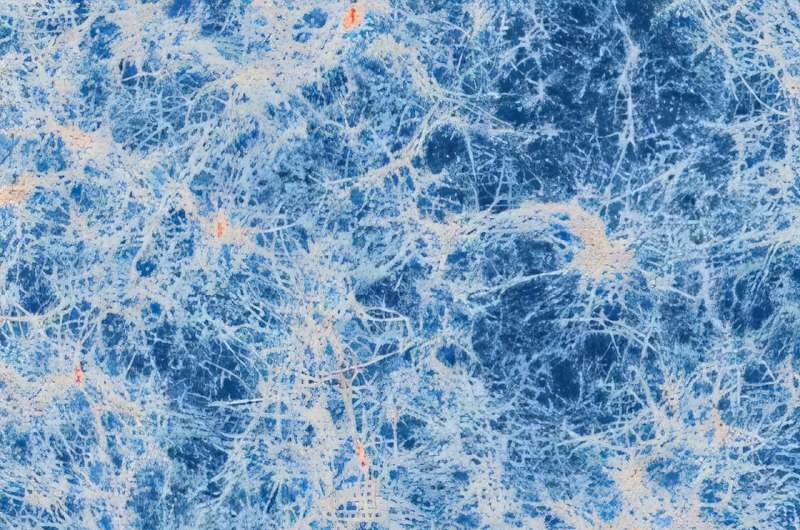
Woven Filaments of a Cosmic Web: Our modern telescopes and simulations have revealed that the universe truly has a “woven” large-scale structure. The image above is a computer simulation of the cosmic web – a representation of how matter (galaxies and gas) is distributed across the cosmos. We see bright knots (orange regions) which are massive clusters of galaxies, connected by luminous filaments (pale threads) stretching across space, and separated by vast dark voids where few galaxies exist. Observational surveys (such as the Sloan Digital Sky Survey) confirm this pattern: galaxies are not scattered randomly but form sheets and filaments arrayed in a spidery web with gigantic empty bubbles between them. In scientific terms, galaxies, groups, and clusters cluster together into superclusters and long “galactic walls”, all arranged in twisting, threadlike structures called the cosmic web. It is as if creation is woven into a cosmic fabric, with matter following “invisible highways” along gravitational filaments. This discovery – only recognized in recent decades – resonates powerfully with the Quran’s ancient phrase “sky full of pathways”. The heavens literally contain interconnected pathways of galaxies and dark matter. The cosmic web can be seen as a modern manifestation of the sky’s “intricately connected” design. Of course, when the Qur’an was revealed, people could only see the Milky Way (itself a band of billions of stars) and imagine perhaps a woven appearance on a clear night. Yet, the metaphor of a woven sky now gains an added layer of meaning: the universe has a network structure – almost like a celestial tapestry of nodes and filaments. This scientific insight does not prove the verse was describing the cosmic web, but it beautifully mirrors the imagery. It inspires believers to reflect that what was described in allegorical or visual terms (“woven sky, full of paths”) corresponds strikingly with reality as unveiled by astronomy. The Quran’s oath by this wondrous heaven is thus extremely apt: the more we learn about the cosmos, the more awe it evokes.
The Expanding Universe and Qur’an 51:47: One of the most profound modern discoveries is that the universe is indeed expanding. In 1929, astronomer Edwin Hubble observed that distant galaxies are receding from us, and the farther a galaxy is, the faster it moves away. Space itself is stretching – a finding now formalized as Hubble’s Law. This led to the Big Bang theory: the universe began in a compact state and has been expanding ever since. How remarkable, then, is the Qur’an’s statement “We built the heaven with might, and indeed We are expanding it”! Modern Muslims often point out that this verse accords with scientific truth unknown to humans at the time of revelation. The original Arabic allows the translation “expanding it,” and that is precisely what the universe is doing. From a faith perspective, this alignment bolsters the sense that the Quranic description is divinely insightful – not in a textbook manner, but in a purposeful ambiguity that fits reality. Classical scholars, as noted, explained “We are al-mūsi‘ūn” in terms of God’s power to make things vast or provide abundance, which is also true. Yet the straightforward reading of mūsi‘ūn as “expanding (in size)” now rings vividly literal. Scientifically, we know that the fabric of space is expanding – and even accelerating due to dark energy. The Qur’an’s wording does not conflict with this at all; in fact, it captures it in a pithy phrase. This doesn’t mean the Quran taught Hubble’s law in detail (and scholars caution against making exaggerated claims). But it is undeniably fascinating that the text says “and We are expanding” when virtually every ancient cosmology (and even scientists up until the 20th century) assumed a static, unchanging universe. The spiritual significance that Muslims draw here is meaningful: the cosmos is dynamic and under God’s active sustenance, “unfolding” by His command. This adds a layer of understanding to the verse – encouraging believers to marvel at a continuously active creation, and it poses no barrier for a scientifically minded reader to appreciate the Quran’s language.
“Seven Heavens in Layers” and the Structure of the Cosmos: The Qur’an describes the heavens as “seven, one above the other” (67:3), implying a layered universe. Modern science does not literally speak of “seven skies,” but it does reveal that the cosmos has distinct layers and levels of structure. For example, Earth’s atmosphere is composed of multiple layers (troposphere, stratosphere, mesosphere, thermosphere, etc.), each with its own properties – a fact one might poetically compare to “seven heavens” if speaking in pre-scientific terms. Beyond our atmosphere, we find hierarchies: Earth itself orbits within a planetary system, which is within a galaxy (the Milky Way), which is part of a local group of galaxies, which in turn sits in a cluster (the Virgo Cluster), nested in a supercluster (Laniakea), and ultimately woven into the cosmic web of superclusters and filaments. In a loose sense, nature is layered “one above another” – from our ground view of the blue sky, up through space, and through successive scales of the universe. The Quranic emphasis that none of these layers has any “discrepancy” or “flaw” is also scientifically resonant. Despite the immense complexity of the cosmos, we find it governed by consistent physical laws and an order that allows structures to form without “cracks” or chaos. Astrophysics shows that from the microscopic scale to the intergalactic scale, the same fundamental forces and patterns (gravity, nuclear forces, etc.) apply; creation is uniform in its principles – no random tear in the fabric of the universe has been found. When 67:3-4 invites us to scan the sky for a flaw, we might think in modern terms of examining the universe for any breakdown of natural law or any region of “broken” physics – none has appeared; the universe is a cohesive whole. Moreover, the notion of “layers” can also be compared to how scientists slice the universe in analysis: e.g. looking at the distribution of galaxies at different epochs (slices of cosmic time) yields layer-like cross-sections of the web of matter. While “seven” may or may not correspond to something specific (some have whimsically pointed out the five main atmospheric layers plus two layers of outer space could equal seven, but this is speculative), the broader point is that the Quran depicts a multilevel cosmos created with order at every level – and this is exactly what we observe. From a spiritual angle, the layered heavens also symbolize the vast unseen realms beyond human reach, evoking humility. Current cosmology indeed shows that above us is an almost unfathomable expanse of galaxies stacked in gigantic structures – a reality that can instill the same awe and humility that the Qur’anic verses seek to inspire.
Synthesis: Faith and Science in Harmony
The parallels between the Quranic portrayal of the heavens and modern cosmological understanding are striking and thought-provoking. Classical Islamic scholars praised the heavens’ beauty, order, and perfection, using the best knowledge of their time. Modern science, through advanced telescopes and theories, has unveiled a universe of colossal scale and intricate structure – yet not a random, haphazard one. It is structured like a web, expanding, and law-governed. Far from clashing with the essence of the Quranic descriptions, these discoveries echo the same themes: vastness, complexity, and coherence of the cosmos. It is as if the metaphors and analogies in the Qur’an were primed to accommodate new meanings as human knowledge grew – without losing their spiritual message.
It’s important to acknowledge that the Quran is not a science textbook; its primary purpose is guidance and reflection, not scientific instruction. Thus, when we say the Quran’s wording “mirrors” modern insights, we approach it as a harmonious convergence, not a direct scientific pronouncement. Muslim thinkers often view these correspondences as signs of the Quran’s divine origin – a source of faith-strengthening wonder that a 7th-century scripture contains phrases so apt for 21st-century science. At the same time, a scientifically minded person can appreciate how poetic imagery happens to align with reality in a meaningful way. One could call it a fortunate coincidence or interpret it as deeper insight; either way, it inspires reflection. The Qur’an itself ends 51:49 (the verse after the expansion verse) by saying “that you may remember (or reflect).” Ultimately, these verses achieve precisely that: they spur us to ponder the cosmos.
Spiritually, the “sky full of pathways,” the seamless layered heavens, and the ever-expanding universe all point to an Almighty Creator who is majestic and in control. A believer standing beneath the night sky can now reflect: above me is a vast network of galaxies and nebulae, utterly organized by God into a beautiful web – truly a “heaven full of hubuk (woven paths)”. The expanding universe underscores that creation is dynamic – God did not just create and abandon it, but His creative command is continuous, expanding and sustaining. The flawless layered heavens remind one that God’s creation is perfect and deliberate, instilling trust in the stability of the cosmos and, by extension, in the reliability of God’s care. Such reflections bridge the scientific awe of the universe with a devotional sense of awe towards the Creator.
In conclusion, the Quranic verses (51:7, 50:6, 51:47, 67:3–4) offer a rich tapestry of meanings that comfortably spans ancient commentary and modern cosmology. The classical scholars grasped the core ideas of order, beauty, and power in these verses, and today’s science broadens our appreciation of how truly ordered, beautiful, and powerful the heavens are. The “sky full of pathways” swears to us that the creation above is not aimless or trivial – it is a grand sign. As we map galactic filaments and measure cosmic expansion, we find our scientific “maps” of reality can be in harmony with our sacred “map” provided by scripture. For a religious reader, this harmony deepens faith; for a science-focused reader, it offers a poetic perspective on data, showing that knowledge and meaning can complement each other. Standing between the scientific and the spiritual, we cannot help but feel a sense of profound wonder. The Qur’an’s ancient words ring true in new ways, encouraging us to “look again and again” at the universe – for in doing so, we only increase in insight and humility before the “Lord of all worlds.”
Sources:
- Quran 51:7 with classical tafsīr (Al-Tabari, Ibn Kathir, etc.) noting hubuk as “beauty, intricacy, tracks” surahquran.com quran.com.
- Quran 67:3–4 commentary emphasizing the flawless, layered heavenssurahquran.com.
- NASA (Imagine the Universe): description of cosmic web structure with filaments, clusters, and voids imagine.gsfc.nasa.gov.
- NASA Science (Large-Scale Structure): on galaxies forming groups, clusters, superclusters, and walls in a twisting cosmic web science.nasa.gov.
- The Glorious Quran and Science – Celestial Reflections: insight on Quran 51:7 and 51:47 aligning with cosmic web and expansion thequran.love.
- Hubble’s discovery of the expanding universe (1929) and its resonance with Quran 51:47 thequran.love.
- Classical exegesis collected in Ma’ariful Quran and others for 51:7 (tracks of angels, orbits of stars) quran.com and Tafsir al-Jalalayn (analogy of wind-woven sand patterns) surahquran.com.
- Islamic perspective on Quran and science: caution and wonder regarding interpreting 51:47 as expansion thequran.love.


 The Glorious Quran and Science
Leave a comment