
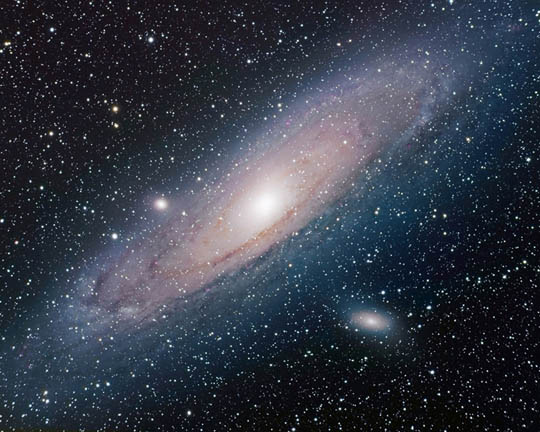
Epigraph
سَنُرِيهِمْ آيَاتِنَا فِي الْآفَاقِ وَفِي أَنفُسِهِمْ حَتَّىٰ يَتَبَيَّنَ لَهُمْ أَنَّهُ الْحَقُّ ۗ أَوَلَمْ يَكْفِ بِرَبِّكَ أَنَّهُ عَلَىٰ كُلِّ شَيْءٍ شَهِيدٌ
We shall show them Our signs in every region of the earth and in themselves, until it becomes clear to them that this is the Truth. Is it not enough that your Lord witnesses everything? (Al Quran 41:53)

Written and Collected by Zia H Shah, Chief Editor of the Muslim Times
The Qur’an frequently draws attention to the cosmos – the skies, stars, sun, moon, and the very structure of the universe – as signs (āyāt) of divine wisdom. In this commentary, we explore selected verses that reference celestial bodies and cosmic order. For each, we provide a brief translation, a spiritual reflection, and a scientific insight highlighting intriguing resonances between the scripture and modern cosmology. The tone is one of awe and contemplation, inviting both faith and curiosity.
1. Qur’an 2:164 – Signs in the Creation of Heaven and Earth
Translation: “Surely in the creation of the heavens and the earth, the alternation of night and day, the ships that sail the sea for people’s benefit, the rain Allah sends down from the sky – reviving the earth after its death – scattering every kind of creature, the shifting of the winds and clouds subservient between sky and earth: in all these are signs for people of understanding.” (2:164)
Reflection: This single verse paints a panoramic picture of nature’s wonders as divine signs. It urges us to reflect on the vast sky above and earth below, the cycle of day and night, life-giving rain, and the wind and clouds that sustain life. In the Quranic view, none of these occur aimlessly – they are deliberate blessings and reminders of the Creator. Night gives way to day in regular rhythm, rain revives barren land, and the cosmos sustains life; such harmony suggests a purposeful design, encouraging gratitude and faith. The verse appeals to “people of understanding” – those willing to ponder how the cosmic order and Earth’s ecology testify to a Wise Sustainer, and not take these everyday miracles for granted. It teaches that worship in Islam is not only ritual but also using one’s intellect to contemplate creation. The faithful observer sees in the blue sky, in each sunrise and rainfall, a message of divine mercy and a call to give thanks.
Scientific Insight: Modern science reveals a profound interconnected order in these phenomena. The alternation of night and day is caused by Earth’s rotation on its axis every ~24 hours. This steady spin creates the balanced cycle of light and dark crucial for organisms’ circadian rhythms and climate stability. If Earth spun significantly faster or slower, life’s patterns would be disrupted. The water cycle – evaporation, cloud formation, and rain – sustains all ecosystems, and we know water is essential for every form of life. From a cosmological perspective, the “heavens and the earth” had a beginning (the Big Bang), and their laws and constants allow life to flourish. Earth’s atmosphere and magnetic field form a “protected canopy” that shields us from harmful radiation and meteoroids. The more we learn about the fine-tuned systems of our planet and the wider universe, the more we perceive the “signs for people of understanding” that Qur’an 2:164 invites us to see. For example, the atmosphere’s precise composition and pressure not only provide air to breathe but also cause deadly meteors to burn up before reaching the ground. Such scientific insights deepen our appreciation: the regularity of sunrise, the nurturing cycle of water, and the invisible shields around Earth all speak to a habitable design. Believers interpret this as evidence of a merciful Creator, while scientists marvel at the rare balance of conditions that make Earth our thriving home. Both can agree that the features listed in 2:164 – from the grand scale of heavens to the microscopic droplets of rain – are truly remarkable and worth our sustained reflection.
2. Qur’an 3:189–191 – Contemplating the Universe with Purpose
Translation: “To Allah belongs the dominion of the heavens and the earth, and Allah is over all things Powerful. Indeed, in the creation of the heavens and the earth and the alternation of night and day are signs for those of understanding – those who remember Allah standing, sitting, and lying on their sides and reflect on the creation of the heavens and the earth [saying], ‘Our Lord, You have not created this aimlessly; glory be to You! So protect us from the punishment of Hell.’” (3:189–191)
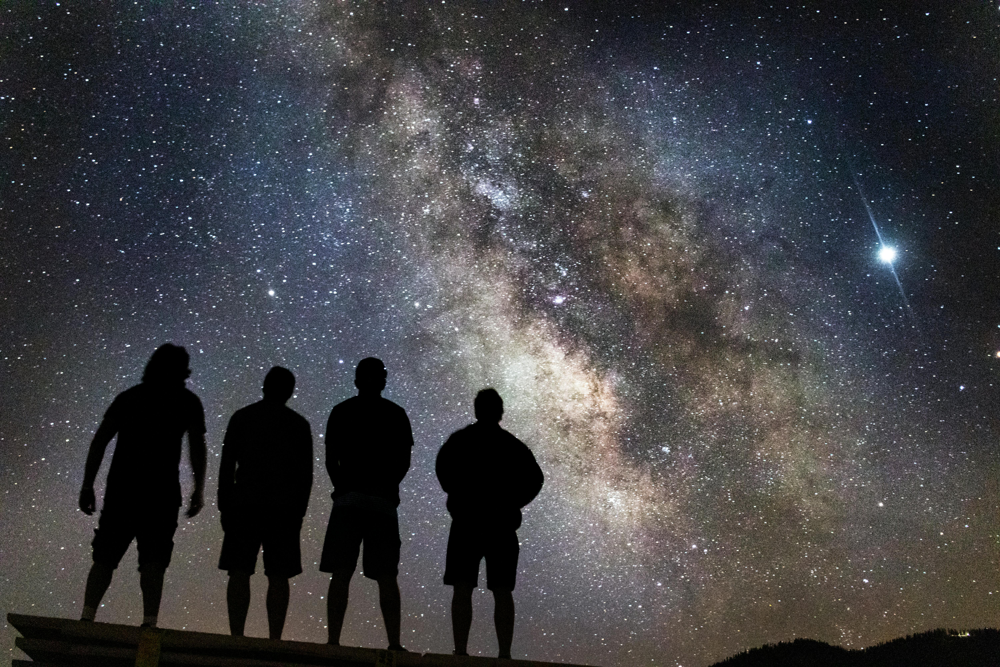
Reflection: These verses present a vivid image of the devout thinker: someone who looks up at the night sky or surveys nature and is filled with remembrance of God. The Qur’an links true understanding with reflection on the cosmos. The believers described in 3:191 gaze at the vast heavens and earth and exclaim that this creation is “not created in vain” – not an accident or without purpose. This is a deeply spiritual conclusion drawn from observing reality. The countless stars, the precise movement of day and night, all point to a meaningful order rather than chaos. Thus, worship in Islam is not confined to rituals; it includes using one’s intellect to contemplate creation. The result of such contemplation is an awareness of the Creator’s glory (“Glory be to You!”) and a humble recognition of human responsibility (“protect us from punishment”). In essence, the Quranic worldview encourages a harmonious blend of scientific wonder and spiritual humility: exploring the universe leads to affirming faith, and understanding our small place in a vast cosmos leads to seeking moral guidance. This balanced perspective fosters both awe at the power of God who holds dominion over the cosmos, and a personal commitment to live meaningfully, knowing nothing in creation is aimless or without accountability.
Scientific Insight: Today’s scientific discoveries greatly expand our sense of the “heavens” that sparked the awe of early believers. We now know the observable universe contains an estimated 2 trillion galaxies and about 10^24 stars – “more stars (and, potentially, Earth-like planets) than all the grains of beach sand on planet Earth.” Such mind-boggling numbers were beyond ancient imagination, yet the Quranic assertion that “the heavens and earth” were created with purpose resonates with modern findings of order on a cosmic scale. Astrophysicists observe that the universe is governed by consistent physical laws everywhere we look – the same laws of physics apply throughout the cosmos. This uniformity (the cosmological principle) means that from distant galaxies millions of light-years away to our local solar system, matter behaves predictably, not chaotically. Many scientists have noted how fine-tuned certain cosmic parameters are (forces, particle masses, etc.) to allow the existence of stable stars and planets. For example, if gravity were slightly stronger or weaker, stars like our sun might not form or burn stably. If the expansion rate of the Big Bang had been a bit different, the universe could have collapsed back on itself or expanded too fast for galaxies to coalesce. Such observations have led physicists to talk about the “Goldilocks” conditions of the universe – just right for life. While science does not pronounce on divine purpose, it reveals a universe that is “playing fair” and intelligible – qualities one might call “not created aimlessly.”
Another layer of resonance: The believers’ exclamation in 3:191 that the cosmos was not made in vain finds an interesting echo in Einstein’s famous quote, “God does not play dice with the universe,” expressing a belief in underlying determinism and meaning in physical law. The more we uncover about cosmic history – from the hot, dense origin to the formation of galaxies – the more we find an underlying order that inspires awe. For a person of faith, this harmony echoes the Qur’an’s invitation to see signs in creation. For a scientist (whether religious or not), the fact that the universe is comprehensible and exhibits structure invites deep philosophical questions. Both perspectives meet in a shared sense of wonder. Thus, Qur’an 3:189–191 beautifully captures the spirit of curiosity leading to enlightenment. It encourages us to study the universe (the domain of science) and let that study inspire remembrance and gratitude (the domain of spirituality). In practice, many scientists who are believers find that astronomy and physics deepen their faith, as they see in the night sky or through a telescope an affirmation that “Our Lord, You have not created this aimlessly”. And even secular scientists often use quasi-spiritual language (like “elegant equations” or “majestic cosmos”) which reflects an almost reverent appreciation of the order in nature. This convergence of viewpoints underscores the timeless relevance of the Qur’anic call to contemplation.
3. Qur’an 6:97 – Guiding Stars in Land and Sea
Translation: “And He it is who made for you the stars, so that by them you may guide yourselves in the darknesses of the land and sea. We have certainly made the signs clear for people who know.” (6:97)
Reflection: Here the Qur’an highlights the practical and spiritual value of the stars. On a practical level, for desert travelers or sailors, the stars have always been a map – guiding them when landmarks or coastlines are not visible. Spiritually, the verse suggests that the One who placed those stars cared about human guidance and well-being. The stars become symbols of divine providence: tiny lights pricking the deep night to help the lost find their way. This is one of the Qur’an’s “clear signs” accessible to all: when you navigate by the North Star or recognize constellations to orient yourself, you are benefiting from a cosmic mercy set up by the Creator. It reminds the believer that just as God provided guidance in physical darkness via stars, He provides moral and spiritual guidance via revelation. The verse thus encourages knowledge (“for people who know”) – studying the stars and heavens is viewed as uncovering God’s signs. There is humility and gratitude implied: ancient peoples who looked up and successfully journeyed using starlight would naturally feel thankful for this reliable celestial roadmap. And indeed, nearly every culture’s lore thanks the heavens for guidance: from the Polynesians crossing oceans by star paths to Arab traders crossing the Sahara by following celestial markers. The Qur’an affirms this as a deliberate blessing. It’s a reminder that even in our darkest moments, “lights” have been provided for guidance – whether literally in the sky, or metaphorically in the heart and conscience.
Scientific Insight: For centuries, celestial navigation was the primary way mariners and caravan travelers determined their course at night. The Pole Star (Polaris) in the northern hemisphere, for example, appears fixed in the sky directly above the North Pole, so its altitude in the sky equals your latitude. As a maritime history source notes, “long before GPS, sailors learned to identify the stars… to navigate out of sight of land.” Tools like the astrolabe and sextant were developed to measure angles to stars and figure out one’s latitude on Earth. The fact that the stars reliably rise and set in known patterns (due to Earth’s rotation and orbit) made such navigation possible. Crucially, this reliability is rooted in physics: Earth’s axis points toward Polaris, and the stars’ positions shift predictably with the seasons. For example, in the northern sky the Big Dipper’s “pointer stars” always indicate the North Star’s position. By learning these patterns, travelers could find the cardinal directions. Today, even with modern technology, we still use celestial fixes as a backup for sea navigation, and spacecraft navigate by star trackers – devices that recognize star patterns to calibrate orientation.
The phrase “darknesses of the land and sea” also resonates with human history: before artificial lighting, true darkness at night was a challenge and danger. The stars and moon were literally the only lights available across open oceans or deserts. Their importance to navigation cannot be overstated – e.g., Arabian Bedouins had detailed knowledge of star positions and gave names to dozens of stars and asterisms, using them as a nocturnal compass. An interesting scientific tidbit: not only humans, but many animals use stars for navigation. Studies have shown that migratory birds navigate partly by the stars, and even dung beetles can orient by the Milky Way’s glow! This suggests a deep biological appreciation of celestial “signs.” It’s as if nature itself has been tuned to these guiding lights.
So when the Qur’an says God “made for you the stars for guidance”, one can appreciate this on multiple levels. Astronomically, stars are giant nuclear furnaces trillions of miles away – yet their light serves humble creatures on Earth to find their way. The constancy of star positions (over human timescales) is due to the immense distances (their motion is negligible to our eye) and Earth’s stable rotation axis. That stability (the slow wobble of Earth’s axis takes 26,000 years to noticeably change pole stars) has been a boon for navigation across millennia. Believers may see this stability as God’s providence; scientists would describe it as a consequence of angular momentum conservation and Earth’s moment of inertia (bolstered by the stabilizing effect of the Moon on our axial tilt). In either view, the outcome is the same: fixed reference points in the sky that allowed human exploration of the entire globe. Even today, the field of astrophysics owes a debt to navigation, as many early astronomers (like Hipparchus, and later Islamic astronomers like al-Battani) catalogued stars precisely to improve navigation and timekeeping.
Thus, Qur’an 6:97 captures a simple truth with profound implications: the night sky is not just beautiful, it’s practical. It’s a map and compass of divine making. Science celebrates this by teaching celestial navigation in naval academies and by acknowledging how crucial star maps were to our species’ voyages. In a broader sense, the verse sets a paradigm: use empirical observation (“people who know”) to appreciate divine blessings. Studying the stars leads to guidance in travel, and in the Quranic context, also guidance of the soul (since pondering such signs leads one to God). That interplay of practical knowledge and spiritual insight is a hallmark of Quranic epistemology and resonates with the experience of many scientists who find their study of nature guiding them to larger truths.
4. Qur’an 7:54 – Creation in Six Days and Cosmic Order
Translation: “Indeed, your Lord is Allah who created the heavens and the earth in six days, then established Himself on the Throne. He makes the night cover the day, chasing it rapidly. And [He created] the sun, the moon, and the stars, all subject to His command. Unquestionably, His is the creation and the command; blessed is Allah, Lord of the worlds.” (7:54)
Reflection: This verse encapsulates a grand narrative of creation. In majestic sweep, it declares the creation of the cosmos in “six days”, an assertion of deliberate, phased creation (the exact nature of these “days” is often understood not as 24-hour periods, but as stages or epochs beyond human time). The scene then zooms into the rhythmic covering of day by night – an everyday miracle presented dynamically: night “chases” day “rapidly,” suggesting the continuous rotation of the celestial sphere and the quick onset of dusk. The sun, moon, and stars are described as subjugated to God’s command, emphasizing God’s ongoing governance (the “command”) over creation even after its initial making. The spiritual message is the sovereignty of God over time and space: He brought the universe into being in an ordered way, and He sustains its order (the day-night cycle, the courses of sun and moon) even now. The proper response is praise – “blessed is Allah, Lord of the worlds.” Believers take comfort that the cosmos is not run by capricious forces but by a beneficent Lord. The verse implicitly encourages trust: just as night and day unfailingly follow each other by His command, one can trust in God’s dependable management of all affairs. It also draws a link between creation (the making) and command (the governing laws) – both belong to God. Early scholars often reflected that Allah created the universe and also laid down its natural laws (“command”) by which it operates. Thus, studying those laws (science) can be a way to appreciate the “blessed” nature of the Creator. The mention of God establishing Himself on the Throne after creation is a metaphor for His absolute authority and control over the universe.
Scientific Insight: Modern cosmology provides an interesting parallel to the idea of creation in stages or epochs. The universe did not appear fully formed in an instant; rather, it has a history – from the hot dense state of the Big Bang to the formation of basic particles, then atoms, stars, galaxies, and planets over billions of years. This sequential development can be likened to “cosmic days” or chapters of creation. While science counts ~13.8 billion years rather than six days, the principle of orderly progression is common to both narratives. After the Big Bang, the universe went through an inflationary epoch (a split-second of exponential expansion), followed by particle formation, the decoupling of light (release of the cosmic microwave background “afterglow”), the dark ages, then the first stars igniting, galaxies assembling, etc. The Quran’s language captures the principle of an ordered creation, even if not detailing scientific timelines. It’s noteworthy that many cultures had chaotic creation myths, but the Qur’an emphasizes order and intentionality.
Furthermore, the verse’s depiction of night covering day in swift pursuit beautifully matches what we now understand: Earth’s rotation causes the sun to “set” and night to blanket the hemisphere turned away from the sun. At any given moment, from space one would see half the Earth in daylight and half in darkness, with the terminator (the day-night boundary) sweeping westward continuously as Earth spins (~1670 km/h at the equator). The phrase “chasing it rapidly” is an apt description of how quickly dusk can fall. Travelers near the equator know that twilight can be very short – the tropical night arrives almost “rapidly” after sunset. Even at higher latitudes with longer twilight, the progression of night overtaking day is relentless. This steady alternation has been constant for billions of years, due to Earth’s stable rotation. If Earth’s rotation were much slower, day and night would last longer (like Mercury’s day is months long), which would cause extreme temperature swings. But a roughly 24-hour rotation turns out to be excellent for life’s daily rhythms. We might call that coincidence; a believer calls it part of the fine-tuning of Earth for life.
The sun, moon, and stars being “subject to His command” aligns with the scientific observation that all these bodies follow fixed laws of nature. The sun shines by the laws of nuclear fusion; the Earth orbits the sun and the moon orbits Earth by gravitational laws; stars and galaxies move according to physics. In essence, they obey the “command” set for them. The verse hints at this by pairing creation with command – reminiscent of how physicist James Clerk Maxwell said, “The laws of nature are the mathematical thoughts of God.” Or in Qur’anic terms, after creating the universe, God “decreed its laws” (see 41:12). Modern astronomy has shown that if these laws were slightly different (e.g., if the gravitational constant were weaker, stars might not ignite; if stronger, stars might burn too fast or collapse early), the cosmos would be unrecognizable. So, the stability and predictability of celestial motions are indeed remarkable.
For example, we can predict solar and lunar eclipses centuries in advance because the sun-moon-earth system is so regular. That regularity is exactly what the Quran implies by describing them as subjugated. Historically, the ancients were awed that the heavens seemed orderly, not random, which is one reason astronomy became one of the first sciences. The Islamic civilization itself put great effort into astronomy – for calendars, prayer times, and direction to Mecca – under the view that by understanding the divine order in the heavens, one appreciates God’s wisdom. Verses like 7:54 would have fueled that view: God is Lord of the worlds and commanded the stars; by studying their motions, we are studying God’s handiwork.
Another subtle note: “Lord of the worlds” might imply not just Earth but countless worlds. Today we know there are many other “worlds” – over 5,000 exoplanets have been discovered beyond our solar system, and potentially billions more await. The Quran doesn’t detail that, but its plural “worlds” leaves the concept open. Science has moved from thinking Earth is the center of creation to seeing us as one planet among many around one star among billions. Yet the laws (commands) that govern physics here seem to hold throughout those worlds. This again reinforces the idea of a single authority behind it all, which is precisely the spiritual point of the verse.
In summary, Qur’an 7:54’s portrayal of an ordered creation finds affirmation in the coherence and regularity that science observes in cosmic phenomena, from the grand scale of galactic formations to the simple certainty of each sunrise. The more we understand those natural “commands” or laws, the more we can appreciate the “blessed” nature of the One who set them. This verse effectively bridges cosmogony (creation story) with cosmology (ongoing cosmic operation), and invites us to marvel at both.
5. Qur’an 13:2 – Heavens without Visible Pillars
Translation: “Allah is He who raised the heavens without pillars that you can see, then He established Himself on the Throne. And He subjected the sun and the moon, each running for an appointed term. He conducts the whole affair. He makes the signs clear so that you may be certain of the meeting with your Lord.” (13:2)
Reflection: In this verse, the Qur’an tackles a possible misconception of its original audience: how are the skies held aloft? Many ancient cultures imagined physical supports – cosmic pillars or a world-mountain – holding up the sky. The Qur’an clarifies that the heavens are “raised without pillars that you can see,” subtly implying that if there are supports, they are invisible. This draws attention to God’s unseen power upholding creation. The imagery of a vast canopy (the sky) overhead with no visible props instills awe and reliance on God’s might. The verse goes on to mention the sun and moon being subjected to God’s law, each orbiting or moving until an appointed time (the term could refer to their lifespan or the preordained time for the end of the world). Spiritually, this assures believers that all cosmic phenomena are under divine control – they follow a destiny set by the Creator. The phrase “He conducts the whole affair” (or “He regulates all matters”) reinforces the idea of divine providence: not only did God create the heavens, He actively maintains order in the universe. Finally, it says these signs are clarified so that one may be certain of meeting the Lord – implying that reflection on the well-ordered cosmos can strengthen one’s conviction in a purposeful creation and an ultimate return (Day of Judgment) to the Creator. In essence, if an invisible force holds up the sky, and invisible decrees guide the sun and moon, then believing in unseen realities like an afterlife becomes more plausible. For early listeners, this verse invalidated myths of sky-gods physically propping up the firmament and directed them to the true God whose power is subtle yet supreme.
Scientific Insight: The notion of an unseen force holding up the heavens strikingly parallels the modern understanding of gravity. We now explain that planets, moons, and stars are not held by visible pillars but by the invisible force of gravitational attraction. Isaac Newton’s law of universal gravitation (1687) showed that massive bodies attract one another across empty space – essentially “pillars you cannot see.” In Newton’s words, gravity explains how the planets are kept in their orbits around the sun without any physical rods or ropes. As one analysis puts it, “Gravity… causes orbital motions among the trillions of celestial bodies in the universe.” Thus, the sky has no visible columns because its stability comes from physical laws rather than giant props.
To an ancient person, it was bewildering that the sky doesn’t fall. Today, we understand the Earth’s atmosphere stays in place because gravity holds the gases (air) to Earth, and the atmosphere gradually thins with altitude rather than having a hard edge. The clouds seem suspended with no pillars; that’s because updrafts, pressure, and buoyancy (all unseen) keep them afloat. The sun and moon “hang” in the sky because they orbit due to gravitational force and orbital velocity (the moon doesn’t crash to Earth because its sideways motion balances gravity, creating orbit). This is the same principle that keeps satellites up – essentially “invisible pillars” of centripetal force. So one could interpret “raised the heavens without pillars you can see” as hinting that whatever holds them up is not visible – a remarkably accurate statement about gravity 1,000+ years before Newton.
Furthermore, the verse dispels the myth of a solid dome sky being propped up. Modern astronomy tells us the “sky” is an illusion of perspective; in reality, above Earth is space, filled with planets and stars at vast distances. There is no need for physical pillars because each object is bound in space by gravity or momentum. The sun holding 99.8% of the solar system’s mass acts as the gravitational “pillar” for the planets’ orbits, yet we don’t see anything connecting Earth to the sun – it’s the curvature of spacetime or gravitational field doing the job. Interestingly, early Islamic commentators themselves sometimes suggested that unseen pillars (perhaps forces) might exist, since the verse says “without pillars that you can see,” implying maybe pillars that cannot be seen by the eye. This interpretation aligns uncannily well with how we describe gravity.
The verse also mentions the sun and moon each running for an appointed term. Astronomically, the sun has a finite lifetime (~5 billion more years before it exhausts its fuel and goes red giant. The moon too is slowly spiraling away from Earth (by ~3.8 cm/year due to tidal effects, and in the far future its orbital dynamics will change. While ancient readers wouldn’t know these specifics, the statement is scientifically valid: these celestial bodies are not eternal; they have a “term.” If interpreted in context of the Day of Judgment, it also resonates with scenarios like the sun’s light being folded up (as hinted in Qur’an 81:1) – which we now could see as, eventually, the sun will indeed cease to shine as we know it (becoming a white dwarf). Either way, it instills the idea that even mighty celestial bodies obey a timeline set by God.
The phrase “He conducts the whole affair” suggests the idea of natural laws or an underlying control to every process. In science, we seek a unified theory that “conducts” all forces (like the dream of a Theory of Everything combining gravity with quantum mechanics). We haven’t found it yet, but every step (Newton’s laws, Maxwell’s equations for electromagnetism, etc.) reveals a more encompassing order. Believers see each discovery as another facet of “the affair God conducts.” It’s telling that the verse invites clarity of signs leading to certainty of meeting God – meaning, by understanding nature’s functioning (signs), one gains confidence in the reality of higher truths (like meeting the Lord). Historically, the consistent operation of gravity and the movement of heavenly bodies gave humankind the concept of predictability, which is foundational for rational thinking about the future and thus conceptualizing a promised future event (like an afterlife) as credible under a trustworthy God.
In summary, Qur’an 13:2 aligns with scientific truth on a fundamental level: invisible forces (gravity) give the sky its stability and govern the motions of sun and moon. What was once explained by mythological pillars is now explained by physics – yet the wonder remains the same. The verse bridges the gap between tangible observation (sky has no pillars) and intangible reality (but something holds it up). Modern physics merely quantifies that “something.” And as the verse concludes, understanding this should lead to certainty in God’s plan. For a scientist believer, discovering gravity’s role can indeed strengthen faith: it’s a glimpse into the sophistication of how God “raises” the universe. For a non-believer, it at least affirms the Quranic statement is consistent with natural reality – quite a foresight for a 7th-century text. Either way, the heavens still stand without pillars, and we stand under an upheld sky, marveling.
6. Qur’an 15:16 – Constellations Beautifying the Sky
Translation: “And indeed, We have placed constellations in the sky and beautified it for observers.” (15:16)
Reflection: This verse highlights the aesthetic dimension of the night sky. The Arabic term burūj (constellations) can mean stellar groupings or great stars – often understood as the zodiac or prominent star formations. The Qur’an asserts that God “placed” these in the heaven and made them beautiful for those who look up. This conveys that the starry sky’s beauty is intentional. The night sky could have been dull or empty, but instead it is sprinkled with lights that form patterns (like Orion, the Big Dipper, etc.) which humans have gazed at in wonder throughout history. The verse invites us to see the splendor of the cosmos as a deliberate gift. For the 7th-century Arab audience, constellations had practical importance (marking seasons and directions) but here the emphasis is on their visual glory – a source of inspiration and awe. It teaches that God is not only powerful but also an artist who adorns the universe. Observers are meant to take joy and comfort from this celestial adornment. The following verses in the passage (15:17–18) mention protection of the sky from evil (i.e., meteor showers depicted as flaming arrows against devils), but 15:16 focuses on the positive image: the sky as a grand canopy studded with lights to please the eye and heart of the beholder. Spiritually, this resonates with the concept that nature is a sign of God’s beauty (jamāl). Appreciating the stars can thus be an act of spiritual contemplation, recognizing the Creator who “loves beauty” (per an Islamic hadith) and who “made everything He created excellent and beautiful” (Qur’an 32:7).
Scientific Insight: The mention of “constellations” aligns with how humans have long imposed patterns on the stars. Of course, science now knows these groupings are apparent – the stars in a constellation may be hundreds of light-years apart and unrelated, but to our perspective they form a pattern. The Qur’an’s recognition of this human practice (“for observers”) is noteworthy. It validates the experience of stargazers who see pictures in the sky. Today we know that the stars making up, say, Orion’s Belt are at very different distances and one (Alnitak) is a hot blue supergiant while another (Mintaka) is a massive binary star. Yet our eyes connect them with imaginary lines into a “belt” on a hunter figure. The beauty of the night sky that the verse speaks of is very real: even though stars are physical balls of plasma, our perception organizes them into constellations that carry meaning and beauty. Modern astronomy still uses the 88 official constellations (established by the International Astronomical Union) to map the sky, though now they’re more like coordinate boundaries. We continue to refer to Orion, Ursa Major, Scorpio, etc., when discussing parts of the sky. There’s something enduring about these star patterns.
The Qur’an saying “We have beautified the sky for observers” finds resonance in the fact that humans across all cultures have found the starry sky mesmerizing. From a scientific standpoint, the night sky’s appearance is due to several factors: the stars’ distribution in our Milky Way galaxy (most bright stars we see are relatively nearby in our galaxy, and the Milky Way band is the dense plane of our galaxy seen from within), our night vision which can see faint lights as beautiful points, and the contrast of bright stars against dark space. If we lived in a galaxy with thick dust clouds blocking the view, or if our atmosphere was always clouded, we wouldn’t see this beauty. Earth is fortunate to have a relatively clear atmosphere (when free of pollution) and we’re in a part of the Milky Way where we can see many other stars. In fact, on a clear night away from city lights, the human eye can see a few thousand stars. Add a small telescope and millions come into view. The more we have developed scientifically (telescopes, cameras), the more beauty we have uncovered: star clusters like the Pleiades (tiny dipper-like cluster), nebulae like Orion Nebula (a stellar nursery glowing in purples and reds), and galaxies like Andromeda visible as a faint smudge have all added to the splendor.
In the Qur’anic time, “constellations” might specifically refer to the zodiac signs which the sun, moon, and planets move through – these 12 star groups (like Leo, Orion’s neighbor Taurus, etc.) were well known. They were indeed used for calendrical signs and navigation. But the verse’s phrasing leans on their beauty rather than function. Astronomers today still get poetic: for example, we talk about the “jewel box” cluster, the “butterfly nebula”, etc., appreciating aesthetics. There is also a deep concept in cosmology: why is the night sky dark? This is Olbers’ Paradox – if the universe were infinite and filled uniformly with stars, every line of sight should eventually hit a star, making the sky bright like the sun. The fact that it’s mostly dark with distinct points of light is because the universe is finite in age and expanding, so distant stars’ light hasn’t all reached us and space is mostly empty. This allows us to have a beautiful starry sky instead of a whiteout. One could say the universe’s properties conspire to give us the contrast that makes stargazing possible. Likewise, our eyes can distinguish tiny variations in star brightness and color. The star Betelgeuse in Orion is red-orange, while Rigel in Orion’s foot is blue-white; our eyes see those colors. The ancient Arabs, including the Prophet Muhammad ﷺ, were known to describe star colors (e.g., Sirius as bluish, Arcturus as reddish). This color and brightness variety adds to the aesthetic. Scientifically, it corresponds to star temperatures and spectral types. But to the observer, it’s just lovely variety – a “beautified sky.”
Furthermore, modern cosmology reveals beauty on scales unimagined before: galaxies themselves form spiral patterns (like the Milky Way’s spiral arms which we only mapped in the last century), clusters of galaxies form elegant distributions, and through the Hubble Space Telescope we’ve seen images like the “Pillars of Creation” (star-forming columns) which are visually stunning. One could argue that the Qur’an’s statement holds even as we extend “observer” to our telescopes and satellites – each new sky view still has beauty. There’s no law saying the universe had to appear beautiful to us; it could have been dull. But from Saturn’s rings to eclipses (a perfectly placed moon giving us corona to see), there are many instances where the alignment of nature and human aesthetic sense is striking. Some scientists consider this anthropic – if the universe were chaotic and ugly perhaps intelligent life wouldn’t find meaning – but it remains somewhat mysterious that it’s so visually inspiring.
In summary, Qur’an 15:16 reminds us that beyond function, there is artistry in creation. The constellations as seen by human eyes generate stories, art, and guidance. Scientifically, while we remove the mystical connect-the-dots and see stars as separate astrophysical objects, we still appreciate the overall sky panorama. And interestingly, as science has shown us nebulae and galaxies, we’ve created new “constellations” in our mind – e.g., seeing a horsehead shape in the Horsehead Nebula, or an eye in Helix Nebula. The human penchant to find beauty and pattern in the stars is very real and perhaps even hardwired (some speculate it aided early navigation and timekeeping, thus selected for in evolution). The Qur’an frames that as God’s doing: He placed the stars and made them pleasing. In modern terms, one might say the universe has an underlying harmony and symmetry that our brains resonate with. Mathematics often describes beauty in physical laws (like the elegant symmetry of a spiral galaxy shaped by gravity). Thus, the cosmos is not only rational but also sublime, fitting the Qur’anic view that it is “masabīḥ” (lamps, 41:12) and “zīna” (adornment, 37:6) in the lowest heaven. For any star-lover or astronomer, this verse rings true: the heavens are indeed “beautified for observers.”
7. Qur’an 16:12 – Day, Night, Sun and Moon in Service
Translation: “And He has subjected for you the night and day, and the sun and moon; and the stars are subjected by His command. Surely in that are signs for people who reason.” (16:12)
Reflection: This verse emphasizes how major celestial phenomena are made beneficial and manageable (“subjected for you”) to human life. Night and day alternate in a reliable pattern that is favorable – night for rest, day for work and growth. The sun and moon are “harnessed” to humanity’s advantage: the sun providing light and warmth, the moon offering gentle light at night and marking months. The stars again are mentioned as under God’s command, which, as in 6:97, hints at their use for navigation and as part of a law-bound cosmos. The key theme is human-centric mercy in cosmic design – the phrase “for you” indicates that the Creator arranged these immense phenomena with human flourishing in mind. This engenders gratitude and a sense of privilege: the vast universe isn’t indifferent to us; it’s actually set up to support life and civilization. Spiritually, this fosters trust and responsibility. Trust, because seeing the sun rise each day or the stars guide travelers assures us of God’s consistent care. Responsibility, because if these mighty creations serve us, we ought to serve God and steward the earth responsibly. The verse closes by saying these are signs for people who reason – highlighting that understanding the benefit and order in these cycles should lead a rational person to acknowledge the Creator’s grace and wisdom. It’s a gentle rebuttal to idol worship: why worship the sun or moon when they are serving you by God’s leave? Instead, worship the One who subjected them for your needs.
Scientific Insight: From a scientific standpoint, Earth’s habitability indeed depends on the precise tuning of day, night, sun, and moon:
- Day and Night: Earth’s rotation period (~24 hours) is just right to balance temperature differences between day and night. If days were extremely long (like on Mercury, where one day lasts 176 Earth days), the sunlit side would scorch while the dark side would freeze. Our relatively quick rotation spreads the sun’s heat evenly, moderating the climate. This diurnal cycle has allowed life to develop circadian rhythms – nearly all living creatures have internal 24-hour clocks synchronized with the day-night cycle. These rhythms regulate sleep, feeding, hormone release, etc., showing how deeply life is tied to Earth’s rotation. If Earth’s spin were chaotic or random, life would struggle to adapt. The verse says night and day are “subjected for you” – indeed, they provide a natural schedule for human activity and rest, essential for our wellbeing. Modern medicine has found that disrupting the natural day-night cycle (e.g., shift work or too much artificial light at night) can harm health – which underscores how much we depend on that God-given pattern. Additionally, the length of our day has been quite stable through human history (though it increases by about 1.7 milliseconds per century due to tidal friction). This stability allows consistent calendars and timekeeping. Ancient people measured days and years by the sun’s motion; that consistency made agriculture possible (knowing when seasons change) and rituals like daily prayers reliable. “Subjected” implies control – Earth’s rotation is extremely regular thanks to conservation of angular momentum; it doesn’t randomly speed up or slow down (barring minute tidal effects). That physical law yields a stable day-night rhythm, which for believers is part of the intended order.
- The Sun: Our sun is a stable, middle-aged star of just the right mass and output to sustain life on Earth. It emits a broad spectrum of radiation, but our atmosphere filters out the most harmful parts (like most UV) letting primarily visible light through – exactly what plants need for photosynthesis and what our eyes are tuned to see. The sun’s energy drives the climate and water cycle (evaporation, winds), making it the engine of life’s environment. If the sun were much larger (hotter), Earth might be too close and get scorched; if much smaller (cooler), Earth might freeze or tidal lock. We find ourselves in the habitable zone – not by chance, say the faithful, but by providence. “Subjected the sun for you” rings true when we consider phenomena like solar eclipses – our moon appears almost exactly the same size as the sun in the sky, which is why total solar eclipses happen. This is a coincidence of nature (the sun’s diameter is ~400 times the moon’s, but also ~400 times farther away), but it has given science opportunities to study the sun’s corona and led to historical awe and calibration of calendars. One might call it a lucky fluke; others might see intention in making the sun and moon that apparent size from Earth’s perspective. Either way, the sun’s steadiness is crucial. Observations show the sun’s output only varies by about 0.1% over its 11-year sunspot cycle – a remarkably stable star. This means climate has mainly stayed within a range that life can handle. If the sun were more variable (like some red dwarf stars which flare violently), Earth’s surface conditions would be erratic.
- The Moon: The moon is “subjected” to orbit Earth, and this has multiple benefits. Its gravitational pull causes tides, which have influenced ocean circulation, coastal ecosystems, and possibly the evolution of life (some theories suggest life’s transition from sea to land was aided by tidal pools). Tides also help recycle nutrients along coasts and estuaries. The moon also acts as a stabilizer for Earth’s axial tilt (obliquity). Without the moon, simulations indicate Earth’s tilt could chaotically vary over long periods, leading to severe climate swings (imagine if the Earth’s axis tilted far more, giving extreme seasons, or even toppled over). With the moon’s gravitational influence, Earth’s tilt oscillates only slightly (between about 22.1° and 24.5° over 41,000 years). This stability has ensured moderate, regular seasons for hundreds of millions of years, allowing ecosystems and agriculture to adapt predictably. We might say the moon acts as a flywheel for Earth’s rotation. Moreover, the moon’s cycle of phases (29.5 days) gave humanity the concept of a month – an intermediate time unit between day and year. Many calendars (including the Islamic lunar calendar) are based on this. So in a societal sense, the moon also structured human timekeeping and festivals. The phrase “for you” very much applies: the moon doesn’t benefit from its orbit, we do. Even the soft moonlight at night historically extended productive hours after sunset (for hunting, traveling, etc.) without being as harsh as daylight. This is elegantly balanced: full moon nights are bright enough to walk by, yet not so bright that they cancel night’s restfulness.
- The Stars: “The stars are subjected by His command” – we’ve touched on this with 6:97. One scientific angle: as the Earth rotates, the stars seem to move across the sky nightly, and annually the night sky changes with Earth’s orbit. This provided ancient astronomers a fixed “command” or law to rely on – the appearance of certain stars at dawn or dusk signaled seasonal changes (e.g., the heliacal rising of Sirius in ancient Egypt marked the Nile flood season). So stars were subjected to mark times and directions. They also, in a sense, serve us by being the source of virtually all elements heavier than helium. The carbon in our bodies, the oxygen we breathe, the iron in our blood – all were forged in stars (either in stellar cores or supernovae). Thus, literally, the stars’ life cycles provided the raw material for “us.” Humans are made of star stuff, as Carl Sagan said. It’s poetic, then, to read that the stars are made subject to God’s command for us – not only do they guide us, they are us, in terms of material composition. Of course, that’s a modern realization unknown to early listeners, but it adds depth: the cosmos is a unity and human existence is woven into the history of stars (something a believer might see as God’s grand design where nothing is wasted – even star death has purpose, seeding future life).
In all this, the refrain is “surely in that are signs for people who reason.” Science is essentially reason applied to nature. And indeed, reasoning about day, night, sun, moon, and stars has led to huge insights: rotation of Earth, heliocentric orbit, gravitation, stellar nucleosynthesis, etc. Each of these discoveries can be seen as uncovering a new “sign.” For instance, understanding that the sun’s energy comes from fusion (E=mc²) is a sign of how matter and energy are interconvertible – something far from obvious but fundamental to the universe. For a religious mind, that E=mc² might be a sign of the elegance of God’s physics. Or understanding that our 24-hour day is tied to Earth’s size and angular momentum (had Earth accreted differently, our day length could be different) might be a sign of providence that it ended up so life-friendly.
Overall, Qur’an 16:12 harmonizes with a key principle in science: the comprehensibility and utility of the cosmos. Einstein once marveled that “The most incomprehensible thing about the universe is that it is comprehensible.” We find that the environment is not hostile chaos; it has patterns we can discern and harness. The Qur’an says, essentially, yes, because the Creator made it that way for you. This verse, therefore, invites both gratitude (for the benefits we reap from cosmic cycles) and intellectual engagement (using one’s reason to recognize those benefits as signs). The scientific insights above reinforce that these are not superficial conveniences; they run to the core of why Earth is habitable and how humanity thrives. Such alignment of cosmic conditions with our needs might stir one to think it’s “just right” – a notion reflected in the anthropic principle in cosmology. The Qur’anic perspective gives that anthropic principle a theistic interpretation: it’s just right because it was intentionally subjected for us by a Wise Creator.
8. Qur’an 16:15–17 – Mountains, Pathways, and Guiding Stars
Translation: “And He has placed firm mountains on the earth lest it sway with you, and rivers and roads so that you may be guided, and landmarks. And by the stars they are [also] guided. Is He who creates like one who does not create? Will you not then remember?” (16:15–17)
Reflection: In these verses, the Qur’an draws attention to features of the earth that facilitate human life: mountains, rivers, pathways, and landmarks – and then ties it back to stars for navigation, echoing verse 6:97. The mention of mountains “lest it sway (shake) with you” suggests that mountains stabilize the earth’s crust or surface for human habitation. Whether understood literally (preventing constant earthquakes) or figuratively (providing ecological and climate stability), mountains are portrayed as part of Earth’s design to be a stable home. Rivers and natural pathways in terrain are seen as provided routes so humans can travel and find their way (long before paved roads, river valleys and passes were nature’s highways). “Landmarks” refers to any prominent natural feature (like mountain peaks or distinctive rock formations) that people use for orientation. Finally, it reiterates that people “are guided by the stars” at night. The spiritual thread here is guidance and provision: God has outfitted the Earth with means for us to find our way both geographically and, by extension, spiritually. The rhetorical question – “Is He who creates like one who does not create?” – challenges the notion of equating idols or created beings with the Creator. None of those false gods created mountains or stars. Only the true Creator has done that; therefore He alone deserves recognition and worship. “Will you not then remember?” is an appeal to memory and mindfulness – don’t forget these obvious signs of God when you live your daily life. The verses instill gratitude (for the hospitable Earth with its navigational aids) and conviction (in the greatness of the Creator versus powerless idols). They suggest that the earth’s very geography is arranged for human benefit, much like the sky’s features, which altogether make the case that a Merciful Intelligence is behind creation.
Scientific Insight: Each element listed has interesting correspondence in science:
- Mountains stabilizing Earth: The phrase “lest it sway (shake) with you” has been interpreted by some to mean mountains help stabilize the earth’s crust from constant tremors. Geologically, mountains are a result of plate tectonics, and they also come with earthquakes (mountain-building is a cause of quakes, not a prevention!). However, there is a kernel of truth in a broader sense: plate tectonics (which forms mountains) plays a crucial role in Earth’s long-term climate stability and habitability. Through processes like the carbon-silicate cycle, mountain uplift exposes rock to weathering which removes CO₂ from the atmosphere and regulates temperature over millions of years. Without mountain-building and plate tectonics, Earth might have undergone runaway greenhouse or become a waterworld with no land – either extreme would make it less hospitable. Also, mountains often anchor ecosystems and influence weather patterns (rain shadows, etc.), preventing climatic “swings” in some regions by acting as barriers and moderators. Another perspective: mountains have deep “roots” of dense rock that extend into the mantle (isostasy), which do add some stability to crustal blocks, akin to how the keel of a ship provides balance. The Qur’an likely speaks in observational terms – people in a quake-prone area (like Arabia, near fault lines) might notice that regions with big mountains aren’t constantly trembling, whereas flat floodplains (like Mesopotamia) still get quakes too, but it’s not obvious without instruments. Modern science would clarify that it’s not so simple (earthquakes happen under mountains too, e.g., the Himalayas). Nevertheless, the idea that mountains contribute to Earth’s livability is valid. Recent research even suggests that plate tectonics (hence mountains) could be a rare phenomenon making Earth special among planets, often called the “planetary thermostat” that keeps Earth’s climate in the Goldilocks zone. If Earth’s crust were perfectly smooth with no mountains, plate tectonics might have shut down or climate might oscillate more violently. So in an indirect but profound way, mountains have stabilized Earth as a life-bearing platform over geological time.
- Rivers and natural roads: Earth’s surface is etched with river networks that often provide natural routes for travel and exploration. Many major cities grew on rivers for this reason. The Qur’an points out that these features “guide” us – indeed, historically people followed river valleys and mountain passes to navigate through difficult terrain. Before modern maps, one couldn’t go in a straight line from A to B across wilderness; you’d follow the available path which was often dictated by geography. Rivers not only quench thirst and provide irrigation, but also act as nature’s highways (think of the Nile, the Amazon, or in desert, dry riverbeds wadis used as travel routes). “Roads” in this verse likely includes such wādiyān (valleys) and sabīl (paths) through mountains. Scientifically, we can say that erosion by water and tectonic uplift have together created valleys and passes that conveniently link regions. It didn’t have to be so – if Earth were perfectly flat or conversely entirely jagged, travel would be severely hampered. Our planet has a mix of terrains that challenge yet also allow movement. Early humans migrated across continents often by following river corridors or coastal routes. In that sense, Earth’s topography itself “guided” our species’ dispersion. Modern geology can map ancient trade routes that clearly hug rivers or mountain contours. This alignment of geology with human mobility needs is part of why civilization could spread and trade networks form. A stark contrast is Venus: with no water erosion or human life, its surface has no analogous “roads” – just harsh volcanic plains and acid rain. On Earth, one can argue the combination of solid land, water carving paths, and varied terrain provided both barriers (isolating cultures enough to diversify) and corridors (connecting them enough to trade and exchange knowledge). This balance was crucial in human development.
- Landmarks: A landmark is basically any distinct feature that catches the eye from a distance – a lone hill, a unique rock outcrop, a tall tree, etc. Before GPS and compasses, navigating by landmarks was essential. The Arabian caravans, for instance, knew specific rocks or dunes as markers on their routes. Mariners used coastal mountains or peculiar cloud patterns over islands as landmarks when sailing. From a science perspective, our brain’s navigation center (the hippocampus) is adept at recognizing and remembering landmarks; it’s a key part of how we orient. The verse acknowledges that God provided such features in the landscape to help us find our way. One might even extend “landmarks” to constellations in the sky (which the verse immediately links to stars guiding). Indeed, the Arabic could also encompass notable stars or planetary conjunctions as “landmarks” of the heavens. Scientifically, the fact that certain mountains are tall and visible from afar or that certain rock formations are unique is partly chance and partly the result of erosional differences in rock hardness. Earth’s dynamic geology thus incidentally created signposts. In flat featureless deserts, travelers relied even more on stars (no landmarks), whereas in diverse terrain they could say “after the twin-peaked mountain, turn north.” Today we put up signboards and beacons – effectively creating artificial landmarks – but the natural ones are still used (airline pilots visually identify coastlines or peaks as they approach airports).
- Stars (again) for guidance: Verse 16:16 reiterates what 6:97 said – humans use stars to navigate. The context of listing terrestrial aids (mountains, rivers, paths, landmarks) and then adding stars shows how navigation was a comprehensive skill: by day, one follows rivers and mountains; by night, one follows stars. Even today, if lost at night without a compass, the sky is the ultimate guide. Science can add that the pole star (Polaris) has been within a degree of true north for the last many centuries, which is very convenient for navigation. It wasn’t always so – due to axial precession, 5,000 years ago the North Star was a different star (Thuban). But ancient Egyptians did use Thuban similarly. That Earth always has some relatively bright star near the pole at any given era is a lucky quirk. If we lived in a star-poorer region of the galaxy, maybe no bright star would mark north. But we do have one now – Polaris (of medium brightness actually, but still serviceable). This has been a linchpin for navigators in the northern hemisphere. In the southern hemisphere, there’s no bright pole star (Sigma Octantis is very dim), but seafarers used the Southern Cross constellation to get south direction. In all cases, humans found patterns in stars to guide them. That’s “God’s signage” in a believer’s view, and “exploiting fixed patterns” in a scientist’s view – both true.
The closing question “Is He who creates like one who does not create?” is a call to use logic (reason). From a scientific perspective, one might rephrase: “Can something that didn’t design these systems be equal to the One that did?” The obvious answer: No. It’s almost like an early teleological argument: look at all these useful features (stabilizing mountains, guiding rivers, stars) – can we really say this came from nothing or from powerless idols? It invites the listener to infer a Creator behind the “user-friendly” design of Earth. Modern intelligent design arguments often cite similar examples of fine-tuning. One doesn’t have to go fully into that debate to appreciate that Earth is extremely well-suited for beings like us. The Qur’an links that suitability to an intentional Creator and pushes aside the idea of worshipping things that didn’t create anything (later verse 16:20 notes idols create nothing and are themselves created).
Remembering (“will you not remember?”) in Quranic terms often means taking to heart what you already know deep down. So these verses kind of say: you know these things (mountains, stars) are blessings – remember Who gave them. Scientists might “remember” by acknowledging the fortunate circumstances of Earth’s geology and astronomy and being conscientious in preserving them (e.g., not over-exploiting mountains via mining to cause landslides, or keeping waterways clean). A believer extends that to moral remembrance of God.
In summary, Qur’an 16:15–17 covers wayfinding and stability on Earth, connecting them to divine favor. Science affirms that mountains influence planetary stability, rivers carve paths that shape human civilization, landmarks are vital for orientation, and stars have been reliable navigation aids. All these form a network of guidance systems that have allowed humans to traverse and populate the planet. Seeing this as a “guided world” can inspire in a person what the Qur’an intended: appreciation for the Creator’s providence and rejection of attributing such natural marvels to false gods or blind chance alone. And indeed, when we “remember” or reflect using reason, we see that the world is full of guideposts. This notion can be metaphorically extended: just as God set physical guideposts, He also set moral and spiritual guideposts (prophets, scriptures) – another parallel a thoughtful reader might draw. The consistent theme: God does not leave us aimless, whether in the desert at night or in the journey of life.
9. Qur’an 21:30–33 – Origin of the Universe, Life from Water, and Orbits
Translation: “Do the disbelievers not see that the heavens and the earth were joined together and then We split them apart? And We made from water every living thing. Will they not then believe? And We placed mountains on the earth, lest it should shake with them, and We made in it broad pathways so that they might be guided. And We made the sky a protected canopy, yet they turn away from its signs. And He is the One who created the night and the day and the sun and the moon; each is swimming along in an orbit.” (21:30–33)
Reflection: This remarkable passage touches on multiple acts of creation and sustenance, presenting them as evidences for faith. It begins with a bold cosmological statement: the heavens and earth were once a unified entity (“joined together”) before God separated them. This implies the universe had a single origin – a beginning point – before the differentiated heaven and earth came to be. It then immediately mentions that water is the basis of life (“every living thing” made of water), highlighting the essential role of water in creation. The rhetorical question “Will they not then believe?” connects these facts of nature to an appeal for faith – as if to say, understanding these truths should lead one to acknowledge the Creator. Next, the verses reinforce themes discussed earlier: mountains to stabilize the earth (preventing constant shaking), paths to travel (natural routes), and the sky as a protected canopy (shielding life), though sadly people ignore these signs. Finally, the passage culminates in a description of celestial bodies in motion: the alternation of night and day, and the fact that the sun and moon each “swim” in an orbit. In short, 21:30–33 presents a mini narrative of creation: a universe with a beginning, life emerging with water, Earth shaped with stability and guidance for humans, a sky that protects, and celestial orbits that regulate time.
The spiritual takeaway is powerful: such an intricately arranged reality is calling on humans to “not turn away” but to recognize the Creator’s hand. It combats disbelief by urging people to reflect on origins and order – from the macro-scale origin of the cosmos to the micro-scale composition of living cells – as clear pointers to God’s existence and care. The inclusion of both cosmic phenomena (Big Bang-like separation, orbital motion) and everyday phenomena (rain, mountains, daily cycle) shows how the Qur’an weaves them into a single coherent argument for faith. It’s saying, in essence: Look at the big picture and the small details – everywhere you will find the mark of divine wisdom. The passage also links to hope and accountability: the One who brought forth life and set this careful order can surely resurrect and gather us (implied by reminding disbelievers to believe).
Scientific Insight: These verses align strikingly with several modern scientific concepts:
- Primordial Unity and Separation (Big Bang): “The heavens and the earth were joined together and then We split them apart” is often paralleled with the Big Bang theory of cosmic origin. According to modern cosmology, at the very beginning all matter and energy were concentrated in an extremely hot, dense state – essentially a singular “joined” entity. The universe then expanded and separated into distinct parts over time. As one scientific summary states: “Around 13.7 billion years ago, everything in the entire universe was condensed in an infinitesimally small, hot, and dense point (a singularity). This then rapidly expanded,” giving rise to space and time as we know them. In the early moments, there wasn’t yet “earth” or “heavens” (stars/galaxies); it was an undifferentiated plasma. Only later did subatomic particles and hydrogen form, then coalesce into stars (which produce heavier elements that later form planets). In that sense, “heavens and earth” (meaning the sky above and earth below, or broadly, cosmic matter and future planetary matter) were initially one connected fabric of energy before separating into structured forms. The Qur’anic wording captures the essence of this scenario in accessible terms for its audience: everything was once one mass, then parted. It is important not to claim the Qur’an is a physics textbook (it doesn’t mention timescales or plasma), but the agreement in concept is noteworthy. This verse stands out given that historically many thought the universe was eternal and static. The Big Bang theory, which only became accepted in the mid-20th century, confirmed a singular origin and subsequent expansion (a “splitting apart”). It’s as if 21:30 anticipated the idea of a common origin of all creation. Some Islamic commentators in the modern era gleefully note how 21:30’s phrasing fits this scientific discovery closely, though classical scholars had various interpretations (some thought it referred to the separation of rain clouds from sky, or of the earth from a primal nebula). Regardless, the resonance with Big Bang and unified origin is strong and often cited in the discourse on “Qur’an and science.” It’s certainly a point of fascination that a 7th-century text speaks of the universe’s beginning in a way that harmonizes with today’s astrophysics understanding.
- Life from Water: “We made from water every living thing.” Biologically, it is true that every known life form on Earth is composed mostly of water. Cells are typically 70% or more water by weight. Water is the solvent of life’s chemistry, enabling proteins to fold, nutrients to transport, and metabolic reactions to occur. Furthermore, the consensus among scientists is that life originated in water, likely in Earth’s early oceans or hydrothermal vents. Fossil evidence and geochemistry indicate life began in the seas perhaps ~3.5 to 4 billion years ago. There is also the fact that life absolutely requires liquid water – wherever we find water on Earth, we tend to find life, and where water is absent (like dry deserts or sterilized spacecraft), life struggles or is absent. NASA’s astrobiology motto has been “follow the water” when searching for life on other planets. The Qur’an using water as the essence of life is a profound truth. It not only preempts the discovery of cells’ composition, but also can be read to imply life’s origin from water. Some classical commentators even said this verse indicates life began in water, which is impressive insight before modern science. An interesting side note: recently, scientists like those at NASA’s JPL have simulated how life’s building blocks could form in undersea alkaline hydrothermal vents. These vents create natural proton gradients and chemical cycles – essentially a natural “laboratory” that could assemble organic molecules into the first cells. What do these vents gush? Heated water with minerals. So indeed, the frontiers of origin-of-life research echo “from water every living thing.” It’s one of the undisputed principles of biology that water is the matrix of life. For someone hearing this in Muhammad’s time, it might simply mean “all living things need water to survive” (an obvious fact in a desert context). But the wording “made every living thing from water” hints at a material origin, which is scientifically spot-on.
- Mountains and Pathways (Geological stability and routes): “Placed mountains on earth lest it should shake with them, and made broad pathways so they might be guided.” This reiterates 16:15. We’ve already discussed how mountains contribute to tectonic stability and climate regulation. This verse adds “broad pathways” implying natural travel routes. The combination suggests that Earth’s topography was shaped in a way to both stabilize (via mountains) and facilitate (via valleys and plains) human life. Geologically, the formation of large mountain ranges (through plate collisions) often also creates adjacent basins and plains (due to crustal warping) which can become fertile valleys or travel corridors. For example, the rise of the Himalayas created the vast Indo-Gangetic plain, one of the world’s flattest, most fertile, and most populated areas, literally a “broad pathway” along north India. One could say the verse astutely observes a pattern: where there are mountains, there are often wide valleys or plateaus alongside that humans use. Science would explain isostasy, erosion, and deposition – when mountains rise, nearby land often sinks a bit or gets filled with eroded sediment, forming flat areas. It’s a holistic view of terrain formation. That this is linked to guidance (both physical guidance and possibly metaphorical guidance by the signs of God) shows how intimately people’s environment is tied to their journey of life.
- Sky as a Protected Canopy: “We made the sky a protected canopy.” This is a clear reference to the protective functions of Earth’s atmosphere and perhaps magnetosphere. We’ve touched on this in 13:2 and 31:10, but here it’s concise: the sky (heaven) serves as a shield. We know the ozone layer protects life from harmful ultraviolet radiation, the atmosphere as a whole burns up most meteors (so we don’t get constant bombardment), and the magnetosphere deflects solar wind and cosmic rays. Earth is uniquely well-protected compared to, say, the Moon (which has no atmosphere, so every meteor hits the surface and there’s no UV shield). This verse says disbelievers “turn away” from these signs – indeed, for a long time people didn’t realize how lucky we are for our atmosphere. Only in the last century did we discover the ozone layer and then unfortunately damage it with CFCs, prompting global action to heal it (successful, mostly). The mention in a 7th-century text that the sky is a secure canopy is another example of a prescient observation: only someone who reflects on why things don’t fall from the sky constantly or why sunlight doesn’t kill us might surmise some form of protection is in place. Today’s science not only confirms this protection but quantifies it (e.g., UV-B absorption by ozone, meteor burn-up altitude ~80 km up, etc.).
- Celestial Orbits (Sun, Moon, Night, Day): “He created the night and the day and the sun and the moon; each is swimming along in an orbit.” This encapsulates the concept that all these elements – day/night (which result from Earth’s rotation), and the sun and moon – move in defined paths. We’ve earlier discussed 36:38–40 in detail which similarly mentions celestial bodies “swimming” in orbits. Verse 21:33 states it succinctly. From science: Earth’s rotation causes night and day (an “orbit” of Earth around its axis every 24 hours), the moon orbits Earth (~29.5 days relative to sun to complete phases), and Earth orbits the sun (1 year). Thus night/day cycle, lunar month, and year are all orbital motions. The sun itself orbits the center of the Milky Way (~230 million years per galactic year). So, literally, everything is in orbit. The use of the term “swim” (yasbaḥūn) conveys the image of effortless gliding through space, much like planets indeed travel through the vacuum of space with no friction, resembling celestial swimmers. It’s poetically and scientifically apt. Historically, no one knew about galactic orbits, but they did perceive regular movements of sun and moon. The Qur’an doesn’t delve into what each is orbiting, just that they have orbits – which is true. Critics in the past might have thought the sun doesn’t orbit anything (since in Ptolemaic astronomy everything orbits Earth), but the Qur’an doesn’t fall into the trap of geocentrism; it just says they all move in orbits. Modern science filled in the details: Earth orbits sun, moon orbits Earth, sun orbits in galaxy. There’s a nice consistency here: no conflict with our current understanding, and even a subtle hint that orbits are ubiquitous.
Taken together, Qur’an 21:30–33 is like a summary of cosmological and biological knowledge in four short verses: universe’s beginning, water-based life, geological features aiding life, atmospheric protection, and cosmic mechanics. For a believer, it’s a powerful sign that the Qur’an, while not a science book, aligns with scientific reality in profound ways. For a scientist (Muslim or not), it’s at least an interesting set of statements to ponder how a 7th-century person might have such insights or whether it’s lucky phrasing that stands the test of time.
At the very least, these verses have encouraged positive discussions: many Muslims working in science mention 21:30 as an inspiration to study cosmology or biology, feeling their faith told them of these truths centuries ago. While one must be careful not to oversimplify (the Qur’an doesn’t give equations or specifics), the spirit of inquiry is certainly there: “Will you not then believe?” – or one might say, “will you not then investigate and reflect?” because belief in Islam is often a result of deep reflection (tafakkur) on such signs. Thus, the convergence here between scripture and science can serve as a bridge, encouraging a holistic appreciation of truth, where scientific discovery becomes a means of spiritual remembering, exactly as the Qur’an suggests in these ayat (signs).
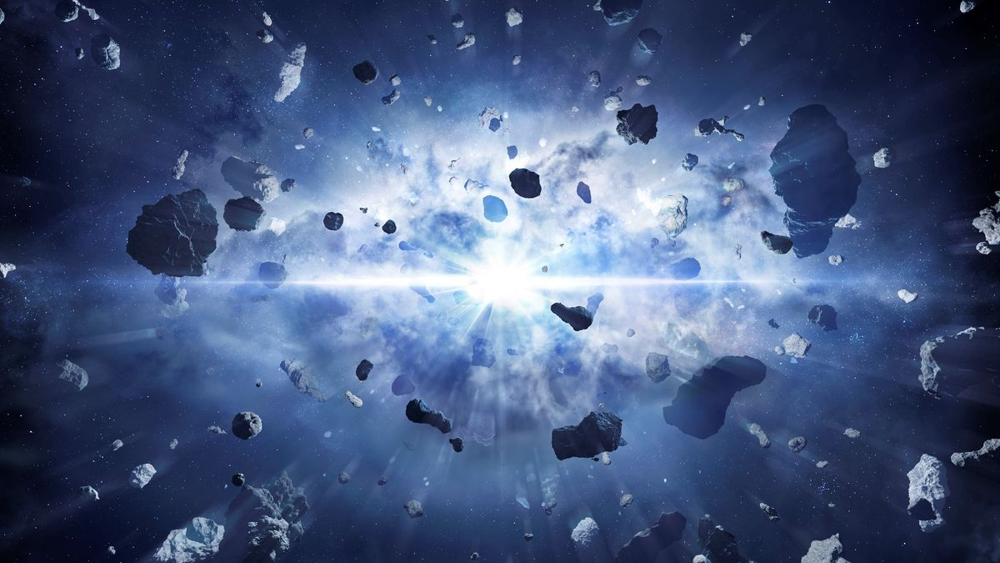
10. Qur’an 25:61–62 – The Radiant Sun, Gentle Moon, and Cycles of Time
Translation: “Blessed is He who placed in the sky great constellations and placed therein a radiant lamp and a luminous moon. And He is the One who made the night and day in succession for whoever desires to remember or desires gratitude.” (25:61–62)
Reflection: These verses begin with an expression of divine blessing – “Blessed is He” – regarding the arrangement of the heavens. God is praised for positioning “great constellations” (burūj) in the sky, indicating the mighty structures or regions of stars (often interpreted as the twelve zodiac constellations or just towering formations of stars) that adorn the night. Then notably, the Qur’an differentiates between the sun and moon by descriptive terms: the sun is called sirāj (a radiant lamp or burning light) and the moon is called nūr (a light or illumination). This suggests an understanding that the sun is a source of light, whereas the moon’s light is softer, derived light. The Qur’an uses similar wording elsewhere (for example, 71:16 calls the sun sirāj and the moon nūr). Spiritually, the pairing of “radiant lamp” and “luminous moon” paints a picture of the sky’s two primary lights: one blazing and life-giving by day, the other gentle and guiding by night. It shows a complementary balance ordained by God. The sun’s intense brilliance is tempered by the cool, reflected glow of the moon. This balance can symbolize many things: the interplay of God’s attributes of Majesty (Jalāl, like the intense sun) and Beauty (Jamāl, like the soft moonlight), or the need for both activity (day) and rest/reflection (night) in our lives.
Verse 62 emphasizes that God made night and day alternate – a cycle – specifically “for whoever wants to remember or wants to be grateful.” This implies the daily cycle is intended to facilitate human spiritual practice: “remembering” (dhikr) and “gratitude” (shukr). The night’s calm encourages reflection, remembrance of God under the stars; the day’s blessings encourage gratitude through work and witnessing God’s providence. It suggests that time itself is a gift: the fact that we don’t have perpetual day or unending night is a mercy that allows us to experience different states and respond appropriately – mindful contemplation in one, active gratitude in the other. In other words, the rhythmic change of day-night is for us, to structure our lives around reflection and thanks.
This is a profound spiritual insight: time cycles are not arbitrary; they are there to prompt spiritual consciousness. The believer reading this is nudged to use daytime to thank God through good deeds and earning lawful provision, and nighttime to remember God through rest, prayer, or star-gazing meditation. The verses highlight God’s wisdom in creation: not only creating physical entities (stars, sun, moon) but doing so in a way that serves moral and spiritual ends.
Scientific Insight: The Qur’an’s distinction between the sun as a “radiant lamp” and the moon as a “light” is precisely how modern astronomy differentiates them: the sun generates light by itself (through nuclear fusion), whereas the moon shines by reflected sunlight. This is a basic scientific fact: the moon does not emit visible light of its own; it reflects about 12% of the sunlight that hits it (its albedo). The intensity and quality of moonlight are thus directly derived from the sun. The Qur’an’s terms capture this: sirāj implies a lamp that burns fuel to produce light (like an oil lamp), and nūr implies light that is imparted or reflected. This nuance was not lost on some early Muslim scholars; for instance, the medieval scholar Fakhr al-Din al-Razi noted that the sun being called sirāj indicates it is the source, and moon’s nūr indicates it reflects light. Centuries later, science fully confirmed that the moon’s light is indeed reflected sunlight (Ibn al-Haytham in the 11th century had already argued that based on optics).
Additionally, calling the sun a lamp implies it’s a singular intense light for our world – a good analogy because the sun is the singular source of virtually all energy on Earth (driving photosynthesis, weather, etc.) just like a lamp in a room is the primary light. The moon being a “light” acknowledges its visible illumination but subtly downplays it compared to the sun. Scientifically, sunlight is ~400,000 times brighter than the full moon’s light. Our eyes can adapt to both, which is remarkable. The Qur’an’s phrasing matches the relative importance: the sun is central (a lamp lighting everything), the moon is an adornment and secondary guide (a light in darkness).
The verse also mentions “great constellations” or “stellar formations” (burūj) in the sky. We talked about constellations in 15:16; here “great constellations” could specifically hint at the zodiac – the divisions of the sky through which the sun, moon, and planets move. In ancient astronomy, the sky was divided into 12 “mansions” or signs (like Aries, Taurus, etc.), each associated with a part of the year. These were indeed “placed” in the sky in that from Earth’s perspective, they’re fixed star patterns that form the backdrop for the sun and planets. The Babylonians, Greeks, and others had similar zodiac systems, and the Arabs were aware of them too (manāzil al-qamar – 28 lunar mansions across the zodiac). The Qur’an doesn’t endorse astrology (reading fortunes in stars is condemned in hadith), but it acknowledges these prominent sky divisions. One could say scientifically, the zodiac constellations are simply an artifact of our viewpoint in the Milky Way. But interestingly, each zodiac sign corresponds to a sector of the sky with unique bright stars, so they are indeed noticeable “burūj.” For example, Orion (considered a burj or constellation just outside the zodiac) is very striking with its belt and bright stars. Why mention constellations? Possibly to underscore the grandeur of the heavens – not only individual stars, but patterns and structures that span large areas. Today, we also know of even greater structures: star clusters, galaxies, clusters of galaxies. Those might be considered modern “burūj” on a galactic scale – huge “fortresses” of stars.
The interplay of night and day in succession is a straightforward observation that implies Earth’s rotation. If one did not rotate or did so chaotically, night and day wouldn’t alternate uniformly. The verse takes it as a given that the cycle is regular and purposeful. Science has explored what sets the length of our day. It likely comes from how Earth formed and the momentum imparted to it by collisions and accretion. The current rotation might also be influenced by the Moon’s stabilizing effect. Regardless, once set, the rotation period has been quite stable over human history. Many organisms (including humans) have circadian rhythms slightly different than 24h (often around 24.2h in humans), but they synchronize to 24h with environmental cues. This suggests life might have adapted to Earth’s rotation period. If Earth’s day were, say, 30 hours, perhaps life’s rhythms would adapt to that instead. But for us, 24h is our hard-wired cycle. The Qur’an saying this is for remembering and gratitude is insightful because indeed, humans culturally and religiously use daily cycles for such practices (e.g., many religions have morning and evening prayers or meditations). Biologically, memory consolidation in the brain happens partly during sleep at night, so one could poetically say night is literally for “remembering” (the brain processing and storing memories). And daytime activity allows us to act on gratitude by being productive and kind.
Another scientific insight: The phrase can also be understood as “He made night and day follow each other”. This continuous succession over billions of years requires conservation of angular momentum – Earth’s rotation persists because there’s nothing significant to stop it (except very gradually the Moon’s tidal friction). This physical law (Newton’s first law) keeps the cycle going. If Earth abruptly stopped rotating (as in some doomsday scenarios), half the globe would have eternal day and half eternal night – which would be catastrophic. But because of physics, that doesn’t happen naturally. So the reliability of the alternation is almost guaranteed by fundamental laws. A believer would say those laws are the command of God, ensuring that day-night cycle doesn’t fail, “for whoever wants to remember or be grateful.” It’s like a built-in clock that never needs winding.
Overall, Qur’an 25:61–62 combine an appreciation of cosmic beauty (constellations, shining sun, glowing moon) with an appreciation of time’s rhythm and its spiritual utility. The scientific perspective enriches this by confirming that the sun and moon have fundamentally different light production mechanisms (nuclear fusion vs. reflection), that star patterns exist and have been constant for millennia allowing calendars (the zodiac constellations mark months), and that the day-night alternation is a stable and beneficial feature of Earth’s rotation.
One could make a subtle point: the term “luminous moon” (qamar munīr) implies the moon itself gives off light, which is technically true in that it’s reflecting; it’s not producing photons internally, but it is visibly luminous in the sky. The combination with the sun being a lamp clarifies any potential confusion – the lamp is the source, the moon is the lit object. No other ancient text so clearly delineated this, which is often highlighted as the Qur’an avoiding the mistake of calling the moon a *source
11. Qur’an 31:29 & 35:13 – Merging of Night and Day, Sun and Moon in Balance
Translation: “Do you not see that Allah merges the night into the day and merges the day into the night, and has subjected the sun and the moon – each running for an appointed term – and that Allah is All-Aware of what you do?” (31:29)
“He blends the night into the day and blends the day into the night, and He has subjected the sun and the moon – each running [its course] for a specified term. That is Allah, your Lord; to Him belongs all control. And those you invoke besides Him do not possess even the membrane of a date seed.” (35:13)
Reflection: Both verses marvel at the seamless transition of day and night and the obedient motion of the sun and moon. The image of merging or blending (Arabic yūliju, meaning to cause to enter or overlap) highlights the gradual dawn and dusk – daylight slowly fades into night and night into morning. This gentle progression is a mercy, preventing sudden darkness or light. It symbolizes how God’s management of the world is smooth and benevolent, not abrupt or chaotic. The verses also reiterate that the sun and moon are “subjected” to divine law, each moving until an appointed time – which can mean each day’s cycle, each month’s cycle, or ultimately until the Day of Judgment (their finite lifespans in the cosmic plan). Spiritually, this assures us of the reliability of God’s ordering: we can count on sunrise after night and moonrise after sunset, as surely as we count on God’s promise and justice. The line “Is Allah who creates like one who does not create?” (in 35:13-14 context) and the mention that idols “do not own a date-seed’s membrane” drive home that only the Creator wields such control over these vast cycles; false gods control nothing. For a believer, every sunrise is a daily reminder of God’s renewed grace, and every sunset a reminder to reflect and trust that light will come again – metaphors for hope and resurrection. Notably, 31:29 ends by saying God is aware of our actions: just as day and night interchange without fail, our deeds and moral choices are never lost in darkness; they are seen and will be recompensed. The interplay of cosmic order and moral order is subtly drawn: the One who keeps the heavens cycling also keeps account of our lives. We are urged to “see” these signs and thus remember that life has a rhythm and a purpose under a Watchful Lord.
Scientific Insight: The gradual merging of night into day is a direct consequence of Earth’s rotation and atmosphere. Earth spins on its axis (~23 hours 56 minutes per full rotation), causing the sun to rise and set from any given location. If Earth had no atmosphere, day would turn to night very suddenly as the sun dipped below the horizon. But thanks to our atmosphere, we experience twilight – the sun’s rays scatter in the upper sky even after it sets, giving a period of dim light rather than immediate darkness. This is exactly a “merging” or blending: daylight doesn’t just switch off, it fades gracefully. The duration of twilight varies with latitude and season, but everywhere on Earth there is some transition period. This soft changeover is beneficial for human and animal life. Diurnal animals get a cue to find shelter as it gets gradually darker; nocturnal creatures likewise use dusk as a signal to become active. If night fell instantaneously, many creatures would be caught unprepared. Thus, the aeronomy (science of the upper atmosphere) reveals that our sky, by scattering sunlight, creates dawns and dusks ideally suited for life’s rhythms. From an astronomical perspective, the continuous alternation of day and night for billions of years indicates Earth’s rotation has remained remarkably stable. Earth doesn’t randomly slow down or speed up in any dramatic way (tidal friction from the moon is lengthening the day very slowly, only about 2 milliseconds per century). This stability is thanks to conservation of angular momentum – a physics principle that states a spinning body will keep a constant spin unless acted on by a force. It’s almost poetic: a law of nature guarantees the continuation of the day-night cycle, just as the Qur’an implies a divine guarantee. Scientists can calculate that Earth’s rotation may have been a bit faster in the past (a day was perhaps 22 hours long 600 million years ago), but it has slowed to 24 hours in a very steady manner. There’s no risk of Earth suddenly stopping its rotation on its own (that would violate fundamental physics).
The verses also speak of the sun and moon running “to a term appointed”. Astronomically, we can interpret this as the fact that these bodies have finite lifespans or predictable endpoints. The sun will not shine forever; as noted earlier, it’s about halfway through its ~10-billion-year main sequence life, after which it will exhaust its hydrogen fuel. So indeed, the sun is running its course until a decreed time. The moon, on a shorter scale, goes through its phases and orbits around Earth with clockwork precision, effectively “running” to the end of each monthly term when it’s “reborn” as the new moon. Additionally, the moon is gradually receding from Earth (by about 3.8 cm per year, which means in the far future, its apparent size will shrink (no more total solar eclipses in a few hundred million years). That’s another aspect of an appointed term for our current Earth-moon configuration.
Another scientific facet is the conservation of energy and balance in the Earth-sun-moon system: the sun’s immense gravitational pull and Earth’s orbital momentum keep Earth in a stable yearly orbit (so seasons and years are consistent), and Earth’s rotation plus the moon’s gravity keep the day-night cycle consistent with slight tidal braking. The phrase “to Him belongs all control” (35:13) aptly describes what science calls the fine-tuning of orbital mechanics. If Earth were not tilted just so (23.5°), or if our day were much longer/shorter, or if our distance from the sun varied wildly, the transitions of day-night and seasonal cycles could be far more erratic, potentially making advanced life difficult. But Earth’s tilt oscillates only mildly (stabilized by the moon), our orbit is nearly circular (so the length of day doesn’t change drastically through the year), and our rotation is at a comfortable speed. These are like cosmic dial settings that make our environment stable. From a believer’s viewpoint, this is “Allah’s control” and “subjecting” of sun and moon to serve life on Earth. From a scientific viewpoint, these are fortunate parameters in the equations of motion that yield a livable planet.
Interestingly, these verses also hint at astronomical knowledge: the ancients knew the sun and moon had regular movements (terms), but not that the sun itself would have an “end.” The Quranic wording leaves it open – traditional exegesis often saw the “appointed term” as either each day’s sunset for the sun, each month’s cycle for the moon, or the Day of Resurrection when both will cease their function. Science adds another layer: an actual physical end for the sun (becoming a red giant and then a white dwarf). While that end is billions of years away (long after humans, if we last that long, will have needed to relocate), it’s intriguing that the Quran doesn’t present the sun as an eternal deity (unlike some sun-worshipping cultures) but as a created thing on a set course.
Furthermore, “merging night into day” can be seen as an allusion to the fact that at any given moment, somewhere on Earth it is day and somewhere it is night, and the boundary between them (the terminator line) is constantly moving. Satellite imagery shows a beautiful line of shadow moving across Earth’s surface as it rotates – a literal blending zone between day and night. It’s as if night is continuously pouring into day on one side of Earth and day pouring into night on the other, in a never-ending cycle. A “global” perspective like this wasn’t possible in the 7th century, yet the description is remarkably apt. It evokes the image of Earth as a sphere lit on one side by the sun – a concept only firmly established many centuries later (though some ancient Greek thinkers like Eratosthenes understood the Earth was round and used differences in shadows to estimate its circumference as early as the 3rd century BCE). The Quran doesn’t explicitly say Earth is round here, but merging day and night implies a continuous process on a round world rather than a flat earth (where conceptually, day and night might be seen as more separate regions). Some commentators have noted this subtle hint of a spherical Earth rotating in sunlight.
In sum, Qur’an 31:29 and 35:13 highlight the regularity and control in cosmic cycles. Science confirms the regularity (through laws of physics) and gives credit to initial conditions and forces; faith gives credit to the Originator of those laws and conditions. The verses and science together inspire a feeling that the more we understand these daily marvels – the pink and orange of a sunrise, the starry dome emerging at dusk, the fact that we can set our clocks by the sun and calendar by the moon – the more we have reason to “remember” our Creator and be “grateful.” After all, we live on a planet that turns like clockwork under a sky that protects us, lit by a star that’s stable and accompanied by a useful moon – none of which had to be the case, but it is, for our benefit. These are the very observations the Qur’an calls us to make using “reason,” and modern science, by detailing them, has only multiplied the opportunities for such remembrance and gratitude.
12. Qur’an 36:38–40 & 55:5 – Precise Orbits of the Sun and Moon
Translation (36:38–40): “And the sun runs to its resting place. That is the determination of the All-Mighty, All-Knowing. And the moon – We have determined for it phases, until it returns like an old curved date-stalk. It is not for the sun to overtake the moon, nor does the night outstrip the day. Each floats in an orbit.” (36:38–40)
Translation (55:5): “The sun and the moon [move] by precise calculation.” (55:5)
Reflection: These verses emphasize the orderliness and separation of the sun and moon’s movements. In Surah Yā-Sīn, the sun is described as running its course to a “resting place” or an appointed endpoint – highlighting that the sun’s journey (daily across the sky, or its longer cosmic journey) is fixed by God’s decree. The moon’s phases are clearly noted: from new crescent to full and back to a thin “old date-stalk” shape (a beautifully apt simile in an Arab context, comparing the waning crescent to the curved, withered palm frond). This shows an appreciation of the cyclic nature of the moon’s appearance. Importantly, verse 40 sets a rule: the sun and moon have distinct roles – “it is not for the sun to overtake the moon”, and likewise night and day keep their proper sequence without one bursting in out of turn. This speaks to a cosmos of non-interference and balance. The sun governs the day, the moon the night; they each have their lane. Night doesn’t prematurely cut short the day nor does day encroach before its time – an assurance of stability. “Each floats in an orbit” could refer to the orbits of the celestial bodies or the regular paths they take in our sky (from our perspective). Either way, motion is orderly, not erratic.
Surah 55:5 succinctly states “the sun and the moon [move] by precise calculation.” This highlights the mathematical regularity in their motions. Spiritually, this precision is a sign of the Divine “measure” (Qadar) by which all things are set. It invites us to trust in the reliability of God’s design. The ancients could predict eclipses and the coming of seasons by observing the heavens; the Qur’an hints that this predictability is no accident but a sign – the universe operates on God’s clock. For the faithful, this fosters a sense of security (the celestial lights won’t clash or fail arbitrarily) and an admiration for God’s wisdom (Who else could set such a grand clockwork in motion?). It also subtly encourages the pursuit of knowledge: since the sun and moon follow calculation, we are meant to calculate and learn – which Muslims did, excelling in astronomy and calendrical science in part due to verses like these. In daily life, the separation of sun and moon roles also has a moral metaphor: just as the sun shouldn’t encroach on the moon’s domain, everything in creation has its proper place and duty – so we should observe the boundaries and duties God has set for us (human ethics, times of prayer, etc.) to maintain harmony.
Scientific Insight: These verses are remarkably rich in astronomical content:
- The sun’s “resting place” (Arabic: mustaqarr) has been interpreted variously. Some classical scholars thought it refers to the time of sunset (the sun “rests” at night beneath the horizon), others to a physical endpoint (perhaps alluding to an ultimate end of the sun’s course). From a modern view, one could link it to the fact that the sun orbits the center of the galaxy and also will one day exhaust its fuel – thus it has an appointed destination in time and space. Another possibility: the sun’s “resting place” could be figurative for the limit of its apparent journey (the far west each evening, as observed). Either way, the emphasis is that the sun’s motion is governed and finite, not random or endless.
- The moon’s phases are a staple of observational astronomy. The Qur’an’s description “until it returns like an old dry palm branch” precisely captures the last waning crescent before it disappears into new moon. This shows attention to the entire cycle, not just the waxing side. The month in Islamic (lunar) calendar begins when that thin crescent is sighted after new moon, so this verse also underpins Islamic time-reckoning. Scientifically, the moon’s phases result from its orbit around Earth, presenting different portions of its sunlit half to us. The fact that this is regular (29.53 days per synodic month) is the “determination” mentioned. Astronomers can calculate the moon’s phase for any date past or future easily because it’s such a stable cycle. The imagery used indicates the waning crescent’s slenderness; we now know that at that phase the moon is almost between Earth and sun, so we see only a sliver of the side illuminated by the sun. The Quran’s language might even hint at the moon’s orbit being somewhat curved (like the shape of that frond). Notably, it doesn’t say the moon itself shrinks, just that its appearance does – which aligns with reality.
- “Not for the sun to overtake the moon” – In literal terms, this ensures the sun and moon never appear in the sky as if chasing each other such that the sun catches up to the moon’s position. Indeed, in nature, the sun and moon occasionally align (during a new moon, causing a solar eclipse if precisely aligned), but the sun never moves into the moon’s orbit or path in a way that cancels the moon’s motion. They operate on different schedules: the sun “moves” through the sky once a day due to Earth’s rotation, the moon takes about 24.8 hours to return to the same position (hence moonrise is ~50 minutes later each day). The phrase can also be understood as “the sun never catches up to the moon [in its course]” meaning their cycles (year vs month) are independent. Modern science quantifies this: the moon orbits Earth roughly 12 times in one year, but there is no resonance where, say, the sun and moon meet at some point periodically except in eclipses, which are brief and actually a testament to their precise orbits. Another way: the sun will never lap the moon in the sense of moving out of its fixed annual path to collide or overtake – they have separate orbital planes (the moon’s orbit is inclined about 5° to the ecliptic). There’s a stability in that separation, preventing, for instance, continuous eclipses. The second half, “nor does the night outstrip the day”, reinforces that there’s a proper sequence. Earth’s rotation direction is constant (west-to-east), ensuring day and night follow in order without irregular jumps. It implies a fixed rotational direction and speed – which is exactly what Earth has. The sun won’t suddenly rise in the west (until possibly the end times in Islamic eschatology, but naturally speaking it hasn’t in all of human history because Earth’s rotation hasn’t reversed).
- “Each floats in an orbit” – At the surface level for a 7th century listener, this could mean each of these celestial bodies moves in its own path across the sky. But scientifically, it’s spot on: the sun orbits the center of our Milky Way, the moon orbits Earth, and Earth (causing day-night) orbits the sun. Nothing in space is static; everything is in motion relative to something. The word “float” (yasbaḥūn) conveys motion through a fluid or space effortlessly. Indeed, in the vacuum of space, planets and stars move along orbital trajectories as if gliding, held by gravity but encountering no resistance. We have stunning visualizations from simulations showing stars orbiting the galactic center in elegant ellipses, and planets around the sun likewise. The phrase also demarcates plurality: each – meaning not only the sun and moon, but implicitly every celestial body – has an orbit or path. This was not obvious to ancient people; many believed in a solid sky with fixed stars, etc. But the Qur’an uses dynamic imagery (everything is swimming!). Modern astrophysics sees even galaxies moving in clusters, clusters in superclusters – essentially, everything is indeed in motion. So this statement has grown more profound with time.
- Surah 55:5 saying “the sun and moon [move] by precise calculation (bi ḥusbān)” underscores the mathematical regularity of their motions. We now know their movements are so regular that they can be described with equations and predicted. For example, we can predict solar and lunar eclipses to the minute even centuries ahead because of this precision. The term ḥusbān implies calculation or reckoning; the same root gives ḥisāb (arithmetic). Medieval Islamic astronomers took this to heart and developed sophisticated mathematics (like spherical trigonometry) to calculate prayer times, moon sightings, and eclipses. They saw in this verse an encouragement to do astronomy. It is striking that the Qur’an does not say the sun and moon move chaotically or by whim of gods, but by calculation, inviting a scientific mindset. Today, we use Newton’s laws and Kepler’s laws to calculate orbital mechanics. The fact that these laws work – that nature follows mathematical relationships – is a deep fact about the universe. Eugene Wigner famously wrote about the “unreasonable effectiveness of mathematics” in describing nature. A believer might respond that it’s not unreasonable at all if the Creator set the sun and moon in measured courses. For instance, the length of the year (time for Earth to orbit once) is about 365.2422 days, and the length of the month (lunar orbit) about 29.5306 days. These are constants in our solar system that can be measured to great precision – indeed precise calculation.
To put it simply, the Qur’an is observing that astronomy is a science of precision, and modern science has shown just how precise: millisecond pulsars, atomic clocks synced to solar time, etc., all reveal an elegant cosmic timekeeping. When verse 36:39 highlights lunar phases and 36:40/55:5 the stable orbits, it implies the idea of a cosmic clock. The moon is the calendar hand, the sun the daily hand, and they never conflict – thereby keeping time accurately. Humans have used this cosmic clock for millennia (a month approximates a lunar cycle, a year a solar cycle). It’s only in the last few centuries we’ve moved to mechanical and then atomic clocks, but even those have to be occasionally synced with leap seconds due to Earth’s minuscule rotation changes. We still ultimately rely on the cosmos to define time (e.g., the second is defined by atomic vibrations, but our calendar is still tied to Earth’s orbit around the sun and rotation).
In conclusion, these verses highlight cosmic precision and order. The spiritual takeaway is that such orderliness comes from a Wise Planner – it’s not random. The scientific perspective not only affirms the order but provides the details of how (gravity, inertia, conservation laws) and even the why in a physical sense (angular momentum from the solar system’s formation, etc.). But the deeper “why” – why should the universe follow laws at all, and why those laws – remains a philosophical question. Many scientists of faith answer that by pointing to the Creator. Qur’an 55:5 essentially told us 1400 years ago: look, the cosmos is law-governed (calculated), that’s a sign. And indeed, the drive to find those laws has been a major triumph of human intellect, yielding the understanding we have today. It’s a beautiful example of how a spiritual principle (cosmic order) propelled scientific discovery (astronomy and physics), and how scientific discovery in turn enhances our appreciation of that spiritual principle. The more precisely we can calculate an eclipse or the motion of a planet, the more we might stand in awe of the One who ordained such fine-tuned harmony, saying as the Qur’an begins Surah Yā-Sīn, “Yā-Sīn… By the Wise Qur’an…Certainly, We have put everything in precise measure (قدر)”.
13. Qur’an 51:7 – The Sky’s Woven Paths (Cosmic Web)
Translation: “By the sky full of pathways,” (51:7) – or in another translation: “By the heaven with its woven structure,”. (51:7)
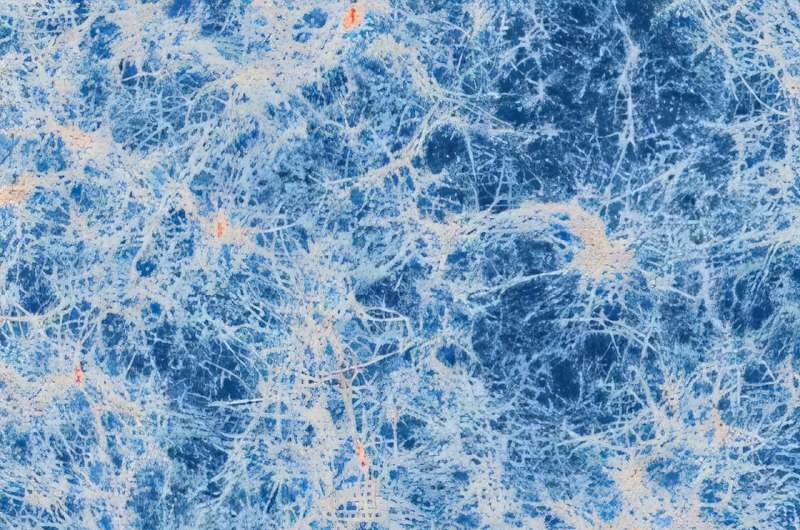
Reflection: This verse is an oath – God swears “by the sky” characterized in a very evocative way. The Arabic “dhāt al-ḥubuk” can mean possessing paths, or woven patterns, or threads neatly knit together. Classical commentators have offered interpretations like: the sky with its well-ordered paths (perhaps referring to the orbits of stars/planets or the tracks of angels), or the sky adorned with beautifully intertwined clouds or star configurations, analogous to a woven tapestry. Either way, it conveys the notion of a sky that is not chaos but has a cohesive, patterned structure. In the Qur’anic context, oaths by natural phenomena serve to draw attention to their significance and to assert the truth of whatever statement follows (in this case, verses about the truth of resurrection and divine judgment follow in the surah). So “the sky full of pathways” is invoked as a witness to God’s power and precision. Spiritually, one can reflect on how the heavens above are multi-layered and interconnected: perhaps it hints at the invisible highways (like the routes taken by angels or the decrees descending, as other verses mention “affairs descending through the heavens”). It gives an impression of the cosmos as a grand, woven carpet or a well-structured dome, not a random expanse. This can instill a sense of security and awe – we live under a sky that is firm, reliable, and richly patterned by the Creator. It’s also humbling: if the very fabric of heaven is complex and orderly, how much beyond our full comprehension is the Creator who wove it! In an era without telescopes, just seeing the Milky Way band on a dark night might evoke the idea of a celestial “web” of stars. This oath encourages believers to contemplate the majesty above and realize that the same God who made the “fabric” of the universe is fully capable of weaving the events of our lives and history with purpose.
Scientific Insight: The phrase “sky full of pathways / woven structure” is intriguingly resonant with modern discoveries about the large-scale structure of the universe. For a long time, when astronomers looked at the distribution of galaxies, it seemed roughly uniform at very large scales. But with more data (especially late 20th and early 21st century), we found that galaxies are not evenly spread like dust in a room – they form a cosmic web: immense filaments and sheets of galaxies interlaced, with huge voids (relatively empty bubbles) in between. Supercomputers simulating the universe’s evolution (under gravity and dark matter influence) show that matter clumps along filaments like the strands of a spiderweb, where filaments intersect you get galaxy clusters (nodes in the web), and vast empty spaces stretch between these filaments. Actual observations such as the Sloan Digital Sky Survey have mapped hundreds of thousands of galaxies and revealed this web pattern – sometimes poetically described as the “universe’s hidden highways” or “interwoven filaments.” An image generated from a simulation or a deep survey looks remarkably like a piece of lymph or neural network – a lace-like structure on the scale of hundreds of millions of light-years. This is a far cry from how the night sky looks to the naked eye (which is just stars mostly within our own galaxy), but it is the reality of the cosmos on its grandest scales.
When the Qur’an refers to the sky (heaven) as having a “woven” quality, it is tempting to see a parallel here. Of course, no human could see the cosmic web until very recently, and we doubt 7th-century Arabs thought of galaxies at all. They might have thought of the cloud belts or star clouds or the way the sky can have streaky cirrus clouds that look woven. But the metaphor of weaving is interestingly apt for how space is structured. Today, we also speak of the “fabric of spacetime” in relativity – a different concept (smooth geometry rather than clumpy web), but noning space as something with properties that can curve or ripple (gravitational waves detected in 2015 are like vibrations through that fabric). If one extends “paths” to mean the orbits and trajectories of celestial bodies, then indeed the sky is crisscrossed by the paths of planets, comets, stars orbiting centers, galaxies orbiting each other. Space is dynamic and threaded by these invisible lanes. In fact, one old interpretation of 51:7 by early Muslims was that it refers to the paths of the stars – which we now call orbits or the apparent annual paths (the ecliptic for the sun, etc.). On long exposure photography, star trails form concentric woven rings around the pole – quite literally showing “paths in the sky.”
Another possibility is atmospheric: the Arabic word for “woven” (ḥubuk) can imply well-knit or also ripples. There’s a phenomenon called airplane contrails or cloud streets that make sky patterns, but clearly, the Qur’an isn’t referencing human airplanes. However, naturally, sometimes you see wave patterns in high clouds (from gravity waves in the atmosphere). Also, at a microscopic level, the sky’s protective layers (like the ozone layer or magnetosphere) have structures, but those wouldn’t be known then.
Given our modern vantage, the cosmic web interpretation is the most striking. It’s almost poetic coincidence: scientists speak of the cosmic web, and the Qur’an speaks of a heaven with pathways.
14. Qur’an 51:47–49 – Expansion of the Universe and Creation in Pairs
Translation: “And the heaven – We built it with might, and indeed, We are expanding (the universe). And the earth – We have spread it out, and excellent is the preparer [of all things]. And of everything We have created pairs, that you may reflect (or remember).” (51:47–49)
Reflection: These verses (from Surah adh-Dhāriyāt) contain two profound concepts: the expansion of the heavens and the creation of all things in pairs. In 51:47, God proclaims the sky (or universe) is built strongly and is in a state of expansion. This emphasizes God’s ongoing power in sustaining and unfolding creation. It counters any notion that the cosmos is static or that God created it and left it; rather, the creation is active and dynamic under His watch. The might (power) with which heaven is built also comforts the believer that the cosmos is not fragile chaos, but robustly constructed by the Almighty.
In 51:49, the statement that everything is created in pairs is understood in multiple ways by Islamic scholars: male and female (for living creatures), two complementary parts (like day and night, positive and negative, matter and anti-matter in modern parlance), or pairs as in species and their complements. The purpose given is “that you may reflect/remember”. There is a didactic angle: by observing the pairing in nature, one may remember the Oneness of the Creator (since pairing suggests an underlying unity and design). The concept of pairs can also humble us, as it implies completeness lies only when pairs unite (like male and female to propagate life), suggesting that creation is made with interdependence, not self-sufficiency – ultimate self-sufficiency belongs only to God (who is One, not part of a pair). Spiritually, one might see in pairs the idea of duality that defines our experiences – we know light by darkness, good by evil’s contrast, mercy by wrath, etc. Those dualities drive home moral lessons and the need to choose one side of the pair (virtue over vice).
These verses invite us to marvel at both the cosmic scale (expanding universe) and the microscopic or relational scale (pairs in everything). The phrase “that you may reflect” (51:49) shows that these are meant to spur deep thought. When revealed, the idea of the heavens expanding would have been mysterious – perhaps understood figuratively as the vastness of sky or the way clouds seem to expand. Today, it gains new depth with cosmology. The idea of universal pairing, similarly, would prompt a believer to observe nature’s patterns (like plant pollen and ovules, or the binary nature of many phenomena) and realize a deliberate symmetry in creation that bespeaks of the Creator’s wisdom. In essence, the verses teach that the cosmos is not random: it has purposeful structure (built mightily, expanding under control, balanced in pairs) – and recognizing this should lead one to remember God and align with the harmony He embedded in creation.
Scientific Insight: The statement “We are expanding it” with regard to the heavens (51:47) is a striking parallel to the modern discovery that the universe is indeed expanding. In 1929, Edwin Hubble observed that galaxies are receding from us, with more distant galaxies moving faster away – implying space itself is stretching (the Hubble Law). This was a revolutionary confirmation of the Big Bang model: that the universe began from a compact state and has been expanding since. The Qur’an’s original Arabic (wa innā la-mūsi‘ūn) can be translated as “We are surely expanding (it)” or “We are enrichers/extentders”. The most straightforward reading in context of building the heaven is expansion or widening. It’s jaw-dropping for Muslims that a hint of cosmic expansion appears in a 7th-century text. Classical scholars interpreted “expanding” as providing abundance or ample provision in the sky, or making it spacious. But the primary meaning “expanding in size” fits perfectly with what modern cosmology says: space itself is growing. Current measurements (using distant supernovae, cosmic microwave background, etc.) show the expansion is even accelerating (due to dark energy).
Of course, one must be cautious; we shouldn’t claim the Qur’an taught Hubble’s law explicitly – it’s a brief mention open to interpretation. But it is fascinating that no contradiction exists; if anything, it aligns suggestively with a scientific truth uncovered 1300 years later. Many Muslims see this as evidence of the Qur’an’s divine origin, or at least a remarkable point of reflection. From a secular viewpoint, one could chalk it up to a lucky guess or a metaphorical flourish. Yet, considering that the default belief historically (until the 20th century) was an eternal, static universe, the Qur’anic phrasing stands out. It gave believers the flexibility to accept the expanding-universe concept without theological conflict, which is noteworthy. It’s also scientifically accurate in saying the “heaven” was built with might/power (bi-aydin – could imply with power or hands metaphorically); indeed, tremendous energy (power) was involved in the Big Bang expansion, and continues to drive expansion now (dark energy pervading space).
Now, the concept of “pairs” in 51:49 has intriguing scientific echoes too. Virtually every system we look at shows some type of duality or pairing:
- In biology, sexual reproduction is the norm for multicellular life – male and female pairs in animals and plants (and even many microorganisms exchange genetic material in pair-like processes). Only a few forms of life are truly asexual, and even those often have some exchange of genes. The discovery of eggs, sperm, pollination, etc., put concrete detail to “created everything in pairs of its kind”. Carl Linnaeus in the 18th century noted that plants have male stamens and female pistils, which was not widely known earlier (some ancient hints existed, but Linnaeus formalized plant sexuality). The Qur’an in another verse (36:36) also says God created “the pairs of all things which the earth produces, and of themselves (humans) and of that which they know not,” which many interpret to include plants having pairs.
- In physics, a surprising development in the 20th century was the prediction and discovery of antiparticles – for each fundamental particle, there exists a corresponding anti-particle (with opposite charge). Paul Dirac theoretically predicted the positron (anti-electron) in 1928, and it was found in 1932. Now we know electrons have positrons, protons have anti-protons, neutrons have anti-neutrons, quarks have anti-quarks, etc. Matter and antimatter are “pairs” that were created together in the early universe (and mysteriously, slightly more matter survived, leading to our material universe). Some Muslims have likened Qur’an 51:49’s general phrase “everything in pairs” to anticipating matter-antimatter or other dualities in physics (like positive/negative charge, north/south magnetic poles). Those specific concepts are certainly modern, but it’s interesting that the Qur’an used “everything” – not just living things – in pairs. This broadens the scope beyond the obvious male-female context. The verse invites discovering pairs “of that which they know not” (as 36:36 adds), leaving open scientific exploration.
- In chemistry, many elements come in molecular forms that are paired (like diatomic gases: hydrogen, oxygen, nitrogen come as H₂, O₂, N₂ – pairs of atoms). While Qur’an likely didn’t mean this specifically, it’s another pervasive pairing in nature.
- Even abstract things come in pairs: matter and energy, space and time (unified in relativity), wave and particle (dual nature of quantum objects), etc. While these may be philosophical stretches of “pair,” it shows the theme of duality is deeply ingrained in our understanding of the universe.
From a scientific viewpoint, not absolutely “everything” is in a male-female pair; for example, some animals are hermaphrodites, some particles (like photon is its own antiparticle) don’t have a distinct different partner. But the language is general enough to cover the vast majority of natural phenomena. One interesting scientific reflection: by saying everything is in pairs, it subtly suggests complementarity as a fundamental principle. Modern science indeed finds complementarity – e.g., in quantum physics, certain properties (position/momentum, wave/particle) are complementary pairs that together give a full description but cannot be observed simultaneously. Niels Bohr’s principle of complementarity in the 1920s could be philosophically linked to this idea – that reality often comes in pairs of aspects.
Crucially, the verse says the reason for the pairs is “that you may reflect/remember”. From a scientific perspective, what do pairs teach us? They teach us to look for symmetries and opposites in nature, which has been a guiding principle in science (e.g., looking for the opposite charge, the other hemisphere, etc.). Symmetry considerations have led to numerous discoveries (like Dirac predicting positrons from requiring symmetry in his equations). So reflecting on pairs has literally furthered science. Also, the prevalence of pairing in biology helps us appreciate biodiversity and the need for both sexes – which has practical implications for ecology (e.g., preserving pollinators so plants can reproduce).
Another subtlety: “pairs” also resonates with the human experience that we find meaning in relationships – a solitary existence is not how we are built. Psychologically and socially, humans seek a partner or at least companionship (pairing in friendship, community). In a cosmic sense, perhaps everything being in pairs hints that creation itself is paired with the Creator – creation as one part, Creator as the other (not that God is a “pair” in the sense of equals, but meaning creation finds completeness only in relation to God). This might be going beyond literal science into metaphysics, but it’s a reflective thought that some theologians have expressed: all these pairs point to the ultimate unity (God), who is outside the pair system. In science language, one could say the only thing not seeming to have a counterpart in observable nature is the universe as a whole – which raises the question of a “multiverse” (are there other universes as a pair/ensemble?). The Qur’an’s mention of “seven heavens and likewise earths” (65:12) might hint at multiple worlds, but that’s speculative. Interestingly, some scientific theories do entertain multiple universes as pairs (like matter universe and antimatter universe mirror, etc.), but we are firmly in theoretical territory there.
In conclusion, Qur’an 51:47–49 presents two grand ideas: cosmic expansion and universal pairing. Science has validated the first robustly (universe expanding) and given much evidence for the second (from gender in biology to symmetry in physics). These verses encourage a holistic reflection: from the expansion of galaxies to the dualities in every atom, the universe’s fabric is intentional and instructive. For the faithful scientist, this is both humbling and thrilling: humbling because it suggests a wisdom far beyond ours behind it all, and thrilling because it assures us that by studying these features (expansion, pairs) we are indeed “remembering God” in a way, fulfilling the verse’s call to reflect. Even for a non-believer, these verses show that the Qur’an was engaging with profound natural phenomena that remain at the forefront of scientific inquiry – which at least testifies to the Qur’an’s richness as a text that doesn’t shy away from the grand questions of existence.
15. Qur’an 52:35–36 – Created from Nothing or Divine Cause?
Translation: “Or were they created from nothing, or are they themselves the creators? Or did they create the heavens and the earth? Rather, they are not certain.” (52:35–36)
Reflection: These rhetorical questions in Surah at-Tūr challenge the listener to ponder the origin of existence. They present a logical trilemma: Either humans (and by extension everything) popped into being without any cause (“from nothing”), or we are self-caused (“themselves the creators”), or there is an external Creator (implied by dismissing the first two). The next verse extends the argument to the entire cosmos: did you create the heavens and earth? Obviously, the answer expected is no – we did not create ourselves or the universe. Thus, by elimination, the only coherent answer is that a transcendent Creator brought everything into existence. “Rather, they are not certain” points out that those who deny God have no firm answer to these questions; their disbelief isn’t built on a satisfying alternative explanation but on uncertainty or avoidance of the question. This is a classic argument for God’s existence known in theology as the argument from creation or contingency. Spiritually, it awakens the fitrah (innate intuition): deep down, we recognize that nothing comes from nothing, and something cannot create itself if it didn’t exist to begin with. By stirring this basic logic, the Qur’an guides people from heedlessness to realizing the necessity of a First Cause – an uncreated Creator. It’s notable that the Qur’an doesn’t delve into complex philosophy here; it uses simple, almost child-like clarity: “Did X come from nothing? No. Did X make itself? No. Then someone made X.” This straightforward reasoning is accessible to everyone. The verses encourage humility – we are created, not self-sovereign – and gratitude to our Originator. They also indirectly critique the arrogance of those who act as if they are independent of any higher power. By referencing “heavens and earth,” it ties personal existence to the entire universe’s existence: both require an ultimate cause beyond themselves. This cosmic perspective broadens one’s thinking – our existence isn’t an isolated question but part of the grand question of why anything exists at all.
Scientific Insight: Science, especially cosmology, grapples with the question: “How did the universe originate?” Currently, the Big Bang theory describes the development of the universe from an extremely hot, dense initial state, but it doesn’t claim to answer what (if anything) came before the Big Bang or what caused it. Some physicists propose that time itself began with the Big Bang, making the question “what was before?” meaningless in their models. Others have speculative models of a prior state, such as oscillating or cyclic universes, vacuum fluctuations, multiverses, etc. But none of these models truly gets around the fundamental question posed by 52:35–36: Why is there something rather than nothing? – or – Could existence arise without any cause? As theoretical physicist (and Nobel laureate) Steven Weinberg said, “the ultimate question… why these laws rather than some other laws… seems to lie beyond science.” In modern discourse, one hears debates: some atheists like Lawrence Krauss have argued the universe could come “from nothing” by quantum mechanics – but their “nothing” often isn’t truly nothing; it’s a quantum vacuum, which is actually something (a realm with laws, fields, potentialities). The Qur’an’s question “were they created from nothing?” pre-empts this, forcing clarity on what nothing means: sheer non-existence cannot produce existence because non-existence has no potential, no power, no being. This aligns with the philosophical principle ex nihilo nihil fit – from nothing, nothing comes. Scientists largely operate under the assumption that events have causes (causality), though at quantum scales causality can be probabilistic. Even in quantum physics, events (like virtual particles appearing) occur within the framework of quantum fields and energy-time uncertainty – not absolute nothingness. So science has not found a true example of something arising from absolute nothing without any underlying laws or conditions. In fact, the more science uncovers about the universe’s origin, the more finely-tuned conditions it finds that had to be in place (like specific quantum states, densities, etc.). That can push the question back (e.g., “what set those conditions?”) but not remove it.
The Qur’an’s second question, “or are they themselves the creators?”, is interestingly mirrored in some modern thought where humans think they can “create” new forms of life (through genetic engineering, synthetic biology, AI, etc.). But even in those endeavors, we are not creating from scratch; we are rearranging existing matter and using existing natural laws. We have not created a single atom of matter from nothing, nor given life to truly non-living matter without using life-derived components. The verse is more pointed at self-creation paradox: for something to create itself, it would have to exist before it existed – a logical impossibility. No scientific theory suggests self-creation either, because it’s logically untenable. Stephen Hawking once wrote in The Grand Design that the universe could spontaneously create itself from nothing because of the law of gravity. Critics pointed out the flaw: gravity is not “nothing,” it’s something (a law, a field). So even brilliant scientists sometimes blur the distinction, but logic snaps it back: either something beyond the universe exists to bring it forth, or one falls into irrational positions like self-causation or causeless existence. The Qur’an, in these compact verses, catches that logical ball very cleanly.
Another aspect is the anthropic coincidences: the heavens and earth (i.e., the universe’s fundamental constants and Earth’s properties) are such that they permit life. Science notes dozens of these fine-tuned parameters (strength of forces, masses of particles, expansion rate, etc.) that if slightly different, no stars, planets, or life as we know it could exist. Some scientists posit a multiverse to explain this (if countless universes exist with random parameters, we’d find ourselves in the one that supports life). But a multiverse just pushes the need for an explanation up one level (who or what generated the multiverse and set its rules?). The Qur’anic rhetorical questions cut to the chase: either it’s nothing, the thing itself, or a transcendent Creator. The fine-tuning argument in modern apologetics basically adds detail to “did you create the heavens and earth?” – obviously we did not, nor did we set their finely-tuned constants. As the verse says, “Rather, they are not certain” – science can quantify the fine-tuning but doesn’t claim to know why those specific values. There is an uncertainty or resort to chance or unprovable multiverses.
Thus, these verses highlight an area where science reaches an epistemological boundary. Science excels at explaining how processes unfold within the universe, but the ultimate origin (the “initial singularity” or “why these laws”) edges into metaphysics. The Qur’an invites the reader to not shy away from that ultimate question. Historically, when this verse was revealed, it challenged Arab polytheists who weren’t providing any coherent account of creation (they mostly inherited a vague idea that Allah created but then associated others with Him). Today, it challenges the modern skeptic or materialist who might say “the universe just exists” or “came from a quantum fluctuation” – it calls that out as an uncertain and inadequate answer.
On a human level, it also humbles us. We are makhlooq (created beings), not khaaliq (creators) in the fundamental sense. Psychology research shows humans have a tendency for “illusory control”, sometimes overestimating their independence or effect. These verses correct that: you did not bring yourself here, and you do not hold up the sky. A scientist might think of it this way: every atom in our bodies, every law our life depends on (like gravity keeping us on Earth, electromagnetic force holding our molecules together) – we didn’t invent any of that. We awaken as consciousness into a universe already running by rules we had no hand in making. That realization can inspire either existential angst or, as the Qur’an urges, remembrance of the Creator and gratitude. The phrase “they are not certain” is also an invitation to seek certainty – the Qur’an positions faith in God as a rational certainty once these alternatives are dismissed. And interestingly, many great scientists (past and present) do end up with a sense of awe and even faith precisely because they confront the profound contingency of the universe. As physicist Gerald Schroeder put it, “Science will not eliminate God. It will draw us closer to God by understanding His creation.” The Qur’an, ahead of its time, sets the philosophical framework that still resonates in discussions about the origin of the universe in cosmology and philosophy today.
In summary, verses 52:35–36 make a succinct case for the necessity of a Creator. Science in all its advancements has not found a more logical explanation for the origin of all things – it either leaves the question open (saying “we don’t know yet”) or sometimes inadvertently echoes one of the two rejected options (like implying a quantum void “created” or the universe “popped into existence spontaneously” – which really doesn’t escape the conundrum). Thus, these Qur’anic questions remain deeply relevant, serving as a checkpoint where science meets philosophy and theology. They urge the reflective person, whether in the desert 1400 years ago or in a modern physics lab, to acknowledge that behind the grand tapestry of existence, there must be an uncaused Cause. The humility and curiosity that realization brings are exactly “remembering” (dhikr) and “reflecting” (fikr), as the Qur’an constantly encourages. In the spirit of these verses, one famous scientist, astronomer Allan Sandage (who discovered quasars), said upon accepting faith, “It was my science that drove me to the conclusion that the world is much more complicated than can be explained by science… It is only through the supernatural that I can understand the mystery of existence.” Such a sentiment is precisely what Surah at-Tūr is aimed at eliciting – moving from uncertainty to certainty in the belief that we and the cosmos have a Creator.
16. Qur’an 65:12 – Many Heavens and Earths: Cosmic Plurality and Order
Translation: “Allah is He who created seven heavens and of the earth the like of them. The command descends among them so that you may know that Allah is over all things Competent and that Allah has encompassed all things in knowledge.” (65:12)
Reflection: This verse speaks of multiple layers of heaven and earth – “seven heavens” is a phrase often used in the Qur’an to denote the fullness of the skies (the number seven in Arabic can imply abundance or completion). Here it intriguingly adds “and of the earth the like thereof,” suggesting that just as there are seven heavens, there are perhaps seven earths or earth-like realms. Classical commentators have varied in interpretation: some say it means seven zones of Earth or seven continents; others allow it could mean seven distinct worlds or planets (though they often admitted only Allah knows the details of those other earths). In any case, the verse clearly implies our world is not the only one in God’s creation – He has fashioned multiple “earths” under multiple “heavens.” It emphasizes God’s sovereignty over the entire cosmos: His “command” (His divine decrees, laws, and management) flows through all these layers and worlds. The purpose stated is for us to realize Allah’s omnipotence and omniscience: that He is able to create countless worlds and sustain them all with His power, and that His knowledge encompasses everything happening in the heavens above and earths below.
Spiritually, this humbles human beings – we are not the center of the universe; we are one part of a vast, layered creation. Yet, it also ennobles us, because we are addressed by the One whose reach spans all realities. The verse invites a sense of wonder at God’s dominion: if even the farthest heaven and furthest earth are governed by His command, surely our own lives are within His caring oversight too. It combats any thought that something could be beyond God’s knowledge or ability. In the Prophet’s time, people could hardly conceive of what those “seven earths” might be, but they would grasp the message: Don’t limit God in your mind; His creation and control are far more expansive than you imagine.
Today, as we talk about exoplanets and the enormity of space, this verse resonates anew – it’s as if telling us, “Yes, there are other Earth-like worlds out there; that’s all part of God’s plan and doesn’t diminish His attention to you in the least, for His command and knowledge connect everything.” It encourages an attitude of cosmic modesty (we’re not alone in existence) and cosmic confidence (God’s law and order extend everywhere, so the universe is not random). The number seven might literally mean seven or could symbolize completeness; either way, “the like thereof” for Earth certainly leaves room for the existence of other planets or realms. The descending of the command can also hint at revelation and sustenance coming down through the heavens to earth(s) – bridging physical and spiritual governance.
Scientific Insight: While not explicit, Qur’an 65:12 intriguingly suggests the existence of multiple “earths”. In modern terms, this aligns with the idea of exoplanets – planets beyond our solar system. For most of history, the only known planets were the ones in our solar system (Mercury through Saturn were known in antiquity; Uranus, Neptune discovered by 19th century; Pluto in 1930, though later reclassified as dwarf planet). The idea that stars could have their own planets (other “earths”) was long speculated (for example, some medieval scholars like Fakhr al-Din al-Razi mused that “the like of them” could mean other worlds, and Giordano Bruno in the 16th century famously asserted infinite worlds around other stars, for which he was persecuted). But it wasn’t until the 1990s that astronomers confirmed the first exoplanet around another sun-like star. As of 2025, over 5,500 exoplanets have been discovered, and it’s believed that the Milky Way alone may host billions. Among these, a subset are Earth-sized or in the habitable zone of their stars, raising the possibility of Earth-like conditions (water, atmosphere). So literally, we now know there are many “earths” – at least in the sense of terrestrial planets. Science has validated that our Earth is not unique; the processes that formed it (accretion disk around a star) are common. This is a huge shift from a geocentric or even heliocentric-without-others worldview. The Qur’an’s casual mention of plural earths is notable – if taken literally, it was a remarkable insight beyond its time. If taken as metaphorical layering, it’s still intriguing because now we see physically that there are layered structures in Earth (crust, mantle, core – sometimes listed as seven layers in literature) and layered atmospheres (troposphere, stratosphere, etc., also often enumerated as seven). However, “the like of them (earths)” strongly implies distinct entities parallel to Earth, not just layers of one Earth.
Some recent Muslim thinkers see in this verse a tacit openness to extraterrestrial life. If there are multiple earths, could some have life and even beings? The Qur’an doesn’t explicitly say, but interestingly, 42:29 mentions Allah “scattered creatures (dabbā) throughout the heavens and earth” – which could hint at life beyond Earth. Scientifically, we haven’t yet found confirmed life elsewhere, but we’re actively looking (Mars probes, moons of Jupiter/Saturn, SETI for signals, etc.). The Quranic worldview certainly allows for it; in fact, verses like this might even prepare the faithful for such a discovery by emphasizing God’s mastery over all worlds. It would not rattle Islamic theology to find life on another planet; those would just be among the “nations” of God’s creation (Qur’an 42:29 ends with “He is able to gather them when He wills,” which some interpret as possibly uniting creatures of different worlds – a fanciful but intriguing notion). Contrast this with how earth-centric many pre-modern cosmologies were. The Qur’an’s language is subtle but expansive.
The phrase “seven heavens” is more ambiguous scientifically. Historically, some Muslims equated the seven heavens with the 7 observable astronomical levels: the Moon’s orbit as 1st heaven, Mercury’s as 2nd, up to Saturn’s as 7th (since they could see 7 moving objects: Moon, Mercury, Venus, Sun, Mars, Jupiter, Saturn). The stars were thought by Ptolemaic astronomy to be on an 8th sphere. The Qur’an doesn’t detail this scheme, though some hadiths and commentators used Ptolemaic ideas to visualize the seven heavens as concentric celestial spheres. Modern astronomy has done away with the notion of solid concentric shells; we see space as continuous and filled with billions of galaxies. Some contemporary Muslims see “seven heavens” as seven layers of the universe (perhaps dimensions or multiverse levels). Others say it’s metaphorical for the fullness of the cosmos. One could also see parallels in science: the sky is layered (troposphere, stratosphere, mesosphere, thermosphere, exosphere, then interplanetary space, then interstellar space… one can count layers differently but often atmosphere is counted as 5 layers up to exosphere, then magnetosphere is another, and the heliosphere another – you could get 7 in some models). But it’s speculative to match seven heavens to scientific layers one-to-one.
What is clear and scientifically concordant is the notion that the scale of creation is multi-tiered. We see scales from subatomic to human to planetary to galactic to cosmic web. The “heavens” can mean all higher levels above Earth. “Seven” could imply the many scales or just a completeness; interestingly, some astrophysicists talk of a “hierarchy of structure” in the universe (stars -> galaxies -> clusters -> superclusters -> filaments…), though not exactly seven, it’s multiple levels.
The verse says God’s “command descends among them.” In Islamic understanding, this can refer to divine decrees/order (both natural laws and revelation) that span all realms. Scientifically, one might liken this to the universality of physical laws: the same gravitational force that makes an apple fall on Earth governs the motion of stars in distant galaxies. Physics has discovered that the laws are remarkably uniform across space and time (as far as we can tell). That is essentially a “command” that pervades all the heavens and earths. We send spacecraft to other planets confident that our physics will work there too – and it does. This uniformity reflects the concept of “the command of Allah” being active throughout creation (which the verse uses to illustrate God’s knowledge and power). Had laws been local or different in each domain, the cosmos would be erratic. Instead, as the verse suggests, a consistent command (or set of laws) runs through the whole fabric of the cosmos. In fact, finding that the same 92 natural elements we know on Earth are found via spectra in distant stars, or that distant galaxies follow the same gravity – all this shows a unity of design. The Quranic phrase “so you may know Allah is capable of all things and His knowledge encompasses all” can be seen reflected in how science has revealed one coherent universe governed by knowable laws, suggesting one Knower behind it.
In summary, Qur’an 65:12 subtly anticipated a plurality of worlds and reinforces a unified law across them. Science today confirms the plurality (exoplanets, possibly innumerable habitable zones) and the unity (uniform physical laws). This broadens our perspective: humanity is not a fluke in a small corner, but part of a vast, possibly teeming cosmos, yet that entire cosmos is under one sovereign law – an insight that encourages both humility (we’re small) and dignity (we can comprehend universal laws). It’s a profound alignment that the more we learn about astronomy, the more we stand in awe much as the verse intends – marveling at God’s competence over all things and knowledge of all, whether in the seventh heaven or the seventh earth or anywhere in between.
17. Qur’an 85:1 – Celestial Fortresses: The Sky Full of Constellations
Translation: “By the sky with constellations,” (85:1)
Reflection: This brief verse opens Surah al-Burūj with an oath: God swears “by the heaven containing burūj.” Burūj in Arabic means fortresses, strongholds, or towers, and by extension came to refer to the prominent star formations or constellations that dominate the sky like majestic castles in the night. Swearing by the sky filled with constellations implies that these glittering star patterns are of great significance and beauty. It sets a scene of the night sky as a grand, orderly array – almost like a celestial calendar or storyboard. In Arab culture, as in many others, constellations had practical and poetic importance (guiding travel, marking seasons, inspiring folklore). By invoking them, the Qur’an grabs the listener’s attention to something they already admire and rely on.
Spiritually, an oath by the sky’s constellations emphasizes the seriousness of the surah’s subsequent message (which deals with God’s watchfulness and judgment). It’s as if saying: “Look at the mighty stars – as real as they are, so is the truth that follows.” It also hints at the idea that just as stars in their lofty fortresses witness human affairs from above, so too God witnesses and will record and judge (this resonates with 85:9-10 later, which assure that God is witness to the persecution of believers and will punish the oppressors). The image of stars as fortresses can comfort the oppressed: even if on earth they face cruelty, above them the sky stands as a protective canopy dotted with “watchtowers” (stars) under God’s command.
Another nuance: constellations are relatively fixed on human timescales (the patterns change only subtly over millennia due to star motions). This stability made them reliable markers. The oath by constellations could underscore the reliability of God’s promise – as fixed as the stars in their places. Also, fortresses implies guardianship; in later verses of this surah (85:11), we see mention of God’s Throne and His might, so perhaps the starry sky is a symbol of the guarded nature of the universe – nothing escapes God.
In any case, the spiritual effect is to draw our gaze upward in awe and to preface the idea that the Creator of those mighty star-castles can surely uphold justice and reward faith. It invites reflection on the vastness and order of the cosmos as a prelude to trusting God’s oversight of our moral order. Many exegetes say each oath in Qur’an is connected to the theme of the section; here one might say: “Heaven with its burūj bears witness – the tale of the oppressed believers and the tyrants (mentioned in 85:4-8) is not forgotten; the Ruler of the sky’s fortresses has it in His care.”
Scientific Insight: The term burūj (constellations) in a scientific context refers to the recognizable groupings of stars on the celestial sphere. There are 88 official constellations used by modern astronomers to map the sky. When Qur’an 85:1 was revealed, people were familiar with many ancient constellations (like Orion, known as “al-jabbar” to Arabs, or the Big Dipper part of Ursa Major known as “Banāt Naʿsh”). These patterns are essentially accidents of our line of sight – the stars in a constellation can be light-years apart and not physically related, but they appear near each other from Earth. Nevertheless, they had real utility: for example, navigation (the “burūj” helped navigators know directions and latitudes), and calendrical signs (certain constellations rising at dawn indicated seasonal changes). The Qur’an’s acknowledgement of “sky full of constellations” shows an appreciation for how the sky is both beautiful and functional.
Scientifically, one could say constellations are projections of the stellar distribution onto an imaginary sphere around Earth. They are humanity’s way of imposing meaning on the random scatter of stars. But intriguingly, the distribution of bright stars isn’t completely random; it’s influenced by our galaxy’s structure (the Milky Way’s band, etc.), so certain “fortresses” of stars (like Orion or Scorpio) stand out strikingly. Why do some stars cluster in our view? Often they might be physically near each other (e.g., the Pleiades cluster – a literal fortress of stars bound together) or lie along the dense plane of the galaxy. So in a way, burūj can be seen as signifying star clusters or notable stellar arrangements. Modern astronomy indeed identifies stellar clusters (open clusters like Pleiades, globular clusters) that are like “cities of stars” up in the heavens. These could be considered real fortresses of stars, not just line-of-sight groupings. The verse likely meant the conspicuous constellations known to people, but the metaphor extends well: the sky truly does have “forts” of stars – think of the Galactic center bulge as a massive fortress of billions of stars tightly packed, or globular clusters as spherical stellar citadels.
From a cosmological perspective, swearing by the constellations also underscores the vast scale: constellations span huge swaths of space (the Orion constellation’s stars range hundreds of light-years deep). It hints at a multitude of stars beyond just our sun and a grand design. One could poetically link “heaven with constellations” to what science calls the cosmic web – filaments of galaxies that form patterns on the largest scale (we included an image earlier of the cosmic web). Those aren’t constellations to the eye, but to scientific instruments they show that even galaxies form cluster patterns (e.g., the Coma Cluster of galaxies is a “burj” of galaxies in the sky). It’s intriguing how each deeper look at the sky shows structure: from constellations of stars to clusters of galaxies to clusters of clusters.
Another scientific resonance: The word burūj also means zodiacal constellations in classical usage (the 12 signs through which the sun and planets move). They were like 12 fortresses guarding the ecliptic. The Qur’an using burūj might well include those. The zodiac constellations are tied to the Earth’s orbit and the ecliptic plane. While astrology is not endorsed, the existence of the zodiac signs is a factual description of the sky’s layout. In Quran 15:16 and 25:61, we saw mention of constellations too. Here, swearing by them could be also seen as swearing by the order of the ecliptic and the calendar. The zodiac “fortresses” divide the year into sections. This relates to time-keeping – the surah might be linking cosmic order to moral order (time will come for judgment, just as stars rise in their time).
Science of timekeeping indeed used the zodiac; the sun’s apparent position among those constellations told ancient people what time of year it was. Even today, astronomers refer to coordinates by constellations (e.g., “in the constellation Virgo”). So the sky’s division into constellations is a foundational part of how we systematically understand the heavens – like addresses in the sky.
In conclusion, Qur’an 85:1’s oath captures the grandeur and reliability of the starry heavens. Scientifically, it highlights an aspect of nature – the patterned night sky – that has both aesthetic and practical import. It reminds us that humans throughout time have looked up and seen essentially the same constellations, drawing guidance and inspiration. That continuity connects us to our ancestors under the same sky. And in a way, it connects science to spirituality: when we map constellations or admire Hubble photos of star clusters, we’re engaging with those same “burūj,” fulfilling perhaps the call to reflect on the heavens as signs. The oath by the constellations can be seen as God directing us: “Pay attention to this magnificent celestial order, and realize the truth that follows.” Modern science, by uncovering ever more about those stars (their distances, energies, life cycles), only deepens that appreciation. It’s as if the more we learn about the fortress of Orion – say, that its stars include the red supergiant Betelgeuse and the bright blue Rigel, or that the Orion Nebula within it is birthing new stars – the more awe we feel. That awe can translate into stronger faith for believers or at least a sense of wonder at existence for others.
As the Quran states elsewhere (85:13-14 and 86:1-3), the same Lord of the starry sky can revive the dead and knows every secret. Thus, the constellations serve as a cosmic backdrop for the drama of human faith, reminding us that the God who arranged the stars in recognizable patterns is fully capable of arranging guidance and judgment in our lives, and that none of our deeds are lost in the void – they’re all under the watchful “fortresses” of heaven, under God’s command.
Conclusion: Across these verses we have journeyed through the Qur’an’s depiction of the natural world – from the origin of the universe to the daily sunrise, from the far-flung galaxies (heavens) to the water in a living cell, from the orbits of stars to the moral orbit of human souls. The Qur’anic perspective is that the entire cosmos is a tapestry of signs (āyāt): pointers to the Divine. We’ve seen how remarkably many of these descriptions align with modern scientific understanding – not in the sense of providing technical detail, but in capturing the essence of phenomena that centuries later became scientific truths (like the expansion of the universe or the concept of universal natural laws. This convergence is not only intellectually satisfying but spiritually enriching, inviting a posture of curiosity and humility.
For example, reflecting on Qur’an 2:164 we appreciated how Earth’s systems sustain life; science detailed those systems and thereby amplified our awe and gratitude. In 21:30, the Qur’an compelled us to consider a common origin of everything and life’s water foundation; cosmology and biology strongly echo these ideas. The orbital motions celebrated in 36:38–40 and 55:5 we found to be precisely calculable – a fact that has allowed humanity to navigate and even send spacecraft to other planets using the “precise calculation” of celestial mechanics. The mention of “seven heavens and earths” in 65:12 set the stage for thinking beyond our planet – and today we know countless planets exist. The concept that “the command of God” pervades all levels of the cosmos resonates with our discovery that one set of physical laws applies everywhere we look. And the foundational philosophical query in 52:35–36 (“created from nothing or themselves the creators?”) still stands at the border of science and metaphysics, pointing to a cause beyond the material domain.
What emerges is a picture of profound harmony between the Quranic worldview and the discoveries of science, when each is understood in its lane. The Qur’an is not giving scientific theory; it’s giving signs and purposes – but those signs often intersect with scientific truth, as if to say: Open your eyes, studying nature will reinforce what revelation is telling you. We saw that theme explicitly in verses like 3:191 (those who reflect on creation conclude it’s not aimless) and 51:47–49 (the more we grasp cosmic expansion and pairing in nature, the more we remember God’s wisdom). Throughout, the tone remained one of awe, gratitude, and reflection.
In this spiritually reflective scientific commentary, we repeatedly found that understanding the science behind a verse’s imagery enhances the intended spiritual impact. Knowing the size of the universe (2 trillion galaxies or more) makes “heavens and earth were joined then split” even more staggering – thus “Will they not then believe?” hits harder. Recognizing how crucial water’s properties are to biochemistry makes “We made every living thing from water” an even more humbling sign. Realizing the sun will indeed run out of fuel one day makes the notion of it “running to an appointed term” very concrete – instilling trust that this world is not forever, aligning with our moral sense that a higher end awaits. Appreciating that the moon’s orbit keeps time and that gravity invisibly supports the sky enriches our appreciation of verses about “the sky raised without pillars” and the sun-moon in orbits by precise measure.
Conversely, the Qur’anic perspective adds meaning and context to scientific facts. It urges us not to stop at the mechanism but to see the significance: the expansion of the universe isn’t just a mindless explosion – it’s an ongoing act of divine might. The pairing in creation hints at a purposeful symmetry – perhaps that we need companionship, we understand things by opposites, and ultimately that everything contingent points to an Absolute beyond pairs (as the Qur’an elsewhere says, “He is above having a partner or pair”). The stable cycles of celestial bodies are not just happenstance but a stage set for humans to develop rhythms of remembrance and gratitude (as 25:62 beautifully indicated).
In summary, through these verses we’ve woven a tapestry where scriptural insights and scientific knowledge illuminate each other. The Qur’anic verses invite us to a state of dhikr (remembrance of God) and fikr (deep thought) about the universe. Modern science provides an astounding amount of material for that fikr, much of which strengthens the dhikr. Far from being at odds, the two act like the pairs the Qur’an itself mentions – complementary. The result for a reader is an enriched sense of awe (Arabic: taqwā often begins with awe of God’s signs) and a deeper spiritual connection when looking at a starry night or a sunrise or a glass of water. One begins to see the “ayat” (signs) in the creation as clearly as the “ayat” of the Qur’an recited.
We are thus invited to be, in the Quranic phrase, “ʾulū l-albāb” – people of intellect and core insight – who ponder creation and declare, “Our Lord, You have not created this aimlessly! Exalted are You!” In doing so, we fulfill the purpose of these verses: to cultivate a mindset that blends scientific curiosity with spiritual humility, leading to an enduring sense of wonder, responsibility, and closeness to the Creator of this magnificent cosmos. Each new scientific discovery then doesn’t distance us from God but rather becomes another “burj” – a towering fortress of evidence – testifying to His glory.
“Blessed is Allah, Lord of the worlds” – indeed, whether in the glitter of a far galaxy or the quiet of a thoughtful heart, that Lord’s signs abound, awaiting our recognition and appreciation.



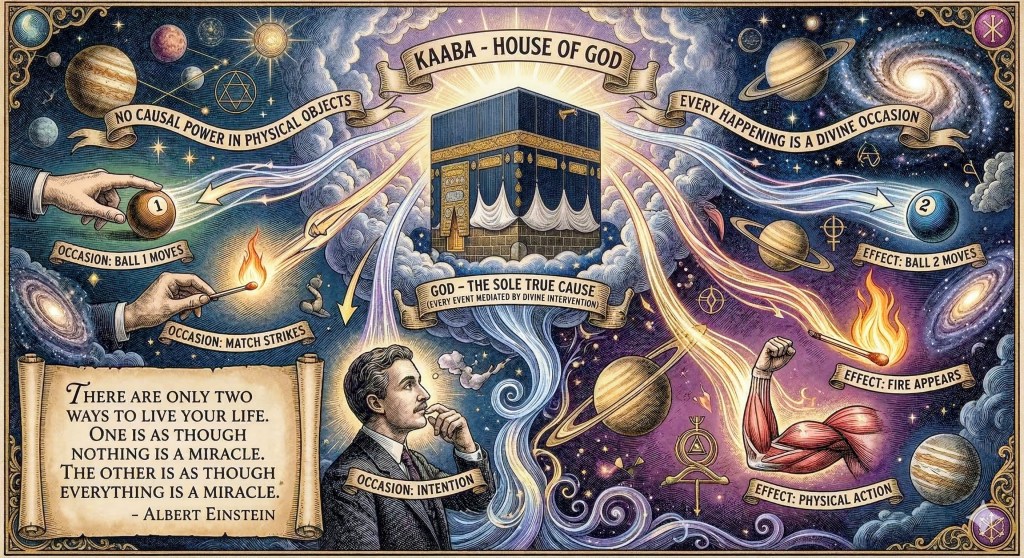

 The Glorious Quran and Science
Leave a reply to The Glorious Qur’an 21:30–33 – Scientific and Theological Insights – The Glorious Quran and Science Cancel reply