
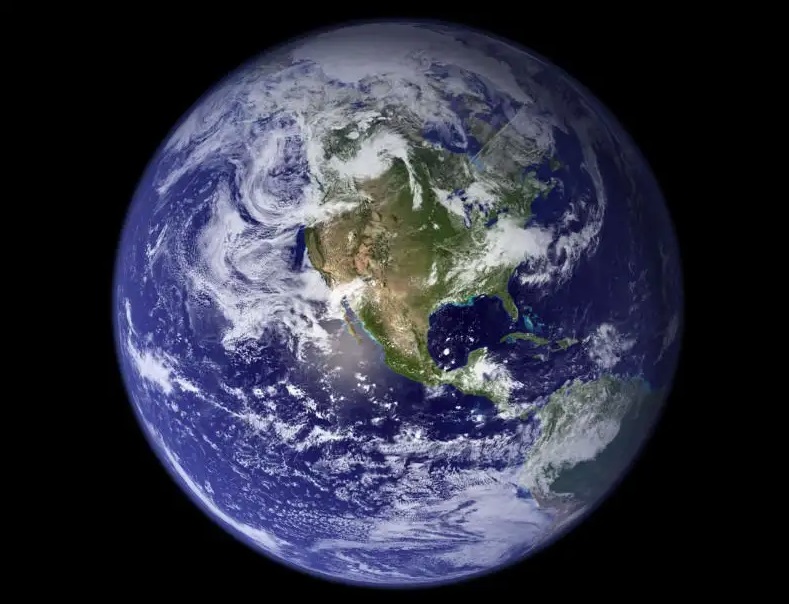
Written and collected by Zia H Shah MD, Chief Editor of the Muslim Times
There is a verse in the Bible that talks about four corners of the earth:
After this I saw four angels standing at the four corners of the earth, holding back the four winds of the earth to prevent any wind from blowing on the land or on the sea or on any tree. (Revelation 7:1)
Some fundamentalist Christians oblige with a literal reading. The belief in a flat Earth is rare but has gained disproportionate visibility due to social media. Surveys suggest:
~2–4% of Americans (2018 YouGov poll) claim to “mostly” or “completely” believe the Earth is flat.
~5–10% express uncertainty (“not sure”).
In Europe, similar polls (e.g., France, 2023) show 1–3% adherence.
In the 9th century, Caliph al-Ma’mun commissioned a team of astronomers and geographers to measure the Earth’s circumference. They conducted measurements between Tadmur (Palmyra) and Raqqa in modern-day Syria, determining the length of one degree of latitude and calculating Earth’s circumference to be approximately 24,000 miles, a value remarkably close to modern measurements.
Abu Rayhan al-Biruni (973–1048 CE) was a towering Persian polymath of the Islamic Golden Age, renowned for his groundbreaking contributions across astronomy, mathematics, geography, history, and comparative religion. He is celebrated for his methodical and objective approach to studying nature and culture. For example, in his seminal work Tahqiq ma li-l-Hind (“Research on India”), al-Biruni offered one of the earliest comprehensive accounts of Indian science, philosophy, and culture, emphasizing empirical research and critical inquiry.
Al-Biruni also made significant advances in geodesy and astronomy—measuring the earth’s circumference with remarkable accuracy—and his writings have influenced both the Islamic world and later European scholarship. His works reflect a commitment to rational observation, often comparing and contrasting various cultural and scientific traditions in a spirit of inquiry that remains influential to this day.
Al-Biruni devised a remarkably ingenious method based on geometric principles and careful observation. Here’s a concise explanation of his technique:
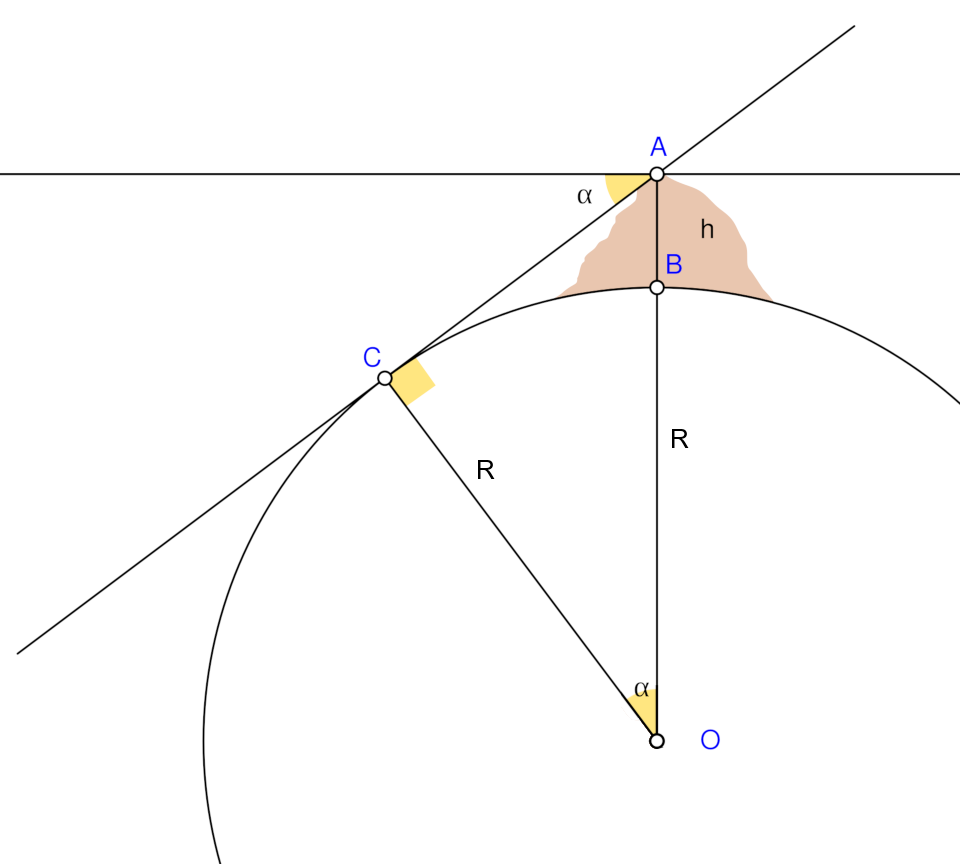
Al-Biruni first measured the height (h) above ground of an elevated point—often the top of a mountain or a high building. From that point, he observed the horizon and determined the dip angle (θ)—the angle by which the horizon appears below the horizontal line.
Al-Biruni measured the size of the earth using the following method: He went up a mountain of know height and measured the dip angle from horizontal down to the horizon using an Astrolabe. From the observer height and the dip angle using trigonometry he calculated the size of the earth using the following formula he derived:
R = h * cos(α) / (1 – cos(α)), where ‘R’ is the Earth’s radius, ‘h’ is the observer’s height above sea level, and ‘α’ is the dip angle (the angle between the horizontal and the apparent horizon).
Al-Biruni arrived at a radius estimate of about 6,339.6 km—only slightly different from today’s accepted value.
We cannot be certain as to what led Al-Biruni to his insights about earth being a sphere and to calculate its radius, but it is likely to be multi-factorial.
Several verses in the Quran discuss how beautifully Allah has spread out the earth for habitation, for example, in Surah Ghashiah. However, others suggest its spherical reality and, as such, reflect Allah’s omniscience.
Below is a discussion of several Quranic verses that some scholars and modern interpreters have cited as suggesting a curved, spherical Earth rather than a flat one. It is essential to note that the Qur’an does not explicitly state, “the earth is a sphere.” Still, various verses have been interpreted—both classically and in light of modern science—as implying a curved, dynamic planet. Here are some of the key verses:
1. Qur’an 79:30
Arabic:
وَالْأَرْضَ دَحَاهَا
Common Translation:
“And after that He spread the earth.”
Interpretation:
While many traditional translations render the verb “dahaha” as “spread out,” some modern scholars note that its root can also mean “to shape like an egg.” This reading suggests that the earth’s form may be akin to an ostrich egg—that is, roughly spherical or oblate in shape.
Key Points:
- The Arabic word dahaha (دَحَاهَا) derives from the root d-h-w, which can mean “to spread” but also carries connotations of “to expand in all directions” or “to make egg-shaped”.
- Some classical scholars, such as Ibn Manẓur in Lisān al-ʿArab, link dahaha to the word for “ostrich egg” (udḥiya), implying a rounded shape.
- Modern linguists and scientists (e.g., Dr. Zaghloul El-Naggar) argue this hints at Earth’s spheroid shape.
2. Qur’an 55:17
Arabic:
رَبُّ الْمَشْرِقَيْنِ وَرَبُّ الْمَغْرِبَيْنِ
Translation:
“Lord of the two easts and Lord of the two wests.”
Interpretation:
The mention of multiple “easts” (and, implicitly, “wests”) suggests that there are different points on the horizon where the sun rises and sets. On a curved, spherical earth, observers at different locations will naturally experience variations in the rising and setting points of the sun. This plurality would be difficult to account for on a uniformly flat plane.
Key Points:
- The “two easts and two wests” refer to the solstices—the northernmost and southernmost points where the sun rises and sets due to Earth’s axial tilt.
- This phenomenon is only observable on a spherical Earth orbiting the sun. On a flat Earth, the sun’s path would be uniform for all observers.
- Al-Tabari (classical exegete) explained this as a sign of Allah’s precision in celestial mechanics.
3. Quran 39:5
Arabic:
خَلَقَ السَّمَاوَاتِ وَالْأَرْضَ بِالْحَقِّ ۖ يُكَوِّرُ اللَّيْلَ عَلَى النَّهَارِ وَيُكَوِّرُ النَّهَارَ عَلَى اللَّيْلِ
Translation:
“He created the heavens and the earth with truth (for a purpose) He wraps (yukawwiru) the night over the day and wraps the day over the night…”
Key Points:
- The Arabic verb yukawwiru (يُكَوِّرُ) means “to wrap” or “to coil”, evoking the image of a spherical object.
- This describes the seamless transition of day and night due to Earth’s rotation on its axis, which is only possible on a spherical body. A flat Earth would have abrupt day-night transitions.
- Classical scholars like Ibn Kathir interpreted this as a reference to Earth’s curvature.
4. Qur’an 21:33
Arabic:
وَهُوَ الَّذِي خَلَقَ اللَّيْلَ وَالنَّهَارَ وَالشَّمْسَ وَالْقَمَرَ ۖ كُلٌّ يَسْبَحُونَ
Translation:
“And it is He who created the night and the day and the sun and the moon; all [the celestial bodies] swim along, each in its orbit.”
Interpretation:
The term “yasbahoon” (swim along) implies that these bodies move in curved, natural paths consistent with orbital motion. While this verse does not directly describe the earth’s shape, the language is often understood as part of a cosmic order governed by gravitational dynamics—a picture more consistent with a spherical (or at least curved) earth.
5. Qur’an 36:40 (related observation):
Arabic:
لَا الشَّمْسُ يَنبَغِي لَهَا أَن تُدْرِكَ الْقَمَرَ وَلَا اللَّيْلُ سَابِقُ النَّهَارِ ۚ وَكُلٌّ فِي فَلَكٍ يَسْبَحُونَ
Translation: “It is not for the sun to overtake the moon, nor does the night outstrip the day. They float each in an orbit.”
Interpretation:
While not addressing the earth’s shape directly, this verse emphasizes orderly, curved paths (orbits) for celestial bodies. While discussing how the sun and moon do not overtake each other, the Quran changes the subject to day and night on planet Earth. By using subtle language, Allah made this verse worthwhile for the seventh-century Arabs, later for the early Muslim scientists of the 9th-11th centuries, and also for modern humanity in the 20th and 21st centuries. The dynamics of orbits naturally depend on bodies being approximately spherical so that gravitational forces act uniformly.
Synthesis and Implications
Taken together, these verses create a picture of a cosmos where:
- Directional plurality: The use of plurals like “Mashariq” and references to both easts and wests imply that sunrise and sunset occur at multiple, shifting points—an observation more easily explained by a curved surface than a flat one.
- Orbital motion: Descriptions of the sun, moon, and other celestial bodies “swimming” in their orbits suggest gravitational dynamics typical of spherical bodies.
- Subtle linguistic hints: The term in 79:30 (“dahaha”) has been reinterpreted by some modern scholars as hinting at an “egg-like” shape, which many scientists understand to be a description closer to a sphere (or an oblate spheroid) than a flat disc.
Conclusion
While classical exegesis (tafsir) predominantly emphasized the miraculous and all-encompassing nature of Allah’s creation without an explicit statement on the earth’s shape, modern interpretations have drawn on these verses to argue that the Qur’an is not inconsistent with a spherical earth model. This perspective is part of a broader scholarly effort to read the Qur’an in light of observable natural phenomena.
The Quran’s descriptions of celestial mechanics—such as the cyclical wrapping of day and night, the sun’s varying rising points, and Earth’s orbital motion—align with a spherical Earth when analyzed through linguistic, exegetical, and scientific lenses. While the Quran is not a scientific textbook, its verses invite reflection on natural phenomena as signs (ayat) of divine design. As Ibn Rushd (Averroes) wrote: “The Quran directs us to study the universe, for it is the manifestation of Allah’s wisdom.”


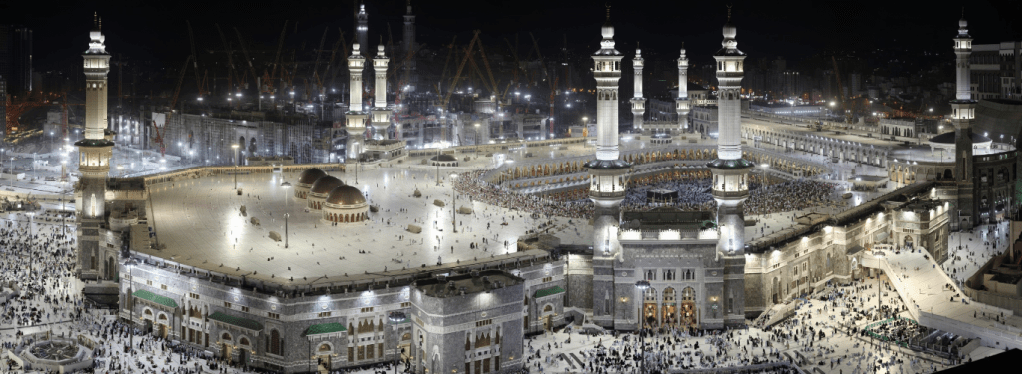
 The Glorious Quran and Science
Leave a comment